AWS IoT SiteWise startet Unterstützung für private VPC-Links

AWS IoT SiteWise unterstützt jetzt Amazon Virtual Private Cloud (VPC)-Endpunkte über AWS PrivateLink für Datenebenen-APIs (PUT- und GET-APIs). Sie können Daten von Ihrer VPC aus sicher senden und empfangen, ohne das öffentliche Internet zu durchlaufen und ohne öffentliche IPs zu verwenden. Sie können dies tun, indem Sie einen VPC-Endpunkt für den AWS IoT SiteWise Service erstellen, um eine private Verbindung zwischen Ihrem VPC und AWS IoT SiteWise herzustellen. Weitere Informationen finden Sie auf der Seite AWS IoT SiteWise und Schnittstellen-VPC-Endpunkte in unserem Entwicklerhandbuch.
Quelle: aws.amazon.com

Introducing Patterns: Prebuilt Blocks for Beautifully Designed Websites

The WordPress Editor is a powerful tool that can help bring your design ideas to life but one of the best parts is, you don’t have to start from scratch. Building sophisticated designs can be as easy as picking Patterns from our growing library, and snapping them together to create beautiful-looking posts and pages. As of today, we’re now offering over 100 individual Patterns — with more being added all the time!

If you’ve never used Patterns before we’ve got an introduction to help you get started and also highlight some new features.

The best way to introduce Patterns is to use them. Here’s how you can add them to a post or a page on WordPress.com.

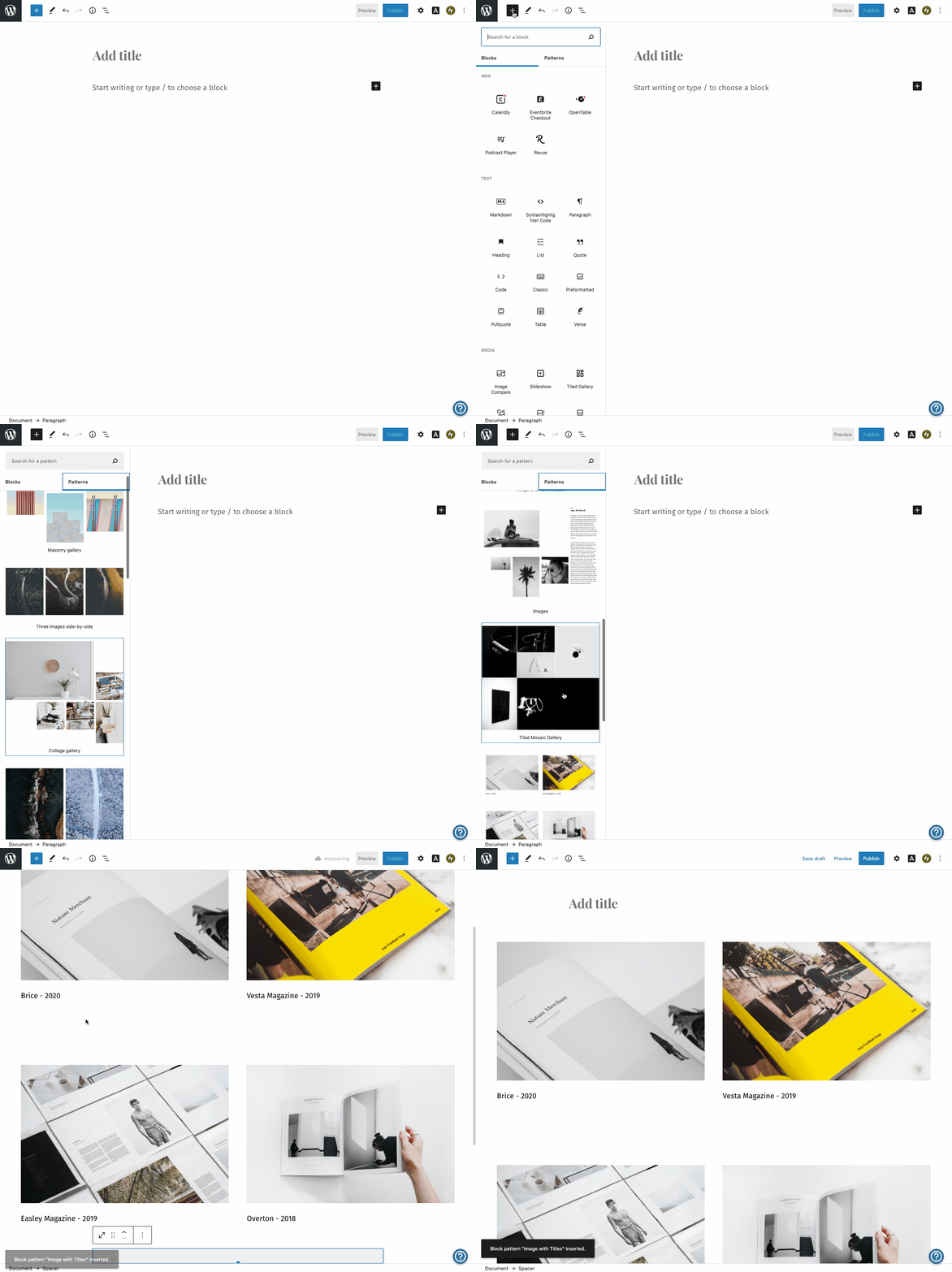
Head to the WordPress Editor and click the + icon to add a new block.Click on the Patterns tab.Click on the Pattern you’d like to see in your document and it’ll be inserted at the location of your cursor.

Here’s a quick demo that shows how to add an image gallery. 

If you’re familiar with the Block Editor, the process will look similar. Once you’ve inserted a Pattern into a post or a page, you’ll be able to see how you can customize and edit the Pattern by clicking on different areas. The image below reveals the editing options that appear with our example. 

Each Pattern is a collection of different blocks carefully put together to help you produce great looking blog posts and pages in the Editor. In the example above, it’s a collection of Image, Paragraph, Spacer, and Column Blocks. All pre-arranged into a simple but elegant Pattern for displaying images. Using Patterns in the Editor is kind of like having a WordPress web designer right there with you building up a design element by element.

The idea is that, once you’ve inserted a Pattern, you can start customizing it to make it yours.

For even more customization options with Patterns, try combining them with the updated fonts on WordPress.com.

Over 100 Patterns to Choose From

This is where the number of Patterns gets exciting. Think of it like having over 100 templates you can add to your posts and pages. You can browse by category to see all the available Pattern options.

Taking a look at a few all together might be helpful. Here are some of my recent favorites. 

They’re not favorites because they look great, but instead because these Patterns use so many different Blocks to produce a unique and useful design. Take the center Registration Form Pattern, for example. It combines a Heading Block, Paragraph Blocks, the Form Block, and the Columns Block into one Pattern that together, can make up an entire page.

More Patterns are on the Way

We’re just getting started creating new Patterns for you. What type of Pattern would make it easier to create Posts and Pages on your site? More are on the way and we’d love to hear your ideas and feedback so we can make your publishing and site-building experience even better.

And if you have anything to share that you’ve made with a Pattern or with the Editor let us know! We’d love to see and hear how you’re using Patterns on WordPress.com.
Quelle: RedHat Stack

Expert Advice: How to Improve Remote Education Collaboration

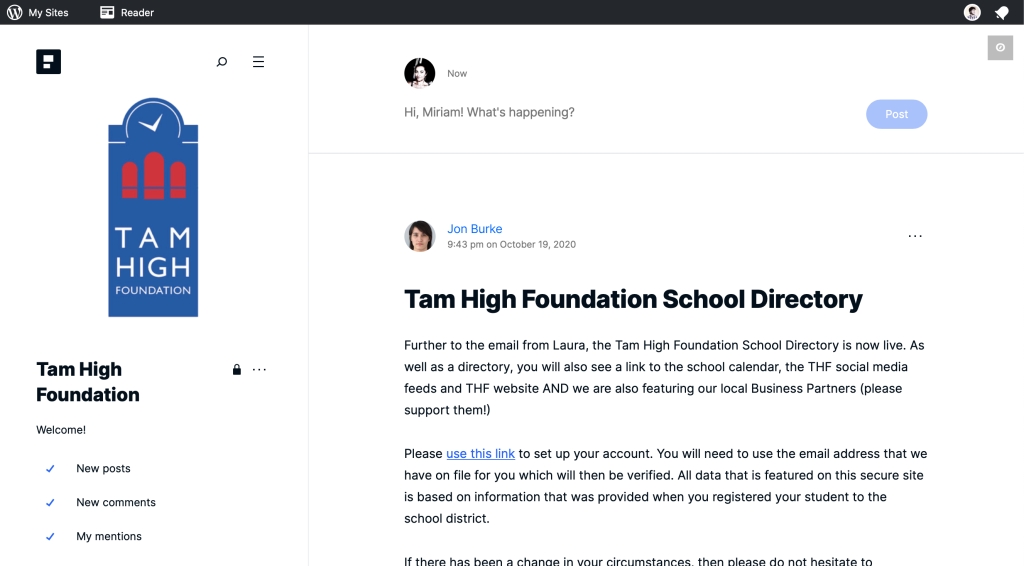
As we’re witnessing with schools and learning communities around the world, education is shifting dramatically. With the right set of tools, your class, team, or group can learn to communicate and collaborate more efficiently online. Since our company was founded over fifteen years ago, the people behind the scenes at WordPress.com have worked from home — or from anywhere they choose in the world — and have learned a lot along the way.

A tool we call P2 has been indispensable to us, and to a growing number of educators. Want to learn our tips and tricks? Join us for a free webinar on Thursday, November 5, so you and your team can learn to make the most of this tool for remote collaboration. You can also sign up for the free beta version of P2 that is now available.

Date: Thursday, November 5, 2020Time: 10:00 am PT | 12:00 pm CT | 1:00 pm ET | 18:00 UTCRegistration link: https://zoom.us/webinar/register/4016033198190/WN_WjX8jQhIQ0iZVPpfGAklhQWho’s invited: Anyone looking to improve internal team collaboration or build a public forum with P2 are welcome, but this webinar is specially designed for educators and teachers.

Register for the webinar today! We look forward to seeing you.
Quelle: RedHat Stack

All treats, no tricks with product recommendation reference patterns

In all things technology, change is the only constant. This year alone has brought more uncertainty than ever before, and the IT shadows have felt full of perils. With the onset of the pandemic, the way consumers shop has shifted faster than anyone could have predicted. The move to online shopping vs. brick and mortar stores was already happening, but it’s significantly accelerated just this year alone. Shoppers have quickly transitioned to online purchasing, resulting in increased traffic and varying fulfillment needs. Shopper expectations have evolved as well, with 66% of online purchasers choosing a retailer based on convenience, while only 47% choosing a retailer based on price/value, according to Catalyst and Kantar research.So the pressure is on for retailers to become digital and make sure shoppers are happy. But there’s no reason to be spooked out. Done right, you can serve customers better with an understanding of their customers’ purchasing behavior and patterns using predictive analytics. Deep, data-driven insights are important to ensuring customer demand and preferences are accurately met. To make it easier to treat (not trick) your customers to better recommendations, we recently introduced Smart Analytics reference patterns, which are technical reference guides with sample code for common analytics use cases with Google Cloud, including predicting customer lifetime value, propensity to purchase, product recommendation systems, and more. We heard from many customers that you needed an easy way to put your analytics tools into practice, and that these are some common use cases.Understanding product recommendation systemsProduct recommendation systems are an important tool for understanding customer behavior. They’re designed to generate and provide suggestions for items or content a specific user would like to purchase or engage with. A recommendation system creates an advanced set of complex connections between products and users, and compares and ranks these connections in order to recommend products or services as customers browse your website, for example. A well-developed recommendation system will help you improve your shoppers’ experience on a website and result in better customer acquisition and retention. These systems can significantly boost sales, revenues, click-through-rates, conversions, and other important metrics because personalizing a user’s preferences creates a positive effect, in turn translating to customer satisfaction, loyalty, and even brand affinity. Instead of building from scratch and reinventing the wheel every time, you can take advantage of these reference patterns to quickly start serving customers. It’s important to emphasize that recommender systems are not new, and you can build your own in-house or from any cloud provider. Google Cloud’s unique ability to handle massive amounts of structured and unstructured data, combined with our advanced capabilities in machine learning and artificial intelligence, provide a powerful set of products and solutions for retailers to leverage across their business.Using reference patterns for real-world casesIn this reference pattern, you will learn step-by-step how to build a recommendation system by using BigQuery ML (a.k.a. BigQu-eerie ML

Modernize your Java apps with Spring Boot and Spring Cloud GCP

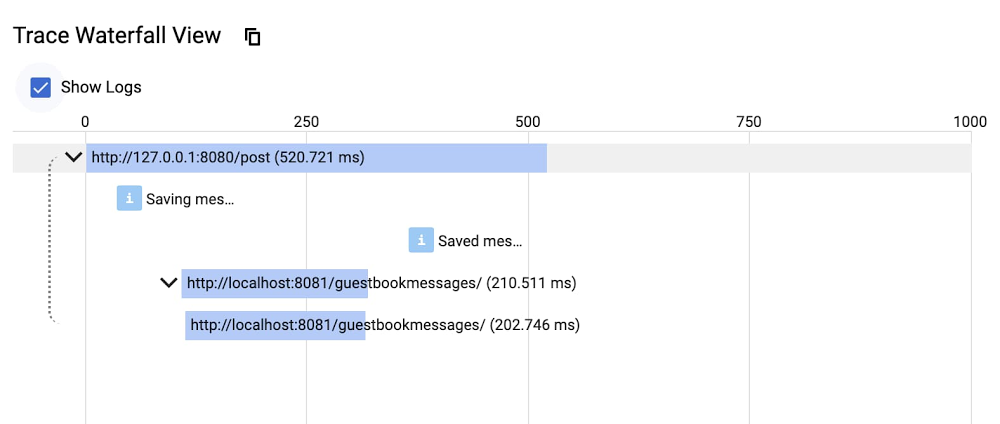
It’s an exciting time to be a Java developer: there are new Java language features being released every 6 months, new JVM languages like Kotlin, and the shift from traditional monolithic applications to microservices architectures with modern frameworks like Spring Boot. And with Spring Cloud GCP, we’re making it easy for enterprises to modernize existing applications and build cloud-native applications on Google Cloud. First released two years ago, Spring Cloud GCP allows Spring Boot applications to easily utilize over a dozen Google Cloud services with idiomatic Spring Boot APIs. This means you don’t need to learn a Google Cloud-specific client library, but can still utilize and realize the benefits of the managed services:If you have an existing Spring Boot application, you can easily migrate to Google Cloud services with little to no code changes.If you’re writing a new Spring Boot application, you can leverage Google Cloud services with the framework APIs you already know.Major League Baseball recently started their journey to the cloud with Google Cloud. In addition to modernizing their infrastructure with GKE and Anthos, they are also modernizing with a microservices architecture. Spring Boot is already the standard Java framework within the organization. Spring Cloud GCP allowed MLB to adopt Google Cloud quickly with existing Spring Boot knowledge.”We use the Spring Cloud GCP to help manage our service account credentials and access to Google Cloud services.” – Joseph Davey, Principal Software Engineer at MLBSimilarly, bol.com, an online retailer, was able to develop their Spring Boot applications on GCP more easily with Spring Cloud GCP.”[bol.com] heavily builds on top of Spring Boot, but we only have a limited capacity to build our own modules on top of Spring Boot to integrate our Spring Boot applications with GCP. Spring Cloud GCP has taken that burden from us and makes it a lot easier to provide the integration to Google Cloud Platform.” – Maurice Zeijen, Software Engineer at bol.comDeveloper productivity, with little to no custom codeWith Spring Cloud GCP, you can develop a new app, or migrate an existing app, to adopt a fully managed database, create event-driven applications, add distributed tracing and centralized logging, and retrieve secrets—all with little to no custom code or custom infrastructure to maintain. Let’s look at some of the integrations that Spring Cloud GCP brings to the table. DataFor a regular RDBMS, like PostgreSQL, MySQL, and MS SQL, you can use Cloud SQL and continue to use Hibernate with Spring Data, and connect to Cloud SQL simply by updating the JDBC configuration. But what about Google Cloud databases like Firestore, Datastore, and the globally-distributed RDBMS Cloud Spanner? Spring Cloud GCP implements all the data abstractions needed so you can continue to use Spring Data, and its data repositories, without having to rewrite your business logic. For example, you can start using Datastore, a fully-managed NoSQL database, just as you would any other database that Spring Data supports.You can annotate a POJO class with Spring Cloud GCP annotations, similar to how you would annotate Hibernate/JPA classes:Then, rather than implementing your own data access objects, you can extend a Spring Data Repository interface to get full CRUD operations, as well as custom query methods.Spring Data and Spring Cloud GCP automatically implement the CRUD operations and generate the query for you. Best of all, you can use built-in Spring Data features like auditing and capturing data change events.You can find full samples for Spring Data for Datastore, Firestore, and Spanner on GitHub.MessagingFor asynchronous message processing and event-driven architectures, rather than manually provision and maintain complicated distributed messaging systems, you can simply use Pub/Sub. By using higher-level abstractions like Spring Integration, or Spring Cloud Streams, you can switch from an on-prem messaging system to Pub/Sub with just a few configuration changes.For example, by using Spring Integration, you can define a generic business interface that can publish a message, and then configure it to send a message to Pub/Sub:You can consume messages in the same way. The following is an example of using Spring Cloud Stream and the standard Java 8 streaming interface to receive messages from Pub/Sub by simply configuring the application:You can find full samples with Spring Integration and Spring Cloud Stream on GitHub.ObservabilityIf a user request is processed by multiple microservices and you would like to visualize that whole call stack across microservices, then you can add distributed tracing to your services. On Google Cloud, you can store all the traces in Cloud Trace, so you don’t need to manage your own tracing servers and storage.Simply add the Spring Cloud GCP Trace starter to your dependencies, and all the necessary distributed tracing context (e.g., trace ID, span ID, etc) is captured, propagated, and reported to Cloud Trace.This is it—no custom code required. All the instrumentation and trace capabilities use Spring Cloud Sleuth. Spring Cloud GCP supports all of Spring Cloud Sleuth’s features, so distributed tracing is automatically integrated with Spring MVC, WebFlux, RestTemplate, Spring Integration, and more.Cloud Trace generates a distributed trace graph. But notice the “Show Logs” checkbox. This Trace/Log correlation feature can associate log messages to each trace so you can see the logs associated with a request to isolate issues. You can use Spring Cloud GCP Logging starter and its predefined logging configuration to automatically produce the log entry with the trace correlation data.You can find full samples with Logging and Trace  on GitHub.SecretsYour microservice may also need access to secrets, such as database passwords or other credentials. Traditionally, credentials may be stored in a secret store like HashiCorp Vault. While you can continue to use Vault on Google Cloud, Google Cloud also provides the Secret Manager service for this purpose. Simply add the Spring Cloud GCP Secret Manager starter so that you can start referring to the secret values using standard Spring properties:In the applications.properties file, you can refer to the secret values using a special property syntax:You can find a full sample with Secret Manager on GitHub.More in the works, in open sourceSpring Cloud GCP closely follows the Spring Boot and Spring Cloud release trains. Currently, Spring Cloud GCP 1.2.5 works with Spring Boot 2.3 and Spring Cloud Hoxton release train. Spring Cloud GCP 2.0 is on its way and it will support Spring Boot 2.4 and the Spring Cloud Ilford release train.In addition to core Spring Boot and Spring Cloud integrations, the team has been busy developing new components to meet developers’ needs:Cloud Monitoring support with MicrometerSpring Cloud Function’s GCP Adapter for Cloud Functions Java 11Cloud Spanner R2DBC driver and Cloud SQL R2DBC connectors to enable scalable and fully reactive servicesExperimental Graal VM support for our client libraries, so you can compile your Java code into native binaries, to significantly reduce your startup times and memory footprint.Developer success is important to us. We’d love to hear your feedback, feature requests, and issues on GitHub, so we can understand your needs and prioritize our development work. Try it out!Want to see everything in action? Check out the Developer Hands-on Keynote from Google Cloud Next ‘20: On Air, where Daniel Zou shows how to leverage Spring Boot and Spring Cloud GCP when modernizing your application with Anthos, Service Mesh, and more:You can also easily try Spring Cloud GCP with many samples. Or, you can take the guided Spring Boot on GCP course on Qwiklab or Coursera. Last but not least, you can find out about detailed features and configurations in the reference documentation.Related ArticleAnnouncing Spring Cloud GCP 1.1: deepening ties to Pivotal’s Spring FrameworkHere at Google we have been working hard with Pivotal’s Spring team to integrate the Spring Framework and Google Cloud Platform (GCP). La…Read Article
Quelle: Google Cloud Platform