How we're advancing intelligent automation in network security

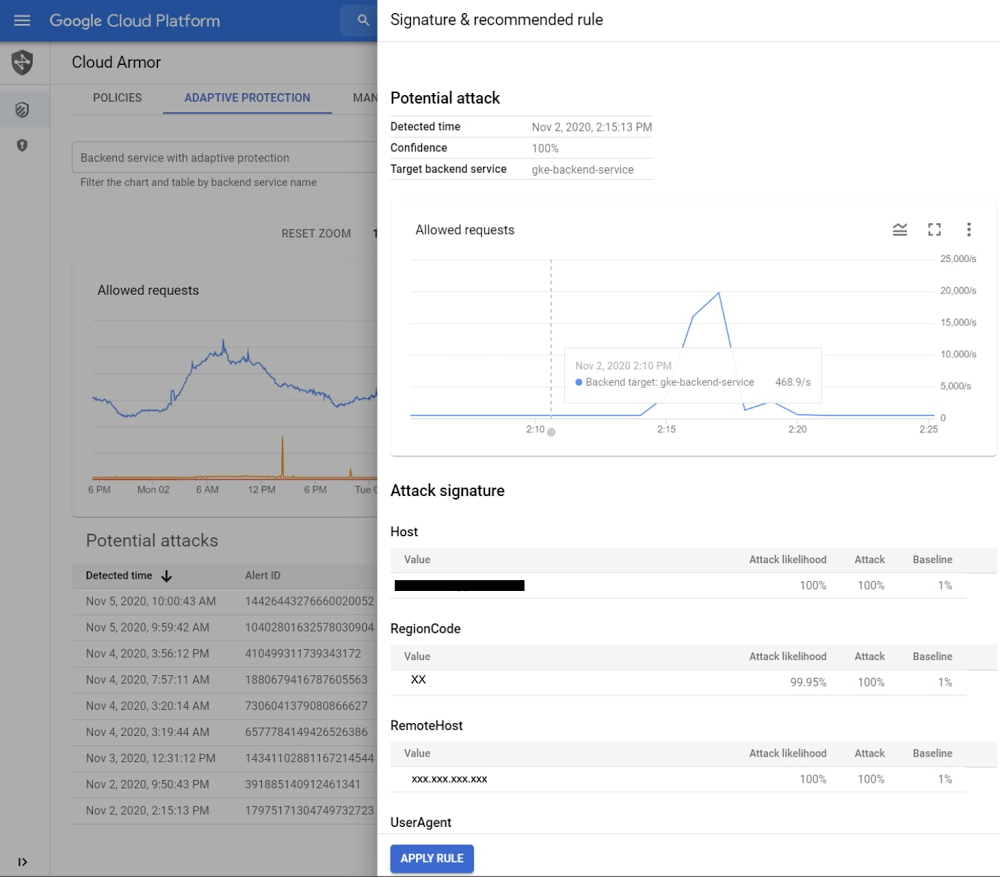
We’re always looking to make advanced security easier for enterprises so they can stay focused on their core business. Already this year, we’ve worked to strengthen DDoS protection, talked about some of the largest attacks we have stopped and made firewall defences more effective. We continue to push our pace of security innovation, and today we’re announcing enhancements to existing protections, as well as new capabilities to help customers protect their users, data, and applications in the cloud. 1. Using machine learning to detect and block DDoS Attacks with Adaptive ProtectionWe recently talked about how our infrastructure absorbed a 2.54 Tbps DDoS attack, the culmination of a six-month campaign that utilized multiple methods of attack. Despite simultaneously targeting thousands of our IPs, presumably in hopes of slipping past automated defenses, the attack had no impact.We recognize the scale of potential DDoS attacks can be daunting. By deploying Google Cloud Armor integrated into our Cloud Load Balancing service—which can scale to absorb massive DDoS attacks—you can protect services deployed in Google Cloud, other clouds, or on-premise from attacks. Cloud Armor, our DDoS and WAF-as-a-service, is built using the same technology and infrastructure that powers Google services.Today, we are excited to announce Cloud Armor Adaptive Protection—a unique technology that leverages years of experience using machine learning to solve security challenges plus deep experience protecting our own user properties against Layer 7 DDoS attacks. We use multiple machine learning models within Adaptive Protection to analyze security signals for each web service to detect potential attacks against web apps and services. This system can detect high volume application layer DDoS attacks against your web apps and services and dramatically accelerate time to mitigation. For example, attackers frequently target a high volume of requests against dynamic pages like search results or reports in web apps in order to exhaust server resources to generate the page. When enabled, we learn from a large number of factors and attributes about the traffic arriving at your services so we know what “normal” looks like. We’ll generate an alert if we believe there is a potential attack, taking into account all of the relevant context for your workload. In other words, where traditional threshold based detection mechanisms could generate a great deal of lower confidence alerts that would require investigation and triage only once an attack has accelerated to the detection threshold, Adaptive Protection produces high confidence signals about a potential attack much earlier, while the attack is still ramping up. Adaptive Protection won’t just surface the attack, but will actually provide context on why the system felt it was malicious and then provide a rule to mitigate the attack as well. This protection is woven into our cloud fabric and only alerts the operator for more serious issues with context, an attack signature, and a Cloud Armor rule that they can then deploy in preview or blocking mode. Rather than spending hours analysing traffic logs to triage the ongoing attack, application owners and incident responders will have all of the context they need to make a decision on whether and how to stop the potentially malicious traffic. Cloud Armor Adaptive Protection is going to simplify protection in a big way, and will be rolling out to the public in preview soon.Adaptive Protection suggested rule2. Better firewall rule management with Firewall Insights We have been making a number of investments into our network firewall to provide insights and simplify control that allow easier management of more complex environments. Firewall insights helps you optimize your firewall configurations with a number of detection capabilities, including shadowed rule detection to identify firewall rules that have been accidentally shadowed by conflicting rules with higher priorities. In other words, you can automatically detect rules that can’t be reached during firewall rule evaluation due to overlapping rules with higher priorities. This helps detect redundant firewall rules, open ports, and IP ranges and help operators to tighten the security boundary. It will also help surface to admins a sudden hit increases on firewall rules and drill down to the source of the traffic to catch an emerging attack.Within firewall insights you’ll also see metrics reports showing how often your firewall rules are active, including the last time they were hit. This allows security admins to verify that firewall rules are being used in the intended way, ensuring that firewall rules allow or block their intended connections. These insights can operate at massive volume and help remove human errors around firewall rule configuration or simply highlight rules that are no longer needed as an environment changes over time. Firewall insights will be generally available soon.Firewall Insights3. Flexible and scalable controls with Hierarchical Firewall PoliciesFirewalls are an integral part of almost any IT security plan. With our native, fully distributed firewall technology, Google Cloud aims to provide the highest performance and scalability for all your enterprise workloads.  Google Cloud’s hierarchical firewall policies, provide new, flexible levels of control so that you can benefit from centralized control at the organization and folder level, while safely delegating more granular control within a project to the project owner. Hierarchical firewalls provide a means to enforce firewall rules at the organization and folder levels in the GCP Resource Hierarchy.  This allows security administrators at different levels in the hierarchy to define and deploy consistent firewall rules across a number of projects so that they are applied to all VMs in currently existing and yet-to-be-created projects. Hierarchical firewall policies allow configuring rules at the Organization and Folder levels, in addition to firewall rules at the VPC level. Since leveraging Hierarchical Firewalls  requires fewer firewall rules, managing multiple environments becomes simpler and more effective. Further, being able to manage the most critical firewall rules in one place can help free up project level administrators from having to keep up with changing organization wide policies. Hierarchical firewall policies will be generally available soon.Hierarchical firewall policies4. New controls for Packet Mirroring Google Cloud Packet Mirroring allows you to mirror network traffic from your existing Virtual Private Clouds (VPCs) to third party network inspection services. With this service, you can use those third-party tools to collect and inspect network traffic at scale, providing intrusion detection, application performance monitoring, and better security visibility, helping you with the security and compliance of workloads running in Compute Engine and Google Kubernetes Engine (GKE). We are adding new filters to mirror packets that will be generally available soon. With traffic direction control, you can now mirror either the ingress or egress traffic, helping users better manage their traffic volume and reduce costs.Traffic Direction: New Ingress & Egress controls for Packet MirroringWith these enhancements, we are helping Google Cloud customers stay safe when using our network security products. For a hands-on experience on our Network Security portfolio, you can enroll in our network security labs here. You can also learn more about Google Cloud security in the latest installment of Google Cloud Security Talks, live today.Related ArticleExponential growth in DDoS attack volumesHow Google prepares for and protects against the largest volumetric DDoS attacks.Read Article
Quelle: Google Cloud Platform

Google Cloud AI digitizes StoryCorps archive: largest collection of human voices on planet

For many of us the holiday season will look different this year, separated from the people we love. If you’re in this boat too—mitigating the spread of the coronavirus—thank you and we hope the following story might offer an alternative, but helpful way to connect with friends and family. While we know virtual get-togethers can never fully match the intimacy of in-person conversations, they can keep us connected and maybe even preserve some special moments for future generations. In this spirit, we are sharing our collaboration with StoryCorps, a national non-profit organization dedicated to preserving humanity’s stories through 1:1 interviews. Over the past 17 years, StoryCorps has recorded with more than 600,000 people and sent those recordings to the U.S. Library of Congress where they are preserved for generations to come at the American Folklife Center. This is the world’s largest collection of human voices on the planet, but, it’s been relatively inaccessible. That’s when StoryCorps approached us to help make its rich archive of first-person history universally accessible and useful. StoryCorps + Google Cloud AIIn 2019, StoryCorps and Google Cloud partnered to unlock this amazing archive using artificial intelligence (AI) and create an open, searchable and accessible audio database for everyone to find and listen to first-hand perspectives from humanity’s most important moments. Diving into how this works: for an audio recording to be searchable, the audio file and “moments” or keywords within that file—needed to be tagged with terms for which you would search. First we used Speech-to-Text API to transcribe the audio file.Then Natural Language API identified keywords and their salience from the transcription.The transcript and keywords were loaded to an Elastic Search index.Resulting in a searchable transcript on the StoryCorps Archive.Here is an example of how these Cloud AI technologies work using an actual StoryCorps interview.Building empathy and understanding through connection StoryCorps’ mission is impressive. Not only is it preserving humanity’s stories, its aim is to “build connections between people and create a more just and compassionate world” by sharing those stories as widely as possible. This is where our path with StoryCorps crosses on a deeper level. Our mission for AI technology is one where everyone is accounted for, extending well beyond the training data in computer science departments. This deeper understanding could allow organizations in every sector to unlock new possibilities of what they have to offer while being inclusive, equitable and socially beneficial. But that’s our story to figure out and we’re working hard at it. Whatever you decide to do this holiday season, please stay safe. In the meantime, perhaps your family would like to use the StoryCorps platform or app to connect, preserve and share a story of your own.Related ArticlePicture what the cloud can do: How the New York Times is using Google Cloud to find untold stories in millions of archived photosThe New York Times is building a pipeline on Google Cloud Platform to preserve its extensive photo archive, store it in the cloud, and le…Read Article
Quelle: Google Cloud Platform

The need for speed: Using C2 machines for your HPC workloads

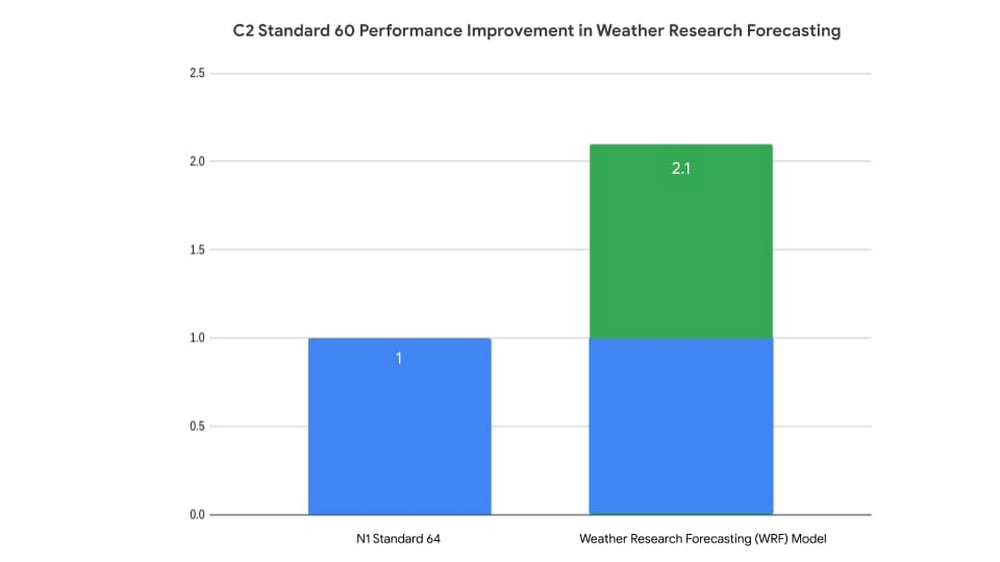
Cloud opens many new possibilities for High Performance Computing (HPC). But while the cloud offers the latest technologies and a wide variety of machine types (VMs), not every VM is suited to the demands of HPC workloads. Google Cloud’s Compute-optimized (C2) machines are specifically designed to meet the needs of the most compute-intensive workloads, such as HPC applications in fields like scientific computing, Computer-aided Engineering (CAE), biosciences, and Electronic Design Automation (EDA), among many others.The C2 is based on the second generation Intel® Xeon® Scalable Processor and provides up to 60 virtual cores (vCPUs) and 240GB of system memory. C2s can run at a sustained frequency of 3.8GHz and offer more than 40% improvement compared to previous generation VMs for general applications. Compared to previous generation VMs, total memory bandwidth improves by 1.21X and memory bandwidth/vCPU improves by 1.94X.1 Here we take a deeper look at using C2 VMs for your HPC workloads on Google Cloud.Resource isolationTightly-coupled HPC workloads rely on resource isolation for predictable performance. C2 is built for isolation and consistent mapping of shared physical resources (e.g., CPU caches, and memory bandwidth). The result is reduced variability and more consistent performance. C2 also exposes and enables explicit user control of CPU power states (“C-States”) on larger VM sizes, enabling higher effective frequencies and performance.NUMA nodesIn addition to hardware improvements, Google Cloud has enabled a number of HPC-specific optimizations on C2 instances. In many cases, tightly-coupled HPC applications require careful mapping of processes or threads to physical cores, along with care to ensure processes access memory that is closest to their physical cores. C2s provide explicit visibility and control of NUMA domains to the guest operating system (OS), enabling maximum performance.AVX-512 supportSecond generation Xeon processors support Intel Advanced Vector Extension 512 (Intel AVX-512) for data parallelism. AVX-512 instructions are SIMD (Single Instruction Multiple Data) instructions, and along with additional and wider registers enable packing of 64 single-precision (or 32 double-precision) floating point operations into one instruction. This means that more can be done in every clock cycle, reducing overall execution time. The latest generation of AVX-512 instructions in the 2nd generation Xeon processor include DL Boost instructions that significantly improve performance for AI inferencing by combining three INT8 instructions into one—thereby maximizing the use of compute resources, utilizing the cache better, and avoiding potential bandwidth bottlenecks.Low- latencyHPC workloads often scale out to multiple nodes in order to accelerate time to completion. Google Cloud has enabled “Compact Placement Policy” on the C2, which allocates up to 1320 vCPUs placed in close physical proximity, minimizing cross-node latencies. Compact placements, in conjunction with Intel MPI library, optimizes multi-node scalability of HPC applications. You can learn more about best practices for ensuring low latency on multi-node workloads here.Development toolsAlong with the hardware optimizations, Intel offers a comprehensive suite of development tools (including performance libraries, Intel Compilers, and performance monitoring and tuning tools) to make it simpler to build and modernize code with the latest techniques in vectorization, multithreading, multi-node parallelization, and memory optimization. Learn more about Intel’s Parallel Studio XE here.Bringing it all together Combining all the improvements in hardware and optimizations done in Google Cloud stack, C2 VMs perform up to 2.10X better compared to previous generation N1 for HPC workloads for roughly the same size VM.2In many cases HPC applications can scale up to the full node. A single C2 node (60 vCPUs and 240GB) offers up to 2.49X better performance/price compared to a single N1 node (96 vCPUs and 360GB).3C2s are offered in predefined shapes intended to deliver the most appropriate vCPU and memory configurations for typical HPC workloads. In some cases, it is possible to further optimize performance or performance/price via a custom VM shape. For example, if a certain workload is known to require less than the default 240GB of a C2 standard 60vCPU VM, a custom N2 machine with less memory can deliver roughly the same performance at a lower cost. We were able to achieve up to 1.09X better performance/price by tuning the VM shape to the needs of several common HPC workloads.4Get started todayAs more HPC workloads start to benefit from the agility and flexibility of cloud, Google Cloud and Intel are joining forces to create optimized solutions for specific needs of these workloads. With the latest optimizations in Intel 2nd generation Xeon processors and Google Cloud, C2 VMs deliver the best solution for running HPC applications in Google Cloud, while giving you the freedom to build and evolve around your unique business needs. Many of our customers with need for high performance have moved their workloads to C2 VMs and confirmed our expectations.To learn more about C2 and the second generation of Intel Xeon Scalable Processor, contact your sales representative or reach out to us here. And if you’re participating in SC20 this week, be sure to check out our virtual booth, where you can watch sessions, access resources, and chat with our HPC experts.1. Based on internal analysis of our c2-standard-60 and n1-standard-96 machine types, using the STREAM Triad Best Rate benchmark.2. Based on internal analysis of our c2-standard-60 and n1-standard-96 machine types, using our Weather Research Forecasting (WRF) benchmark.3. Based on the High Performance Conjugate Gradients (HPCG) benchmark, analyzing Google Cloud VM Instance pricing on C2-standard-60 ($3.1321/hour) and N1-standard-96 ($4.559976) as of 10/15/20204. Based on GROMACS and NAMD benchmarks, analyzing Google Cloud VM Instance pricing on N2-custom-80 with 160GB ($3.36528) and C2-standard-60 ($3.1321/hour) as of 10/15/2020Related ArticleIntroducing Compute- and Memory-Optimized VMs for Google Compute EngineGoogle Cloud is the first public cloud provider to offer Compute-Optimized VMs and Memory-Optimized VMs based on Intel 2nd Generation Xeo…Read Article
Quelle: Google Cloud Platform

Empowering customers and the ecosystem with an open cloud

Every organization that moves to the cloud has a unique journey driven by many factors including evolving operating environments and regulatory requirements. For all organizations, including those experiencing growth across regions and dynamic market circumstances, we recommend an open cloud approach that ensures operational and technical consistency across public clouds or private data centers and effective management of infrastructure, applications, and data across the organization.We believe that an open cloud can meet the needs of diverse companies, providing choice, flexibility and openness. Our open cloud philosophy is grounded in the belief that customers need autonomy and control over their infrastructure. Giving customers options to build, migrate and deploy their applications across multiple environments both in the cloud and on-premises allows them to avoid vendor lock-in and innovate across environments faster. We are proud of our leadership in advancing an open cloud, and this commitment underpins and drives our contributions to the open source and open data communities, as well as our approach to building technology solutions. Advancing computing through open source Open source plays a critical role in an open cloud. Many companies have mission-critical workloads or sensitive data that have “survivability requirements” in the event that a provider is forced to suspend or terminate cloud services due to country or region policy changes. To move workloads to other clouds, it’s important to develop them using open source and open standards.At Google Cloud, we don’t think it’s possible to fully address survivability requirements with a proprietary solution. Instead, solutions based on open source tools and open standards are the route to addressing customer and policymaker concerns. More importantly, open source gives customers the flexibility to deploy—and, if necessary, migrate—critical workloads across or off public cloud platforms.Google has a long history of sharing technology through open source—from projects like Kubernetes, which is now the industry standard in container portability and interoperability in the cloud, to TensorFlow, a platform to help everyone develop and train machine learning models. As Google’s Chief Economist Hal Varian said, “Open data and open source are good not only for us and our industry, but also benefit the world at large.” Our belief in customer choice is fundamental to how we develop our technology and rooted in leveraging open source APIs and interoperable solutions. In addition, we partner with the leading organizations in the fields of data management and analytics to build products that combine the benefits of open source with managed cloud solutions.Another way we provide flexibility is hybrid and multi-cloud environments. Anthos, our hybrid and multi-cloud platform, is built on open technologies like Kubernetes, Istio, and Knative, enabling an ecosystem that fosters competition and that unlocks new partnerships. In this spirit, last week OVHcloud and Google Cloud announced a strategic partnership to jointly build a trusted cloud solution in Europe. This partnership will focus on delivering the best of Google Cloud technology innovation and value in the most agile way, and help European customers accelerate their business transformation in the cloud while meeting addressing their strict data security and privacy requirements.Break down data silos and uncover new insights with public datasetsCustomers rely on Google Cloud to get better insights from their data. Our data analytics solutions such as BigQuery help them harness the potential of that data. One of our newest analytics solutions, BigQuery Omni, allows customers to cost-effectively access and securely analyze data across multi-cloud environments. Those tools enable customers to make their own data more open—both in and out of their organization. As we help enable data accessibility and portability, our highest priority is to do so securely and responsibly. At the same time, through the Google Cloud Public Datasets program, we work with data providers to host 100+ high-demand public datasets to allow customers and the research community to discover unique insights for solving real business and societal problems. For example, earlier this year, we added critical COVID-19 public datasets to support the global response to the novel coronavirus.We also share our discoveries and tools with the community to help everyone share data safely and in a manner that advances the important work of researchers, developers and journalists. Teams at Google have released over 80 open datasets through our research site, and share other aggregated, anonymized product insights. Take for example YouTube-8M, a large-scale, labeled video dataset used by researchers to further computer vision and video understanding. In addition, with more than 31 million datasets, Dataset Search allows anyone to discover and filter relevant data sets in accordance with usage rights, formats, and other key parameters. And our Kaggle community of nearly 5 million users hosts 50,000 public datasets and 400,000 public notebooks to support machine learning and artificial intelligence research. Paving the way to an open cloud through continued collaborationGoogle Cloud will continue to build towards an open cloud and work with partners and policymakers to support our customers, open-source communities, and society at large. We are excited to see the important work organizations achieve through openness, and remain committed to supporting them through our continued contributions to open source and open data.
Quelle: Google Cloud Platform

AWS Managed Services (AMS) ist jetzt in der AWS-Region Europa (Paris) verfügbar

Amazon Managed Services (AMS) unterstützt nun die AWS-Region Europa (Paris). Sie können AMS verwenden, um den Betrieb Ihres Kontos zu überwachen, einschließlich Vorfall-, Problem-, Patch- und Sicherheitsverwaltung für Ihre AWS-Ressourcen. Zusätzlich zum Betrieb der AWS-Services bietet AMS eine sichere AWS Landing Zone und Funktionen, die Ihnen helfen, die Anforderungen der Compliance-Programme für HIPAA, HITRUST, GDPR, SOC, ISO und PCI zu erfüllen.
Quelle: aws.amazon.com





