DAL-e: Hyundai setzt Roboter zur Kundenansprache ein
Der DAL-e ist ein Roboter mit menschenähnlichen Proportionen, der in Hyundai- und Kia-Autohäusern mit Kunden kommunizieren soll. (Roboter, Technologie)
Quelle: Golem

Der DAL-e ist ein Roboter mit menschenähnlichen Proportionen, der in Hyundai- und Kia-Autohäusern mit Kunden kommunizieren soll. (Roboter, Technologie)
Quelle: Golem

40 Prozent höhere Dichte, 15 Prozent sparsamer und das, obwohl Microns 1a-DRAM für (LP)DDR4-RAM noch eine ältere Halbleiterfertigung nutzt. (Micron, Crucial)
Quelle: Golem

Apple hat mit iOS 14.4 schon das vierte Haupt-Update seines iPhone-Betriebssystems veröffentlicht. Viele neue Features sind nicht enthalten. (iOS 14, iPhone)
Quelle: Golem
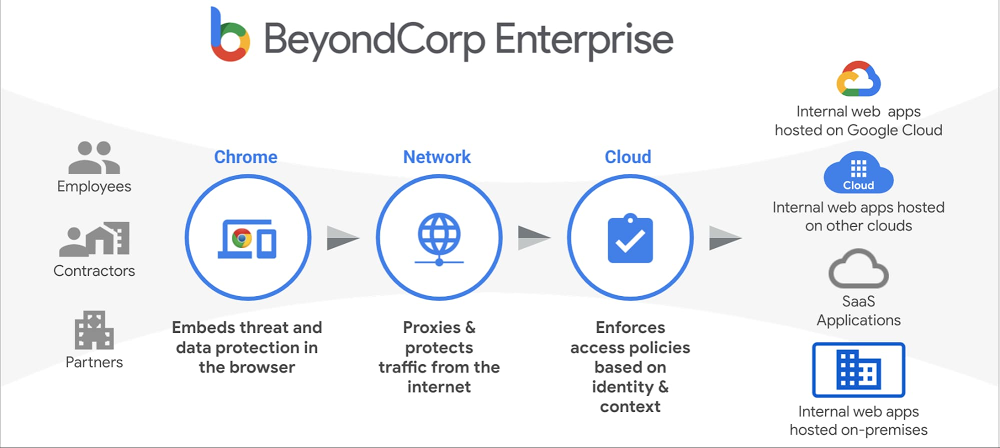
Security issues continue to disrupt the status quo for global enterprises. Recent incidents highlight the need to re-think our security plans and operations; attackers are getting smarter, attacks are more sophisticated, and assumptions about what is and isn’t locked down no longer hold. The challenge, however, is to enable disruptive innovation in security without disrupting security operations. Today, we’re excited to announce the general availability of Google’s comprehensive zero trust product offering, BeyondCorp Enterprise, which extends and replaces BeyondCorp Remote Access. Google is no stranger to zero trust—we’ve been on this journey for over a decade with our own implementation of BeyondCorp, a technology suite we use internally to protect Google’s applications, data, and users. BeyondCorp Enterprise brings this modern, proven technology to organizations so they can get started on their own zero trust journey. Living and breathing zero trust for this long, we know that organizations need a solution that will not only improve their security posture, but also deliver a simple experience for users and administrators.A modern, proven, and open approach to zero trustBecause our own zero trust journey at Google has been ongoing for a decade, we realize customers can’t merely flip a switch to make zero trust a reality in their own organizations, especially given varying resources and computing environments that might look different than ours. Nonetheless, these enterprises understand the zero trust journey is an imperative. As a result, we’ve invested many years in bringing our customers a solution that is cost-effective and requires minimal disruption to existing deployments and business processes, using trust, reliability and scale as our primary design criteria.The end result is, BeyondCorp Enterprise, delivering three key benefits to customers and partners:1) A scalable, reliable zero trust platform in a secure, agentless architecture, including: Non-disruptive, agentless support delivered through the Chrome Browser, which supports more than 2 billion users worldwide.Google’s global network with 144 network edge locations, available in more than 200 countries and territories, so that users can work reliably from anywhere.The entire surface area protected by our scalable DDoS protection service, proven to withstand the largest DDoS attacks recorded (2.5 TB/sec) in recent times.Built-in, verifiable platform security, which has been made more important with recent software supply chain attacks. 2) Continuous and real-time end-to-end protectionEmbedded data and threat protection, newly added to Chrome, to prevent malicious or unintentional data loss and exfiltration and malware infections from the network to the browser.Strong phishing-resistant authentication to ensure that users are who they say they are. Continuous authorization for every interaction between a user and a BeyondCorp-protected resource. End-to-end security from user to app and app to app (including microsegmentation) inspired by the BeyondProd architecture.Automated public trust SSL certificate lifecycle management for internet-facing BeyondCorp endpoints powered by Google Trust Services. 3) A solution that’s open and extensible, to support a wide variety of complementary solutions Built on an expanding ecosystem of technology partners in our BeyondCorp Alliance which democratizes zero trust and allows customers to leverage existing investments.Open at the endpoint to incorporate signals from partners such as Crowdstrike and Tanium, so customers can utilize this information when building access policies.Extensible at the app to integrate into best-in-class services from partners such as Citrix and VMware.In short, if cloud-native zero trust computing is the future—and we believe it is—then our solution is unmatched when it comes to providing scale, security and user experience. With BeyondCorp Enterprise, we are bringing our proven, scalable platform to customers, meeting their zero trust requirements wherever they are.Customers are committed to zero trustWe’ve worked with customers around the world to battle-test our BeyondCorp Enterprise technology and to help them build a more secure foundation for a modern, zero-trust architecture within their organization. Vaughn Washington, VP of Engineering at Deliveroo, a global food delivery company headquartered in the UK, says, “We love that BeyondCorp Enterprise makes it so easy to bring the zero trust model to our distributed workforce. Having secure access to applications and associated data is critical for our business. With BeyondCorp Enterprise, we manage security at the app level, which removes the need for traditional VPNs and associated risks. With BeyondCorp Enterprise and Chrome Enterprise working together, we have additional visibility and controls to help us keep our data secure.””We want to improve the experience for our developers and continue to raise the bar on our security posture by adopting a zero trust architecture. Google’s experience with zero trust and the capabilities of BeyondCorp Enterprise made them an ideal partner for our journey,” said Tim Collyer, Director of Enterprise Information Security at Motorola Solutions, Inc.Support from a robust ecosystem of partnersOur partners are key to our effort to further promote and democratize this technology. The BeyondCorp Alliance allows customers to leverage existing controls to make adoption easier while adding key functionality and intelligence that enables customers to make better access decisions. Check Point, Citrix, CrowdStrike, Jamf, Lookout, McAfee, Palo Alto Networks, Symantec (a division of Broadcom), Tanium and VMware are members of our Alliance who share our vision.“As we enter a new era of security, enterprises want a seamless security model attuned to the realities of remote work, cloud applications, and mobile communications. Zero trust is that model, and critical to its efficacy is the ability to readily assess the health of endpoints. Who is accessing them? Do they contain vulnerabilities? Are they patched and compliant?” said Orion Hindawi, co-founder and CEO of Tanium. “With Google Cloud, we’re on a journey to offer today’s distributed businesses joint solutions that provide visibility and control into activities across any network to any application for both users and endpoints.”Matthew Polly, VP WW Alliances, Channels, and Business Development at CrowdStrike said, “In today’s complex threat environment, zero trust security is fundamental for successful protection. BeyondCorp Enterprise customers will be able to seamlessly leverage the power of the CrowdStrike Falcon platform to deliver complete protection through verified access control to their business data and applications and secure their assets and users from the sophisticated tactics of cyber adversaries, including lateral movement.” “The rapid move to the cloud and remote work are creating dynamic work environments that promise to drive new levels of productivity and innovation. But they have also opened the door to a host of new security concerns and sparked a significant increase in cyberattacks,” said Fermin Serna, Chief Information Security Officer, Citrix. “To defend against them, enterprises must take an intelligent approach to workspace security that protects employees without getting in the way of their experience following the zero trust model. And with Citrix Workspace and BeyondCorp Enterprise, they can do just this.”Dan Quintas, Sr. Director of Product Management at VMware also added, “Google’s commitment to security is clear and in today’s environment, device access policies are a key piece of the zero trust framework. Using Workspace ONE integrations in BeyondCorp Enterprise, customers can leverage device compliance status information to protect corporate information and ensure their users stay productive and secure.”We also continue to collaborate with Deloitte’s industry-leading cyber practice to deliver end-to-end architecture, design, and deployment services to assist our customers’ zero-trust journeys.“Implementing and operationalizing a zero trust architecture is critically important for organizations today,” said Deborah Golden, Deloitte Risk & Financial Advisory Cyber & Strategic Risk leader and principal, Deloitte & Touche LLP. “Both Google Cloud and Deloitte are well positioned to deliver this secure transformative change for our clients and together provide a modern security approach that’s seamless to integrate into existing infrastructures.”Take the next stepThe adoption of zero trust is an imperative for security modernization, and BeyondCorp Enterprise can help organizations overcome the challenges that come with the embrace of such a disruptive innovation. To learn more about BeyondCorp Enterprise, register for our upcoming webinar on Feb 23 and be sure to check out our BeyondCorp product home page.To learn more about the security features of Chrome Enterprise, including the new threat and data protection features available in BeyondCorp Enterprise, attend our upcoming webinar on January 28 by registering here.
Quelle: Google Cloud Platform

Businesses increasingly gather data to better understand their customers, products, marketing, and more. But unlocking valuable and meaningful insights from that data requires powerful, reliable, and scalable solutions. We hear from our BigQuery and Looker customers that they’ve been able to modernize business intelligence (BI) and allow self-service discovery on the data the business collects. Insights are quickly made available not just to data scientists or data analysts, but to everyone in your organization, including key business decision-makers. In this post, we hear from several Google Cloud customers who’ve used BigQuery and Looker and how they’re using their data insights to unlock new opportunities. Data analysis, acceleratedSunrun, the leader in residential solar power, offers clean, reliable, affordable solar energy and battery storage solutions. With the increasing demand for renewable energy, Sunrun needed a better way to manage their growing volumes of data across installation operations, installed systems, customer operations, and sales. Their legacy data stack required IT and data team support for almost every internal data request. Sunrun’s legacy Oracle data warehouse wasn’t equipped to scale across growing analytics demands or easily unlock predictive insights, and this limitation led to data silos and conflicts. After their evaluation process, Sunrun migrated to Google Cloud’s smart analytics platform—including BigQuery and Looker —to reduce extract, transform, and load (ETL) complexity, run fast queries with ease, and make data accessible and trusted throughout the organization. Key benefitsOptimization of construction processes through insights into productivity and labor data, making planning more efficient and identifying areas of opportunity.A 50% reduction in data warehouse design time, ETL, and data modeling.A reduction of their entire data development cycle by more than 60% to enable accelerated decision-making with a modernized, simplified architecture.An enablement of self-service analytics across their core business through a hub-and-spoke analytics model, ensuring all metrics are governed and trusted.A unification of metric definitions throughout the company with LookML, Looker’s modeling layer.Looker dashboards that facilitate regular executive huddles to set and execute data-driven strategies based on a single source of truth.With Looker, Sunrun was able to bring the IT and business sides of the organization closer together, and improve their ability to recognize trends across their retail business, including the performance and impact of their relationships with major retail partners. Across Sunrun, data is analyzed with the customer’s experience and business goals in mind. Since Sunrun’s migration from their on-premises legacy data stack to a modern cloud environment, they’ve created infrastructure and business-wide efficiencies to help them meet the growing demand for solar power.Business intelligence you can build uponAfter relying upon Excel workbooks for data analysis, Emery Sapp & Sons, a heavy civil engineering company, chose BigQuery and Looker as key components of a new data stack that could scale with their business growth. This unified their wide variety of data sources and provided them with a holistic view of the business. Looker met their need to enable user-friendly self-service across the organization, so that all teams could access and act on accurate data through a business-user friendly interface, all with minimal maintenance.Key benefitsPre-built, automated cost and payroll reports in Looker deliver data on schedule in a fraction of the time that Emery Sapp & Sons teams used to spend generating reports.A weekly profitability and accounts receivable dashboard with real-time data allows them to better predict cash flows and provide guidance on which customers they need to be talking with.Tracking of Zendesk support tickets in Looker easily shows what’s open, urgent, high priority, pending, and closed, allowing them to identify trends.Instant access to total outstanding amounts and bills owing reports for the accounts receivable team. Branch managers can sort that information by customer and prioritize follow-up communications. Now able to visualize the necessary information intuitively, Emery Sapp & Sons can quickly understand and act upon important data. Since modernizing their data stack, they’ve cut hours they once spent on manual activities and freed up time to concentrate on what the data means for their business. They can now focus on strategic initiatives that will fuel their growth and serve their customers.Advancing care in an uncertain timeCommonwealth Care Alliance (CCA) is a community-based healthcare organization providing and coordinating care for high-need individuals who are often vulnerable or marginalized. At the first signs of COVID-19 last winter, CCA knew their members would need enhanced care and attention. Their staff and clinicians would need reliable data that was available quickly and integrated across many domains and sources. Fortunately, they had already put in place an advanced analytics platform with BigQuery and Looker, which the CCA data science team has used to deliver valuable information and predictive insights to CCA’s clinicians, and to develop and deploy data ops and machine learning (ML) ops capabilities. All of Google Cloud was available under a single business associate agreement (BAA) to meet CCA’s HIPAA requirements, and BigQuery proved elastic and available as a service. These two features offered reliable platform performance and allowed the small data science team to stay focused and nimble while remaining compliant.Using a query abstraction and a columnar-based data engine, CCA could adapt to clinicians’ changing needs and provide data and predictive insights via general dashboards and role-specific dashboards—internally referred to as action boards, which help clinicians decide how to react to the specific needs of each member. Key benefitsRegular updates to BigQuery and Looker from CCA’s internal care management platform and electronic health records.Quick creation and distribution of custom concepts—such as “high risk for COVID-19”—in Looker’s flexible modeling layer, LookML. Tailored dashboards allow each clinician and care manager to access data relevant to their members, including recommended actions for coordinated care.Looker’s user attributes and permissions integrate with data, such as service disruptions, to allow clinicians to understand and react to changing conditions.Using BigQuery and Looker, CCA’s data science team provides secure, companywide access to trusted data without burdening internal resources. As the COVID-19 pandemic and its effects continue to evolve, CCA continually uses the latest available information to update and guide their member support and care strategies. Now, the data science team can move on to deeper feature engineering and causal inference to enrich the insights delivered to their clinicians and the care provided to their members.Saving $10,000 a month and moreLabel Insight helps retailers and brands stay on top of trends and market demand by analyzing the packaging and labeling of different products. Their customers use this information to inform decisions around repackaging existing products or creating new products that are in line with the latest dietary trends. Before, with their on-premises legacy BI system, numerous data silos, and cumbersome processes, it became increasingly costly, complicated, and time-consuming to quickly extract helpful insights from the data. Though Label Insight had rich data sets, accessing them would often take one person an entire week of analysis. This process was not scalable, repeatable, or reliable. Today, Label Insight’s new data platform includes BigQuery as their data warehouse and Looker for business intelligence. When evaluating data warehouse offerings, their executive team found that the more they used BigQuery, the more they’d receive significant benefits and ROI for the company. BigQuery now offers them virtually infinite, cost-effective, scalable storage capacity and unrivalled performance.With easy-to-set-up dashboards, reporting, and analytics, Looker democratizes data for users across the entire Label Insight organization. Looker also enables governance and control, helping them make use of the high-quality data in BigQuery, and freeing up their data team from constantly managing reporting requests. With Looker’s ability to integrate insights via embedded analytics into its existing applications like Slack, Label Insight can access consistent, accurate data in their favorite task management tools, enabling everyone to continue providing value to their customers.Key benefitsAn ROI of 200%, with a savings of 120 labor hours on reporting per week, which has opened up time and resources for their teams to pursue new initiatives.A recurring savings amounting to $10,000/month.An approximately 60% (and growing) user engagement score on the platform, and with the help of their Looker superusers, goals to continue growing that number.Extract, transform and load (ETL) automation with Fivetran provides quick and easy access to data across their 17 different sources.Modernizing Label Insight’s data technology stack has transformed their business in all the ways they were hoping for. Home-run engagement for fans and clubsThe fan data engineering team at Major League Baseball (MLB) is responsible for managing more than 350 data pipelines to ingest data from third-party and internal sources and centralize it in an enterprise data warehouse (EDW). That EDW drives data-related initiatives across the internal product, marketing, finance, ticketing, shop, analytics, and data science departments, and from all 30 MLB Clubs. The team had previously used Teradata as their EDW.MLB was experiencing issues such as query failures and latency and synchronization problems with their EDW. Providing direct user access was often challenging due to network connectivity restrictions and client software setup issues. With a migration from Teradata to BigQuery completed in 2019, MLB has realized numerous benefits from their modern, cloud-first data warehouse platform.Key benefitsSide-by-side performance tests run with minimal cost and no commitment. By switching from on-demand to flat-rate pricing, MLB could fix costs, avoid surprise overages, and share unused capacity between departments.Data democratization boosted by the secure, one-click sharing of datasets with any Workspace user or group. Access to BigQuery’s web console to review and run SQL queries on data, and to use Connected Sheets to analyze large data sets with pivot tables in a familiar interface. A 50% increase in query completion speed compared with the previous EDW. Integrations with several services MLB uses, including Google Ads, Google Campaign Manager, and Firebase.Integration of BigQuery with Looker, MLB’s new BI tool, which provides a clean and high-performing interface for business users to access and drill into data. A reduction in operational overhead of the previous database administration.Support coverage by Google for any major service issues, letting IT teams focus on more strategic work.MLB can now take a more comprehensive and frictionless approach to using data to serve their fans and the league. Two projects already facilitated by their move to BigQuery and Looker include:OneView: This initiative compiles over 30 pertinent data sources into a single table, with one row per fan, to facilitate downstream personalization and segmentation initiatives like news article personalization. Real-time form submission reporting: By using the Google-provided Dataflow template to stream data from Pub/Sub in real time to BigQuery, MLB creates Looker dashboards with real-time reporting on form submissions for initiatives such as their “Opening Day Pick ‘Em” contest. This allows their editorial team to create up-to-the-minute analyses of results.With MLB’s new data stack up and running, they’re able to serve data stakeholders better than ever before, and can harness their new data-driven capabilities to create better online and in-person experiences for their fans.Ready to modernize your business intelligence? Explore the combined data analytics solution of BigQuery and Looker.Related ArticleHow rapid integrated clinical data helps prioritize care for a vulnerable populationSee how one healthcare company is using data to better connect its doctors and patients during COVID-19, using advanced data analytics in…Read Article
Quelle: Google Cloud Platform
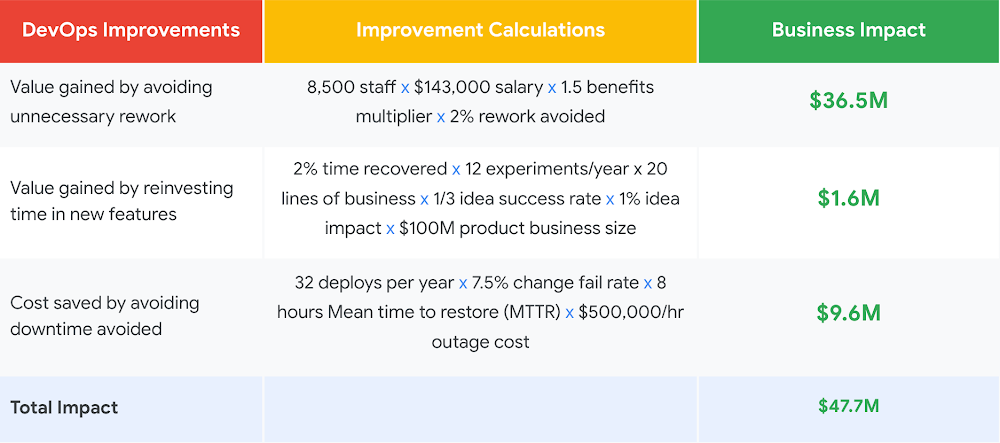
2020 challenged some of the best laid plans by enterprises. With nearly everything moving online, Covid-19 pushed forward years of digital transformation. DevOps was at the heart of this transformation journey. After all, delivering software quickly, reliably, and safely to meet the changing needs of customers was crucial to adapt to this new normal.It is unlikely that the pace of modernization will slow down in 2021. As IT and business leaders further drive digital adoption within their organizations via DevOps, the need to quantify the business benefit from a digital transformation remains top of mind. A reliable model is imperative to drive the right level of investments and measure the returns. This is precisely why we wrote How to Measure ROI of DevOps Transformation. This white paper is backed with scientific studies conducted by DevOps Research and Assessment, DORA, with 31,000 professionals worldwide over 6 years to provide clear guidance based on impartial industry data. We found the financial savings of DevOps transformation varies from from $10M to $259M a year.Looking beyond cost to valueThe most innovative companies undertake their technology transformations with a focus on the value they can deliver to their customers. Hence, in addition to measuring cost savings, we show how DevOps done right can be a value driver and innovation engine. Let’s look deeper into how we quantify the cost and value-generating power of DevOps. Cost-driven categoryHere, we focus on quantifying the cost savings and efficiencies realized by implementing DevOps—for example, how an investment in DevOps reduces costs by cutting the time it takes to resolve outages and avoiding downtime as much as possible. However, focusing solely on reducing costs can rarely yield systemic, long-term gains; thereby increasing the importance of going beyond cost-driven strategies. The cost savings achieved in year one “no longer count” beyond year two as the organization adjusts to a new baseline of costs and performance. Worse, only focusing on cost savings signals to technical staff their job is potentially at risk due to automation rather than being liberated from drudge work to better drive business growth. This leads to negative effects on morale and productivity. Value-driven categoryThere are two value drivers in a DevOps transformation, (1) improved efficiency through the reduction of unnecessary rework, and (2) the potential revenue gained by reinvesting the time saved in new offer capabilities.Adding these cost and value driven categories together, IT and business decision makers can get an estimate of the potential value their organizations can expect to gain from a DevOps transformation. This helps justify the investment needed to implement the required changes. To quantify the impact, we leverage industry benchmark data across low, medium, high, and elite DevOps teams, as described by DORA in its annual Accelerate: State of DevOps report. Combining cost and valueAs an example, let’s consider the impact of a DevOps transformation on a large organization with 8,500 technical staff and a medium IT performer. Using the data gained from the DevOps report, we can calculate both the cost and value driven categories along with total impact. While this example represents what a medium IT performer at a large organization might expect by investing in DevOps, companies of all sizes and performance profiles can leverage DevOps to drive performance. In the white paper, we calculate the impact of DevOps across organizations of different sizes—small, medium, and large—as well as across four distinct performance profiles—low, medium, high, elite. There will be variation in these measurements based on your team’s current performance, compensation, change fail rate, benefits multiplier, and deployments per year, so we share our methodology in the white paper and invite you to customize the approach based on your specific needs and constraints. ROI of DevOps TransformationROI of DevOps Transformation: How to quantify the impact of your modernization initiativesYears of DORA research show that undertaking a technology transformation initiative can produce sizable returns for any organization. Our goal with the white paper is to provide IT and business decision makers an industry backed, data driven foundational basis for determining their investment in DevOps. Download the white paper here to calculate the impact of DevOps on your organization, while driving your digital transformation. Related ArticleRead Article
Quelle: Google Cloud Platform
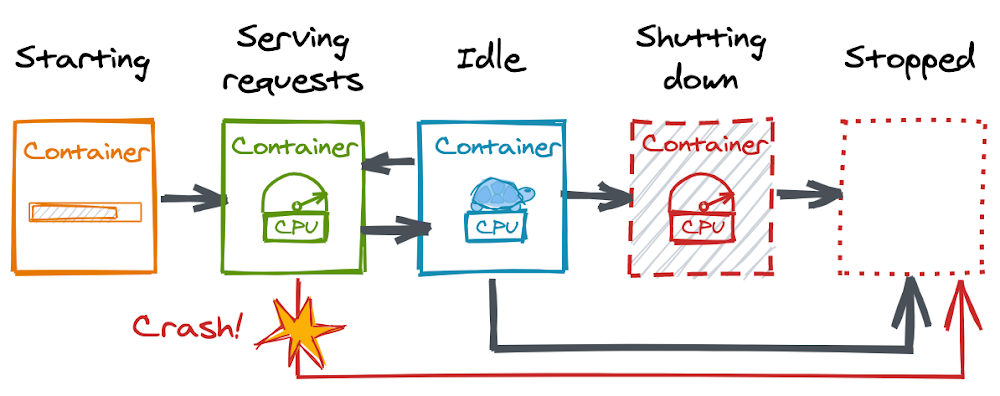
Editor’s note: Today’s post comes from Wietse Venema, a software engineer and trainer at Binx.io and the author of the O’Reilly book about Google Cloud Run. In today’s post, Wietse shares how understand the full container lifecycle, and the possible state transitions within it, so you can make the most of Cloud Run.Serverless platform Cloud Run runs and autoscales your container-based application. You can make the most of this platform when you understand the full container lifecycle and the possible state transitions within it. Let’s review the states, from starting to stopped. First, some context for those who have never heard of Cloud Run before (if you have, skip down to “Starting a Container”). The developer workflow on Cloud Run is a straightforward, three-step process:Write your application using your favorite programming language. Your application should start an HTTP server. Build and package your application into a container image. Deploy the container image to Cloud Run. Once you deploy your container image, you’ll get a unique HTTPS endpoint back. Cloud Run then starts your container on demand to handle requests and ensures that all incoming requests are handled by dynamically adding and removing containers. Explore the hands-on quickstart to try it out for yourself. It’s important to understand the distinction between a container image and a container. A container image is a package with your application and everything it needs to run; it’s the archive you store and distribute. A container represents the running processes of your application.You can build and package your application into a container image in multiple ways. Docker gives you low-level control and flexibility. Jib and Buildpacks offer a higher-level, hands-off experience. You don’t need to be a container expert to be productive with Cloud Run, but if you are, Cloud Run won’t be in your way. Choose the containerization method that works best for you and your project.Starting a ContainerWhen a container starts, the following happens:Cloud Run creates the container’s root filesystem by materializing the container image. Once the container filesystem is ready, Cloud Run runs the entrypoint program of the container (your application). While your application is starting, Cloud Run continuously probes port 8080 to check whether your application is ready. (You can change the port number if you need to.)Once your application starts accepting TCP connections, Cloud Run forwards incoming HTTP requests to your container.Remember, Cloud Run can only deploy container images that are stored in a Docker repository on Artifact Registry. However, it doesn’t pull the entire image from there every time it starts a new container. That would be needlessly slow. Instead, Cloud Run pulls your container image from Artifact Registry only once, when you deploy a new version (called a revision on Cloud Run). It then makes a copy of your container image and stores it internally.The internal storage is fast, ensuring that your image size is not a bottleneck for container startup time. Large images load as quickly as small ones. That’s useful to know if you’re trying to improve cold start latency. A cold start happens when a request comes in and no containers are available to handle it. In this case, Cloud Run will hold the request while it starts a new container. If you want to be sure a container is always available to handle requests, configure minimum instances, which will help reduce the number of cold starts. Because Cloud Run copies the image, you won’t get into trouble if you accidentally delete a deployed container image from Artifact Registry. The copy ensures that your Cloud Run service will continue to work. Serving RequestsWhen a container is not handling any requests, it is considered idle. On a traditional server, you might not think twice about this. But on Cloud Run, this is an important state:An idle container is free. You’re only billed for the resources your container uses when it is starting, handling requests (with a 100ms granularity), or shutting down. An idle container’s CPU is throttled to nearly zero. This means your application will run at a really slow pace. That makes sense, considering this is CPU time you’re not paying for. When your container’s CPU is throttled, however, you can’t reliably perform background tasks on your container. Take a look at Cloud Tasks if you want to reliably schedule work to be performed later. When a container handles a request after being idle, Cloud Run will unthrottle the container’s CPU instantly. Your application — and your user — won’t notice any lag. Cloud Run can keep idle containers around longer than you might expect, too, in order to handle traffic spikes and reduce cold starts. Don’t count on it, though. Idle containers can be shut down at any time.Shutting DownIf your container is idle, Cloud Run can decide to stop it. By default, a container just disappears when it is shut down. However, you can build your application to handle a SIGTERM signal (a Linux kernel feature). The SIGTERM signal warns your application that shutdown is imminent. That gives the application 10 seconds to clean things up before the container is removed, such as closing database connections or flushing buffers with data you still need to send somewhere else. You can learn how to handle SIGTERMs on Cloud Run so that your shutdowns will be graceful rather than abrupt.So far, I’ve looked at Cloud Run’s happy state transitions. What happens if your application crashes and stops while it is handling requests? When Things Go WrongUnder normal circumstances, Cloud Run never stops a container that is handling requests. However, a container can stop suddenly in two cases: if your application exits (for instance due to an error in your application code) or if the container exceeds the memory limit. If a container stops while it is handling requests, it takes down all its in-flight requests at that time: Those requests will fail with an error. While Cloud Run is starting a replacement container, new requests might have to wait. That’s something you’ll want to avoid.You can avoid running out of memory by configuring memory limits. By default, a container gets 256MB of memory on Cloud Run, but you can increase the allocation to 4GB. Keep in mind, though, if your application allocates too much memory, Cloud Run will also stop the container without a SIGTERM warning.SummaryIn this post, you learned about the entire lifecycle of a container on Cloud Run, from starting to serving and shutting down. Here are the highlights: Cloud Run stores a local copy of your container image to load it really fast when it starts a container.A container is considered idle when it is not serving requests. You’re not paying for idle containers, but their CPU is throttled to nearly zero. Idle containers can be shut down. With SIGTERM you can shut down gracefully, but it’s not guaranteed to happen. Watch your memory limits and make sure errors don’t crash your application. I’m a software engineer and trainer at Binx.io and the author of the O’Reilly book about Google Cloud Run (read the full chapter outline). Connect with me on Twitter: @wietsevenema (open DMs).Related ArticleTrigger Cloud Run with events from more than 60 Google Cloud sourcesNow, you can invoke applications running on Cloud Run with events generated by over 60 Google Cloud services.Read Article
Quelle: Google Cloud Platform
Operational resilience continues to be a key focus for financial services firms. Regulators from around the world are refocusing supervisory approaches on operational resilience to support the soundness of financial firms and the stability of the financial ecosystem. Our new white paper discusses the continuing importance of operational resilience to the financial services sector, and the role that a well-executed migration to Google Cloud can play in strengthening it. Here are the key highlights: Operational resilience in financial servicesFinancial services firms and regulators are increasingly focused on operational resilience, reflecting the growing dependency that the financial services industry has on complex systems, automation and technology, and third parties. Operational resilience can be defined as the “ability to deliver operations, including critical operations and core business lines, through a disruption from any hazard”1. Given this definition, operational resilience needs to be thought of as a desired outcome, instead of a singular activity, and as such, the approach to achieving that outcome needs to address a multitude of operational risks including: Cybersecurity: Continuously adjusting key controls, people, processes and technology to prevent, detect and react to external threats and malicious insiders.Pandemics: Sustaining business operations in scenarios where people cannot, or will not, work in close proximity to colleagues and customers.Environmental and Infrastructure: Designing and locating facilities to mitigate the effects of localised weather and infrastructure events, and to be resilient to physical attacks.Geopolitical: Understanding and managing risks associated with geographic and political boundaries between intragroup and third-party dependencies.Third-party Risk: Managing supply chain risk, and in particular of critical outsourced functions by addressing vendor lock in, survivability and portability.Technology Risk: Designing and operating technology services to provide the required levels of availability, capacity, performance, quality and functionality. Operational resilience benefits from migrating to Google CloudThere is a growing recognition among policymakers and industry leaders that, far from creating unnecessary new risk, a well-executed migration to public cloud technology over the coming years will provide capabilities to financial services firms that will enable them to strengthen operational resilience in ways that are not otherwise achievable. Foundationally, Google Cloud’s infrastructure and operating model is of a scale and robustness that can provide financial services customers a way to increase their resilience in a highly commercial way.Equally important are the Google Cloud products, and our support for hybrid and multi-cloud, that help financial services customers manage various operational risks in a differentiated manner:Cybersecurity that is designed in, and from the ground up. From encryption by default, to our Titan security chip, to high-scale DOS defences, to the power of Google Cloud data analytics and Security Command Center our solutions help you secure your environment.Solutions that decouple employees and customers from physical offices and premises. This includes zero-trust based remote access that removes the need for complex VPNs, rapidly deployed customer contact center AI virtual agents, and Google Workspace for best-in-class workforce collaboration.Globally and regionally resilient infrastructure, data centers and support. We offer a global footprint of 24 regions and 73 zones allowing us to serve customers in over 200 countries, with a globally distributed support function so we can support customers even in adverse circumstances.Strategic autonomy through appropriate controls. Our recognition that customers and policymakers, particularly in Europe, strive for even greater security and autonomy is embodied in our work on data sovereignty, operational sovereignty, and software sovereignty.Portability, substitutability and survivability, using our open cloud. We understand that from a financial services firm’s perspective, achieving operational resilience may include solving for situations where their third parties are unable, for any reason, to provide the services contracted.Reducing technical debt, whilst focusing on great financial products and services. We provide a portfolio of solutions so that financial services firms’ technology organisations can focus on delivering high-quality services and experiences to customers, and not on operating foundational technologies such as servers, networks and mainframes.We are committed to ensuring that Google Cloud solutions for financial services are designed in a manner that best positions the sector in all aspects of operational resilience. Furthermore, we recognize that this is not simply about making Google Cloud resilient: the sector needs autonomy, sovereignty and survivability. You can learn more about Google Cloud’s point of view on operational resilience in financial services by downloading the white paper.1. “Sound Practices to Strengthen Operational Resilience”, FRB, OCC, FDIC
Quelle: Google Cloud Platform

Today, Docker and JFrog announced a new partnership to ensure developers can benefit from integrated innovation across both companies’ offerings. This partnership sets the foundation for ongoing integration and support to help organizations increase both the velocity and quality of modern app development.
The objective of this partnership is simple: how can we ensure developers can get the images they want and trust, and make sure they can access them in whatever development process they are using from a centralized platform? To this end, the new agreement between Docker and JFrog ensures that developers can take advantage of their Docker Subscription and Docker Hub Official Images in their Artifactory SaaS and on-premise environments so they can build, share and run apps with confidence.
At a high level, a solution based on the Docker and JFrog partnership looks like this:
In this sample architecture, developers can build apps with images, including Docker Official Images and images from popular OSS projects and software companies, from Docker Hub. As images are requested, they are cached into JFrog Artifactory, where images can be managed by corporate policies, cached for high performance, and mirrored across an organization’s infrastructure. Also, the images in Artifactory can take advantage of other features in the JFrog suite, including vulnerability scanning, CI/CD pipelines, policies and more. All without limits.
This is an exciting first for Docker, as the partnership with JFrog opens up new ways of integrating leading tools to improve outcomes for developers. With integration across Docker Hub and Artifactory, premier access to the trusted high-quality Docker Official Images in Docker Hub, and secure, central access to images in Artifactory, we believe this partnership will bring immediate results to our developer communities including:
More value to Docker Subscription users with tight integration into private repositoriesPremier access to trusted, high-quality images from Docker HubCentral access to Docker Official Images in ArtifactoryStreamlined application development workflows
But this is just the beginning. Over the coming months, we are working to keep improving the integration and connection here to bring new capabilities and productivity improvements to modern app developers. You can get started now! If you are an Artifactory user you will see the benefits of premier access to Docker Hub images right away. You can learn more about the announcement from the JFrog blog here. And, you can get technical details and how-to information from JFrog documentation.
The post New Docker and JFrog Partnership Designed to Improve the Speed and Quality of App Development Processes appeared first on Docker Blog.
Quelle: https://blog.docker.com/feed/

2,5 Stunden ohne Steckdose kann der PH510PG mittels integriertem Akku auskommen. Das Bild ist allerdings nicht sehr hochauflösend. (Beamer, Heimkino)
Quelle: Golem






