Symfonisk Picture Frame: Ikea packt Sonos-Lautsprecher in einen Bilderrahmen
Vor der offiziellen Ankündigung eines neuen Symfonisk-Lautsprechers hat Ikea einen Bilderrahmen mit Sonos-Technik veröffentlicht. (Ikea, Multi-Room)
Quelle: Golem

Vor der offiziellen Ankündigung eines neuen Symfonisk-Lautsprechers hat Ikea einen Bilderrahmen mit Sonos-Technik veröffentlicht. (Ikea, Multi-Room)
Quelle: Golem

Die neuen Barebones von Gigabyte haben zudem zwei freie RAM-Bänke und Platz für ein 2,5-Zoll-Laufwerk. Das alles ist möglichst kompakt. (Gigabyte, AMD)
Quelle: Golem

Der Fleischkonzern JBS musste nach einer Ransomware-Attacke viele Fabriken stilllegen. Das FBI und die US-Regierung haben sich eingeschaltet. (Security, Server)
Quelle: Golem

Bisher klaffte zwischen dem Ryzen 7 5800X und dem Ryzen 5 5600X eine große preisliche Lücke. Der Ryzen 7 5700G füllt diese. (AMD Zen, Prozessor)
Quelle: Golem

Tesla hat die Rechte zur Verwendung der eigenen Marke für Restaurants beantragt. Der Schritt könnte auf eine alte Idee von Elon Musk zurückgehen. (Tesla, Elektroauto)
Quelle: Golem

Editor’s note: Today we hear from ForgeRock, a multinational identity and access management software company with more than 1,100 enterprise customers, including a major public broadcaster. In total, customers use the ForgeRock Identity Platform to authenticate and log in over 45 million users daily, helping them manage identity, governance, and access management across all platforms, including on-premises and multicloud environments. Operating at that kind of scale isn’t easy. In this blog post, ForgeRock Engineering Director, Warren Strange discusses the three things that help make their developers efficient and productive, and the Google Cloud tools they use along the way. At ForgeRock, we’ve been an early adopter of Kubernetes, viewing it as a strategic platform. Running on Kubernetes allows us to drive multicloud support across Google Kubernetes Engine (GKE), Amazon (EKS), and Azure (AKS). So no matter which cloud our customers are running on, we are able to seamlessly integrate our products into customers’ environments. Making it easier for ForgeRock’s developers and operators to build, deploy and manage applications has been crucial in our ability to continually provide high quality solutions for our customers. We’re always looking for tools to improve productivity and keep our developers focused on coding instead of configuration. Google Cloud’s suite of DevOps tools have streamlined three specific practices to help keep our developers productive: 1. Make developers productive within IDEsDeveloper productivity is core to the success of any organization, including ForgeRock. Since developers spend most of their time within their IDE of choice, our goal at ForgeRock has been to make it easier for our developers to write Kubernetes applications within the IDEs they know and love. Cloud Code helps us precisely with that: it makes the process of building, deploying, scaling, and managing Kubernetes infrastructure and applications a breeze. In particular, working with the Kubernetes YAML syntax and schema takes time, and a lot of trial and error to master. Thanks to YAML authoring support within Cloud Code, we can easily avoid the complicated and time consuming task of writing YAML files at ForgeRock. With YAML authoring support, developers save time on every bug. Cloud Code’s inline snippets, completions, and schema validation, a.k.a. “linting,” further streamline working with YAML files. The benefits of Cloud Code extend to local development as well. Iterating locally on Kubernetes applications often requires multiple manual steps, including building container images, updating Kubernetes manifests, and redeploying applications. Doing these steps over and over again can be a chore. Cloud Code supports Skaffold under the hood, which tracks changes as they come and automatically rebuilds and redeploys—reducing repetitive development tasks. Finally, developing for Kubernetes usually involves jumping between the IDE, documentation, samples etc. Cloud Code reduces this context switching with Kubernetes code samples. With samples, we can get new developers up and running quickly. They spend less time learning about configuration and management of the application—and spend more time on writing and evolving the code.2. Drive end-to-end automationTo further improve developer productivity, we’ve focused on end-to-end automation: from writing code within IDEs, to automatically triggering CI/CD pipelines and running the code in production. In particular, Tekton, Cloud Build, Container Registry, and GKE have been critical to Forgerock as we streamline the flow of code, feedback and remediation through the build and deployment processes. The process looks something like this:We begin by developing Kubernetes manifests and dockerfiles using Cloud Code. Then we use Skaffold to build containers locally, while Cloud Build helps with continuous integration (CI). The Cloud Build GitHub app allows us to automate builds and tests as part of our GitHub workflow. Cloud Build is differentiated from other continuous integration tools since it is fully serverless. It scales up and scales down in response to load, with no need for us to pre-provision servers or pay in advance for additional capacity. We pay for the exact resources we use. Once the image is built by Cloud Build, it is stored, managed, and secured in Google’s Container Registry. Just like Cloud Build, Container Registry is serverless, so we only pay for what we use. Additionally, since Container Registry comes with automatic vulnerability scanning, every time we upload a new image to Container Registry, we can also scan it for vulnerabilities. Next, a Tekton pipeline is triggered, which deploys the docker images stored in Container Registry and Kubernetes manifests to a running GKE cluster. Along with Cloud Build, Tekton is a critical part of our CI/CD process at ForgeRock. Most importantly, since Tekton comes with standardized Kubernetes-native primitives, we can create continuous delivery workflows very quickly.After deployment, Tekton triggers a functional test suite to ensure that the applications we deploy perform as expected. The test results are posted to our team Slack channel so all developers have instant access and insights about each cluster. From there, we are able to provide our customers with their finished product request.3. Leverage multicloud patterns and practicesThe industry has seen a shift towards multicloud. Organizations have adopted multicloud strategies to minimize vendor lock-in, take advantage of best-in-class solutions, improve cost-efficiencies, and increase flexibility through choice. At ForgeRock, we’re big proponents of multicloud. Part of that comes from the fact that our identity and access management product work across Google Cloud, AWS, and Azure. Developing products using open-source technologies such as Kubernetes has been particularly helpful in driving this interoperability. Tekton has been another critical project that has allowed us to prevent vendor lock-in. Thanks to Tekton, our continuous delivery pipelines can deploy across any Kubernetes cluster. Most importantly, since Tekton pipelines run on Kubernetes, these pipelines can be decoupled from the runtime. Like Tekton and Kubernetes, both Cloud Build and Container Registry are based on open technologies. Community-contributed buildersand official builder images allow us to connect to a variety of tools as a part of the build process. And finally, with support for open technologies like Google Cloud buildpacks within Cloud Build, we can build containers without even knowing Docker. Making it easier for developers and operators to build, deploy and manage applications is critical for the success of any organization. Driving developer productivity within IDEs, leveraging end-to-end automation, and support for multi-cloud patterns and practices are just some of the ways we are trying to achieve this at ForgeRock. To learn more about ForgeRock, and to deploy the ForgeRock Identity Platform into your Kubernetes cluster, check out our open-source ForgeOps repository on GitHub.
Quelle: Google Cloud Platform
Editor’s note: PedidosYa is the market leader for online food ordering in Latin America, serving 15 markets and over 400 cities. It’s also one of the largest brands within the German multinational company Delivery Hero SE. With over 20 million app downloads, PedidosYa provides the best online delivery experience through 71,000+ online partners, including restaurants, shops, drugstores, and specialized markets. Having constant access to fresh customer data is a key requirement for PedidosYa to improve and innovate our customer’s experience. Our internal stakeholders also require faster insights to drive agile business decisions. Back in early 2020, PedidosYa’s leadership tasked the data team to make the impossible possible. Our team’s mission was to democratize data by providing universal and secure access while creating a comprehensive information ecosystem across PedidosYa. We also had to achieve this goal while keeping costs under control— even during the migration stage and removing operational bottlenecks. Challenges with legacy cloud infrastructurePedidosYa first built its data platform on top of AWS. Our data warehouse ran on Redshift, and our data lake was in S3. We used Presto and Hue as the user interfaces for our data analysts. However, maintaining this infrastructure was a daunting task. Our legacy platform couldn’t keep up with the increasing analytics demands. For example, the data stored on S3 complemented by Presto/Hue required high operational overhead. This was because Presto and our IAM (identity access management) didn’t integrate well in our legacy ecosystem. Managing individual users and mapping IAM roles with groups and Kerberos was operationally time-consuming and costly. Further, sharding access on the S3 files was far too complicated to enable seamless ACLs (access control lists). There were also challenges with workload management. Our data warehouse had batch data loaded overnight. If one analyst scheduled a query to run during the overnight ETL (extract, transform, load) workload, it would disrupt the current ETL task. This could stop the entire data pipeline. We’d have to wait until data engineers intervened with a manual fix.It was also difficult to understand whether a query error was due to performance issues or platform resource exhaustion. This lack of clarity affected our data analysts’ ability to autonomously improve querying efficiency. Data team members needed to manually inspect personal queries looking for performance issues. Also, the current architecture was prone to a ‘tragedy of the commons’ situation; it was seen as an unlimited and free resource. As a result, it was impossible to disentangle the infrastructure from different stakeholder teams, as all had very different needs. The decision to modernize our data warehouseGiven the growing challenges from our legacy platform, our tech team decided to transform our analytics environment with a modern data warehouse. They required the following key criteria from their next data platform: Scalability – The ability to grow with elastic infrastructure.Cost control – Cost management and transparency. These factors promote efficiency and ownership—both key aspects of data democratization.Metadata management – Intuitive data platform focusing on users’ previous SQL knowledge. Plus, being able to enrich the informational ecosystem with metadata, to diminish data gatekeepers.Ease of management – The team needed to reduce operational costs with a serverless solution. Data engineers wanted to focus on their key roles rather than acting as database administrators and infrastructure engineers. The team also wanted much higher availability, and to reduce the impact of maintenance windows and vacuum/analysis.Data governance and access rights – With a growing employee base with varying data access requirements, the team needed a simple yet comprehensive solution to understand and track user access to data.Migrating to Google CloudAfter exploring other alternatives, we concluded Google Cloud had an answer to each of our decision drivers. Google Cloud’s serverless, managed, and integrated data platform, coupled with its seamless integration across open-source solutions, was the perfect answer for our organization. In particular, the natural integration with Airflow as a job orchestrator and Kubernetes for flexible on-demand infrastructure was key. We used Dataflow together with Pub/Sub and Cloud Functions for our data ingestion requirements, which has made our deployment process with Terraform seamless. Because we set up everything in our environment programmatically, operation time has diminished. Google Cloud reduced the deployment process from about 16 hours in our legacy platform to 4 hours. This is partly due to the friendliness of automating the deployment (such as schema check, load test, table creation, build.) process with Terraform, Cloud Functions, Pub/Sub, Dataflow, and BigQuery on GCP. Input messages processed with Dataflow allow us to abstract and plan the schema changes according to the needs of the functional team. For example, schema changes raise an alarm, and then we can modify the raw layer table schema. By doing this, we ensure that backend modifications that we don’t control do not affect upper layers.A key reason why we picked Google Cloud was because of its advanced cost and workload management coupled with its transparent log analytics. This information gives us a complete view into any query performance issues to make improvements on the fly. Further, we achieved a significant amount of cost savings by consolidating multiple tools to BigQuery.With BigQuery, we’ve been able to reduce our total cost per query by 5x.This was due to a number of reasons:Automating pipeline deployment made it much simpler to maintain the data processing processes. Analysts are conscious about what queries they’re running, resulting in running better, more optimized queries. Analysts use a Data Studio dashboard to see their queries and all the associated costs. As a result, there’s a lot more transparency for each persona. With these changes, we can easily manage and assign costs associated with each workload with their own cost centers using specific Google Cloud projects.Change management is always challenging. However, BigQuery is intuitive and doesn’t have a steep learning curve from Hue/Hive on SQL basics. BigQuery also allowed the team to expand its capabilities and enabled them to properly work with nested structures, avoiding unnecessary joins and improving query efficiency. Additionally, we now use Data Catalog as our unique point of truth for metadata management. This allows our team to break the data access barriers and enable federation of data across the organization. By using Airflow to orchestrate everything, we keep track of every data stream. With this information, each end user can see their regularly used data entities’ status via the dashboard. This also adds transparency to our everyday data processes.Finally, with Google Cloud’s IAM rules applied across the different products, data sharing and access is close to a noOps experience. We have programmatically implemented access according to roles and level access within the company. This allows certain pre-validated roles to view more sensitive information. These solutions help drive a more automated data governance experience. Up next: Google Cloud AI/MLThe new stack based on BigQuery has created significant productivity gains. Freed from the burden of operational management, PedidosYa’s data team can now focus on adding value through data tools and products. Our data engineers are better equipped to integrate constantly changing transactional and operational data.The dataOps team can automate the infrastructure and provide autonomy to the end user.Our data quality team can focus on bringing added value to data stakeholders. Data scientists and data analytics can spend more time analyzing data and less time asking data gatekeepers for data access.PedidosYa can now democratize data access with a well-governed architecture. We are still at the beginning of our journey, but we are closer to achieving our vision of building a data-driven organization. Up next: expanding our artificial intelligence and machine learning capabilities.Tune in to Google Cloud’s Applied ML Summit on June 10th, 2021, or listen on-demand later, to learn how to apply groundbreaking machine learning technology in your projects.Related ArticleTransforming your business with the data cloudAccelerate your business transformation with the data cloud.Read Article
Quelle: Google Cloud Platform
Last week, we announced the Preview of Datastream, our serverless and easy-to-use change data capture and replication service. Datastream currently supports access to streaming, low-latency data from Oracle and MySQL databases into Google Cloud services such as Cloud Spanner, Cloud SQL, and BigQuery.With this in mind, we understand that our customers are using different tools and technologies and we want to meet them where they are. Logical replication and decoding for example, is an inherent part of the PostgreSQL ecosystem and it is a commonly used functionality. Therefore, today we are excited to announce the public preview of logical replication and decoding for Cloud SQL for PostgreSQL. By releasing those capabilities and enabling change data capture (CDC) from Cloud SQL for PostgreSQL, we strengthen our commitment to building an open database platform that meets critical application requirements and integrates seamlessly with the PostgreSQL ecosystem.Let’s take, for example, a retailer’s ecommerce system in which each order is saved in a database. Placing the order in the database is just one part of the order processing. How does the inventory get updated? By leveraging CDC, downstream systems can be notified of such changes and act accordingly—in this case, update the inventory in the warehouse.Another common use case is data analytics pipelines. Businesses want to perform analytics on the freshest data possible. For example, low stock on some products might need to kick off certain logistical processes, such as restocking or alerting. You can leverage logical decoding and replication to get the freshest data from the operational systems to your data pipelines and from there to your analytics platform with low latency.What is logical replication and decoding?Logical replication enables the mirroring of database changes between two Postgres instances in a storage-agnostic fashion. Logical replication provides flexibility both in terms of what data can be replicated between instances and what versions those instances can be running.Logical decoding enables the capture of all changes to tables within a database in different formats, such as JSON or plaintext, to name a few. Once captured, they can be consumed by a streaming protocol or a SQL interface. What problems can I solve with logical replication and decoding?Here’s what you can solve easily with logical replication and decoding:Selective replication of sets of tables between instances so that only relevant data sets need be sharedSelective replication of table rows between instances mainly to reduce size of dataSelective replication of table columns from the source to remove non-essential or sensitive dataData gather/merge from multiple sources to form a data lakeStream fresh data from operational database to the data warehouse for near real time analyses Upgrades instances between major versions with near zero downtimeHow can I participate in the public preview?To get started, check out documentation for this feature and release notes. To use this feature in public preview, spin up a new instance of Postgres (any version is fine) and follow the instructions in the documentation.Related ArticleThe 5 benefits of Cloud SQL [infographic]Check out this infographic on the 5 benefits of Cloud SQL, Google Cloud’s managed database service for MySQL, PostgreSQL and SQL Server.Read Article
Quelle: Google Cloud Platform
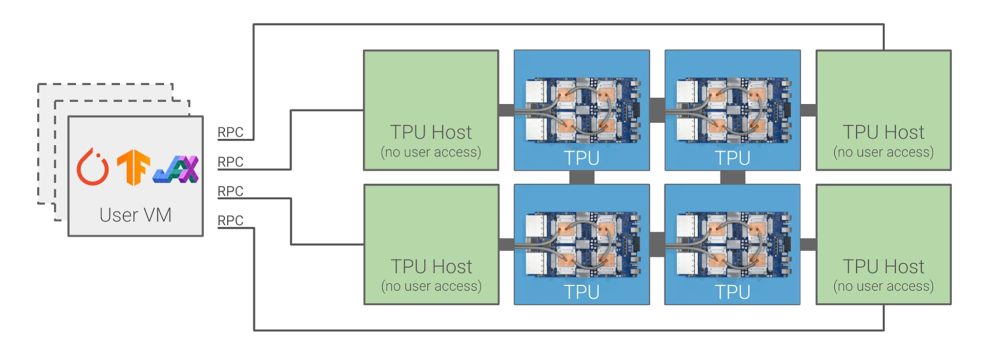
Today, we’re excited to announce new Cloud TPU VMs, which make it easier than ever before to use our industry-leading TPU hardware by providing direct access to TPU host machines, offering a new and improved user experience to develop and deploy TensorFlow, PyTorch, and JAX on Cloud TPUs. Instead of accessing Cloud TPUs remotely over the network, Cloud TPU VMs let you set up your own interactive development environment on each TPU host machine.Now you can write and debug an ML model line-by-line using a single TPU VM, then scale it up on a Cloud TPU Pod slice to take advantage of the super-fast TPU interconnect. You have root access to every TPU VM you create, so you can install and run any code you wish in a tight loop with your TPU accelerators. You can use local storage, execute custom code in your input pipelines, and more easily integrate Cloud TPUs into your research and production workflows.In addition to Cloud TPU integrations with TensorFlow, PyTorch, and JAX, and you can even write your own integrations via a new libtpu shared library on the VM. “Direct access to TPU VMs has completely changed what we’re capable of building on TPUs and has dramatically improved the developer experience and model performance.”— Aidan Gomez, co-founder and CEO, CohereA closer look at the new Cloud TPU architectureUntil now, you could only access Cloud TPUs remotely. You would typically create one or more VMs that would then communicate with Cloud TPU host machines over the network using gRPC:By contrast, Cloud TPU VMs run on the TPU host machines that are directly attached to TPU accelerators, as shown below:This new Cloud TPU system architecture is simpler and more flexible. In addition to major usability benefits, you may also achieve performance gains because your code no longer needs to make round trips across the datacenter network to reach the TPUs. Furthermore, you may also see significant cost savings: If you previously needed a fleet of powerful Compute Engine VMs to feed data to remote hosts in a Cloud TPU Pod slice, you can now run that data processing directly on the Cloud TPU hosts and eliminate the need for the additional Compute Engine VMs.What customers are sayingEarly access customers have been using Cloud TPU VMs since last October, and several teams of researchers and engineers have used them intensively since then. Here’s what they have to say:Alex Barron is a Lead Machine Learning Engineer at Gridspace. Gridspace provides an out-of-the-box product for observing, analyzing and automating 100% of voice calls in real time. The company’s software powers voice operations at USAA, Bloomberg and Square, among other leading companies.“At Gridspace we’ve been using JAX and Cloud TPU VMs to train massive speech and language models. These models power advanced analytics and automation capabilities inside our largest contact center customers. We saw an immediate 2x speed up over the previous Cloud TPU offering for training runs on the same size TPU and were able to scale to a 32-host v3-256 with no code changes. We’ve been incredibly satisfied with the power and ease of use of Cloud TPU VMs and we look forward to continuing to use them in the future.”— Alex BarronJames Townsend is a researcher at the UCL Queen Square Institute of Neurology in London. His team has been using JAX on Cloud TPU VMs to apply deep learning to medical imaging.“Google Cloud TPU VMs enabled us to radically scale up our research with minimal implementation complexity. There is a low-friction pathway, from implementing a model and debugging on a single TPU device, up to multi-device and multi-host (pod scale) training. This ease-of-use, at this scale, is unique, and is a game changer for us in terms of research possibilities. I’m really excited to see the impact this work can have.”— James TownsendPatrick von Platen is a Research Engineer at Hugging Face. Hugging Face is an open-source provider of natural language processing (NLP) technologies and creator of the popular Transformers library. With Hugging Face, researchers and engineers can leverage state-of-the-art NLP models with just a couple lines of code.”At Hugging Face we’ve recently integrated JAX alongside TensorFlow and PyTorch into our Transformers library. This has enabled the NLP community to efficiently train popular NLP models, such as BERT, on Cloud TPU VMs. Using a single v3-8, it is now possible to pre-train a base-sized BERT model in less than a day using a batch size of up to 2048. At Hugging Face, we believe that providing easy access to Cloud TPU VMs will make pre-training of large language models possible for a much wider spectrum of the NLP community, including small start-ups as well as educational institutions.”— Patrick von PlatenBen Wang is an independent researcher who works on Transformer-based models for language and multimodal applications. He has published open-source code for training large-scale transformers on Cloud TPU VMs and for orchestrating training over several Cloud TPU VMs with Ray.“JAX on Cloud TPU VMs enables high-performance direct access to TPUs along with the flexibility to build unconventional training setups, such as pipeline parallel training across preemptible TPU pod slices using Ray.”— Ben WangKeno Fischer is a core developer of the Julia programming language and co-founder of Julia Computing, where he leads a team applying machine learning to scientific modeling and simulation. He is the author of significant parts of the Julia compiler, including Julia’s original TPU backend.“The new TPU VM offering is a massive step forward for the usability of TPUs on the cloud. By being able to take direct advantage of the TPU hardware, we are no longer limited by the bandwidth and latency constraints of an intermediate network connection. This is of critical importance in our work where machine learning models are often directly coupled to scientific simulations running on the host machine.” — Keno Fischer The Julia team is working on a second-generation Cloud TPU integration using the new libtpu shared library. Please sign up here to receive updates.And finally, Shrestha Basu Mallick is a Product Manager on the Sandbox@Alphabet team, which has successfully adapted TPUs for classical simulations of quantum computers and to perform large-scale quantum chemistry computations. “Thanks to Google Cloud TPU VMs, and the ability to seamlessly scale from 1 to 2048 TPU cores, our team has built one of the most powerful classical simulators of quantum circuits. The simulator is capable of evolving a wavefunction of 40 qubits, which entails manipulating one trillion complex amplitudes! Also, TPU scalability has been key to enabling our team to perform quantum chemistry computations of huge molecules, with up to 500,000 orbitals. We are very excited about Cloud TPUs.”— Shrestha Basu MallickPricing and availabilityCloud TPU VMs are now available via preview in the us-central1 and europe-west4 regions. You can use single Cloud TPU devices as well as Cloud TPU Pod slices, and you can choose TPU v2 or TPU v3 accelerator hardware. Cloud TPU VMs are available for as little as $1.35 per hour per TPU host machine with our preemptible offerings. You can find additional pricing information here.Get started todayYou can get up and running quickly and start training ML models using JAX, PyTorch, and TensorFlow using Cloud TPUs and Cloud TPU Pods in any of our available regions. Check out our documentation to get started:JAX quickstartPyTorch quickstartTensorFlow quickstart
Quelle: Google Cloud Platform






