Friday Five — July 16, 2021

The Friday Five is a weekly Red Hat® blog post with 5 of the week’s top news items and ideas from or about Red Hat and the technology industry. Consider it your weekly digest of things that caught our eye.

Quelle: CloudForms

6 Ways WordPress.com Courses Help You Grow

WordPress.com experts invite you to join our community-driven courses to get your blog or podcast started, launched, or taken to the next level. Join today for on-demand content, access to a course community of peers, weekly office hours with our dedicated experts, and virtual meet-ups to connect with other learners like you. Start learning here. 

Overheard on our Blogging for Beginners Course Community: “Taking this course has pushed me to think beyond my comfort zone and take a step back in my journey to become a better blogger and focus on what I truly want to write about.”

Join the WordPress.com Course Communities here.

Quelle: RedHat Stack

Reaffirming Google Cloud’s commitments to EU businesses in light of the EDPB’s Recommendations

From retail companies to auto manufacturers and financial services institutions, organizations across Europe rely on our cloud services to run their businesses. We are committed to helping our customers meet stringent data protection requirements by offering industry-leading technical controls, contractual commitments, and continued transparency to support their risk assessments and compliance needs. On June 21, 2021, the European Data Protection Board (EDPB) published its finalRecommendations on supplementary measures following the Court of Justice of the European Union’s ruling, which invalidated the EU-US Privacy Shield Framework and upheld the validity of the EU Standard Contractual Clauses (SCCs). The EDPB’s guidance is important to help organizations address international data transfers. Many of the Board’s recommendations align with our long-standing practices. In the light of the above, we want to reaffirm our commitment to GDPR compliance and to help Google Cloud customers meet their compliance objectives when using our services. In particular:A customer-controlled cloudOur customers own their data and we believe they should have the strongest levels of control over data stored in the cloud.  Our public cloud provides customers with world-class levels of visibility and control over their data through our services.   With the capabilities we offer, Google Cloud Platform customers can store data in the European region, ensure customer data is not moved outside of Europe, and prevent users and administrators outside of Europe from accessing their data. They can exercise control over who accesses their data by managing their own encryption keys, ensuring the keys are stored in a European region, and storing them outside Google Cloud’s infrastructure. Customers can also require detailed justification and approval each time a key is requested to decrypt data using External Key Manager, and deny Google the ability to decrypt their data for any reason using Key Access Justifications, which is now in General Availability. You can learn more by reading our blog on advancing control and visibility in the cloud. For insight into what this commitment means to customers from a technical perspective, please see our post on options for data residency, operational transparency and control. Google Cloud was the first and is currently the only cloud provider to offer the ability for customers to store and manage encryption keys for cloud-resident data outside the provider’s infrastructure with programmatic control over decryption based on specific justifications, including government access requests.Our Google Workspace (formerly G Suite) customers can opt to store their covered data in Europe. Additionally, we’re taking encryption a step further in Workspace by giving customers direct control of encryption keys and the identity service they choose to access those keys. With Client-side encryption, customer data is indecipherable to Google, while users can continue to take advantage of Google’s native web-based collaboration, access content on mobile devices, and share encrypted files externally. This capability is currently available in Public Beta for Google Drive, Docs, Sheets, and Slides with plans to extend it to other Workspace services. Customers can also benefit from third party solutions that offer end-to-end encryption for Gmail. With these solutions, customers can keep keys in their preferred geo-location and manage access to covered content.Google Cloud will continue to invest in capabilities that ensure that our customers control the location of and access to their data.New Standard Contractual Clauses The European Commission has published new Standard Contractual Clauses to help safeguard European personal data. Google Cloud plans to implement the new SCCs to help protect our customers’ data and meet the requirements of European privacy legislation. Like the previous SCCs, these clauses can be used to facilitate lawful transfers of data.Transparency to help your risk-based assessmentThe EDPB’s recommendations introduce a risk-based approach under which data exporters should assess the level of risk to fundamental rights that a certain transfer would entail in practice.Our Transparency Report discloses the number of requests made by law enforcement agencies and government bodies for Enterprise Cloud customer information. The historical numbers show that the number of Enterprise Cloud-related requests is extremely low compared to our Enterprise Cloud customer base. For example, our report shows that we didn’t produce any Google Cloud Platform Enterprise customer data in response to government requests for the last reporting period. The likelihood of Enterprise Cloud customer information data being affected by these types of requests is therefore low.We also work hard to help our customers conduct a meaningful assessment by giving a clear and detailed understanding of our process for responding to government requests for Cloud customer data in rare cases where they do happen.AccountabilityWe are always looking at ways to increase our accountability and compliance support for our customers. Recently we announced our adherence to the EU GDPR Code of Conduct.  Codes of conduct are effective collaboration instruments among industry players and data protection authorities where state-of-the-art industry practices can be tailored to meet stringent data protection requirements. We believe that this Code provides a robust basis to build an international data transfer tool for cloud services and will continue to support industry efforts in this regard.  We also continue to follow and be certified against internationally-recognized privacy and security standards such as ISO/IEC 27001, ISO/IEC 27017, ISO/IEC 27018, and ISO/IEC 27701. Certifications provide independent validation of our ongoing dedication to world-class security and privacy. Strong policy advocacyWe will continue to advocate for the principles we believe should guide access requests by government authorities for enterprise data anywhere in the world. Government engagement on a bilateral and multilateral level is critical for modernizing laws and establishing rules for the production of electronic evidence across borders in a manner that respects international norms and resolves any potential conflicts of law. Google has long supported these efforts, including work to find a successor to the US-E.U. Privacy Shield to restore legal certainty around trans-Atlantic personal data flows and develop common global principles on government access to data at the Organisation for Economic Co-operation and Development (OECD) level. We will continue to support these efforts while protecting the privacy and security of our customers. Millions of organisations with users in Europe rely on our cloud services to run their businesses every day, and we remain steadfastly committed to helping them meet their regulatory requirements by maintaining a diverse set of compliance tools in light of EDPB’s recommendations.Related ArticleGoogle Cloud’s contribution to an environment of trust and transparency in EuropeThe Belgian Data Protection Authority has approved a new Cloud Code of Conduct, and Google Cloud is among the first cloud providers to ad…Read Article
Quelle: Google Cloud Platform

Introducing Quilkin: open-source UDP proxies built for game server communication

Traditionally, dedicated game servers for real time multiplayer games have used bespoke UDP protocols for communication and synchronization of gameplay among the players within a game. This communication is most often bundled into monolithic game servers and clients, pairing the technical functionality of communication protocols, such as custom network physics synchronisation, security, access control, telemetry and metrics, with the extremely high computational requirements of physics simulations, AI computation and more.Developed in collaboration with Embark Studios, Quilkin is a UDP proxy, tailor-made for high performance real-time multiplayer games. Its aim is twofold:Pull common functionality, such as security, access control, telemetry and metrics out of monolithic dedicated game servers and clients.Provide this common functionality in a composable and configurable way, such that it can be reused across a wide set of multiplayer games.This reusable foundation then allows game developers to spend more of their time focusing on building the game-specific aspects of building their multiplayer communication protocols, rather than these common aspects.Challenges with multiplayer Game Server communicationIn fast-paced, multiplayer games, the full simulation of a session of gameplay generally occurs within the memory of a monolithic dedicated game server, whose responsibility covers everything from network physics and AI simulation to communications from client back to server and more.Since the entire state of the game is memory resident, each client connects directly to the dedicated game server the player is playing on, which presents several challenges:Each dedicated game server is a single point of failure. If it goes down, then the whole game session (or sometimes multiple sessions) fails. This makes it a target for malicious actors.The IP and port of connection to the game server is public, and exposed to the game client, making it easy to discover and target.Multiple aspects of game server simulation and network communication are tightly coupled in the same process, making reuse and modularity more difficult, and expanding risk of performance issues.If we look at both web and mobile technologies over the past several years, some of these challenges start to look very familiar. Thankfully, one of the solutions to help drive dedicated server workloads to more redundant and distributed orchestration is the utilisation of traffic proxies!By using a proxy for multiplayer UDP traffic, in front of our dedicated games servers within a low latency network such as what is available on Google Cloud, we can address these key challenges as follows:Greater reliability. Proxies provide redundant points of communication entry. UDP packets can be sent to any number of proxies and routed to the dedicated game server. While a dedicated game server will still generally be a single point of failure, proxies improve redundancy and potential failover at the communication layer.Greater security. The IP and port of the dedicated game server is no longer public. Game clients may only have visibility into a subset of the proxy pool, limiting a potential attack surface.Greater scalability. We start to break apart the single process, as we can move aspects of the communication protocol, metrics, communication security and access control into the proxy. This removes the non-game specific computation out of your game server’s processing loop.As a result, the entire system is now more resilient as proxies can be scaled independently, not only for performance reasons but also to distribute load in case of malicious actors.Introducing Quilkin: The UDP proxy for Game ServersEmbark Studios and Google Cloud came together and built Quilkin, to provide a standard, open source solution.  Based out of Stockholm, Embark Studios is a (relatively) new studio made up of seasoned industry veterans.  They were the perfect collaboration partner to create Quilkin with, given their team’s experience with large scale real time multiplayer games.  Quilkin is an open-source, non-transparent UDP proxy specifically designed for use with large scale multiplayer dedicated game server deployments, to ensure security, access control, telemetry data, metrics and more.Quilkin is designed to be used behind game clients as well as in front of dedicated game servers, and offers the following major benefits:Obfuscation. Non-transparent proxying of UDP data, making the internal state of your game architecture less visible to bad actors.Out of the box metrics. For UDP packet traffic and communication.Visibility. A composable set of processing filters that can be applied for routing, access control, rate limiting, and more.Flexibility. Ability to to be utilised as a standalone binary, with no client/server changes required or as a Rust library, depending on how deep an integration you wish for your system and/or custom processing Filters you wish to build.Compatibility. Can be integrated with existing C/C++ code bases via Rust FFI, if required.Onboarding. Multiple integration patterns, allowing you to choose the level of integration that makes sense for your architecture and existing platform.Until now, these sorts of capabilities are only available to large game studios with resources to build their own proprietary technology. We think leveling the playing field for everyone in the games industry is an important and worthy endeavor. That’s why we collaborated with Google Cloud and initiated this project together.At Embark, we believe open source is the future of the games industry and that open, cross-company collaboration is the way forward, so that all studios, regardless of size, are able to achieve the same level of technical capabilities. —Luna Duclos, Tech Lead, Embark StudiosGoogle Cloud is excited to announce Quilkin as the latest entry in our portfolio of open-source solutions for gaming.  Quilkin complements our existing OSS solutions including Agones for game servers, Open Match for matchmaking, and Open Saves for persistence.  These are designed to work together as an open and integrated ecosystem for gaming.  We’re proud to include Embark Studios as our latest open source collaborator for gaming along with Ubisoft, Unity, and 2K Games.  Google Cloud will continue to work closely with our partners in industry and the community to offer planet-scale solutions to power the world’s largest games. —Rob Martin, Chief Architect, Google Cloud for GamesGetting started with QuilkinWhile Quilkin can support more advanced deployment scenarios like above, the easiest way to get started with Quilkin is to deploy it as a sidecar to your existing dedicated game server. This may initially limit some of the benefits, but it’s an easy path to getting metrics and telemetry data about your UDP communication, with a very low barrier to entry and the ability to expand over time.While Quilkin is released as both binaries and container images, and is not tied to any specific hosting platform, we’ll use Agones and Google Cloud Game Servers as our game server hosting platform for this example.First we will create a ConfigMap to store the yaml for a static configuration for Quilkin that will accept connections on port 26001 and route then to the Xonotic (an open source, multiplayer FPS game) dedicated game server on port 26000:Second, we’ll take the example container that Agones provides for the Xonotic dedicated game server, and  run Quilkin alongside each dedicated game server as a sidecar, in an Agones Fleet of game servers like so:Once applied, when we query the cluster for the running GameServers, everything looks the same as it would without Quilkin! Nothing else in our system needs to be aware that the traffic is being intercepted, and we can freely take advantage of the functionality of Quilkin without adjusting either client or server code.If this has piqued your interest, make sure to have a look at the walkthrough, where we step through this same scenario and then extend it to compress UDP packets from the game client to server, without having to change either programs.This just scratches the surface, however: there’s even more to Quilkin, including an xDS compliant admin API, a variety of existing Filters to manipulate and route UDP packets and more.What’s next for QuilkinQuilkin is still in its early stages, with this 0.1.0 alpha release, but we’re very happy with the foundation that has been laid.There are a variety of features in the roadmap, from enhanced metrics and telemetry, new filters and filter types, and more.If you would like to try out this release, you can grab the binaries or container images from our releases page, step through our quickstarts and review different integration options with your dedicated game servers.To get involved with the project, please:Check out our Github repositoryJoin our Discord communityJoin the quilkin-discuss mailing listFollow us on TwitterEmbark Studios has also released their own announcement blog post, going deeper into the plans they have for their own production game backend infrastructure, and where Quilkin fits in.Thanks to everyone who has been involved with this project across Google Cloud and Embark Studios, and we look forward to the future for Quilkin!
Quelle: Google Cloud Platform

Create alerts from your logs, available now in Preview

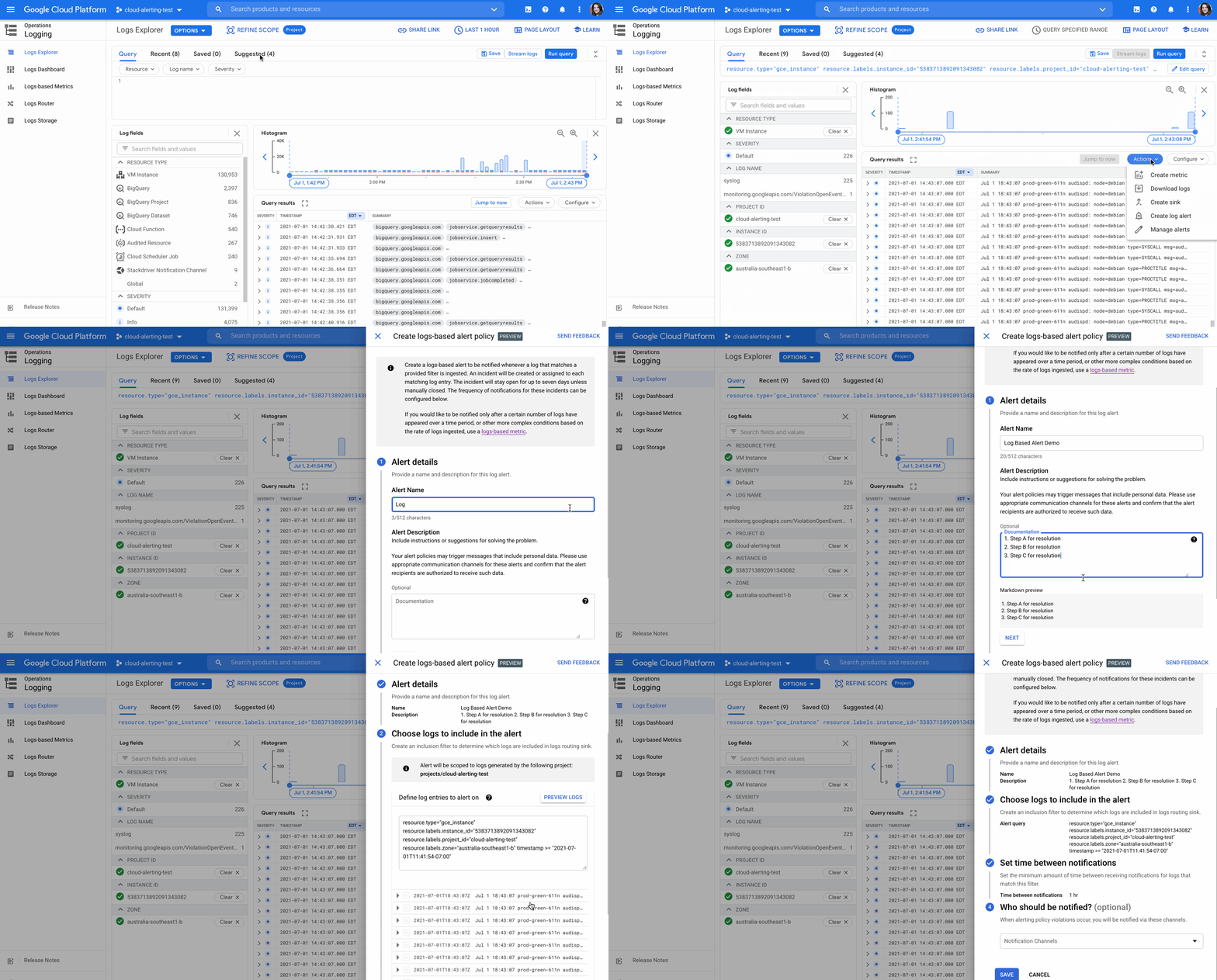
Being alerted to an issue with your application before your customers experience undue interruption is a goal of every development and operations team. While methods for identifying problems exist in many forms, including uptime checks and application tracing, alerts on logs is a prominent method for issue detection. Previously, Cloud Logging only supported alerts on error logs and log-based metrics, but that was not robust enough for most application teams.Today, we’re happy to announce the preview of log-based alerts, a new feature that opens alerts to all log types, adds new notification channels, and helps you make alerts more actionable within minutes. The alert updates include: the ability to set alerts on any log type and content,additional notification channels such as SMS, email groups, webhooks (and more!) anda metadata field for alerts so playbooks and documentation can be included.Alert on any logs dataWhile error logs and log-based metrics are sufficient for many indicators of application and system health, there are some events in security, such as suspicious IP address activity, or runtime system issues such as host errors, where you want to get alerted immediately. We’re happy to announce that you can now set alerts on single log entries via the UI or API.Creating an alert in the UI is easy:Go to Logs Explorer and run your query. Under Actions > Create Log Alert.Enter the following information: a) alert name & documentation, b) any edits to your log query if necessary (and preview the results to confirm it is correct), c) select the minimum interval between alerts for this policy, and d) select the notification channel(s).Click “Save” and you’re done!For more information on configuring a log-based alert, visit the documentation page.Creating a log-based alert in the Google Cloud ConsoleNew notification channelsCloud Logging is pre-integrated with Google Cloud services and can be configured to send alerts when something goes wrong. While email notifications from Cloud Logging were effective during business hours, operations teams and their development cohorts expressed a need for a greater number of communication channels for their global extended workforce partners and after-hours triage units. That’s why we’re excited to announce, as part of this preview, that logging alerts of any kind can be sent to an email group, SMS, mobile push notifications, webhooks, Pub/Sub, and Slack.Enhanced metadata for alertsAlerts are just the first step to actually solving an issue within your service or application. Development and operations teams usually have a playbook or documentation for incidents or occurrences where they want to create an alert. Including links to these materials can save valuable time, especially as workforces involve more geographic distribution and collaboration between a greater number of teams. With this preview announcement, you can now include documentation or links to playbooks that allow your team to investigate and solve alerts.Overview of the fields that are configured as part of logs-based alertsConfigure your logging alerts todayIf you have a critical log field that your team is watching, consider setting up an alert on it today. See the documentation that walks you through each step of configuring an alert.If you’d like to be alerted after a certain count of your log entries, consider a Log-based metric. This allows you to set a threshold for the number of log events that occur within a specific time period before you are notified.If you have suggestions or feedback, please join our Cloud Operations group on the Google Cloud Community site.Related ArticleRead Article
Quelle: Google Cloud Platform