Umweltschutz: Gericht zwingt Shell zur CO2-Reduktion
Ein niederländisches Bezirksgericht zwingt Shell, seine CO2-Emissionen bis 2030 netto um 45 Prozent zu reduzieren. Shell will Berufung einlegen. (Umweltschutz, Technologie)
Quelle: Golem

Ein niederländisches Bezirksgericht zwingt Shell, seine CO2-Emissionen bis 2030 netto um 45 Prozent zu reduzieren. Shell will Berufung einlegen. (Umweltschutz, Technologie)
Quelle: Golem

Vom Zwei-Bay-Modul zum 8-Bay-SSD-Gehäuse: Sandisk Professional erweitert den Speicherplatz einer Workstation mit vielen HDDs und SSDs. (Sandisk, Speichermedien)
Quelle: Golem

Google hat in San José die Genehmigung für einen neuen Campus erhalten. Neben Büros baut der Konzern dort Wohnraum und öffentliche Bereiche aus. (Google, Internet)
Quelle: Golem

Die SN750 SE für PCs nutzt PCIe Gen4, das D30 Game Drive für Konsolen setzt auf USB-C. Zudem bietet Western Digital ein Modell für Xbox Series X an. (Western Digital, Speichermedien)
Quelle: Golem
As organizations are adopting agile and DevOps to improve their processes and products at breakneck speed, security considerations may be left in the dust and digital risks left unmanaged. Therefore, organizations must have security automation as part of their digital transformation. This article intends to provide you with security basics and an automation approach to assess platforms, products, and services to comply with security policies, regulatory, and compliance requirements.
Quelle: CloudForms
How do you follow a two-day, global event packed with more than 30 Ask the Expert sessions, new product announcements, award-winning customer success stories, and celebrity meet-and-greets? Invite everyone back for more, and make it an even more personalized experience.
Quelle: CloudForms

Every company in every industry is on a journey to become more data-driven whether that’s providing great digital experiences to customers, or driving operational excellence through AI, or detecting hidden patterns in data to improve decision making. To help with this transformation, we are excited to announce new products and services designed to fully unify your databases, analytics and AI in an open data cloud, so that you can get the most value from your data.Here are some of our latest innovations to help your organization succeed in today’s data-driven world: Centrally manage, monitor and govern your data across data lakes, data warehouses and data marts, and make this data securely accessible to a variety of analytics and data science tools from a single view with Dataplex. Learn more here. Move and synchronize data between heterogeneous databases, storage and applications reliably to support real-time analytics, database replication and event-driven architectures with Datastream, our serverless change data capture (CDC) and replication service, available in preview. Learn more here.Access and share valuable datasets and analytics assets (think BigQuery ML models, Looker Blocks, data quality recipes, etc.) across any organizational boundary with Analytics Hub, a fully-managed service built on BigQuery that allows you to efficiently and securely create data sharing ecosystems with governance in mind. Sign up for the Analytics Hub product preview to learn more and check out this blog post.Speed up your rate of experimentation with AI projects and accelerate time to business value with Vertex AI, our comprehensive AI platform that gives data scientists and machine learning (ML) engineers a way to simplify the process of building, training, and deploying ML models at scale. Learn more here.Multi-cloud investments with Anthos, BigQuery Omni, Looker, and our flexible data platform are helping organizations accelerate decision making regardless of their cloud strategy.Customers leading data-driven transformationEver-changing consumer expectations and increased data complexity has made business decision-making much harder. As a result, an insight gap to realize value from data continues to grow with increased data silos across the business and increased risk of security. Digital transformation leaders are digging out of this complexity and offering increased value to their customers by leveraging an open data cloud. Carrefourhad less than 5% of its apps running in the cloud in 2018. By the end of 2020, more than 25% of its applications (approximately 800!) are cloud-based. Its 700TB data lake moved from on-premise to Google Cloud in only a few months and without any service interruption and now scales to 2TB+ per day. Using BigQuery, its data scientists can access larger amounts of data and spend most of their time on model development. And Carrefour is using Looker to provide data-based insights to its suppliers to optimize the collaboration.One of the largest transportation logistics companies in North America, JB Hunt, will use Google’s data cloud to better predict outcomes, empower users, and make informed decisions. Real-time data is a cornerstone in the $1 trillion logistics industry, as customers have increased expectations for faster services and more transparency on their shipments. And Etsyhas helped its community of sellers turn their ideas into successful businesses. The company has adapted its marketplace on which creators are connected with millions of buyers. Etsy achieved scale with better search and smarter recommendations that have helped grow buyer retention and business revenue, all while improving the sustainability of its business. More data cloud innovationsIn addition to the new products above, we are excited to announce updates to BigQuery, Dataflow, Looker, and Spanner technologies. BigQuery Omni for Azure, now in preview, builds on our commitment to multi-cloud by giving you a way to analyze data across public clouds from a single pane of glass. We believe in flexibility when it comes to analytics and this announcement, along with last year’s introduction of BigQuery Omni for AWS, helps you access and securely analyze data across Google Cloud, AWS, and Azure. Join our session Unlock Innovation and Flexibility with a MultiCloud Strategy to learn how customers like Electronic Arts are developing applications and analyzing data residing across multiple clouds with BigQuery Omni, Looker, and Apigee to innovate faster.Looker hosted on Microsoft Azure, now generally available, adds Azure to our range of hosting options. With Looker, data teams can connect to data located on the cloud (or clouds) of their choice with support for more than 60 distinct database dialects, host Looker where it makes sense for their data strategy (Google Cloud, AWS, Azure and self-hosted), and deliver data and insights to where they add the most value. Dataflow Prime brings resource utilization, radical simplicity and integrated ML to streaming ETL and continuous analytics use cases. Dataflow Prime, with innovations in vertical autoscaling, right fitting and proactive diagnostics, removes the operational toil associated with infrastructure sizing and provisioning, tuning, and debugging performance and data freshness problems. Dataflow Prime provides ML integration, an open framework and APIs and unified batch and streaming data processing for real-time applications. For more information, check out this blog post.And we’re making Cloud Spanner, our fully managed relational database that supports strong consistency and infinite scale, accessible to more customers by lowering the entry price by 90%. We’re also offering more granular instance sizing (coming soon) while providing the same scale and reliability, opening up Spanner to more workloads. In addition, BigQuery federation to Spanner is coming soon, which lets users query transactional data residing in Spanner, from BigQuery, for richer, real-time insights. And Key Visualizer, available now in public preview, provides interactive monitoring, which allows developers to quickly identify trends and usage patterns in Spanner for improved decision making. Finally, we’re announcing that Bigtable joins Firestore and Spanner with industry leading 99.999% availability SLA. For more information, check out this blog post.Lastly, BigQuery ML Anomaly Detection provides a way to more easily detect problematic data patterns for a variety of use cases, including bank fraud detection and manufacturing defect analysis.Data analytics partner ecosystem, powered by BigQuery Google Cloud has a thriving partner ecosystem for data analytics and we’re looking at new ways of celebrating those partners who are building data-driven applications and delivering new analytics services to their customers, all powered by BigQuery. Partners such as Quantum Metric, Shape Security, and Trax are leveraging processing, collection, storage, and analytics on BigQuery to solve their customer challenges for customer analytics, security, and data exchanges. Reach out to us through our Partner Advantage Program to learn more about how you can use BigQuery to power your applications. And watch keynote and strategy presentations on-demand at the Data Cloud Summit, to learn and share new ways we can all use data for good.
Quelle: Google Cloud Platform

Customers tell us that sharing and exchanging data with other organizations is a critical element of their analytics strategy, but it’s hamstrung by unreliable data and processes, and only getting harder with security threats and privacy regulations on the rise. Furthermore, traditional data sharing techniques use batch data pipelines that are expensive to run, create late arriving data, and can break with any changes to the source data. They also create multiple copies of data, which brings unnecessary costs and can bypass data governance processes. These techniques do not offer features for data monetization, such as managing subscriptions and entitlements. Altogether, these challenges mean that organizations are unable to realize the full potential of transforming their business with shared data.To address these limitations, we are introducing Analytics Hub, a new fully managed service, available in Q3, in preview, that helps you unlock the value of data sharing, leading to new insights and increased business value. With Analytics Hub you get:A rich data ecosystem by publishing and subscribing to analytics-ready datasets. Control and monitoring over how your data is being used, because data is shared in one place.A self-service way to access valuable and trusted data assets, including data provided by Google. For example, a unique dataset from Google Search Trends will be available, that you can query and combine with your own data.An easy way to monetize your data assets without the overhead of building and managing the infrastructure. Built on a decade of cross-organizational sharingWhile Analytics Hub is a new service, it builds on BigQuery, Google’s petabyte-scale, serverless cloud data warehouse. BigQuery’s unique architecture provides separation between compute and storage, enabling data publishers to share data with as many subscribers as you want without having to make multiple copies of your data. With BigQuery, there are no servers to deploy or manage, which means that data consumers get immediate value from shared data. Data can be provided and consumed in real-time using the streaming capabilities of BigQuery and you can leverage the built in machine learning, geospatial, and natural language capabilities of BigQuery or take advantage of the native business intelligence support with tools like Looker, Google Sheets, and Data Studio.BigQuery has had cross-organizational, in-place data sharing capabilities since it was introduced in 2010. We took a look at usage metrics in BigQuery and found that over a 7 day period in April, we had over 3,000 different organizations sharing over 200 petabytes of data. These numbers don’t include data sharing between departments within the same organization.As you can see, data sharing in BigQuery is already popular. But we want to make it easier and even more scalable.Raising the bar on data sharing To make data sharing easier and more scalable in BigQuery, Analytics Hub introduces the concepts of shared datasets and exchanges. As a data publisher, you create shared datasets that contain the views of data that you want to deliver to your subscribers. Next, you create exchanges, which are used to organize and secure shared datasets. By default, exchanges are completely private, which means that only the users and groups that you give access to can view or subscribe to the data. You can also create internal exchanges or leverage public exchanges provided by Google. Finally, you publish shared datasets into an exchange to make them available to subscribers. Data subscribers search through the datasets that are available across all exchanges for which they have access and subscribe to relevant datasets. This creates a linked dataset in their project that they can query and join with their own data. Subscribers pay for the queries that they run against the data while the publisher pays for the storage of the data. Data providers can add new data, new tables, or new columns to the shared dataset and these will be immediately available to subscribers. In addition, the publisher can track subscribers, disable subscriptions, and see aggregated usage information for the shared data. Analytics Hub makes it easy for you to publish, discover, and subscribe to valuable datasets that you can combine with your own data to derive unique insights. Here are some types of data that will be available through Analytics Hub:Public datasets: Easy access to the existing repository of over 200 public datasets, including data about weather and climate, cryptocurrency, healthcare and life sciences, and transportation. Google datasets: Unique, freely-available datasets from Google. One example of this is the COVID-19 community mobility dataset. Another example is the forthcoming Google Trends dataset, which will provide the top 25 search terms and top 25 rising search terms over a 5 year window in 210 distinct locations in the US. Trends data can be used by everyone in the organization to gain insights into what customers care about.Commercial (paid for) datasets: We are working with leading commercial data providers to bring their data products to Analytics Hub. If you are interested in delivering your data via Analytics Hub, we’re also introducing Data Gravity, an initiative that provides storage benefits and new distribution paths for data published through Analytics Hub. Internal datasets: We know that data sharing can be challenging in larger organizations. Analytics Hub can be used for internal data, for example, to share standardized customer demographics with your sales engineering and data science teams.Customers and partners using Analytics Hub“Google Search Trends data has always been an important tool for our WPP agency data teams. At WPP we believe that data variety is a superpower which is why we are excited to use the new Trends dataset availability within BigQuery, plus the launch of Analytics Hub. The best creativity in the world is informed by data insights, and influenced by what people search for, so the operational efficiencies we’ll gain via the Analytics Hub and the insights we can drive with Trends data are just phenomenal.”—Di Mayze Global Head of Data and AI, WPP“Equifax Ignite is our shared data analytics environment within our Equifax data fabric. We are excited to partner with Google to leverage Analytics Hub and BigQuery to deliver data to over 400 statisticians and data modelers as well as securely sharing data with our partner financial institutions.” —Kumar Menon, SVP Data Fabric and Decision Science, Equifax”The flow of data and insights between our teams at Deloitte and our clients is paramount for building truly transformational data cultures. With its purpose-built architecture for secure data exchanges and sharing analytics resources, Google Cloud’s Analytics Hub can help provide significant operational efficiencies for how Deloitte teams support our clients’ data-driven initiatives within their industry ecosystems. It will also help minimize the worries about scale, privacy and security, or the administrative burden associated with each.” —Navin Warerkar, Managing Director, Deloitte Consulting LLP, and US Google Cloud Data & Analytics GTM Lead”Crux Informatics is proud to partner with Google to support the launch of Analytics Hub, removing friction for those who need access to analytics-ready data. With thousands of datasets from over 140 sources, Crux Informatics will accelerate access to data on Analytics Hub and together provide a more efficient and cost effective solution to deliver datasets in Google Cloud’s ecosystem.” —Will Freiberg, CEO, Crux InformaticsNext steps for Analytics HubThis is just the beginning for Analytics Hub. As we get to preview and general availability, we will be adding additional capabilities, including workflows for publishing and subscribing, publishing analytics assets (Looker Blocks, Data Studio reports, Connected Google Sheets) along with the shared data, the ability for data publishers to specify query restrictions on the usage of their data, and making it easy for data publishers to create sandbox environments for subscribers to work with their data, even if they are not yet on Google Cloud. We will provide features in Analytics Hub for monetization of data, including managing subscriptions, data entitlements, and billing.Please sign up for the preview, which is scheduled to be available in the third quarter of 2021. In the meantime, you can learn more about BigQuery and how to leverage its built-in data sharing capabilities. Please go to g.co/cloud/analytics-hub to register your interest in Analytics Hub.Related ArticleTransforming your business with the data cloudAccelerate your business transformation with the data cloud.Read Article
Quelle: Google Cloud Platform
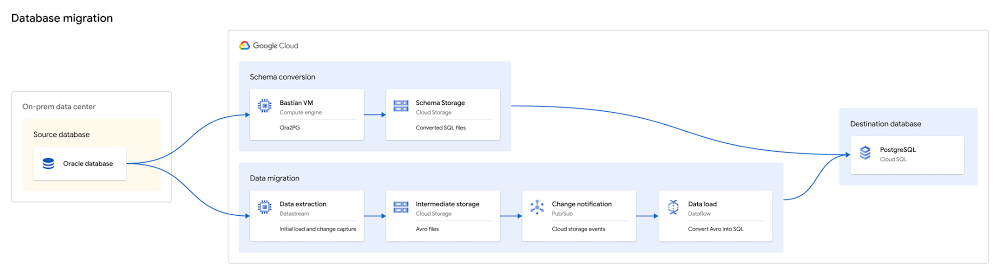
One of the biggest obstacles faced by enterprises pursuing digital transformation is the challenge of migrating off of legacy databases. These databases are typically locked into on-premises data centers, expensive to upgrade and difficult to maintain. We want to make it easier. To that end, we’ve built an open source toolkit that can help you migrate Oracle databases into Cloud SQL for PostgreSQL, and do so with minimal downtime and friction.Click to enlargeThe Oracle to Postgres toolkit uses a mix of existing open source and Google Cloud services, and our own Google-built tooling to support the process of converting schema, setting up low-latency, ongoing data replication, and finally performing migration validation from Oracle to Cloud SQL for PostgreSQL.Migrations are a multi-step process, and can be complex and iterative. We have worked to simplify them, and created a detailed process with stages that are well-documented and easy to run.The stages of a database migration typically include:Deploying and preparing resources, where required resources are deployed and the docker images are built that will be used during the subsequent stages.Converting the schema with Ora2Pg, which is often an iterative process of converting, rebuilding, reviewing, and revising the schema until it aligns with your needs.Continuously migrating the data, which leverages Datastream and Dataflow.Datastream ingests the data from Oracle by reading the log using LogMiner, then stages the data in Google Cloud Storage. As new files are written, a Pub/Sub notification is emitted, and the files are picked up by Dataflow using a custom template to load the data into Cloud SQL for PostgreSQL. This allows you to migrate your data in a consistent fashion using CDC for low downtime.Validating the data migration, which can be used to ensure all data was migrated correctly and it is safe to begin using the destination database. It can also be used to ensure downstream objects (like views or PL/SQL) have been translated correctly.Cutting over to use PostgreSQL, where the application switches from reading Oracle to Postgres.Following these steps will help to ensure a reliable migration with minimal business impact.Since the process of migration tends to be iterative, try migrating a single table or single schema in a test environment before approaching production. You can also use the toolkit to migrate partial databases. For instance, you can migrate one specific application’s schema, while leaving the remainder of your application in Oracle.This post will walk you through each stage in more detail, outlining the process and considerations we recommend for the best results.Deploying and Preparing ResourcesInstalling the Oracle to Postgres toolkit requires a VM with Docker installed. The VM will be used as a bastion and will require access to the Oracle and PostgreSQL databases. This bastion will be used to deploy resources, run Ora2Pg, and run data validation queries.The toolkit will deploy a number of resources used in the migration process. It will also build several Docker images which are used to run Dataflow, Datastream, Ora2Pg, and Data Validation.The Google Cloud resources which are deployed initially are:Any required APIs for Datastream, Dataflow, Cloud Storage, and Pub/Sub which are currently disabled are enabledA Cloud SQL for PostgreSQL destination instanceA Cloud Storage bucket to stage the data as it is transferred between Datastream and DataflowA Pub/Sub topic and subscription setup with Cloud Storage notifications to notify on the availability new filesThe migration preparation steps are:Docker images are built forOra2PgData validationDatastream managementConnectivity is tested to both the Oracle DB and the Cloud SQL for PostgreSQL instanceBefore you begin, ensure that the database you’d like to migrate is compatible with the usage of Datastream. Converting schemas with Ora2Pg Migrating your schema can be a complex process and may sometimes involve manual adjustment to fix issues originating from usage of non-standard Oracle features. Since the process is often iterative, we have divided this into two stages, one to build the desired PostgreSQL schema and a second to apply the schema.The toolkit defines a base Ora2pg configuration file which you may wish to build on. The features selected by default align with the data migration template as well, particularly regarding the use of Oracle’s ROWID feature to reliably replicate tables to PostgreSQL, and the default naming conventions from Ora2Pg (that is, changing all names to lowercase). These options should not be adjusted if you intend to use the Data Migration Dataflow template, as it assumes they have been used.The Oracle ROWID feature, which maintains a consistent and unique identifier per row, is used in the migration as a default replacement for primary keys, in the event that the table does not have a primary key. This is required for data migration using the toolkit, though the field can be removed after the migration is finished if the field is not required by the application. The design converts an Oracle ROWID value into an integer, and then the column is defined as a sequence in PostgreSQL. This allows you to continue to use the original ROWID field as a primary key in PostgreSQL even after the migration is complete.The final stage of the Ora2Pg template applies the desired SQL files which were built in the previous step to PostgresQL. To run this multiple times as you iterate, make sure to clear previous schema iterations from PostgreSQL before re-applying. Since the goal of the migration toolkit is to support migration of Oracle tables and data to PostgreSQL, it does not convert or create all Oracle objects by default. However, Ora2Pg does support a much broader set of object conversions. In the event that you’d like to convert additional objects beyond tables and their data, the docker image can be used to convert any Ora2Pg supported types; however, this is likely to require varying degrees of manual fixes depending on the complexity of your Oracle database. Please refer to the Ora2Pg documentation for support in these steps.Continuously migrating the dataThe data migration phase will require deploying two resources for replication, Datastream and Dataflow. A Datastream stream that pulls the desired data from Oracle is created, and the initial table snapshots (“backfills”) will begin replicating as soon as the stream is started. This will load all the data into Cloud Storage, then leveragingDataflow and the Oracle to PostgreSQL template to replicate from Cloud Storage into PostgreSQL.Datastream utilizes LogMiner for CDC replication of all changes for the selected tables from Oracle, and aligns backfills and ongoing changes automatically. The advantage of the fact that this pipeline buffers data in Cloud Storage is that it allows for easy redeployment in the event that you’d like to re-run the migration, if, say, a PostgreSQL schema changes, without requiring you to re-run backfills against Oracle.The Dataflow job is customized with a pre-built, Datastream-aware template to ensure consistent, low-latency replication between Oracle and Cloud SQL for PostgreSQL. The template uses Dataflow’s stateful API to track and consistently enforce order at a primary key granularity. As mentioned above, this leverages the Oracle ROWID for tables which do not have a primary key, for reliable replication of all desired tables. This ensures the template can scale to any desired number of PostgreSQL writers, to maintain low latency replication at scale, without losing consistent order. During the initial replication (“backfill”), it’s a best-practice to monitor and consider scaling up PostgreSQL resources if replication speeds are running slower than expected, as this phase in the pipeline has the greatest likelihood of being a bottleneck. Replication speeds can be verified using the events per second metric in the Dataflow job.Note that DDL changes on the source are not supported during migration runtime, so ensure your source schema can be stable for the duration of the migration run.Validating the data migrationDue to the inherent complexity of heterogeneous migrations, it is highly recommended to use the data validation portion of the toolkit as you prepare to complete the migration. This is to ensure that the data was replicated reliably across all tables, that the PostgreSQL instance is in a good state and ready for cutover, and to validate complex views or PL/SQL logic in the event that you used Ora2Pg to migrate additional Oracle objects beyond tables (though outside the scope of this post).We provide validation tooling which is created from the latest version of our open source Data Validator. The tool allows you to run a variety of high-value validations, including schema (column type matching), row count, and more complex aggregations.After Datastream reports that backfills are complete, an initial validation can ensure that tables look correct and that no errors which resulted in data gaps have occurred. Later in the migration process, you can build filtered validations or validate a specific subset of data for pre-cutover validation. Note that since this type of validation is run once you’ve stopped replicating from source to destination, it’s important that it runs faster than the backfill validation to minimize downtime. For this reason, it gives a variety of options to filter or limit the number of tables validated to run more quickly while still giving high confidence of the integrity of the migration.If you’ve re-written PL/SQL as part of your migration, we encourage more complex validation usage. For example, using `–sum “*”` in a validation will ensure that the values in all numeric columns add up to the same value. You can also group on a key (like a date/timestamp column) to validate slices of the tables. These will help ensure the table is not just valid, but is also accurate after SQL conversion occurs.Cutting over to use PostgreSQLThe final step in the migration is the cutover stage, when your application begins to use the destination Cloud SQL for PostgreSQL instance as its system of record. Since the time of cutover is preceded by database downtime, this should be scheduled in advance if it can cause a business disruption. As part of the process of preparing for cutover, it’s a best practice to validate that your application has been updated to be able to read from and write to PostgreSQL, and the user has all the permissions required before the final cutover occurs.The process of cutover is:Check if there are any open transactions on Oracle and ensure that the replication lag is minimal When there are no outstanding transactions, stop writes to the Oracle database – downtime beginsEnsure all outstanding changes are applied to the Cloud SQL for PostgreSQL instanceRun any final validations with the Data ValidatorPoint the application at the PostgreSQL instanceAs mentioned above, running final validations will add downtime, but is recommended as a way to ensure a smooth migration. Preparing Data Validations beforehand and timing their execution accordingly will allow you to balance downtime with confidence in the migration result.Get started todayYou can get started today with migrating your Oracle databases to Cloud SQL for PostgreSQL with the Oracle to PostgreSQL toolkit. You can find much more detail on running the toolkit in the Oracle to PostgreSQL Tutorial, or in our Oracle to PostgreSQL Toolkit repository.
Quelle: Google Cloud Platform
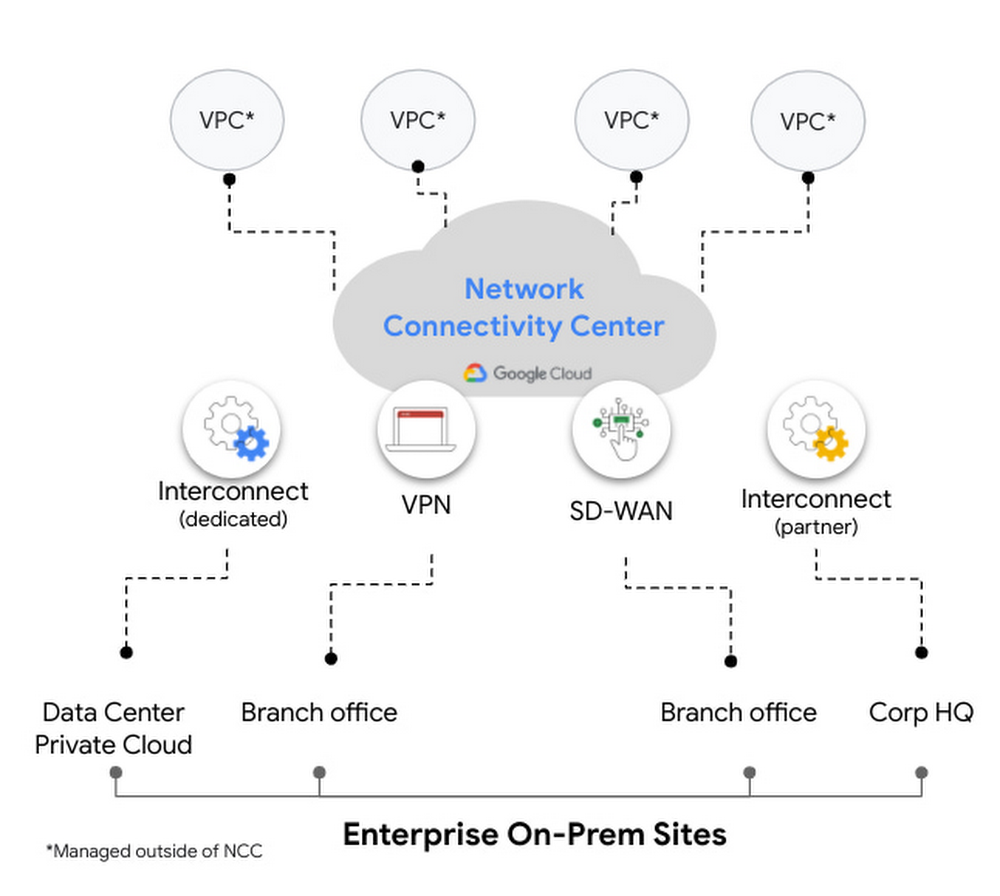
Last month, we announced the preview launch of Network Connectivity Center, a new solution designed to simplify on-prem and cloud connectivity to Google Cloud. Today, we are excited to announce integrations with Fortinet, Palo Alto Networks, Versa Networks and VMware, allowing enterprises to embrace the power of automation and simplify their networking deployments even further. Network Connectivity Center lets administrators to easily create, manage and connect heterogeneous on-premises and cloud networks to Google Cloud resources such as VPCs, which leverage Google’s global network infrastructure. The solution provides a centralized management model that allows connectivity between on-prem locations and to application workloads in Google Cloud via multiple hybrid connectivity types such as Cloud VPN, Cloud Interconnect and third-party router appliances such as SD-WAN VMs or any other type of network virtual appliance. Network Connectivity Center is a globally available resource that enables global connectivity, allowing third-party virtual appliances to easily connect with VPCs using standard BGP, enabling dynamic route exchange and simplifying the overall network architecture and connectivity model. Network Connectivity Center can also allow dynamic route exchange between customer sites, for site-to-site connectivity.Developing a WAN architecture to connect multiple on-prem locations with each other and to cloud VPCs can be cumbersome. Our partners’ integrations with Network Connectivity Center make for a more unified customer experience, reducing the operational overhead of manually deploying various resources with automated workflows. Read on for more details about these integrations from Fortinet, Palo Alto Networks, Versa Networks and VMware:Fortinet Fortinet Secure SD-WAN and Adaptive Cloud Security empowers organizations to secure any application on any cloud and to deliver applications with a seamless, secure, and superior quality of experience (QoE) to its users. Fortinet’s FortiGate Secure SD-WAN integration with Google Cloud Network Connectivity Center allows customers to more effectively interconnect applications and workloads running on Google Cloud for hybrid cloud and multi cloud deployments. The result is an even more simplified, automated, and operationally efficient cloud on-ramp experience—all with the industry-best security intelligence and protection from FortiGuard Labs. More here. Palo Alto NetworksPalo Alto Networks Prisma SD-WAN is one of the industry’s first next-generation SD-WAN that is application-defined, autonomous, and cloud-delivered. With the integration of Prisma SD-WAN, organizations can seamlessly connect branches including remote offices, small sites, and large corporate offices to multi-cloud. This turnkey integration expands our strategic partnership, allowing organizations to simplify and further automate branch-to-cloud connectivity with our unique API-based CloudBlades platform without any service disruptions. In addition, organizations can gain deep application intelligence and visibility while extending Prisma Access capabilities, our cloud-delivered security platform, to Google Cloud and ensure security and optimal branch-to-branch connectivity. Together, Prisma SD-WAN combined with Prisma Access that leverages Google Cloud becomes one of the industry’s most comprehensive SASE solutions. More here.Palo Alto Networks VM-Series Virtual Next-Generation Firewalls integrate with Network Connectivity Center to deliver streamlined connectivity with best-in-class enterprise security. With Network Connectivity Center, VM-Series firewalls can be deployed to provide horizontal scale, cross-region redundancy, and active-active high availability with session synchronization. More here.Versa NetworksIntegrating Network Connectivity Center with Versa Secure SD-WAN from Versa SASE delivers reliable, enterprise-grade connectivity for branch users to on-prem and cloud workloads. Versa Secure SD-WAN provides network SLA monitoring, Deep Packet Inspection, video and voice performance analytics, and Forward Error Correction to overcome underperforming links and deliver an optimal and consistent user experience.By deploying Versa Secure SD-WAN with Network Connectivity Center, customers can achieve reliable end-to-end connectivity—from users located in branch and remote locations to the on-prem and cloud applications. The Versa Secure SD-WAN solution offers end-to-end QoS that allows for complete performance visibility across the network, thereby delivering significant savings for an organization’s total consumption costs. More here.VMwareVMware SD-WAN™, a cloud-hosted networking service of VMware SASE, delivers secure, reliable, efficient and agile access when using Google Cloud Network Connectivity Center. This combined solution enables organizations—across all industries and around the globe—to gain simple-to-deploy, high-performance connectivity for branch office locations, data centers, cloud destinations and remote workers. VMware SD-WAN breaks down barriers to workload migration resulting from poor user experience pegged to WAN conditions.By combining the flexibility of SD-WAN and on-demand nature of cloud, enterprises can now more easily access their Google Cloud workloads from their SD-WAN connected sites globally based on business needs in an agile manner via Network Connectivity Center SD-WAN partner integrations. More here. Global connectivity made easyTo learn more about Google Cloud Network Connectivity Center and get started, check out our documentation pages.Related ArticleIntroducing Network Connectivity Center: A revolution in simplifying on-prem and cloud networkingWith Network Connectivity Center, you can connect and manage VPNs, interconnects, third-party routers and SD-WAN across on-prem and cloud…Read Article
Quelle: Google Cloud Platform






