Künstliche Intelligenz: Anthropic-Chef warnt vor Risiken durch Superintelligenz
In einem Essay warnt Anthropic-CEO Dario Amodei vor existenziellen Risiken durch KI – und setzt gleichzeitig auf neue Sicherheitsstandards. (KI, Software)
Quelle: Golem

In einem Essay warnt Anthropic-CEO Dario Amodei vor existenziellen Risiken durch KI – und setzt gleichzeitig auf neue Sicherheitsstandards. (KI, Software)
Quelle: Golem

Eine gefährliche Sicherheitslücke betrifft alle gängigen Office-Versionen. Angesichts der aktiven Ausnutzung sollten Anwender zügig patchen. (Sicherheitslücke, Microsoft)
Quelle: Golem

Das US-Verkehrsministerium nutzt Google Gemini zum Entwurf von Sicherheitsregeln. Das Ziel: Schnelligkeit statt höchster Präzision. (Politik, Donald Trump)
Quelle: Golem

Kaitlyn Dever bereitet sich auf die Dreharbeiten zu Staffel 3 vor. Die neue Staffel rückt Abby in den Mittelpunkt. (The Last of Us, Spiele)
Quelle: Golem

Meta wird verschiedene Abomodelle für seine Apps testen. Facebook, Instagram und Whatsapp sollen so mehr KI-Funktionen erhalten. (Meta, Soziales Netz)
Quelle: Golem
We recently showed how to pair OpenCode with Docker Model Runner for a privacy-first, cost-effective AI coding setup. Today, we’re bringing the same approach to Claude Code, Anthropic’s agentic coding tool.
This post walks through how to configure Claude Code to use Docker Model Runner, giving you full control over your data, infrastructure, and spend.
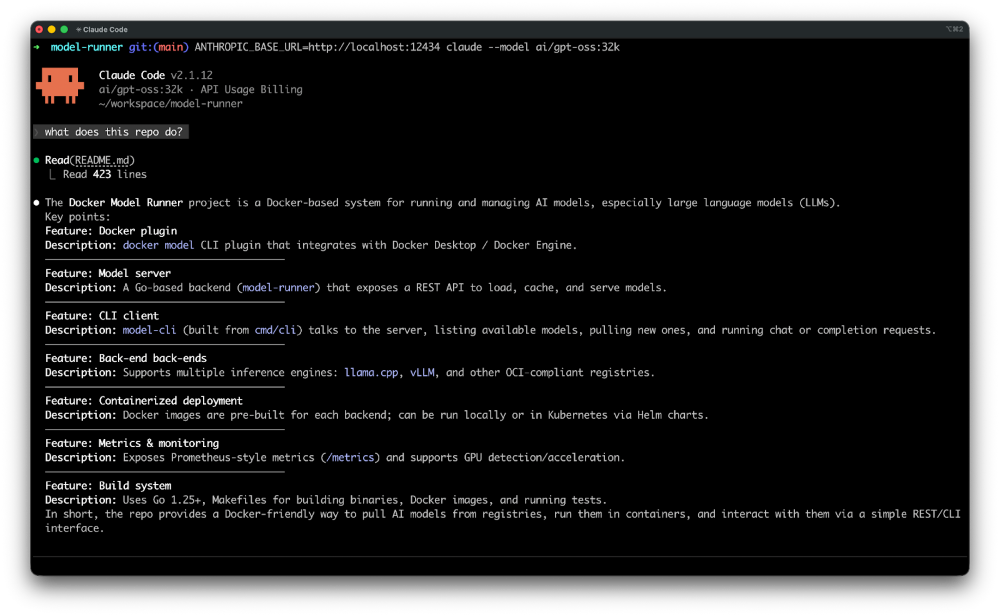
Figure 1: Using local models like gpt-oss to power Claude Code
What Is Claude Code?
Claude Code is Anthropic’s command-line tool for agentic coding. It lives in your terminal, understands your codebase, and helps you code faster by executing routine tasks, explaining complex code, and handling git workflows through natural language commands.
Docker Model Runner (DMR) allows you to run and manage large language models locally. It exposes an Anthropic-compatible API, making it straightforward to integrate with tools like Claude Code.
Install Claude Code
Install Claude Code:macOS / Linux:
curl -fsSL https://claude.ai/install.sh | bash
Windows PowerShell:
irm https://claude.ai/install.ps1 | iex
Using Claude Code with Docker Model Runner
Claude Code supports custom API endpoints through the ANTHROPIC_BASE_URL environment variable. Since Docker Model Runner exposes an Anthropic-compatible API, integrating the two is simple.
Note for Docker Desktop users:If you are running Docker Model Runner via Docker Desktop, make sure TCP access is enabled:
docker desktop enable model-runner –tcp
Once enabled, Docker Model Runner will be accessible at http://localhost:12434.
Increasing Context Size
For coding tasks, context length matters. While models like glm-4.7-flash, qwen3-coder and devstral-small-2 come with 128K context by default, gpt-oss defaults to 4,096 tokens.
Docker Model Runner makes it easy to repackage any model with an increased context size:
docker model pull gpt-oss
docker model package –from gpt-oss –context-size 32000 gpt-oss:32k
Once packaged, use it with Claude Code:
ANTHROPIC_BASE_URL=http://localhost:12434 claude –model gpt-oss:32k
ANTHROPIC_BASE_URL=http://localhost:12434 claude –model gpt-oss "Describe this repo."
That’s it. Claude Code will now send all requests to your local Docker Model Runner instance.
Run Claude Code locally with gpt-oss using Docker Model Runner
Here’s what it looks like in action:
Figure 2: Claude Code powered by Docker Model Runner keeps everything local and in your control
$ docker model pull gpt-oss
$ docker model package –from gpt-oss –context-size 32000 gpt-oss:32k
$ ANTHROPIC_BASE_URL=http://localhost:12434 claude –model gpt-oss:32k "Describe this repo."
▐▛███▜▌ Claude Code v2.1.12
▝▜█████▛▘ gpt-oss:32k · API Usage Billing
▘▘ ▝▝ ~/workspace/model-runner
❯ Describe this repo.
Read(README.md)
⎿ Read 423 lines
Docker Model Runner (DMR)
– A Go-based tool that lets developers pull, run, and serve AI models
directly from Docker Hub or any OCI-compatible registry.
– Consists of two main components:
a. model-runner – a server/daemon that manages model lifecycle,
inference, and metrics.
b. model-cli – a CLI plugin (docker model) that communicates with
the server, listing models, pulling new ones, and executing inference.
– Supports multiple inference backends: llama.cpp, vLLM, and others.
– Built with Docker Desktop in mind, but also works with Docker Engine
on Linux.
– Provides a REST API for model management and inference, plus a
/metrics endpoint for Prometheus-style monitoring.
Claude Code reads your repository, reasons about its structure, and provides an accurate summary, all while keeping your code entirely on your local machine.
Monitor the requests sent by Claude Code
Want to see exactly what Claude Code sends to Docker Model Runner? Use the docker model requests command:
docker model requests –model gpt-oss:32k | jq .
Figure 3: Monitor requests sent by Claude Code to the LLM
This outputs the raw requests, which is useful for understanding how Claude Code communicates with the model and debugging any compatibility issues.
Making It PersistentFor convenience, set the environment variable in your shell profile:
# Add to ~/.bashrc, ~/.zshrc, or equivalent
export ANTHROPIC_BASE_URL=http://localhost:12434
Then simply run:
claude –model gpt-oss:32k "Describe this repo."
How You Can Get Involved
The strength of Docker Model Runner lies in its community, and there’s always room to grow. To get involved:
Star the repository: Show your support by starring the Docker Model Runner repo.
Contribute your ideas: Create an issue or submit a pull request. We’re excited to see what ideas you have!
Spread the word: Tell your friends and colleagues who might be interested in running AI models with Docker.
We’re incredibly excited about this new chapter for Docker Model Runner, and we can’t wait to see what we can build together. Let’s get to work!
Learn More
Read the companion post: OpenCode with Docker Model Runner for Private AI Coding
Check out the Docker Model Runner General Availability announcement
Visit our Model Runner GitHub repo
Get started with a simple hello GenAI application
Learn more about Claude Code from Anthropic’s documentation
Quelle: https://blog.docker.com/feed/
AWS is announcing flexible billing for Amazon WorkSpaces Core managed instances, adding monthly flat-rate pricing alongside existing hourly billing. Customers can now choose the optimal pricing model based on their end user usage patterns. Monthly billing is ideal for predictable full-time desktops and hourly billing is ideal for variable usage patterns. Both options are pay-as-you-go with no long-term commitments. Amazon WorkSpaces Core managed instances simplifies virtual desktop infrastructure (VDI) migrations with highly customizable instance configurations. WorkSpaces Core managed instances provisions resources in your AWS account, handling infrastructure lifecycle management for both persistent and non-persistent workloads. Monthly pricing delivers savings vs hourly billing at always-on utilization, optimized for real-world VDI use cases. With flexible billing, customers benefit from predictable costs for persistent desktop workloads and the flexibility to mix hourly and monthly billing within the same deployment. VDI partners utilizing WorkSpaces Core managed instances including Citrix, Workspot, Dizzion, and Leostream can now integrate with new WorkSpaces API billing features to enable the monthly billing option when instances are created. Hourly billing remains the default billing option for managed instances. In addition, starting today, hourly utility rates for WorkSpaces Core managed instances will now be combined and billed by Amazon WorkSpaces to simplify pricing. Previously, hourly rates were split between Amazon EC2 and Amazon WorkSpaces on customer bills. There is no change to the effective rates for on-demand hourly usage of WorkSpaces Core Managed Instances with this announcement. To learn more about Amazon WorkSpaces Core managed instances flexible billing, visit the WorkSpaces for VDI partners pricing page. For more information, see the WorkSpaces for VDI partners product page. For technical documentation, see the Amazon WorkSpaces Core Documentation.
Quelle: aws.amazon.com

Die AfD fordert für Behörden eine Kaufverpflichtung für Autos aus baden-württembergischer Produktion. Ökonomen halten dies für gefährlich. (Auto, Elektroauto)
Quelle: Golem

Bei Amazon gibt es derzeit eine interessante Starthilfe-Powerbank zum Sonderpreis im Angebot. Sie kostet keine 40 Euro. (Technik/Hardware, Amazon)
Quelle: Golem

Die Softshelljacke von 33,000ft ist wasserdicht, winddicht und atmungsaktiv und eignet sich als leichte Übergangsjacke. (Technik/Hardware)
Quelle: Golem






