Bill Nelson: Nasa-Chef warnt vor chinesischem Weltraumprogramm
Gibt es Streit um den Mond? Nasa-Chef Bill Nelson fürchtet, dass China den Trabanten als militärischen Außenposten für sich haben möchte. (Nasa, Raumfahrt)
Quelle: Golem

Gibt es Streit um den Mond? Nasa-Chef Bill Nelson fürchtet, dass China den Trabanten als militärischen Außenposten für sich haben möchte. (Nasa, Raumfahrt)
Quelle: Golem

Ouca Bikes hat ein elektrisches Lastenrad vorgestellt, das eine Zuladung von rund 250 kg transportieren kann. Das E-Bike fährt auf drei Rädern. (E-Bike, Technologie)
Quelle: Golem

Die Gamesbranche wehrt sich bislang vehement gegen jedes neue Blockchain-Projekt. Manager und Entwickler erklären warum. Von Daniel Ziegener (Spiele-Entwicklung, Steam)
Quelle: Golem

Der M2-Chip im Test und Neues von Sony und VW: die Woche im Video. (Golem-Wochenrückblick, Games)
Quelle: Golem
When you deploy an application on Kubernetes, it runs as a service account — a system user understood by the Kubernetes control plane. The service account is the basic tool for configuring what an application is allowed to do, analogous to the concept of an operating system user on a single machine. Within a Kubernetes cluster, you can use role-based access control to configure what a service account is allowed to do (“list pods in all namespaces”, “read secrets in namespace foo”). When running on Google Kubernetes Engine (GKE), you can also use GKE Workload Identity and Cloud IAM to grant service accounts access to GCP resources (“read all objects in Cloud Storage bucket bar”).How does this work? How does the Kubernetes API, or Cloud Storage know that an HTTP request is coming from your application, and not Bob’s? It’s all about tokens: Kubernetes service account tokens, to be specific. When your application uses a Kubernetes client library to make a call to the Kubernetes API, it attaches a token in the Authorization header, which the server then validates to check your application’s identity.How does your application get this token, and how does the authentication process work? Let’s dive in and take a closer look at this process, at some changes that arrived in Kubernetes 1.21 that will enhance Kubernetes authentication, and how to modify your applications to take advantage of the security capabilities.Legacy tokens: Kubernetes 1.20 and belowLet’s spin up a pod and poke around. If you’re following along, make sure that you are doing this on a 1.20 (or lower) cluster.code_block[StructValue([(u’code’, u'(dev) $ kubectl apply -f – <<EOFrnapiVersion: v1rnkind: Podrnmetadata:rn name: basic-debian-podrn namespace: defaultrnspec:rn serviceAccountName: defaultrn containers:rn – image: debianrn name: mainrn command: [“sleep”, “infinity”]rnEOFrnrn(dev) $ kubectl exec -ti basic-debian-pod — /bin/bashrnrn(pod) $ ls /var/run/secrets/kubernetes.io/serviceaccountrnca.crtrnnamespacerntoken’), (u’language’, u”), (u’caption’, <wagtail.wagtailcore.rich_text.RichText object at 0x3ed5e9ba4790>)])]What are these files? Where did they come from? They certainly don’t seem like something that ships in the Debian base image:ca.crt is the trust anchor needed to validate the certificate presented by the Kubernetes API Server in this cluster. Typically, it will contain a single, PEM-encoded certificate.namespace contains the namespace that the pod is running in — in our case, default.token contains the service account token — a bearer token that you can attach to API requests. Eagle-eyed readers may notice that it has the tell-tale structure of a JSON Web Token (JWT): <base64>.<base64>.<base64>.An aside for security hygiene: Do not post these tokens anywhere. They are bearer tokens, which means that anyone who holds the token has the power to authenticate as your application’s service account.To figure out where these files come from, we can inspect our pod object as it exists on the API server:code_block[StructValue([(u’code’, u'(dev) $ kubectl get pods basic-debian-pod -o yamlrnapiVersion: v1rnkind: Podrnmetadata:rn name: basic-debian-podrn namespace: defaultrn # Lots of stuff omitted hereu2026rnspec:rn serviceAccountName: defaultrn containers:rn – image: debianrn name: mainrn command:rn – sleeprn – infinityrn volumeMounts:rn – mountPath: /var/run/secrets/kubernetes.io/serviceaccountrn name: default-token-g9gggrn readOnly: truern # Lots of stuff omitted hereu2026rn volumes:rn – name: default-token-g9gggrn secret:rn – defaultMode: 420rn secretName: default-token-g9gggrn # Lots of stuff omitted hereu2026′), (u’language’, u”), (u’caption’, <wagtail.wagtailcore.rich_text.RichText object at 0x3ed5e9ba4250>)])]The API server has added… a lot of stuff. But the relevant portion for us is:When the pod was scheduled, an admission controller injected a secret volume into each container in our pod.The secret contains keys and data for each file we saw inside the pod.Let’s take a closer look at the token. Here’s a real example, from a cluster that no longer exists.code_block[StructValue([(u’code’, u’eyJhbGciOiJSUzI1NiIsImtpZCI6ImtUMHZXUGVVM1dXWEV6d09tTEpieE5iMmZrdm1KZkZBSkFMeXNHQXVFNm8ifQ.eyJpc3MiOiJrdWJlcm5ldGVzL3NlcnZpY2VhY2NvdW50Iiwia3ViZXJuZXRlcy5pby9zZXJ2aWNlYWNjb3VudC9uYW1lc3BhY2UiOiJkZWZhdWx0Iiwia3ViZXJuZXRlcy5pby9zZXJ2aWNlYWNjb3VudC9zZWNyZXQubmFtZSI6ImRlZmF1bHQtdG9rZW4tZzlnZ2ciLCJrdWJlcm5ldGVzLmlvL3NlcnZpY2VhY2NvdW50L3NlcnZpY2UtYWNjb3VudC5uYW1lIjoiZGVmYXVsdCIsImt1YmVybmV0ZXMuaW8vc2VydmljZWFjY291bnQvc2VydmljZS1hY2NvdW50LnVpZCI6ImFiNzFmMmIwLWFiY2EtNGJjNy05MDVhLWNjOWIyZDY4MzJjZiIsInN1YiI6InN5c3RlbTpzZXJ2aWNlYWNjb3VudDpkZWZhdWx0OmRlZmF1bHQifQ.UiLY98ETEp5-JmpgxaJyyZcTvw8AkoGvqhifgGJCFC0pJHySDOp9Zoq-ShnFMOA2R__MYbkeS0duCx-hxDu8HIbZfhyFME15yrSvMHZWNUqJ9SKMlHrCLT3JjLBqX4RPHt-K_83fJfp4Qn2E4DtY6CYnsGUbcNUZzXlN7_uxr9o0C2u15X9QAATkZL2tSwAuPJFcuzLWHCPjIgtDmXczRZ72tD-wXM0OK9ElmQAVJCYQlAMGJHMxqfjUQoz3mbHYfOQseMg5TnEflWvctC-TJd0UBmZVKD-F71x_4psS2zMjJ2eVirLPEhmlh3l4jOxb7RNnP2N_EvVVLmfA9YZE5A’), (u’language’, u”), (u’caption’, <wagtail.wagtailcore.rich_text.RichText object at 0x3ed5d1fd6dd0>)])]As mentioned earlier, this is a JWT. If we pop it in to our favorite JWT inspector, we can see that the token has the following claims:code_block[StructValue([(u’code’, u'{rn “iss”: “kubernetes/serviceaccount”,rn “kubernetes.io/serviceaccount/namespace”: “default”,rn “kubernetes.io/serviceaccount/secret.name”: “default-token-g9ggg”,rn “kubernetes.io/serviceaccount/service-account.name”: “default”,rn “kubernetes.io/serviceaccount/service-account.uid”: “ab71f2b0-abca-4bc7-905a-cc9b2d6832cf”,rn “sub”: “system:serviceaccount:default:default”rn}’), (u’language’, u”), (u’caption’, <wagtail.wagtailcore.rich_text.RichText object at 0x3ed5d1fd6310>)])]Breaking them down:iss (“issuer”) is a standard JWT claim, meant to identify the party that issued the JWT. In Kubernetes legacy tokens, it’s always hardcoded to the string “kubernetes/serviceaccount”, which is technically compliant with the definition in the RFC, but not particularly useful.sub (“subject”) is a standard JWT claim that identifies the subject of the token (your service account, in this case). It’s the standard string representation of your service account name (the one also used when referring to the serviceaccount in RBAC rules): system:serviceaccount:<namespace>:<name>. Note that this is technically not compliant with the definition in the RFC, since this is neither globally unique, nor is it unique in the scope of the issuer; two service accounts with the same namespace and name but from two unrelated clusters will have the same issuer and subject claims. This isn’t a big problem in practice, though.kubernetes.io/serviceaccount/namespace is a Kubernetes-specific claim; it contains the namespace of the serviceaccount.kubernetes.io/serviceaccount/secret.name is a Kubernetes-specific claim; it names the Kubernetes secret that holds the token.kubernetes.io/serviceaccount/service-account.name is a Kubernetes-specific claim; it names the service account.kubernetes.io/serviceaccount/service-account.uid is a Kubernetes-specific claim; it contains the UID of the service account. This claim allows someone verifying the token to notice that a service account was deleted and then recreated with the same name. This can sometimes be important.When your application talks to the API server in its cluster, the Kubernetes client library loads this JWT from the container filesystem and sends it in the Authorization header of all API requests. The API Server then validates the JWT signature and uses the token’s claims to determine your application’s identity.This also works for authenticating to other services. For example, a common pattern is to configure Hashicorp Vault to be able to authenticate callers using service account tokens from your cluster. To make the task of the relying party (the service seeking to authenticate you) easier, Kubernetes provides the TokenReview API; the relying party just needs to call TokenReview, passing the token you provided. The return value indicates whether or not the token was valid; if so, it also contains the username of your serviceaccount (again, in the form system:serviceaccount:<namespace>:<name>).Great. So what’s the catch? Why did I ominously title this section “legacy” tokens? Legacy tokens have downsides:Legacy tokens don’t expire. If one gets stolen, or logged to a file, or committed to Github, or frozen in an unencrypted backup, it remains dangerous until the end of time (or the end of your cluster).Legacy tokens have no concept of an audience. If your application passes a token to service A, then service A can just forward the token to service B and pretend to be your application. Even if you trust service A to be trustworthy and competent today, because of point 1, the tokens you pass to service A are dangerous forever. If you ever stop trusting service A, you have no practical recourse but to rotate the root of trust for your cluster.Legacy tokens are distributed via Kubernetes secret objects, which tend not to be very strictly access-controlled, and means that they usually aren’t encrypted at rest or in backups.Legacy tokens require extra effort for third-party services to integrate with; they generally need to explicitly build support for Kubernetes because of the custom token claims and the need to validate the token with the TokenReview API.These issues motivated the design of Kubernetes’ new token format called bound service account tokens.Bound tokens: Kubernetes 1.21 and upLaunched in Kubernetes 1.13, and becoming the default format in 1.21, bound tokens address all of the limited functionality of legacy tokens, and more:The tokens themselves are much harder to steal and misuse; they are time-bound, audience-bound, and object-bound.They adopt a standardized format: OpenID Connect (OIDC), with full OIDC Discovery, making it easier for service providers to accept them.They are distributed to pods more securely, using a new Kubelet projected volume type.Let’s explore each of these properties in turn.We’ll repeat our earlier exercise and dissect a bound token. It’s still a JWT, but the structure of the claims has changed:code_block[StructValue([(u’code’, u'{rn “aud”: [rn “foobar.com”rn ],rn “exp”: 1636151360,rn “iat”: 1636147760,rn “iss”: “https://container.googleapis.com/v1/projects/taahm-gke-dev/locations/us-central1-c/clusters/mesh-certs-test2″,rn “kubernetes.io”: {rn “namespace”: “default”,rn “pod”: {rn “name”: “basic-debian-pod-bound-token”,rn “uid”: “a593ded9-c93d-4ccf-b43f-bf33d2eb7635″rn },rn “serviceaccount”: {rn “name”: “default”,rn “uid”: “ab71f2b0-abca-4bc7-905a-cc9b2d6832cf”rn }rn },rn “nbf”: 1636147760,rn “sub”: “system:serviceaccount:default:default”rn}’), (u’language’, u”), (u’caption’, <wagtail.wagtailcore.rich_text.RichText object at 0x3ed5d1fd6650>)])]Time-binding is implemented by the exp (“expiration”), iat (“issued at”), and nbf (“not before”) claims; these are standardized JWT claims. Any external service can use its own clock to evaluate these fields and reject tokens that have expired. Unless otherwise specified, bound tokens default to a one-hour lifetime. The Kubernetes TokenReview API automatically checks if a token is expired before deciding that it is valid.Audience binding is implemented by the aud (“audience”) claim; again, a standardized JWT claim. An audience strongly associates the token with a particular relying party. For example, if you send service A a token that is audience-bound to the string “service A”, A can no longer forward the token to service B to impersonate you. If it tries, service B will reject the token because it expects an audience of “service B”. The Kubernetes TokenReview API allows services to specify the audiences they accept when validating a token.Object binding is implemented by the kubernetes.io group of claims. The legacy token only contained information about the service account, but the bound token contains information about the pod the token was issued to. In this case, we say that the token is bound to the pod (tokens can also be bound to secrets). The token will only be considered valid if the pod is still present and running according to the Kubernetes API server — sort of like a supercharged version of the expiration claim. This type of binding is more difficult for external services to check, since they don’t have (and you don’t want them to have) the level of access to your cluster necessary to check the condition. Fortunately, the Kubernetes TokenReview API also verifies these claims.Bound service account tokens are valid OpenID Connect (OIDC) identity tokens. This has a number of implications, but the most consequential can be seen in the value of the iss (“issuer”) claim. Not all implementations of Kubernetes surface this claim, but for those that do (including GKE), it points to a valid OIDC Discovery endpoint for the tokens issued by the cluster. The upshot of this is that the external services do not need to be Kubernetes-aware in order to authenticate clients using Kubernetes service accounts; they only need to support OIDC and OIDC Discovery. As an example of this type of integration, the OIDC Discovery endpoints underlie GKE Workload Identity, which integrates the Kubernetes and GCP identity systems.As a final improvement, bound service account tokens are deployed to pods in a more scalable and secure way. Whereas legacy tokens are generated once per service account, stored in a secret, and mounted into pods via a secret volume, bound tokens are generated on-the-fly for each pod, and injected into pods using the new Kubelet serviceAccountToken volume type. To access them, you add the volume spec to your pod and mount it into the containers that need the token.code_block[StructValue([(u’code’, u'(dev) $ kubectl apply -f – <<EOFrnapiVersion: v1rnkind: Podrnmetadata:rn name: basic-debian-pod-bound-tokenrn namespace: defaultrnspec:rn serviceAccountName: defaultrn containers:rn – image: debianrn name: mainrn command: [“sleep”, “infinity”]rn volumeMounts:rn – name: my-bound-tokenrn mountPath: /var/run/secrets/my-bound-tokenrn volumes:rn – name: my-bound-tokenrn projected:rn sources:rn – serviceAccountToken:rn path: tokenrn audience: foobar.comrn expirationSeconds: 3600rnEOF’), (u’language’, u”), (u’caption’, <wagtail.wagtailcore.rich_text.RichText object at 0x3ed5d1fd6e90>)])]Note that we have to choose an audience for the token up front, and that we also have control over the token’s validity period. The audience requirement means that it’s fairly common to mount multiple bound tokens into a single pod, one for each external party that the pod will be communicating with.Internally, the serviceAccountToken projected volume is implemented directly in Kubelet (the primary Kubernetes host agent). Kubelet handles communicating with kube-apiserver to request the appropriate bound token before the pod is started, and periodically refreshes the token when its expiry is approaching.To recap, bound tokens are:Significantly more secure than legacy tokens due to time, audience, and object binding, as well as using a more secure distribution mechanism to pods.Easier to iterate with for external parties, due to OIDC compatibility.However, the way you integrate with them has changed. Whereas there was a single legacy token per service account, always accessible at /var/run/secrets/kubernetes.io/serviceaccount/token, each pod may have multiple bound tokens. Because the tokens expire and are refreshed by Kubelet, applications need to periodically reload them from the filesystem.Bound tokens have been available since Kubernetes 1.13, but the default token issued to pods continued to be a legacy token, with all the security downsides that implied. In Kubernetes 1.21, this changes: the default token is a bound service account token. Kubernetes 1.22 finishes off the migration by promoting bound service account tokens by default to GA.In the next sections, we will take a look at what these changes mean for users of Kubernetes service account tokens, first for clients, and then for service providers.Impacts on clientsIn Kubernetes 1.21, the default token available at /var/run/secrets/kubernetes.io/serviceaccount/token is changing from a legacy token to a bound service account token. If you use this token as a client, by sending it as a bearer token to an API, you may need to make changes to your application to keep it working.For clients, there are two primary differences in the new default token:The new default token has a cluster-specific audience that identifies the cluster’s API server. In GKE, this audience is the URL https://container.googleapis.com/v1/projects/PROJECT/locations/LOCATION/clusters/NAME.The new default token expires periodically, and must be refreshed from disk.If you only ever use the default token to communicate with the Kubernetes API server of the cluster your application is deployed in, using up-to-date versions of the official Kubernetes client libraries (for example, using client-go and rest.InClusterConfig), then you do not need to make any changes to your application. The default token will carry an appropriate audience for communicating with the API server, and the client libraries handle automatically refreshing the token from disk.If your application currently uses the default token to authenticate to an external service (common with Hashicorp Vault deployments, for example), you may need to make some changes, depending on the precise nature of the integration between the external service and your cluster.First, if the service requires a unique audience on its access tokens, you will need to mount a dedicated bound token with the correct audience into your pod, and configure your application to use that token when authenticating to the service. Note that the default behavior of the Kubernetes TokenReview API is to accept the default Kubernetes API server audience, so if the external service hasn’t chosen a unique audience, it might still accept the default token. This is not ideal from a security perspective — the purpose of the audience claim is to protect yourself by ensuring that tokens stolen from (or used nefariously by) the external service cannot be used to impersonate your application to other external services.If you do need to mount a token with a dedicated audience, you will need to create a serviceAccountToken projected volume, and mount it to a new path in each container that needs it. Don’t try to replace the default token. Then, update your client code to read the token from the new path.Second, you must ensure that your application periodically reloads the token from disk. It’s sufficient to just poll for changes every five minutes, and update your authentication configuration if the token has changed. Services that provide client libraries might already handle this task in their client libraries.Let’s look at some concrete scenarios:Your application uses an official Kubernetes client library to read and write Kubernetes objects in the local cluster: Ensure that your client libraries are up-to-date. No further changes are required; the default token already carries the correct audience, and the client libraries automatically handle reloading the token from disk.Your application uses Google Cloud client libraries and GKE Workload Identity to call Google Cloud APIs: No changes are required. While Kubernetes service account tokens are required in the background, all of the necessary token exchanges are handled by gke-metadata-server.Your application uses the default Kubernetes service account token to authenticate to Vault: Some changes are required. Vault integrates with your cluster by calling the Kubernetes TokenReview API, but performs an additional check on the issuer claim. By default, Vault expects the legacy token issuer of kubernetes/serviceaccount, and will reject the new default bound token. You will need to update your vault configuration to specify the new issuer. On GKE, the issuer follows the pattern https://container.googleapis.com/v1/projects/PROJECT/locations/LOCATION/clusters/NAME.Currently, Vault does not expect a unique audience on the token, so take care to protect the default token. If it is compromised, it can be used to retrieve your secrets from Vault.Your application uses the default Kubernetes service account token to authenticate to an external service: In general, no immediate changes are required, beyond ensuring that your application periodically reloads the default token from disk. The default behavior of the Kubernetes TokenReview API ensures that authentication keeps working across the transition. Over time, the external service may update to require a unique audience on tokens, which will require you to mount a dedicated bound token as described above.Impacts on servicesServices that authenticate clients using the default service account token will continue to work as clients upgrade their clusters to Kubernetes 1.21, due to the default behavior of the Kubernetes TokenReview API. Your service will begin receiving bound tokens with the default audience, and your TokenReview requests will default to validating the default audience. However, bound tokens open up two new integration options for you.First, you should coordinate with your clients to start requiring a unique audience on the tokens you accept. This benefits both you and your clients by limiting the power of stolen tokens:Your clients no longer need to trust you with a token that can be used to authenticate to arbitrary third parties (for example, their bank or payment gateways).You no longer need to worry about holding these powerful tokens, and potentially being held responsible for breaches. Instead, the tokens you accept can only be used to authenticate to your service.To do this, you should first decide on a globally-unique audience value for your service. If your service is accessible at a particular DNS name, that’s a good choice. Failing that, you can always generate a random UUID and use that. All that matters is that you and your clients agree on the value.Once you have decided on the audience, you need to update your TokenReview calls to begin validating the audience. In order to give your clients time to migrate, you should conduct a phased migration:Update your TokenReview calls to specify both your new audience and the default audience in the spec.audiences list. Remember that the default audience is different for every cluster, so you will either need to obtain it from your client, or guess it based on the kube-apiserver endpoint they provide you. As a reminder, for GKE cluster, the default audience is https://container.googleapis.com/v1/projects/PROJECT/locations/LOCATION/clusters/NAME. At this point, your service will accept both the old and the new audience.Have your clients begin sending tokens with the new audience, by mounting a dedicated bound token into their pods and configuring their client code to use it.Update your TokenReview calls to specify only your new audience in the spec.audiences list.Second, if you have certain requirements, you can consider integrating with Kubernetes using the OpenID Connect Discovery standard. If instances of your service integrate with thousands of individual clusters, need to support high authentication rates, or aim to federate with many non-Kubernetes identity sources, you can consider integrating with Kubernetes using the OpenID Connect Discovery standard, rather than the Kubernetes TokenReview API.This approach has benefits and downsides: The benefits are:You do not need to manage Kubernetes credentials for your service to authenticate to each federated cluster (in general, OpenID Discovery documents are served publicly).Your service will cache the JWT validation keys for federated clusters, allowing you to authenticate clients even if kube-apiserver is down or overloaded in their clusters.This cache also allows your service to handle higher call rates from clients, with lower latency, by taking the federated kube-apiservers off of the critical path for authentication.Supporting OpenID Connect gives you the ability to federate with additional identity providers beyond Kubernetes clusters.The downsides are:You will need to operate a cache for the JWT validation keys for all federated clusters, including proper expiry of cached keys (clusters can change their keys without advance warning).You lose some of the security benefits of the TokenReview API; in particular, you will likely not be able to validate the object binding claims.In general, if the TokenReview API can be made to work for your use case, you should prefer it; it’s much simpler operationally, and sidesteps the deceptively difficult problem of properly acting as an OpenID Connect relying party.Related ArticleHere’s what to know about changes to kubectl authentication coming in GKE v1.25Starting with GKE v1.25, you will need to download and use a new kubectl plugin called “gke-gcloud-auth-plugin” to authenticate to GKERead Article
Quelle: Google Cloud Platform
The new version of the Google logging client library for Go has been released. Version 1.5 adds new features and bug fixes including new structured logging capabilities that complete last year’s effort to enrich structured logging support in Google logging client libraries.Here are few of the new features in v1.5:Faster and more robust way to detect and capture Google Cloud resources that the application is running on.Automatic source location detection to support log observability for debugging and troubleshooting.W3C header traceparent for capturing tracing information within the logged entries.Better control over batched ingestion of the log entries by supporting the partialSuccess flag within Logger instances.Support for out-of-process ingestion with redirection of the logs to stdout and stderr using a structured logging format.Let’s look into each closer:Resource detectionResource detection is an existing feature of the logging library. It detects a resource on which an application is running. Retrieves the resource’s metadata. And implicitly adds this metadata to each log entry the application ingests using the library. It is especially useful for applications that run on Google Cloud since it collects a lot of resource’s attributes from the Metadata server of the resource. These attributes enrich ingested logs with additional information such as a location of the VM, a name of the container or a service Id of the AppEngine service. The below Json shows a sample of the retrieved information after detecting the resource as a GKE container and retrieving resource metadata according to the documentation.code_block[StructValue([(u’code’, u'{rn “type”: “k8s_container”,rn “labels”: {rn “project_id”: “dev-env-060122″,rn “location”: “us-central1-a”,rn “cluster_name”: “dev-test-cluster-47fg”,rn “namespace_name”: “default”,rn “pod_name” : “frontend-4fgd4″,rn “container_name”: “frontend-4fgd4-acgf12a5″rn }rn}’), (u’language’, u”), (u’caption’, <wagtail.wagtailcore.rich_text.RichText object at 0x3e4c9ad10a50>)])]The implementation is optimized to avoid performance degradation during the data collection process. Previously, the heuristic for identifying the resource was heavily based on environment variables which could result in many false positives. Additionally, the implementation performed too many queries to the metadata server which could sometimes cause delayed responses. In the 1.5 release the heuristic was updated to use additional artifacts beside the environment variables in the resource detection logic and the number of the queries to the metadata server was reduced to a bare minimum. As a result, false detection of GCP resources is decreased by an order of magnitude and the performance penalties to run the heuristic in non-GCP resources is decreased as well. The change does not affect the ingestion process and does not require any changes in the application’s code.Source location capturingIt is useful to capture the location in code where the log was ingested. While the main usage is in troubleshooting and debugging it can be useful in other circumstances. In this version of the library you can configure your logger instance to capture the source location metadata for each log entry ingested using Logger.Log() or Logger.LogSync() functions. Just pass the output of the SourceLocationPopulation() as a LoggerOption argument in the call to Client.Logger() when creating a new instance of the logger. The following snippet creates a logger instance that adds source location metadata into each ingested log with severity set to Debug:code_block[StructValue([(u’code’, u’logger := client.Logger(“debug-logger”,rn logging.SourceLocationPopulation(PopulateSourceLocationForDebugEntries))’), (u’language’, u”), (u’caption’, <wagtail.wagtailcore.rich_text.RichText object at 0x3e4cee876f50>)])]The function SourceLocationPopulation() accepts the following constants:logging.DoNotPopulateSourceLocation ‒ is a default configuration that prevents capturing the source location in the ingested logslogging.PopulateSourceLocationForDebugEntries ‒ adds the source location metadata into logs with Debug severity.logging.AlwaysPopulateSourceLocation ‒ populates the source location in all ingested logs.This feature has to be enabled explicitly because the operation of capturing the source location in Go may increase the total execution time of the log ingestion by a factor of 2. It is strongly discouraged to enable it for all ingested logs.Use W3C context header for tracingYou could add tracing information with your logs in the previous versions of the library. The way to do it was directly, by providing trace and span identification and, optionally, the sampling flag. The following code demonstrates the manual setting of the trace and span identifiers:code_block[StructValue([(u’code’, u’logger := client.Logger(“my-log”)rn// u2026rnlogger.Log(rn logging.Entry{rn Payload: “keep tracing”,rn Trace: “4bf92f3577b34da6a3ce929d0e0e4736″,rn SpanID: “00f067aa0ba902b7″,rn })’), (u’language’, u”), (u’caption’, <wagtail.wagtailcore.rich_text.RichText object at 0x3e4cee8fa650>)])]Or indirectly, by passing an instance of the http.Request as a part of the Http request metadata:code_block[StructValue([(u’code’, u’logger := client.Logger(“my-log”)rn// u2026rnfunc MyHandler(w http.ResponseWriter, r *http.Request) {rn logger.log(rn logging.Entry{rn Payload: “My handler invoked”,rn HttpRequest: &logging.HttpRequest{rn Request: r,rn },rn })rn}’), (u’language’, u”), (u’caption’, <wagtail.wagtailcore.rich_text.RichText object at 0x3e4cee8fa110>)])]In the latter case, the library will try to pull tracing information from the x-cloud-tracing-context header. From this release, the library also supports W3C tracing context header. If both headers are present, the tracing information is captured from the W3C traceparent header.Out-of-process logs’ ingestionBy default the library supports synchronous and asynchronous log ingestions by calling the Cloud Logging API directly. In certain cases the log ingestion is better to be done using external logging agents or built-in support for logs collection. In this release, you can configure a logger instance to write logs to stdout or stderr instead of ingesting it to Cloud Logging directly. The following example creates a logger that redirects logs to stdout using specially formatted Json string:code_block[StructValue([(u’code’, u’logger := client.Logger(“not-ingesting-log”, RedirectAsJSON(os.Stdout)rnlogger.Log(logging.Entry{Severity: logging.Debug, Payload: “out of process log”})’), (u’language’, u”), (u’caption’, <wagtail.wagtailcore.rich_text.RichText object at 0x3e4cee3a1c10>)])]The above code will print something like the following line to the standard output:code_block[StructValue([(u’code’, u'{“message”:”out of process log”, “severity”:”DEBUG”, “timestamp”:”seconds:1656381253″}’), (u’language’, u”), (u’caption’, <wagtail.wagtailcore.rich_text.RichText object at 0x3e4cee3a1310>)])]In some circumstances, when the standard output cannot be used for printing logs, the logger can be configured to redirect output to the standard error (os.Stderr) with the same effect.There are a couple of things to be aware of when you use the out-of-process logging:Methods Logger.Log() and Logger.LogSync() behave the same way when the logger is configured with the out-of-process logging option. They write the Jsonified logs to the provided io.Write writer. And an external logging agent determines the logs’ collection and ingestion.You do not have control over the Log ID. All logs that are ingested by the logging agent or the built-in support of the managed service (e.g. Cloud Run) will use the Log ID that is determined out-of-process.More control over batch ingestionWhen you ingest logs using Logger.Log() function, the asynchronous ingestion batches multiple log entries together and ingest them using the entries.write Logging API. If the ingestion of any of the aggregate logs fails, no logs get ingested. Starting with this release you can control this logic by opting in the partial success flag. When the flag is set, the Logging API tries to ingest all logs, even if some other log entry fails due to a permanent error such as INVALID_ARGUMENT or PERMISSION_DENIED. This option can be opted-in when creating a new logger using the PartialSuccess logger option:code_block[StructValue([(u’code’, u’logger := client.Logger(“my-log”, PartialSuccess())’), (u’language’, u”), (u’caption’, <wagtail.wagtailcore.rich_text.RichText object at 0x3e4cee3a1d10>)])]Wrapping upWhen you upgrade to version 1.5 you get a more robust and deterministic resource detection algorithm while keeping the behavior of the library unchanged. Additional functionality such as out-of-process ingestion, source location or batch ingestion control can be opted-in using the logger options. With these new features and fixes the behavior of the library becomes more deterministic and robust. Learn more about the release at go.pkg.dev. Please also visit the library’s project on Github.Related ArticleGetting Started with Google Cloud Logging Python v3.0.0Learn how to manage your app’s Python logs and related metadata using Google Cloud client libraries.Read Article
Quelle: Google Cloud Platform
Developers favor the path of least resistance when building, shipping, and deploying their applications. It’s one of the reasons why containerization exists — to help developers easily run cross-platform apps by bundling their code and dependencies together.
While we’ve built upon that with Docker Desktop and Docker Hub, other groups like the World Wide Web Consortium (W3C) have also created complementary tools. This is how WebAssembly (AKA “Wasm”) was born.
Though some have asserted that Wasm is a replacement for Docker, we actually view Wasm as a companion technology. Let’s look at WebAssembly, then dig into how it and Docker together can support today’s demanding workloads.
What is WebAssembly?
WebAssembly is a compact binary format for packaging code to a portable compilation target. It leverages its JavaScript, C++, and Rust compatibility to help developers deploy client-server web applications. In a cloud context, Wasm can also access the filesystem, environment variables, or the system clock.
Wasm uses modules — which contain stateless, browser-compiled WebAssembly code — and host runtimes to operate. Guest applications (another type of module) can run within these host applications as executables. Finally, the WebAssembly System Interface (WASI) brings a standardized set of APIs to enable greater functionality and access to system resources.
Developers use WebAssembly and WASI to do things like:
Build cross-platform applications and games
Reuse code between platforms and applications
Running applications that are Wasm and WASI compilable on one runtime
Compile WebAssembly files to a single target for dependencies and code
How does WebAssembly fit into a containerized world?
If you’re familiar with Docker, you may already see some similarities. And that’s okay! Matt Butcher, CEO of Fermyon, explained how Docker and Wasm can unite to achieve some pretty powerful development outcomes. Given the rise of cloud computing, having multiple ways to securely run any software atop any hardware is critical. That’s what makes virtualized, isolated runtime environments like Docker containers and Wasm so useful.
Matt highlights Docker Co-Founder Solomon Hykes’ original tweet on Docker and Wasm, yet is quick to mention Solomon’s follow-up message regarding Wasm. This sheds some light on how Docker and Wasm might work together in the near future:
“So will wasm replace Docker?” No, but imagine a future where Docker runs linux containers, windows containers and wasm containers side by side. Over time wasm might become the most popular container type. Docker will love them all equally, and run it all ???? https://t.co/qVq3fomv9d
— Solomon Hykes (@solomonstre) March 28, 2019
Accordingly, Docker and Wasm can be friends — not foes — as cloud computing and microservices grow more sophisticated. Here’s some key points that Matt shared on the subject.
Let Use Cases Drive Your Technology Choices
We have to remember that the sheer variety of use cases out there far exceeds the capabilities of any one tool. This means that Docker will be a great match for some applications, WebAssembly for others, and so on. While Docker excels at building and deploying cross-platform cloud applications, Wasm is well-suited to portable, binary code compilation for browser-based applications.
Developers have long favored WebAssembly while creating their multi-architecture builds. This remains a sticking point for Wasm users, but the comparative gap has been narrowed with the launch of Docker Buildx. This helps developers achieve very similar results as those using Wasm. You can learn more about this process in our recent blog post.
During his presentation, Matt introduced what he called “three different categories of compute infrastructure. Each serves a different purpose, and has unique relevance both currently and historically:
Virtual machines (heavyweight class) – AKA the “workhorse” of the cloud, VMs package together an entire operating system — kernels and drivers included, plus code or data — to run an application virtually on compatible hardware. VMs are also great for OS testing and solving infrastructure challenges related to servers, but, they’re often multiple GB in size and consequently start up very slowly.
Containers (middleweight class) – Containers make it remarkably easy to package all application code, dependencies, and other components together and run cross-platform. Container images measure just tens to hundreds of MB in size, and start up in seconds.
WebAssembly (lightweight class) – A step smaller than containers, WebAssembly binaries are minuscule, can run in a secure sandbox, and start up nearly instantly since they were initially built for web browsers.
Matt is quick to point out that he and many others expected containers to blow VMs out of the water as the next big thing. However, despite Docker’s rapid rise in popularity, VMs have kept growing. There’s no zero-sum game when it comes to technology. Docker hasn’t replaced VMs, and similarly, WebAssembly isn’t poised to displace the containers that came before it. As Matt says, “each has its niche.”
Industry Experts Praise Both Docker and WebAssembly
A recent New Stack article digs into this further. Focusing on how WebAssembly can replace Docker is “missing the point,” since the main drivers behind these adoption decisions should be business use cases. One important WebAssembly advantage revolves around edge computing. However, Docker containers are now working more and more harmoniously with edge use cases. For example, exciting IoT possibilities await, while edge containers can power streaming, real-time process, analytics, augmented reality, and more.
If we reference Solomon’s earlier tweet, he alludes to this when envisioning Docker running Wasm containers. The trick is identifying which apps are best suited for which technology. Applications that need heavy filesystem control and IO might favor Docker. The same applies if they need sockets layer access. Meanwhile, Wasm is optimal for fuss-free web server setup, easy configuration, and minimizing costs.
With both technologies, developers are continuously unearthing both new and existing use cases.
Docker and Wasm Team Up: The Finicky Whiskers Game
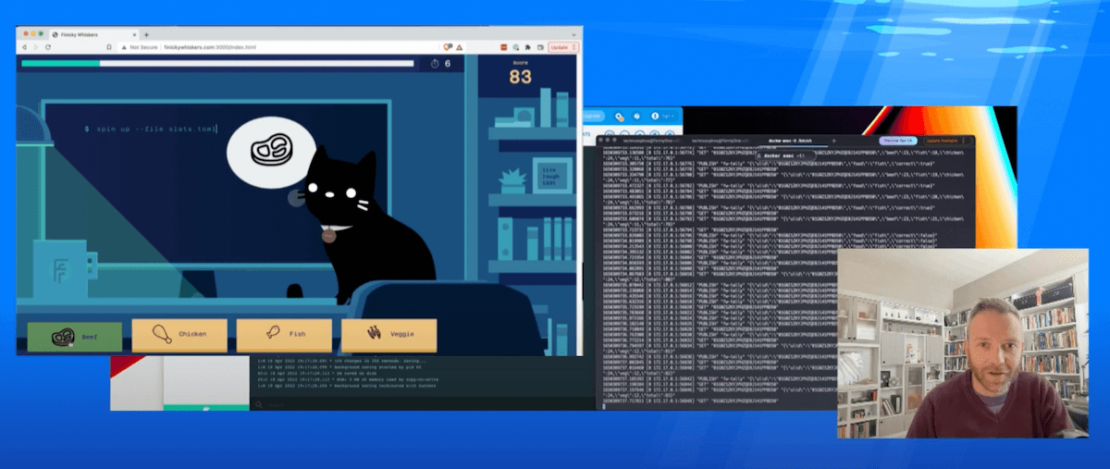
Theoretical applications are promising, but let’s see something in action. Near the end of his talk, Matt revealed that the Finicky Whiskers game he demoed to start the session actually leveraged Docker, WebAssembly, and Redis. These three technologies comprised the game engine to form a lightning-fast backend:
Matt’s terminal displays backend activity as he interacts with the game.
Finicky Whiskers relies on eight separate WebAssembly modules, five of which Matt covered during his session. In this example, each button click sends an HTTP request to Spin — Fermyon’s framework for running web apps, microservices, and server applications.
These clicks generate successively more Wasm modules to help the game run. These modules spin up or shut down almost instantly in response to every user action. The total number of invocations changes with each module. Modules also grab important files that support core functionality within the application. Though masquerading as a game, Finicky Whiskers is actually a load generator.
A Docker container has a running instance of Redis and pubsub, which are used to broker messages and access key/value pairs. This forms a client-server bridge, and lets Finicky Whiskers communicate. Modules perform data validation before pushing it to the Redis pubsub implementation. Each module can communicate with the services within this Docker container — along with the file server — proving that Docker and Wasm can jointly power applications:
Specifically, Matt used Wasm to rapidly start and stop his microservices. It also helped these services perform simple tasks. Meanwhile, Docker helped keep the state and facilitate communication between Wasm modules and user input. It’s the perfect mix of low resource usage, scalability, long-running pieces, and load predictability.
Containers and WebAssembly are Fast Friends, Not Mortal Enemies
As we’ve demonstrated, containers and WebAssembly are companion technologies. One isn’t meant to defeat the other. They’re meant to coexist, and in many cases, work together to power some pretty interesting applications. While Finicky Whiskers wasn’t the most complex example, it illustrates this point perfectly.
In instances where these technologies stand apart, they do so because they’re supporting unique workloads. Instead of declaring one technology better than the other, it’s best to question where each has its place.
We’re excited to see what’s next for Wasm at Docker. We also want Docker to lend a helping hand where it can with Wasm applications. Our own Jake Levirne, Head of Product, says it best:
“Wasm is complementary to Docker — in whatever way developers choose to architect and implement parts of their application, Docker will be there to support their development experience,” Levirne said.
Development, testing and deployment toolchains that use Docker make it easier to maintain reproducible pipelines for application delivery regardless of application architecture, Levirne said. Additionally, the millions of pre-built Docker images, including thousands of official and verified images, provide “a backbone of core services (e.g. data stores, caches, search, frameworks, etc. )” that can be used hand-in-hand with Wasm modules.”
We even maintain a collection of WebAssembly/Wasm images on Docker Hub! Download Docker Desktop to start experimenting with these images and building your first Docker-backed Wasm application. Container runtimes and registries are also expanding to include native WebAssembly support.
Quelle: https://blog.docker.com/feed/

Mehrere 100.000 Euro teure Inhalte wie in Diablo Immortal laden zur Manipulation ein. Ein neues System von Denuvo soll das verhindern. (Denuvo, DRM)
Quelle: Golem

Im ersten Halbjahr 2022 haben die Milliardäre der Welt reichlich Vermögen eingebüßt – unter anderem Elon Musk, Jeff Bezos und Mark Zuckerberg. (Wirtschaft, Mark Zuckerberg)
Quelle: Golem

Ehemalige Fabrikarbeiter von Tesla sagen, sie seien von Kollegen, Managern und von der Personalabteilung rassistisch beleidigt worden. (Tesla, Elektroauto)
Quelle: Golem






