ADAC-Test: Elektroautos als Zugmaschinen – was bringt's?
Der ADAC hat den Stromverbrauch von Elektroautos mit Anhängern und Fahrradgepäckträgern gemessen. Gute Noten gibt es dabei keine. (Elektroauto, Auto)
Quelle: Golem

Der ADAC hat den Stromverbrauch von Elektroautos mit Anhängern und Fahrradgepäckträgern gemessen. Gute Noten gibt es dabei keine. (Elektroauto, Auto)
Quelle: Golem

Quelle: <a href="Something Weird's Happening In This Senate Race: Fun“>BuzzFeed

Auf dem Caravan-Salon in Düsseldorf werden die ersten Wohnmobile mit Elektroantrieb gezeigt. Doch die Branche tut sich schwer mit der Antriebswende. Ein Bericht von Franz W. Rother (Elektroauto, Technologie)
Quelle: Golem

Neuer Anlauf nach den gescheiterten Centriq 2400: Qualcomm soll an Server-Chips mit Nuvia-Kernen arbeiten, Unterstützung gibt es von Amazon. (Qualcomm, Cloud Computing)
Quelle: Golem

Mit der schwedischen Aonic Group investiert nach Unity ein weiteres Unternehmen in die Monetarisierung von Mobilegames. (Mobile Games, Onlinewerbung)
Quelle: Golem

Nur vier Monate nach der Einführung ist für die Snap Pixy Schluss: Der Snap-CEO streicht die Weiterentwicklung der Drohne. (Snapchat, Drohne)
Quelle: Golem

Die Kryptowährungs-Börse hat seine Mitarbeiterzahl seit Juni 2022 weiter reduziert. Selbst intern sind keine genauen Zahlen bekannt. (Fintech, Bitcoin)
Quelle: Golem
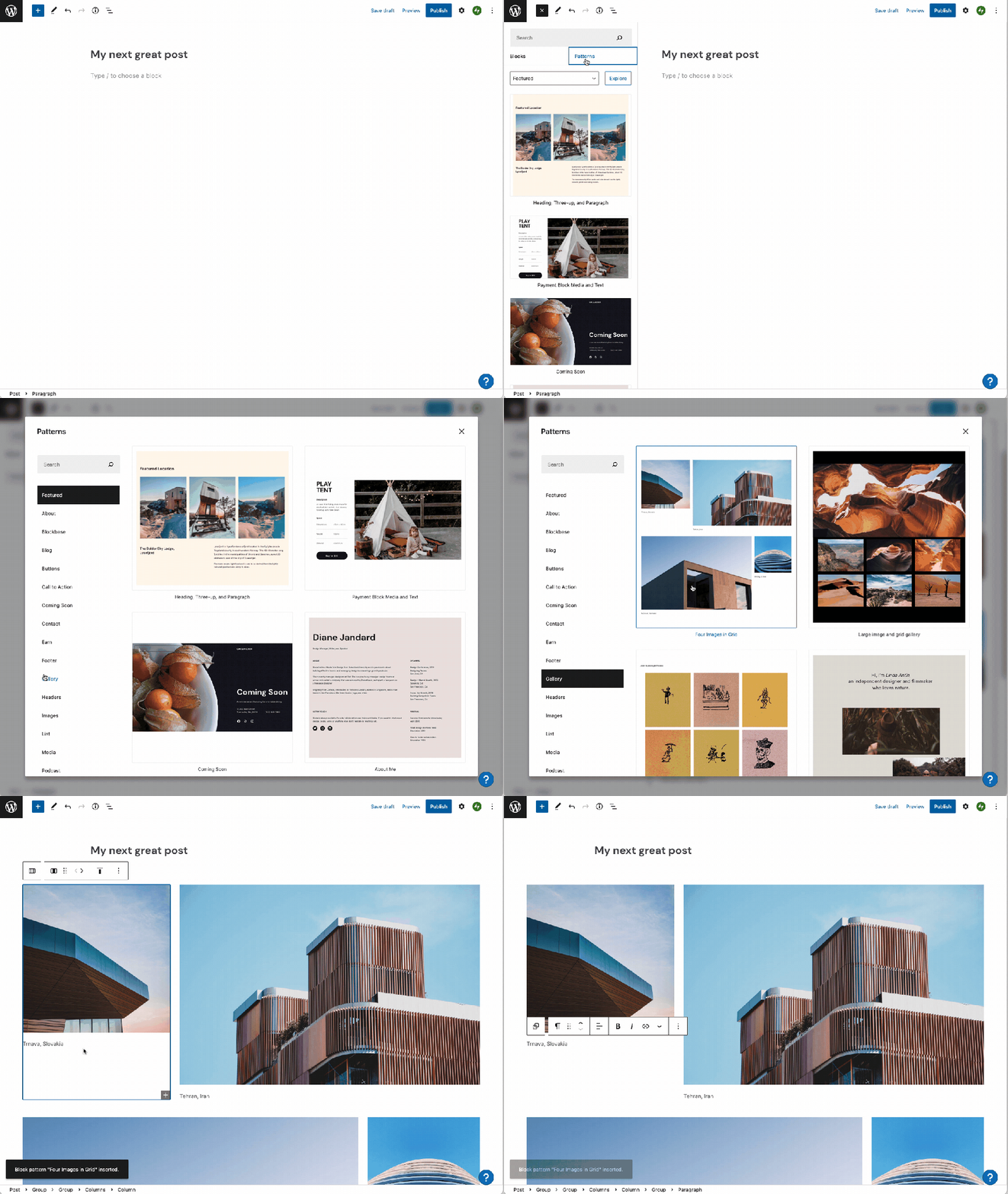
Since we launched Patterns in 2020, we’ve been steadily adding to our library of prebuilt Block templates for you to easily make your site stand out even more. There are now over 260 Patterns that can be inserted into your pages and posts in just seconds.
If you’ve never used Patterns before, you can access them by hitting the “+” button at the top left of any page or post you’re working on. From there, you can do a few things:
Use the search box to search for a term like “Header,” “Subscription,” or “Link in Bio” and select from the results Or click on the “Patterns” tab and use the drop down menu to explore the top results across various categories Or click on the “Explore” button to bring up our entire library of Patterns, organized by category
Here’s a quick demo that shows how to add an image gallery using the new Pattern explorer:
We’re always adding more Patterns, month by month — we’ve added over 45 new ones since July! — and we can’t wait for you to see some of the fun designs coming up. Think of them as an ever-growing library of sophisticated slices of web design you can customize and add to your posts, pages, and Block themes.
Below is a quick look at some of our favorites from the year so far.
If you use a lot of images in your posts, we have numerous options for you. There are some great Patterns for galleries, portfolios, and even product listings.
You can find these in the “Gallery” category.
The adage “good things come in small packages” holds true with some of our smaller Patterns that take up less real estate. It all depends on the nature of your website, but a Pattern for donations on a non-profit site or call to subscribe on almost any blog can make a great end for a post or page.
Find these in the “Subscribe” and “Earn” categories, respectively.
And finally, simply exploring some of our bolder Patterns can provide inspiration on working with color, type, and images on your site!
Patterns are an incredibly useful resource in your website design toolbox. Customize, experiment, and take advantage of them whenever you can.
If you need help with Patterns, click here for a more detailed guide.
And be sure to let us know in the comments how you’ve used Patterns on your site and any ideas you have for new ones. We’re always working on more!
Quelle: RedHat Stack

Over the past few years, Google has observed that distributed denial-of-service (DDoS) attacks are increasing in frequency and growing in size exponentially. Today’s internet-facing workloads are at constant risk of attack with impacts ranging from degraded performance and user experience for legitimate users, to increased operating and hosting costs, to full unavailability of mission critical workloads. Google Cloud customers are able to use Cloud Armor to leverage the global scale and capacity of Google’s network edge to protect their environment from some of the largest DDoS attacks ever seen.On June 1, a Google Cloud Armor customer was targeted with a series of HTTPS DDoS attacks which peaked at 46 million requests per second. This is the largest Layer 7 DDoS reported to date—at least 76% larger than the previously reported record. To give a sense of the scale of the attack, that is like receiving all the daily requests to Wikipedia (one of the top 10 trafficked websites in the world) in just 10 seconds.Cloud Armor Adaptive Protection was able to detect and analyze the traffic early in the attack lifecycle. Cloud Armor alerted the customer with a recommended protective rule which was then deployed before the attack ramped up to its full magnitude. Cloud Armor blocked the attack ensuring the customer’s service stayed online and continued serving their end-users.Figure 1: DDoS attack graph peaking at 46M requests per second.What happened: Attack analysis and timelineStarting around 9:45 a.m. PT on June 1, 2022, an attack of more than 10,000 requests per second (rps) began targeting our customer’s HTTP/S Load Balancer. Eight minutes later, the attack grew to 100,000 requests per second. Cloud Armor Adaptive Protection detected the attack and generated an alert containing the attack signature by assessing the traffic across several dozen features and attributes. The alert included a recommended rule to block on the malicious signature. The following is the alert showing details of the attack before it ramped to its peaks.Figure 2: Cloud Armor Adaptive Protection alert listing the top region codes detected as a part of the attack.Our customer’s network security team deployed the Cloud Armor-recommended rule into their security policy, and it immediately started blocking the attack traffic. In the two minutes that followed, the attack began to ramp up, growing from 100,000 rps to a peak of 46 million rps. Since Cloud Armor was already blocking the attack traffic, the target workload continued to operate normally. Over the next few minutes, the attack started to decrease in size, ultimately ending 69 minutes later at 10:54 a.m. Presumably the attacker likely determined they were not having the desired impact while incurring significant expenses to execute the attack. Analyzing the attackIn addition to its unexpectedly high volume of traffic, the attack had other noteworthy characteristics. There were 5,256 source IPs from 132 countries contributing to the attack. As you can see in Figure 2 above, the top 4 countries contributed approximately 31% of the total attack traffic. The attack leveraged encrypted requests (HTTPS) which would have taken added computing resources to generate. Although terminating the encryption was necessary to inspect the traffic and effectively mitigate the attack, the use of HTTP Pipelining required Google to complete relatively few TLS handshakes. Approximately 22% (1,169) of the source IPs corresponded to Tor exit nodes, although the request volume coming from those nodes represented just 3% of the attack traffic. While we believe Tor participation in the attack was incidental due to the nature of the vulnerable services, even at 3% of the peak (greater than 1.3 million rps) our analysis shows that Tor exit-nodes can send a significant amount of unwelcome traffic to web applications and services.The geographic distribution and types of unsecured services leveraged to generate the attack matches the Mēris family of attacks. Known for its massive attacks that have broken DDoS records, the Mēris method abuses unsecured proxies to obfuscate the true origin of the attacks. How we stopped the attackThe attack was stopped at the edge of Google’s network, with the malicious requests blocked upstream from the customer’s application. Before the attack started, the customer had already configured Adaptive Protection in their relevant Cloud Armor security policy to learn and establish a baseline model of the normal traffic patterns for their service. As a result, Adaptive Protection was able to detect the DDoS attack early in its life cycle, analyze its incoming traffic, and generate an alert with a recommended protective rule–all before the attack ramped up. The customer acted on the alert by deploying the recommended rule leveraging Cloud Armor’s recently launched rate limiting capability to throttle the attack traffic. They chose the ‘throttle’ action over a ‘deny’ action in order to reduce chance of impact on legitimate traffic while severely limiting the attack capability by dropping most of the attack volume at Google’s network edge. Before deploying the rule in enforcement mode, it was first deployed in preview mode, which enabled the customer to validate that only the unwelcome traffic would be denied while legitimate users could continue accessing the service. As the attack ramped up to its 46 million rps peak, the Cloud Armor-suggested rule was already in place to block the bulk of the attack and ensure the targeted applications and services remained available. Protecting your applications in the cloudAttack sizes will continue to grow and tactics will continue to evolve. To be prepared, Google recommends using a defense-in-depth strategy by deploying defenses and controls at multiple layers of your environment and your infrastructure providers’ network to protect your web applications and services from targeted web attacks. This strategy includes performing threat modeling to understand your applications’ attack surfaces, developing proactive and reactive strategies to protect them, and architecting your applications with sufficient capacity to manage unanticipated increases in traffic volume. With Google Cloud Armor, you are able to protect your internet facing applications at the edge of Google’s network and absorb unwelcome traffic far upstream from your applications.Related ArticleIntroducing new Cloud Armor features including rate limiting, adaptive protection, and bot defenseCloud Armor strengthens its already formidable defenses with new features to counter advanced L7 attacks and block malicious bots.Read Article
Quelle: Google Cloud Platform
Editor’s note: Since joining Google in 2007, Carrie Bell has gone from working on search ads to managing multiple teams of highly skilled engineers. That may seem unusual, but she says there’s a common theme across it all: empowerment.What was your path to Google?I joined the Army Reserve out of high school, and after a year of training, began attending Marquette University as an English major. That was interrupted by the decision to invade Iraq, where I then spent a year. I came back and took a heavy load to graduate in 2006. Google had just opened an office in Ann Arbor, and they were interested in hiring people with unusual backgrounds who were capable of learning and growing with the company. I spent a lot of time in customer support and sales. People don’t realize how great that experience can be! A customer support person picks up a phone, and they don’t know who the customer is, what their problem is, or what kind of day they are having, and 90%-95% of the time they make that customer happy. It’s a huge deal. In 2013, I started working in Privacy, and began working directly with more engineers with technical skills. Many of my peers were new to Google, and I could help them with understanding things like promotion, job calibration, and understanding how Google works. As my coworkers saw me stepping up, they put me forward as a manager.Most English majors don’t aspire to manage teams of software engineers. I have a non-traditional career path, true. Some opportunities came from taking advantage of what Google offered. Whenever I didn’t feel like I was growing, or I wasn’t well aligned with my manager, I could always find something new. I am highly cognizant that I don’t have my team’s engineering expertise, and I never will. I bring other skills I put a lot of time and effort into—aligning people to a common purpose and aligning people with each other. I want the vision and mission of a team to arise from the collective genius of the group and for it to be owned by everyone, so that even the most junior person on a team knows that what they are doing is important. How does that make things stronger?Every team, in every part of the company, needs a mission, a vision, and a strategy. Often you get a brilliant leader who drives the vision. If that leader moves on to another role, it makes the team feel like they don’t know what to do. That’s bad for everyone, and it’s a lot less likely to happen if everyone has had a role in creating the mission, vision, and strategy.Caring for human beings has always been a core part of my leadership philosophy. As a manager, I’ve found that if I take care of my team, my team will have my back when it comes to our business priorities.Do you think cloud technology has the kind of opportunity you saw 15 years ago?Yes. Serverless computing, where I’m working now, really excites me for how it can transform a small business. The same way search ads helped little businesses find customers and grow quickly, serverless can abstract out a lot of complex issues and be a democratizing force for smaller players. We’re still working on the vision, but that feels right.Related ArticleThe Invisible Cloud: How this Googler keeps the internet moving worldwideMeet Stacey Cline and hear how she came to enable the worldwide movement of Google Cloud’s global technical infrastructure.Read Article
Quelle: Google Cloud Platform






