Governance Is a Developer Experience Problem

This is the third post of a 3-part series by Docker Captain Karan Verma. Catch up on Part 1: Your Laptop Is the New Production Environment and Part 2: Runtime Enforcement, Not Runtime Advice.

The conversation around AI governance often starts with security. That’s understandable. When autonomous systems can execute commands, access tools, and interact with production-adjacent environments, organizations naturally focus on risk. But after spending time thinking about agent workflows, I’ve become convinced that governance is about more than security. It’s also a developer experience problem.

The Trust Bottleneck

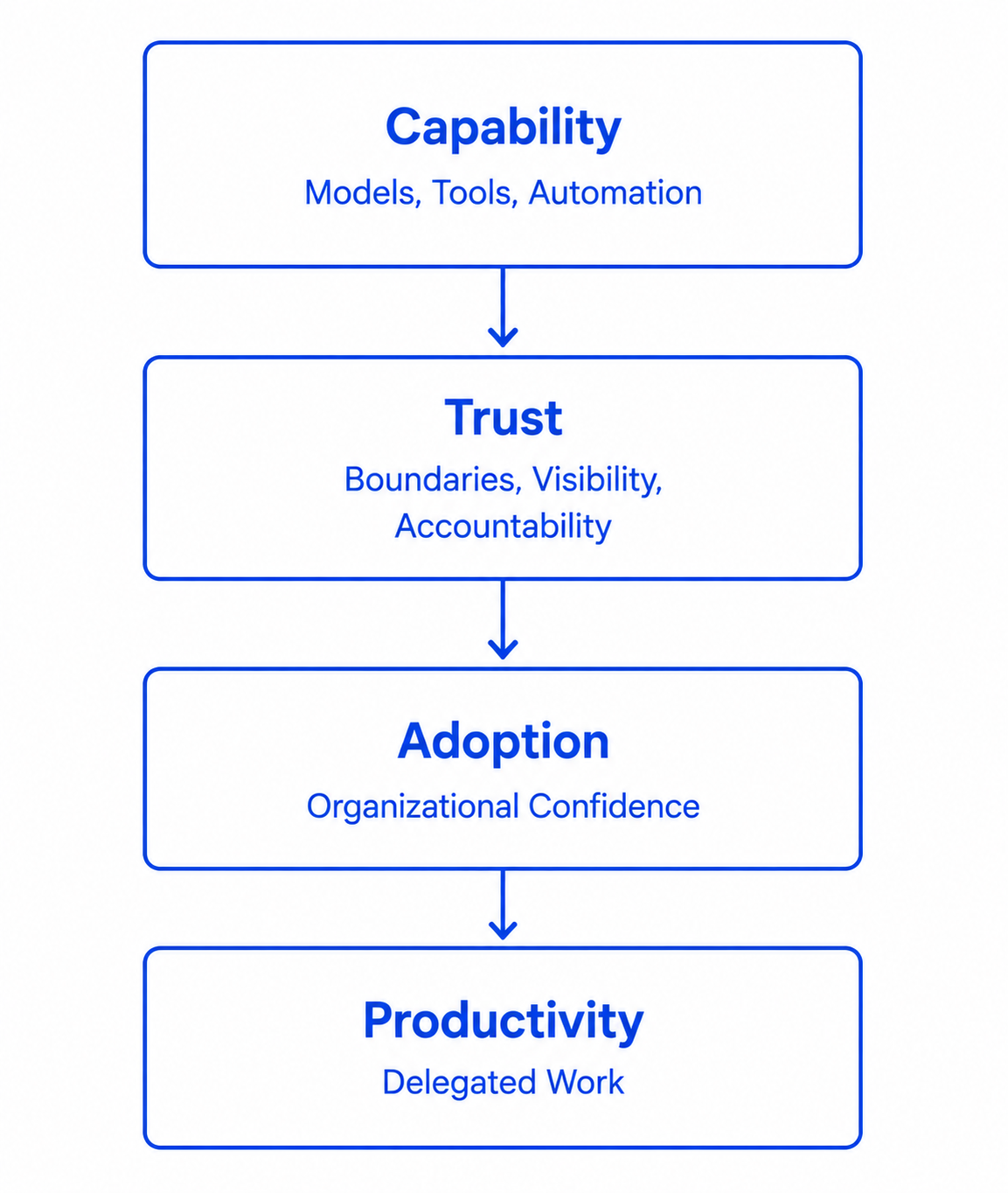
Most organizations don’t struggle to adopt new tools because the tools are incapable. They struggle because the organization doesn’t trust them yet. The history of software development is full of examples. Cloud adoption accelerated when organizations became comfortable with cloud governance. Containers accelerated when teams gained confidence in isolation and operational controls. CI/CD accelerated when organizations trusted automated deployment pipelines. The pattern repeats. Capability arrives first. Trust arrives later. Adoption follows trust. AI agents are no different.

Caption: Capability alone does not drive adoption. Trust enables organizations to delegate work, expand usage, and realize productivity gains.

The Wrong Tradeoff

Governance is often framed as a choice between speed and control. Move fast and accept risk. Or add controls and slow everyone down. In practice, the most successful developer platforms rarely make this tradeoff. Instead, they create environments where developers can move quickly because boundaries already exist. A developer deploying through a mature platform doesn’t need to think about every networking rule, access policy, or infrastructure safeguard every time they ship code. The platform already provides those guarantees. The same principle applies to agent systems. The goal isn’t to force developers to manually approve every action. The goal is to create environments where useful actions can happen safely by default.

A Tale of Two Teams

Imagine two engineering teams using the same coding agent. The first team allows agent usage only in limited experiments because nobody is completely certain what the agent can access, execute, or modify. Every new workflow requires additional review. Every new capability triggers a discussion about risk.

The second team operates within clearly defined boundaries around execution, tools, and credentials. Developers understand where agents run, what systems they can access, and how activity is observed.

The underlying model is identical. The difference is trust. Over time, that difference may matter more than the model itself. Organizations rarely scale technology they do not trust.

Why Boundaries Create Freedom

This idea sounds counterintuitive at first. Boundaries feel restrictive. But in software systems, boundaries often enable autonomy rather than limiting it.

When organizations know:

where agents run,

what agents can access,

which tools agents can use,

how activity is observed,

They become more comfortable delegating work. Without those boundaries, every workflow becomes an exception process. Every deployment requires discussion. Every new capability triggers concern. Every new tool requires negotiation. Governance reduces uncertainty. Reducing uncertainty increases trust. And trust enables adoption.

The Platform Shift

One thing that stands out in recent discussions around agent infrastructure is that governance is increasingly moving into the platform itself. Developers shouldn’t need to become security experts every time they use an agent. Just as developers rely on platforms to handle identity, networking, deployment, and observability concerns, governance increasingly becomes part of the environment where agents operate. When governance is embedded into the platform, developers spend less time worrying about boundaries and more time focusing on outcomes. That’s a developer experience improvement as much as a security improvement.

Governance as an Enabler

The organizations that adopt agents most successfully may not be the organizations with the fewest controls. They may be the organizations with the clearest controls. Clear boundaries create confidence. Confidence enables delegation. Delegation unlocks productivity. Viewed through that lens, governance is not the thing slowing agent adoption. It is one of the things that makes large-scale adoption possible.

Looking Ahead

The conversation around AI agents often focuses on what models can do. Increasingly, I think the more interesting question is what organizations are willing to trust them to do. That trust won’t come from capability alone. It will come from visibility, accountability, and well-defined boundaries because the future of agentic software is unlikely to be determined solely by the most capable agents. It will also be shaped by the environments that make those agents trustworthy enough to use at scale.

Learn more

Read about why AI Agents need isolation

Read Part and Part 2 of this AI Governance series

Find out how Docker’s AI Governance solutions work across all tools

Quelle: https://blog.docker.com/feed/

Amazon Aurora serverless now scales faster to support agentic AI and other bursty workloads

Amazon Aurora serverless now delivers higher initial capacity during scale-up events, reaching up to 12 ACUs within a second and continuing to scale up to 256 ACUs as your workload grows. When the workload finishes, Aurora serverless automatically scales down to zero. This makes it especially well-suited for agentic AI applications, which typically have bursts of activity, long idle windows, and unpredictable traffic patterns. Aurora serverless handles all of it automatically, scaling capacity with your agents, so you only pay for what you use. This enhancement is enabled by default on all Aurora serverless clusters running on platform version 3 or 4, with no configuration changes required. Existing clusters on platform versions 1 and 2 can upgrade directly to the latest platform version 4 to benefit from these improvements. You can verify your cluster’s platform version in the AWS Management Console under the instance configuration section, or via the RDS API’s ServerlessV2PlatformVersion parameter. For pricing details and Region availability, visit Amazon Aurora Pricing. To learn more, read the Aurora serverless scaling documentation, and get started by creating an Aurora serverless database in just a few steps in the AWS Management Console.
Quelle: aws.amazon.com

AWS IAM Identity Center makes managment of AWS account access optional for new organization instances

AWS IAM Identity Center now lets you decide whether to enable management of AWS account access when you create a new organization instance. This allows you to use IAM Identity Center to manage access to AWS applications only, without the need to manage access to AWS accounts. This feature is available at the time of initial configuration of an IAM Identity Center instance and does not affect existing IAM Identity Center instances.
IAM Identity Center enables you to connect your workforce identities to AWS once and offer AWS application owners across your organization streamlined access management. Application end users benefit from single sign-on, user awareness, and consistent authentication experience across AWS applications. Previously, this meant you also needed to manage access to AWS accounts. With this release, account management is now optional. When you choose not to enable management of AWS accounts, IAM Identity Center does not provision its service-linked role into your member accounts, which reduces the access surface in your environment. You can enable account management permissions later through instance settings or the UpdateInstance API. 
This capability is available in all AWS Regions where IAM Identity Center is available. To get started, see Configure instance settings in the IAM Identity Center User Guide.
Quelle: aws.amazon.com

Amazon DynamoDB now supports real-time vector search

Today, AWS announces the general availability of vector search for Amazon DynamoDB, a new feature to index and search vectors in real time. As vector datasets grow into the billions or trillions, vector search at scale traditionally trades off search speed, scale, and accuracy: latency climbs with vector count unless you accept lower recall or throughput. DynamoDB now supports native vector search with single-digit millisecond latency at 99%+ recall and is designed for any scale, even trillions of vectors. With DynamoDB vector search, you store vector embeddings alongside your other attributes and generate them using a model of your choice, including models available on Amazon Bedrock. You create a vector index and run approximate nearest neighbor searches, pick the vector index partition key to scale, and filter on attributes to scope results. You get the same serverless benefits you rely on today: zero infrastructure management, zero downtime, zero maintenance windows, and pay for only what you use. You can already use DynamoDB to store memory for AI agents, and with vector search you can now add semantic retrieval over that memory for agentic grounding, along with product similarity search, personalized advertising, retrieval augmented generation, and recommendation systems, with predictable performance. To learn more, visit the AWS News Blog, Amazon DynamoDB product page, and Amazon DynamoDB Developer Guide.
Quelle: aws.amazon.com

AWS Marketplace adds AI Insights so buyers can understand pricing before they buy

You can now understand how a product’s pricing works before you buy it. Available in the pricing section of the listing in AWS Marketplace, AI Insights explains each product’s pricing in plain language: what a pricing unit maps to, how your bill changes as usage scales, how multiple pricing dimensions combine into one cost, and what is and isn’t included. Answering these questions used to mean having to visit multiple websites and piecing together pricing details on your own. Now the context sits on the listing, so you can evaluate pricing and move to purchase without switching tabs.
AI Insights cites sources so you can see where the explanations come from. AI Insights draws from the pricing the seller publishes on the Marketplace listing, and additional pricing context on the seller’s public website.
AI Insights is live today on most listings where external pricing context is available. It is available in all commercial AWS Regions where AWS Marketplace is available. To see it, open any product listing on the AWS Marketplace website and scroll to the pricing section. Sellers can review what appears on their listing and request edits at any time through the Contact Us form linked in the AI Insights page on the AWS Marketplace Seller Guide.
Quelle: aws.amazon.com