AWS App Runner unterstützt jetzt Internet Protocol Version 6 (IPv6) für öffentlichen eingehenden Datenverkehr

AWS App Runner unterstützt jetzt IPv6-basierten Datenverkehr für öffentliche App Runner-Service-Endpunkte, sodass Kunden über IPv6 auf ihren App Runner-Service-Endpunkt zugreifen können. Dies hilft Kunden dabei, die IPv6-Compliance-Anforderungen zu erfüllen, und macht die Adressübersetzung zwischen IPv4 und IPv6 überflüssig.
Quelle: aws.amazon.com

Microsoft is now a FinOps Certified Service Provider

In an era where cloud computing has become the backbone of modern business operations, efficient financial management is the linchpin that keeps organizations agile and cost-effective. The FinOps Framework has emerged as a powerful approach to optimize cloud costs, allowing organizations to efficiently manage their cloud expenditure. Today, we are thrilled to announce that Microsoft has achieved a milestone that reaffirms our commitment to empowering our customers and partners in their journey towards optimized cloud spending. We are now a FinOps Certified Service Provider. This certification is a testament to our unwavering dedication to providing you with the best-in-class solutions for managing your cloud finances and ensuring that your organization thrives in this era of digital transformation.

FinOps consulting journey at Microsoft

Our journey in FinOps consulting dates back to the early days of Microsoft Azure, where we embarked on a mission to assist organizations in navigating the complex landscape of cloud cost management. Over the years, we have had the privilege of collaborating with countless organizations, ensuring they unlock the full potential of their cloud investments. What truly excites us, however, is the remarkable momentum that the FinOps Foundation has generated. This foundation has played a pivotal role in cultivating a vibrant and inclusive community of FinOps professionals, united by a shared passion for optimizing cloud expenditures.

Together with this dynamic community, we are poised to take the world of FinOps to the next level. Our continued collaboration, knowledge-sharing, and dedication to the cause will not only enhance our collective understanding of cloud financial management but also drive innovation and excellence in this critical domain. With the power of collaboration and the momentum of the FinOps community, we are prepared to shape the future of FinOps, making it more accessible, efficient, and beneficial for all.

At Microsoft, our commitment to you extends throughout the entire service lifecycle. Whether you are Unified Enterprise Support customer, receiving Proactive Services, or a Microsoft Industry Solutions Delivery (ISD) customer, receiving modernization and enabling innovation for the Microsoft cloud, we are here to provide the expertise and guidance you need to meet your FinOps goals. 

Your goals may by focused on enablement or long-term optimization. We receive many questions from our customers that correspond to each of these goal categories:

Enablement:

“I’m looking to improve our financial forecast for the upcoming year.”—Chief Financial Officer.

“I’ve been meaning to make our cloud spending more efficient but haven’t had the time.”—Chief Technical Officer.

“I’m setting our unit’s KPIs and want to make our operations for the coming quarter leaner.”—Business Unit Lead.

“I need to support our leadership in achieving our quarterly goals and make operations more efficient.”—Product/Application Owner.

Long-term optimization:

“I’m concerned about the economic downturn and need to improve our bottom line.”—Chief Financial Officer.

“I need to reduce my operational cost so that I can free up money for innovative projects.”—Chief Technology Officer.

“I need to make sure our group’s strategy is aligned to company goals.”—Business Unit Lead.

“I work closely with the product and am responsible for the changes.”—Product/Application Owner.

With these questions and requirements in mind, we have developed a series of offerings that provide the solutions.

FinOps solution offerings at Microsoft

Our Unified Enterprise Support currently has three FinOps offerings:

FinOps Introduction

FinOps Assessment

FinOps Operations for Azure

Azure Cost Management Tool Chain

Azure Billing Mechanics

Azure Cost Management Mechanics

Azure Cost Optimization Opportunities

Our Industry Solutions Delivery, Journey to FinOps offering helps our customers optimize their existing landscape, establish a cost-conscious culture, and supporting governance controls to maximize the value of their Azure spend. This offer helps our customers:

Understand the underlying drivers of cost by cloud resource types.

Uncover the link between current cost and performance and cost optimization levers.

Achieve tangible impact/savings through a systematic and continuous cost optimization process while aligning with performance, scalability, and stability goals.

Develop or accelerate a cost-conscious organization.

You can also leverage publicly available FinOps information including:

Review your capability using the FinOps Assessments.

Learn more through the FinOps documentation available.

We’ll share more details on these and other service offerings in future blog posts.

The Microsoft vision for the future of FinOps

Looking forward, we are excited to share our vision for the future of FinOps. Engaging with the FinOps community through the FinOps Foundation Slack and active participation in working groups is a vital part of our strategy. Some of the working groups we actively contribute to include FinOps Open Cost and Usage Specification (FOCUS), aimed at building and maintaining a common specification for cloud cost, usage, and billing data) and FinOps Champion (focused on creating a FinOps Champion Program). These initiatives demonstrate our commitment to shaping the future of cloud cost management.

We are continuously exploring new ways to enhance your FinOps experience. Our goal is to bring you the latest tools, best practices, and thought leadership that will empower you in the ever-evolving cloud ecosystem. As the cloud landscape continues to evolve, we are dedicated to ensuring that your organization remains at the forefront of FinOps, equipped with the knowledge and tools needed to thrive in this dynamic environment.

Microsoft as a FinOps Certified Service Provider

Microsoft’s certification as a FinOps Certified Service Provider is a significant milestone in the realm of cloud cost management. It highlights the growing importance of FinOps in the cloud industry and underscores the critical role of financial discipline in optimizing cloud spending. By achieving this certification, Microsoft has positioned itself as a leader in cloud cost management, benefiting its customers, the industry, and cloud users around the world.

As organizations continue to embrace cloud computing, the need for effective cloud cost management will only grow. With the Microsoft’s commitment to FinOps, businesses can expect greater control over their cloud expenses, ensuring that their cloud investments align with their financial goals and operational needs. The FinOps Foundation recently launched the State of FinOps Survey for 2024 to collect industry data to help organizations better understand FinOps trends and common challenges faced. Please consider taking the time to complete this survey and check out past years results.

Your success is our utmost priority, and we encourage you to take action today. Reach out to your dedicated account representative to discover how we can help you achieve your FinOps objectives. Additionally, we invite you to review our publicly available FinOps documentation, which is a valuable resource for in-depth insights into optimizing your cloud finances. You can also actively engage with us in the FinOps Foundation community, where you can connect with fellow professionals, share valuable insights, and stay updated on the latest industry trends.

What’s next for FinOps?

We look forward to the opportunity to meet you in person at Microsoft Ignite and the FinOps Foundation Seattle Roadshow on November 15, 2023. These events provide an excellent platform to network, share experiences, and continue building a brighter and more cost-efficient cloud future together. Your journey to optimized cloud spending starts here, and we are here to support you every step of the way.
The post Microsoft is now a FinOps Certified Service Provider appeared first on Azure Blog.
Quelle: Azure

Come build with us: Microsoft and OpenAI partnership unveils new AI opportunities

At OpenAI’s first DevDay Conference on November 6, 2023, Microsoft Chairman and CEO Satya Nadella made a surprise appearance during OpenAI CEO Sam Altman’s keynote to deliver a powerful message: “Our job number one is to build the best systems, so you can build the best models and deliver those to developers.” This was a testament to the deep partnership between Microsoft and OpenAI. We’re excited about the latest announcements from OpenAI’s first DevDay event and want to highlight the opportunities it presents for all AI builders.

New models: GPT-4 Turbo on Azure OpenAI Service

We are very enthusiastic about all the new models introduced, including GPT-3.5 Turbo, and updates to models including DALL-E 3, and Whisper 3. Among them, the eagerly awaited GPT-4 Turbo offers lower pricing, extended prompt length, and structured JSON formatting with improved efficiency and control. We’re looking forward to making these great Turbo models available on Azure OpenAI Service by the end of this year in keeping with our standard practice of bringing new model innovation from our partners at OpenAI to the Azure OpenAI Service.

Increasing access for all AI Builders

OpenAI’s announcement of lower pricing is significant. It will make the models more accessible and increase their utilization, allowing a broader range of applications to harness their power and ushering in a new era of generative AI. On Azure OpenAI Service, token pricing for the new models will be at parity with OpenAI’s prices.

And in an exciting development, Microsoft made GitHub Enterprise available to all DevDay conference in-person attendees to use for free for 90 days. GitHub Enterprise is a powerful tool for developers, assisting in code completion and development. Its integration with Microsoft’s ecosystem aligns with the mission of helping developers easily bring ideas to life on Azure.

GPTs: New ways to create and monetize

GPTs are a new way for anyone to create a tailored version of ChatGPT to be more helpful in their daily life, at specific tasks, at work, or at home—and then share that creation with others. No coding is required. You can make them for yourself, just for your company’s internal use, or for everyone. Just like with plug-ins, we are looking forward to building deep ecosystem support for GPTs, which we’ll share more on next week at our Microsoft Ignite conference.

Microsoft and OpenAI partnership

OpenAI’s introduction of a Custom Models program will be of particular interest to enterprises, and Microsoft will continue to offer the convenience of integrating OpenAI’s services seamlessly within Microsoft’s existing ecosystem and support infrastructure, providing a comprehensive solution for all enterprise needs.

Sam Altman, OpenAI’s CEO, echoed the sentiment of a strong and productive partnership with Microsoft. “I think we have the best partnership in tech,” Altman told Nadella onstage.

Nadella went on to talk about the companies’ alignment. “Our mission is to empower every person and every organization on the planet to achieve more. And to me, ultimately, AI is only going to be useful if it truly does empower…it’s about being able to get the benefits of AI broadly disseminated to everyone,” Nadella said.

With these announcements, developers and enterprises are now poised to explore new horizons, empowered by the combined strengths of Microsoft and OpenAI, and the limitless possibilities of generative AI.

Get started with Azure OpenAI Service today

Apply now for access to Azure OpenAI Service. 

Review the new documentation for Azure OpenAI Service.

Explore the playground and customization in Azure AI Studio.

Learn more about Data, Privacy, and Security for Azure OpenAI Service.

Bookmark the What’s New page.

The post Come build with us: Microsoft and OpenAI partnership unveils new AI opportunities appeared first on Azure Blog.
Quelle: Azure

Azure sets a scale record in large language model training

Azure empowers intelligent services like Microsoft Copilot, Bing, and Azure OpenAI Service that have captured our imagination in recent days. These services, facilitating various applications like Microsoft Office 365, chatbots, and search engines with generative AI, owe their magic to large language models (LLMs). While the latest LLMs are transcendental, bringing a generational change in how we apply artificial intelligence in our daily lives and reason about its evolution, we have merely scratched the surface. Creating more capable, fair, foundational LLMs that consume and present information more accurately is necessary.  

How Microsoft maximizes the power of LLMs

However, creating new LLMs or improving the accuracy of existing ones is no easy feat. To create and train improved versions of LLMs, supercomputers with massive computational capabilities are required. It is paramount that both the hardware and software in these supercomputers are utilized efficiently at scale, not leaving performance on the table. This is where the sheer scale of the supercomputing infrastructure in Azure cloud shines and setting a new scale record in LLM training matters. 

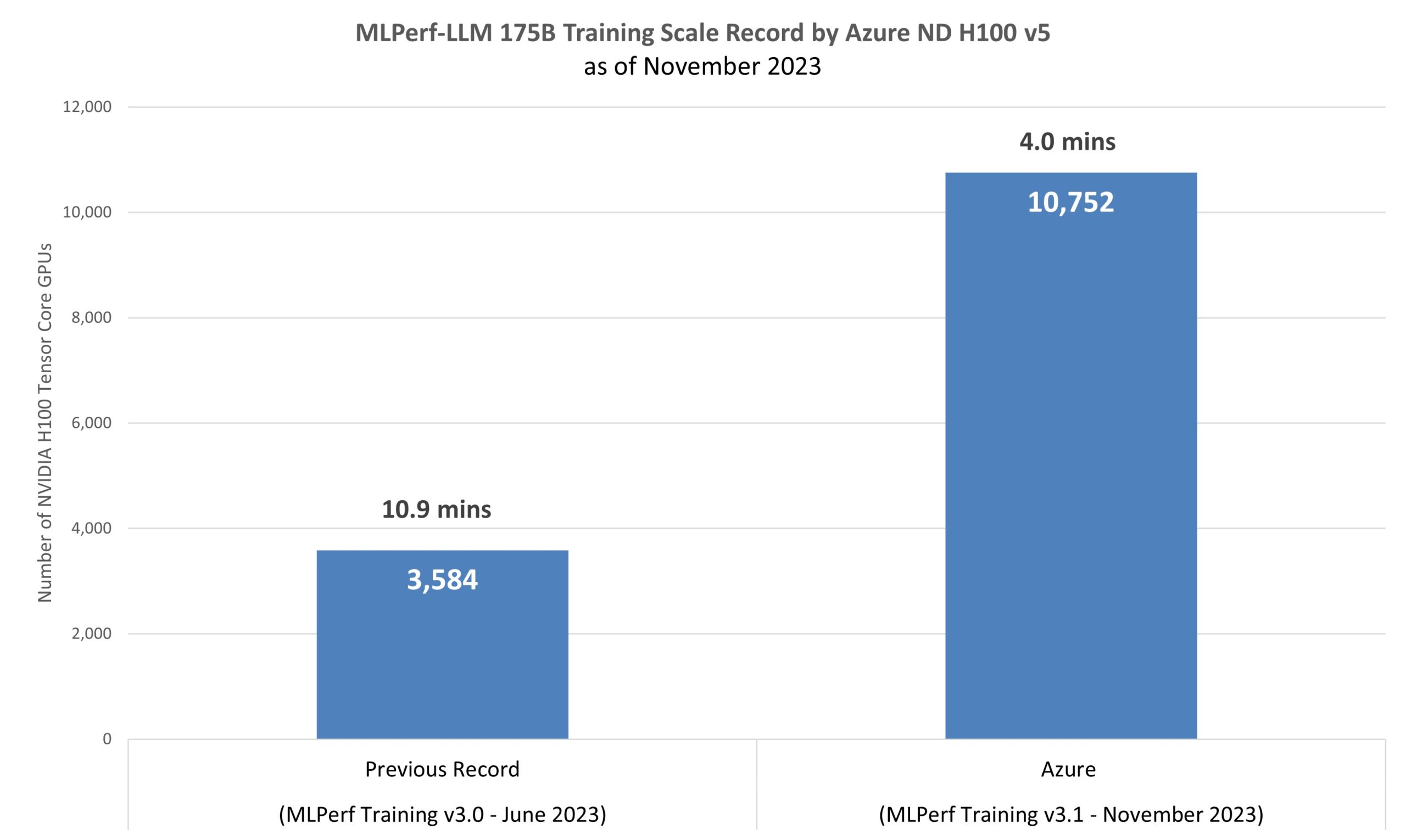
Figure 1: Scale records on the model GPT-3 (175 billion parameters) from MLPerf Training v3.0 in June 2023 (3.0-2003) and Azure on MLPerf Training v3.1 in November 2023 (3.1-2002). 

Customers need reliable and performant infrastructure to bring the most sophisticated AI use cases to market in record time. Our objective is to build state-of-the-art infrastructure and meet these demands. The latest MLPerf™ 3.1 Training results1 are a testament to our unwavering commitment to building high-quality and high-performance systems in the cloud to achieve unparalleled efficiency in training LLMs at scale. The idea here is to use massive workloads to stress every component of the system and accelerate our build process to achieve high quality.

The GPT-3 LLM model and its 175 billion parameters were trained to completion in four minutes on 1,344 ND H100 v5 virtual machines (VMs), which represent 10,752 NVIDIA H100 Tensor Core GPUs, connected by the NVIDIA Quantum-2 InfiniBand networking platform (as shown in Figure 1). This training workload uses close to real-world datasets and restarts from 2.4 terabytes of checkpoints acting closely a production LLM training scenario. The workload stresses the H100 GPUs Tensor Cores, direct-attached Non-Volatile Memory Express disks, and the NVLink interconnect that provides fast communication to the high-bandwidth memory in the GPUs and cross-node 400Gb/s InfiniBand fabric. 

“Azure’s submission, the largest in the history of MLPerf Training, demonstrates the extraordinary progress we have made in optimizing the scale of training. MLCommons’ benchmarks showcase the prowess of modern AI infrastructure and software, underlining the continuous advancements that have been achieved, ultimately propelling us toward even more powerful and efficient AI systems.”—David Kanter, Executive Director of MLCommons 

Microsoft’s commitment to performance

In March 2023, Microsoft introduced the ND H100 v5-series which completed training a 350 million parameter Bidirectional Encoder Representations from Transformers (BERT) language model in 5.4 minutes, beating our existing record. This resulted in a four times improvement in time to train BERT within just 18 months, highlighting our continuous endeavor to bring the best performance to our users.

Figure 2: Relative size of the models BERT (350 million parameters) and GPT-3 (175 billion parameters) from MLPerf Training v3.1.  

Today’s results are with GPT-3, a large language model in the MLPerf Training benchmarking suite, featuring 175 billion parameters, a remarkable 500 times larger than the previously benchmarked BERT model (figure 2). The latest training time from Azure reached a 2.7x improvement compared to the previous record from MLPerf Training v3.0. The v3.1 submission underscores the ability to decrease training time and cost by optimizing a model that accurately represents current AI workloads.

The power of virtualization

NVIDIA’s submission to the MLPerf Training v3.1 LLM benchmark on 10,752 NVIDIA H100 Tensor Core GPUs achieved a training time of 3.92 minutes. This amounts to just a 2 percent increase in the training time in Azure VMs compared to the NVIDIA bare-metal submission, which has the best-in-class performance of virtual machines across all offerings of HPC instances in the cloud (figure 3).

Figure 3: Relative training times on the model GPT-3 (175 billion parameters) from MLPerf Training v3.1 between the NVIDIA submission on the bare-metal platform (3.1-2007) and Azure on virtual machines (3.1-2002). 

The latest results in AI Inferencing on Azure ND H100 v5 VMs show leadership results as well, as shown in MLPerf Inference v3.1. The ND H100 v5-series delivered 0.99x-1.05x relative performance compared to the bare-metal submissions on the same NVIDIA H100 Tensor Core GPUs (figure 4), echoing the efficiency of virtual machines.

Figure 4: Performance of the ND H100 v5-series (3.1-0003) compared to on-premises and bare metal offerings of the same NVIDIA H100 Tensor Core GPUs (3.1-0107 and 3.1-0121). All the results were obtained with the GPT-J benchmark from MLPerf Inference v3.1, scenarios: Offline and Server, accuracy: 99 percent.

In conclusion, created for performance, scalability, and adaptability, the Azure ND H100 v5-series offers exceptional throughput and minimal latency for both training and inferencing tasks in the cloud and offers the highest quality infrastructure for AI.

Learn more about Azure AI Infrastructure

ND H100 v5 

Azure AI Infrastructure

References

MLCommons® is an open engineering consortium of AI leaders from academia, research labs, and industry. They build fair and useful benchmarks that provide unbiased evaluations of training and inference performance for hardware, software, and services—all conducted under prescribed conditions. MLPerf™ Training benchmarks consist of real-world compute-intensive AI workloads to best simulate customer’s needs. Tests are transparent and objective, so technology decision-makers can rely on the results to make informed buying decisions. 

The post Azure sets a scale record in large language model training appeared first on Azure Blog.
Quelle: Azure

Evolving Microsoft Azure Data Manager for Agriculture to transform data into intuitive insights

The quiet revolution of data and analytics in agriculture 

As AGRITECHNICA 2023—the world’s leading trade fair for agricultural machinery—makes a triumphant return after nearly four years, over 450,000 attendees from 130 countries will come together to witness the latest and greatest agriculture innovations firsthand. However, not all of these breakthrough innovations take up large exhibition spaces. Some are quietly revolutionizing the industry through data and analytics, equipping farmers with tools for smarter, data-driven decision-making.  

These data-driven tools—including transformative AI that is reshaping industries—depend on clean, unified data. That’s why we announced Microsoft Azure Data Manager for Agriculture in March 2023, a data platform that leverages industry-specific data connectors and capabilities to connect and unify farm data from disparate sources. With Azure Data Manager for Agriculture, organizations can leverage high-quality datasets for digital agriculture solutions, allowing customers and partners to focus on product innovation rather than data management.

Today, alongside Bayer at the AGRITECHNICA 2023 conference, we’re thrilled to announce the latest updates to Azure Data Manager for Agriculture that are ushering in an era of AI in agriculture.

A growing ecosystem of partners and data with Microsoft Fabric integrations

To start, Azure Data Manager for Agriculture is evolving to include new integrations with Microsoft Fabric. This begins with the inclusion of Microsoft Fabric Data Factory, bringing cloud-scale data movement and transformation to agriculture-specific scenarios. Now, third-party data partners can build connectors to ingest data from more sources into a unified database. Leveraging these Fabric integrations, Microsoft and our partners are expanding Azure Data Manager for Agriculture with more agriculture-specific connectors and capabilities so that insights are no longer limited by specific data types and sources.  

We’ve also built connector patterns that others can use as references and expanded the common data model to incorporate geospatial data, making more data integrations seamless and efficient. Given the importance of the ability to search through time and space when looking at observation data, geospatial ground truth data has been elevated to a first-class component.  

We are also excited to expand support for Bayer’s Climate FieldView as a built-in data source. Once initiated by a farmer, Azure Data Manager for Agriculture provides a straightforward path to retrieving both historic and up-to-date activity files, from which further aggregated insights can be derived. Users can leverage auto-sync planting, application, and harvest activity files from Climate FieldView accounts directly into Azure Data Manager for Agriculture.  

Microsoft and Bayer: Leveraging generative AI to enable interaction with data through language

But it doesn’t stop at data. We believe access to insights and data should be more interactive, intuitive, and entirely human-centric. Imagine, as a farmer, being able to simply ask the question: “Which fields had rain last night?” or “How many acres have been harvested?” and receiving a precise and accurate answer, immediately.  

With new large language model APIs in Azure Data Manager for Agriculture, generative AI in agriculture is now a reality. The large language model APIs enable the seamless retrieval of data mapped to farm operations, sensors, weather, and imagery so that farming-related context and insights can be queried in a conversational context. These capabilities enable others to build their own agriculture copilots that deliver insights to customers and farmers about disease, yield, labor needs, harvest windows, and more—leveraging actual planning and observational data.  

Bayer is the first partner bringing these large language model capabilities to life with a copilot for agriculture. In its early stages, Bayer is presenting an agriculture copilot and testing multiple scenarios with internal teams to discover where large language model capabilities can add value through the ability to interact with agronomic data using natural language.

The Bayer copilot for agriculture is a querying system that helps end users like dealers and farmers get actionable insights from their farm and environment data. Users ask the AI-powered chatbot about different scenarios and the copilot provides accurate responses almost instantly.

Building on a foundation of innovation 

Azure Data Manager for Agriculture has already enabled incredible evolutions in Agriculture with partners like Accenture, Bayer, and Land O’Lakes.  

By integrating disparate data sources and streamlining them into a unified interface, Accenture’s Farm of the Future empowers farmers to track and manage their sustainability initiatives more effectively. Built on Microsoft Azure Data Manager for Agriculture, the solution provides comprehensive oversight of a farm’s sustainability practices. Advanced analytics deliver actionable insights that help farmers optimize resource allocation, minimize environmental impact, and maximize overall agricultural productivity and profitability.  

Bayer’s Climate FieldView platform uses Azure Data Manager for Agriculture’s satellite and weather pipelines and common data model to enable insights on potential yield-limiting factors in growers’ fields. Thanks to Microsoft Azure Data Manager for Agriculture, Bayer can remain focused on building intelligent solutions for growers, rather than investing time and resources in data management. 

Land O’Lakes is using Azure Data Manager for Agriculture to reduce time spent on data integrations, thereby cutting down engineering efforts and costs.

“Our job is to bring all the information together to make sense of it. Azure Data Manager for Agriculture is helping us do that.”
Tom Ryan, President at Truterra, the sustainability division of Land O’Lakes

Land O’Lakes data scientists are now able to derive better insights through comprehensive analytics and intelligent modeling—ultimately supporting more efficient, sustainable farming.  

Learn more about our agriculture solutions

If you’re interested in learning more about our commitment to innovation in agriculture, come visit us at Bayer’s booth (Hall 8, Booth C15) at AGRITECHNICA 2023 in Hanover, Germany the week of November 12 to 18, 2023. We’ll be presenting several sessions, including:  

November 12, 2023—Recent advancements in large language modelling applied to agricultureLearn how AI technology can be applied to agriculture through an improved and efficient enhancement to analytics processing—offering increased insights at the speed of a question. This session will discuss what’s available today and what the near-term future holds.

November 13, 2023—Advancements in technology targeting the Agriculture and food value chain Hear various organizational perspectives about recent advancements in agriculture that support data interoperability, improved transparency across agricultural value chains, accelerated farm and food innovation, and the partnerships driving this change. 

For additional information, visit the Microsoft Azure Data Manager for Agriculture website. The future is bright, as generative AI and other analytics solutions enable insights around optimizing resource allocation, minimizing environmental impact, maximizing agricultural productivity, and much more.  
The post Evolving Microsoft Azure Data Manager for Agriculture to transform data into intuitive insights appeared first on Azure Blog.
Quelle: Azure