This post was co-authored by Patrick McCluskey, Vice President at MongoDB.
As we welcome the era of AI, it’s important to remember that data is the fuel that powers AI. With this understanding, it’s clear why our goal is to make Azure the best destination for data. In Azure, customers benefit from a comprehensive portfolio of database products including relational, non-relational, open source, and caching solutions. We have also established deep partnerships, like the one we have with MongoDB Inc., to enable digital transformation using their databases as managed offerings in Azure.
MongoDB is a leading data platform company that gives developers an intuitive way to model their data. We’ve partnered with MongoDB for years but this year we deepened our partnership significantly, culminating in a multiyear strategic partnership agreement. We’re incredibly proud of the work we’ve done together to make Azure a great place to run MongoDB Atlas. In the past six months alone, MongoDB has become one of our top performing Azure Marketplace partners driven by the adoption of the MongoDB Atlas on Azure pay-as-you-go self-service offering.
Microsoft’s mission is to empower everyone to achieve more, and we know that our customers like using MongoDB to build applications. In year one of our strategic partnership, we collaborated with MongoDB to make it even easier for our joint customers to do more with Microsoft services and MongoDB Atlas on Azure. We’ve enabled developers to use MongoDB Atlas in 40+ Azure regions globally—with our most recent new location being in Doha, Qatar, which we announced last month at our Ignite conference. And we know it’s not just about the data center, it’s also critically important to make it easy for developers to get started with MongoDB Atlas on Azure. GitHub Copilot makes it easy to build MongoDB applications on Azure due to its proficiency in making code suggestions and we’re working together to further improve GitHub Copilot’s performance using MongoDB schema, among other things.
See how MongoDB and GitHub Copilot come together in this video.
Learn More
Explore tools for bringing your vision to life with Azure chevron_right
We’ve already seen customers reaping the benefits of our strategic partnership. For example, our joint work with Temenos helped to enable their banking customers to reach record-high scale. And in another case, Mural, a collaborative intelligence company, shared their experience of building with MongoDB Atlas and Microsoft Azure to help their customers collaborate better and smarter.
MongoDB at Microsoft Ignite 2023
We continue to make investments to improve the customer experience of running MongoDB Atlas on Azure. In November, at Microsoft Ignite 2023, Microsoft and MongoDB announced three significant integrations: Microsoft Semantic Kernel, Microsoft Fabric, and Entity Framework (EF) Core. Let’s look at how customers can benefit from each one.
Semantic Kernel is an open source SDK that enables combining AI services like OpenAI, Azure OpenAI, and Hugging Face with programming languages like C# and Python. At Ignite, MongoDB announced native support for MongoDB Atlas Vector Search in Semantic Kernel. MongoDB Atlas Vector Search allows customers to integrate operational data and vectors in a unified and fully managed platform. Now, customers can use Semantic Kernel to incorporate Atlas Vector Search in applications. This enables, for example, using Atlas Vector Search to interact with retrieval-augmented generation (RAG) in their work with large language models (LLMs), thereby reducing the risk of AI hallucinations, among other benefits.
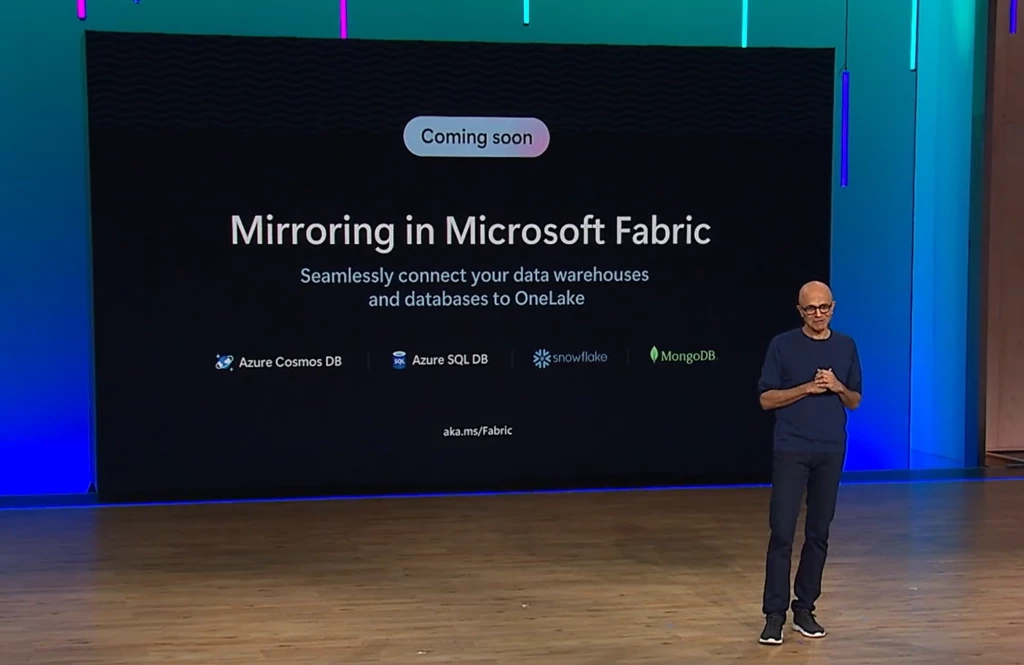
Microsoft Fabric can reshape how your teams work with data by bringing everyone together on a single, AI-powered platform built for the era of AI. MongoDB Atlas is the operational data layer for many applications, these customers use MongoDB Atlas to store data from internal enterprise applications, customer-facing services, and third-party APIs across multiple channels. With connectors for Microsoft Fabric pipelines and Dataflow Gen2, our customers can now combine MongoDB Atlas data with relational data from traditional applications and unstructured data from sources like logs, clickstreams, and more. At Microsoft Ignite, we saw exciting announcements making this integration seamless and easy to use for MongoDB customers. During the first keynote, Microsoft announced that Microsoft Fabric is now generally available, and shared a new frictionless way to add and manage existing cloud data warehouses and databases, like MongoDB, in Fabric called Mirroring. Now, MongoDB customers can replicate a snapshot of their database to OneLake and OneLake will automatically keep this replica in sync in near real-time. You can read more on how to unlock the value of data in MongoDB Atlas with the intelligent analytics of Microsoft Fabric here.
Millions of developers depend on C# to write their applications, and a large percentage of these use Entity Framework (EF) Core, a lightweight, extensible, open source and cross-platform version of the popular Entity Framework data access technology. MongoDB announced that MongoDB Provider for EF Core is now available in Public Preview. This makes it possible for developers using EF Core to build C#/.NET applications with MongoDB while continuing to use their preferred APIs and design patterns.
In each case, we’ve worked closely with MongoDB to ensure developers, data engineers, and data scientists can easily connect their MongoDB data to Microsoft services.
Image of Satya Nadella, Microsoft President and CEO, presenting at Microsoft Ignite.
A year of strengthened collaboration
These new integrations follow a banner year of collaboration between Microsoft and MongoDB. Beyond Microsoft Ignite, we’ve shared a lot of excellent developer news:
The MongoDB for VS Code Extension was made generally available in August 2023. VS Code is the world’s most popular integrated development environment (IDE), and developers downloaded the MongoDB extension over 1 million times during its public preview. This free, downloadable extension makes it easy for developers to build applications and manage data in MongoDB directly from VS Code.
MongoDB integrated with a range of services across the Microsoft Intelligent Data Platform (MIDP), including:
Azure Synapse Analytics, to make it easier to analyze operational data
Microsoft Purview, so users can connect to and safeguard MongoDB data
Power BI, making it possible for data analysts to natively transform, analyze, and share dashboards that incorporate live MongoDB Atlas data
Data Federation: Atlas Data Federation can now be deployed in Microsoft Azure and supports Microsoft Azure Blob Storage in private preview.
Microsoft AI and cloud partners help customers achieve more. This is achieved by partners working together on that Microsoft Intelligent Data Platform, which includes Databases, Analytics, AI, and Governance.
Jointly published tutorials and more covering:
Building serverless functions with MongoDB Atlas and Azure Functions using .NET and C#, NodeJS, or Java;
Creating MongoDB applications using Azure App Service and NodeJS, Python, C#, or Java;
Building Flask and MongoDB applications with Azure App Container Apps;
Developing IoT data hubs for smart manufacturing with MongoDB Atlas and Azure IoT;
Connecting MongoDB Atlas and Azure Data Studio to allow Azure customers to work with their data stored in Atlas on Azure alongside data stored in other Azure data services
It has been a great year for Microsoft and MongoDB, together making it easier for organizations of all sizes to do more with their data.
Learn more about MongoDB Atlas on Azure
Begin using MongoDB Atlas on Azure through the Azure Marketplace at no cost.
Read more about MongoDB Atlas on Azure.
Learn how to migrate your existing environment to MongoDB Atlas.
The post Key customer benefits of the Microsoft and MongoDB expanded partnership appeared first on Azure Blog.
Quelle: Azure