Summary
The recognition for Microsoft over the past couple of weeks comes down to models, infrastructure, data, applications, and developer tools working as one system when AI moves into production.
Enterprise AI is moving into production, and our customers are becoming multi-model. Organizations will use frontier models where capability matters, and smaller, specialized, and open-weight models where economics and finer controls matter. But the value does not come from any model in isolation. It comes from the system around it: infrastructure, data, applications, agents, security, and operations working together. That compounding value is what Microsoft Azure is built to deliver.
A system built from silicon to agent
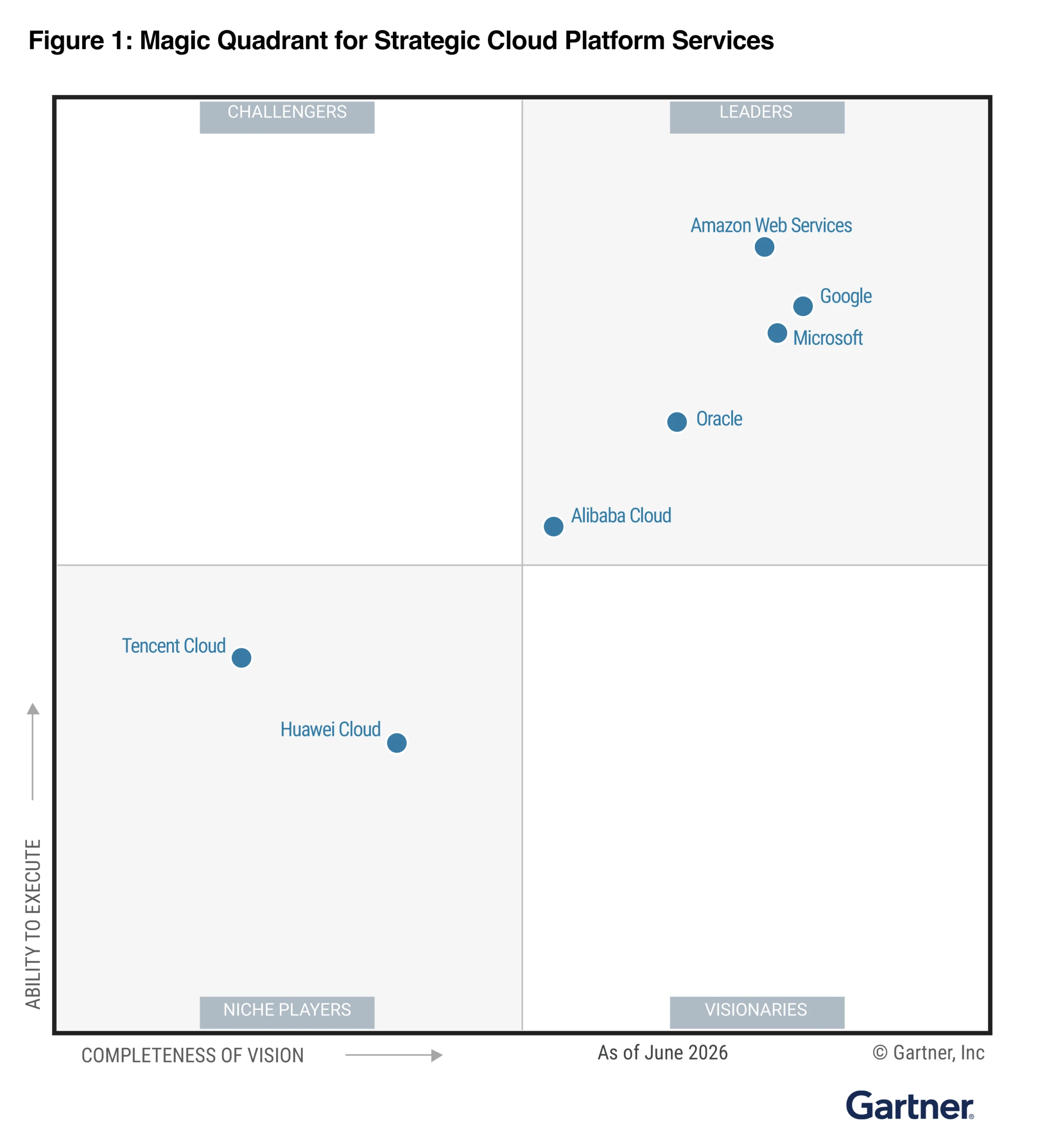
That integration extends into the infrastructure underneath the model. Customers want the flexibility to choose across models and infrastructure without having to stitch together and tune every layer themselves. Microsoft has drawn on decades of running mission-critical systems and operating some of the world’s most demanding AI services at global scale. We believe that breadth and integration across the platform, extending through developer tools and AI applications is a key reason why Microsoft has been named a Leader in both the 2026 Gartner® Magic Quadrant™ for Strategic Cloud Platform Services and The Forrester Wave™: Public Cloud Platforms, Q3 2026.
We appreciate the recognition. What matters more is that customers choosing a platform today are shaping their infrastructure for years, and that choice rests on system-level capability. A cloud platform now must do more than provide individual services. It must give customers choice across models and infrastructure while helping them build faster, run reliably, manage risk, control cost, and improve outcomes. For an enterprise building the next generation of AI applications, how the layers work together matters more than any single feature.
Discover trusted cloud solutions on Microsoft Azure
Microsoft’s Leader placement in the 2026 Gartner® Magic Quadrant™ for Strategic Cloud Platform Services follows Leader placements in the 2025, 2024, and 2023 editions. We believe that what matters for customers, is whether the platform can translate technology into real impact: better performance, greater cost efficiency, faster delivery, and the ability to scale critical systems with confidence.
Microsoft was also named a Leader in The Forrester Wave™: Public Cloud Platforms, Q3 2026. Forrester’s evaluation looks at both the strength of the current offering and the strategy behind it. This recognition provides another independent view of how Azure is evolving as customers move from isolated AI projects to production systems.
Forrester describes Microsoft’s direction as a vision of Azure as a single, vertically integrated system.
Choice without complexity
A multi-model strategy does not mean every model should run the same way. The platform must support those choices across heterogeneous compute while applying consistent security, identity, governance, reliability, and operations.
Microsoft Foundry is central to this approach. It gives developers broad model choice and the tools to evaluate, secure, monitor, and operate AI systems, with Azure infrastructure underneath. This is not about forcing every workload into one model. It is about using reducing the seams between layers so teams can make workload-specific choices while operating consistently across cloud, on-premises, edge, and third-party environments.
Data gives AI its business value
Model choice will keep changing, but the data and business context that make AI useful endure. Customers want to work with data where it already resides, without creating more copies or losing governance along the way. As Forrester puts it: “Models come and go; data has gravity.”
Microsoft Fabric brings analytics and data together, and Microsoft Purview applies governance across that estate. The Azure databases, including Azure SQL and Azure Cosmos DB, connect AI to current operational data. On top of that foundation, Microsoft IQ provides the unified enterprise intelligence layer, giving apps and agents consistent business context across work, data, and knowledge. Together, these capabilities let organizations change models without rebuilding the data, governance, and business context around every application.
UNC Health illustrates why that foundation matters. By modernizing its analytics, the organization is creating a governed data environment that supports care, operations, and research within the requirements of a highly regulated industry. It is the kind of foundation organizations need before AI can be applied responsibly at scale.
Modernization is the catalyst to AI
The applications running a business today contain years of business logic, data, and operating knowledge. They need a modern home where they can continue to support proven processes and connect to new AI experiences. Modernization is therefore part of the AI work, not a separate project. Customers need to decide workload by workload whether to move it, update it, use a managed service, expose it to agents through secure interfaces, or rebuild the parts where there is a clear business reason.
Levi Strauss & Co. shows how modernization and AI become part of the same journey. The company modernized its legacy infrastructure on Azure to build a more resilient foundation, then used Microsoft Foundry to introduce agents that simplify work and accelerate decision-making. A heritage company did not have to leave its existing business behind to adopt AI; it modernized that foundation and built forward from it.
Agents can help teams assess applications, plan upgrades, refactor code, test changes, and support migration while developers and IT teams retain control of architecture and business decisions. GitHub Copilot agentic modernization supports .NET and Java applications, and the work connects across the software lifecycle. This is where the analyst feedback is especially relevant: Gartner highlights Microsoft’s pragmatic approach to application modernization and its integrated, end-to-end software developer lifecycle, while the Forrester report notes our customers’ appreciation for Microsoft’s migration and modernization expertise. The goal is straightforward: help customers modernize the applications they already rely on and so they are ready for the next generation of AI.
Power every AI ambition
As customers run more AI in production, the platform must be more efficient, more reliable, and easier to operate. Customers need the freedom to choose the models and infrastructure that best fit each workload, while the platform reduces the complexity of bringing those choices together.
We’re proud to be recognized as a Leader by Gartner and Forrester, and even more excited by what these evaluations reflect about where the industry is heading. We believe the next generation of cloud will be defined by how well the platform brings infrastructure, data, models, applications, and developer tools together while preserving the choice customers need as each layer continues to evolve.
That’s the direction we’re building toward with Azure, and we’re excited to keep shaping what comes next alongside our customers and partners.
Review the 2026 Gartner® Magic Quadrant™ for Strategic Cloud Platform Services. Read the report.
Review The Forrester Wave™: Public Cloud Platforms, Q3 2026. Read the report.
Gartner® Magic Quadrant™ for Strategic Cloud Platform Services, 2026. By Alessandro Galimberti, Carolin Zhou, Douglas Toombs, Dennis Smith, Ed Anderson, Tobi Bet, Chuck Lawton, 1 September 2026.
Gartner does not endorse any company, vendor, product or service depicted in its publications, and does not advise technology users to select only those vendors with the highest ratings or other designation. Gartner publications consist of the opinions of Gartner’s business and technology insights organization and should not be construed as statements of fact. Gartner disclaims all warranties, expressed or implied, with respect to this publication, including any warranties of merchantability or fitness for a particular purpose.
Gartner and Magic Quadrant are trademarks of Gartner, Inc., and/or its affiliates.
This graphic was published by Gartner, Inc. as part of a larger research document and should be evaluated in the context of the entire document. The Gartner document is available upon request here.
Forrester does not endorse any company, product, brand, or service included in its research publications and does not advise any person to select the products or services of any company or brand based on the ratings included in such publications. Information is based on the best available resources. Opinions reflect judgment at the time and are subject to change. This report is part of a broader collection of Forrester resources, including interactive models, frameworks, tools, data, and access to analyst guidance. For more information, read about Forrester’s objectivity here.
The post Enterprise AI transformation relies on the end-to-end platform: Azure was built for this moment appeared first on Microsoft Azure Blog.
Quelle: Azure