
Driving ROI with Azure AI Foundry and UiPath: Intelligent agents in real-world healthcare workflows

Across industries, organizations are moving from experimentation with AI to operationalizing it within business-critical workflows. At Microsoft, we are partnering with UiPath—a preferred enterprise agentic automation platform on Azure—to empower customers with integrated solutions that combine automation and AI at scale.

One example is Azure AI Foundry agents and UiPath agents (built on Azure AI Foundry) orchestrated by UiPath Maestro™ in business processes, ensuring AI insights seamlessly flow into automated business processes that deliver measurable value.

Get started with agents built on Azure AI Foundry

From insight to action: Managing incidental findings in healthcare

In healthcare, where every insight can influence a life, the ability of AI to connect information and trigger timely action is especially transformative. Incidental findings in radiology reports—unexpected abnormalities uncovered during imaging studies like CT or MRI scans—represent one of the most challenging and overlooked gaps in patient care

As the volume of patient data grows, overlooked incidental findings outside the original imaging scope can delay care, raise costs, and increase liability risks.

This is where AI steps in. In this workflow, Azure AI Foundry agents and UiPath agents—orchestrated by UiPath Maestro™—work together to operationalize this process in healthcare:

Radiology reports are generated and finalized in existing systems.

UiPath medical record summarization (MRS) agents review reports, flagging incidental findings.

Azure AI Foundry imaging agents analyze historical PACS images and radiology data, comparing past results with current findings relevant to the additional findings.

UiPath agents aggregate all results—including pertinent EMR history, prior imaging, and AI-generated imaging insights—into a comprehensive follow-up report.

The aggregated information is forwarded to the original ordering care provider in addition to the primary radiology report, eliminating the need to manually comb through the chart and prior exams for pertinent information. This creates both a secondary notification of the incidental finding and puts the summarized, relevant patient information in the clinicians’ hands, efficiently supporting the provision of safe, timely care.

UiPath Maestro™ orchestrates the business process, routing the consolidated packet to the ordering physician or specialist for next steps.

The combination of UiPath and Azure AI Foundry agents turns siloed data into precise documentation that can be used to create actionable care pathways—accelerating clinical decision making, reducing physician workload, and improving patient outcomes.

This scenario is enabled by:

UiPath Maestro™: Orchestrates complex workflows that span multiple agents, systems, and data sources; and integrates natively with Azure AI Foundry and UiPath Agents, providing tracing capabilities that create business trust in underlying AI agents.

UiPath agents: Extract and summarize structured and unstructured data from EMRs, reports, and historical records.

Azure AI Foundry agents: Analyze medical images and generate AI-powered diagnostic insights with healthcare-specific models on Azure AI Foundry that provide secure data access through DICOMweb APIs and FHIR standards, ensuring compliance and scalability.

Together, this creates an agentic ecosystem on Azure where AI insights are not isolated but operationalized directly within end-to-end business processes.

Delivering customer value

By embedding AI into automated workflows, customers see tangible ROI:

Improved outcomes: Faster detection and follow-up on incidental findings.

Efficiency gains: Automated data collection, summarization, and reporting reduce manual physician workload.

Cost savings: Early detection helps prevent expensive downstream interventions.

Trust and compliance: Built on Azure & UiPath’s security, privacy, and healthcare data standards.

This is the promise of combining enterprise-grade automation with enterprise-ready AI.

What customers are saying about AI automation in healthcare

AI-powered automation is redefining how healthcare operates. At Mercy, we are beginning to partner with Microsoft and UiPath which will allow us to move beyond data silos and create intelligent workflows that truly serve patients. This is the future of care—where insights instantly translate into action.
Robin Spraul, Automation Manager-Automation Opt & Process Engineering, Mercy

Partnership perspectives

With UiPath Maestro and Azure AI Foundry working together, we’re helping enterprises operationalize AI across workflows that matter most. This is how we turn intelligence into impact.
Asha Sharma, Corporate Vice President, Azure AI Platform

Healthcare is just the beginning. UiPath and Microsoft are empowering organizations everywhere to unlock ROI by bringing automation and AI together in real-world business processes.
Graham Sheldon, Chief Product Officer, UiPath

Looking ahead

This healthcare scenario is one of many where UiPath and Azure AI Foundry are transforming operations. From finance to supply chain to customer service, organizations can now confidently scale AI-powered automation with UiPath Maestro™ on Azure.

At Microsoft, we believe AI is only as valuable as the outcomes it delivers. Together with UiPath, we are enabling enterprises to achieve those outcomes today.

const currentTheme =
localStorage.getItem(‘msxcmCurrentTheme’) ||
(window.matchMedia(‘(prefers-color-scheme: dark)’).matches ? ‘dark’ : ‘light’);

// Modify player theme based on localStorage value.
let options = {“autoplay”:false,”hideControls”:null,”language”:”en-us”,”loop”:false,”partnerName”:”cloud-blogs”,”poster”:”http://cdn-dynmedia-1.microsoft.com/is/image/microsoftcorp/1090860-UiPath-Azure-HLS-Incidental?wid=1280″,”title”:””,”sources”:[{“src”:”http://cdn-dynmedia-1.microsoft.com/is/content/microsoftcorp/1090860-UiPath-Azure-HLS-Incidental-0x1080-6439k”,”type”:”video/mp4″,”quality”:”HQ”},{“src”:”http://cdn-dynmedia-1.microsoft.com/is/content/microsoftcorp/1090860-UiPath-Azure-HLS-Incidental-0x720-3266k”,”type”:”video/mp4″,”quality”:”HD”},{“src”:”http://cdn-dynmedia-1.microsoft.com/is/content/microsoftcorp/1090860-UiPath-Azure-HLS-Incidental-0x540-2160k”,”type”:”video/mp4″,”quality”:”SD”},{“src”:”http://cdn-dynmedia-1.microsoft.com/is/content/microsoftcorp/1090860-UiPath-Azure-HLS-Incidental-0x360-958k”,”type”:”video/mp4″,”quality”:”LO”}],”ccFiles”:[{“url”:”https://azure.microsoft.com/en-us/blog/wp-json/msxcm/v1/get-captions?url=https%3A%2F%2Fwww.microsoft.com%2Fcontent%2Fdam%2Fmicrosoft%2Fbade%2Fvideos%2Fproducts-and-services%2Fen-us%2Fazure%2F1090860-uipath-azure-hls-incidental%2F1090860-UiPath-Azure-HLS-Incidental_cc_en-us.ttml”,”locale”:”en-us”,”ccType”:”TTML”}]};

if (currentTheme) {
options.playButtonTheme = currentTheme;
}

document.addEventListener(‘DOMContentLoaded’, () => {
ump(“ump-69129fb513f58″, options);
});

The post Driving ROI with Azure AI Foundry and UiPath: Intelligent agents in real-world healthcare workflows appeared first on Microsoft Azure Blog.
Quelle: Azure

The new era of Azure Ultra Disk: Experience the next generation of mission-critical block storage

Since its launch at Microsoft Ignite 2019, Azure Ultra Disk has powered some of the world’s most demanding applications and workloads: From real-time financial trading and electronic health records to high-performance gaming and AI/ML services. Ultra Disk was a breakthrough in cloud block storage innovation from the start, introducing independent configuration of capacity, IOPS, and throughput to deliver precise performance at scale. And we’ve continued to push boundaries ever since. Committing to a purposeful evolution, not just enhancing performance and resilience for mission-critical workloads but working to ensure every advancement addresses the real-world needs of our customers.

How to deploy and use an Ultra Disk?

These advancements are not just theoretical; they’re driving real impact for customers operating on a global scale. One example being BlackRock, a global asset manager and technology provider, who leverages Azure Ultra Disk in conjunction with M-series Virtual Machines to power their mission-critical investment platform, Aladdin. For BlackRock, delivering ultra-low latency and exceptional reliability is paramount to swiftly adapting to dynamic market conditions and managing portfolios with agility and confidence.

Now that we’re on Azure, we have a springboard to unlock adoption of cloud-managed services to be able to engineer and operate at greater scale and adopt innovative technologies.
Randall Fradin, Head of Cloud Managed Services and Platform Engineering, BlackRock

Read the full customer story here.

Stories like BlackRock’s illustrate the power of Ultra Disk in action and they inspire us to keep evolving. That’s why today, we are excited to unveil a transformative update to Ultra Disk, designed to deliver superior speed, resilience, and cost efficiency for your most sensitive workloads. This major refresh introduces higher performance, greater flexibility to optimize cost, and instant access snapshots to support business continuity. With these advancements, Ultra Disk empowers organizations to accelerate operations, restore data rapidly, and scale with confidence–no matter the level of demand or criticality.

What’s new with Ultra Disk?

Ultra Disk delivers reliable performance with improved average, P99.9, and outlier latency

For mission-critical workloads, even brief disruptions can have significant impacts. That is why we have prioritized reducing tail latency at P99.9 and above. Our platform enhancements have resulted in 80% reduction in both P99.9 and outlier latency, along with a 30% improvement in average latency. These advancements make Ultra Disk the best choice for highly I/O-intensive and latency-sensitive workloads, such as transaction logs for mission-critical applications.

If you are using local SSD or Write Accelerator to achieve lower latencies, we recommend exploring Ultra Disk as an alternative option for enhanced data persistency and greater flexibility for capacity and performance.

Optimize application cost without sacrificing performance

Our goal is to support workload in maximizing both efficiency and performance. Ultra Disk’s latest provisioning model now offers greater granular control over capacity and performance, enabling better cost management. Workloads on small disks can save up to 50% while large disks can save up to 25%. These updated features are now available for both new and existing Ultra Disks:

 Greater control Previous GiB capacity billing Billed at 1 GiB granularity Billed at tiers Maximum IOPS per GiB 1,000 IOPS per GiB 300 IOPS per GiB Minimum IOPS per disk 100 IOPS  Higher of 100 or 1 IOPS per GiB Minimum MB/s per disk 1 MB/s Higher of 1 MB/s or 4 KB/s per IOPS 

A financial application operates its core database on Ultra Disk to serve market trend insight. This database stores large amount of data but only require moderate IOPS and throughput at low latency when needed (no more than 12,500 GiB, 5000 IOPS and 200 MB/s). With more flexible control over capacity and performance, this deployment now saves 22% from its Ultra Disk spending, illustrated below using East US prices.

Cost per month Previous Improved flexibility Savings 12,500 GiB $1,594 for 13,312 GiB (rounded to next tier) $1,497 for 12,500 GiB -6% 5,000 IOPS $661 for 13,312 IOPS $248 for 5,000 IOPS -62% 200 MB/s $70 for 200 MB/s No change No change Ultra Disk Total$2,324 $1,815-22% 

Unlock high performance workloads on Azure Boost and Ultra Disk

Ultra Disk and Azure Boost now enable a new class of high-performance workloads: 

Memory Optimized Mbv3 VM – Standard_M416bs_v3 – GA, up to 550,000 IOPS and 10GB/s

Azure Boost Ebdsv5 VM – GA up to 400,000 IOPS and 10GB/s

Stay tuned for newest Azure Boost VM announcement at 2025 Ignite for unprecedented remote Block Storage performance

These innovations empower customers to confidently operate high-demand applications such as large-scale SQL databases, electronic health record systems, and mission-critical enterprise platforms. Ultra Disk is equipped to address rigorous performance requirements leveraging the latest advancements in Virtual Machine technology.

Instant Access Snapshot enables you to restore and run your business application immediately

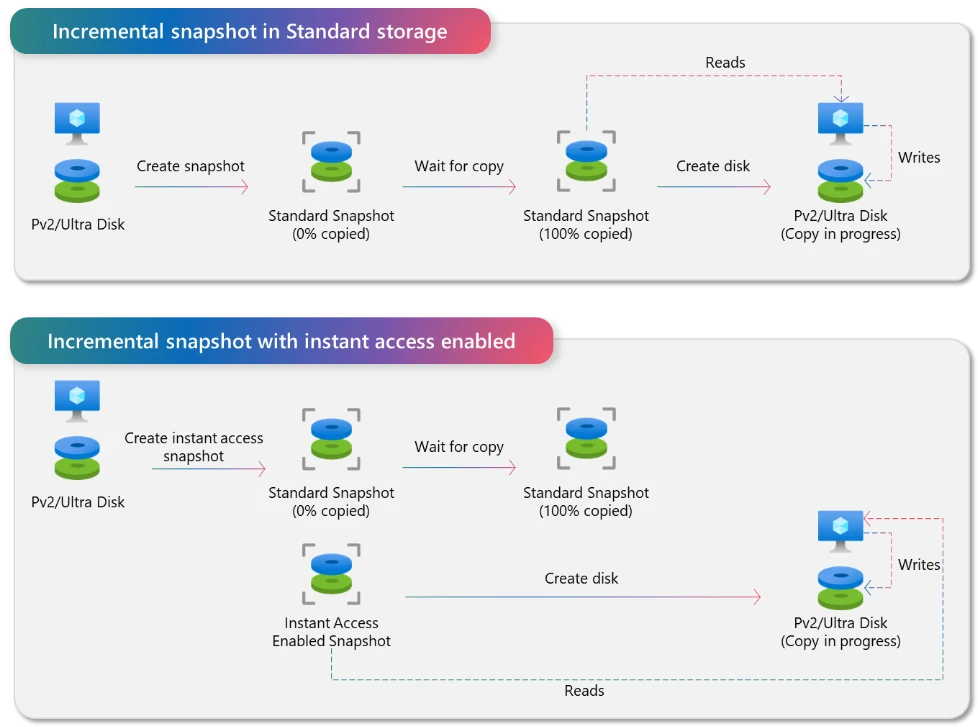
We are thrilled to announce an exciting new experience: Instant Access Snapshot for Ultra and Premium SSD v2 disks, now available in public preview. With Instant Access, you can immediately use snapshots after creation to generate new disks, eliminating the wait time (often spanning numerous hours) traditionally required for background data copy before the snapshot is in a ready and usable state. Disks generated from these Instant Access Snapshots now hydrate up to 10x faster and experience minimal read latency impact during the hydration process. This advanced capability marks a significant leap forward in the public cloud market, enabling rapid recovery and replication scale-out for your organization in real time. No more lengthy restoration processes or costly downtime! Instant Access Snapshot empowers you to get back to business within moments, not hours.

Building on the foundation of security, flexibility, and efficiency for Ultra Disk

Let’s walk through a few other features recently released that will greatly enhance your high-performance workload experience on Ultra Disk.

Operate with cost-efficiency by expanding your Ultra Disk capacity live with the support of live resize and dynamically adjusting Ultra Disk performance to avoid over provisioning. 

Run your business application securely with encryption at host on Ultra Disk. Encryption at host will encrypt your data starting from the VM host and then store the encrypted data in Ultra Disk.

Azure Site Recovery – Recover your VM applications with Ultra Disk seamlessly in another Azure region when your primary region is down.

Azure VM Backup – Backup your VM applications equipped with Ultra Disk easily and securely.

Azure Disk Backup – Backup a specific Ultra Disk that is critical to your business operation to lower your backup cost and for more customized backup operations.

Third party backup and disaster recovery support: We understand that you may have preferred third party service for your backup and disaster recovery procedures. Check out the third-party services here that now support Ultra Disk.

Migrate your clustered application to Azure as-is that uses SCSI Persistent Reservations to Ultra Disk with shared disk capability. Shared disk capability unlocks easy migration and further cost optimization for your mission-critical clustered applications.

Getting started: Unlock new possibilities for your business

Join us on this journey to redefine what’s possible for your mission critical business applications. With Azure Ultra Disk, you can experience the future of high-performance storage today, empowering your organization to move faster, recover instantly, and scale with confidence.

New to Ultra Disk? Start with our comprehensive documentation and how to deploy an Ultra Disk.

Have questions or feedback? Reach out to our team at AzureDisks@microsoft.com.

Start using Azure Ultra Disk today

The post The new era of Azure Ultra Disk: Experience the next generation of mission-critical block storage appeared first on Microsoft Azure Blog.
Quelle: Azure

Securing our future: November 2025 progress report on Microsoft’s Secure Future Initiative

When we launched the Secure Future Initiative (SFI), our mission was clear: accelerate innovation, strengthen resilience, and lead the industry toward a safer digital future. Today, we’re sharing our latest progress report that reflects steady progress in every area and engineering pillar, underscoring our commitment to security above all else. We also highlight new innovations delivered to better protect customers, and share how we use some of those same capabilities to protect Microsoft. Through SFI, we have improved the security of our platforms and services and our ability to detect and respond to cyberthreats.

Read the latest Secure Future Initiative reportFostering a security-first mindsetEngineering sentiment around security has improved by nine points since early 2024. To increase security awareness, 95% of employees have completed the latest training on guarding against AI-powered cyberattacks, which remains one of our highest-rated courses. Finally, we developed resources for employees and made them available to customers for the first time to improve security awareness.

Governance that scales globallyThe Cybersecurity Governance Council now includes three additional Deputy Chief Information Security Officers (CISOs) functions covering European regulations, internal operations, and engagement with our ecosystem of partners and suppliers. We launched the Microsoft European Security Program to deepen partnerships and better inform European governments about the cyberthreat landscape and collaborating with industry partners to better align cybersecurity regulations, advance responsible state behavior in cyberspace, and build cybersecurity capacity through the Advancing Regional Cybersecurity Initiative in the global south. You can read more on our cybersecurity policy and diplomacy work.

Secure by Design, Secure by Default, Secure OperationsMicrosoft Azure, Microsoft 365, Windows, Microsoft Surface, and Microsoft Security engineering teams continue to deliver innovations to better protect customers. Azure enforced secure defaults, expanded hardware-based trust, and updated security benchmarks to improve cloud security. Microsoft 365 introduced a dedicated AI Administrator role, and enhanced agent lifecycle governance and data security transparency to give organizations more control and visibility. Windows and Surface advanced Zero Trust principles with expanded passkeys, automatic recovery capabilities, and memory-safe improvements to firmware and drivers. Microsoft Security introduced data security posture management for AI and evolved Microsoft Sentinel into an AI-first platform with data lake, graph, and Model Context Protocol capabilities.

Engineering progress that sets the benchmarkWe’re making steady progress across all engineering pillars. Key achievements include enforcing phishing-resistant multifactor authentication (MFA) for 99.6% of Microsoft employees and devices, migrating higher-risk users to locked-down Azure Virtual Desktop environments, completing network device inventory and lifecycle management, and achieving 99.5% detection and remediation of live secrets in code. We’ve also deployed more than 50 new detections across Microsoft infrastructure with applicable detections to be added to Microsoft Defender and awarded $17 million to promote responsible vulnerability disclosure.

Actionable guidanceTo help customers improve their security, we highlight 10 SFI patterns and practices customers can follow to reduce their risk. We also share additional best practices and guidance throughout the report. Customers can do a deeper assessment of their security posture by using our Zero Trust Workshops which incorporate SFI-based assessments and actionable learnings to help customers on their own security journeys.

Security as the foundation of trustCybersecurity is no longer a feature—it’s the foundation of trust in a connected world.

With the equivalent of 35,000 engineers working full time on security, SFI remains the largest cybersecurity effort in digital history. Looking ahead, we will continue to prioritize the highest risks, accelerate delivery of security innovations, and harness AI to increase engineering efficiency and enable rapid anomaly detection and automated remediation.

The cyberthreat landscape will continue to evolve. Technology will continue to advance. And Microsoft will continue to prioritize security above all else. Our progress reflects a simple truth: trust is earned through action and accountability.

We are grateful for the partnership of our customers, industry peers, and security researchers. Together, we will innovate for a safer future.

Read our November 2025 progress report​​Learn more with Microsoft SecurityTo learn more about Microsoft Security solutions, visit our website. Bookmark the Security blog to keep up with our expert coverage on security matters. Also, follow us on LinkedIn (Microsoft Security) and X (@MSFTSecurity) for the latest news and updates on cybersecurity.
The post Securing our future: November 2025 progress report on Microsoft’s Secure Future Initiative appeared first on Microsoft Azure Blog.
Quelle: Azure
GitHub Universe 2025: Where developer innovation took center stage

At GitHub Universe 2025, the theme was clear: the ability to see, steer, and build across agents will bring the greatest impact and GitHub is the platform that’s transforming and empowering how developers and agents work together. As we heard from Kyle Daigle, Chief Operating Officer, GitHub, on stage this week, it is “the new era of collaboration.” Agents have become an integral part of software development already, taking on manual, repetitive coding tasks so developers can focus on complex problem-solving and creative, higher impact work. Developers have been at the forefront of AI from the beginning. They are showing us how agents can break down traditional roles, redefine processes, and introduce a scaling effect so we can build AI-powered solutions as quickly as we can dream them up.

GitHub is supporting every developer, on every language, and running locally or in any cloud, as they set an example for every other business function on the role of AI. This year’s GitHub Universe event was a celebration of code and community, and a showcase of developer tools, developer control, and developer choice. Our friends at GitHub announced key innovations to build agentic apps with enterprise-grade security, scalability, and trust. Now with Agent HQ—the open ecosystem that unites every agent on a single platform—there is one mission control to assign, govern, and track multiple agents in one place. Microsoft is helping turn this vision into velocity, delivering the infrastructure and products developers need to build what’s next. The rise of agents is a transformation we first introduced at Microsoft Build, and it’s accelerating fast. By harnessing the full power of the Azure portfolio, agentic AI becomes more than a productivity boost. It’s a strategic advantage.

Record-breaking growth and momentum

GitHub’s Octoverse 2025 report, released this week, offers an annual snapshot of global software development trends, highlighted record-breaking growth, and momentum across the developer ecosystem:

Find the full Octoverse 2025 summary here

180M+ developers work and build on GitHub.

Nearly 80% of developers new to GitHub use Copilot in their first week.

630M total projects on GitHub, +121M in 2025, the biggest year yet.

1.12B contributions to public and open source repositories, +13% year-over-year.

4.3M+ AI-related repositories, nearby double since 2023.

TypeScript and Python are the two most used languages in 2025, signaling a shift driven by AI preferences.

These numbers reflect a global movement—developers embracing AI, open source, and cloud-native tools to build faster and smarter. At Microsoft, we are customer zero when it comes to leveraging AI every day across various business processes and workflows. Nearly all of Microsoft’s engineers use GitHub Copilot as part of their development processes. Agents will make us not only more efficient and faster but fundamentally reinvent how we work.

This transformation isn’t just enterprise-led. As AI and agentic workflows are redefining how software gets built, it was clear while in San Francisco this week, startups are at the forefront.

I work with startups all over the world building cutting-edge data and AI solutions, and I see every day how GitHub Copilot makes it possible for startups to run leaner, make the most of their dev resources and ship faster. It makes a huge difference in terms of their quality of output and time to market. GitHub Copilot is now the standard that’s powering the next generation of AI solutions.
Heena Purohit, Global Director, Data and AI, Microsoft for Startups

This next era is about giving developers even more autonomy, intelligence, and infrastructure to help organizations unlock new value. When developers thrive, the business thrives.

Empowering every organization with AI tools built for what’s next

Microsoft Azure offers a full-stack platform that brings together AI-powered developer tools, agents, and enterprise-grade security from cloud to edge. It’s a human-centered approach to software delivery, designed to help every organization move faster, build smarter, and innovate with confidence. Agents are changing the game by assisting developers (and each other) across the entire lifecycle. Agents can tackle bug fixes, documentation to code reviews, and deploy to Azure, so developers can focus on what they do best: create.

You can now build and deploy AI agents end-to-end in Visual Studio Code with help from GitHub Copilot. AI Toolkit for VS Code lets developers explore models and build agents where they code—with evaluation and tracing in one place. Now, with prompt-first agent development powered by GitHub Copilot and built on the Microsoft Agent Framework, developers can create, refine, and launch production-ready agents faster and more intuitively than ever—all from within their favorite editor.

Azure MCP Server is now generally available, giving your agents the power of cloud and redefining how developers interact with Azure. Built on Model Context Protocol (MCP), it can create a secure, standards-based bridge between Azure services—like AKS, ACA, App Service, Cosmos DB, SQL, AI Foundry, and Fabric—and AI-powered tools such as GitHub Copilot. Imagine managing cloud resources, generating infrastructure-as-code, and troubleshooting deployments—all through natural language, right from your favorite IDE or MCP-compatible client, and all aligned with Azure best practices. Azure MCP Server accelerates innovation, eliminates context switching, and delivers enterprise-grade security and scalability. It’s not just a tool—it’s the future of intelligent cloud development.

Modern app development is in a new era—where developers are moving from writing code to orchestrating autonomous systems that understand and act on intent. On the main stage this week, Amanda Silver, Corporate Vice President and Head of Product for Apps and Agents at Microsoft, showcased how Microsoft and GitHub Copilot work together to empower spec-driven development, code generation with Azure context, prompt first agent creation, workflow orchestration, and operational excellence. Together, redefining how human creativity becomes production-ready innovation.

Becoming frontier starts here

At Microsoft, we’re proud to be part of this journey—providing the infrastructure and integration that make agentic development real for enterprises around the world.

GitHub Universe 2025 wasn’t just a showcase, it was a signal. AI is now the default expectation in software development, and agentic workflows are becoming the new standard. And with GitHub and Azure working together, we uniquely deliver the tools, platforms, and vision to help every developer thrive.

We’re building that future alongside GitHub, our customers, our startups and partner ecosystem, and the global developer community. Because when the right tools are in the hands of developers, transformation isn’t a question of if—it’s a matter of how fast. When developers lead, innovation follows.

Build in cloud with Azure
Microsoft Azure can help you get started with AI-powered developer tools, agents, and enterprise-grade security.

Start your AI journey

The post GitHub Universe 2025: Where developer innovation took center stage appeared first on Microsoft Azure Blog.
Quelle: Azure
Resiliency in the cloud—empowered by shared responsibility and Azure Essentials

Empowering organizations to shape the future of cloud with resilient, always-on solutions.

Overview

In today’s digital-first era, downtime is not an option—businesses must be resilient to thrive.

Imagine it’s 2:00 AM and an outage occurs. Whether your team responds with panic or calm depends on how well you’ve prepared. Fast recovery isn’t luck—it’s the result of intentional planning for resiliency by design.

Reliability means your cloud service works as expected, delivering consistent uptime and performance. Resiliency is your ability to quickly recover when things go wrong—like outages or disasters.

Reliability is the promise; building resiliency is how we keep that promise. Leading organizations build resiliency into their cloud solutions from the start, using zone-redundant architectures as a baseline and expanding to multi-region deployments for their most critical workloads.

Microsoft’s Azure Essentials is designed to make these practices accessible and actionable for every organization.

What is Azure Essentials?

Shared responsibility

Reliability and resiliency in the cloud are achieved through a partnership between Microsoft and our customers. The shared responsibility model clarifies accountability by role:

AreaMicrosoft(Platform reliability)Customer/Partner(Solution resiliency)Global platform availabilityDelivers global infrastructure and uptimeN/AFoundational SLAsGuarantees service levelsN/ASolution architecture and SLOsN/ADesign and maintain solution-level objectivesConfiguration, deployments, and operationsN/AImplement and manage deployments and operationsBackup and disaster recoveryProvides secure backup capabilitiesDevelop and test recovery plansValidationOffers platform validation toolsTest solution’s ability to withstand failuresGovernance and complianceSets shared guardrailsEnforce policies and compliance within environment

Note: N/A indicates that the responsibility does not apply to that party.

Real stories, real impact:

Publix Employees Federal Credit Union leveraged Azure’s disaster recovery capabilities to minimize downtime during severe weather. The University of Miami adopted availability zones and robust recovery strategies to ensure continuity for students and faculty. These stories show how platform reliability and customer resiliency combine for real-world results.

How Microsoft helps: Azure Essentials as the anchor

At the heart of Microsoft’s approach is Azure Essentials—the unified methodology that brings together all the tools, guidance, and best practices our customers need. Azure Essentials enables organizations to build resilient, reliable, and secure cloud solutions at every stage of their journey.

Azure Essentials brings together:

Foundational blueprints: Azure Well-Architected Framework and Cloud Adoption Framework guidance to establish secure, cost-effective environments from day one.

Actionable assessments: Optimization tools and gap analyses for continuous improvement.

Integrated tools: Validation with Azure Chaos Studio, monitoring with Azure Monitor, security with Microsoft Defender for Cloud, and automation with Azure DevOps.

Resilient design patterns: Support for migration, modernization, AI innovation, and unified data platforms with zone-redundant architectures and disaster recovery solutions.

Continuous improvement: Ongoing validation, monitoring, and remediation to maintain a strong resiliency posture.

Azure Essentials in action: Practical stages

Start resilient: Apply zone-redundant patterns, align security and governance, and embed resiliency early using Azure Blueprints and reference architectures.

Get resilient: Address gaps in existing deployments through assessments and targeted remediation plans and recommend high-availability strategies such as multi-region deployments.

Stay resilient: Implement continuous validation and improvement cycles, using telemetry, policy, and partner services to enforce resiliency posture.

With Azure Essentials, you’re not just preparing for the future—you’re helping to shape it, setting a new standard for resilient, always-on cloud innovation.

Resiliency across Azure solutions

Azure Essentials empowers organizations to build resiliency into every Azure solution—whether you’re migrating workloads, innovating with AI, or unifying your data platform. Here’s how each solution area supports resilient cloud operations, with direct links to practical guidance:

Migration and modernization: Architect for zone-redundancy, implement backup and disaster recovery, and validate resiliency after migration. Learn more.

This resource provides actionable strategies for designing cloud solutions that minimize downtime and ensure business continuity through redundancy and robust architecture.

AI apps and agents: Deploy models across multiple zones or regions, build resilient APIs and data pipelines, and continuously monitor and retrain models. Learn more.

This link offers practical guidance on building and deploying AI-powered applications that are resilient, scalable, and secure, with real-world examples and best practices.

Unified data platform: Design for durability and rapid recovery with geo-redundancy, regular backups, and automated recovery processes. Learn more.

This article explains how to architect data platforms for resilience, covering strategies for backup, recovery, and high availability using Microsoft Fabric.

Organizations can architect for fault tolerance, eliminate single points of failure, back up and test recovery regularly, and enforce governance at scale. Tools like Azure Advisor, Azure Monitor, and Azure DevOps help automate and monitor operations, while Azure Chaos Studio enables validation and testing.

Where to find more information

Ready to get your organization’s cloud environment resilient? Start with these resources:

Explore: Backup and disaster recovery.

Use: Reliability guides by service.

Access technical methodology: Azure Essentials.

Start your project with experts and investments: Azure Accelerate.

Register for: Microsoft Ignite sessions on resiliency best practices.

Take the next step to make resiliency and reliability your default by leveraging Azure Essentials and the rest of these resources today.

Get started with Azure Accelerate
Fuel transformation with experts and investments across the cloud and AI journey.

What is Azure Accelerate?

The post Resiliency in the cloud—empowered by shared responsibility and Azure Essentials appeared first on Microsoft Azure Blog.
Quelle: Azure

Introducing Agent HQ: Any agent, any way you work

The current AI landscape presents a challenge we’re all too familiar with: incredible power fragmented across different tools and interfaces. At GitHub, we’ve always worked to solve these kinds of systemic challenges—by making Git accessible, code review systematic with pull requests, and automating deployment with Actions.

With 180 million developers, GitHub is growing at its fastest rate ever—a new developer joining every second. What’s more, 80% of new developers are using Copilot in their first week. AI isn’t just a tool anymore; it’s an integral part of the development experience. Our responsibility is to ensure this new era of collaboration is powerful, secure, and seamlessly integrated into the workflow you already trust.

At GitHub Universe, we’re announcing Agent HQ, GitHub’s vision for the next evolution of our platform. Agents shouldn’t be bolted on. They should work the way you already work. That’s why we’re making agents native to the GitHub flow.

Agent HQ transforms GitHub into an open ecosystem that unites every agent on a single platform. Over the coming months, coding agents from Anthropic, OpenAI, Google, Cognition, xAI, and more will become available directly within GitHub as part of your paid GitHub Copilot subscription.

To bring this vision to life, we’re shipping a suite of new capabilities built on the primitives you trust. This starts with a mission control, a single command center to assign, steer, and track the work of multiple agents from anywhere. It extends to VS Code with new ways to plan and customize agent behavior. And it is backed by enterprise-grade functionality: a new generation of agentic code review, a dedicated control plane to govern AI access and agent behavior, and a metrics dashboard to understand the impact of AI on your work.

We are also deeply committed to investing in our platform and strengthening the primitives you rely on every day. This new world of development is powered by that foundational work, and we look forward to sharing more updates.

Let’s dive in.

In this postGitHub is your Agent HQ: An open ecosystem for all agentsMission control: Your command center, wherever you buildNew in VS Code: Plan, customize, and connectIncreased confidence and control for your teamGitHub is your Agent HQ: An open ecosystem for all agentsThe future is about giving you the power to orchestrate a fleet of specialized agents to perform complex tasks in parallel, not juggling a patchwork of disconnected tools or relying on a single agent. As the pioneer of asynchronous collaboration, we believe it’s our responsibility to make sure these next-generation async tools just work.

With Agent HQ what’s not changing is just as important as what is. You’re still working with the primitives you know—Git, pull requests, issues—and using your preferred compute, whether that’s GitHub Actions or self-hosted runners. You’re accessing agents through your existing paid Copilot subscription.

On top of that foundation, we’re opening the doors to a new world of capability. Over the coming months, coding agents from Anthropic, OpenAI, Google, Cognition, and xAI will be available on GitHub as part of your paid GitHub Copilot subscription.

Don’t want to wait? Starting this week, Copilot Pro+ users can begin working with OpenAI Codex in VS Code Insiders, the first of our partner agents to extend beyond its native surfaces and directly into the editor.

‘Our collaboration with GitHub has always pushed the frontier of how developers build software. The first Codex model helped power Copilot and inspired a new generation of AI-assisted coding. We share GitHub’s vision of meeting developers wherever they work, and we’re excited to bring Codex to millions more developers who use GitHub and VS Code, extending the power of Codex everywhere code gets written.’

Alexander Embiricos, Codex Product Lead, OpenAI

‘We’re partnering with GitHub to bring Claude even closer to how teams build software. With Agent HQ, Claude can pick up issues, create branches, commit code, and respond to pull requests, working alongside your team like any other collaborator. This is how we think the future of development works: agents and developers building together, on the infrastructure you already trust.’

Mike Krieger, Chief Product Officer, Anthropic

‘The best developer tools fit seamlessly into your workflow, helping you stay focused and move faster. With Agent HQ, Jules becomes a native assignee, streamlining manual steps and reducing friction in everyday development. This deeper integration with GitHub brings agents closer to where developers already work, making collaboration more natural and efficient.’

Kathy Korevec, Director of Product at Google LabsMission control: Your command center, wherever you buildThe power of Agent HQ comes from mission control, a unified command center that follows you wherever you work. It’s not a single destination; it’s a consistent interface across GitHub, VS Code, mobile, and the CLI that lets you direct, monitor, and manage every AI-driven task. With mission control, you can choose from a fleet of agents, assign them work in parallel, and track their progress from any device.

We’re also providing:

New branch controls that give you granular oversight over when to run CI and other checks for agent-created code.Identity features to control which agent is building the task, managing access, and policies just like you would with any other developer on your team.One-click merge conflict resolution, improved file navigation, and better code commenting capabilities.New integrations for Slack and Linear, on top of our recently announced connections for Atlassian Jira, Microsoft Teams and Azure Boards, and Raycast.Logos for Slack, Linear, Microsoft Teams, VS Code, Azure Boards, Jira, and Raycast.Try mission control today.

New in VS Code: Plan, customize, and connectMission control is in VS Code, too, so you’ve got a single view of all your agents running in VS Code, in the Copilot CLI, or on GitHub.

Today’s brand new release in VS Code is all about working alongside agents on projects, and it’s not surprising that great results start with a great plan. Getting the context right before a project is critical, but that same context needs to carry through into the work. Copilot already adapts to the way your team works by learning from your files and your project’s culture, but sometimes you need more pointed context.

So today, we’re introducing Plan Mode, which works with Copilot, and asks you clarifying questions along the way, to help you to build a step-by-step approach for your task. Providing the context upfront improves what Copilot can do and helps you find gaps, missing decisions, or project deficiencies early in the process—before any code is written. Once you approve, your plan goes to Copilot to start implementing, whether that’s locally in VS Code or using an agent in the cloud.

For even finer control, you can now create custom agents in VS Code with AGENTS.md files, source-controlled documents that let you set clear rules and guardrails such as “prefer this logger” or “use table-driven tests for all handlers.” This shapes Copilot’s behavior without you re-prompting it every time.

Now you can rely on the new GitHub MCP Registry, available directly in VS Code. VS Code is the only editor that supports the full MCP specification. Discover, install, and enable MCP servers like Stripe, Figma, Sentry, and others, with a single click. When your task calls for a specialist, create custom agents in GitHub Copilot with their own system prompt and tools to help you define the ways you want Copilot to work.

Increased confidence and control for your teamAgent HQ doesn’t just give you more power—it gives you confidence. Ensuring code quality, understanding AI’s influence on your workflow, and maintaining control over how AI interacts with your codebase and organization are essential for your team’s success, and we’re tackling these challenges head-on.

When it comes to code quality, the core problem is that “LGTM” doesn’t always mean “the code is healthy.” A review can pass, but can still degrade the codebase and quickly become long-term technical debt. With GitHub Code Quality, in public preview today, you’ve got org-wide visibility, governance, and reporting to systematically improve code maintainability, reliability, and test coverage across every repository. Enabling it extends Copilot’s security checks to look at the maintainability and reliability impact of the code that’s been changed.

And we’ve added a code review step into the Copilot coding agent’s workflow, too, so Copilot gets an initial first-line review and addresses problems (before you even see the code).

Screenshot of GitHub Code Quality, showing the results of Copilot’s review.As an organization, you need to know how Copilot is being used. So today, we’re announcing the public preview of the Copilot metrics dashboard, showing Copilot’s impact and critical usage metrics across your entire organization.

For enterprise administrators who are managing AI access, including AI agents and MCP, we’re focused on providing consistent AI controls for teams with the control plane—your agent governance layer. Set security policies, audit logging, and manage access all in one place. Enterprise admins can also control which agents are allowed, define access to models, and obtain metrics about the Copilot usage in your organization.

For developers, by developersWe built Agent HQ because we’re developers, too. We know what it’s like when it feels like your tools are fighting you instead of helping you. When “AI-powered” ends up meaning more context-switching, more babysitting, more subscriptions, and more time explaining what you need to get the value you were promised.

That ends today.

Agent HQ isn’t about the hype of AI. It’s about the reality of shipping code. It’s about bringing order and governance to this new era without compromising choice. It’s about giving you the power to build faster, with more confidence, and on your terms.

Welcome home. Let’s build.
The post Introducing Agent HQ: Any agent, any way you work appeared first on Microsoft Azure Blog.
Quelle: Azure

Building the future together: Microsoft and NVIDIA announce AI advancements at GTC DC

Microsoft and NVIDIA are deepening our partnership to power the next wave of AI industrial innovation. For years, our companies have helped fuel the AI revolution, bringing the world’s most advanced supercomputing to the cloud, enabling breakthrough frontier models, and making AI more accessible to organizations everywhere. Today, we’re building on that foundation with new advancements that deliver greater performance, capability, and flexibility.

With added support for NVIDIA RTX PRO 6000 Blackwell Server Edition on Azure Local, customers can deploy AI and visual computing workloads distributed and edge environments with the seamless orchestration and management you use in the cloud. New NVIDIA Nemotron and NVIDIA Cosmos models in Azure AI Foundry give businesses an enterprise-grade platform to build, deploy, and scale AI applications and agents. With NVIDIA Run:ai on Azure, enterprises can get more from every GPU to streamline operations and accelerate AI. Finally, Microsoft is redefining AI infrastructure with the world’s first deployment of NVIDIA GB300 NVL72.

Explore our partnership on Azure Local

Today’s announcements mark the next chapter in our full-stack AI collaboration with NVIDIA, empowering customers to build the future faster.

Expanding GPU support to Azure Local

Microsoft and NVIDIA continue to drive advancements in artificial intelligence, offering innovative solutions that span the public and private cloud, the edge, and sovereign environments.

As highlighted in the March blog post for NVIDIA GTC, Microsoft will offer NVIDIA RTX PRO 6000 Blackwell Server Edition GPUs on Azure. Now, with expanded availability of NVIDIA RTX PRO 6000 Blackwell Server Edition GPUs on Azure Local, organizations can optimize their AI workloads, regardless of location, to provide customers with greater flexibility and more options than ever. Azure Local leverages Azure Arc to empower organizations to run advanced AI workloads on-premises while retaining the management simplicity of the cloud or operating in fully disconnected environments. 

NVIDIA RTX PRO 6000 Blackwell GPUs provide the performance and flexibility needed to accelerate a broad range of use cases, from agentic AI, physical AI, and scientific computing to rendering, 3D graphics, digital twins, simulation, and visual computing. This expanded GPU support unlocks a range of edge use cases that fulfill the stringent requirements of critical infrastructure for our healthcare, retail, manufacturing, government, defense, and intelligence customers. This may include real-time video analytics for public safety, predictive maintenance in industrial settings, rapid medical diagnostics, and secure, low-latency inferencing for essential services such as energy production and critical infrastructure. The NVIDIA RTX PRO 6000 Blackwell enables improved virtual desktop support by leveraging NVIDIA vGPU technology and Multi-Instance GPU (MIG) capabilities. This can not only accommodate a higher user density, but also power AI-enhanced graphics and visual compute capabilities, offering an efficient solution for demanding virtual environments.

Earlier this year, Microsoft announced a multitude of AI capabilities at the edge, all enriched with NVIDIA accelerated computing:

Edge Retrieval Augmented Generation (RAG): Empower sovereign AI deployments with fast, secure, and scalable inferencing on local data—supporting mission-critical use cases across government, healthcare, and industrial automation.

Azure AI Video Indexer enabled by Azure Arc: Enables real-time and recorded video analytics in disconnected environments—ideal for public safety and critical infrastructure monitoring or post-event analysis.

With Azure Local, customers can meet strict regulatory, data residency, and privacy requirements while harnessing the latest AI innovations powered by NVIDIA.

Whether you need ultra-low latency for business continuity, robust local inferencing, or compliance with industry regulations, we’re dedicated to delivering cutting-edge AI performance wherever your data resides. Customers now access the breakthrough performance of the NVIDIA RTX PRO 6000 Blackwell GPUs in new Azure Local solutions—including Dell AX-770, HPE ProLiant DL380 Gen12, and Lenovo ThinkAgile MX650a V4.

To find out more about upcoming availability and sign up for early ordering, visit: 

Dell for Azure Local

HPE for Azure Local

Lenovo for Azure Local

Powering the future of AI with new models on Azure AI Foundry

At Microsoft, we’re committed to bringing the most advanced AI capabilities to our customers, wherever they need them. Through our partnership with NVIDIA, Azure AI Foundry now brings world-class multimodal reasoning models directly to enterprises, deployable anywhere as secure, scalable NVIDIA NIM™ microservices. The portfolio spans a range of different use cases:

NVIDIA Nemotron Family: High accuracy open models and datasets for agentic AI

Llama Nemotron Nano VL 8B is available now and is tailored for multimodal vision-language tasks, document intelligence and understanding, and mobile and edge AI agents. 

NVIDIA Nemotron Nano 9B is available now and supports enterprise agents, scientific reasoning, advanced math, and coding for software engineering and tool calling. 

NVIDIA Llama 3.3 Nemotron Super 49B 1.5 is coming soon and is designed for enterprise agents, scientific reasoning, advanced math, and coding for software engineering and tool calling.

NVIDIA Cosmos Family: Open world foundation models for physical AI

Cosmos Reason-1 7B is available now and supports robotics planning and decision making, training data curation and annotation for autonomous vehicles, and video analytics AI agents extracting insights and performing root-cause analysis from video data.

NVIDIA Cosmos Predict 2.5 is coming soon and is a generalist model for world state generation and prediction. 

NVIDIA Cosmos Transfer 2.5 is coming soon and is designed for structural conditioning and physical AI.

Microsoft TRELLIS by Microsoft Research: High-quality 3D asset generation 

Microsoft TRELLIS by Microsoft Research is available now and enables digital twins by generating accurate 3D assets from simple prompts, immersive retail experiences with photorealistic product models for AR and virtual try-ons, and game and simulation development by turning creative ideas into production-ready 3D content.

Together, these open models reflect the depth of the Azure and NVIDIA partnership: combining Microsoft’s adaptive cloud with NVIDIA’s leadership in accelerated computing to power the next generation of agentic AI for every industry. Learn more about the models here.

Maximizing GPU utilization for enterprise AI with NVIDIA Run:ai on Azure

As an AI workload and GPU orchestration platform, NVIDIA Run:ai helps organizations make the most of their compute investments, accelerating AI development cycles and driving faster time-to-market for new insights and capabilities. By bringing NVIDIA Run:ai to Azure, we’re giving enterprises the ability to dynamically allocate, share, and manage GPU resources across teams and workloads, helping them get more from every GPU.

NVIDIA Run:ai on Azure integrates seamlessly with core Azure services, including Azure NC and ND series instances, Azure Kubernetes Service (AKS), and Azure Identity Management, and offers compatibility with Azure Machine Learning and Azure AI Foundry for unified, enterprise-ready AI orchestration. We’re bringing hybrid scale to life to help customers transform static infrastructure into a flexible, shared resource for AI innovation.

With smarter orchestration and cloud-ready GPU pooling, teams can drive faster innovation, reduce costs, and unleash the power of AI across their organizations with confidence. NVIDIA Run:ai on Azure enhances AKS with GPU-aware scheduling, helping teams allocate, share, and prioritize GPU resources more efficiently. Operations are streamlined with one-click job submission, automated queueing, and built in governance. This ensures teams spend less time managing infrastructure and more time focused on building what’s next. 

This impact spans industries, supporting the infrastructure and orchestration behind transformative AI workloads at every stage of enterprise growth: 

Healthcare organizations can use NVIDIA Run:ai on Azure to advance medical imaging analysis and drug discovery workloads across hybrid environments. 

Financial services organizations can orchestrate and scale GPU clusters for complex risk simulations and fraud detection models. 

Manufacturers can accelerate computer vision training models for improved quality control and predictive maintenance in their factories. 

Retail companies can power real-time recommendation systems for more personalized experiences through efficient GPU allocation and scaling, ultimately better serving their customers.

Powered by Microsoft Azure and NVIDIA, Run:ai is purpose-built for scale, helping enterprises move from isolated AI experimentation to production-grade innovation.

const currentTheme =
localStorage.getItem(‘msxcmCurrentTheme’) ||
(window.matchMedia(‘(prefers-color-scheme: dark)’).matches ? ‘dark’ : ‘light’);

// Modify player theme based on localStorage value.
let options = {“autoplay”:false,”hideControls”:null,”language”:”en-us”,”loop”:false,”partnerName”:”cloud-blogs”,”poster”:”https://cdn-dynmedia-1.microsoft.com/is/image/microsoftcorp/1089732-ActualizeNVIDIA-RUN-AI-AZURE?wid=1280″,”title”:””,”sources”:[{“src”:”https://cdn-dynmedia-1.microsoft.com/is/content/microsoftcorp/1089732-ActualizeNVIDIA-RUN-AI-AZURE-0x1080-6439k”,”type”:”video/mp4″,”quality”:”HQ”},{“src”:”https://cdn-dynmedia-1.microsoft.com/is/content/microsoftcorp/1089732-ActualizeNVIDIA-RUN-AI-AZURE-0x720-3266k”,”type”:”video/mp4″,”quality”:”HD”},{“src”:”https://cdn-dynmedia-1.microsoft.com/is/content/microsoftcorp/1089732-ActualizeNVIDIA-RUN-AI-AZURE-0x540-2160k”,”type”:”video/mp4″,”quality”:”SD”},{“src”:”https://cdn-dynmedia-1.microsoft.com/is/content/microsoftcorp/1089732-ActualizeNVIDIA-RUN-AI-AZURE-0x360-958k”,”type”:”video/mp4″,”quality”:”LO”}],”ccFiles”:[{“url”:”https://azure.microsoft.com/en-us/blog/wp-json/msxcm/v1/get-captions?url=https%3A%2F%2Fwww.microsoft.com%2Fcontent%2Fdam%2Fmicrosoft%2Fbade%2Fvideos%2Fproducts-and-services%2Fen-us%2Fazure%2F1089732-actualizenvidia-run-ai-azure%2F1089732-ActualizeNVIDIA-RUN-AI-AZURE_cc_en-us.ttml”,”locale”:”en-us”,”ccType”:”TTML”}]};

if (currentTheme) {
options.playButtonTheme = currentTheme;
}

document.addEventListener(‘DOMContentLoaded’, () => {
ump(“ump-69012f878d8eb”, options);
});

Reimagining AI at scale: First to deploy NVIDIA GB300 NVL72 supercomputing cluster

Microsoft is redefining AI infrastructure with the new NDv6 GB300 VM series, delivering the first at-scale production cluster of NVIDIA GB300 NVL72 systems, featuring over 4600 NVIDIA Blackwell Ultra GPUs connected via NVIDIA Quantum-X800 InfiniBand networking. Each NVIDIA GB300 NVL72 rack integrates 72 NVIDIA Blackwell Ultra GPUs and 36 NVIDIA Grace™ CPUs, delivering over 130 TB/s of NVLink bandwidth and up to 136 kW of compute power in a single cabinet. Designed for the most demanding workloads—reasoning models, agentic systems, and multimodal AI—GB300 NVL72 combines ultra-dense compute, direct liquid cooling, and smart rack-scale management to deliver breakthrough efficiency and performance within a standard datacenter footprint. 

Azure’s co-engineered infrastructure enhances GB300 NVL72 with technologies like Azure Boost for accelerated I/O and integrated hardware security modules (HSM) for enterprise-grade protection. Each rack arrives pre-integrated and self-managed, enabling rapid, repeatable deployment across Azure’s global fleet. As the first cloud provider to deploy NVIDIA GB300 NVL72 at scale, Microsoft is setting a new standard for AI supercomputing—empowering organizations to train and deploy frontier models faster, more efficiently, and more securely than ever before. Together, Azure and NVIDIA are powering the future of AI. 

Learn more about Microsoft’s systems approach in delivering GB300 NVL72 on Azure.

Unleashing the performance of ND GB200-v6 VMs with NVIDIA Dynamo 

Our collaboration with NVIDIA focuses on optimizing every layer of the computing stack to help customers maximize the value of their existing AI infrastructure investments. 

To deliver high-performance inference for compute-intensive reasoning models at scale, we’re bringing together a solution that combines the open-source NVIDIA Dynamo framework, our ND GB200-v6 VMs with NVIDIA GB200 NVL72 and Azure Kubernetes Service(AKS). We’ve demonstrated the performance this combined solution delivers at scale with the gpt-oss 120b model processing 1.2 million tokens per second deployed in a production-ready, managed AKS cluster and have published a deployment guide for developers to get started today. 

Dynamo is an open-source, distributed inference framework designed for multi-node environments and rack-scale accelerated compute architectures. By enabling disaggregated serving, LLM-aware routing and KV caching, Dynamo significantly boosts performance for reasoning models on Blackwell, unlocking up to 15x more throughput compared to the prior Hopper generation, opening new revenue opportunities for AI service providers. 

These efforts enable AKS production customers to take full advantage of NVIDIA Dynamo’s  inference optimizations when deploying frontier reasoning models at scale. We’re dedicated to bringing the latest open-source software innovations to our customers, helping them fully realize the potential of the NVIDIA Blackwell platform on Azure. 

Learn more about Dynamo on AKS.

Get more AI resources

Join us in San Francisco at Microsoft Ignite in November to hear about the latest in enterprise solutions and innovation.

Explore Azure AI Foundry and Azure Local.

The post Building the future together: Microsoft and NVIDIA announce AI advancements at GTC DC appeared first on Microsoft Azure Blog.
Quelle: Azure

Microsoft named a Leader in the 2025 Gartner® Magic Quadrant™ for Distributed Hybrid Infrastructure

We’re proud that Microsoft has once again been named a Leader in the 2025 Gartner® Magic Quadrant™ for Distributed Hybrid Infrastructure. This is the third year in a row we’ve been recognized by Gartner, and we feel it reflects the impact we’re delivering by helping organizations run workloads seamlessly across hybrid, edge, multicloud, and sovereign environments with Azure. 

See the full 2025 Gartner Magic Quadrant for Distributed Hybrid Infrastructure report here

Azure’s adaptive cloud: built on Azure Arc and Azure Local

The reality for many organizations today is that not every workload belongs in a hyperscale datacenter. Azure’s adaptive cloud approach recognizes that reality and brings the cloud model to every environment through two core technologies.

Azure Arc brings Azure management to any environment, including datacenters, edge, and multicloud. It unifies on-premises and non-Azure resources through Azure Resource Manager and enables services such as Azure Kubernetes Service (AKS), Microsoft Defender for Cloud, Azure IoT Operations, and Azure AI Video Indexer.

Azure Local leverages Azure Arc to bring Azure services and management to customer-owned environments, enabling customers to run cloud-native workloads such as virtual machines and Arc-enabled AKS locally. Azure Local also supports Microsoft’s Sovereign Private Cloud strategy, enabling isolated, compliance-driven operations with Azure consistency.

Together, Azure Arc and Azure Local give customers unified governance, security, and management across distributed environments. They help organizations innovate faster, stay secure, and scale with confidence.

Real-world impact across industries

Azure’s adaptive cloud approach is especially valuable for organizations that need to balance local operations with the flexibility of the cloud. Manufacturers and industrial companies are deploying AI models at the edge to improve safety, quality, and automation while managing them centrally in Azure. Regulated sectors such as financial services, healthcare, and government maintain compliance and data residency as they modernize with Azure. Enterprises with distributed sites are using a single management plane to connect operations, improve efficiency, and gain real-time insight across locations.

Across these industries, we’re seeing customers embrace Azure’s adaptive cloud approach enabled by Azure Arc:

Publix Employees Federal Credit Union (PEFCU) consolidated operations using Azure Arc and Azure Local, reducing disaster recovery time to under 10 minutes per VM and freeing engineers to focus on innovation.

Delta Dental of California modernized its core payor system with containerized workloads, improving performance, uptime, and compliance.

CDW migrated 800 virtual machines to Azure Local, doubling SQL performance and strengthening governance and security with Azure Policy and Microsoft Defender for Cloud.

Coles and Emirates Global Aluminum (EGA) continue to scale operations with Azure Local, running GPU-enabled AI workloads that enhance analytics, customer experiences, and manufacturing insights.

These organizations are adopting Azure’s adaptive cloud approach to run workloads where they are needed most while unifying operations, security, and innovation across every environment.

Building the future together 

Recognition from Gartner is an important milestone to us, but what matters most is what our customers are achieving with Azure every day. We’re continuing to invest in making Azure more adaptive, more secure, and more capable across every environment so organizations can innovate on their own terms. We’re grateful for the trust our customers place in us and inspired by how they are shaping the future of cloud infrastructure right alongside us.

Learn more 

Learn how your organization can accelerate innovation with Azure Local and Azure Arc.

Explore Sovereign Private Cloud with Azure Local and Microsoft 365 Local.

Join us at Microsoft Ignite in San Francisco this November to explore the latest in enterprise innovation.

Gartner, Magic Quadrant for Distributed Hybrid Infrastructure, Julia Palmer, Jeffrey Hewitt, Dennis Smith, Tony Harvey, Elaine Zhang, 8 September 2025.

GARTNER is a registered trademark and service mark of Gartner and Magic Quadrant is a registered trademark of Gartner, Inc. and/or its affiliates in the U.S. and internationally and are used herein with permission. All rights reserved. This graphic was published by Gartner, Inc. as part of a larger research document and should be evaluated in the context of the entire document. The Gartner document is available upon request from Microsoft. Gartner does not endorse any vendor, product or service depicted in its research publications, and does not advise technology users to select only those vendors with the highest ratings or other designation. Gartner research publications consist of the opinions of Gartner’s research organization and should not be construed as statements of fact. Gartner disclaims all warranties, expressed or implied, with respect to this research, including any warranties of merchantability or fitness for a particular purpose. 
The post Microsoft named a Leader in the 2025 Gartner® Magic Quadrant™ for Distributed Hybrid Infrastructure appeared first on Microsoft Azure Blog.
Quelle: Azure

Fully managed cloud-to-cloud transfers with Azure Storage Mover

In today’s modern world, cloud strategies are evolving rapidly. Many organizations are embracing multicloud environments, while others are looking to consolidate and migrate workloads to a single trusted platform. At Microsoft, we recognize that the need for secure, reliable, and efficient data movement across platforms is critical. Today, we are announcing the General Availability of cloud-to-cloud migration from AWS S3 to Azure Blob Storage using Azure Storage Mover. 

Since its launch in 2023, Azure Storage Mover has been simplifying on-premises data migrations for organizations of all sizes, making large-scale data transfers to Azure faster, more secure, and less complex. For those who are unfamiliar, Azure Storage Mover is a free, fully managed migration service designed to move data from Files Shares and NAS Storage into Azure Object and File storage with minimal disruption. It enables efficient, scalable, and reliable data transfers via Azure’s centralized orchestration; while also maintaining file metadata and supporting both one-time migrations and sync tasks without requiring custom scripts or third-party tools.

Ready to simplify migration?

Azure Storage Mover’s new cloud-to-cloud migration capability enables direct transfers from AWS S3 to Azure Blob. Unlike on-premises migrations, cloud-to-cloud transfers do not require a self-hosted agent, simplifying setup and eliminating additional compute requirements. This approach reduces infrastructure costs and migration overhead; no agents, no scripts, and fully managed. Key capabilities include: 

Direct parallel transfers: Storage Mover supports high-speed, server-to-server parallel file transfers, optimizing migration performance for large datasets.

Integrated automation: Users can leverage the Azure portal/CLI for automated workflows and repeatable job tracking while ensuring metadata preservation—removing reliance on scripts or third-party tools. 

Secure transfers: All data transfers are encrypted in transit, and the service integrates with Azure’s security and compliance frameworks, including Azure Active Directory, Multicloud Arc connector and role-based access control (RBAC). 

Incremental sync: After initial migration, Storage Mover can perform incremental syncs, transferring only changed files to minimize downtime and ensure data consistency. 

Monitoring and observability: Migration progress can be tracked via the Azure portal, CLI, or REST API, and is integrated with Azure Monitor and Log Analytics for detailed telemetry and error reporting. 

Real-world impact: How customers are accelerating migration 

During public preview, customers have already realized the benefits of cloud-to-cloud migration and transferred petabytes (PBs) of data from AWS to Azure. For example, one of our customers, Syncro, in partnership with SOUTHWORKS, migrated hundreds of terabytes from AWS S3 to Azure Blob with minimal downtime. The phased migration approach, enabled by Storage Mover, allows for complex orchestration, data integrity, and immediate access to Azure’s analytics and AI capabilities. 

Syncro, a leading provider of IT management solutions, faced the challenge of migrating hundreds of terabytes of data from AWS S3 to Azure Blob. Using Azure Storage Mover, SOUTHWORKS completed the pilot migration, transferring 60 TB in the first phase and planning ongoing migrations for approximately 120 TB. The solution enabled complex, phased migrations, maintained data integrity, and leveraged Azure’s advanced analytics and AI capabilities immediately upon arrival.
— Johnny Halife, CTO, SOUTHWORKS

Beyond simplifying migration, Azure Storage Mover opens the door to a broader ecosystem of innovation, helping organizations maximize the value of their data once it’s in Azure. Migrating AI training data into Azure Blob Storage allows organizations to quickly leverage advanced artificial intelligence and machine learning capabilities. With immediate access to powerful Azure tools, teams can develop, train, and deploy models at scale to unlock innovation and accelerate insights across the Azure ecosystem.

Additional product updates 

We’re also excited to announce several new service capabilities for Azure Storage Mover, including support for additional source and target pairs:

Migration from on-premises SMB shares to Azure Object storage.

Support for migration from on-premises NFS shares to Azure Files NFS 4.1 share.

Planning data migration to Azure storage? Discover recommended Storage Migration solutions using Azure Copilot.

Coming soon: Storage Mover availability in Azure US Government regions. 

Ready to modernize your data estate? 

Azure Storage Mover’s cloud-to-cloud migration capabilities are now available to simplify your multicloud journey and accelerate digital transformation. Get started today! 
The post Fully managed cloud-to-cloud transfers with Azure Storage Mover appeared first on Microsoft Azure Blog.
Quelle: Azure

Innovation spotlight: How 3 customers are driving change with migration to Azure SQL

Organizations are under constant pressure to modernize their estate. Legacy infrastructure, manual processes, and increasing data volumes in silos make it harder to deliver the performance, security, and agility that today’s business landscape demands to keep pace with the competitive pressures.

Continue reading to learn about how three organizations—Thomson Reuters, Hexure, and CallRevu—each jumpstarted their transformation with migration of their on-premises workloads to Microsoft Azure. As a result, organizations were able to improve operational efficiency and accelerate AI-powered innovation. Their stories reveal how fully managed platform-as-a-service solutions like Microsoft Azure SQL Managed Instance helps organizations move from legacy constraints to a scalable and secure AI-ready foundation ready to power future possibilities.

Try Azure SQL Managed Instance today

Modernization at scale: Thomson Reuters  

For Thomson Reuters, one of the world’s most trusted providers of tax and accounting solutions, modernization was less of an option and more of a necessity. Supporting over 7,000 firms and 70,000 users during the peak of tax season required an infrastructure that was both robust and scalable. The company previously hosted more than 18,000 databases and over 500 terabytes of data on third-party servers, an approach that came with high costs, operational complexity, and challenges scaling to meet seasonal demand.  

By migrating this massive estate into Azure SQL Managed Instance from another cloud hosting environment, Thomson Reuters achieved modernization at scale. With programs like Microsoft Azure Migrate to support every step of the migration journey, and automation tools like PowerShell and Azure Resource Manager templates, they were able to streamline deployments and maintain performance while minimizing disruptions. Azure’s fully managed platform allowed Thomson Reuters to streamline database administration and automated key tasks like backups and updates. As a result, their teams could focus on delivering value to customers rather than managing infrastructure. Azure Virtual Desktop together with Windows 11 facilitated access to tax preparation applications, reducing complexity and costs.  

The benefits were immediate and significant. Thomson Reuters gained: 

Consistent performance during seasonal peaks.

Improved resiliency.

Reduced support overhead.

Optimized costs across licensing and infrastructure.  

Thomson Reuters now has a foundation for continued growth and the flexibility to scale its services as demand requires.

Thomson Reuters transforms tax prep for 7K businesses with Azure SQL Managed Instance

Operational efficiency and performance: Hexure  

While Thomson Reuters’ story highlights scale, Hexure’s migration shows the operational efficiency gains that come from moving to a fully managed platform with Azure SQL Managed Instance and Microsoft Azure App Service. Hexure provides digital solutions for insurance and financial services companies—managing sensitive customer information across many databases and applications.  

The company faced challenges with aging infrastructure that slowed down critical processes and demanded heavy manual intervention. Provisioning new customer instances, managing backups, and handling failovers was time-intensive. Processing delays made it harder to serve clients with the speed and reliability customers expect.  

Migrating to Azure SQL Managed Instance changed that equation. Hexure cut processing times by up to 97%, transforming overnight batch jobs into near-instant operations. Migration times were reduced by more than 80% thanks to built-in compatibility and automation. With Microsoft Azure Key Vault, Hexure could better manage cybersecurity and protection of their data. Features like point-in-time restore, automated backups, and geo-replication not only boosted resilience but also ensured compliance with industry regulations.  

Equally important, the move allowed Hexure to:  

Onboard new customers in minutes versus hours.

Deliver faster shipping cycles for features and platform improvements.

Reduce management of infrastructure—including servers.

With migration, Hexure could now focus on innovation and customer service. For an industry where trust and responsiveness are critical, this operational leap forward directly translates into stronger client relationships.

Hexure cuts processing time by up to 97.2% with Azure SQL Managed Instance

Innovation with AI and insights: CallRevu  

CallRevu’s story illustrates the next frontier: innovation. CallRevu helps automotive dealerships improve lead conversion, follow-up, and customer experience by analyzing phone calls across more than 5,000 locations. Handling this volume of conversational data requires not only advanced analytics, but scalable platform. 

With a fully managed solution built on Azure SQL Managed Instance, Microsoft Azure Kubernetes Service together with Microsoft Azure AI services, CallRevu created a platform that goes beyond storing and managing data. It ensures reliable, scalable performance for call data and transcriptions, while services like Microsoft Azure OpenAI for real-time summaries and insights. This integration allows CallRevu to surface actionable insights in real time—helping dealerships connect marketing to results, improve agent performance, and ultimately drive more sales. 

The company also benefits from the operational simplicity that Azure SQL Managed Instance delivers. By migrating from their on-premises SQL Server environment, they were able to benefit from automated backups, scaling, and monitoring to reduce administrative overhead, while built-in security helps protect sensitive customer interactions. Data is mirrored in Microsoft Fabric allowing Power BI dashboards to generate real-time insights. With a strong and agile data foundation in place, CallRevu can focus on innovating faster—bringing AI-powered capabilities to an industry where customer engagement is a critical differentiator while also:  

Increasing customer satisfaction by 10%.

Saving USD500,000 annually in labor costs.

Increasing lead conversion by 15%.

CallRevu delivers real-time insights for auto dealerships with Azure AI Foundry

Take the next step in your transformation journey  

Modernization is not a one-time project—it’s a journey that is different for every organization. For some organizations, the first step is simply migrating off legacy servers. For others, it’s about rethinking how operations can run more efficiently. And for many, it’s about leveraging cloud and AI to create entirely new opportunities.  

The experiences of Thomson Reuters, Hexure, and CallRevu highlight how migration to a platform-as-a-service anchored on database solutions like Azure SQL Managed Instance supports every stage of that journey. By providing a managed, secure, and scalable cloud platform, backed by the tools and programs, organizations can migrate with confidence, operate more efficiently, and innovate faster.

Ready to get started? Here are some free tools you can start trying today: 

Try Azure SQL Managed Instance free today. 

Learn how Azure Migrate can help you get started.

Join Microsoft at PASS Data Community Summit 2025 to continue your learning journey and how Azure is making it easier than ever to start your transformation journey. Learn more on our sponsorship and presence.
The post Innovation spotlight: How 3 customers are driving change with migration to Azure SQL appeared first on Microsoft Azure Blog.
Quelle: Azure

