Azure Data Explorer Technology 101

Imagine you are challenged with the following task: Design a cloud service capable of (1) accepting hundreds of billions of records on a daily basis, (2) storing this data reliably for weeks or months, (3) answering complex analytics queries on the data, (4) maintaining a low latency (seconds) of delay from data ingestion to query, and finally (5) completing those queries in seconds even when the data is a combination of structured, semi-structured, and free text?

This is the task we undertook when we started developing the Azure Data Explorer cloud service under the codename “Kusto”. The initial core team consisted of four developers working on the Microsoft Power BI service. For our own troubleshooting needs we wanted to run ad-hoc queries on the massive telemetry data stream produced by our service. Finding no suitable solution, we decided to create one.

As it turned out, we weren’t the only people in Microsoft who needed this kind of technology. Within a few months of work, we had our first internal customers, and adoption of our service started its steady climb.

Nearly five years later, our brainchild is now in public preview. You can watch Scott Guthrie’s keynote, and read more about what we’re unveiling in Azure Data Explorer announcement blog. In this blog post we describe the very basics of the technology behind Azure Data Explorer. More details will be available in an upcoming technology white paper.

What is Azure Data Explorer?

Azure Data Explorer is a cloud service that ingests structured, semi-structured, and unstructured data. The service then stores this data and answers analytic ad-hoc queries on it with seconds of latency. One common use is for ingesting and querying massive telemetry data streams. For example, the Azure SQL Database team uses the service to troubleshoot its service, run monitoring queries, and find service anomalies. This serves as the basis for taking auto-remediation actions. Azure Data Explorer is also used for storing and querying the Microsoft Office Client telemetry data stream, giving Microsoft Office engineers the ability to analyze how users interact with the individual Microsoft Office suite of applications. Another example depicts how Azure Monitor uses Azure Data Explorer to store and query all log data. Therefore, if you have ever written an Azure Monitor query, or browsed through your Activity Logs, then you are already a user of our service.

Users working with Azure Data Explorer see their data organized in a traditional relational data model. Data is organized in tables, and all data records of the table are of a strongly-typed schema. The table schema is an ordered list of columns, each column having a name and a scalar data type. Scalar data types can be structured (e.g. int, real, datetime, or timespan), semi-structured (dynamic), or free text (string). The dynamic type is similar to JSON – it can hold a single value of other scalar types, an array, or a dictionary of such values. Tables are contained in databases, and a single deployment (a cluster of nodes) may host multiple databases.

To illustrate the power of the service, below are some numbers from the database utilized by the team to hold all the telemetry data from the service itself. The largest table of this database accepts approximately 200 billion records per day (about 1.6 PB of raw data in total), and the data for that table is retained for troubleshooting purposes for 14 days.

The query I used to count these 200 billion records took about 1.2 seconds to complete:

KustoLogs | where Timestamp > ago(1d) | count

While executing this query, the service also sent new logs to itself (to the very same KustoLogs table). Shown below is the query to retrieve all of those logs according to the correlation ID, here forced to use the term index on the ClientActivityId column through the use of the has operator, simulating a typical troubleshooting point query.

KustoLogs | where Timestamp > ago(1d) | where ClientActivityId has “4c8fcbab-6ad9-491d-8799-9176fabaf93e”

This query took about 1.1 seconds to complete, faster than the previous query, even though much more data is returned. This is due to the fact that two indexes are used in conjunction – one on the Timestamp column and another on the ClientActivityId (string) column.

Data storage

The heart of the storage/query engine is a unique combination of three highly successful technologies: column store, text indexing, and data sharding. Storing data in a sharded column store makes it possible to store huge data sets, as data arranged in column order compresses better than data stored in row order. Query performance is also improved, as sharding allows one to utilize all available compute resources, and arranging data in columns allows the system to avoid loading data in columns that are not required by the particular query. The text index, and other index types, make it possible to efficiently skip entire batches of records when queries are predicated on the table’s raw data.

Fundamentally, data is stored in Azure Blob, with each data shard composed of one or more blobs. Once created through the ingestion process, a data shard is immutable. All its storage artifacts are kept the same without change, until the data shard itself is deleted. This has a number of important implications:

It allows multiple Compute nodes in the cluster to cache the data shard, without complex change management coordination between them.

It allows multiple Compute clusters to refer to the same data shard.

It adds robustness to the system, as there’s no complex code to “surgically modify” parts of existing storage artifacts.

It allows “travel back in time” to a previous snapshot as long as the storage artifacts of the data shard are not hard-deleted.

Azure Data Explorer uses its own proprietary format for the data shards storage artifacts, custom-built for the technology. For example, the format is built so that storage artifacts can be memory-mapped by the process querying them, and allows for data management operations that are unique to our technology, including index-only merge of data shards. There is no need to transform the data prior to querying.

Indexing at line speed

The ability to index free-text columns and dynamic (JSON-like) columns at line speed is one of the things that sets our technology apart from many other databases built on column store principles. Indeed, building up an inverted text index (Bloom filters are used for low-cardinality indexes, but are rarely useful for free-text fields) is a complex task in Compute resources (hash table often exceeds the CPU cache size) and Storage resources (the size of the inverted index itself is considerable).

Azure Data Explorer has a unique inverted index design. In the default case, all string and dynamic (JSON-like) columns are indexed. If the cardinality of the column is high, meaning that the number of unique values of the column approaches the number of records, then the engine defaults to creating an inverted term index with two “twists”. The index is kept at the shard level so multiple data shards can be ingested in parallel by multiple Compute nodes, and is low granularity so instead of holding per-record hit/miss information for each term, we only keep this information per block of about 1,000 records. A low granularity index is still efficient in skipping rarely occurring terms, such as correlation IDs, and is small enough so it’s more efficient to generate and load. Of course, if the index indicates a hit, the block of records must still be scanned to determine which of the individual records matches the predicate, but in most cases this combination results in faster (potentially much faster) performance.

Having low granularity, and therefore small, indexes also makes it possible to continuously optimize how data shards are stored in the background. Data shards that are small are merged together as a background activity, improving compression and indexing. For example, because the data they contain comes in continuously and we want to keep query latency small. Beyond a certain size, the storage artifacts holding the data itself stop getting merged, and the engine just merges the indexes, which are usually small enough so that merging them results in improved query performance.

Column compression

Data in columns is compressed by standard compression algorithms. By default, the engine uses LZ4 to compress data, as this algorithm has an excellent performance and reasonable compression ratio. In fact, we estimate that this compression is virtually always to be preferred over keeping the data uncompressed, simply because the saving on moving the data into the CPU cache is worth the CPU resources to decompress it! Additional compression algorithms are supported, such as LZMA and Brotli, but most customers just use the default.

The engine always holds the data compressed, including when it is loaded into the RAM cache.

One interesting trade-off is to avoid performing “vertical compression”, used, for example, by Microsoft SQL Server Analysis Server Tabular Models. This column store optimization looks for a few ways to sort the data before finally compressing and storing it, often resulting in better compression ratios and therefore improved data load and query times. This optimization is avoided by Azure Data Explorer as it has a high CPU cost, and we want to make data available for query quickly. The service does enable customers to indicate the preferred sort order of data for cases in which there is a dominant query pattern, and we might make vertical compression a future background activity as an optimization.

Metadata storage

Alongside the data, Azure Data Explorer also maintains the metadata that describes the data, such as:

The schema of each table in the database

Various policy objects that are used during data ingestion, query, and background grooming activities

Security policies

Metadata is stored according to same principles as data storage – in immutable Azure Blob storage artifacts. The only blob which is not immutable is the “HEAD” pointer blob, which indicates which storage artifacts are relevant for the latest metadata snapshot. This model has all the advantages noted above due to immutability.

Compute/Storage isolation

One of the early decisions taken by the designers of Azure was to ensure there’s isolation between the three fundamental core services: Compute, Storage, and Networking. Azure Data Explorer strictly adheres to this principle – all the persistent data is kept in Azure Blob Storage, and the data kept in Compute can be thought of as “merely” a cache of the data in Azure Blob. This has several important advantages:

Independent scale-out. We can independently scale-out Compute (for example, if a cluster’s CPU load grows due to more queries running concurrently) vs. Storage (for example, if the number of storage transactions per second grows to a point one needs additional Storage resources).

Resiliency to failures. In cases of failures, we can simply create a new Compute cluster and switch over traffic from the old Compute cluster without a complex data migration process.

The ability to scale-up Compute. Applying a similar procedure to the above, with the new cluster being of a higher Compute SKU than the older cluster.

Multiple Compute clusters using the same data. We can even have multiple clusters that use the same data, so that customers can, for example, run different workloads on different clusters with total isolation between them. One cluster acts as the “leader”, and is given permission to write to Storage, while all others act as “followers” and run in read-only mode for that data.

Better SKU fitness. This is closely related to scale-out. The Compute nodes used by the service can be tailored to the workload requirements precisely because we let Azure Storage handle durable storage with SKUs that are more appropriate for storage.

Last, but not least, is that we’re relying on Azure Storage for doing what it does best – store data reliably through data replication. This means that very little coordination work needs to happen between service nodes, simplifying the service considerably. Essentially, just metadata writes need to be coordinated.

Compute data caching

While Azure Data Explorer is careful to isolate Compute and Storage, it makes full use of the local volatile SSD storage as a cache – in fact, the engine has a sophisticated multi-hierarchy data cache system to make sure that the most relevant data is cached as “closely” as possible to the CPU. This system critically depends on the data shard storage artifacts being immutable, and consists of the following tiers:

Azure Blob Storage – persistent, durable, and reliable storage

Azure Compute SSD (or Managed Disks) – volatile storage

Azure Compute RAM – volatile storage

An interesting aspect of the cache system is that is works completely with compressed data. This means that the data is held compressed even when in RAM, and only decompressed when needed for an actual query. This makes optimal use of the limited/costly cache resources.

Distributed data query

The distributed data query technology behind Azure Data Explorer is strongly impacted by the scenario the service is built to excel in – ad-hoc analytics over massive amounts of unstructured data. For example:

The service treats all temporary data produced by the query as volatile, held in the cluster’s aggregated RAM. Temporary results are not written to disk. This includes data that is in-transit between nodes in the cluster.

The service has a rather short default for query timeouts (about four minutes). The user can ask to increase this timeout per query, but the assumption here is that queries should complete fast.

The service queries provide snapshot isolation by having all relevant data shards “stamped” on the query plan. Since data shards are immutable, all it takes is for the query plan to reference the combination of data shards. Additionally, since queries are subject to timeout (four minutes by default, can be increased up to one hour), it’s sufficient to guarantee that data shards “linger” for one hour following a delete, during which they are no longer available for new queries.

Perhaps most notable of all: The service implements a new query language, optimized for both ease of use and expressiveness. Our users tell us it is (finally!) a pleasure to author and read queries expressed in this syntax. The language’s computation model is similar to SQL in that it is built primarily for a relational data model, but the syntax itself is modeled after data flow languages, such as Unix pipeline of commands.

In fact, we regard the query language as a major step forward, and the toolset built around it as one of the most important aspects of the service that propelled its adoption. You can find more information about the query language. You can also take an online PluralSight course.

One interesting feature of the engine’s distributed query layer is that it natively supports cross-cluster queries, with optimizer support to re-arrange the query plan so that as much of the query is “remoted” to the other cluster as needed to reduce the amount of data exchanged between the two (or more) clusters.

Summary

In this post, we’ve touched on the very basics of the technology behind Azure Data Explorer. We will continue to share out more about the service in the coming weeks.

To find out more about Azure Data Explorer you can:

Try Azure Data Explorer in preview now.

Find pricing information for Azure Data Explorer.

Access documentation for Azure Data Explorer.

The post Azure Data Explorer Technology 101 appeared first on Azure Blog.
Quelle: Azure
Redefining how we deliver the power of Azure to the edge

At Microsoft Inspire 2023, I’m excited to hear from our partners, who are an integral part of our edge offerings and how we deliver value to customers. We live in a globally distributed world that is more connected than at any point in history, and organizations across the planet and across industries want to connect their operations to the cloud, embrace AI, and manage technology at scale with lower cost and less complexity.

One of the greatest challenges our customers face in their digital transformation journeys today is how to deliver cloud-connected experiences reliably across a globally distributed footprint that extends to where they live, work, and make decisions. They look for solutions that are simple, secure, and observable, either in retail brick-and-mortar stores with no technical staff or factories spread across multiple continents, so they can make local, real-time decisions and draw insights from aggregated data. Every industry has a unique set of business and operational needs that rely on a combination of cloud resources, on-premises servers, and datacenters, often from distributed offices and remote sites.

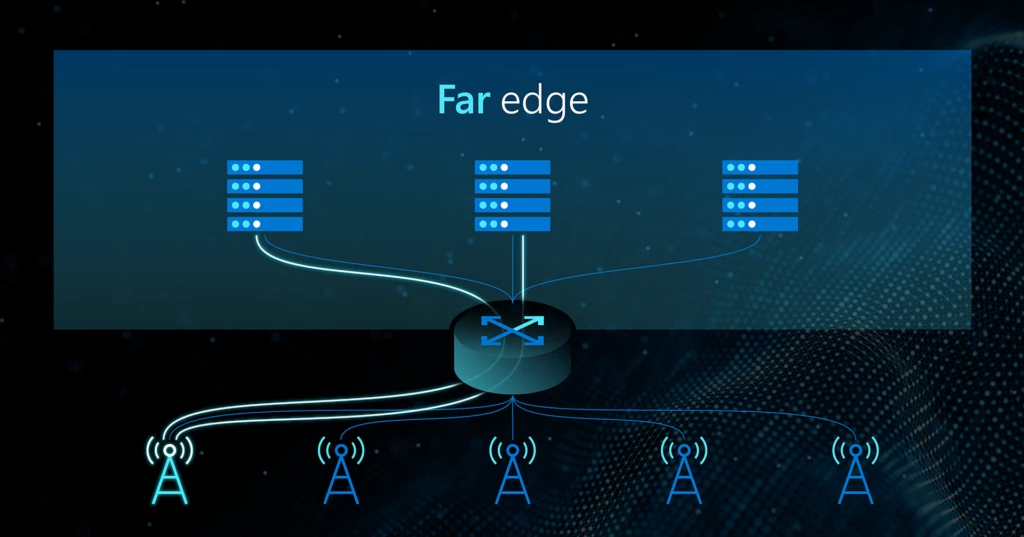
Microsoft Azure is a unified cloud-to-edge platform that enables our customers to span their global footprint, organizational boundaries, and complex operations out in the real world. Our goal is to make it easier for our customers and partners to bring just enough of Azure’s cloud-born capabilities wherever they need them. We deliver these capabilities from the cloud to the customer’s edge through a portfolio of cloud-to-edge services, tools, and infrastructure enabled by Azure Arc. With Azure Arc, customers can connect their on-premises, edge, and multicloud resources to Azure, deploy Azure native services on those resources, and extend Azure services to the edge.

Delivering cloud-native agility anywhere

Carnival Corporation is simplifying its distributed operations by using Azure to manage its complex physical environments.

Carnival Corporation’s operations span from their corporate headquarters in Miami, Florida to their portfolio of brands, operating 92 cruise ships sailing from more than 700 ports and destinations. Each vessel generates mountains of data while it serves every need of thousands of guests at a time while also traversing global waterways and the unpredictability that goes with it. Every hour across their vast and dynamic network, Carnival Corporation must coordinate a myriad of business functions—from supporting 160,000 team members with training and pay, to keeping more than 300,000 customers and crew safe. With these inherently complex operations, every vessel must be tracked, fueled, supplied, and staffed as they move about the world.  

To streamline their global operations, Carnival Corporation is deploying an array of Azure technologies, including Azure Arc. These technologies extend cloud computing beyond the four walls of the datacenter out to the edge—bringing cloud-native capabilities to ships, giving them a consistent operations and management platform that can fully manage services from ashore in the cloud, but also onboard their vessels.

Carnival Corporation’s digital transformation with Azure is making a positive impact on the operations and safety of its ships and their crews. Ultimately, Carnival Corporation’s customers reap the benefits from more efficient back-end operations and fewer disrupted itineraries with ships adjusting more easily to weather, scheduling, or navigational challenges to reach their destinations on time.

“When our guests have a wonderful experience on a Carnival Corporation ship, it’s the result of enormous behind-the-scenes management that now all occurs on Azure,”
—Franco Caraffi, IT Director, Global Maritime and Environmental Compliance at Carnival Corporation.

A Holland America ship, one of Carnival Corporation’s nine brands, cruising in front of the Seattle skyline.

Our partners are key to customer success at the edge

Customers, like Carnival Corporation, have operations across many locations and typically have existing infrastructure that must be supported to drive cloud-native agility to the edge. This is where partners, from original equipment manufacturers (OEMs) to independent software vendors (ISVs) to system integrators (SIs), play a critical role in easing adoption of cloud innovation and successfully turning cloud capabilities into business impact.

Microsoft is forging industry partnerships with infrastructure leaders that simplify and accelerate customers’ ability to take advantage of cloud capabilities. With Dell Technologies, we recently announced the Dell APEX Cloud Platform for Azure. As a result of engineering collaboration between Microsoft and Dell, it natively integrates with Azure to provide a turnkey experience to customers, including simplified deployment, consistent management, and orchestration capabilities for Azure Arc enabled infrastructure.

Partner collaborations like this help tighten the gaps that naturally occur when customers bring Azure together with their existing infrastructure, resulting in a more secure and consistent customer experience.

Simplifying operations, management, and security across distributed environments

Another important aspect of edge solutions is security. Our cloud-to-edge approach helps organizations unify security across multicloud deployments, datacenters, and thousands of remote edge sites with heterogeneous assets using trusted cloud-scale services such as Microsoft Defender for Cloud, Azure Monitor, Azure Policy, and more.

For more than 30 years, customers have trusted Windows Server and SQL Server as foundational platforms for their mission-critical workloads. At Microsoft Inspire 2023, we are announcing the availability of Extended Security Updates (ESU), enabled by Azure Arc, to streamline migration and modernization of server environments. With the upcoming end-of-support for Windows Server 2012/2012 R2 and SQL Server, customers will be able to purchase and seamlessly deploy the ESUs in on-premises or multicloud environments right from the Azure portal. ESUs enabled by Azure Arc give customers a cloud consistent way to help secure and manage their on-premises environments, starting with Windows Server and SQL Server, with a flexible model that enables them to plan their modernization, migration, or upgrade.

Learn how Azure Arc can help secure and manage cloud-to-edge operations

We want to make it easier for our customers and partners across every industry to harness the power of today’s technological advances to solve their biggest challenges. Whether you are a partner building cloud integrated solutions for on-premises deployments, or a customer looking to transform operations cloud-to-edge, Azure Arc can help you extend just enough Azure from the cloud to the edge to meet your needs. Today, you can take advantage of Azure Arc to secure and manage your distributed environments and drive innovation anywhere with Azure.
The post Redefining how we deliver the power of Azure to the edge appeared first on Azure Blog.
Quelle: Azure

Microsoft Cost Management updates—June 2023

Whether you’re a new student, a thriving startup, or the largest enterprise, you have financial constraints, and you need to know what you’re spending, where it’s being spent, and how to plan for the future. Nobody wants a surprise when it comes to the bill, and this is where Microsoft Cost Management comes in.

We’re always looking for ways to learn more about your challenges and how Microsoft Cost Management can help you better understand where you’re accruing costs in the cloud, identify and prevent bad spending patterns, and optimize costs to empower you to do more with less. Here are a few of the latest improvements and updates based on your feedback:

Reservation utilization alerts.

Updates for Azure pricing pages.

Help shape the future of cost reporting.

What’s new in Cost Management Labs.

New ways to save money with Microsoft Cloud.

New videos and learning opportunities.

Documentation updates.

Let us dig into the details.

Reservation utilization alerts

Organizations are always looking for ways to optimize their cloud spend and make the most of their investments. So, maximizing the usage of purchased reservations is on top of mind for many of our customers. In cost management, you have always had the ability to view and monitor reservation utilization percentages. With the recently launched preview of reservation utilization alerts, now you can also get email notifications when any of your selected reservations are below your configured threshold value for utilization. Getting started is easy, go to cost alerts and create an alert rule of type ‘reservation utilization’. You may already be familiar with this experience if you have configured alerts for anomalies in your subscriptions.

Reservation utilization alerts can be created at the Billing account (EA), Billing profile (MCA), and Customer (MPA) scopes. To learn more, please see Reservation utilization alerts—preview.  

Updates for Azure pricing pages

June 2023 has seen many improvements and new prices added to our Azure pricing experiences, and we’re excited to share them with you. These changes will help make it easier for you to estimate the costs of your solutions.

The Virtual Machines Selector tool has been improved to help customers find the closest matching virtual machine to their technical requirements, making it easier to estimate costs for various Azure products.

We have launched pricing details for a new service, Azure AI Content Safety, which detects harmful user-generated and AI-generated content in applications and services.

Our Cognitive Services have seen many changes, including new custom summarization and custom sentiment detection offers on Language Service, a new Vision Florence feature “Shelf Analysis” on Computer Vision, and new pricing for Disconnected Containers Commitment tier across Language Service, Translator Service, Language Understanding, and Speech Services. These updates will make it easier for customers to estimate costs for AI solutions.

Many new offers have been added across Virtual Machines (new NG Series and Dlsv5 went generally available), Block Blobs and Azure Data Lake Storage (Cold Tier pricing estimation added to the calculator), Form recognizer (updated calculator and pricing page with new “read” commitment tier and new PAYG offers), Data Explorer (simplified and added new SKUs to the pricing page), Azure Container Instances (introduced spot containers pricing in public preview), Azure NetApp Files (added pricing for the new Double encryption offer), Azure Monitor (updated pricing on SMS and Voice Call offers), and Azure Communication Services (added estimation for the call recording offer to the calculator). These updates will provide customers with more options and flexibility when estimating costs for different Azure services.

We’re constantly working to improve our pricing tools and make them more accessible and user-friendly. We hope these updates will make it easier for customers to estimate costs and choose the right Azure services for their needs. If you have any feedback or suggestions for future improvements, please let us know!

Help shape the future of cost reporting

Do you report on or manage costs for your team or organization? Do you need to group and organize costs across multiple subscriptions, resource groups, or billing accounts? We are exploring new capabilities to improve cost allocation and would love to get your feedback in a brief, 10-minute survey.

Please share this with others within your organization. We are looking for as much feedback as we can get to address one of the most common pain points we hear about from large teams and organizations.

What’s new in Cost Management Labs

With Cost Management Labs, you get a sneak peek at what’s coming in Microsoft Cost Management and can engage directly with us to share feedback and help us better understand how you use the service, so we can deliver more tuned and optimized experiences. Here are a few features you can see in Cost Management Labs:

New: Anomaly and reservation utilization alert rules—Now enabled by default in Labs.Manage anomaly and reservation utilization alerts from the new Alert rules page. Anomaly detection alerts are available for all subscriptions and reservation utilization alerts are available for Enterprise Agreement billing accounts and Microsoft Customer Agreement billing profiles. You can enable the Alert rules page in Cost Management from the Try preview menu.

New: Drill down in Cost analysis smart views—Now enabled by default in Labs.Drill into your cost data with one click using Cost analysis smart views. You can drill into a row to view the full details, view related resources from the context menu (three dots), open the resource to manage it from the Go to menu, remove filters using the Customize command, and use the Back command to undo a change. You can enable this option from the Try preview menu.

New: Streamlined Cost Management menu.Organize Cost Management tools into related sections for reporting, monitoring, optimization, and configuration settings. You can enable this option from the Try preview menu.

Merge cost analysis menu items.Only show one cost analysis item in the Cost Management menu. All classic and saved views are one-click away, making them easier than ever to find and access. You can enable this option from the Try preview menu.

Recommendations view.View a summary of cost recommendations that help you optimize your Azure resources in the cost analysis preview. You can opt in using the Try preview menu.

Forecast in the cost analysis preview.Show your forecast cost for the period at the top of the cost analysis preview. You can opt in using Try preview.

Group related resources in the cost analysis preview.Group related resources, like disks under virtual machines or web apps under App Service plans, by adding a “cm-resource-parent” tag to the child resources with a value of the parent resource ID.

Charts in the cost analysis preview.View your daily or monthly cost over time in the cost analysis preview. You can opt in using Try Preview.

View cost for your resources.The cost for your resources is one click away from the resource overview in the preview portal. Just click View cost to quickly jump to the cost of that resource.

Change scope from the menu.Change scope from the menu for quicker navigation. You can opt-in using Try Preview.

Of course, that’s not all. Every change in Microsoft Cost Management is available in Cost Management Labs a week before it’s in the full Azure portal or Microsoft 365 admin center. We’re eager to hear your thoughts and understand what you’d like to see next. What are you waiting for? Try Cost Management Labs today.

New ways to save money in the Microsoft Cloud

Here are new and updated offers you might be interested in:

Azure HX Virtual Machines for HPC.

Azure HBv4 Virtual Machines for HPC.

Azure Stream Analytics is launching a new competitive pricing model.

Azure Monitor managed service for Prometheus.

Cost-optimizations with transformations on Log Analytics for troubleshooting Cosmos DB.

Azure Front Door upgrade from standard to premium.

Reduced pricing for Azure Video Indexer.

Zone Redundant Storage for Azure Disks is now available in Japan East and Korea Central.

Preview: NGads V620 Series VMs optimized for cloud gaming.

Preview: Red Hat Enterprise Linux (RHEL) 9.2 support for AMD confidential VMs.

Preview: Azure Container Instances(ACI) Spot containers.

Preview: Azure Front Door Standard/Premium in Azure Government.

Preview: Azure Chaos Studio is now available in West US 2 region.

New videos and learning opportunities

Here is a new video you may be interested in:

Jellyfish Pictures ramps up VFX rendering while reducing costs by 80 percent (~2 minutes).

Follow the Microsoft Cost Management YouTube channel to stay in the loop with new videos as they’re released and let us know what you’d like to see next.

Want a more guided experience? Start with Control Azure spending and manage bills with Microsoft Cost Management.

Documentation updates

Here are a few documentation updates you might be interested in:

Newly updated menu in the Cost Management documentation.

Updated: Create and manage budgets—Added details about push notifications.

New: Published Reservation utilization alerts article.

New: Published Copy billing roles from one MCA to another MCA across tenants with a script billing article.

New: Published Access your EA billing account in the Azure Government portal Azure Government article.

9 updates based on your feedback.

Want to keep an eye on all documentation updates? Check out the Cost Management and Billing documentation change history in the azure-docs repository on GitHub. If you see something missing, select Edit at the top of the document and submit a quick pull request. You can also submit a GitHub issue. We welcome and appreciate all contributions!

What’s next?

These are just a few of the big updates from last month. Don’t forget to check out the previous Microsoft Cost Management updates. We’re always listening and making constant improvements based on your feedback, so please keep the feedback coming.

Follow @MSCostMgmt on Twitter and subscribe to the YouTube channel for updates, tips, and tricks. You can also share ideas and vote up others in the Cost Management feedback forum or join the research panel to participate in a future study and help shape the future of Microsoft Cost Management.

Best wishes from the Microsoft Cost Management team. Stay safe and stay healthy.
The post Microsoft Cost Management updates—June 2023 appeared first on Azure Blog.
Quelle: Azure
AI for business leaders: Discover AI advantages in this Microsoft AI Learn series

AI is becoming a game-changer for businesses across industries and is ushering in a transformative era of innovation, efficiency, and unprecedented possibilities. With AI continuing to automate and optimize vast swaths of the economy, it’s become table stakes for executives and other business decision-makers (BDMs) to understand the latest developments. As a leader in all things AI, Microsoft has spearheaded a curriculum created especially for you and your colleagues to help you build the knowledge, insights, and skills needed to make the most of AI technologies.1

No matter your level of technical know-how, this comprehensive AI educational series spans vertical and horizontal topics focused on outcomes to help your organization extract the many benefits AI offers:

Explore the competitive advantage of AI and how it offers improved decision-making, efficiency, and productivity.

Learn about the potential of AI and what you need to make informed decisions about its adoption and implementation.

Discover real-world examples from the Microsoft AI journey.

Get guidance and best practices from Microsoft experts and other industry leaders.

Introducing the Transform Your Business with Microsoft AI educational series

Transform Your Business with Microsoft AI is designed to bridge the gap between AI technology and business strategy. It helps BDMs understand the potential of AI and equips them with the necessary insights to make informed decisions about AI adoption and implementation. It caters to individuals responsible for shaping AI strategy, managing AI projects, and driving digital transformation within their organizations.

Our curriculum is divided into several modules, each addressing a specific area of AI implementation. Topics include AI strategy, culture, responsible AI, ethics, organizational change management, data-driven decision-making, and AI transformation in specific industries. Modules are presented in a variety of learning formats to accommodate different learning preferences and schedules. These include self-paced online courses, immersive workshops, case studies, snackable videos and articles, and more.

Participants will get insight into real-world examples from the Microsoft AI journey, showcasing how AI technologies have been applied successfully across various business domains. In addition, we bring together experts from Microsoft, as well as industry leaders and AI practitioners, to provide guidance and share best practices. You’ll hear from experienced professionals who have implemented AI in real-world scenarios, offering valuable perspectives and lessons learned.

How companies are using AI to increase efficiency and customer service

Many companies across industries have already begun realizing the value of engaging not only with AI but with the AI experts and solutions at Microsoft.

H&R Block uses AI and Microsoft tools to improve customer experience and the accuracy and efficiency of its tax preparation services. They use Azure Form Recognizer to extract data from tax documents automatically, which saves time and reduces errors.

Azure Cognitive Search makes it easier for tax professionals to find the information they need, and Azure Machine Learning models help better predict and minimize the likelihood of audits for their clients. An AI chatbot created by Azure Bot Service can answer customer questions every day so customers can get help with their taxes at any time.

Construction company Strabag SE also employs Microsoft AI solutions to improve efficiency and reduce risk. They use Microsoft Azure Active Directory to provide single sign-on access to their employees, and Azure Synapse Analytics, Azure Databricks, Azure Machine Learning, and Azure SQL to build data-driven insights. This has helped them to improve their project planning, risk management, and cost control.

In addition, Strabag SE utilizes AI to predict the likelihood of project delays, identify potential safety hazards on construction sites, and optimize their supply chain, so that they can get the materials they need when they need them while controlling costs.

H&R Block and Strabag SE are just two examples of how AI and Microsoft tools are being used to improve financial outcomes for companies across different industries. As AI technology continues to develop, we can expect to see even more innovative ways to use AI to increase efficiency, planning, customer service, safety, and more.

Stay on the cutting edge of AI advancements

Just as the launch of ChatGPT has created excitement and awareness of AI within the consumer sphere, ongoing advancements in large language models and generative AI has created an urgency to get AI deployed across organizations at a faster pace. As the technology continues to evolve, we’ll help you stay on the cutting edge by providing updates on the latest developments, emerging trends, and evolving best practices through additional resources and community engagement.

With an emphasis on responsible AI, including ethics, fairness, transparency, and accountability, this learning path aims to empower organizations of all sizes—from startups to large enterprises—to harness the potential of AI.

Transform Your Business with Microsoft AI is accessible globally, allowing business leaders from around the world to benefit from its educational resources. It aims to empower organizations of all sizes, ranging from startups to large enterprises, to harness the potential of AI and drive innovation.

AI has the potential to reshape the business world in profound ways, ushering in a transformative era of innovation, efficiency, and unprecedented possibilities. With its ability to process vast amounts of data, learn from patterns, and make autonomous decisions, AI has the power to change how businesses operate, compete, and create value. By taking part in Transform Your Business with Microsoft AI, business leaders can arm themselves with the knowledge, insights, and skills needed to leverage AI technologies strategically.

Discover more

For more information and to begin your journey, visit the Microsoft Learn homepage.

1 Microsoft is a Leader in the 2023 Gartner® Magic Quadrant™ for Cloud AI Developer Services, June 8, 2023.
The post AI for business leaders: Discover AI advantages in this Microsoft AI Learn series appeared first on Azure Blog.
Quelle: Azure

Supercharge your skills with Microsoft CLX tracks for Azure

The Microsoft Azure Connected Learning Experience (CLX) program is expanding with three new tracks for Azure professionals. Enhance your Azure networking, Microsoft Sentinel in Azure, and Windows Server migration skills your way with these personalized and self-paced courses that help you learn on your own time as efficiently and effectively as possible. At the end of each course, you’ll walk away with the knowledge and skills to boost your cloud computing career.

What are the new tracks?

With data volumes growing every year, it’s never been more important to make sure that your Microsoft Azure systems are connected and secure—and that’s why our new CLX tracks are designed to strengthen your Azure Networking, Windows Server migration, and Microsoft Sentinel in Azure skills. From mitigating threats with Sentinel to managing your Windows Server workloads on Azure to uncovering new insights with a connected suite of Azure resources, our new CLX tracks can help you learn the fundamentals of cloud-native security and Azure connectivity so you can protect and connect your mission-critical systems.

New course AttendeesCourse contentAZ-700: Designing and Implementing Microsoft Azure Networking Solutions  Azure network engineersLearn how to design and implement a secure network infrastructure in Azure and how to establish hybrid connectivity, routing, private access to Azure services, and monitoring in Azure. In this course, you’ll learn the ins and outs of Azure networking. Practice designing and implementing core networking infrastructure, application delivery services, and private access to Azure services, and design, implement, and manage connectivity services. You’ll also learn to secure network connectivity to Azure resources—and though this course is meant for Azure network engineers, anyone with an interest in Azure networking can enroll.MS-Sentinel: Mitigate threats using Microsoft Sentinel in Azure (Part of SC-200)*Note: This track is not a certification course, but instead is a part of the SC-200 course. Because of this, learners are not eligible to receive a Microsoft certification exam voucher for completing this track.Security Analyst Threat Intelligence Analyst Incident Responder Security Engineer Security Operations Center (SOC) ManagerIn this course, you’ll learn to protect your organization against threats with Microsoft Sentinel, a cloud-native Security Information and Event Management (SIEM) and Security Orchestration, Automation, and Response (SOAR) solution. You’ll practice leveraging Sentinel’s capabilities to identify and respond to threats in real time by designing and configuring a Sentinel workspace, managing Sentinel analytics rules and incidents, and much more. At the end of the course, you’ll have gained the skills you need to effectively use Sentinel to mitigate threats and protect your organization’s most mission-critical resources.Migrate and manage Windows Server workloads on AzureSystem AdministratorAzure Cloud AdministratorAzure Cloud ConsultantMigrating and managing Windows Server workloads on Azure involves transferring existing applications and infrastructure from on-premises to the Azure cloud platform. Azure offers various tools and services, such as Azure Site Recovery, Azure Virtual Machines, Azure Backup, and Azure Monitor, to support this migration and management process. This allows organizations to leverage the benefits of cloud computing while still using their familiar Windows Server workloads.

What is the CLX program?

The CLX program is a comprehensive, step-by-step learning program designed for IT professionals and other aspiring learners looking to master core concepts in cloud services. It combines self-paced interactive labs and skilling content with virtual sessions led by Microsoft tech experts to help learners like you strengthen their understanding of the latest cloud topics in a way that meets your needs and fits your schedule. The program’s unique design ensures you get exactly the skills you need as efficiently as possible, and it includes four steps:

Knowledge AssessmentThe program kicks off with a 20-question Knowledge Assessment to gauge your skills. Based on your results, it will then present you with only the course content that’s relevant to your skills and knowledge gaps—making sure you use your time as efficiently as possible in a way that fits your experience.

Interactive labsYou’ll then dive into learning modules and hands-on, interactive online labs that mirror what you’ll experience in the professional world—helping you learn efficiently and effectively. The interactive labs are available on demand and can be used as many times as needed.

Virtual sessionAfter finishing the interactive labs, you can choose to attend a virtual session led by Microsoft-certified trainers that dive deeply into the course content. Led by Microsoft-certified trainers (MCTs), these group sessions feature live discussions, insights, and practical guidance, and you can ask follow-up questions to get real-time help alongside peers and pros. To make sure you get the skills you need wherever you’re located, the two-to-four-hour sessions are held regularly in three time zones—Australian Easter Daylight Time (AEST), Greenwich Mean Time (GMT), and Pacific Daylight Time (PDT).

Practice testAt the end of your CLX journey, you’ll take an 80-question practice test that helps you assess your learning and prepare you for your final Microsoft certification exam. This two-hour test is very similar to the final exam, helping you accurately test your understanding and target areas for improvement.Once you’ve finished the program’s four steps, you’ll walk away with the knowledge and skills to help you excel in the world of Azure. You’ll also receive a 50% discount voucher for the Microsoft Azure Certification exam (this is a voucher only available with certain courses), so you can prove your skills and advance your cloud computing career.

How can I sign up?

Check out our Microsoft CloudEvents Portal and our Microsoft Azure CLX introductory video to learn more and sign up for the CLX program. You can also read about many other courses in CLX that are designed to boost your Azure skills in our previous blog, and you can check out our CLX AI in Azure skilling content here.
The post Supercharge your skills with Microsoft CLX tracks for Azure appeared first on Azure Blog.
Quelle: Azure
Develop Microsoft Azure skills with 30 Days to Learn It

In today’s rapidly evolving job market, having a competitive edge is essential. With technology advancing at an unprecedented pace, it’s becoming increasingly important to keep up with the latest trends and tools. The Microsoft Cloud Skills Challenge 30 Days to Learn It program is aimed at helping individuals develop proficiency in the most in-demand skills in the tech industry, such as learning the Microsoft Azure platform. The program offers various learning journeys designed for participants with different levels of experience and technical backgrounds.

The challenge is open to IT professionals and developers of all skill levels and is designed to provide a flexible and accessible way to learn new skills and advance their careers. To participate, individuals simply need to sign up for the challenge on the Microsoft Learn platform and begin completing the available learning modules.

Completing any challenge within 30 days can make individuals eligible for a 50 percent discount on a Microsoft Certification exam. These certifications can boost a participant’s career prospects and earning potential and are widely recognized in the tech industry.

Our results speak for themselves: Upon completion of the program, 77 percent of professionals get a promotion, land a new role, or enter technical programs after becoming certified. Additionally, 74 percent of surveyed professionals got more autonomy in their jobs, and 35 percent of candidates who completed a certification received a salary increase of 30 percent or more.

Microsoft Azure 30 Days to Learn It program

In this blog, we will focus on Microsoft Azure-based 30 Days to Learn It challenges, though a variety of learning paths exist, including Microsoft 365, Dynamics 365, and Microsoft Power Platform. Microsoft Azure is a cloud computing platform that offers a wide range of services, including compute, storage, networking, and AI. It is a popular choice for developers because it is scalable, reliable, and secure. Azure can help developers build and deploy applications faster and more easily, and it can help them save money on infrastructure costs.

Check out our full lineup of challenges to get started on your career advancement today:

ToolTraining DescriptionAzure Network EngineerGain expertise in planning, implementing, and maintaining Azure networking solutions, including hybrid networking, connectivity, routing, security, and private access to Azure services. This learning journey is designed for participants who have experience with networking concepts and connectivity methods.Azure Database AdministratorBegin learning how to manage the operational aspects of cloud-native and hybrid data platform solutions built with Microsoft SQL Server and Microsoft Azure Data Services. This learning journey is designed to equip participants with a variety of methods and tools to perform day-to-day operations at an introductory level.Windows Server Hybrid AdministratorGain expertise in configuring and managing Windows Server on-premises, hybrid, and infrastructure as a service (IaaS) platform workloads. This learning journey is designed for participants who administer core and advanced Windows Server workloads and services using on-premises, hybrid, and cloud technologies.Azure Virtual Desktop FundamentalsGain the ability to plan the architecture for an Azure Virtual Desktop deployment, manage access and security, manage user environments and apps, and monitor and maintain an Azure Virtual Desktop environment.Azure AI FundamentalsGet a solid foundation in machine learning and AI concepts including computer vision, natural language processing, and conversational AI. This learning journey is designed for participants with both technical and non-technical backgrounds.Azure DeveloperParticipate in all phases of cloud development to create end-to-end solutions. Design, build, test, and maintain cloud applications using compute, storage, management, and security services on Azure.Azure Data ScientistDesign and implement a data science solution on Azure. Learn how to build machine learning models, no-code predictive models, and machine learning solutions, and run data science workloads in the cloud.Azure Data FundamentalsGain a foundation in core database concepts in cloud environments and data services including relational data, non-relational data, big data, and analytics. This learning journey is designed for participants with both technical and non-technical backgrounds.Azure Cosmos DB DeveloperStart developing modern applications in the cloud with a fully managed, NoSQL database. This learning journey is designed for participants with experience designing, implementing, and monitoring cloud-native applications that store and manage data.Designing Azure Infrastructure SolutionsDesign cloud and hybrid solutions that run on Microsoft Azure, including compute, network, storage, monitoring, and security.Java on Azure DeveloperStart developing modern Java applications in the cloud with managed compute, databases, and DevOps services. This learning journey is designed for participants with familiarity developing and running Java applications and beginner-level experience with cloud infrastructure.DevOps EngineerDesign and implement DevOps processes and practices. Develop an instrumentation strategy with logging, telemetry, and monitoring. Manage source control with GitHub to foster collaboration and automate build and deployment processes.Azure Synapse AnalyticsTake your data analytics skills to the next level with Azure Synapse Analytics. Learn how to integrate, transform, and consolidate data from various structured and unstructured data systems into structures that are suitable for building analytics solutions.

The Microsoft Cloud Skills Challenge 30 Days to Learn It is a free, self-paced learning program that can help developers learn Microsft Azure, earn a Microsoft certification, get hands-on experience, and connect with other developers. The program covers a wide range of Azure topics, including Azure App Service, Azure Data Factory, and Azure Machine Learning. It also includes hands-on labs and a community forum, which can help developers learn the skills they need to build and deploy cloud-based applications, gain confidence, and build relationships.

Learn more at our 30 Days to Learn It website.
The post Develop Microsoft Azure skills with 30 Days to Learn It appeared first on Azure Blog.
Quelle: Azure

How Microsoft Cloud is embracing FinOps practitioners

In February 2023, I announced that Microsoft joined the FinOps Foundation as a premier member and outlined five areas we planned to explore and invest in:

Defining specifications and evolving best practices.

Aligning our collective guidance.

Improving our products and services.

Advancing training and certification programs.

Engaging with the community.

We’ve been busy over the past four months and with FinOps being top of mind as several of us land in San Diego for the second annual FinOps X conference that’s kicking off later today, I wanted to share some of that progress with you.

Helping FinOps practitioners learn and grow

While we’ve been dedicated to helping people manage and optimize their costs for years, this month is especially pivotal for FinOps practitioners managing costs in Microsoft Cloud.

First up is a new FinOps solutions page to help centralize the various resources available today and in the future. Whether you’re new to FinOps or you have years of experience, this page will connect you to Microsoft solutions that can empower your organization to efficiently adopt FinOps best practices.

One of the resources you’ll find on the FinOps solutions page is a new FinOps with Azure e-book. This 20-page e-book is a great resource for those new to FinOps in Azure. The e-book will guide you through the FinOps principles to highlight Microsoft solutions that can support your cloud journey and help your organization maximize the cloud business value.

When you’re ready to dig into the next level of detail and start your FinOps journey, check out the new FinOps documentation. If you’re new, you’ll get an introduction to FinOps and the FinOps Framework with a guide for how to approach each iteration through the FinOps lifecycle. And whether you’re new or experienced, you’ll also find guides that help you understand and implement each capability in Azure.

You’ll also find newly updated Microsoft Cost Management documentation, which has been reorganized to help you navigate and find related guidance quicker and easier than ever. Whether you’re looking for reporting and analytics, monitoring, optimization, cost allocation, or automation and extensibility, everything you need to implement your FinOps capabilities in Microsoft Cost Management has been restructured for ease of use.

These same changes are also coming to the Azure Portal, where you’ll find a new Cost Management menu that organizes capabilities into these same groups, again making it easier than ever to navigate to the capabilities you need to drive your FinOps practice.

Enable the new streamlined menu yourself from try preview in Cost Management and let us know what you’d like to see next.

Helping FinOps practitioners get answers faster

Everyone loves new guidance that teaches you how to solve complex problems or streamline how you work, but why stop there? Just like documentation can guide your learning experience, our vision of Cost Management is to guide you through your data, helping you discover deeper insights into costs and deliver answers quicker than ever before. This starts with significant performance improvements within the Cost analysis experience. Many have already noticed considerably faster load times over the last few months. Expect to see even more improvements in the coming months.

Beyond performance, you may have also noticed some major improvements to the new Cost analysis experience. Everyone’s familiar with the customizable charts in Cost analysis, but many are still new to smart views in Cost analysis. Smart views add intelligent insights about your costs like anomaly detection, more flexible download options, and the ability to multi-task and explore multiple perspectives of your cost at the same time. You can take a quick peek into cost details by expanding any row—and now, for the first time, you can also drill down into cost details with one click.

Drill down in smart views improves the classic filtering in customizable views by allowing you to drill into the data you’re looking at without needing to manually look up values in a filter on the side of the page, which interrupts your flow. Simply click the item you’re interested in, and you’ll switch to a view that gives you the next level of detail. Or perhaps you’re interested in related costs. Select the context menu (three dots) next to the name and choose from the related attributes to find resources of the same type or in the same resource group, for instance. And if you need to manage the resource, simply select Go to > Resource from the menu. After you’ve drilled into your costs, you can select the Customize command at the top to remove filters or simply select the Back command on that view to undo the last change. Enable drill down yourself from try preview in Cost Management and let us know what you’d like to see next.

Looking forward, smart views will also provide quick access to your Cost Management AI assistant. The assistant will help you perform quick analyses, provide insights, and offer recommendations to better understand, analyze, manage, and forecast your cloud costs.

But whether you use smart views or customizable views, the new Cost analysis experience remembers what you used and offers quick access to views you used recently or pinned to the top of the list. Soon, you’ll also see support for customizable views directly within the tabbed experience, making it easier to switch between your customizable, saved, and smart views.

Helping FinOps practitioners scale their efforts

Many practitioners can meet their basic needs with the native Cost Management experiences in the Azure Portal, but there are times when you need more. Maybe you’re looking to automate onboarding and setup. Or perhaps you need more advanced reporting merged with business data. Or maybe you have a more complex cost allocation or chargeback strategy that requires integrating with other systems. Whatever your scenario is, the FinOps toolkit open-source project seeks to offer solutions that help you automate and extend native cloud capabilities to meet the common needs of the FinOps community. The toolkit is an exploratory community-driven project with contributors across the globe and includes learnings from Microsoft architects and engineers in the field to help you get off the ground quicker with:

Starter kits that help you get started with cost management and optimization.

Automation scripts to streamline cost configuration and management at scale.

Advanced solutions to facilitate building custom solutions.

As an example, many people who discover Cost Management scheduled alerts or anomaly detection are immediately interested in automating setup across all subscriptions. To streamline automation, we contributed code to the FinOps toolkit and published the bicep modules for scheduled actions in the official Bicep Registry. Whether you’re creating a scheduled alert for a resource group or a subscription cost anomaly alert, adding a reference to the Bicep Registry module is quick and easy:

Looking beyond automation, another example is when organizations want to build custom reporting or optimization solutions. Custom solutions always start with data ingestion, but most organizations don’t realize the complexities introduced by nuances within different billing systems or managing data at scale. The FinOps toolkit includes a data pipeline code sample that ingests cost data into a central data store and includes pre-built Power BI reports to get you started quickly. The solution was designed and implemented by Brett Wilson (Principal Cloud Solution Architect) and Anthony Romano (Senior Consultant) to enable faster, more reliable reporting against multiple billing accounts, subscriptions, and resource groups and normalizes cost data to the FinOps Open Cost and Usage Specification (FOCUS) schema.

If you’re not familiar with FOCUS, it’s an open specification for billing data that we’re leading with the FinOps Foundation. We’re partnering with many practitioners, vendors, and cloud providers to deliver a draft specification we can all adopt. You’ll hear more about this at FinOps X this week. There’s a lot to cover, so I’ll share more details in a future blog post.

Stay tuned for more updates about the FinOps toolkit. There are many solutions the community would like to share and we’re always eager to hear from you about what you’d like to see next.

Helping FinOps practitioners drive efficiency

We’re always looking for ways to help organizations optimize their cloud usage and rates to drive efficiencies that ultimately result in more business value. (This focus on business value might be my favorite aspect of FinOps.) And as the heart of all optimization in Azure, you’ll usually see these show up in Azure Advisor first, like the ability to customize the lookback period for right-sizing recommendations, which gives you more flexibility to improve the accuracy of cost recommendations, or the ability to automate cost savings with Resource Graph.

But also keep in mind that not all optimization and efficiency opportunities are ahead of us—some are behind us. As FinOps practitioners, you’re of course aware of commitment-based discounts, like reservations and savings plans. It’s perhaps the most discussed way to optimize your costs by committing to specific usage or spending thresholds. But one part of that story that sometimes goes untold is monitoring your reservations. You can now configure reservation utilization alerts in Cost Management to stay informed when your reservation utilization drops below an acceptable threshold. You can configure reservation utilization and anomaly alerts from the new alert rules page in Cost Management.

And last, but not least, I’d like to share a solution that saves you time as well as money! As part of the FinOps toolkit, you also have a new cost optimization workbook that centralizes some of the most used tools to help you drive your utilization and efficiency goals, like Advisor recommendations, Hybrid Benefit, and more. The cost optimization workbook was designed and implemented by Arthur Clares (Senior Cloud Solution Architect) and Seif Bassem (Senior Cloud Solution Architect) and is based on the Well-Architected Framework and feedback we’ve heard from working directly with organizations driving their own FinOps practices.

What’s Next for FinOps?

I’ve just walked you through a sampling of the things we’ve been working on since joining the FinOps Foundation earlier this year. This is only a taste of what’s to come. Looking ahead, you can expect to see:

Even more FinOps learning resources along with more comprehensive documentation that helps you drive FinOps maturity.

Our portal experiences will continue to improve as we integrate more intelligent systems that surface insights more naturally and streamline your workflow.

We’ll continue to evolve and expand the FinOps toolkit to cover more scenarios, like FOCUS adoption, in collaboration with the open-source community.

New and updated tools and services that help you save money and drive efficiency with Microsoft Cloud.

And, if you’re at FinOps X this week, please catch us in our sessions where we’ll share tips on how to manage cost data at scale on Wednesday and how to implement FinOps capabilities in the Microsoft Cloud on Thursday. We’ll also be in the FOCUS and Technical Advisory Council sessions as well as at our booth! We look forward to catching you there or in the FinOps Slack community!

And if that wasn’t enough, here’s one last tip: Stay informed with all FinOps updates with the new FinOps tag on the Azure blog!

All the best from your friendly FinOps ambassadors at Microsoft!
The post How Microsoft Cloud is embracing FinOps practitioners appeared first on Azure Blog.
Quelle: Azure

What’s new in Azure Data & AI: How customers realize tangible ROI with the industry leading AI platform

Last month at Microsoft Build 2023, we unveiled new capabilities and a copilot framework to empower organizations to achieve more with generative AI using their own data or data from a third-party they have access to. From Azure OpenAI Service to Microsoft Fabric, it’s clear this technology can accelerate innovation among builders of all skill levels, increasing the value and relevance of big data through the power of natural language.

Amidst all the announcements at Microsoft Build 2023, I also value the focus our Chief Technology Officer Kevin Scott placed on product fundamentals. Yes, generative AI is exciting and enables meaningful advances in application development, speed, and cost efficiency, but that “does not absolve any of us of the responsibility of thinking about what good product-making looks like.” Like every platform shift before, generative AI will impact how builders build. It should not change why we build: to solve real-world problems.

I recently explored the context and impact of the monumental platform shift we are facing in the Wall Street Journal, followed by my thoughts on how leading companies are using generative AI to drive business value and how other organizations can assess and plan for AI success. These articles were the culmination of countless conversations with customers and partners that recognize AI readiness as a continuous journey. And since we’re in the early days of this new platform shift, learning from peers is essential as we embark on the journey together.

In this month’s blog, I’ll highlight recent product updates and spotlight great customers and partners who are putting Azure to work to solve real problems in innovative ways. I hope these examples inspire you to put Azure to work at your organization. If you are a Microsoft partner, please join us July 18 to 19, 2023 at Microsoft Inspire for in-depth learning on how you can drive customer success with the latest innovations from Azure.

Customers expanding productivity, accessibility, and innovation with Azure AI

A quick reminder: Microsoft runs on Azure AI. It’s a point of pride for our company and an incredible pressure test that translates to accelerated learning and industry-leading innovation on behalf of our partners and customers. Microsoft was recently recognized as a Leader for the 4th year in a row in the 2023 Gartner® Magic Quadrant™ for Cloud AI Developer Services, placing furthest for Completeness of Vision. This month, a new Total Economic Impact™ (TEI) study conducted by Forrester Consulting, also revealed that Azure AI customers have collectively witnessed a 284 percent ROI over 3 years.  We are committed to making Azure AI the trusted AI platform for every developer to invent with purpose, whether extending a Microsoft solution or building something net new from the ground up. 

San Raffaele University and Research Hospital transforms clinical research and delivers precision medicine using AI

San Raffaele University and Research Hospital is one of the largest of its kind in Italy, as well as a pioneer of cutting-edge translational research and technology adoption at both a national and international level. During COVID-19, the organization saw an opportunity to start using AI to better triage incoming symptomatic patients and identify their future reaction to the virus. Fast forward to today, the pilot project has been turned into an intelligent data solution powered by AI—which San Raffaele is using to transform clinical research, improve the end-to-end patient journey inside the hospital and accelerate its own move towards precision medicine.

Reddit improves accessibility and SEO through Azure Cognitive Service for vision image and caption generation

Reddit is a community of communities where millions of users across the globe find and share images and other content around their interests, hobbies, and passions. The company sought to enhance the search engine optimization (SEO) of its images in an effort to broaden the site’s accessibility, particularly for users who are blind or have low vision. Using AI, Reddit was able to quickly generate accurate alt text for its vast catalogue of images; applying their solution to existing images on the platform as well as the thousands of new images added daily.

ERM combats corporate ‘greenwashing’ with ESG assessment tool powered by Azure Machine Learning

In pursuit of helping companies around the world achieve net-zero carbon emissions, ERM, the largest global pure play sustainability consultancy, has built a standardized software-as-a-service (SaaS) tool that can rate companies based on their environmental, social, and governance (ESG) risks for private capital investors. ESG Fusion combines machine learning and subject matter expertise to provide peer reviewed ESG reports to ERM clients. Powered by Microsoft Azure Machine Learning, ESG Fusion can provide a comprehensive assessment of a company’s ESG risks and opportunities within two business days—a big step in promoting sustainable business practices around the globe.

Customers modernizing their data to fuel advanced analytics and intelligent applications

Powering organization-specific AI experiences requires a constant supply of clean data from a well-managed and highly integrated analytics system. One of our biggest announcements at Microsoft Build 2023 last month was Microsoft Fabric, an end-to-end, unified analytics platform that brings together all the data and analytics tools that organizations need to bring their data into era of AI. With Fabric, customers don’t need to piece together different data services from multiple vendors. Instead, they can enjoy a highly integrated and easy-to-use product designed to simplify their analytics needs—complete with a single purchase model allowing customers to use their analytics budget for the components of the analytics value chain they are most focused on. Learn why customers like Ferguson, T-Mobile, and Aon are excited about Microsoft Fabric.

American Airlines gains speed and boosts reliability by flying real-time data to Azure SQL

American Airlines wanted to move its real-time customer data domain from an aging on-premises datacenter to the cloud. After evaluating several possible routes, the airline’s Customer Hub team chose Microsoft Azure SQL because it satisfied every one of their demanding requirements. The complex process unfolded in multiple phases to shift both data and apps to Azure, giving them greater flexibility, automated maintenance, and alignment with the airline’s transformation goals so that American Airlines can deploy solutions to customers faster.

Rockwell Automation transforms industrial business with Azure Cosmos DB

Rockwell Automation, a leader in the industrial automation space, embarked on a digital transformation journey to offer their customers a more seamless and productive SaaS platform. This WIRED article explores how Rockwell set out to deliver a cloud-based, collaborative data environment that is available anywhere, anytime, for both their employees and customers. They used Azure Cosmos DB and Azure Kubernetes Service to scale automatically and keep costs in line with growth.

Rx Health makes sense of data from millions of health wearables with Azure Cosmos DB

Managing terabytes of wearable-generated health data is a difficult task without the right tools. Azure Cosmos DB is helping developers of medical Internet of Things (IoT) applications bridge the gap between the structured world of health record systems and the more dynamic world of non-relational databases and IoT. For example, Rx Health, an automated care coordination company, uses sensor-based technologies and Azure Cosmos DB to power a heart failure program which monitors congestive heart failure patients at home and provides educational and motivational messages from medical professionals directly to their mobile devices.

Xbox combines AI and Azure Cosmos DB to provide better gaming experiences 

Whether it’s generating more realistic opponents or more helpful allies, AI is changing the way games are played. In a recent video by Ars Technica, Haiyan Zhang, General Manager of Gaming AI at Xbox, highlighted how AI and real-time player and game data is being used to balance and improve game play. For content safety, Xbox uses Watch For, a Microsoft media AI platform that analyzes images, videos, live steams, and other media content in real-time and is powered by Azure Cosmos DB. Using Azure Cosmos DB, Watch For processes hundreds of millions of requests and billions of classifications each month for safer game play.

Aware propels platform performance and enhanced customer experiences with Azure Cosmos DB

Aware is an industry leader in contextual intelligence, transforming digital voices at scale into actionable organizational insights that help business leaders address the growing unstructured dataset of enterprise collaboration tools. To manage the vast amounts of data its platform needs to ingest, the company turned to Microsoft Azure Cosmos DB to augment and support its traditional Azure Database for PostgreSQL architecture. The company now has fewer issues with large content data, better platform performance, reduced costs, and a more consistent experience for its customers.

Dentsu builds an Azure-supported analytics platform to modernize data across the organization

Dentsu is a marketing and advertising network dedicated to brand partnership that delivers meaningful progress and growth through unique and innovative media campaigns and bespoke data-driven solutions. The global organization spans more than 145 markets with 65,000 employees and serves 11,000 clients. To accelerate business insights across the organization, Dentsu invested in a modern data analytics effort that would take their business transformation to the next level. Now, Dentsu has a stronger data culture, supported by a reporting and analytics ecosystem that users can trust for business-critical decisions.

Swedbank migrates big data platform to Azure Cloud for enhanced security and scalability

Swedbank is a multinational bank with a 200-year history. Recently, the company took the bold decision to migrate its big data platform to the cloud in search of greater scalability and security. With Azure Databricks functioning at the core of this solution, the successful migration has brought the bank a wealth of benefits. From reduced time-to-market and cost savings to significant improvements in its ability to detect fraud—it has set the bank and its 7.7 million customers on course for a more secure future.

Swedbank migrates big data platform to Azure Cloud for enhanced security and scalability

Swedbank is a multinational bank with a 200-year history. Recently, the company took the bold decision to migrate its big data platform to the cloud in search of greater scalability and security. Leveraging the power of Azure Databricks, the successful migration has brought the bank a wealth of benefits. From reduced time-to-market and cost savings to significant improvements in its ability to detect fraud—it has set the bank and its 7.7 million customers on course for a more secure future.

Recent product announcements from Azure Data and AI

In case you missed it: we had a lot of announcements at Microsoft Build 2023 in May! You can see the full rundown in our Microsoft Build 2023 Book of News. To close this month’s blog post, I’ll highlight some other recent announcements to support your development of even more intelligent applications.

Azure OpenAI Service on your data is now available in public preview. This feature allows you to harness the power of OpenAI models, such as ChatGPT and GPT-4, with your own data in the Azure AI Studio. This revolutionizes the way you interact with and analyze your data, providing greater accuracy, speed, and valuable insights.

Custom Text Analytics for health is now in public preview, available as part of the Azure Cognitive Service for Language. This feature extends the capabilities of Text Analytics for health, a pre-built natural language processing (NLP) solution for extracting and labelling medical information from unstructured medical text. Now, customers can build their own healthcare entity extraction model using data from specific medical domains or unique organizational data such as abbreviations.

Accelerate content discovery and insight extraction for video and audio files using ChatGPT and Azure OpenAI service with Azure Video Indexer. This feature will allow you to enable deep search on video archives and can be especially useful for organizations that need to quickly review large volumes of video content for specific information. We listened to customer feedback and lowered the price on our most popular presets by 40 percent while also adding new advanced presets to improve and add more AI capabilities. Soon, you will be able to unlock content discovery and insights anywhere including on-premises, with the Azure Arc enabled extension.

Pronunciation Assessment is now generally available in 19 languages in Azure Cognitive Service for Speech. This update extends support from English to 18 additional languages and quality enhancements to existing features, including accuracy, fluency, and intonation assessment. This feature supports comprehensive language learning solution for learners and educators worldwide, enabling learners to receive detailed feedback on their pronunciation skills and identify areas where they need improvement. Berlitz and HelloTalk are both utilizing pronunciation assessment to help facilitate language learning on a global scale.

What’s next?

Thank you for reading and we’ll see you again next month. If you’re a partner, I hope you will join us July 18 to 19, 2023 at Microsoft Inspire for more announcements, case studies, and expert guidance tailored to help your business succeed with Microsoft.

Gartner Magic Quadrant for Cloud AI Developer Services, Jim Scheibmeir, Svetlana Sicular, Arun Batchu, Mike Fang, Van Baker, Frank O’Connor, 22 May 2023. Gartner is a registered trademark and service mark and Magic Quadrant is a registered trademark of Gartner, Inc. and/or its affiliates in the U.S. and internationally and are used herein with permission. All rights reserved.

Gartner does not endorse any vendor, product or service depicted in its research publications, and does not advise technology users to select only those vendors with the highest ratings or other designation. Gartner research publications consist of the opinions of Gartner’s research organization and should not be construed as statements of fact. Gartner disclaims all warranties, expressed or implied, with respect to this research, including any warranties of merchantability or fitness for a particular purpose.
The post What’s new in Azure Data & AI: How customers realize tangible ROI with the industry leading AI platform appeared first on Azure Blog.
Quelle: Azure

Healthcare revolution with Microsoft Azure: An AI wellness check  

Generative AI has emerged as a game-changer in various industries, and healthcare is no exception. With its ability to generate new content, models, and insights, generative AI has the potential to revolutionize medical research, diagnosis, treatment, and patient care by allowing healthcare providers to increase productivity with less administrative burden while shifting their focus to patient care. 

Azure OpenAI Service and Epic’s EHR software 

In April 2023, one of the largest electronic health records providers, Epic, used Azure OpenAI Service to integrate large language model tools and AI into its electronic health record software. Epic currently has the largest share of acute care hospitals in the U.S. market: Globally, about 2,130 hospitals use Epic for its medical records software and more than 305 million patients have a current electronic record in Epic. 

One of the integration’s tools, which helps automatically draft message responses, is already being implemented at UC San Diego Health, UW Health in Madison, Wisconsin, and Stanford Health Care.   

“The urgent and critical challenges facing healthcare systems and their providers demand a comprehensive approach combining Azure OpenAI Service with Epic’s industry-leading technology.”
Eric Boyd, Corporate Vice President, AI Platform, Microsoft.

Epic’s exploration of OpenAI’s GPT-4 with Azure OpenAI Service has shown the potential to increase the power and accessibility of self-service reporting. By doing so it’s made it easier for healthcare organizations and their providers to identify operational improvements, including ways to reduce costs and to find answers to questions both locally and within a broader context. And that’s just the beginning. 

AI influencing the future of healthcare

Below we look at more ways that AI is expected to help the healthcare industry pave the way to wellness:

Accelerating drug discovery: One of the most time-consuming and costly aspects of healthcare is the discovery and development of new drugs. One way to speed up the drug-development process is through computational modeling so that molecules can be prioritized in silico without being physically available, and only the molecules most likely to succeed are synthesized and measured. To enable such a speedup through computational modeling, a machine learning model must be able to precisely predict molecular properties, and whether a proposed drug molecule will be able to affect the protein target associated with the disease. Machine learning is highly effective at recognizing patterns in images and text, where millions of lines of such data are available, thereby accelerating the time it takes to produce drugs that can successfully combat illness.

Enhancing medical imaging analysis: Medical imaging plays a crucial role in supporting the diagnosis, treatment, and monitoring of various diseases. Project InnerEye from Microsoft Research is developing machine learning and open-source software to empower healthcare organizations and innovators to develop their own solutions that can assist clinicians in planning radiotherapy treatments so that they can spend more time with their patients. Cambridge University Hospitals NHS Foundation Trust is one of the early adopters to use open-source technology from Project InnerEye, creating an Azure-based medical AI tool called OSAIRIS that reduces the amount of time cancer patients wait for radiotherapy treatment. Working alongside OSAIRIS, the specialist can plan radiotherapy treatments about two and half times faster than working alone, ensuring that more patients who need treatment can get it sooner and thus improving the likelihood of better outcomes.

Supporting pathologists, and their patients, around the globe: PathPresenter, in collaboration with Microsoft, has focused on ensuring seamless interoperability between scanners, image management software, AI models, and hospital infrastructure, to reduce the reporting burden on pathologists and accelerate the adoption of digital workflows by pathologists and institutions worldwide for the benefit of patients and society. Microsoft Azure offers unique solutions in digital pathology that are scalable and can serve digital pathology images several gigabytes in size—even on poor internet connections encountered in remote regions. 

Equip more clinicians with medical imaging AI: AI has the potential to revolutionize medical imaging by enabling faster and more accurate analysis of imaging data, leading to better patient outcomes. Together, Nuance + Microsoft, and NVIDIA are working to simplify the translation of imaging AI models into existing and trusted clinical applications that can deliver genuine benefits for everyday patient care without requiring providers to change their workflows or their underlying IT systems.

Improving COVID-19 clinical decision support: Providence, a healthcare system with 51 hospitals and more than 1,085 clinics, is headquartered in Renton, Washington, near the epicenter of the first major US COVID-19 outbreak. Providence used the existing Microsoft Azure Health Bot service and configured it to create an AI-based tool to triage patients and answer their questions specifically about COVID-19 symptoms, freeing providers to attend to the patients who needed it most. The Azure Health Bot with COVID-19 templates that Providence deployed has since been adopted by several thousand healthcare providers, the US Centers for Disease Control and Prevention (CDC), NGOs (non-governmental organizations), and international health authorities.

Scalable Data Storage: Health First was one of the first healthcare providers to deploy WhereScape with Azure Synapse Analytics. Implementing both familiar and new products helped the network to accelerate its operations. With faster turnaround times, Health First employees could focus on using data to improve patient care and operational decisions. Health First experienced more than a 90 percent improvement in workload processing times. With Azure Synapse Analytics and Power BI, the daily data refresh was about 75 percent faster, down to 3 hours from a 12-hour overall run time, which improved the company’s capability to provide actionable insights for both clinical and operational decisions.

As the use of AI in healthcare continues to evolve, we anticipate a future where healthcare systems are increasingly able to handle more challenging cases and discover solutions to some of the most pressing healthcare issues facing individuals and communities worldwide today. Microsoft’s innovative initiatives in this space highlight the immense potential of AI. We’re looking forward to helping accelerate drug discoveries, enhance medical imaging analysis, improve clinical decision making, and scale to better support operational decisions. 

Our commitment to responsible AI

Microsoft has a layered approach for generative models, guided by Microsoft’s responsible AI principles. In Azure OpenAI Service, an integrated safety system provides protection from undesirable inputs and outputs and monitors for misuse. In addition, Microsoft provides guidance and best practices for customers to responsibly build applications using these models and expects customers to comply with the Azure OpenAI Code of Conduct. With GPT-4, new research advances from OpenAI have enabled an additional layer of protection. Guided by human feedback, safety is built directly into the GPT-4 model, which enables the model to be more effective at handling harmful inputs, thereby reducing the likelihood that the model will generate a harmful response. 

Get started with Azure OpenAI Service 

Apply for access to Azure OpenAI Service by completing this form. 

Learn about Azure OpenAI Service and the latest enhancements. 

Get started with GPT-4 in Azure OpenAI Service in Microsoft Learn. 

Read our Partner announcement blog, Empowering partners to develop AI-powered apps and experiences with ChatGPT in Azure OpenAI Service. 

Learn how to use the new Chat Completions API (preview) and model versions for ChatGPT and GPT-4 models in Azure OpenAI Service.  

Provide feedback Let us know what you think of Azure and what you would like to see in the future.

Build your cloud computing and Azure skills with free courses by Microsoft Learn.

The post Healthcare revolution with Microsoft Azure: An AI wellness check   appeared first on Azure Blog.
Quelle: Azure

Explore the benefits of Azure OpenAI Service with Microsoft Learn

As the field of AI continues to grow, developers are constantly seeking new and innovative ways to integrate it into their work. With the launch of Azure OpenAI Service, developers now have even more tools at their disposal to take advantage of this powerful technology. Azure OpenAI Service can be used to create chatbots, generate text, translate languages, and write different kinds of creative content. As the platform continues to evolve, developers will be able to use it to build even more powerful and sophisticated applications.

In this article, we will explore the benefits of utilizing OpenAI and Azure OpenAI Service for developers, as well as the various learning paths Microsoft has established to get you started.

Introduction to OpenAI and Azure OpenAI Service

Azure OpenAI Service is a fully managed service that allows developers to easily integrate OpenAI models into their applications. With Azure OpenAI Service, developers can quickly and easily access a wide range of AI models, including natural language processing, computer vision, and more. Azure OpenAI Service provides a simple and easy-to-use API that makes it easy to get started with AI.

For developers who may not have experience with Azure OpenAI Service, here are some ways it can help:

Simplified integration: A simple and easy-to-use API offers various endpoints that can be used for different tasks, such as text generation, summarization, sentiment analysis, language translation, and more.

Pre-trained models: Already fine-tuned on vast amounts of data, these pre-trained models make it easier for developers to leverage the power of AI without having to train their own models from scratch.

Customization: Developers can also fine-tune the included pre-trained models with their own data with minimal coding, providing an opportunity to create more personalized and specialized AI applications.

Documentation and resources: Azure OpenAI Service provides comprehensive documentation and resources that can help developers get started quickly, including tutorials, guides, and code samples that cover various use cases and scenarios.

Community support: With an active community willing to help and share their experiences via forums and support channels, developers can ask questions, seek guidance, and learn from others.

Scalability and reliability: Hosted on Microsoft Azure, the service provides robust scalability and reliability that developers can leverage to deploy their AI applications with confidence, without having to worry about managing the underlying infrastructure.

Responsible AI: Azure OpenAI Service promotes responsible AI by adhering to ethical principles, providing explainability tools, governance features, diversity and inclusion support, and collaboration opportunities. These measures help ensure that AI models are unbiased, explainable, trustworthy, and used in a responsible and compliant manner.

Learning paths for developers to adopt Azure OpenAI Service

With the rapid adoption and far-reaching possibilities of the recent AI boom, there isn’t a better time to start your skilling journey and stay ahead in this competitive field of technology. Getting started with Azure OpenAI Service is easy, thanks to the newest Microsoft learning path, including a range of resources, including tutorials, documentation, and sample code, to help developers get up to speed with the platform.

Azure OpenAI Service Learning Path – Develop AI solutions with Azure OpenAI ModuleSummaryLearning objectivesGet started with Azure OpenAI ServiceThis module provides engineers with the skills to begin building an Azure OpenAI Service solution.Create an Azure OpenAI Service resource and understand types of Azure OpenAI base models.Use the Azure OpenAI Studio, console, or REST API to deploy a base model and test it in the Studio’s playgrounds.Generate completions to prompts and begin to manage model parameters.Build natural language solutions with Azure OpenAI ServiceThis module provides engineers with the skills to begin building apps that integrate with the Azure OpenAI Service.Integrate Azure OpenAI into your application.Differentiate between different endpoints available to your application.Generate completions to prompts using the REST API and language specific SDKs.Apply prompt engineering with Azure OpenAI servicePrompt engineering in Azure OpenAI is a technique that involves designing prompts for natural language processing models. This process improves accuracy and relevancy in responses, optimizing the performance of the model.Understand the concept of prompt engineering and its role in optimizing Azure OpenAI models’ performance.Know how to design and optimize prompts to better utilize AI models.Include clear instructions, request output composition, and use contextual content to improve the quality of the model’s responses.Generate images with Azure OpenAI ServiceAzure OpenAI Service includes the DALL-E model, which you can use to generate original images based on natural language prompts.Describe the capabilities of DALL-E in the Azure OpenAI Service.Use the DALL-E playground in Azure OpenAI Studio.Use the Azure OpenAI REST interface to integrate DALL-E image generation into your apps.Generate code with Azure OpenAI ServiceThis module shows engineers how to use the Azure OpenAI Service to generate and improve code.Use natural language prompts to write code.Build unit tests and understand complex code with AI models.Generate comments and documentation for existing code.

The future of AI for developers

OpenAI and Azure OpenAI Service have the potential to revolutionize the developer experience, and with the various learning paths available developers can quickly and easily get started. With the constant development and updates being made to the platform, developers can continue to explore the capabilities of Azure OpenAI Service to see even more groundbreaking applications and innovations in the years to come.

Ready to get started with Azure OpenAI Service? Check out the official Microsoft Learn path to discover more about the platform and get hands-on experience with AI. You can also learn and develop essential AI skills with the Microsoft Learn AI Cloud Skills Challenge, which begins on July 17, 2023. Preview the topics and sign up now. With Azure OpenAI Service, the possibilities are endless!
The post Explore the benefits of Azure OpenAI Service with Microsoft Learn appeared first on Azure Blog.
Quelle: Azure



