Grok 4 is now available in Azure AI Foundry: Unlock frontier intelligence and business-ready capabilities

Today’s enterprises are entering a new phase of AI adoption—one where trust, flexibility, and production readiness aren’t optional; they’re foundational. Microsoft has collaborated closely with xAI to bring Grok 4, their most advanced model, to Azure AI Foundry—delivering powerful reasoning within a platform designed for business-ready safety and control.

Check out the Azure AI Foundry Grok 4 model card

Grok 4 undeniably has exceptional performance. With a 128K-token context window, native tool use, and integrated web search, it pushes the boundaries of what’s possible in contextual reasoning and dynamic response generation. But performance alone isn’t enough. AI at the frontier must also be accountable. Over the last month, xAI and Microsoft have worked closely to enhance responsible design. The team has evaluated from a responsible AI perspective, putting Grok 4 through a suite of safety tests and compliance checks. Azure AI Content Safety is on by default, adding another layer of protection for enterprise use. Please see the Foundry model card for more information about model safety.

In this blog, we’ll explore what makes Grok 4 stand out, how it compares to other frontier models, and how developers can access it via Azure AI Foundry.

Grok 4: Enhanced reasoning, expanded context, and real-time insights

Grok models were trained on xAI’s Colossus supercomputer, utilizing a massive compute infrastructure that xAI claims delivers a 10 times leap in training scale compared to Grok 3. Grok 4’s architecture marks a significant shift from its predecessors, emphasizing reinforcement learning (RL) and multi-agent systems. According to xAI, the model prioritizes reasoning over traditional pre-training, with a heavy focus on RL to refine its problem-solving capabilities.

Key architectural highlights include:

First-principles reasoning: “think mode”

One of Grok 4’s headline features is its first-principles reasoning ability. Essentially, the model tries to “think” like a scientist or detective, breaking problems down step by step. Instead of just blurting out an answer, Grok 4 can work through the logic internally and refine its response. It has strong proficiency in math (solving competition-level problems), science, and humanities questions. Early users have noted it excels at logic puzzles and nuanced reasoning better than some incumbent models, often finding correct answers where others get confused. Put simply, Grok 4 doesn’t just recall information—it actively reasons through problems. This focus on logical consistency makes it especially attractive if your use case requires step-by-step answers (think of research analysis, tutoring, or complex troubleshooting scenarios).

Example prompt: Explain how you would generate electricity on Mars if you had no existing infrastructure. Start from first principles: what are the fundamental resources, constraints, and physical laws you would use?

Extended context window

Perhaps one of Grok 4’s most impressive technical feats is its handling of extremely large contexts. The model is built to process and remember massive amounts of text in one go. In practical terms, this means Grok 4 can ingest extensive documents, lengthy research papers, or even a large codebase, and then reason about them without needing to truncate or forget earlier parts. For use cases like:

Document analysis: You could feed in hundreds of pages of a document and ask Grok to summarize, find inconsistencies, or answer specific questions. Grok 4 is far less likely to miss the details simply because it ran out of context window, compared to other models.

Research and academia: Load an entire academic journal issue or a very long historical text and have Grok analyze it or answer questions across the whole text. It could, for example, take in all of Shakespeare’s plays and answer a question that requires connecting info from multiple plays.

Code repositories: Developers could input an entire code repository or multiple files (up to millions of characters of code) and ask Grok 4 to find where a certain function is defined, or to detect bugs across the codebase. This is huge for understanding large legacy projects.

xAI has claimed that this is not just “memory” but “smart memory.” Grok can intelligently compress or prioritize information in very long inputs, remembering the crucial pieces more strongly. For the end user or developer, the takeaway is: Grok 4 can handle very large input texts in one shot. This reduces the need to chop up documents or code and manage context fragments manually. You can throw a ton of information at it and it can keep the whole thing “in mind” as it responds.

Example prompt: Read this Shakespeare play and find my password (password is buried in the long context text).

Data-aware responses and real-time insights

Another strength of Grok 4 is how it can integrate external data sources and trending information into its answers—effectively acting as a data analyst or real-time researcher when needed. It understands that sometimes the best answer needs to come from outside its training data, and it has mechanisms to retrieve and incorporate that external data. It turns the chatbot into more of an autonomous research assistant. You ask a question, it might go read a few things online, and come back with an answer that’s enriched by real data. Of course, caution is needed—live data can sometimes be incorrect, or the model might pick up on biased sources; one should verify critical outputs.

Example prompt: Check the latest news on global AI regulations (past 48 hours). 

Summarize the top 3 developments.

Highlight which regions or governments are driving the changes.

Explain what impact these updates could have on companies deploying foundation models.

Provide the sources you referenced.

Stacking up Grok 4: How it performs against top models

Grok 4 showcases impressive capabilities on high-complexity tasks. These benchmarks underscore Grok 4’s leading-edge capabilities in high-level reasoning, STEM disciplines, complex problem-solving, and industry-specific tasks. These benchmark numbers are calculated using our own internal Azure AI Foundry benchmarking service, which we use to compare models across a set of industry standard benchmarks.

Family of Grok models 

 In addition to Grok 4, Azure AI Foundry also has 3 additional Grok models already available.

Grok 4 Fast Reasoning is optimized for tasks requiring logical inference, problem-solving, and complex decision-making, making it ideal for analytical applications.

Grok 4 Fast Non-Reasoning focuses on speed and efficiency for straightforward tasks like summarization or classification, without deep logical processing.

Grok Code Fast 1 is tailored specifically for code generation and debugging, excelling in programming-related tasks across multiple languages.

While all three models prioritize speed, their core strengths differ: reasoning for logic-heavy tasks, non-reasoning for lightweight operations, and code for developer workflows. 

Pricing including Azure AI Content Safety: 

Model Deployment Type Price $/1M tokens Grok 4 Global Standard Input- $5.5 Output- $27.5 

Get started with Grok 4 in Azure AI Foundry

Lead with insight, build with trust. Grok 4 unlocks frontier‑level reasoning and real‑time intelligence, but it is not a deploy and forget model. Pair Azure’s guardrails with your own domain checks, monitor outputs against evolving standards, and iterate responsibly—while we continue to harden the model and disclose new safety scores. Please see the Azure AI Foundry Grok 4 model card for more information about model safety.

Head over to ai.azure.com, search for “Grok,” and start exploring what these powerful models can do.

Azure AI Foundry
Explore the Grok 4 model in Azure AI Foundry.

Try it now

The post Grok 4 is now available in Azure AI Foundry: Unlock frontier intelligence and business-ready capabilities appeared first on Microsoft Azure Blog.
Quelle: Azure
Agent Factory: Designing the open agentic web stack

This blog is a wrap-up post in a blog series called Agent Factory which shares best practices, design patterns, and tools to help guide you through adopting and building agentic AI.

The rise of AI agents—autonomous software entities acting on behalf of users and organizations—marks a transformative moment for enterprise technology. But as we’ve explored throughout this blog series, building effective agents is about more than just code. It requires a repeatable blueprint, spanning use case design, developer tooling, observability, integrations, and governance. 

Throughout this series, we’ve walked through the journey of building enterprise-grade agents: from early use cases and design patterns to the tools and developer workflows needed to move from prototype to production, to the importance of observability, interoperability, and open standards, and finally the governance and security principles required to deploy agents responsibly. 

Now, as we conclude the series, we zoom out to the bigger picture: the agentic web stack. Much like HTTP and TCP/IP standardized the internet, this stack provides the common services and protocols needed to make multi-agent ecosystems secure, scalable, and interoperable across organizational boundaries. 

Learn more with Azure AI Foundry

Blueprint: 8 essential components and services

A robust agentic web stack is not one technology but a composition of services that together provide the foundation for open, secure, and enterprise-grade multi-agent systems. Here’s what it takes—and how Azure AI Foundry is making it real. 

1. Communication protocol service

Agents need a shared “language” to exchange messages, requests, and structured data. Without it, collaboration breaks down into isolated silos. Standards like Model Context Protocol (MCP) and Agent-to-Agent (A2A) provide this foundation, ensuring agents can negotiate, coordinate, and cooperate—regardless of who built them or where they’re hosted. In Azure AI Foundry, A2A support enables not only intra-organization workflows but also cross-boundary collaboration, where supply chain partners or business ecosystems can securely exchange actions through a common protocol.

2. Discovery registry service

Just as the web needed directories and search engines, agents need a way to be found and reused. The Catalog serves as the listing of assets—a curated collection of agents, tools, and applications that can be discovered and composed into new solutions. The Registry, by contrast, tracks the deployed instances of those assets—the live agentic app instances running across providers, with their endpoints, health, and status. Together, the Catalog and Registry bridge the gap between what’s available and what’s active, enabling developers to publish once, discover broadly, and reliably orchestrate workflows against running systems.

3. Identity and trust management service

Trust is the lifeblood of the agentic web. Every agent must carry a verifiable identity, enforced through standards like OIDC (OpenID Connect) and JWT (JSON Web Token), and tied into enterprise systems like Microsoft Entra ID. In Azure AI Foundry, identity is not an afterthought—it’s the control plane. This enables fine-grained role-based access, ensures that only authorized actors participate in workflows, and provides auditable accountability for every action an agent takes. Combined with encrypted channels, this identity-first model enforces a zero-trust security posture across the agentic stack.

4. Tool invocation and integration service

No agent can succeed in isolation; value comes when agents can connect with data, APIs, and enterprise systems. The Model Context Protocol (MCP) provides a vendor-neutral standard for exposing tools in a way that any compliant agent can invoke. In Azure AI Foundry, MCP integration is deeply embedded, so developers can register enterprise APIs once and instantly make them available to multiple agents—whether they’re built on Microsoft’s agent frameworks like Semantic Kernel and AutoGen, LangGraph, or third-party SDKs. This eliminates bespoke integrations and allows enterprises to compose workflows from best-in-class components.

5. Orchestration service

Single agents can handle discrete tasks, but the real breakthroughs come from multi-agent orchestration: teams of agents collaborating across multi-step, distributed processes. Azure AI Foundry delivers this through a unified framework that brings together Semantic Kernel and AutoGen—and extends it with multi-agent workflow orchestration inside Azure AI Foundry Agent Service. These workflows manage dependencies, allocate resources, and resolve conflicts, enabling enterprise-scale use cases such as financial transaction processing or IT incident response.

6. Telemetry and observability service

As we covered in Part 3, observability is non-negotiable for reliable agents. Azure AI Foundry extends OpenTelemetry with agent-aware instrumentation—tracing conversations, capturing performance data, and surfacing anomalies in real time. This makes agent behavior explainable and debuggable, while also serving governance needs: every decision and action is logged, auditable, and tied back to identity. For enterprises, this is the bedrock of trust, compliance, and continuous improvement.

7. Memory service

Agents without memory are limited to stateless interactions; agents with memory become adaptive, contextual, and human-like in their continuity. Azure AI Foundry supports both short-term session memory and long-term enterprise knowledge integration. Imagine a customer support agent that recalls prior interactions across channels, or a supply chain agent that tracks historical disruptions to improve future decisions. With memory, agents evolve from transactional helpers into strategic partners that learn and adapt over time.

8. Evaluation and governance service

Finally, no stack is complete without governance. This includes continuous evaluation, policy enforcement, ethical safeguards, and regulatory compliance. In Azure AI Foundry, governance hooks are built into orchestration, observability, and identity services—enabling enterprises to block unsafe actions, enforce approvals for sensitive workflows, and generate compliance-ready audit trails. This ensures organizations don’t just innovate fast, but innovate responsibly.

Strategic use cases and business value

The agentic web stack is not theoretical; it unlocks concrete enterprise value.

End-to-end business process automation: Imagine a procure-to-pay workflow where one agent negotiates with suppliers, another verifies compliance, a third triggers payment, and a fourth updates ERP records. With Azure AI Foundry’s orchestration and discovery registry, these agents collaborate seamlessly, cutting manual intervention and cycle times from weeks to hours.

Cross-organization supply chain synchronization: In global supply chains, delays often come from mismatched systems and data. With A2A and discovery services, a logistics agent from one company can securely interoperate with a customs agent from another—both governed by identity and observability. The result: faster border clearance, lower costs, and higher resilience. 

Knowledge worker augmentation: Agents built with Azure AI Foundry can take on repetitive but high-value tasks—scheduling, research, first-draft writing—while humans focus on creativity and judgment. The memory integration ensures continuity: a legal research agent remembers prior cases analyzed, while a marketing agent recalls brand guidelines across campaigns.

Complex IT operations: When outages occur, every second counts. Multi-agent workflows in Azure AI Foundry can detect anomalies, route alerts, execute diagnostics, and propose mitigations across distributed environments. Observability ensures root causes are transparent, while governance enforces that corrective actions comply with policy.

Memory-driven customer journeys: A customer support agent that recalls a prior complaint, a personalization agent that adapts recommendations, a compliance agent that enforces rules—working together, these create adaptive, context-rich interactions. The outcome is not just efficiency but stronger relationships and trust.

Preparing for the agentic era

For organizations, the path forward is as much about strategy and culture as it is about technology: 

Start with open standards: Adopt MCP and A2A from the outset, even in pilots, to avoid future rework and ensure interoperability. 

Invest in foundations: Identity, observability, and memory are not optional; they are the pillars that differentiate ad hoc automations from enterprise-grade systems. 

Operationalize governance: Define policies now and embed them into workflows through Azure AI Foundry’s governance services, so oversight scales with adoption. 

Engage the ecosystem: Participate in open-source and standards communities, influence their direction, and ensure your organization’s voice is heard. 

Prepare your workforce: Train employees not just to use agents, but to collaborate with them, supervise them, and improve them over time. 

Leaders who act on these imperatives will not only adopt agentic AI but shape its trajectory in their industries.

Shaping the future together at Ignite 2025 

The Agent Factory series has laid out the foundations: design patterns, developer tools, observability practices, interoperability standards, and governance principles. The agentic web stack brings these threads together into a cohesive vision: an open, secure, and interoperable ecosystem where agents can scale across organizational boundaries. 

Azure AI Foundry is your platform to make this vision real—unifying frameworks, standards, and enterprise capabilities so organizations can accelerate value while staying in control. 

At Ignite 2025, we’ll showcase the next wave of innovations—from multi-agent orchestration to deeper integrations with enterprise apps, data, and security systems. Join us to see how Azure AI Foundry is not only enabling enterprises to adopt agentic AI but also shaping the agent-driven future of business. 

Did you miss these posts in the series?

The new era of agentic AI—common use cases and design patterns

Building your first AI agent with the tools to deliver real-world outcomes

Top 5 agent observability best practices for reliable AI

From prototype to production—developer tools and rapid agent development

Connecting agents, apps, and data with new open standards like MCP and A2A

Creating a blueprint for safe and secure AI agents

Azure AI Foundry
Build AI agents that automate tasks and enhance user experiences.

Learn more

The post Agent Factory: Designing the open agentic web stack appeared first on Microsoft Azure Blog.
Quelle: Azure
Introducing Microsoft Marketplace — Thousands of solutions. Millions of customers. One Marketplace.

An image of part of the Microsoft Marketplace digital dashboard.A new breed of industry-leading company is taking shape — Frontier Firms. These organizations blend human ambition with AI-powered technology to reshape how innovation is scaled, work is orchestrated and value is created. They’re accelerating AI transformation to enrich employee experiences, reinvent customer engagement, reshape business processes and unlock creativity and innovation.

To empower customers in becoming Frontier, we’re excited to announce the launch of the reimagined Microsoft Marketplace, your trusted source for cloud solutions, AI apps and agents. This further realizes Marketplace as an extension of the Microsoft Cloud, where we collaborate with our partner ecosystem to bring their innovations to our customers globally. By offering a comprehensive catalog across cloud solutions and industries, Microsoft Marketplace accelerates the path to becoming a Frontier Firm. With today’s announcement, we are excited to share:

The new Microsoft Marketplace, a single destination to find, try, buy and deploy cloud solutions, AI apps and agents. Azure Marketplace and Microsoft AppSource are now unified to simplify cloud and AI management. Available today in the US and coming soon to customers worldwide.Tens of thousands of cloud and industry solutions in the Marketplace catalog across a breadth of categories ranging from data and analytics to productivity and collaboration, in addition to industry-specific offerings.Over 3,000 AI apps and agents are newly available directly on Marketplace and in Microsoft products — from Azure AI Foundry to Microsoft 365 Copilot — with rapid provisioning within your Microsoft environment through industry standards like Model Context Protocol (MCP).Marketplace integrations with Microsoft’s channel ecosystem, empowering you to buy where and how you want — whether from your cloud service provider (CSP) or relying on a trusted partner to procure cloud and AI solutions on your behalf.YouTube Video

AI apps and agents for every use caseMicrosoft Marketplace gives you access to thousands of AI apps and agents from our rich partner ecosystem designed to automate tasks, accelerate decision-making and unlock value across your business. With a new AI Apps and Agents category, you can easily and confidently find AI solutions that integrate with your organization’s existing Microsoft products.

“With Microsoft Marketplace, we reduced configuration time of AI apps from nearly 20 minutes to just 1 minute per instance. That efficiency boost has translated into increased productivity and lower operating costs. Marketplace is a strategic channel for Siemens, where we’ve seen an 8X increase in customer adoption. It’s a powerful platform for scaling both sides of our business.”

— Jeff Zobrist, VP Global Partner Ecosystem and Go To Market |Siemens Digital Industries Software

Special thanks to these partners who are launching new AI offerings in Microsoft Marketplace today:

A sampling of company logs in Microsoft Marketplace.

Comprehensive catalog across cloud solutions and industriesMicrosoft Marketplace offers solutions across dozens of categories ranging from data and analytics to productivity and collaboration, in addition to industry-specific offerings. Microsoft Marketplace is a seamless extension of the Microsoft Cloud, uniting solutions integrated with Azure, Microsoft 365, Dynamics 365, Power Platform, Microsoft Security and more.

“The Microsoft Marketplace, in particular, helps us balance innovation with confidence by giving us access to trusted solutions that integrate seamlessly with our Azure environment — ultimately enabling us to move faster while staying true to our Five Principles.”

— Matthew Hillegas, Commercial Director – Infrastructure & Information Security |Mars Inc.

For organizations with a Microsoft Azure Consumption Commitment, 100% of your purchase for any of the thousands of Azure benefit eligible solutions available on Marketplace continue to count toward your commitment. This helps you spend smarter to maximize your cloud and AI investments.

Integrated experience from discovery to deploymentContextually relevant cloud solutions, AI apps and agents built by our partners are also available directly within Microsoft products — providing users, developers and IT practitioners with approved solutions in the flow of work. For example, Agent Store includes Copilot agents within the Microsoft 365 Copilot experience. The same applies for apps in Microsoft Teams, models and tools in Azure AI Foundry and future experiences including MCP servers.

By integrating offerings from Marketplace directly into the Microsoft Cloud, IT is equipped with management and control tools that enable both innovation and governance. When you acquire a Copilot agent or an app running on Azure from Microsoft Marketplace, it’s provisioned and distributed to team members aligned to your security and governance standards.

YouTube Video

Powering partner growthFor our partners, Microsoft Marketplace sits at the center of how we work together. We’re continuously expanding its capabilities to help our partners drive growth — whether that means scaling through digital sales, deepening channel partnerships or landing transformative deals.

We’ve invested in multiparty private offers, CSP integration and CSP private offers to connect software development companies and channel partners on Marketplace, creating more complete solutions to address customers’ needs. Today, we’re excited to share that valued partners including Arrow, Crayon, Ingram Micro, Pax8 and TD SYNNEX are integrating Microsoft Marketplace into their marketplaces, further extending customer reach.

Additionally, a new Marketplace capability called resale enabled offers is now in private preview. This empowers software companies to authorize their channel partners to sell on their behalf through private offers — unlocking new routes to market.

“We’re incredibly excited about the path forward with Microsoft. This integration with the Marketplace catalog is just the beginning — we see endless potential to co-innovate and help customers navigate their AI-first transformation with confidence.”

— Melissa Mulholland, Co-CEO | SoftwareOne and Crayon

Nicole Dezen, Chief Partner Officer and Corporate Vice President, Global Channel Partner Sales at Microsoft, shares more details about the partner opportunity with Microsoft Marketplace in her blog.

Becoming Frontier with Microsoft MarketplaceWhether you’re seeking to accelerate innovation, empower your teams with AI or unlock new value through trusted partners, Microsoft Marketplace brings together the solutions, expertise and ecosystem to meet your business needs. Explore the new Microsoft Marketplace. Thousands of solutions. Millions of customers. One Marketplace.

Alysa Taylor is the Chief Marketing Officer for Commercial Cloud and AI at Microsoft, leading teams that enable digital and AI transformation for organizations of all sizes across the globe. She is at the forefront of helping organizations around the world harness digital and AI innovation to transform how they operate and grow.

NOTE

Source: Work Trend Index Annual Report, 2025: The year the Frontier Firm is born, April 23, 2025
The post Introducing Microsoft Marketplace — Thousands of solutions. Millions of customers. One Marketplace. appeared first on Microsoft Azure Blog.
Quelle: Azure
Accelerate migration and modernization with agentic AI

Every organization has an innovation agenda. Whether it’s building AI-native applications, creating more engaging customer experiences, or unlocking new efficiencies—ambition is never the problem. But for many teams, it’s their technical debt that stands in the way. Legacy systems, outdated codebases, and fragmented infrastructure slow progress and drain resources. In fact, over 37% of application portfolios require modernization today—and that number will remain high over the next three years.1 Developers want the freedom to innovate, but migration and modernization is often slow, complex, and hard to start. These delays translate into lost opportunities and stalled transformation.

Generative AI changes the game. Teams are using it to tackle migration and modernization faster and with less friction. At today’s Migrate and Modernize Summit, we’re sharing agentic AI tools built to drive real progress—quickly. From GitHub Copilot’s app modernization for Java and .NET, to new AI-powered features in Microsoft Azure Migrate that simplify migration across teams, to Microsoft Azure Accelerate—a new offering that pairs expert guidance with investment support—these tools help organizations move forward with confidence.

GitHub Copilot app modernization for Java and .NET 

Modernizing legacy apps used to take months. With GitHub Copilot’s autonomous AI agents, it can now take days.  

Over 150 million developers—including engineering teams at 90% of the Fortune 100—use GitHub to build and collaborate. Now, with new capabilities in GitHub Copilot for application modernization across Java and .NET, those organizations can accelerate their modernization efforts significantly.

Get started with modernizing your Java and .NET apps today.

What’s new: 

General availability of automated .NET and Java upgrades—Upgrading to the latest versions of .NET and Java unlocks performance, security, and feature enhancements, but managing breaking changes and dependency updates can be time-consuming. GitHub Copilot now automates this process with AI agents that analyze your codebase, detect breaking changes, suggest safe migration paths, and apply build fixes (including dependency updates and security vulnerability checks.) The Microsoft Teams organization used this capability to upgrade multiple projects to .NET 8—cutting months of effort down to just hours. 

App modernization for Java is now generally available, with .NET in public preview. Running modernized applications on Microsoft Azure unlocks a scalable, secure, and cost-efficient foundation. With built-in high availability, global reach, integrated monitoring, and enterprise-grade security—Azure makes it easier for teams to deploy, operate, and scale with confidence. The modernization process is streamlined: it analyzes your app, identifies dependencies, resolves platform-specific issues, containerizes the code, generates deployment artifacts, and launches into dev/test environments—all while aligning with your organization’s security and compliance standards. Ford China used this approach to modernize middleware apps, cutting time and effort by 70%.  

With GitHub Copilot app modernization, developers can stay focused on building what’s next—while AI handles the tedious, time-consuming work of updating legacy code. The results are already showing up: customers are cutting timelines, reducing effort, and unlocking faster paths to innovation.

Learn more about the new GitHub Copilot capabilities here

What’s new in Azure Migrate: Streamlining migration and modernization across apps and teams

Migration and modernization often stall when IT, developers, data, and security teams aren’t aligned. Azure Migrate is introducing new agentic AI features to close those gaps, simplify complexity, and expand support—so teams can move faster, together:

AI-powered guidance (Preview): Agentic capabilities in Azure Migrate now offer a guided experience that automates key tasks and builds on what your teams already know. This helps you move faster and smarter—without retraining or retooling. 

Connected workflows with GitHub Copilot (Preview): IT and developers can now collaborate seamlessly. Azure Migrate links directly to GitHub Copilot’s app modernization tools, so both teams can plan and execute modernization in sync. 

Application-awareness by default (Preview): Get broad visibility across your portfolio and deep insights into each app. Understand dependencies, keep resources aligned, and make smarter, data-driven decisions throughout your migration. 

Expanded support for databases and infrastructure (Preview): Azure Migrate now supports more scenarios—including PostgreSQL and popular Linux distributions—so no app gets left behind. 

Learn more about the new Azure Migrate capabilities here

Migrate and modernize your databases in Azure

At the heart of every digital transformation is data. This year’s Migrate and Modernize Summit was more than a showcase of new features—it was a demonstration of how Microsoft Azure is reimagining the migration and modernization journey for organizations of every size, including for their databases.

Azure’s commitment to open source shines through in our latest PostgreSQL innovations. The journey to using PostgreSQL in Azure begins with the recently announced public preview of Azure Migrate Discovery and Assessment for PostgreSQL, a new capability that streamlines planning and accelerates migrations from on-premises, AWS, or GCP to Azure Database for PostgreSQL. This tool provides comprehensive discovery and assessment, helping organizations confidently map their migration path.

This and other Azure databases migration innovations are not just features—they are part of a unified approach to data modernization that reduces migration complexity and ultimately empower you to create the next generation of AI apps. Whether you’re migrating SQL Server, Oracle, PostgreSQL, or Sybase workloads, Azure’s latest tooling and services provide a streamlined, intelligent path to the cloud.

Learn more about the new database migration and modernization capabilities here

Accelerate transformation with Microsoft expertise and support 

Transformation isn’t just about adopting new technology—it’s about empowering your teams and refining processes to meet business goals. Microsoft provides a range of resources to help you build skills, reduce risk, and move faster with confidence. That includes expert help through  Microsoft Unified, free role-based training and certifications with Microsoft Learn, and curated technical guidance and best practices through Azure Essentials.

Now, with Azure Accelerate, we’re going further. This program connects you directly with trusted experts, unlocks funding for eligible projects, and supports every stage of your cloud and AI journey—from migration and modernization to data platforms and intelligent agents. One standout feature is the Cloud Accelerate Factory, where Microsoft engineers work alongside your team or partners to provide zero-cost deployment support for over 30 Azure services. That means faster delivery, fewer roadblocks, and more time for your teams to focus on high-impact work. Customers like Thomson Reuters have already used Azure Accelerator to migrate over 500TB of data and modernize mission-critical systems.

Learn more about Azure Accelerate in our announcement blog 

Move forward with confidence 

Modernization shouldn’t be a guessing game. Tools like GitHub Copilot and Azure Migrate are designed to bring every app—legacy or new—into the software development lifecycle. With agentic AI and end-to-end support, it’s easier than ever to start strong and scale fast. 

Whether you’re kicking off your cloud journey or expanding AI across your organization, Azure gives you the clarity, speed, and support to move forward with confidence.

Explore GitHub Copilot for App Modernization.

Learn about the latest Azure Migrate capabilities.

Unlock the full value of cloud and AI with expert help with Azure Accelerate.

1 IDC, Top Application Types for Modernization: Worldwide, doc #US53053825, January 2025
The post Accelerate migration and modernization with agentic AI appeared first on Microsoft Azure Blog.
Quelle: Azure
How Azure Cobalt 100 VMs are powering real-world solutions, delivering performance and efficiency results

Azure Cobalt 100 is our in-house, custom-built, Arm-based cloud CPU powering general compute workloads in the cloud. Cobalt 100 systems are designed to deliver high performance, energy efficiency, and cost effectiveness for a wide range of workloads. Cobalt 100 systems have been live for nearly a year and now available in 29 Microsoft datacenter regions globally, delivering meaningful results and benefits to Azure customers across industries.

Get started with Azure Cobalt 100 VMs

Cobalt 100, Microsoft’s in-house CPU for the cloud

Cloud analytics leaders like Databricks and Snowflake are adopting Cobalt 100 VMs to support their data platforms. These companies handle massive volumes of data and rely on scalable infrastructure to deliver real-time insights and machine learning capabilities. The balance of compute power and energy efficiency offered by Cobalt 100 VMs makes it an ideal choice for large-scale data processing.

We continue to see adoption of Cobalt 100 VMs from customers who are achieving real world performance and efficiency gains:

“At OneTrust, we’re constantly optimizing our platform to deliver scalable, high-performance solutions for AI-ready governance. The Azure Cobalt 100 VMs represent a major advancement in cloud infrastructure, and we’ve seen meaningful improvements in throughput and efficiency during our evaluations. Microsoft’s innovation in Arm-based architecture enables us to better serve our global enterprise customers with faster, more cost-effective services.”
— Steve Finch, VP of Architecture & Ops, OneTrust

“At Siemens, we’re committed to pushing the boundaries of silicon verification performance. By adopting Azure Cobalt 100 VMs, we’ve achieved up to a  20% performance boost  in our Questa One DFT simulations – accelerating fault and formal verification cycles across analog, memory, and digital workloads. This leap in efficiency empowers our teams to deliver faster, more reliable results for one of the most complex designs in the industry.” 
– Abhi Kolpekwar, VP & GM, Siemens EDA, Siemens Digital Industries Software

“We conducted extensive benchmarking of the new Cobalt 100 VMs for containerized application workloads running on AKS and observed measurable price-performance gains compared to Azure’s previous-generation Arm-based VM series, with improvements evident across both throughput and cost-efficiency metrics. Following these results, we have migrated 70% of our AKS workloads to Cobalt 100 VMs and are in the process of migrating the remaining 30%.”
— Gopala Krishna Padidadakala, Sr Director of Cloud Engineering, Sprinklr

 “Temenos is proud to set a new industry benchmark for scalable, AI-powered banking on Microsoft Azure, leveraging the breakthrough performance of Cobalt 100 VMs. The combination of Temenos’ cloud-native platform and Azure’s Arm-based Cobalt 100 VMs allowed us to achieve over 40% efficiency improvement compared to the 2024 benchmark exercise, enabling banks to run demanding workloads with greater efficiency and sustainability. This collaboration empowers financial institutions to innovate faster and scale securely, transforming the future of digital banking.”  
— Eugene Khmelevsky, Head of Architecture and Data, Temenos

Microsoft’s own services are also benefiting from the adoption of Cobalt 100 VMs. The deployment of Cobalt 100 VMs for Microsoft’s services demonstrates its ability to support large-scale, mission-critical applications.

Microsoft Teams has achieved up to 45% better performance using these VMs than previously possible. Teams is a latency-sensitive application that serves millions of users worldwide, and the ability to process requests more efficiently has a direct impact on user experience. The media processor capability in Teams—supporting audio/video streaming—runs on Cobalt 100 VMs with lower compute footprint. That translates to resource reduction of up to 35% fewer compute cores needed for the workload. Cobalt 100 VMs unlock exceptional efficiency, empowering teams to achieve more, faster, with fewer resources.

Microsoft Defender for Endpoint (MDE) is a cloud-native security service with hundreds of microservices that perform threat detection, data analysis, and protection at massive scale. We have seen 40% better performance in MDE’s cyber data curator, running on Cobalt 100 VMs. Curator groups high-volume data into partitions in real time for fast, scalable processing. Faster processing and higher throughput translate to better user experiences, including faster threat response in MDE.

These results underscore the value of Microsoft’s approach to architect and develop customized infrastructure; Cobalt 100 is not just a new type of general compute VM, but one of the most optimized compute products in Azure. Whether it’s accelerating product development, scaling analytics platforms, or improving user experiences, customers are finding that the combination of performance, efficiency, and cost-effectiveness makes Cobalt 100 VMs a compelling choice for modern cloud workloads.

Cobalt 100 demonstrates Microsoft’s end-to-end systems strategy in practice. By designing the CPU in-house and optimizing it for Azure’s infrastructure, Microsoft has created a tightly integrated infrastructure that delivers consistent performance across a variety of cloud scenarios. This approach allows for better control over power consumption, thermal management, and workload distribution, resulting in a powerful and efficient cloud environment.

As more organizations look to modernize their infrastructure and adopt cloud-native technologies, the demand for highly performant and energy-efficient compute resources will continue to grow. Azure Cobalt 100 VMs are well-positioned to meet this demand, offering a scalable and sustainable solution for a wide range of applications.

By delivering faster, more efficient computing, Azure Cobalt 100 empowers organizations to push the boundaries of what’s possible with better price performance across industry use cases in their respective fields.

Start your journey on Cobalt 100 VMs – try today! 

Check out the Cobalt 100 panel from Arm and Azure at Microsoft Build 2025.

Learn more about Azure’s breakthrough microfluidics cooling for AI chips.

Learn more about how Azure is scaling networking innovation in hollow core fiber.

Learn more about Microsoft’s global infrastructure.  

The post How Azure Cobalt 100 VMs are powering real-world solutions, delivering performance and efficiency results appeared first on Microsoft Azure Blog.
Quelle: Azure
Agent Factory: Creating a blueprint for safe and secure AI agents

This blog post is the sixth out of a six-part blog series called Agent Factory which shares best practices, design patterns, and tools to help guide you through adopting and building agentic AI.

Trust as the next frontier

Trust is rapidly becoming the defining challenge for enterprise AI. If observability is about seeing, then security is about steering. As agents move from clever prototypes to core business systems, enterprises are asking a harder question: how do we keep agents safe, secure, and under control as they scale?

The answer is not a patchwork of point fixes. It is a blueprint. A layered approach that puts trust first by combining identity, guardrails, evaluations, adversarial testing, data protection, monitoring, and governance.

Learn more about building trust with Azure AI Foundry

Why enterprises need to create their blueprint now

Across industries, we hear the same concerns:

CISOs worry about agent sprawl and unclear ownership.

Security teams need guardrails that connect to their existing workflows.

Developers want safety built in from day one, not added at the end.

These pressures are driving the shift left phenomenon. Security, safety, and governance responsibilities are moving earlier into the developer workflow. Teams cannot wait until deployment to secure agents. They need built-in protections, evaluations, and policy integration from the start.

Data leakage, prompt injection, and regulatory uncertainty remain the top blockers to AI adoption. For enterprises, trust is now a key deciding factor in whether agents move from pilot to production.

What safe and secure agents look like

From enterprise adoption, five qualities stand out:

Unique identity: Every agent is known and tracked across its lifecycle.

Data protection by design: Sensitive information is classified and governed to reduce oversharing.

Built-in controls: Harm and risk filters, threat mitigations, and groundedness checks reduce unsafe outcomes.

Evaluated against threats: Agents are tested with automated safety evaluations and adversarial prompts before deployment and throughout production.

Continuous oversight: Telemetry connects to enterprise security and compliance tools for investigation and response.

These qualities do not guarantee absolute safety, but they are essential for building trustworthy agents that meet enterprise standards. Baking these into our products reflects Microsoft’s approach to trustworthy AI. Protections are layered across the model, system, policy, and user experience levels, continuously improved as agents evolve.

How Azure AI Foundry supports this blueprint

Azure AI Foundry brings together security, safety, and governance capabilities in a layered process enterprises can follow to build trust in their agents.

Entra Agent IDComing soon, every agent created in Foundry will be assigned a unique Entra Agent ID, giving organizations visibility into all active agents across a tenant and helping to reduce shadow agents.

Agent controlsFoundry offers industry first agent controls that are both comprehensive and built in. It is the only AI platform with a cross-prompt injection classifier that scans not just prompt documents but also tool responses, email triggers, and other untrusted sources to flag, block, and neutralize malicious instructions. Foundry also provides controls to prevent misaligned tool calls, high risk actions, and sensitive data loss, along with harm and risk filters, groundedness checks, and protected material detection.

Risk and safety evaluationsEvaluations provide a feedback loop across the lifecycle. Teams can run harm and risk checks, groundedness scoring, and protected material scans both before deployment and in production. The Azure AI Red Teaming Agent and PyRIT toolkit simulate adversarial prompts at scale to probe behavior, surface vulnerabilities, and strengthen resilience before incidents reach production.

Data control with your own resourcesStandard agent setup in Azure AI Foundry Agent Service allows enterprises to bring their own Azure resources. This includes file storage, search, and conversation history storage. With this setup, data processed by Foundry agents remains within the tenant’s boundary under the organization’s own security, compliance, and governance controls.

Network isolationFoundry Agent Service supports private network isolation with custom virtual networks and subnet delegation. This configuration ensures that agents operate within a tightly scoped network boundary and interact securely with sensitive customer data under enterprise terms.

Microsoft PurviewMicrosoft Purview helps extend data security and compliance to AI workloads. Agents in Foundry can honor Purview sensitivity labels and DLP policies, so protections applied to data carry through into agent outputs. Compliance teams can also use Purview Compliance Manager and related tools to assess alignment with frameworks like the EU AI Act and NIST AI RMF, and securely interact with your sensitive customer data under your terms.

Microsoft DefenderFoundry surfaces alerts and recommendations from Microsoft Defender directly in the agent environment, giving developers and administrators visibility into issues such as prompt injection attempts, risky tool calls, or unusual behavior. This same telemetry also streams into Microsoft Defender XDR, where security operations center teams can investigate incidents alongside other enterprise alerts using their established workflows.

Governance collaboratorsFoundry connects with governance collaborators such as Credo AI and Saidot. These integrations allow organizations to map evaluation results to frameworks including the EU AI Act and the NIST AI Risk Management Framework, making it easier to demonstrate responsible AI practices and regulatory alignment.

Blueprint in action

From enterprise adoption, these practices stand out:

Start with identity. Assign Entra Agent IDs to establish visibility and prevent sprawl.

Built-in controls. Use Prompt Shields, harm and risk filters, groundedness checks, and protected material detection.

Continuously evaluate. Run harm and risk checks, groundedness scoring, protected material scans, and adversarial testing with the Red Teaming Agent and PyRIT before deployment and throughout production.

Protect sensitive data. Apply Purview labels and DLP so protections are honored in agent outputs.

Monitor with enterprise tools. Stream telemetry into Defender XDR and use Foundry observability for oversight.

Connect governance to regulation. Use governance collaborators to map evaluation data to frameworks like the EU AI Act and NIST AI RMF.

Proof points from our customers

Enterprises are already creating security blueprints with Azure AI Foundry:

EY uses Azure AI Foundry’s leaderboards and evaluations to compare models by quality, cost, and safety, helping scale solutions with greater confidence.

Accenture is testing the Microsoft AI Red Teaming Agent to simulate adversarial prompts at scale. This allows their teams to validate not just individual responses, but full multi-agent workflows under attack conditions before going live.

Learn more

Create with Azure AI Foundry.

Join us at Microsoft Secure on September 30 to learn about our newest capabilities and how Azure AI Foundry integrates with Microsoft Security to help you build safe and secure agents, with speakers including Vasu Jakkal, Sarah Bird, and Herain Oberoi.

Implement a responsible generative AI solution in Azure AI Foundry.

Did you miss these posts in the Agent Factory series?

The new era of agentic AI—common use cases and design patterns

Building your first AI agent with the tools to deliver real-world outcomes

Top 5 agent observability best practices for reliable AI

From prototype to production—developer tools and rapid agent development

Connecting agents, apps, and data with new open standards like MCP and A2A

Azure AI Foundry
Build trustworthy AI agents that automate tasks, enhance user experiences, and deliver results.

Learn more

The post Agent Factory: Creating a blueprint for safe and secure AI agents appeared first on Microsoft Azure Blog.
Quelle: Azure
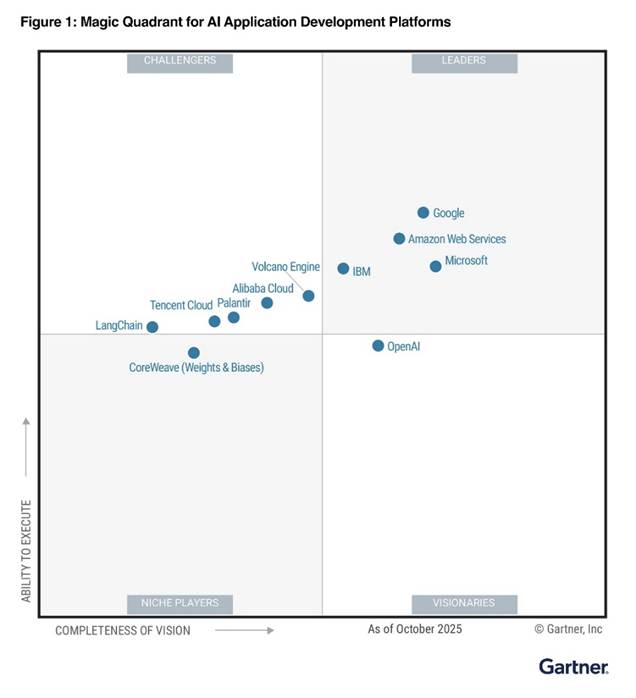
Microsoft named a Leader in the 2025 Gartner® Magic Quadrant™ for Global Industrial IoT Platforms 

We’re proud to share that Microsoft has been recognized as a Leader in the 2025 Gartner Magic Quadrant for Global Industrial IoT (IIoT) Platforms. We believe this recognition underscores our commitment to empowering industries with intelligent, secure, and scalable solutions that drive real-world impact. 

As industrial organizations continue to modernize their operations, Azure’s adaptive cloud approach, which includes Azure IoT, Azure Arc, and more, can help manufacturing, energy, and logistics organizations to enhance efficiency, optimize performance, and drive secure innovation at scale.

Accelerate digital transformation with Azure IoT

Recognized in industrial IoT

In today’s data-driven industrial landscape, Internet of Things (IoT) technology already serves as a strategic driver of operational excellence and competitiveness. Connected sensors and edge devices capture machines and process data that can then be integrated with other key enterprise systems such as Manufacturing Execution System (MES), Enterprise Resource Planning (ERP), and analytics in digital twin models to predict failures, optimize asset utilization, and reduce downtime. These capabilities result in business value by helping organizations improve key performance indicators (KPIs) such as quality assurance, energy efficiency, and supply chain traceability.

As the backbone for AI, IoT provides high frequency telemetry and controls the pathways needed for advanced analytics and machine learning. This synergy powers additional industrial use cases like self-dispatching field services, vision-based quality inspection, process optimization, energy load balancing, and intelligent operator assistance. Industrial IoT, especially when deployed with an adaptive cloud approach, can transform AI from isolated pilots into scalable, production-grade capabilities that could boost yield, throughput, and sustainability. These capabilities can help unlock a new type of organization, what we call the Frontier Industrial firm—industrial companies operating at the leading edge of digitalization to pursue superior productivity. 

We continue to help industrial organizations transform by focusing on the key areas our customers prioritize: 

Comprehensive platform for industrial needs: Microsoft’s industrial IoT platform enables a wide variety of industrial use cases through its ability to bring data from distributed and collocated devices into a common data foundation for analysis and action. Key capabilities include Azure IoT Hub, Azure Digital Twins, Microsoft Defender for IoT, Azure IoT Operations, and Microsoft Fabric. Together, these tools help empower organizations to make data-driven decisions, boost operational efficiency, and scale AI across varied deployment environments.  

Industrial data acquisition and management: Microsoft’s focus on standards, ecosystem partnerships, and helping customers take advantage of existing investments are key pillars of its industrial data management strategy. Industrial data acquisition and management are challenging today due to the complexity of industrial environments. To help with this, Azure IoT Operations natively integrates with brownfield environments and enables high-velocity operational technology (OT)/IoT data collection and contextualization using Akri connectors. Once gathered, the data is stored in OneLake using Microsoft Fabric, allowing for unified modeling in a central location.   

Azure Arc-enabled Kubernetes extends these capabilities with open-standard APIs that integrate seamlessly with Azure’s cloud management graph (ARM graph), ensuring consistent security, auditing, and policy enforcement. Meanwhile, Azure Device Registry unifies asset management by representing edge assets as Azure resources which lays the groundwork for scalable application deployments. 

Real-time intelligence for smarter decisions: Microsoft’s strength in industrial data management is more than just technical, it is transformational. By cleaning, contextualizing, and curating OT/IoT data at the edge, Azure IoT Operations builds a solid foundation for real-time intelligence. Integrated with Microsoft Fabric and Azure Digital Twin Builder, this enables AI-enhanced decision making that helps customers optimize production quality, improve equipment reliability, and support sustainable operations.  

Integration with Microsoft Copilot in Azure: Microsoft is redefining intelligence with the integration of Copilot and generative AI capabilities across its IoT platform, especially Azure IoT Operations and Microsoft Fabric. With Copilot in Azure you can retrieve intelligent recommendations for operations management, advanced data analysis, and visualization. This empowers industrial teams to make faster and smarter decisions, whether optimizing workflows, interpreting complex datasets, or managing supervisory tasks.  

Cloud-to-edge integration with the adaptive cloud approach: Microsoft’s IoT platform enabled by Azure Arc’s adaptive cloud approach unifies hybrid, multicloud, edge, and IoT environments. This provides a consistent unified control plane for applications, data, and governance that meets industrial needs for scalability and operational efficiency.  

Secure by design, intelligent by default: Azure IoT Operations is designed with security at its core. This proactive approach is intended to reduce operational burden for users. Microsoft also has a fully integrated security suite, including Microsoft Defender for IoT, Microsoft Sentinel and Microsoft Entra. 

Shaping the future of digital operations 

Our roadmap will focus on expanding AI capabilities—including agentic and generative AI—across the Azure stack. We are committed to helping customers harness the full potential of their data, streamline operations, and innovate faster. We remain focused on evolving our platform to meet various industrial needs. As we continue to innovate, our priority is making it easier for customers and partners to build confidently on Azure. 

Microsoft has a robust partner ecosystem that can help ensure local expertise and tailored solutions for every industry, to unlock new opportunities and deliver even greater impact. Whether it is co-innovating on industry-specific solutions or scaling AI adoption globally, our partners are essential to helping customers build confidently on Azure.  

Learn more

Discover how Microsoft’s IoT offerings can enhance your operations. Explore the resources below for more information-

Explore Azure IoT portfolio.

Explore our unified data platform, Microsoft Fabric, and learn more about Digital Twin Builder in Microsoft Fabric.

Check out our IoT Partner Ecosystem.

Gartner, Magic Quadrant for Global Industrial IoT Platforms, By Scot Kim, Sudip Pattanayak, Emil Berthelsen, Sushovan Mukhopadhyay, Wam Voster, Akhil Singh, September 8, 2025.

Gartner does not endorse any vendor, product or service depicted in its research publications and does not advise technology users to select only those vendors with the highest ratings or other designation. Gartner research publications consist of the opinions of Gartner’s Research & Advisory organization and should not be construed as statements of fact. Gartner disclaims all warranties, expressed or implied, with respect to this research, including any warranties of merchantability or fitness for a particular purpose.

GARTNER is a registered trademark and service mark of Gartner, Inc. and/or its affiliates in the U.S. and internationally, Magic Quadrant is a registered trademark of Gartner, Inc. and/or its affiliates and is used herein with permission. All rights reserved.

This graphic was published by Gartner, Inc. as part of a larger research document and should be evaluated in the context of the entire document. The Gartner document is available upon request from here.
The post Microsoft named a Leader in the 2025 Gartner® Magic Quadrant™ for Global Industrial IoT Platforms  appeared first on Microsoft Azure Blog.
Quelle: Azure
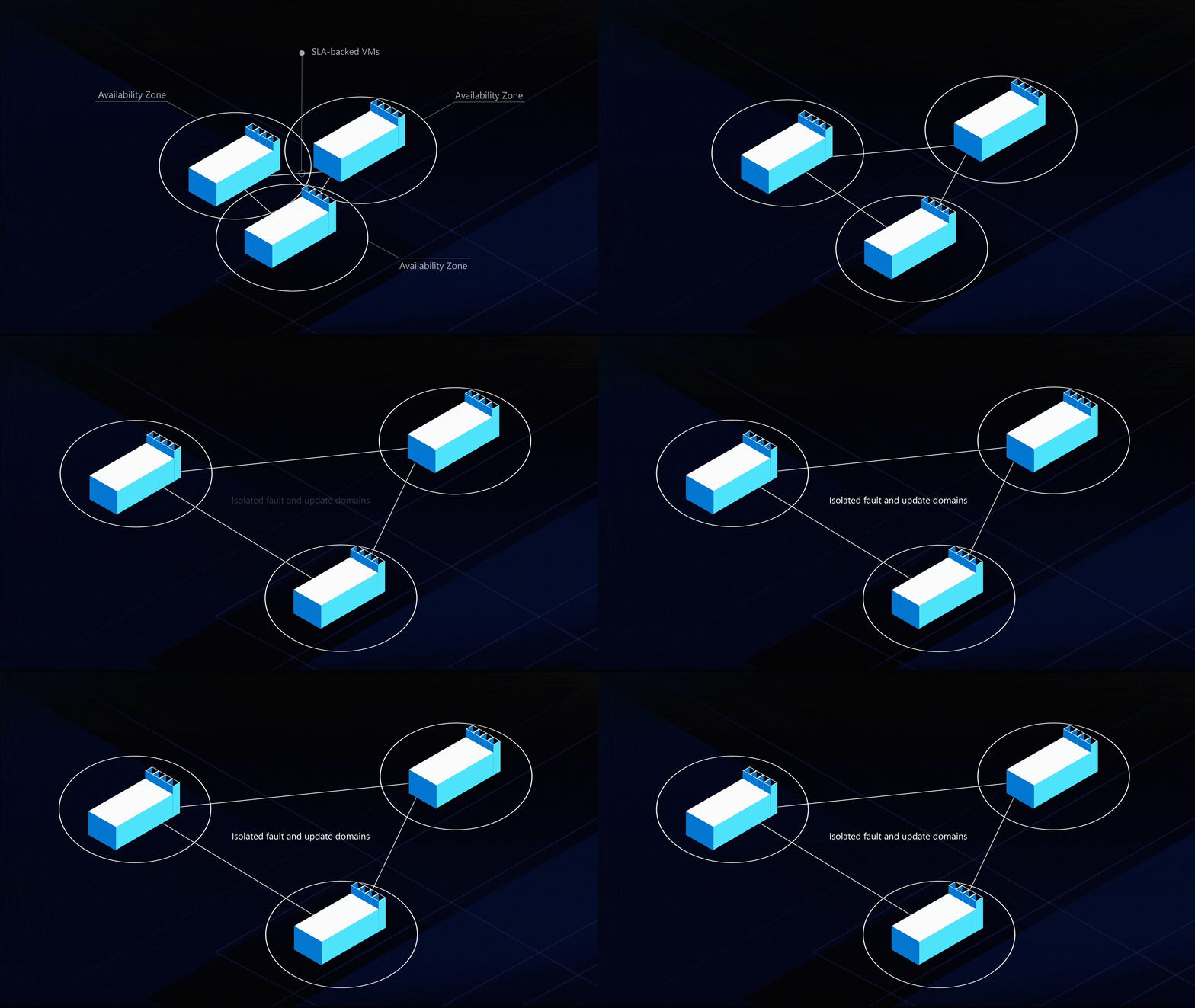
Inside the world’s most powerful AI datacenter

This week we have introduced a wave of purpose-built datacenters and infrastructure investments we are making around the world to support the global adoption of cutting-edge AI workloads and cloud services.

Today in Wisconsin we introduced Fairwater, our newest US AI datacenter, the largest and most sophisticated AI factory we’ve built yet. In addition to our Fairwater datacenter in Wisconsin, we also have multiple identical Fairwater datacenters under construction in other locations across the US.

In Narvik, Norway, Microsoft announced plans with nScale and Aker JV to develop a new hyperscale AI datacenter.

In Loughton, UK, we announced a partnership with nScale to build the UK’s largest supercomputer to support services in the UK.

These AI datacenters are significant capital projects, representing tens of billions of dollars of investments and hundreds of thousands of cutting-edge AI chips, and will seamlessly connect with our global Microsoft Cloud of over 400 datacenters in 70 regions around the world. Through innovation that can enable us to link these AI datacenters in a distributed network, we multiply the efficiency and compute in an exponential way to further democratize access to AI services globally.

So what is an AI datacenter?

The AI datacenter: the new factory of the AI era

Aerial view of Microsoft’s new AI datacenter campus in Mt Pleasant, Wisconsin.

An AI datacenter is a unique, purpose-built facility designed specifically for AI training as well as running large-scale artificial intelligence models and applications. Microsoft’s AI datacenters power OpenAI, Microsoft AI, our Copilot capabilities and many more leading AI workloads.

The new Fairwater AI datacenter in Wisconsin stands as a remarkable feat of engineering, covering 315 acres and housing three massive buildings with a combined 1.2 million square feet under roofs. Constructing this facility required 46.6 miles of deep foundation piles, 26.5 million pounds of structural steel, 120 miles of medium-voltage underground cable and 72.6 miles of mechanical piping.

Unlike typical cloud datacenters, which are optimized to run many smaller, independent workloads such as hosting websites, email or business applications, this datacenter is built to work as one massive AI supercomputer using a single flat networking interconnecting hundreds of thousands of the latest NVIDIA GPUs. In fact, it will deliver 10X the performance of the world’s fastest supercomputer today, enabling AI training and inference workloads at a level never before seen.

The role of our AI datacenters – powering frontier AI

Effective AI models rely on thousands of computers working together, powered by GPUs, or specialized AI accelerators, to process massive concurrent mathematical computations. They’re interconnected with extremely fast networks so they can share results instantly, and all of this is supported by enormous storage systems that hold the data (like text, images or video) broken down into tokens, the small units of information the AI learns from. The goal is to keep these chips busy all the time, because if the data or the network can’t keep up, everything slows down.

The AI training itself is a cycle: the AI processes tokens in sequence, makes predictions about the next one, checks them against the right answers and adjusts itself. This repeats trillions of times until the system gets better at whatever it’s being trained to do. Think of it like a professional football team’s practice. Each GPU is a player running a drill, the tokens are the plays being executed step by step, and the network is the coaching staff, shouting instructions and keeping everyone in sync. The team repeats plays over and over, correcting mistakes until they can execute them perfectly. By the end, the AI model, like the team, has mastered its strategy and is ready to perform under real game conditions.

AI infrastructure at frontier scale

Purpose-built infrastructure is critical to being able to power AI efficiently. To compute the token math at this trillion-parameter scale of leading AI models, the core of the AI datacenter is made up of dedicated AI accelerators (such as GPUs) mounted on server boards alongside CPUs, memory and storage. A single server hosts multiple GPU accelerators, connected for high-bandwidth communication. These servers are then installed into a rack, with top-of-rack (ToR) switches providing low-latency networking between them. Every rack in the datacenter is interconnected, creating a tightly coupled cluster. From the outside, this architecture looks like many independent servers, but at scale it functions as a single supercomputer where hundreds of thousands of accelerators can train a single model in parallel.

This datacenter runs a single, massive cluster of interconnected NVIDIA GB200 servers and millions of compute cores and exabytes of storage, all engineered for the most demanding AI workloads. Azure was the first cloud provider to bring online the NVIDIA GB200 server, rack and full datacenter clusters. Each rack packs 72 NVIDIA Blackwell GPUs, tied together in a single NVLink domain that delivers 1.8 terabytes of GPU-to-GPU bandwidth and gives every GPU access to 14 terabytes of pooled memory. Rather than behaving like dozens of separate chips, the rack operates as a single, giant accelerator, capable of processing an astonishing 865,000 tokens per second, the highest throughput of any cloud platform available today. The Norway and UK AI datacenters will use similar clusters, and take advantage of NVIDIAs next AI chip design (GB300) which offers even more pooled memory per rack.

The challenge in establishing supercomputing scale, particularly as AI training requirements continue to require breakthrough scales of computing, is getting the networking topology just right. To ensure low latency communication across multiple layers in a cloud environment, Microsoft needed to extend performance beyond a single rack. For the latest NVIDIA GB200 and GB300 deployments globally, at the rack level these GPUs communicate over NVLink and NVSwitch at terabytes per second, collapsing memory and bandwidth barriers. Then to connect across multiple racks into a pod, Azure uses both InfiniBand and Ethernet fabrics that deliver 800 Gbps, in a full fat tree non-blocking architecture to ensure that every GPU can talk to every other GPU at full line rate without congestion. And across the datacenter, multiple pods of racks are interconnected to reduce hop counts and enable tens of thousands of GPUs to function as one global-scale supercomputer.

When laid out in a traditional datacenter hallway, physical distance between racks introduces latency into the system. To address this, the racks in the Wisconsin AI datacenter are laid out in a two-story datacenter configuration, so in addition to racks networked to adjacent racks, they are networked to additional racks above or below them.

This layered approach sets Azure apart. Microsoft Azure was not just the first cloud to bring GB200 online at rack and datacenter scale; we’re doing it at massive scale with customers today. By co-engineering the full stack with the best from our industry partners coupled with our own purpose-built systems, Microsoft has built the most powerful, tightly coupled AI supercomputer in the world, purpose-built for frontier models.

High density cluster of AI infrastructure servers in a Microsoft datacenter.

Addressing the environmental impact: closed loop liquid cooling at facility scale

Traditional air cooling can’t handle the density of modern AI hardware. Our datacenters use advanced liquid cooling systems — integrated pipes circulate cold liquid directly into servers, extracting heat efficiently. The closed-loop recirculation ensures zero water waste, with water only needed to fill up once and then it is continually reused.

By designing purpose-built AI datacenters, we were able to build liquid cooling infrastructure into the facility directly to get us more rack-density in the datacenter. Fairwater is supported by the second largest water-cooled chiller plant on the planet and will continuously circulate water in its closed loop cooling system. The hot water is then piped out to the cooling “fins” on each side of the datacenter, where 172 20-foot fans chill and recirculate the water back to the datacenter. This system keeps the AI datacenter running efficiently, even at peak loads.

Aerial view of part of the closed loop liquid cooling system.

Over 90% of our datacenter capacity uses this system, requiring water only once during construction and continually reusing it with no evaporation losses. The remaining 10% of traditional servers use outdoor air for cooling, switching to water only during the hottest days, a design that dramatically reduces water usage compared to traditional datacenters.

We’re also using liquid cooling to support AI workloads in many of our existing datacenters; this liquid cooling is accomplished with Heat Exchanger Units (HXUs) that also operate with zero-operational water use.

Storage and compute: Built for AI velocity

Modern datacenters can contain exabytes of storage and millions of CPU compute scores. To support the AI infrastructure cluster, an entirely separate datacenter infrastructure is needed to store and process the data used and generated by the AI cluster. To give you an example of the scale — the Wisconsin AI datacenter’s storage systems are five football fields in length!

Aerial view of a dedicated storage and compute datacenter used to store and process data for the AI datacenter.

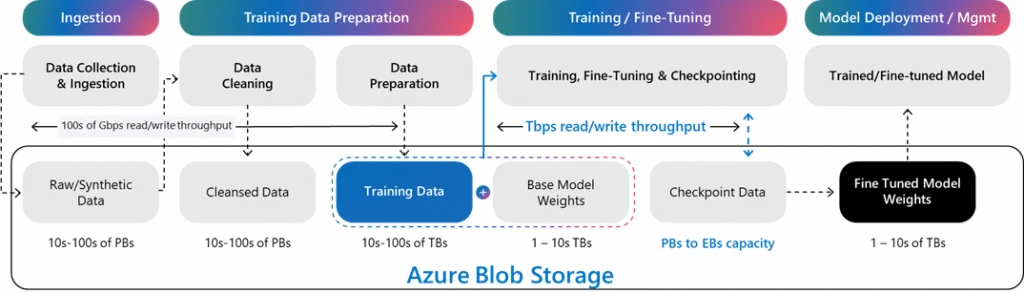
We reengineered Azure storage for the most demanding AI workloads, across these massive datacenter deployments for true supercomputing scale. Each Azure Blob Storage account can sustain over 2 million read/write transactions per second, and with millions of accounts available, we can elastically scale to meet virtually any data requirement.

Behind this capability is a fundamentally rearchitected storage foundation that aggregates capacity and bandwidth across thousands of storage nodes and hundreds of thousands of drives. This enables scale to exabyte scale storage, eliminating the need for manual sharding and simplifying operations for even the largest AI and analytics workloads.

Key innovations such as BlobFuse2 deliver high-throughput, low-latency access for GPU node-local training, ensuring that compute resources are never idle and that massive AI training datasets are always available when needed. Multiprotocol support allows seamless integration with diverse data pipelines, while deep integration with analytics engines and AI tools accelerates data preparation and deployment.

Automatic scaling dynamically allocates resources as demand grows, combined with advanced security, resiliency and cost-effective tiered storage, Azure’s storage platform sets the pace for next-generation workloads, delivering the performance, scalability and reliability required.

AI WAN: Connecting multiple datacenters for an even larger AI supercomputer

These new AI datacenters are part of a global network of Azure AI datacenters, interconnected via our Wide Area Network (WAN). This isn’t just about one building, it’s about a distributed, resilient and scalable system that operates as a single, powerful AI machine. Our AI WAN is built with growth capabilities in AI-native bandwidth scales to enable large-scale distributed training across multiple, geographically diverse Azure regions, thus allowing customers to harness the power of a giant AI supercomputer.

This is a fundamental shift in how we think about AI supercomputers. Instead of being limited by the walls of a single facility, we’re building a distributed system where compute, storage and networking resources are seamlessly pooled and orchestrated across datacenter regions. This means greater resiliency, scalability and flexibility for customers.

Bringing it all together

To meet the critical needs of the largest AI challenges, we needed to redesign every layer of our cloud infrastructure stack. This isn’t just about isolated breakthroughs, but composing multiple new approaches across silicon, servers, networks and datacenters, leading to advancements where software and hardware are optimized as one purpose-built system.

Microsoft’s Wisconsin datacenter will play a critical role in the future of AI, built on real technology, real investment and real community impact. As we connect this facility with other regional datacenters, and as every layer of our infrastructure is harmonized as a complete system, we’re unleashing a new era of cloud-powered intelligence, secure, adaptive and ready for what’s next.

To learn more about Microsoft’s datacenter innovations, check out the virtual datacenter tour at datacenters.microsoft.com.

Scott Guthrie is responsible for hyperscale cloud computing solutions and services including Azure, Microsoft’s cloud computing platform, generative AI solutions, data platforms and information and cybersecurity. These platforms and services help organizations worldwide solve urgent challenges and drive long-term transformation.
The post Inside the world’s most powerful AI datacenter appeared first on Microsoft Azure Blog.
Quelle: Azure

FabCon Vienna: Build data-rich agents on an enterprise-ready foundation

FabCon Vienna: Build data-rich agents on an enterprise-ready foundation

Welcome everyone to the second annual European Microsoft Fabric Community Conference this week in the vibrant city of Vienna, Austria! With more than 130 sessions and 10 full-day workshops, this year’s sold-out European event is bigger than ever and there’s no shortage of incredible learning experiences. More than 4,200 attendees will get to test their driving skills on a high-octane racing simulator powered by Fabric Real Time Intelligence, ask their questions directly at expert-staffed booths, compete for a chance to be crowned the DataViz World Champion, and celebrate Microsoft Power BI’s tenth anniversary.

This event is an opportunity to get much deeper into Microsoft Fabric, which has now become the fastest growing data platform in Microsoft’s history.1 In less than two years, we’ve been able to expand Microsoft Fabric into a complete data and analytics platform with more than 25,000 customers, including about 80% of the Fortune 500, spanning everything from analytics to databases to real-time insights.

Microsoft has massive investments in Fabric, and I’m thrilled to share a new slate of announcements that will further advance Fabric’s vision as the most comprehensive, enterprise-grade data platform on the planet. These announcements include new OneLake shortcut and mirroring sources, a brand-new Graph database enabling you to connect entities across OneLake, new geospatial capabilities with Maps in Fabric, improved developer experiences, and new security controls—giving you what you need to run your mission-critical scenarios on Fabric.Get started with Microsoft Fabric

Unify your data with OneLake, the AI-ready data foundation

Any successful AI or data project starts with the right data foundation. Organizations like Lumen, IFS, NTT Data, and the Chalhoub Group have all adopted Microsoft OneLake as the unified access point for their data. Lumen—a leader in enterprise connectivity—cut 10,000 hours of manual effort with OneLake. “We used to spend up to six hours a day copying data into SQL servers,” says Chad Hollingsworth, Cloud Architect at Lumen. “Now it’s all streamlined. OneLake allowed us to ingest once and use anywhere.”

With mirroring and OneLake shortcuts, we’ve simplified how you connect to and transform your data with a zero-copy, zero-ETL approach that allows you to instantly connect to any data—no matter the cloud, database, vendor, engine, or format. In addition to the recent announcement of mirroring for Azure Databricks, we are thrilled to announce the preview of mirroring for Oracle and Google BigQuery, allowing you to access your Oracle and Google data in OneLake in near real-time. We are also extending Fabric data agents to support all mirrored databases, so you can ask questions about your external database data. Additionally, we are announcing the general availability of OneLake shortcuts to Azure Blob Storage and the preview of new OneLake shortcut transformations to automatically convert JSON and Parquet files to Delta tables, for instant analysis. Finally, we are releasing the OneLake integration with Azure AI Search into general availability, enabling you to easily ground your custom agents with OneLake data.

https://www.youtube-nocookie.com/embed/vgi5yb7KlxY?rel=0&v=vgi5yb7KlxY

With your data in OneLake, the OneLake catalog then provides the tools to discover, govern, and secure your data from a single place. With more than 30 million monthly active Power BI and Fabric users, it’s already the default source of data and insights. We are also launching OneLake security into full preview and creating a new tab in the OneLake catalog called Secure, where you can manage the security and permissions for all your data items. Along with this new tab, we are releasing OneLake catalog Govern tab into general availability.

https://www.youtube-nocookie.com/embed/UiFm5AjKXHQ?rel=0&v=UiFm5AjKXHQ

We are also excited to enrich our extensibility story with the preview of a new OneLake Table API, which lets apps use GET and LIST calls to discover and inspect OneLake tables stored in either Iceberg or Delta format using Fabric’s security model. Finally, for workspace owners, we are releasing preview of OneLake diagnostics that allows you to capture all the data activity and storage operations for a specific workspace into any lakehouse in the same capacity.

Train smarter agents with connected intelligence from graph and maps in Fabric

The first step in starting any agentic project is data. You need to bring the data together and ensure your data estate can handle the volume of data used in training. But sophisticated AI agents require more than simply huge quantities of data. To provide you with accurate answers grounded on your business, they need to first understand the relationships between data. They need to understand your business operations. They need context.

We believe this is the next major shift now required for a modern AI-ready data estate. You can learn more about this shift and our vision in Jessica Hawk’s blog, “Microsoft leads shift beyond data unification to organization, delivering next gen AI readiness.” To help you provide this context to your agents or any other data project, we are excited to announce the preview of two transformative new features in Fabric: Graph and Maps.

Model, analyze, and visualize complex data relationships

Graph in Fabric is designed to enable organizations to visualize and query relationships that drive business outcomes. Built upon the proven architecture principles of LinkedIn’s graph technology, graph in Fabric can help you reveal connections across customers, partners, and supply chains. But like your data, graph is easier to explain visually:

https://www.youtube-nocookie.com/embed/TFrAAdRdyVc?rel=0&v=TFrAAdRdyVc

“Graph in Microsoft Fabric is a game changer. The highly scalable graph engine coupled with Fabric’s ease of use is a uniquely powerful combination.”

—Luke Hiester, Senior Data Scientist, Eastman Chemical Company

Graph will roll out in various Fabric regions starting on October 1, 2025.

Visualize, analyze, and act on location-based data instantly

Maps in Fabric can help you bring geospatial context to your agents and operations by transforming enormous volumes of location-based data into interactive, real-time visualizations that drive location-aware decisions and enhance business awareness. Check out a full demo of the new experience:

https://www.youtube-nocookie.com/embed/zdZOrYR049E?rel=0&v=zdZOrYR049E

By combining streaming analytics, geospatial mapping, and contextual modeling, maps can help you extract location-based insights for your existing business processes to drive better awareness and outcomes.

You can learn more about graph and maps in Yitzhak Kesselman’s “The Foundation for Powering AI-Driven Operations: Fabric Real-Time Intelligence” blog.

Delighting developers with new tools in Fabric

Power BI is a leader in business intelligence for developers with more than 7 million actively building data visuals. Now, Microsoft Fabric is quickly becoming the home for all data developers. To help developers feel even more at home, we’re adding a huge range of new tooling across Fabric.

First, we’ve released the Fabric Extensibility Toolkit into preview—an evolution of the Microsoft Fabric Workload Development Kit but newly designed to help any developer bring their data apps to Fabric for their own organizations along with a simplified architecture and additional automation to drastically streamline development. Developers can now simply build their own Fabric items, and everything else like distribution, user interface, and security is taken care of for you—try it today.

We’re also introducing the preview of Fabric MCP, a developer-focused Model Context Protocol that enables AI-assisted code generation and item authoring in Microsoft Fabric. Designed for agent-powered development and automation, it streamlines how you build using Fabric’s public APIs with built-in templates and best-practice instructions. It also integrates with tools like Microsoft Visual Studio Code and GitHub Codespaces and is fully open and extensible.

With the general availability of Git integration and deployment pipelines with lakehouses, data warehouses, copy jobs, activator, Power BI reports, and many more, we are excited to announce that you can employ continuous integration and continuous delivery (CI/CD) capabilities across the Fabric platform. We are even extending CI/CD support to Fabric data agents. We are also releasing User Data Functions and the Fabric VS Code extension into general availability. And we are releasing an open-source version of the command line interface in Fabric.

Finally, we are also releasing horizontal tabs for open items, support for multiple active workspaces, and a new object explorer—all designed to make multitasking in Fabric smoother, faster, and more intuitive.

Build your mission-critical scenarios on Microsoft Fabric

Fabric has comprehensive, built-in tools for network security, data security, and governance, enabling any organization to effectively manage and govern their data. A detailed overview of all of the existing capabilities are available in the Fabric Security Whitepaper.

Now, we are thrilled to announce significant additions to our security, capacity management, performance, and migration—all of which further cement Fabric as the ideal data platform for every AI and mission-critical scenario. Frontier firms implementing AI need more than just next-generation AI tools. You need a comprehensive, cost-effective data platform to support your projects with end-to-end data protection, integration with developer tools, and performance that can scale to any need. Microsoft Fabric has both the leading generative AI capabilities and the enterprise-ready foundation to truly foster an AI-powered data culture.

Connect securely to even the most sensitive data

First, we are providing additional safeguards to help you manage secure data connections and precisely manage the level of isolation you need in each workspace. We are excited to announce the general availability of Azure Private Link in Fabric and outbound access protection for Spark, and the soon to be released preview of workspace IP filtering—all at the workspace-level. Additionally, we are expanding mirroring to support on-premises data sources and data sources behind firewalls. Finally, we are excited to announce the general availability of customer managed keys for Fabric workspaces.

More granular capacity management

Gaining control over the jobs running on your Fabric capacities is critical to any mission critical scenario. To give you this control, we are announcing the general availability of surge protection for background jobs and the preview of surge protection for workspaces. With surge protection, you can set limits on background activity consumption and now, specific workspace activity—helping you protect capacities from unexpected surges. Learn more.

Enhanced Fabric Data Warehouse performance

Fabric is engineered to handle massive data volumes with exceptional performance across its analytics engines, and we’re continuously enhancing their efficiency. Since August 2024, we’ve released 40 performance improvements to Fabric Data Warehouse driven by your feedback, resulting in a 36% performance improvement in industry standard benchmarks—try it today.

Seamlessly migrate your Synapse data to Fabric

We are also excited to release the general availability of an end-to-end migration experience natively built into Fabric, enabling Azure Synapse Analytics (data warehouse) customers to transition seamlessly to Microsoft Fabric. The migration experience allows you to migrate both metadata and data from Synapse Analytics and comes with an intelligent assessment, guided support, and AI-powered assistance to minimize the migration effort.

Extend Fabric with partner-created workloads and seamless integration with Snowflake

We are excited to announce the general availability of new partner solutions native to Microsoft Fabric from ESRI, Lumel, and Neo4j. ESRI’s advanced geospatial analytics, Lumel’s vibrant business intelligence insights, and Neo4j’s graph analytics are all just a click away in the Fabric workload hub. In addition, several new partners are announcing capabilities built on Microsoft Fabric, learn more by reading the FabCon Vienna partner blog.

In May of 2024, we announced an expanded partnership with Snowflake—committing both our platforms to provide seamless bi-directional integration and enable customers with the flexibility to do what makes sense for their business. Since then, we’ve expanded interoperability between Snowflake and Microsoft OneLake including the ability to write Snowflake tables to OneLake, the ability to use OneLake shortcuts to access Snowflake tables, the ability to read OneLake tables directly from Snowflake, and full support for Apache Iceberg format in OneLake. Now, we are releasing new Iceberg REST Catalog APIs that allow Snowflake to read Iceberg tables from OneLake, keeping OneLake tables automatically in sync. You can learn more about this new announcement and our partnership by reading the Microsoft OneLake and Snowflake interoperability blog.

See more Microsoft Fabric innovation

In addition to the announcements above, we are excited to share a huge slate of other innovations coming to Fabric, including enhancements to SQL databases in Fabric, the preview of Runtime 2.0, the preview of AI functions in Data Wrangler, the general availability of editing semantic models in the Power BI service, and so much more.

You can learn more about these announcements and everything else by reading the Fabric September 2025 Feature summary blog, the Power BI September feature summary blog, or by exploring the latest blogs on the Fabric Updates channel.

Join us at FabCon Atlanta and Microsoft Ignite

Already excited about the next FabCon? Join us in Atlanta, Georgia, from March 16 to 20, 2026, for even more in-depth sessions, cutting-edge demos and announcements, community networking, and everything else you love about FabCon. Register today and use code MSCATL for a $200 discount on top of current Early Access pricing!

In the meantime, you can join us at Microsoft Ignite this year from November 18 to 21, 2025, either in person in San Francisco or online to see even more innovation coming to Fabric and the rest of Microsoft. You’ll see firsthand the latest solutions and capabilities across all of Microsoft and connect with experts who can help you bolster your knowledge, build connections, and explore emerging technologies.

Explore additional resources for Microsoft Fabric

Sign up for the Fabric free trial.

View the updated Fabric Roadmap.

Try the Microsoft Fabric SKU Estimator.

Visit the Fabric website.

Join the Fabric community.

Read other in-depth, technical blogs on the Microsoft Fabric Updates Blog.

Sign up now for our upcoming ask the Fabric expert sessions

Join us on September 24, 2025, for the “Ask the Experts—Microsoft OneLake” webinar where experts from our OneLake team will join to answer all your questions live.

Get certified in Microsoft Fabric

Join the thousands of other Fabric users who’ve achieved more than 50,000 certifications collectively for the Fabric Analytics Engineers and Fabric Data Engineers roles. To celebrate FabCon Vienna, we are offering the entire Fabric community a 50% discount on exams DP-600, DP-700, DP-900, and PL-300. Request your voucher.

Join the FabCon Global Hackathon

Build real-world data and AI solutions that push the boundaries of what’s possible with Microsoft Fabric. Join the hackathon to compete for prizes up to $10,000.

Read additional blogs by industry-leading partners

How AI-native data platforms are redefining business by PricewaterhouseCoopers LLP.

Your Operational Data Just Became Your Smartest Business Agent by iLink Digital.

From OLTP to AI: Choosing Your Microsoft Fabric Database Engine by Lumel Technologies.

Building scalable e-commerce product recommendations with Microsoft Fabric SQL by MAQ Software.

Things You Should Know About MCP in Microsoft Fabric by Nimble Learn.

How to Estimate Microsoft Fabric Costs: Capacity Planning Strategies for AI Workloads by JourneyTeam.

How Microsoft Fabric Modernized & Transformed ERP Data Analytics by Bizmetric.

Unlocking the full value of Data as a Product with Microsoft Fabric and Purview by Thoughtworks.

The post FabCon Vienna: Build data-rich agents on an enterprise-ready foundation appeared first on Microsoft Azure Blog.
Quelle: Azure

Azure Kubernetes Service Automatic: Fast and frictionless Kubernetes for all

Today, I’m excited to announce the general availability of Azure Kubernetes Service (AKS) Automatic, delivering Kubernetes that’s already configured, optimized, and ready to run—right out of the box. AKS Automatic accelerates app delivery with automation, simplifies Kubernetes operations through intelligent defaults, and enables secure, compliant workloads optimized for AI and cloud-native use cases. AKS Automatic will set the standard for a simplified Kubernetes experience. 

Get an introduction to AKS Automatic

Instead of wrestling with setup and operations, teams go from commit to cloud without friction, accelerating delivery and unleashing innovation. AKS Automatic is the perfect balance between simplification and flexibility. By removing the complexity of Kubernetes infrastructure, it empowers teams to focus on building and running applications, while still preserving the extensibility and openness you expect from Kubernetes.

AKS powers mission-critical workloads for some of the world’s most forward-thinking organizations, including OpenAI, BMW, Hexagon, McDonald’s, and the NBA. Across industries, enterprises are leveraging AKS to scale securely and accelerate innovation. AKS Automatic builds on this trusted foundation to make Kubernetes faster, simpler, and more secure for every team.

Removing the “Kubernetes tax”

Even for the most advanced Kubernetes users, the power of the platform can often come with operational overhead. AKS Automatic was built to remove those barriers by:

Lowering the learning curve for new Kubernetes users. “Easy mode” clusters with best-practice defaults and guardrails simplify configuration and operations, while ensuring every app deployed on AKS has the performance, reliability, and security it requires. Even first-time Kubernetes users can have a reliable cluster up and running, fast.

Freeing up resources and reducing operational overhead. Running Kubernetes traditionally can mean maintaining the control plane, tuning node pools, patching systems, handling upgrades, and scaling–all tasks that can consume considerable time and resources. AKS Automatic offloads these day-two operations to Azure, managing your cluster’s infrastructure (node provisioning, scaling, maintenance, and repairs) automatically–freeing your team up to focus on other things.

Mitigating security and reliability risks from misconfiguration. Kubernetes flexibility can be a double-edged sword–a small mistake in setup can expose security vulnerabilities or undermine reliability. AKS Automatic clusters come secure and production-ready right out –of –the box. They enforce a hardened default configuration and Azure continuously patches and monitors cluster components to keep them up to date. This means a stronger security posture and resilient operations without extra effort.

From container image to deployed application in minutes, AKS Automatic streamlines the entire Kubernetes experience. With intelligent defaults, simplified cluster operations, and proactive security built in, teams are freed up to focus on building and running applications, instead of managing infrastructure.

The AKS Automatic PoC has helped our Enterprise Tooling Platform significantly reduce operational overhead. By streamlining deployment and management, it allowed us to focus more on apps and tools workloads rather than infrastructure. We’re now planning to adopt AKS Automatic as our ETP microservices and hosting platform for production.
—Swamy Asha, Solution Engineer at Royal Mail Group

What AKS Automatic delivers

AKS Automatic simplifies Kubernetes by offering a fully managed, opinionated experience that abstracts away from infrastructure complexity, while keeping the full power of Kubernetes at your fingertips. In practical terms, when you create an AKS Automatic cluster, you get:

One-click, production-ready clusters. Spin up a production-grade cluster in minutes. Azure handles node setup, networking, and integrations using best practices—no upfront decisions required. Defaults like Azure Container Networking Interface (CNI) and Azure Linux nodes are preselected, so you’re ready to deploy immediately.

Intelligent autoscaling without manual tuning. AKS Automatic enables dynamic scaling for both pods and nodes using Horizontal Pod Autoscaler (HPA), Vertical Pod Autoscaler (VPA), and KEDA for event-driven scaling–all enabled out –of –the box. It also introduces automated node provisioning via Karpenter, an open-source Kubernetes autoscaler that dynamically scales your cluster up or down based on real-time demand—no manual configuration needed.

Built-in best practices for security and reliability. Every AKS Automatic cluster is production-ready by default. This means security and reliability features are baked in from the start. You get Microsoft Entra ID integration for authentication, role-based access control, and network policies without extra setup. Node images are patched automatically, and Azure Monitor is preconfigured for logs and metrics. Deployment safeguards help prevent misconfigurations that could impact uptime, while automatic node repairs and built-in scaling ensure your workloads run reliably. This means you get a stable, secure cluster on day one.

Azure’s application platform delivers flexibility in how customers want to scale AI Apps and agents in production, from AKS to Azure Container Apps and Azure App Service. AKS Automatic strengthens Azure’s position by making Kubernetes simpler for all teams, accelerating deployment of AI applications and agents and seamlessly integrating with Azure’s ecosystem of services and developer tools.

Kubernetes continues to draw massive interest from customers building new AI applications and agents, as well as those modernizing existing applications and deploying at scale. Even more, we’ve embedded Microsoft’s expertise running Kubernetes at scale – underpinning Microsoft Teams, M365, Xbox Live and more – directly in AKS Automatic configurations to enhance security, scalability, and performance. 

Developer-friendly and fully extensible Kubernetes. While AKS Automatic handles infrastructure, it keeps the experience familiar for developers and platform engineers. You still get the full Kubernetes API, kubectl, and your existing tools all work as expected. AKS Automatic integrates with CI/CD pipelines (e.g., GitHub Actions), enabling fast, repeatable deployments. If you need to customize something or use a specific Kubernetes feature, you still have the full power of Kubernetes at your fingertips.

A platform optimized for AI and cloud-native workloads. AKS Automatic is purpose-built to support the demands of modern applications, including AI, ML, and cloud-native services. It offers GPU support, intelligent workload placement, and dynamic resource allocation to handle compute-intensive tasks like model training and inference.

Open-source alignment. Importantly, none of this comes at the expense of control or openness. AKS Automatic is built on upstream open-source Kubernetes, and it remains 100% conformant with CNCF standards (just like AKS Standard). It leverages open-source projects like KEDA and Karpenter, staying true to the Kubernetes community while delivering a managed experience.

Benefits for startups and enterprises alike

One of the unique aspects of AKS Automatic is that it’s designed to be valuable to a wide range of customers.

For lean teams and startups, it makes Kubernetes feasible even without dedicated DevOps or platform engineers. You get a “it just works” Kubernetes cluster where a lot of the tricky parts (like scaling, security, upgrades) are handled for you. This means a small team can leverage the power of Kubernetes–flexibility, portability, scaling–without getting bogged down in operations. As your needs grow, you still have all the capabilities of Kubernetes available.

For enterprise IT and platform teams, AKS Automatic offers consistency and efficiency at scale. Enterprise platform teams can provide AKS Automatic clusters as a self-service option to internal groups, and have confidence that those clusters will be secure and well-managed out of the box. It frees up experienced Kubernetes operators to focus on higher-value architecture decisions rather than routine cluster maintenance. And because it’s still AKS, it integrates with enterprise tools like Azure Arc, Azure Monitor, and company-wide policies just as well as standard AKS does.

In both cases, the outcome is the same: teams can spend more time on their applications and business logic, and less time on Kubernetes itself. AKS Automatic removes much of the undifferentiated heavy lifting that came with Kubernetes, which means more developer productivity and operational peace of mind.

Get started with AKS Automatic

Getting started is as easy as selecting the “Automatic” option when you create a new AKS cluster. In the Azure Portal, you’ll find a toggle or SKU selection for AKS Automatic during provisioning. With Azure CLI, you can enable it by specifying tier Automatic when creating a cluster. There’s no separate product or new API–it’s the AKS you know, with a new managed mode.

Explore AKS Automatic today

If you’re interested in learning more or trying it out:

Ready to start focusing on innovation instead of infrastructure? Join us live today for the global virtual launch event of AKS Automatic (or catch the recap)!

Check out the documentation and quickstarts. We have updated guides on Microsoft Learn, such as “Introduction to AKS Automatic” which covers how it works, and a quickstart for deploying an app to an AKS Automatic cluster from a GitHub repository (using our automated CI/CD integration). These resources walk you through the experience step by step.

Try converting a test workload. A great way to evaluate AKS Automatic is to take a non-critical workload or a dev/test environment you have on a standard AKS cluster and deploy it to a new AKS Automatic cluster. You’ll quickly notice the differences in what you don’t have to do (no manual node management, etc.), and you can observe the autoscaling in action by putting some load on it. Since the Kubernetes API is the same, migrating an app is usually straightforward – often it’s as simple as pointing your kubectl context to the new cluster and re-applying your manifests or Helm charts.

Join the community conversation. We’re eager to hear from you–what works well, what could be better, and what features you’d like to see next. Kubernetes at scale is a journey, and GA is a milestone, not the end. As we move forward, we’ll continue to enhance AKS Automatic, guided heavily by user input. Connect with our team on our Monthly Community Calls or on our GitHub.

Our team is thrilled to make AKS Automatic generally available and can’t wait to see how you use it. Whether you’re a startup founder looking to scale your app without hiring an ops team, or an enterprise architect aiming to standardize and simplify your company’s Kubernetes footprint, we believe AKS Automatic will help you achieve more with less hassle. It’s Kubernetes, minus the complexity. We invite you to try it out and let us know what you think–and we look forward to a new wave of cloud-native innovation that AKS Automatic will help unlock.
The post Azure Kubernetes Service Automatic: Fast and frictionless Kubernetes for all appeared first on Microsoft Azure Blog.
Quelle: Azure




