Cron jobs in Node.js

medium.com – Every developer sooner or later faces a problem on how to deal with cron jobs. The list of cron jobs use-cases is enormous: cache invalidation, reports generation, refreshing data from external…
Quelle: news.kubernauts.io

Changes to Docker Hub Autobuilds

As many of you are aware, it has been a difficult period for companies offering free cloud compute [1]. Unfortunately, Docker’s Autobuild service has been targeted by the same bad actors, so today we are disappointed to announce that we will be discontinuing Autobuilds on the free tier starting from June 18, 2021. 

In the last few months we have seen a massive growth in the number of bad actors who are taking advantage of this service with the goal of abusing it for crypto mining. For the last 7 years we have been proud to offer our Autobuild service to all our users as the simplest way to set up CI for containerized projects. As well as the increased cost of running the service, this type of abuse periodically impacts performance for paying Autobuild users and induces many sleepless nights for our team

In April we saw the number of build hours spike 2X our usual load and by the end of the month we had already deactivated ~10,000 accounts due to mining abuse The following week we had another ~2200 miners spin up.

As a result of this we have made the hard choice to remove Autobuilds from our free plan as a mitigation for this abuse. While making these changes is never an easy choice, we’ve also continued to focus on making meaningful improvements to the performance of Autobuilds, including:

Increasing the number of parallel builds to 5 for Pro and 15 for Team.Increase the build instance types, so you get a beefier machine to build on!Changed Autobuild to take advantage of BuildKit by default for improved build performance.

All of these improvements should see a faster and more stable build experience with lower queue times. If that sounds good and you are a free user who <3’s their Autobuilds, we are offering 20% off Docker Pro and Team for new and returning subscriptions through June 18, 2021 so you can continue using that Autobuild goodness.

If you’re part of the Docker Open Source program, and currently leveraging Autobuilds as part of a Free plan, we want to continue supporting you and we will be reaching out to make sure you will not be impacted by this change.   

We really appreciate your support and the community’s understanding as the whole industry battles against these abusive few. We want to keep providing awesome and magical services and hope we can find a better solution with everyone going forward.
The post Changes to Docker Hub Autobuilds appeared first on Docker Blog.
Quelle: https://blog.docker.com/feed/

Kubernetes and SSL Certificate Management

betterprogramming.pub – Security is becoming more important than ever and needs to be integrated with any technical solution — even for testing environments. One of the most popular techniques is to use HTTPS protocol with…
Quelle: news.kubernauts.io

Our journey from office-centric to remote-first

Docker Inc. started like many startups with engineers working from a single location. For us, this was in the Bay Area in the US. We were very office-centric, so the natural way to increase diversity and to get engineers from different cultures to work together was to open new offices in diverse locations. Right from the start, our goal was to mix American and European ways of producing software, giving us the best of both cultures.

Step 1 – Opening European offices

In 2015, Docker started to open offices in Europe, starting with Cambridge in the United Kingdom and followed by Paris in France. With these two locations, the long road to gaining experience working with remote employees began.

Having multiple offices scattered around the world is different from being fully remote. But you still start experiencing some of the challenges of not having everybody in the same location simultaneously. We spent a great deal of our time on planes or trains visiting each other.

Despite the robust open-source culture of the company, which shows that you can build great software while not having everybody in the same room, we still had a very office-centric culture. A lot of the context of a given product conversation or decision was linked to a given office. When you were not in the office where the decision was made, you only had partial information about the decision.

We learned a lot during this time: organizing work effectively and enjoyably while appreciating different cultures, time zones (France and US West Coast are 9 hours apart…), paperwork, salary expectations, public holidays, etc. 

Step 2 – Remote Engineers in an office-centric culture

The products Docker builds have a significant impact on the world, so hiring great engineers has never been a problem at Docker. We were artificially limiting ourselves to hiring talent close to one of our offices. We could open more offices or start hiring people as fully remote wherever they lived. In 2017, we hired a couple of very experienced remote engineers who had 5+ years of experience working remotely. They brought a lot of their best practices, and with them, the company learned how to be better at working with remote engineers. 

One of the areas we made changes was in how we ran meetings. Instead of only having remote employees dial in and struggling to follow conversations in conference rooms, we got everyone, even those in offices, to dial in with a good headset so that everyone was on the same level. This drastically improves the quality of meetings for those who are remote. 

We also learned the power of good writing as time zones forced communication to be more asynchronous. Concise, clear, and effective, writing became critical. 

We worked hard on our company core values, one of them is “Open Collaboration”. Following that value, we started to close 1600+ slack channels to concentrate our communication around just a few dozen. We advocated for communication to happen in public slack channels by default and limiting the usage of private channels to only when necessary.

Remote engineers felt better, but there was still a life in the office they couldn’t grasp, this is when we introduced Wormholes. Wormholes are pretty low-tech, they are a monitor, a camera, and speakers open in the offices all day. Remote engineers connect to it, have a view of the offices, and can feel the ambiance and hear general conversations. They can also slack someone to come close to the wormhole for “direct” communication. They were pretty popular until we left our offices to start working from home.

Step 3 – Remote work during a worldwide pandemic

In early 2020, once we were pretty experienced at remote working, we advocated for all positions to be open in any country that we had legal entities, making it easier for us to hire good talent.

Then Covid hit us along with everyone else. Relatively confident in our experience of working remotely, we thought that we were more ready than others to have everyone working at home. We quickly realized that working remotely and working remotely through a pandemic are not the same at all. 

While we had the software and culture to embrace a remote-first workforce, the pandemic itself brought new challenges. Not being able to see each other in the office or family and relatives for such a long time has taken a toll on everybody. This also highlighted inequality that we didn’t realize before: people with small apartments, young kids, or living alone were hit harder than those living with relatives and enjoying a large house.

These hard-learned lessons fueled the way we shape the future of work at Docker. Giving employees help to set up their home office, helping them move from one city to another, and generally spending enough time and energy making sure everybody is comfortable as we transition to this exciting new future of work.

Step 4 – Embracing remote-first

While other companies are pushing their employees to get back to offices, we decided that there is no turning back for Docker Inc. and that we will stay remote-first. All of our offices are closed and will remain so. When Covid releases its pressure on the world, we will offer employees who live near to each other support to meet up and continue to collaborate and drive our culture, while we will look for chances to do this as a whole company both remote and in-person as things return to normal in the future. 

Our journey from office-centric to remote-first has been exciting, and we’re eager to get even better at being remote-first. 

We are now in a position to hire almost wherever you are, so if you’re interested in living this experience with us while producing impactful software, we have positions open in Engineering and Product. 
The post Our journey from office-centric to remote-first appeared first on Docker Blog.
Quelle: https://blog.docker.com/feed/

DockerCon Live 2021: A Look Back at What’s New

Nearly 80,000 participants registered for DockerCon Live 2021! There were fantastic keynotes, compelling sessions, thousands of interactions and everything in-between that a developer and development teams need to help solve their day-to-day application development challenges.

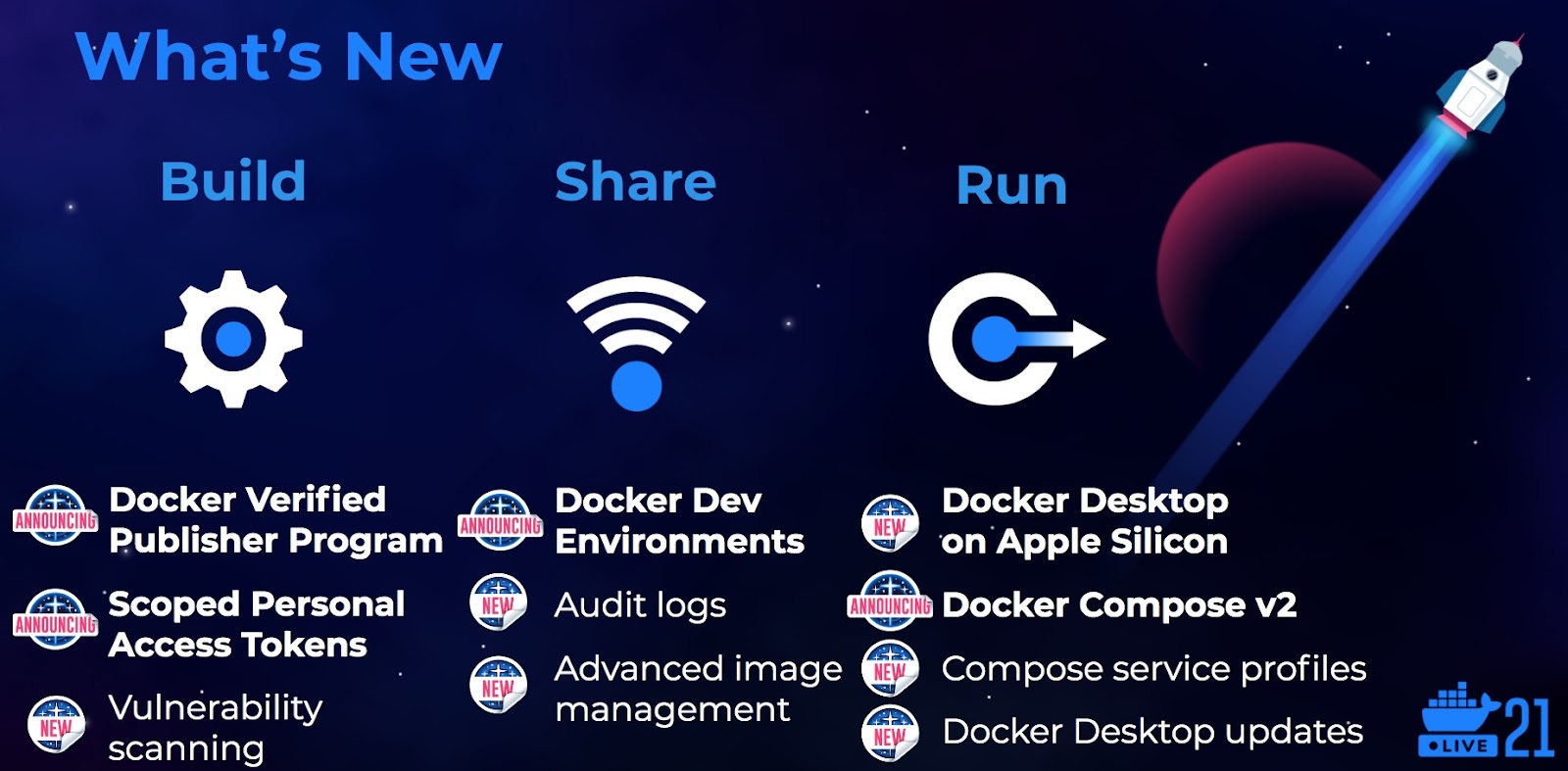
In all that excitement, you might have missed the new innovations that Docker announced to make it easier for developers to build, share and run your applications from code to cloud. These enhancements are a result of Docker’s continued investment and commitment to make sure developers have the best experience possible while making app development more efficient and secure.

Application security is directly tied to the software supply chain. Developers are realizing the importance of integrating security as early as possible in the development process. They  must now consider the security directives of their organization and associated compliance rules while also enabling their teams to work in the most secure, efficient way possible.

These new product enhancements bolster security in a number of dimensions including scanning for vulnerabilities during different development stages and increasing team security by offering tools such as audit logs and scoped access tokens.  

Take a look at what we announced:

Verified Publisher ProgramDocker launched the Docker Verified Publisher program to provide access to Docker differentiated and trusted content that developers can leverage as reliable building blocks for their applications. The Docker Verified Publisher offerings include popular developer components such as Bitnami and Spring software from VMWare, RedHat Universal Base Images (UBI), Canonical Ubuntu and more.

Docker Dev EnvironmentsDocker Development Environments form the foundation of Docker’s new collaborative team development experience. It empowers teams to work better together to create novel, new value for customers by spending less time setting up and debugging environments, bringing the ease of use and reproducibility of containers to an interactive development environment. Developers can now easily share more than just their code, taking the dependencies and wider application context and sharing this with a teammate as simply as doing a docker push. Docker Development Environments will be available this summer. 

Docker Compose v2Docker continues investing in Docker Compose, a developer favorite tool for running multiple container applications. Version 2 incorporates the docker compose command into the Docker CLI. Compose now supports GPU configuration for Windows and Linux as well as Compose Service Profiles. Compose Service profiles can help your team to run different sets of services associated with a profile when you’re debugging vs testing vs developing, while managing all of that configuration in one docker-compose.yml. Docker Compose v2 is currently available in Docker Desktop and will be included in the Docker Linux packages later in the year by default.

Scoped Access TokensWith access to software supply chains becoming a higher security concern, Docker is updating Personal Access Tokens (PATs), to support fine-grained permissioning.  The new Docker token permissions, which are scheduled to release later this summer, include the options to define access that is read only, or read and write or read public repos only. This security feature provides developers and their managers with tighter control over which teams, and which automated application delivery pipelines have access to their code.Learn more in our press release.

Advanced Image ManagementDocker’s Advanced Image Management Dashboard available on Docker Hub for Docker Pro and Team users provides developers with a new level of access and fine grained control for all of the content stored in Docker Hub. Developers can now remove old content and explore older versions of pushed images. 

Vulnerability Scanning Docker also launched vulnerability scanning options as part of Docker Hub and Docker Desktop in conjunction with our partner Snyk to include security testing options along multiple points of the developer inner loop. Docker is also bringing ‘docker scan’ to the Docker CLI on LINUX with the same seamless CLI experience that developers are familiar with. Read more about the Snyk partnership.

Audit LogsAudit logs provide owners of Docker Team accounts a report of all their team member activities.  Team leaders can view and track any changes that are made, that date that a change was made and who initiated the change.  

Docker Desktop on Apple SiliconDocker recently announced support for Docker Desktop on the Apple M1 continuing to support developers in our community with their choice of local development environments. Learn more  

Compose Service ProfilesCompose Service profiles help development teams to run different sets of services associated with a profile when debugging, testing or developing while managing all of that configuration in one docker-compose.yml. 

Docker Desktop UpdatesUpdates to Docker Desktop include integration of Compose, Compose Service profiles and BuildX.  BuildX is Docker’s next-gen build command and enables developers to do multi-architecture builds, share those builds with dev teams and the community on DockerHub, speed up build processes with remote caches and so much more. 

Want to get started right away?

Save 20% off Docker Pro and Team Subscriptions  New and returning customers can use the DOCKERCON21 promo code to receive a 20% discount for an annual subscription, or for the first 3 months of a monthly subscription. Offer is valid until 11:59 PM PT on June 11, 2021. Visit https://www.docker.com/pricing
The post DockerCon Live 2021: A Look Back at What’s New appeared first on Docker Blog.
Quelle: https://blog.docker.com/feed/
Today Is The Day!

It’s here! Ready or not, DockerCon — our free, one-day, all-digital event designed for developers by developers — has arrived. Registration is open until 9 a.m., so if you haven’t already done so, go ahead and sign up!

This is your chance to learn all you can about modern application delivery in a cloud-native world — including the application development technology, skills, tools and people you need to help solve the problems you face day to day.

Final reminders: Don’t forget to catch our line-up of keynote speakers including Docker CEO Scott Johnston, and to bring your questions to Live Panels hosted by Docker Captain Bret Fisher, as well as our two developer-focused panels and Hema Ganapathy’s women’s panel. Just put your questions on selected topics in chat, and the team will do their best to answer them.

If you still need guidance on what to focus on, here’s a reminder of what not to miss. And don’t forget to come celebrate our global community in Community Rooms — a first at DockerCon.

That’s it! Now go forth and carpe DockerCon!

DockerCon LIVE 2021

Join us for DockerCon LIVE 2021 on Thursday, May 27. DockerCon LIVE is a free, one day virtual event that is a unique experience for developers and development teams who are building the next generation of modern applications. If you want to learn about how to go from code to cloud fast and how to solve your development challenges, DockerCon LIVE 2021 offers engaging live content to help you build, share and run your applications. Register today at https://dockr.ly/2PSJ7vn
The post Today Is The Day! appeared first on Docker Blog.
Quelle: https://blog.docker.com/feed/

A Big Thank You to Our DockerCon Live 2021 Sponsors

With DockerCon just a day away, let’s not forget to give a big THANK YOU to all our sponsors.

As our ecosystem partners, they play a central role in our strategy to deliver the best developer experience from local desktop to cloud, and/or to offer best-in-class solutions to help you build apps faster, easier and more securely. Translation: We couldn’t do what we do without them.

So be sure to visit their virtual rooms and special sessions at DockerCon this Thursday, May 27. With more than 20 Platinum, Gold or Silver sponsors this year, you’ll have plenty to choose from.

For example, check out AWS’s virtual room and the session with AWS Principal Technologist Massimo Re Ferrè at 3:15 p.m.-3:45 p.m. PDT.

And check out Microsoft’s virtual room and any of the three sessions it’s offering — How to Package DevOps Tools Using Docker Containers (3:45 p.m.- 4:15 p.m.), Container-Based Development with Visual Studio Code (4:15 p.m.- 4:45 p.m.), and Supercharging Machine Learning Development with Azure Machine Learning and Containers in VS Code! (4:45 p.m.- 5:15 p.m.).

Or there’s Mirantis’ virtual room and their two sessions —A Day in the Life of a Developer: Moving Code From Development to Production Without Losing Control (11:15 a.m.- 11:45 a.m.), and theCUBE interview with Mirantis CEO Adrian Ionel.

Responsibility for cloud native security is increasingly moving towards developers and devops teams, and as our ability to easily integrate security into our pipelines has increased, so has the amount of information about security that these teams are expected to parse. Join Snyk Senior Developer Advocate Matt Jarvis (1:00pm-1:30pm) in a session that covers this important topic.

No matter which of their sessions you choose to attend, you’ll learn something new about modern application delivery in a cloud-native world. Register for DockerCon today at https://dockr.ly/2PSJ7vn.

 DockerCon Live 2021

Join us for DockerCon Live 2021 on Thursday, May 27. DockerCon Live is a free, one day virtual event that is a unique experience for developers and development teams who are building the next generation of modern applications. If you want to learn about how to go from code to cloud fast and how to solve your development challenges, DockerCon Live 2021 offers engaging live content to help you build, share and run your applications. Register today at https://dockr.ly/2PSJ7vn
The post A Big Thank You to Our DockerCon Live 2021 Sponsors appeared first on Docker Blog.
Quelle: https://blog.docker.com/feed/

DockerCon 2021: Women in Tech Panel

At Docker, we feel strongly about embracing diversity and we are committed to being proactive with respect to inclusion. As an example of our support for diversity, we are hosting the Community Rooms during DockerCon with panels and sessions for our global audience in their native languages. We are also highlighting the contributions from our women Captains and community developers.

At DockerCon, the Women in Tech panel will focus on the breadth and depth of knowledge from our panelists and their experiences using Docker technology throughout their career. Join us as we discuss the career choices that led these women to become application developers and hear about key innovations that they are working on.  

Women in Tech Panel 4:15 Pacific on May 27, 2021

This panel is just one event out of a one day event packed with demonstrations, product announcement, company updates and more – all of it is focused on modern application delivery in a cloud-native world.

Our panelists and moderators include:

Hema Ganapathy – ModeratorProduct Marketing, Docker

Hema is a highly seasoned technology professional with 30+ years of experience in software development, telecommunications, cloud computing and big data.  She has held senior positions in companies such as Cisco Systems, Juniper Networks and Alcatel.  She started her career as a software engineer working on complex projects for internet routing and switching and has programmed in many languages.  Currently Hema is in product marketing at Docker.

Dieu Cao – ModeratorSr Director, Product Management – Docker

Dieu Cao is a Sr. Director of Product Management at Docker where she works with the Docker Desktop, Engine, Compose and Build teams.  In Dieu’s spare time, she enjoys playing Minecraft and going to the beach with her family.

Julie Lerman – PanelistDocker Captain and Software Coach – The Data Farm

Julie is a long-time Microsoft MVP who now counts her years as a coder in decades. She makes her living as a mentor and consultant to software teams around the world. You can find Julie presenting on Entity Framework, Domain Driven Design and other topics at user groups and conferences around the world. Julie blogs at thedatafarm.com/blog, is the author of the highly acclaimed “Programming Entity Framework” books, the MSDN Magazine Data Points column and popular videos on Pluralsight.com. Follow Julie on twitter @julielerman.

Melissa McKay – PanelistDocker Captain and Developer Advocate – JFrog

Melissa is a long-time developer/software engineer turned international speaker and is currently a Developer Advocate for JFrog, Inc., sharing in the mission to improve the developer experience with DevOps methodologies. Her background and experience as a software engineer span a slew of languages, technologies, and tools used in the development and operation of enterprise products and services. She is a mom, Java Champion, co-author of the upcoming book DevOps Tools for Java Developers, a huge fan of _UN_conferences, and is always on the lookout for ways to grow and learn. Given her passion for teaching, sharing, and inspiring fellow practitioners, you are likely to cross paths with her in the conference circuit — both online and off!

Jocelyn Matthews – PanelistCommunity Manager – Storj

Jocelyn is Community Manager at Storj Labs. Previously a faculty member of Santa Monica College, she is also a former lab member at CITRIS (the Center for Information Technology Research in the Interest of Society) Banatao Institute. Jocelyn is a former Rosberg-Geist Fellow at the Center for African Studies at UC Berkeley. Her ethnographic social research has received grant funding from HASTAC Humanities, Arts, Science and Technology Alliance Collaboratory; the Sultan Grant for Arab Cultural Studies; UC Berkeley Center for Race and Gender Studies; and the National Science Foundation (NSF). In her spare time, she is an active member of the Bay Area Black Designers group, and the lead admin for DevRel Collective. She cares very much about diversity, inclusion and equity, values she brought to bear both as a former faculty member of the California college system, and while teaching underserved teens in Oakland.

There are only a few days left before DockerCon 2021 – make sure to sign up today!

DockerCon Live2021Join us for DockerCon Live 2021 on Thursday, May 27. DockerCon Live is a free, one day virtual event that is a unique experience for developers and development teams who are building the next generation of modern applications. If you want to learn about how to go from code to cloud fast and how to solve your development challenges, DockerCon Live 2021 offers engaging live content to help you build, share and run your applications. Register today at https://dockr.ly/2PSJ7vn
The post DockerCon 2021: Women in Tech Panel appeared first on Docker Blog.
Quelle: https://blog.docker.com/feed/

DockerCon Is Almost Here!

Can you feel it? DockerCon is just days away. There’s still time to register before the one-day, free, virtual extravaganza takes place this Thursday, May 27. Demonstrations, product announcements, company updates — you name it, it’s on the program. All of it focused on modern application delivery in a cloud-native world.

Do DockerCon your way. There’s tons of options. Be sure to catch our line-up of top-notch keynote speakers, which includes Docker CEO Scott Johnston, CTO Justin Cormack, VP of Products Donnie Berkholz, and special guests from GitHub and Orbital Insight.

Check out our recent blog on what not to miss, such as sessions on coding using Docker’s new HTTP APIs, a dive into Docker Dev Environments, tips for navigating a multi-architecture world, and what to do if your container image has more vulnerabilities than you have Twitter followers.

Got questions? Find answers via Live Panels hosted by Docker Captain Bret Fisher, join Peter McKee on two developer focused panels and participate in Hema Ganapathy’s women’s panel. Just put your questions on selected topics in chat, and the team will do their best to answer them. Note: These live streamed Q&A sessions tend to be DevOps focused and super practical.

And don’t forget to come celebrate our global community in Community Rooms — a first at DockerCon.

We’re looking forward to seeing you and making this the biggest and best DockerCon ever! Register today at https://dockr.ly/2PSJ7vn.

DockerCon Live 2021Join us for DockerCon Live 2021 on Thursday, May 27. DockerCon Live is a free, one day virtual event that is a unique experience for developers and development teams who are building the next generation of modern applications. If you want to learn about how to go from code to cloud fast and how to solve your development challenges, DockerCon Live 2021 offers engaging live content to help you build, share and run your applications. Register today at https://dockr.ly/2PSJ7vn

The post DockerCon Is Almost Here! appeared first on Docker Blog.
Quelle: https://blog.docker.com/feed/






