Introducing SWIFT on Google Cloud

It is hard to understand global payments without understanding SWIFT. For over 40 years, SWIFT, Society for Worldwide Interbank Financial Telecommunication, has secured financial messaging for banks, corporates, brokers, and treasuries in over 200 countries. For example, if you have ever requested a funds transfer from your local bank’s branch or website to a friend or relative who has a different bank in another country, chances are those payment messages went through the SWIFT network. Today, I would like to talk about how Google Cloud is collaborating with SWIFT for SWIFT to offer our joint customers the SWIFT Alliance Connect components in the cloud and how Google Cloud products support SWIFT’s security and operational requirements to reliably process core financial messages. SWIFT recently announced the launch of a new solution, Alliance Connect Virtual, which enables their customers to connect to the SWIFT network directly from the public cloud. Alliance Connect Virtual is a new network connectivity solution that enables SWIFT customers to deploy traditional physical hardware based SWIFT VPN connections as virtual appliances in the public cloud. Typically, organizations require either hosting SWIFT infrastructure hardware on-prem or in co-locations or consuming SWIFT services from external third-parties.Launching Alliance Connect Virtual marks a major milestone in supporting our customers’ journey to the cloud,” says Sophie Racquet, Head of Alliance Connect and Digital Connectivity Product Management at SWIFT. “Whether in the cloud or on-premises, our community will be able to experience the same level of security, reliability and availability, and attest their CSP compliance too. We’ve received overwhelming positive feedback from our pilot customers so far and I’m looking forward to our phased launch throughout 2022.For this initiative, Google Cloud is creating a reference implementation of SWIFT components on Google Cloud to help mutual customers satisfy SWIFT security and operational requirements, increase operational efficiency, and accelerate adoption of cloud for their core payment applications. We expect the SWIFT on Google Cloud reference implementations to be generally available (GA) later in 2022 in parallel with SWIFT’s GA launch of the Alliance Connect Virtual products. Some of the many reasons why customers should consider SWIFT on Google Cloud as their preferred solution include:1) Google Cloud’s security principles focus on a secure-by-design infrastructure, built-in protection, and global network that assists customers in keeping their organizations secure and compliant. Data is encrypted by default, at rest and in transit, to prevent access by any non-authorized entities.2) Google Cloud currently has29 cloud regions, 88 zones, and 146 network edge locations connected via our private, software-defined, high-performance network across 200+ countries, helping our customers better serve their users around the globe. 3) Google Cloud’s serverless, highly scalable, and cost-effective multicloud data warehouse,BigQuery, enables customers to dynamically increase data from bytes to petabytes, with zero operational overhead. Customers can quickly gain business and operational insights about financial messages with real-time predictive analytics while relying on robust security, governance, and reliability controls for high-availability. 4) Google Cloud’sAI platform provides customers with one unified experience to create, deploy, and manage models over time, at scale. It is built with groundbreaking ML tools that  enables customers to deploy models faster with MLOps pipeline tooling including configurable management of data and models. 5) Google Cloud is reducing environmental impact with thecleanest cloud in the industry. Google is carbon neutral today and runs smart, efficient data centers that are twice as energy efficient as a typical enterprise data center. Now that you know some of the reasons customers choose Google Cloud, let’s explore some of the customer challenges we aim to solve by moving SWIFT components to the cloud.  Reducing data center operational costs is one of the key business drivers when customers migrate applications to the cloud. Customers want to run their technology on faster, more scalable, and more affordable infrastructure than their on-prem environments. Virtualized SWIFT components like the SWIFT VPN enable customers to run on optimized virtualization platforms and help customers avoid  separate license agreements with hosting providers. These are all part of a customer’s broader cloud modernization and data center migration initiatives.Customers must deploy SWIFT components in secure and reliable infrastructure to process sensitive financial messages. SWIFT has created the Customer Security Controls Framework (CSCF) which consists of mandatory and advisory security controls for SWIFT users to meet those requirements. A few examples would be the principle of least privilege for physical, network, and application permissions to restrict unauthorized access; encrypting credentials and data in flight and at rest; and providing redundancy and fault tolerance for a highly available platform. These controls evolve over time to combat new and evolving threats and to implement new developments in cybersecurity.Once customers are confident they can satisfy SWIFT’s security requirements and virtualize the components in a cloud environment, they can accelerate their adoption of cloud native services for their core platforms. This opens up the opportunity for customers to leverage new big data and machine learning technologies to help gain new insights and further analysis of the messaging data. Let’s see what the SWIFT components look like on Google Cloud.The SWIFT on Google Cloud solution is a packaged, hybrid solution that’s a combination of SWIFT software in Google Cloud and SWIFT hardware components in a colocation facility. The solution can be broken into two logical components: SWIFT VPN or Alliance Connect Virtual and the corresponding SWIFT applications.Alliance Connect Virtual is the secure VPN communication to and from the SWIFT network to the SWIFT Alliance Gateway (SAG) and SWIFT applications. It leverages the SWIFT VPN  virtual appliance on Compute Engine virtual machines with Cloud KMS as the trusted key store to support FIPS 140-2 Level 2 compliance. Cloud Interconnect provides a high throughput and reliable network to Google colocation and partner peering exchanges. The SWIFT applications include both message processing and business analytics products from SWIFT. Google Cloud provides Bare Metal Solutions (BMS) for hosting the SWIFT Alliance Message Hub (AMH) Oracle database and Hosted Private HSM for the SWIFT HSM requirements. Both services provide low-latency VPC connections for the applications. The entire architecture includes private VPC networks with stateful firewalls for egress/ingress traffic between SWIFT applications, SWIFT VPN, and the SWIFT network. The SWIFT product and package you purchase will determine the final configuration and architecture.Google Cloud continuously invests in secure-by-design infrastructure across the cloud stack to protect our customers. Our use of a private fiber network means that customer data spends less time on the public internet, reducing vulnerability. Customers own their data, and control where it is stored, processed, and transmitted. In addition, Google Cloud addresses the requirements of financial sector laws like FFIEC (US) and EBA (EU) and is audited against international standards like ISO 27017 and ISO 27018.Google Cloud strives to be the best for big data analytics, artificial intelligence, and machine learning among cloud providers. Our fully managed, serverless approach addresses performance, scalability, and availability requirements for data platforms and analytics. With no infrastructure to manage, customers can easily leverage products like BigQuery to analyze gigabytes to petabytes of SWIFT message data in minutes, not months. Customers can create risk-based models on the data running high performance computing (HPC) simulations or mitigate the risks of financial crime using fraud prediction and anomaly detection with the Vertex AI platform. In addition, sustainability is becoming increasingly important to more organizations and Google has invested deeply to become thecleanest cloud in the industry. Google has matched 100% of the energy consumed by our global operations with renewable energy since 2017 and maintains a commitment to carbon neutrality. Every workload you run on Google Cloud has zero net carbon emissions.As you can see, Google Cloud’s collaboration with SWIFT enables our customers to deploy SWIFT components on Google Cloud and supports customers’ security goals. Migrating traditional on-prem financial messaging platforms like SWIFT to Google Cloud increases overall operational efficiency and accelerates the adoption of cloud services. If you’re eager to learn more about how Google Cloud is teaming up with SWIFT, please reach out to your Google Cloud sales representative or partner manager. You can also learn about our solutions for financial services customers here.Related ArticleExpanding our infrastructure with cloud regions around the worldA Google Cloud region is coming to Santiago, Chile, and additional regions are coming to Germany, Israel, KSA and the United States.Read Article
Quelle: Google Cloud Platform

Build your cloud skills with no-cost access to Google Cloud training on Coursera

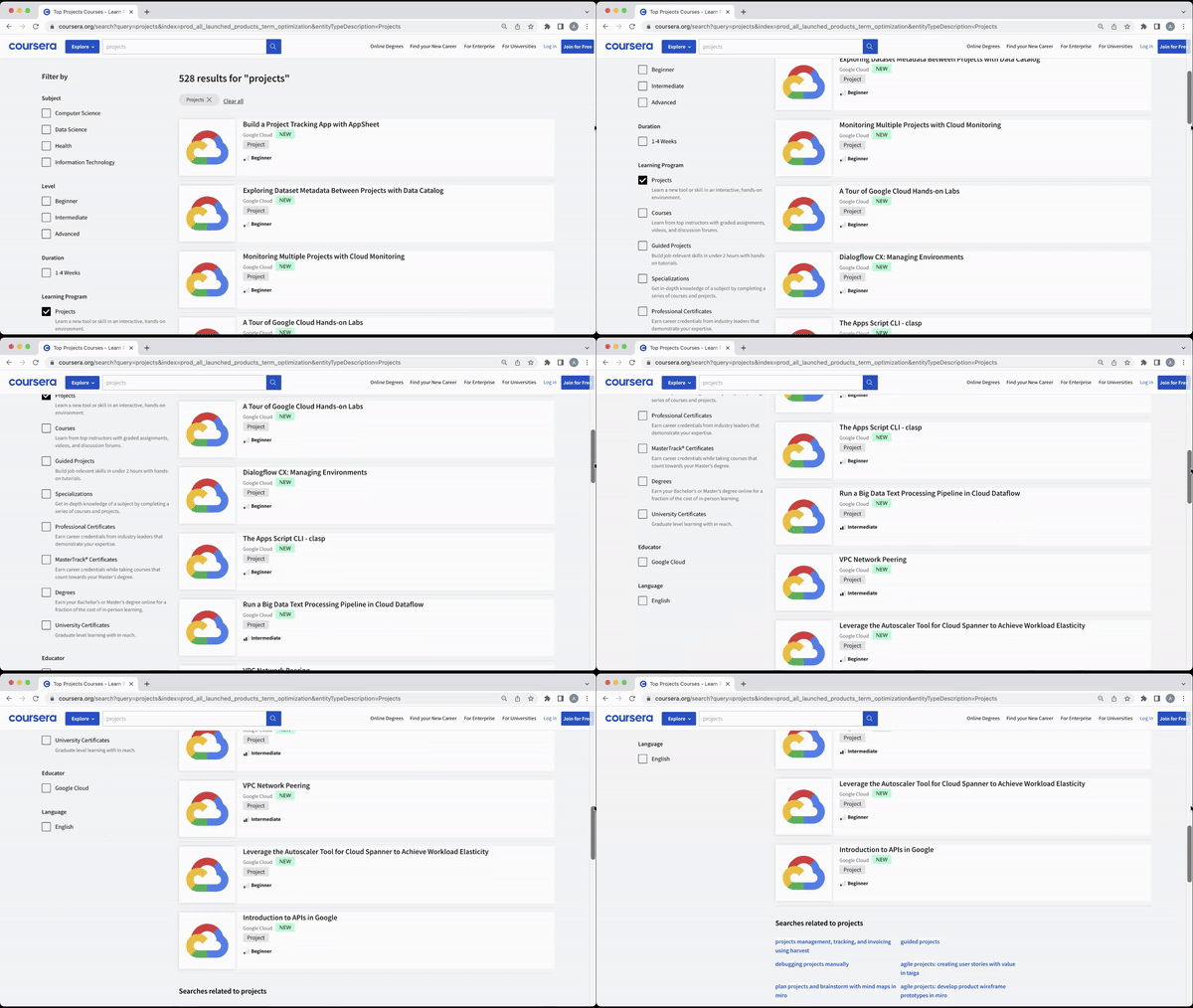
Attracting talented individuals with cloud skills is critical to success, as organizations continue to adopt and optimize cloud technology. The lack of cloud expertise and experience is a top and growing challenge for businesses as they expand their cloud footprint and search for skilled talent. To help meet this need, we are now offering access to over 500 Google Cloud self-paced labs made available on Coursera. A selected collection of the most popular self-paced labs, known as projects, are available at no cost for one month from April 28 – May 29, 2022. Learners can choose their preferred format to claim one month free access to either a top Google Cloud Project, course, Specialization or Professional Certificate.What is a lab?A lab is a learning experience where you complete a scenario based use case by following a set of instructions in a specified amount of time in an interactive hands-on environment. Labs are completed in the real Google Cloud Console and other Google Cloud products using temporary credentials, as opposed to a simulation or demo environment and take 30 – 90 minutes to complete (depending on difficulty level). Our goal is to enable you to apply your new skills and be effective immediately in real-world cloud technology settings.Many of these labs, known in Coursera as projects, include a variety of tasks and activities for you to choose from to best fit your needs. Combine bite-size individual labs to create a personalized set of learning and upskilling with clear application in a sandbox environment. Labs are available for all skill levels, and cover a wide range of topics:Cloud essentialsCloud engineering and architectureMachine learningData analytics and engineeringDevOpsHere is a roundup of some popular and trending labs right now:Getting Started with Cloud Shell and gcloudKubernetes Engine: Qwik StartIntroduction to SQL for BigQuery and Cloud SQLMigrating a Monolithic Website to Microservices on Google Kubernetes EngineGet a feel for the lab experienceCreating a Virtual Machine is one of our most popular labs, taking place directly in Google Cloud Console. In this beginner level project, you will learn how to create a Google Compute Engine virtual machine and understand zones, regions and machine types. It takes 40 minutes to complete and you’ll earn a shareable certificate.As an example of more advanced content, Predict Baby Weight with TensorFlow on AI Platformrequires experience to train, evaluate and deploy a machine learning model to predict a baby’s weight. The lab activities are completed in a real cloud environment, not in a simulation or demo environment. It takes 90 minutes to complete and you will earn a shareable certificate.Kick off your no-cost learning journey todayFor direct access to self-paced labs, we recommend that you get started by taking a look at Coursera’s Collection Page, where you can browse labs/projects by our most popular topics, or explore the full catalog to find the cloud projects that are right for your career goals by browsing Google Cloud ‘projects’ on Coursera.The month of free Google Cloud learning on Coursera is available from April 28 – May 29, 2022, so join us to evolve your skill set and cloud knowledge.Ready to start your learning Google Cloud at no-cost for 30 days? Sign uphere.Related ArticleTraining more than 40 million new people on Google Cloud skillsTo help more than 40 million people build cloud skills, Google Cloud is offering limited time no-cost access to all training contentRead Article
Quelle: Google Cloud Platform

SAP BTP on Google Cloud Announces 5 new capabilities

SAP and Google Cloud’s partnership is about expanding what’s possible and enabling innovation. A lot more has become possible for SAP customers since SAP® Business Technology Platform (SAP BTP) became available on Google Cloud in 2021. SAP BTP brings together intelligent enterprise applications with database and data management, analytics, integration, and extension capabilities on one platform for both cloud and hybrid environments, including hundreds of pre-built integrations for SAP and third-party applications. People can connect applications and combine data in new ways that help them integrate smarter and better collaborate to find answers and solve business problems faster.The following are five use cases from customers who are using SAP BTP on Google Cloud to more successfully manage their businesses.1. Timely insights from combining data from SAP and non-SAP solutions. A North American retailer deployed a joint SAP software and Google Cloud architecture to get better insight into sales teams based on consumer feedback. The company also achieved a closer alignment between supply and demand by positioning product pitches based on availability.A joint architecture like this would include cloud-native solutions such as the SAP Analytics Cloud and SAP Data Warehouse Cloud solutions while leveraging the native AI/ML capabilities and petabyte scale of BigQuery.2. More cost-effective marketing through SAP ERP correlation. Many retail and consumer goods companies are avid users of Google Marketing Platform when it comes to placing and managing ads. Now these customers are using SAP BTP to drive direct correlations between their ERP supply chain and finance data and their marketing investments executed over Google Marketing Platform. This is helping them operate more cost-effectively by providing fast and contextually enriched answers to cost-related questions, such as: Where should I direct my marketing spend? How do I target campaigns based on inventory and margin? How should I focus my supply chain investments based on campaign, location, and demographics data from Google Marketing Platform? 3. Accelerated innovation in core systems with containerized apps. The extensibility and API services of SAP BTP are enabling customers to use Google Kubernetes Engine (GKE) to develop and manage custom applications faster and more efficiently. SAP BTP makes direct read/write capabilities in the core of SAP ERP possible, and GKE provides developers with an environment and the tools for using containers instead of traditional environments. The outcome is better capacity utilization, enterprise-grade scalability, faster deployment of new capabilities within core systems, quicker and less disruptive application maintenance, and the ability to “build in” security protections at the start of the app development cycle instead of after.4. Simplified operations with Google Search and SAP Work Zone. With Google Search embedded into the SAP Work Zone enabled by SAP BTP, daily operations are simplified.  SAP Work Zone provides personalized and integrated employee experiences with centralized access to core business systems. Critical business data that’s used every day is within those systems, and making it easier to quickly find exactly what’s needed helps prevent waiting between process steps, the use of inaccurate or incomplete data, and redundant work.5. Extend SAP Process Automation with Google services and APIs. This solution is helping customers adapt, improve, and innovate business processes with minimum assistance from busy IT teams.The SAP Process Automation solution puts capabilities for workflow management, robotic process automation, and AI services into an intuitive no-code interface, allowing anyone to build and share automated workflows across key process owners, and between SAP and non-SAP applications. As part of SAP BTP, SAP Process Automation integrates diverse SAP software systems with Google solutions to simplify business processes. For example, SAP Fiori apps use task automation services from SAP Process Automation to leverage Google Document AI, collect key information from digital documents, and then automatically post the results in SAP. This reduces the manual effort of repetitive tasks and leads to fewer errors and increased data consistency.These are just five of the ways customers of SAP BTP are benefitting from SAP’s partnership with Google Cloud. Learn more about the SAP on Google Cloud partnership. And join us at SAP Sapphire in Orlando, Florida.Related ArticleTechEd 2021: What’s new for SAP customers on Google CloudGoogle Cloud announces three new cloud capabilities sure to delight SAP customers at SAP TechEd.Read Article
Quelle: Google Cloud Platform
New research shows consumers more interested in brands’ values than ever

Editor’s note: This article first appeared in Consumer Goods Technology MagazineShifting work habits, more online shopping options, rising inflation, and stretched supply chains are just a few factors making it harder to discern what’s top-of-mind for shoppers today.But we’re starting to get a clearer picture of what consumers say they value most right now. New Harris Poll research commissioned by Google Cloud reveals how U.S. shoppers are thinking about consumer goods brands in new ways—from apparel, electronics, and beauty products, to food and beverage. While price unsurprisingly continues to be a major consideration in purchases, the average shopper is increasingly paying close attention to the values of consumer goods brands and how eco-friendly their products and practices are.Shoppers want to buy from brands aligned with their valuesCOVID-19 drove people to reflect on their priorities, elevating concepts like community service, equity, and sustainability. A decade ago, most consumer goods companies would not have made these front-and-center, operational priorities. But today’s consumer not only wants savings and convenience, they also want that good feeling that comes from spending their money with a company that aligns with their values.Our new research reveals that 82% of shoppers prefer a consumer brand’s values to align with their own, and they’ll vote with their wallet if they don’t feel a match. Three-quarters of shoppers reported parting ways with a brand over a conflict in values. Even with their favorite consumer goods products, a majority of shoppers will not compromise on principles. If there’s a value mismatch, 39% of shoppers said they’d permanently boycott their favorite brand, and 24% would break ties at least temporarily. Most won’t be quiet about their concerns either: 28% of consumers that found their values at odds with a brand said they have shared their concerns with friends and family, and another 15% have shared their qualms on social media.Consumer goods companies need to prioritize sustainability A majority of today’s consumers (52%) are especially interested in supporting sustainable brands. They want to know how companies are managing their resources, specifically whether they are sourcing responsibly. These shoppers want to see meaningful, measurable efforts from CPG firms to save energy and reduce waste, like how Nuuly, URBN’s digital rental and resale business, has woven sustainability into its business operations, from its distribution centers to reusable packaging.In fact, 66% of shoppers are now seeking out eco-friendly brands, with 55% saying they would pay more for more sustainable products. But these same shoppers are skeptical too: 72% think that companies and brands overstate their sustainability efforts. And they’re right to question brands’ practical application of their values. According to another Harris Poll survey recently commissioned by Google Cloud, 58% of executives polled across 16 countries admit that their organization has overstated its sustainability efforts.Product availability is table stakesA final point from the research: The global supply chain has stretched past its limits, and 60% of consumers are voicing some level of concern about it. At the end of the day, if a preferred brand isn’t actually on the shelves of a real or digital store, it doesn’t matter what the brand’s values or sustainability efforts are. A staggering 98% said they’d either buy from a different brand or search other stores or websites.What’s a brand to do? After more than 25 years working in the consumer goods industry in roles ranging from marketing and product development to business strategy and technology, at companies like Johnson & Johnson, Kimberly Clark, Carter’s, and now Google Cloud, I’ve seen successful brands do four things well when it comes to their values:1. Don’t be generic.Your brand’s values need to be authentic, and they need to have teeth. But being too bold could run the risk of alienating some consumer segments. This is where technology can help. Personalizing your messages and outreach to specific shopper profiles is one way to ensure that your core values reach the right customers at the right time.2. Make your values clear and consistent. When focusing on which values to highlight with your consumers and the world, make sure they make sense for your brand and that you’ll stick to them over time. For example, it’s painfully obvious when a brand is being opportunistic and inserting itself into conversations around values like sustainability or social justice, when it doesn’t have a history of voicing those values. The key to clear and consistent messaging of values is balancing authenticity with relatability and the appropriate amount of promotion.3. Develop sustainability practices and communicate their impact to everyday people.How everyday people perceive a consumer goods brand’s sustainability initiatives is different from how an investor or general business audience does. Shoppers don’t read business sustainability plans or impact reports. To increase awareness of your brand’s sustainability efforts, consumers need to identify and interact with your brand and products directly. Some of my favorite examples are how I love that Google Maps gives me the choice of eco-friendly driving directions, and that I know I can buy low-waste, packaging-free cosmetics from a company like Lush.4. Reward customer loyalty.Shoppers have more choices than ever before, and supply chain woes are testing preferences even further. But when someone chooses a specific brand because they feel aligned with their values or like their eco-friendly products, that shopper doesn’t always get recognized or thanked. Implementing a rewards program or following-up with customers after their purchases is one way you can make loyal shoppers feel appreciated while creating a lasting relationship that extends as long as possible.
Quelle: Google Cloud Platform

A2A puts customers and the planet first by running SAP on Google Cloud

With more than 2.5 million customers, Italian utility company A2A is committed to delivering electricity, gas, clean water, and waste collection every day. More recently, the company made another significant commitment: To incorporate the principles of the “circular economy” into its way of doing business — part of the UN 2030 Agenda’s Sustainable-Development Goals — all while also aiming to double its client base by 2030. Growing rapidly but sustainably requires operating as efficiently as possible at every level of the organization, from operating smart meters to generating accurate demand projections. That’s why A2A chose to deploy its SAP S/4HANA ERP and the SAP BW/4HANA data warehouse on Google Cloud.Roadblocks to innovationInstead of a linear consumption model that starts with raw materials and ends with use and disposal, the circular economy is a continuous cycle that emphasizes repair, recycling, and the creation of materials rather than their disposal. To take an example from A2A’s own success story: The company keeps 99.7 percent of collected waste out of landfills.1 Of the UN’s sustainability goals, A2A is committing to the three most relevant to its industries: Ensuring availability and sustainable management of water and sanitation for allEnsuring sustainable consumption and production patternsProtecting, restoring, and promoting sustainable use of terrestrial ecosystemsAchieving A2A’s sustainability and customer-first strategies requires high scalability, rapid data ingestion, and rich, accurate analytics. None of this could be reliably supported with the company’s legacy on-premises SAP and Data Warehouse, especially given A2A’s projected growth and the increasing complexity of the data landscape, including IoT deployments and energy market liberalization. Provisioning data infrastructure was also slow and complex. Simply adding a new metric could require increasing capacity by an order of magnitude. And analytical and transactional data lived in siloes, which created a fragmented and out-of-date view of each customer across sales and customer support teams. A2A’s fragmented data also made it difficult to take proactive action when changing priorities or processes required shifting focus from one data source to another. With a data warehouse that refreshed only once every 24 hours, simple processes such as responding to a customer calling because their power has been cut off due to an unpaid bill became cumbersome. Scalability was also a concern. With the on-premises solution, A2A needed to define the budget for its data warehouse over a two-year timeframe, but the rollout of new electricity meters — each sending data every 10 minutes — across Italy made those data requirements hard to predict. The move to the cloud: From monolith to microservicesThe move has been a giant step forward in A2A’s goal of meeting its data-driven, customer-centric strategy. In deploying its SAP systems to Google Cloud, A2A can take advantage of a highly flexible hybrid environment and powerful data management and analytics. It can replicate data from Salesforce, SAP, and other systems in BigQuery, which operates as a data lake with Google Cloud SQL, connected directly to Google Analytics and Google Ads for data-driven customer service, decision-making, and marketing. “From BigQuery we can feed relevant information directly to the people who need it. Our customer operators work on Salesforce, so we use an OData protocol to embed real-time data in that platform. Elsewhere, we present the information through a dashboard, or with a BI component delivering one-page reports.” —Vito Martino, Head of CRM, Marketing and Sales B2C & B2B, A2ABy running SAP on Google Cloud, A2A can also count on an infrastructure platform that provides:Scalability. The robust data architecture on Google Cloud adapts to shifting and increasing demands without compromising on speed or availability, so A2A doesn’t have to worry about over- or under-provisioning as the rollout of smart meters proceeds.Speed. The new A2A data solution refreshes every five minutes instead of 24 hours, so the company can respond to its customers’ needs without delays. Customer operators working in Salesforce now receive real-time data from Google BigQuery so that, when a customer calls, operators can see accurate information in seconds. They can now offer value-added services and sustainable options tailored to the customer’s needs, from energy consumption to their preferred method of communication.Availability. With microservices orchestrated by Google Kubernetes Engine, the team can update the solution through continuous integration and delivery (CI/CD), eliminating the need for downtime when changes are required.Security and control. The A2A IT team uses Google Kubernetes Engine to orchestrate clusters of instances on Google Compute Engine, with Google Cloud Load Balancing and backups on Google Cloud Persistent Disk. Google Cloud Anthos ensures operational consistency across on-premises and cloud platforms.Ready to grow the sustainable wayBy moving to Google Cloud — the industry’s cleanest cloud, with zero net emissions — A2A is ready to grow quickly while locking down the efficiency it will need to meet its ambitious sustainability goals. “To bring sustainable utilities to market, we need to be both responsive to our customers and responsive to the internal needs of A2A,” explains Davide Rizzo, Head of IT Governance and Strategy at A2A. “Understanding what customers need in detail means we can improve their services and reduce their environmental impact at the same time.” Learn moreabout the ways Google Cloud can transform your organization’s SAP solutions with scalability, speed, and advanced analytics capabilities.1.  Circular Economy: one of the four founding pillars of A2A’s 2030 sustainability policy | DrupalRelated Article6 SAP companies driving business results with BigQuerySAP systems generate large amounts of key operational data. Learn how six Google Cloud customers are leveraging BigQuery to drive value f…Read Article
Quelle: Google Cloud Platform

Running VMware in the cloud: How Google Cloud VMware Engine stacks up

Google Cloud VMware Engine delivers an enterprise-grade, cloud-native VMware experience that is built on Google Cloud’s highly performant and scalable infrastructure. By enabling a consistent VMware experience, the service allows customers to adopt Google Cloud rapidly, easily, and with minimal modifications to their vSphere workloads, bringing the best of VMware and Google Cloud together on one platform for a variety of use-cases. These include rapid data center exit, application lift and shift, disaster recovery, virtual desktop infrastructure, or modernization at your own pace.  Here are seven ways VMware Engine outshines alternatives for running your VMware workloads in the cloud, simplify your operations, and help you innovate faster:1. Dedicated 100Gbps east-west networking  Google Cloud VMware Engine nodes come with redundant switching and dedicated 100Gbps east-west networking with no oversubscription of bandwidth, unlike other options where there is generally oversubscription. This is especially important when it comes to running latency-sensitive workloads. 2. Four 9’s of availability in a single zone The service offers 99.99% uptime SLA for a cluster in a single Zone with five to 16 nodes and FTT=2 or more without the need for stretched clusters, which is higher than the alternatives. Further, dedicated connectivity for core service functions such as vSAN and vMotion enables better solution stability and availability. This enables the service to support the needs of enterprise workloads that require high availability.Note: “Cluster” means a deployment of three or more dedicated bare metal nodes running VMware ESXi and associated networking managed via management interfaces.3. Global networking without complex routingGoogle Cloud VMware Engine networking is built based on Google Cloud’s powerful networking architecture. With simplified regional and global routing modes—which allow a VPC’s subnets to be deployed in any region where our service is available—you can architect global networks without the need or overhead of creating and connecting regional network designs. You get instant, direct Layer 3 access between them. In alternative cloud environments, you may have to configure special networking between regions, often requiring VPN-based tunnels over the WAN to enable global uniform network communication. This adds to the deployment and operational complexity, in addition to cost.4. Integrated multi-VPC networkingUsers often have application deployments in different VPC networks, such as separate dev/test and production environments or multiple administrative domains across business units. The service supports “many-to-many” access from VPC networks to Google Cloud VMware Engine networks with multi-VPC networking, allowing you to retain existing deployed architectures and extend them flexibly to your VMware environments. In addition, by providing multi-VPC networking, you can pool their VMware needs—say for QA and dev—to a smaller set of clusters, effectively reducing their costs.For more information about the end-to-end networking capabilities and services available in Google Cloud VMware Engine, please refer to the Private Cloud Networking for Google Cloud VMware Engine whitepaper. Here, you’ll find details about network flows, configuration options, and the differentiated benefits of running your VMware workloads in Google Cloud.5. Unified, cloud-integrated model Google Cloud VMware Engine is a fully managed Google first-party service, operated and supported by Google and its world-class team. With fully integrated identities, billing, and access control, you have a simpler end-to-end experience that is different from other services. You access Google Cloud VMware Engine service via the Google Cloud console, like any other Google Cloud service. You can also access other native Google Cloud services privately from your VMware private cloud running in Google Cloud VMware Engine over local connections.6. Flexibility in third-party ecosystem compatibility With Google Cloud VMware Engine, you can set up existing VMware on-premises third-party tools or products that require additional privileges by using a solution user account. This uniquely enables operational consistency, ensuring that the tools you have invested in and used over the years work on Google Cloud VMware Engine. Furthermore, in key areas such as vSAN data encryption, you have the choice of not only using Google Cloud Key Management Service (KMS)—which is turned on by default on vSAN datastores—but also external KMS providers such as HyTrust, Thales, and Fortanix. 7. Dense nodes with high storage:core and memory:core ratios and fast provisioningGoogle Cloud VMware Engine nodes are dense. Each node is powered by Intel® Xeon® Scalable Processors and comes with 36 cores, 72 hyperthreaded cores, 768 GB memory, 19.2 TB NVMe data and 3.2 TB NVMe cache storage. This, along with oversubscription, leads to high consolidation ratios and compelling storage:core per dollar and memory:core per dollar. In addition, you can rapidly spin up these nodes in a VMware private cloud often in under an hour, enabling on-demand, VMware-consistent capacity in Google Cloud for your needs.These are just a few examples of customer-centric innovation that set Google Cloud VMware Engine infrastructure apart. In addition, migrating to Google cloud can save you up to 38% in TCO.Get started by learning about Google Cloud VMware Engine and your options for migration, or talk to our sales team to join the customers who have embarked upon this journey.The authors would like to thank the Google Cloud VMware Engine product team for their contributions on this blog.Related ArticleSave big by temporarily suspending unneeded Compute Engine VMs—now GARealize huge savings by suspending temporarily unneeded VMs on Google Compute Engine and resume where you left off at a later time.Read Article
Quelle: Google Cloud Platform

Service Catalog: Introducing version selection for Terraform solutions

Enterprise IT admins use Google Cloud Service Catalog Terraform solutions to establish curated catalogs of self-serve Google Cloud infrastructure for their organizations. Now, with support for multiple Terraform versions for Service Catalog solutions, administrators create and validate their deployment configs with a particular version of Terraform. The version selected is used by the Service Catalog to perform the deployment, ensuring end users enjoy a seamless experience when deploying a Service Catalog Terraform solution. This feature also enables both the admins and the platform to take advantage of the most recent capabilities available in Terraform, allowing them to quickly address any compliance concerns that may be present in previous releases.Let’s take a closer look at what is included in this release.Terraform version selectionWith this release, admins can select a specific Terraform version when adding a new Terraform solution to a catalog. The version configuration, once applied, can be viewed on the following pages:Solutions Listings Solution DetailsSolution Deployment HistoryCatalog end users will automatically utilize the version selected by the catalog admin. Different solutions within the same catalog may incorporate different corresponding versions of Terraform, based on an admin’s selection.Version SelectionRelated ArticlePrivate Catalog: Improving Terraform deployment management experiencesWith this release, Private Catalog admins can use Terraform configurations to keep end users informed about updates.Read ArticleGet started with Service CatalogThese new features are available now to all Service Catalog customers. To learn how to use these features, refer to our documentation:Create a Terraform configuration in Service CatalogManage and update your Terraform configurations in Service CatalogRelated ArticleA look at the new Google Cloud Marketplace Private Catalog, now with Terraform supportThe latest version of Private Catalog simplifies management for the products you use from Google Cloud Marketplace.Read Article
Quelle: Google Cloud Platform

7 trends to watch in the API economy

Organizations across every industry are aiming to achieve digital transformation initiatives to stay competitive, which increasingly include overcoming the complexity of hybrid and multicloud environments. With resources stretched and margins getting thinner, application programming interfaces (APIs) and the API economy will continue to play a critical role in connecting services, applications, and clouds.So, what do you need to know to help your organization continue to thrive? Here are the biggest trends shaping the future of the API economy. 1. API security takes center stage.As the number of APIs has surged to support the digital ecosystems and applications of the world, so has concern over security risks. The primary attack surface is no longer the application—Gartner® predicts that in API abuses will become the most-frequent attack vector responsible for data breaches during 2022.1 Today, securing APIs requires visibility across all application interactions and observing, analyzing, and taking action at every level of the technology stack. The fixed security perimeters of the past are slowly vanishing as enterprises become more open and distributed. We expect to see more organizations moving away from network-focused security towards models that prioritize zero-trust and layered defense based on encryption, application identity, and strong authentication and authorization.2. Microservices APIs are gaining speed. Since the launch of Kubernetes (K8s) in 2014, we’ve witnessed a massive industry shift towards decomposing systems into microservices. But enabling thousands of microservices to work together runs the risk of introducing technology sprawl and even recreating many of the pitfalls of monolithic architecture. Even when enterprises adopt concepts like domain-driven design, they often end up with “microservice islands” that support a single application. That’s why we expect to see microservices APIs becoming a new focus for IT departments in 2022 and beyond. For instance, Kubernetes-native ingress gateways are emerging as the crucial point of technology optionality for application modernization. Ingress gateways sit in front of Kubernetes resources, allowing you to deliver new business value by exposing those services with APIs. Whether these APIs power internal applications or developer and partner applications, ingress gateways are key enablers for abstraction, discovery, and easy consumption of underlying resources. This helps maintain the internal agility of microservices while also providing stability—an API contract—for developers and their applications. 3. Event-driven architecture (EDA) continues its big comeback.If we told you five years ago that event-driven architecture (EDA) would still be hot in 2022, we probably would have been laughed out of the room. Yet, according to a 2021 survey from Solace, the majority of organizations (85%) recognize the critical business value in adopting EDA. This seemingly old development concept has found a new life in many interactions, such as serverless, asynchronous, and streaming use cases. In particular, event-driven architecture is becoming the preferred paradigm to support API-agnostic, real-time data exchange between microservices. Still, EDA technology falls short of many of today’s digital requirements, so we expect to see more and more solutions appear with security, access control, and governance capabilities. While event-driven APIs are increasing and driving business innovation, they do not guarantee success. Like any approach, failures can often outnumber successes if teams scale project development faster than operations can keep up. Many organizations have some technology to implement event-driven design but lack the vision of event thinking to conceive, design, and manage event-driven interactions. Enterprises will need to adopt a new way of thinking and undergo proper preparation and skills assessments to ensure initiatives succeed. 4. GraphQL will accelerate BFF (Backends for Frontends). While REST remains the most commonly used standard for designing APIs, GraphQL has been gaining popularity with developers for its flexibility and ease of use. Gartner predicts that by 2025, more than 50% of enterprises will use GraphQL in production, up from less than 10% in 2021.2 One of GraphQL’s standout benefits is that it enables developers to seamlessly query data from multiple apps and services with a single API call. This is particularly useful for the Backends-for-Frontends (BFF) pattern, since it allows companies to aggregate and deliver the exact data requested by a client from multiple microservices without overfetching data or the need to package an API and endpoint for each specific client type. In 2022, we’ll see GraphQL adoption continue to increase and accelerate the use of the BFF pattern.5. It’s not one API gateway to rule them all anymore. APIs are now the “crown jewels” of modern software development, providing the connective tissue that powers nearly every digital product available today. With the majority of software still living on premises, hybrid API architectures enable organizations to continue to innovate while bridging to existing technologies.But heterogeneous distributed IT environments also mean multiple clouds and software vendors for building and deploying APIs, which is particularly challenging given the pervasiveness of hybrid deployments. As a result, expect to see more “multi-APIM by design” during 2022 to enable hybrid API management that is lightweight, portable, and scalable. API management will need to ensure that every API in an organization, regardless of where it comes from, reaps all the benefits of API management—including consistent visibility, governance and security guardrails, and analytics. 6. Conversational APIs go mainstream. We live in the age of voice experiences, from smart homes to vehicle infotainment systems. These interactive experiences aren’t replacing traditional IVR technology altogether, but they dominate for specific devices like smart speakers, smartwatches, and in-car infotainment. There’s a pressing need to enable voice experiences as quickly as other more traditional interfaces, such as mobile apps and websites. As a result, many chat or voice apps and systems will join the API economy and start exposing their own conversational APIs to generate new interactions and innovation across many different platforms. 7. From Shadow IT to Strategic ITAPIs have gained a reputation as the new Shadow IT, as developers often build them without alerting their IT and security teams. Increasingly, more IT departments will start to recognize that APIs are the key way to expose data from tools and apps for internal use. APIs will play a critical role in governing data access, encouraging shadow API publishers to follow a standard process. Instead of an imminent threat, shadow IT can become a technology advantage that will produce new internal apps and drive application innovation that can be leveraged across the entire organization. Learn more about how Apigee is continuing to innovate and helping companies stay ahead of the top API trends.GARTNER is a registered trademark and service mark of Gartner, Inc. and/or its affiliates in the U.S. and internationally and is used herein with permission. All rights reserved.1. Gartner Webinar, API Security: Protect your APIs from Attacks and Data BreachesMark O’Neill, Dionisio Zumerle, Jul 15 20212. Gartner, Predicts 2022: APIs Demand Improved Security and Management, Shameen Pillai, Jeremy D’Hoinne, John Santoro, Mark O’Neill, Sham Gill, 6 December 2021Related ArticleFirst dedicated AI management and MLOps platform on Google Cloud MarketplaceBeing able to make strategic decisions based on automated predictions and more targeted data saved the company $1.3M Euros in two fiscal …Read Article
Quelle: Google Cloud Platform

Google Cloud Partner Consumption Packs accelerate customer journeys to the cloud

When we launched Partner Advantage, we committed to making it predictable and easy for partners to drive business with us. Since launch, those commitments have been validated by channel experts like CRN, which gave Partner Advantage a 5-Star award for 2022, and by the fact that our partners have seen impressive growth* across virtually every facet of their business. I am pleased to announce that our commitments endure today with the launch of Consumption Packs for Deal Acceleration Funds and Partner Services Funds (DAF and PSF for partners).  Inspired by partner feedback, these new packages are designed to accelerate all stages of a customer’s journey to the cloud, and make it even easier and faster for partners to do business with us. Consumption Packs are purpose-built so that partners can plan and initiate customer projects much more quickly, with predictable funding. They include assets and templates that allow partners to deliver Google Cloud designed and validated infrastructure, application migration and modernization plans to customers faster than ever–particularly for customers beginning their journey to the cloud. Based on learnings gathered from thousands of customer deployments, these turnkey packs have been designed by our partners and Google Cloud Partner Engineering and Professional Services’ teams. Here’s a brief look at Consumption Packs in action:Consumption Packs offer pre-approved, curated templates and assets to simplify and shorten the process for most common projects.For Deal Acceleration Funds (DAF), packages include everything partners need to conduct assessments, workshops and proofs-of-concept so they can quickly meet customers where they are on their journey to the cloud.For Partner Services Funds (PSF), packages are structured so that partners can develop cloud ready foundation and migration plans that align with Google Cloud priority solution areas. Packages have pre-determined funding levels to enable faster deployments.  Partners still have the option to engage with Google Cloud Partner Advantage and their customers through customized requests, as they always have. This is ideally suited for projects that require a tailored approach to meet unique customer requirements.We are launching nine consumption packs today focused on key enterprise workloads, with a vision toward introducing additional packages to cover more solutions. Partners can explore Consumption Packs now by visiting the Partner Advantage portal. We welcome your continued feedback and suggestions, and look forward to helping our customers achieve new levels of growth and success, together.See you in the cloud.* The Google Cloud Business Opportunity For Partners, a commissioned Total Economic Impact™ study conducted by Forrester Consulting, October 2021Related ArticleGoogle Cloud Partners driving Retail and Commerce InnovationLearn how Google Cloud Partner Advantage partners help customers solve real-world business challenges in retail and ecommerce.Read Article
Quelle: Google Cloud Platform

BigQuery Omni innovations enhance customer experience to combine data with cross cloud analytics

IT leaders pick different clouds for many reasons, but the rest of the company shouldn’t be left to navigate the complexity of those decisions.  For data analysts, that complexity is most immediately felt when navigating between data silos. Google Cloud has invested deeply in helping customers break down these barriers inherent in a disparate data stack.  Back in October 2021, we launched BigQuery Omni to help data analysts access and query data across the barriers of multi cloud environments. We are continuing to double down in cross-cloud analytics: a seamless approach to view, combine, and analyze data across-clouds with a single pane of glass.  Earlier this year, one of BigQuery Omni’s early adopters, L’Oreal, discussed the merits of a cross-cloud analytics to maximize their data platform.  We know that enterprises need to analyze data without needing to move or copy any data.  We also know that enterprises sometimes need to move small amounts of data between clouds to leverage unique cloud capabilities.  A full cross-cloud analytics solution offers the best of both worlds: analyzing data where it is and flexibility to replicate data when necessary. Last week, we launched BigQuery Omni cross-cloud transfer to help customers with combining data across clouds.  From a single-pane-of-glass, data analysts, scientists, and engineers, can load data from AWS and Azure to BigQuery without any data pipelines. Because it is all managed in SQL, it is accessible among all levels of an organization.  We have designed this feature to provide three core benefits:Usability: With one single-pane-of-glass, users tell BigQuery to filter and move data between clouds without any context-switchingSecurity: With a federated identity model, users don’t have to share or store credentials between cloud providers to access and copy their dataLatency: With data movement managed by BigQuery’s high-performance storage API, users can effortlessly move just the relevant data without having to wait for complex pipesA core use case that we have heard from customers is to combine point of sales (PoS) data from AWS/Azure with Google Analytics data and create a consolidated purchase prediction model. Here’s a demo of that:As you saw in the demo, a data analyst can drive end-to-end workflows across clouds. They can transform data using BigQuery Omni, they can load data using cross-cloud transfer, and they can train an ML model all in SQL. This empowers them to drive real business impact by providing the ability to:  Improve training data by de-deuplicating users across datasetsImprove accuracy of marketing segmentation modelsImprove Return on Ads Spend and save potentially millions for enterprise campaignsBut we’re not stopping there, we will continue to build upon this experience by providing more BigQuery native tools for our customers to assist with smart data movement.  Over time, our cross-cloud data movement will be built on pipeless pipelines:  A cross-cloud lakehouse without the fuss. Get involved with the preview and start participating in our development process by submitting this short form.Related ArticleBigQuery Omni now available for AWS and Azure, for cross cloud data analyticsBigQuery Omni helps teams break down silos by securely and cost-effectively analyzing data across clouds.Read Article
Quelle: Google Cloud Platform



