Uber CEO Travis Kalanick Is Taking A Leave Of Absence
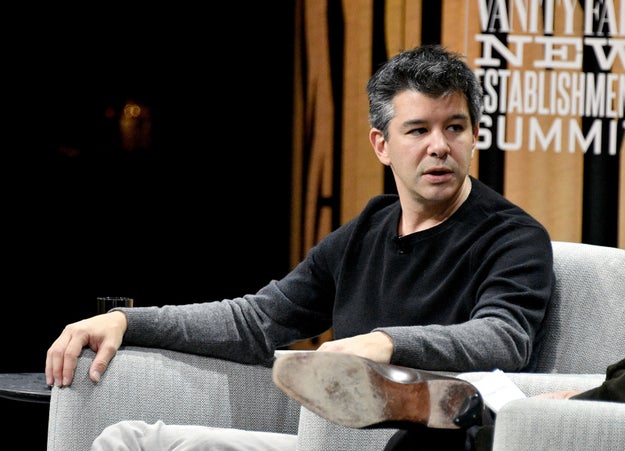
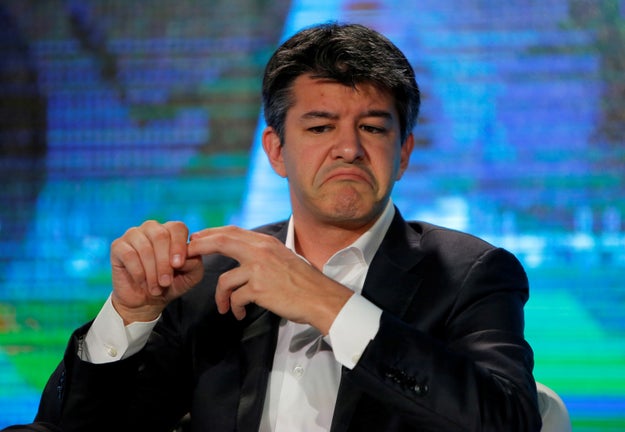
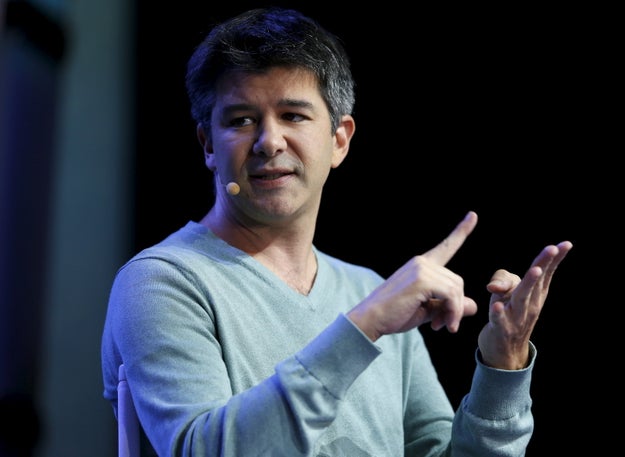
Travis Kalanick

Mike Windle / Getty Images

Uber CEO Travis Kalanick will take a leave of absence from the company, he announced in an email to employees Tuesday.

“If we are going to work on Uber 2.0, I also need to work on Travis 2.0 to become the leader that this company needs and that you deserve,” Kalanick wrote in an email obtained by BuzzFeed News. “During the interim period, the leadership team, my directs, will be running the company.”

Uber's board discussed a potential leave of absence for Kalanick at a board meeting Sunday but did not make any decisions on the matter.

Uber's board met on Sunday in Los Angeles to hear recommendations from former attorney general Eric Holder and Tammy Albarrán after their internal investigation into the company's culture, following allegations of systemic sexism and sexual harassment at the company. “The Board unanimously voted to adopt all the recommendations of the Holder Report. The recommendations will be released to the employees on Tuesday,” a representative for the board said in a statement.

Kalanick's break from the company comes after months of turmoil, as well as a personal tragedy: his mother died in a boating accident last month, and his father was in serious condition.

Members of the board had previously professed faith in Kalanick despite the growing controversies. Still, Kalanick's sabbatical will contribute to a leadership void at Uber, as more than a dozen executives have departed this year alone. The company has for months been searching for a chief operating officer to serve as No. 2 to Kalanick.

Uber has faced crisis after crisis this year. In January, Kalanick dropped out of President Trump’s economic advisory group before its first meeting after protests outside the company's headquarters, employee dissent, and a #DeleteUber backlash that inspired about 200,000 users to delete their accounts. On Feb. 19, a female ex-engineer posted a viral blog detailing systemic sexism at the company, prompting an internal investigation into Uber's workplace culture. Kalanick apologized and promised Uber would “do better.” Later that month, a video surfaced of Kalanick yelling at an Uber driver during an argument about fares. Kalanick, 40, pledged to “grow up” and get “leadership help.” Employees at the company have told BuzzFeed News the incidents have shaken their faith in Kalanick as a leader.

Uber is also embroiled in a bitter trade secrets lawsuit from Alphabet's autonomous vehicle unit Waymo, which alleges that its former employee – who later joined Uber – stole information that the ridehail giant is benefitting from. The company admitted it had shortchanged drivers in New York by millions of dollars over the course of more than two years. The Justice Department opened a criminal investigation into the company's efforts to evade regulators. Recode reported that Kalanick advised employees on sex rules for a company party in Miami in 2013.

Kalanick became CEO of Uber in December 2010, replacing Ryan Graves, who sits on the board and serves as senior vice president of global operations.

Here's Kalanick's full email to employees:

Team,For the last eight years my life has always been about Uber. Recent events have brought home for me that people are more important than work, and that I need to take some time off of the day-to-day to grieve my mother, whom I buried on Friday, to reflect, to work on myself, and to focus on building out a world-class leadership team.

The ultimate responsibility, for where we’ve gotten and how we’ve gotten here rests on my shoulders. There is of course much to be proud of but there is much to improve. For Uber 2.0 to succeed there is nothing more important than dedicating my time to building out the leadership team. But if we are going to work on Uber 2.0, I also need to work on Travis 2.0 to become the leader that this company needs and that you deserve.

During this interim period, the leadership team, my directs, will be running the company. I will be available as needed for the most strategic decisions, but I will be empowering them to be bold and decisive in order to move the company forward swiftly.

It’s hard to put a timeline on this – it may be shorter or longer than we might expect. Tragically losing a loved one has been difficult for me and I need to properly say my goodbyes. The incredible outpouring of heartfelt notes and condolences from all of you have kept me strong but almost universally they have ended with ‘How can I help?‘. My answer is simple. Do your life’s work in service to our mission. That gives me time with family. Put people first, that is my mom’s legacy. And make Uber 2.0 real so that the world can see the inspired work all of you do, and the inspiring people that make Uber great.

See you soon,

Travis

Quelle: <a href="Uber CEO Travis Kalanick Is Taking A Leave Of Absence“>BuzzFeed
Uber CEO Will Have Less Power After An Internal Investigation Into Company's Culture

Travis Kalanick

Mike Blake / Reuters

An internal investigation into Uber's culture recommended that chief executive Travis Kalanick release some of his iron grip on the company, that the ride-hail giant hold its senior leaders accountable, and that create an ethics committee.

The findings were made public Tuesday after Uber announced in February that it would launch an internal investigation, led by former attorney general Eric Holder, into allegations of pervasive sexism and sexual harassment.

A representative for Uber’s board said it unanimously approved all recommendations from the Holder report at a meeting on Sunday — but did not reveal what those recommendations were. The board also discussed whether Uber chief executive Travis Kalanick should take a leave of absence for three months, but did not make any decisions, people familiar with the matter told BuzzFeed News. (Kalanick is also grappling with a family tragedy.)

Uber launched two internal investigations into its workplace culture in February, after former engineer Susan Fowler published a viral blog post alleging sexism and sexual harassment at the company. The first investigation, led by the law firm Perkins Coie, focused on Fowler’s claims. Uber told employees last week that investigators looked into 215 reported claims about issues related to discrimination, sexual harassment, unprofessional behavior, bullying, harassment, retaliation, and physical security. The company said it fired 20 people as a result. The ride-hail giant also brought on Holder and Tammy Albarrán from the law firm Covington & Burling to create a report on its workplace and culture. The firms interviewed current and former employees.

The results of that report come after the company has dealt with months of unrelenting crises. It is facing a leadership void after the departures of more than a dozen executives, including Kalanick’s close confidant Emil Michael, who left the company Monday. It’s unclear whether he was fired or quit.

In addition to its culture crisis, Uber is facing a damning trade secrets lawsuit from self-driving competitor Waymo, part of Google’s parent company. That lawsuit led the company to fire the former head of its self-driving program.

In March, Kalanick was caught on video yelling at an Uber driver during an argument over fares and apologized. “It’s clear this video is a reflection of me—and the criticism we’ve received is a stark reminder that I must fundamentally change as a leader and grow up,” Kalanick wrote in an apology to staff. “This is the first time I’ve been willing to admit that I need leadership help and I intend to get it.” To help, Uber has been searching for a chief operating officer to serve as a No. 2 to Kalanick. That search is still underway.

Leadership has pledged Uber will change. Kalanick told a group of more than 100 female engineers at the company that “I want to root out the injustice. I want to get at the people who are making this place a bad place. And you have my commitment.” Board member Arianna Huffington told reporters during a damage control press call in March the company intends to “make Uber the most admired place to work in.” The company has since implemented a confidential employee hotline, doubled its employee-relations team and put in place a formal system to track employee complaints.

Still, a stream of revelations about the company in recent months have led to questions as to how much Uber can change. Uber investors Mitch and Freada Kapor have since at least 2010 been working to “exert a constructive influence” the Uber’s culture, they wrote in an open letter to the board in February. “We feel we have hit a dead end in trying to influence the company quietly from the inside,” they wrote.

Amid the departures and personnel changes as a result of the internal probes, Uber announced last week that it had hired Harvard Business School professor Frances Frei as senior vice president of leadership and strategy. The company called her “one of the world’s most respected authorities on organizational transformation.”

Quelle: <a href="Uber CEO Will Have Less Power After An Internal Investigation Into Company's Culture“>BuzzFeed

Meet The 82-Year-Old App Developer Who Says Life Gets Better With Age

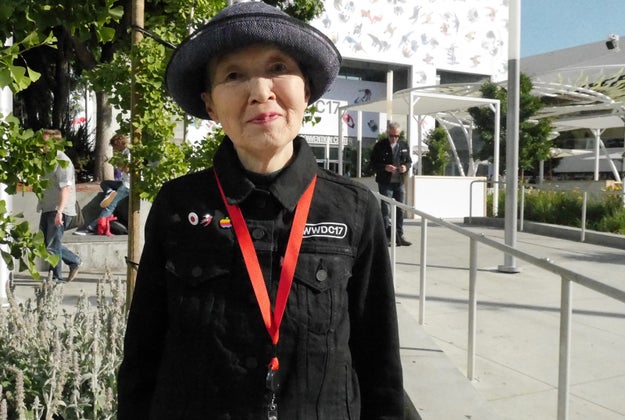
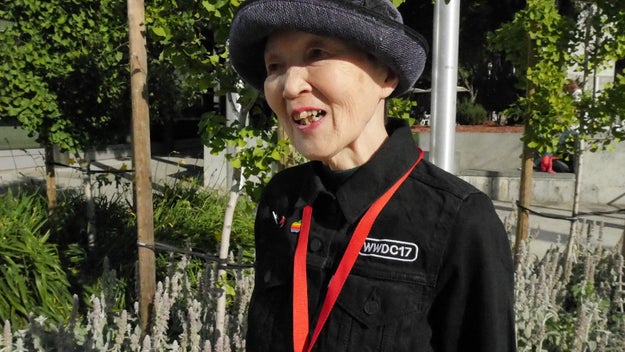
This is Masako Wakamiya. Earlier this year the 82-year-old resident of Japan started learning the Swift programming language and has already released her first app.

This is Masako Wakamiya. Earlier this year the 82-year-old resident of Japan started learning the Swift programming language and has already released her first app.

Yui Kashima / BuzzFeed

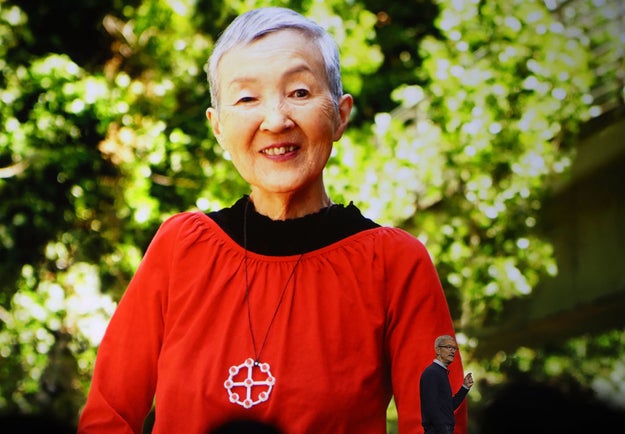
BuzzFeed News caught up with Wakamiya at last week's Worldwide Developers Conference (WWDC) in San Jose, where Apple CEO Tim Cook introduced her as the oldest developer in attendance.

Ma-chan, as she’s affectionately called, discovered the internet when she was retired, caring for her elderly mother full-time, and feeling particularly isolated.

Ma-chan, as she's affectionately called, discovered the internet when she was retired, caring for her elderly mother full-time, and feeling particularly isolated.

Yui Kashima / BuzzFeed

When Ma-chan retired from the bank she'd worked at since finishing high school, she got depressed thinking about life in her sixties and beyond. As an extrovert, she felt trapped in the house while taking care of her mother, like she was no longer part of the outside world.

She didn't know how to use a computer, and it took her three months to get online, but Ma-chan eventually joined a site for seniors called Mellow Club.

Every time her computer connected to the Internet, and she saw the words on the screen that said “Welcome, Ma-chan,” her face became wet — both with sweat and tears, she said.

The internet “gave me wings,” she said. “Those wings took me to a wide world I never knew before I used a computer.”

Next, Ma-chan tried her hand at creating Excel art and became an overnight sensation. “I always liked making things, but for example with handicrafts, you can only give them to people you actually meet, right?” she said. “But I wanted to give some joy to not only my friends, but also to people I had never met. It sounds so romantic.”

“Most applications are for young people, and people of my generation find them boring,” Ma-chan told BuzzFeed News. “As we age, our eyesight gets worse, and we can't move our fingers the way we'd like to. This game is designed so that even people with these problems can enjoy it.”

“It is never a waste to try something and fail,” Ma-chan said of the fits and starts she experienced while learning to code. “You will not die or get injured even if things don’t pan out well. It’s best to enjoy your failures. If you fail, you fail. What’s wrong with that?”

"It is never a waste to try something and fail," Ma-chan said of the fits and starts she experienced while learning to code. "You will not die or get injured even if things don't pan out well. It's best to enjoy your failures. If you fail, you fail. What's wrong with that?"

Justin Sullivan / Getty Images

Besides meeting Apple CEO Tim Cook at WWDC, Ma-chan also connected with the youngest developer at the conference, a 10-year-old boy from Australia named Yuma Soerianto. “I never imagined gaining a friend who is 72 years my junior and lives in the Southern hemisphere,” she said. “I am not proficient in English, but I was able to enjoy chatting with him.”

Ma-chan said she’s having the time of her life, and she’s planning to make another app: “I think my legacy could be to give hope to someone that it is possible to program, even at age 82.”

Ma-chan said she's having the time of her life, and she's planning to make another app: "I think my legacy could be to give hope to someone that it is possible to program, even at age 82."

Yui Kashima / BuzzFeed

“It seems that many people, who are a bit younger than I am, don't think of old age as an enjoyable time,” she said. “I am having the best time of my life!”

When she joined the Mellow Club website, nervous about her transition into retirement, Ma-chan got the message that life is fun at 60, and even more fun at 70.

“What happens after 80?” she said. “Well, it got even better.”

This post was translated from Japanese.

Quelle: <a href="Meet The 82-Year-Old App Developer Who Says Life Gets Better With Age“>BuzzFeed

Tim Cook Just Confirmed That Apple Is Working On Tech For Self-Driving Cars

Justin Sullivan / Getty Images

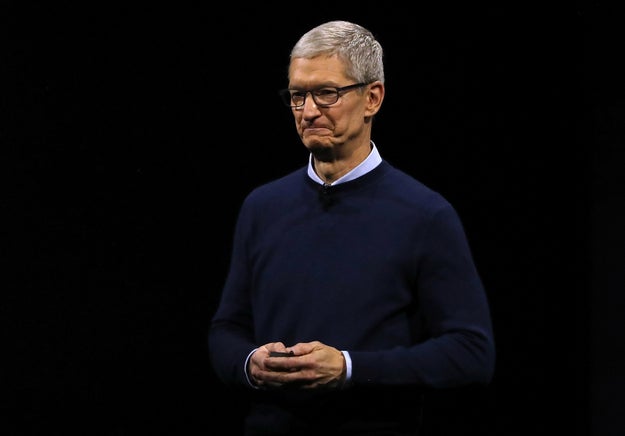
Apple CEO Tim Cook has finally broken his silence on the company’s interest in self-driving cars. Here’s the deal: Apple is working on technology that could make it into self-driving cars, but the company won't say whether or not it will actually make a self-driving car at some point.

“We are focusing on autonomous systems,” Cook said in an interview with Bloomberg. “And clearly, one purpose of autonomous systems is self-driving cars. We sort of see it as the mother of all AI projects. It’s probably one of the most difficult AI projects.”

Cook refused to elaborate on whether this means that Apple would build its own self-driving car in the future. “We’re not really saying from a product point of view what we will do,” he said, “but we are being straightforward that it’s a core technology that we view as being very important.”

Apple did not respond to BuzzFeed News' request for comment.

BuzzFeed News reported in September that Apple had “rejiggered” its electric self-driving car program — internally known as Project Titan — to focus more on autonomous driving technologies.

Meanwhile, other technology companies have been racing to put self-driving cars on the roads. Uber rival Waymo, Alphabet’s autonomous car company, is testing self-driving trucks, BuzzFeed News exclusively reported earlier this month. And legacy automaker Ford announced last year that it plans to mass produce self-driving cars by 2021.

Quelle: <a href="Tim Cook Just Confirmed That Apple Is Working On Tech For Self-Driving Cars“>BuzzFeed

Google Just Released An Interactive Map Of Lynchings In The US

Google Just Released An Interactive Map Of Lynchings In The US

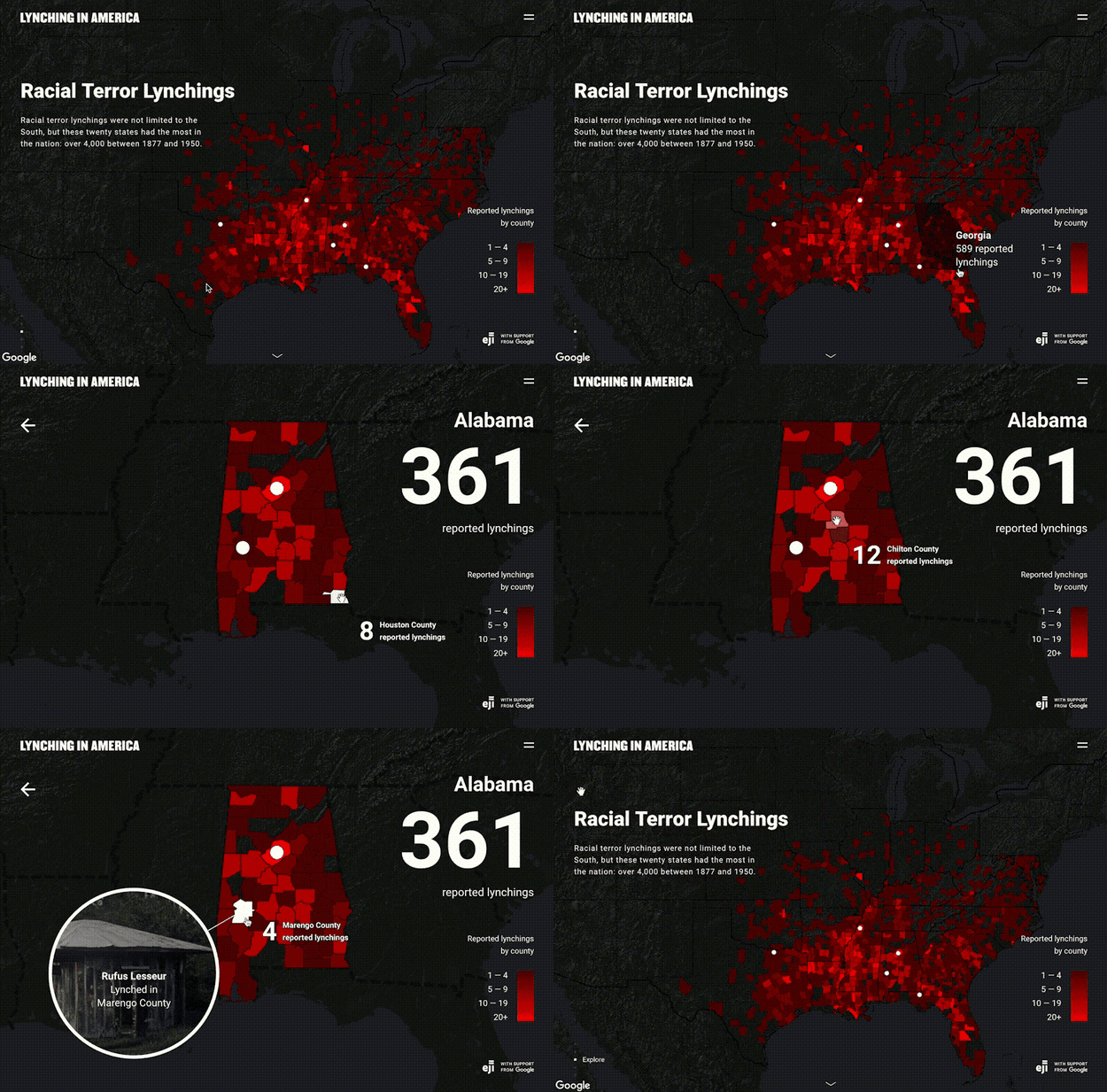
Alphabet's philanthropic arm Google.org worked with the racial justice nonprofit Equal Justice Initiative to create an interactive site that tells the history of lynchings in the United States.

According to a report led by the EJI, more than 4,000 black Americans across 20 states were lynched between 1877 and 1950.

Justin Steele, principal of Google.org, said in a statement, “Racial disparities continue to burden people of color; the criminal justice system is infected with racial bias; and a presumption of dangerousness and guilt has led to mass incarceration, excessive punishment, and police violence against young people of color.”

The site includes an interactive map cataloging how many lynchings were reported in each state and in individual counties. It also highlights certain incidents with audio interviews with the victims' descendants, pictures of where the crimes happened, and written profiles.

The site reads, “In order to heal the deep wounds of our present, we must face the truth of our past… These lynchings were public acts of racial terrorism, intended to instill fear in black communities… The effects of racial terror lynchings are still felt today.”

Google.org also announced on Tuesday that it's donating $1 million to the EJI. Since November 2015, the foundation has doled out nearly $17 million in grants to racial justice activism, which includes another million dollars donated to the Equal Justice Initiative in 2016.

Bryan Stevenson, founder and executive director of the EJI, said in a statement, “Google has been able to take what we know about lynching, and what we have heard from the families, and what we have seen in the spaces and the communities where these acts of terror took place, and make that knowledge accessible to a lot more people.”

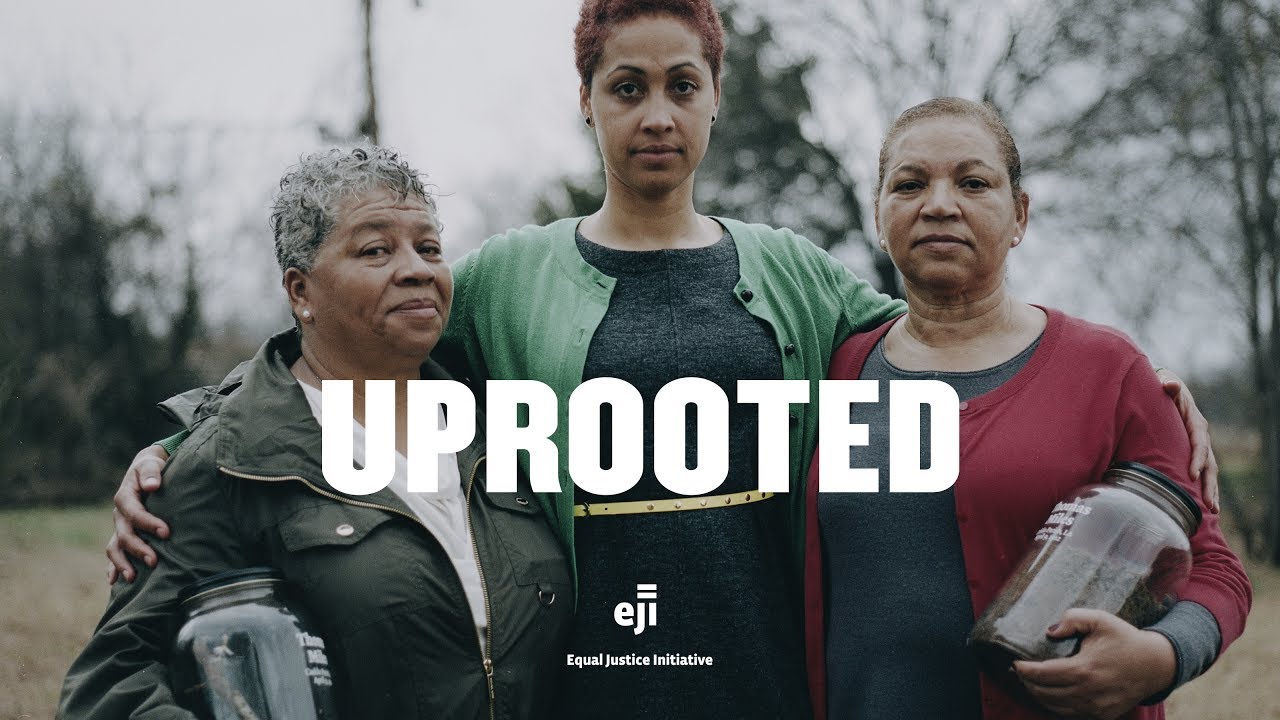
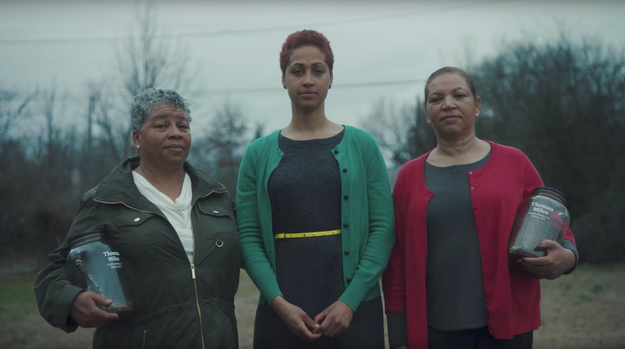
Luz Myles, Phoebe Dedman, and Shirah Dedman, the granddaughters of lynching victim Thomas Miles Sr, holding jars of earth from the tree where he was killed.

The most recent $1 million grant will fund the From Enslavement to Mass Incarceration Museum as well as EJI's planned Memorial to Peace and Justice in Alabama.

An artist's rendering of the Memorial to Peace and Justice

EJI

The museum aims to illustrate the connections between contemporary racial disparities in prison sentencing and slavery. The Memorial to Peace and Justice will honor victims of lynching in the US. Both will be in Montgomery, Alabama and will open in 2018, according to the EJI.

Google.org and EJI have also collaborated on a short film about American lynchings called Uprooted that you can watch on the interactive site.

The film follows the granddaughters and great-granddaughter of lynching victim Thomas Miles Sr as they return to his hometown of Shreveport, Louisiana for the first time in over 100 years. Miles was lynched on April 9, 1912, according to newspapers from that day. He had been arrested April 8 for allegedly exchanging notes with a white woman and released the same day. His widow left the state for California.

You can watch the full film here:

youtube.com

Quelle: <a href="Google Just Released An Interactive Map Of Lynchings In The US“>BuzzFeed

14 Executives Who Have Left Uber This Year

The world’s most highly valued private company has had a challenging 2017.

Staff / Reuters

Uber, the ride-hailing giant with a valuation of $70 billion, has been rocked by an unrelenting series of scandals and staff departures since the beginning of the year.

It started on January 19, when the Federal Trade Commission hit Uber with a $20 million fine for misleading drivers about pay. Only a week later, a #DeleteUber campaign went viral after Uber turned off surge pricing at New York's JFK airport during a taxi workers' strike against President Trump's travel ban. People were also angered that CEO Travis Kalanick had joined one of Trump's advisory boards. Within a few days, Kalanick had quit Trump's advisory board. But by early February, the New York Times reported that nearly 200,000 people removed Uber's app from their smartphones.

Then, on February 19, former Uber engineer Susan Fowler published an explosive blog post in which she alleged a systemic culture of sexual harassment and gender bias at the company. In response to Fowler's blog, Uber launched a harassment and discrimination investigation on February 20 led by former attorney general Eric Holder and Uber board member Ariana Huffington. The investigation has already led to 20 firings.

Amidst all this, Uber has been facing a contentious lawsuit from its self-driving car rival. On February 23, Alphabet's self-driving car company Waymo sued Uber for theft of trade secrets and patent infringement. At the center of the suit is Anthony Levandowski, an engineer who worked for almost a decade on Alphabet's self-driving car efforts until he left to launch a self-driving truck startup called Otto. Not long after, Uber acquired Otto, and Levandowski became the head of its self-driving car program. In its suit, Alphabet alleges that Otto itself was a ruse designed to steal its self-driving car technology.

Throughout Uber's series of public crises, critics have questioned whether Kalanick is fit to continue leading the company. And on June 11, sources told BuzzFeed News that Kalanick is considering taking a leave of absence from Uber.

Holder's report on the investigation into the claims of sexual harassment at the company is expected to be released on June 13.


View Entire List ›

Quelle: <a href="14 Executives Who Have Left Uber This Year“>BuzzFeed

The Case For Interviewing Alex Jones

Last Sunday night, as the second episode of her new NBC news magazine show was wrapping up, Megyn Kelly ran a short teaser for next week’s highly anticipated interview: a sit-down with America's best-known conspiracy theorist, Alex Jones.

The backlash began almost immediately. On Twitter, a #ShameOnNBC hashtag circulated widely within the first few hours. Parents of children who were lost in the Sandy Hook massacre — which Jones has argued repeatedly is a hoax — took to Twitter alongside advocacy groups to condemn not just Jones, but Kelly and NBC as well. The liberal media watchdog site Media Matters suggested that “Megyn Kelly turned to Alex Jones because her struggling show needs a viral moment.” Monday morning, Chelsea Clinton took to Twitter to voice her displeasure with her former employer, NBC. “I hope no parent, no person watches this,” Clinton tweeted. Later in the afternoon, the Wall Street Journal reported that JP Morgan was dropping its local and digital ads around Kelly’s program and all NBC content until after the interview airs.

The argument behind the outrage suggests that featuring Jones on a primetime network television interview show is an irresponsible use of a powerful news platform. To sit Jones across from one of America's most recognizable (and highest paid) news personalities is to legitimize a man with fringe views that many find abhorrent. Furthermore, they note, such exposure could theoretically extend Jones’ reach; what if malleable minds see something they like in Jones' interview and become fans or regular viewers?

It’s a valid argument, but one that misunderstands the media’s role in the Trump era — not to mention Jones’ role inside the pro-Trump media ecosystem. Like it or not, Alex Jones is an architect of our current political moment and as such, the mainstream media shouldn’t try to shield its audience from him or pretend he doesn’t exist — it should be interrogate him.

Jones is a far-fringe personality, and a wildly popular one. While his more outlandish views suggest a man embraced only by the tinfoil hat community — he’s alleged that 9/11 is likely an inside job and that bombs engineered by the government to control the population have turned our frogs gay — Jones’ influence is real and widely felt. If you attended any Trump rally in the leadup to the 2016 election you likely saw his ubiquitous navy “Hillary For Prison” t-shirts, which Jones hawked through his Infowars store (until they sold out, that is). At the Republican National Convention in Cleveland last summer, Jones was greeted like royalty.

Since Jones backed the Trump campaign in 2015, his influence has grown significantly, especially among young males. “So many people watch him now, he’s almost the mainstream,” one of the broadcaster’s young supporters told the New Republic last summer. That piece, which interviewed a number of newly minted Jones fans, describe a similar pattern of conversion: young men intrigued by a viral Infowars video and subsequently won over by Jones’ charisma and message.

According to audience measurement outfit Quantcast reports that Infowars.com pulled in 476 million views during 2016; Alexa suggests that Infowars.com currently receives 340,625 daily unique visitors. And that doesn’t begin to account for the scores of listeners Jones brings in over terrestrial radio or the millions of video views amassed on YouTube.

All 25 former and current Jones associates I spoke with this spring for a profile of him independently suggested that Jones’ influence on the outcome of the election was profound. “Alex doesn't have listeners — he has followers,” one said. “That rural vote for Trump nobody saw coming? It wasn’t only Alex, but I think you can ascribe a significant portion — many first-time voters — of those votes to him.” Another longtime associate of Jones went further. “He's like the Goebbels of 2016. He really won the election for Trump.”

Influence is difficult to quantify, but the money generated by Jones’ media empire provides a helpful gauge. According to one former employee, Jones bragged that the Infowars store grossed $18 million between 2012 and 2013 — though another source puts that number closer to $10 million. Another former employee claimed that Jones’ “moneybombs” — telethon-style fundraisers held to raise money for the ‘information war’ against the mainstream media — can easily pull down $100,000 in a day. Recent court filings show that Jones is paying $516,000 a year in alimony, which which suggests an annual income well into the millions.

But more important is Jones’ perceptible impact on our modern political culture. Jones is, in many ways, the grandfather of the Pro-Trump media, which operates as mirror image of its mainstream counterpart with its own audience, and interpretation of truth. And it's no coincidence that conspiracy culture — be it Seth Rich, Pizzagate, or even elements of Trump/Russia — is ascendent across both fringe and mainstream media at the same time that Jones has become more famous than at any other point in his 20-plus year career.

It’s precisely this influence that makes Jones worthy of interrogation on a national news platform. To suggest otherwise is to fall back on an old, outdated idea of the mainstream media as gatekeepers. The media’s job now is not simply uncovering and sharing news, it's helping its audiences navigate the often treacherous sea of information and “alternative facts.” Jones, the pro-Trump media, and the #MAGAsphere are loud, influential voices with huge, active communities and ties to the White House. It is unwise and increasingly difficult to ignore their very real threat, both to their individual targets and to the mainstream media as a whole.

So an in-depth interview with someone like Jones in front of a big primetime audience is an opportunity, albeit a perilous one. Jones rarely gives sit-down interviews. The opportunity to force him to answer for his most abhorrent views on subjects like Sandy Hook is potentially valuable. At one moment in the teaser, she cuts him off on an answer about Sandy Hook. “That’s a dodge,” Kelly says. “That doesn’t excuse what you did and said about Newtown. You know it.”

Jones is a savvy media manipulator, but also volatile and prone to becoming flustered. Wouldn’t those who find him monstrous welcome the opportunity to see him tripped up, thrown off his game, or unable to respond to a pointed question? Or for the opportunity to have Jones’ rhetoric picked apart and undercut and forever memorialized on video? And what about the opportunity to expose Jones to a new audience who could very well unite around their shared hatred of Jones and Infowars?

To put an interview subject like Jones on his back feet is a tall order for any interviewer. And there’s precedent to suggest that individuals in Kelly’s position — traditional media figures, less in tune with the quirks and pitfalls of the pro-Trump media — might not be equipped to deal with a troll like Jones. CBS’ Scott Pelley, for example, was tripped up when interviewing New Right blogger and pro-Trump media personality Mike Cernovich. And there are hints that Sunday’s interview could veer into similar territory. Kelly’s description of Jones in a tweet previewing the interview as a “conservative” talk show host suggested that Kelly might have overlooked the political nuances of Jones, his show, and his followers. Similarly, the network’s simple decision to wait so long between the interview and air date illustrates a misunderstanding of Jones’ abilities to manipulate a news cycle in bad faith. (After the interview, Jones took to the air to demean Kelly, calling her “Not feminine — cold, robotic, dead,” noting, “I felt zero attraction to Megyn Kelly.”)

One thing is certain: Kelly’s handling of the Jones interview and Jones himself will spark outrage regardless how the interview comes out. And her polarizing reputation — built on a long career at Fox News covering sometimes fraught subjects — will further infuse it with controversy. As will, unfortunately, her gender: Kelly has been the target of vitriolic, misogynist criticism from all sides over the years.

Even now, six days ahead of its Father's Day air date, the interview seems to be hurtling towards catastrophe. On Monday afternoon, Jones called upon NBC to kill the interview, alleging it's been unfairly edited. In doing so, he's commandeered a narrative that shouldn't have been his to control and put NBC in a no-win situation. Pull the interview and cave to Jones; Air the interview and invite an InfoWars-driven barrage of “fake news” insults.

It’s the kind of devious manipulation that’s made Jones — and the pro-Trump media ecosystem he helped create — into an efficient and effective machine, capable of constructing compelling, spurious narratives. To bring a national spotlight on Jones and Infowars is to acknowledge the seriousness of the far-right’s information war. To ignore it, in the hope that it goes away, isn’t just naive, it’s dangerous.

Quelle: <a href="The Case For Interviewing Alex Jones“>BuzzFeed

Uber's Board Just Voted To Approve All Of Eric Holder's Recommendations To Change Its Company Culture

Justin Sullivan / Getty Images

Uber's board voted Sunday to adopt recommendations from an internal investigation into its workplace culture that was kicked off by allegations of systemic sexism and sexual harassment at the ride-hail giant. But what exactly those recommendations are remains to be seen.

The board met for more than six hours Sunday in Los Angeles, where former US Attorney General Eric Holder presented the findings of his firm's report. A representative for Uber's board said it voted unanimously in favor of adopting all of Holder's recommendations, which will be released to the company's employees on Tuesday.

Those recommendations could include the departure of Emil Michael, a top Uber executive who is close to CEO Travis Kalanick, Recode reported. In 2014, Michael embroiled the company in controversy when he suggested Uber could assemble a team of opposition researchers to dig up dirt on its critics, including journalists. He has since played a role in several other controversies.

Last week Uber said it had fired 20 people after investigating 215 reported claims of discrimination and harassment, among other issues. The company launched two investigations into such claims earlier this year after a viral blog post by ex-Uber engineer Susan Fowler laid out allegations of sexism and sexual harassment at the company.

Days after Fowler's blog post published, Kalanick met with more than 100 female engineers of Uber. They called the issues described in Fowler's blog post a “systemic problem,” according to leaked audio obtained by BuzzFeed News.

The company hired the law firm Perkins Coie to investigate Fowler's claims – resulting in the firings announced last week – and then brought on Holder's firm to conduct a separate investigation into Uber's overall culture.

Prior to the release of the findings, Uber's Chief Human Resources Officer Liane Hornsey and board member Arianna Huffington — two public faces who have been managing Uber's unrelenting PR crises — gave interviews to various media outlets playing down the idea that the issues described by Fowler were systemic. In a USA Today interview published May 25, Hornsey said that harassment “didn’t come up as an issue” when she spoke with employees at the company.

In March, Huffington told CNN that sexual harassment was not a “systemic problem” at Uber. BuzzFeed News reported at the time that some Uber employees were frustrated by Huffington's role overseeing the internal investigation, citing her close relationship with Kalanick and her comments to the media.

Uber has since become a poster child for Silicon Valley's bro culture. Last week, Recode published a letter Kalanick wrote to staff in 2013, advising employees on rules about having sex during a company party in Miami.

In February, Uber investors Mitch and Freada Kapor wrote an open letter to Uber’s board, saying that they were “frustrated and disappointed” in the company. “We feel we have hit a dead end in trying to influence the company quietly from the inside,” they wrote.

Last week, Uber announced that it had hired Frances Frei, a Harvard Business School professor, as senior vice president of leadership and strategy to “act as a partner” to Hornsey, the HR head. The company called her “one of the world’s most respected authorities on organizational transformation.”

Quelle: <a href="Uber's Board Just Voted To Approve All Of Eric Holder's Recommendations To Change Its Company Culture“>BuzzFeed

93% Of Top Celebrity Instagram Ads Aren’t Properly Disclosed

Anyone who spends time on Instagram knows that celebrities are doing #ads, and also that there are lots of times a celebrity is clearly doing an ad but isn’t really admitting it, which is kind of shady.

But there’s never been an attempt to actually find out how much #spon is out there – and how much of it follows the FTC’s guidelines for disclosing sponsored content. Then in May the marketing firm Mediakix issued a report on how many advertisements each of the top 50 Instagram accounts post per month, and how many of those are FTC compliant. What they found is that 32 of the top 50 celebrities did some sort of sponsored post. And of those posts, 93% don’t meet the FTC’s guidelines.

How The Numbers Were Counted

Mediakix won’t publish the actual list of Instagram ads (they work with some of the brands), but the company did allow BuzzFeed News to view its list so we could verify their calculations.

First, they took the top 50 celebrities on Instagram. That list isn’t exactly a secret; you can see it on Wikipedia (just take out anything that’s not a person, like @instagram or @natgeo) It’s mostly entertainers like Selena Gomez, Justin Bieber, Nicki Minaj, Gigi Hadid, Katy Perry, a few international soccer players, and of course, the Kardashians. There are some celebrities who did NOT post any ads, like Beyoncé, Taylor Swift, Adele, Lebron James, and Emma Watson.

Next, they looked at all their posts (no Stories) over a four-week period in April 2017. They counted how many of those posts were ads – 152 total ads. Then, they counted how many of those ads followed proper FTC guidelines for advertisements. Only 9 out of 152 were FTC compliant.

Here’s how confusing to a normal person it can get. Notice here how Gigi Hadid uses #ad for her Reebok sponsorship (FTC compliant)

Instagram: @gigihadid

But in this very similar post, she just tags @reebok (not FTC compliant):

Instagram: @gigihadid

What FTC Compliant Means

In a very general sense, it should be clear and apparent to the average person that a celebrity has a “material connection” – is either getting paid cash or was given free swag – to the brand.

Last month, the FTC sent letters to over 90 brands and celebrities who post spon-con to remind them of the guidelines. This was a big-deal move for the FTC, which hadn’t ever sent these types of preemptive “educational” letters before. In these letters, they cracked down on certain types of half-assed disclosures, like #sp instead of #sponsored.

Here’s what they want to see:

  • Clear disclosure like #ad or #sponsored (#sp instead of #sponsored is NOT OK)

  • No hiding the disclosure at the end of a long caption, which gets cut off after 3 lines in Instagram, or in a #forest #of #hashtags #where #no #one #will #notice #ad

  • No using #partner – most people don’t know what that means.

  • No simply tagging the sponsor

So, only 7% of the ads it reviewed followed these rules, according to Mediakix.

What Counts As An “Ad”?

First of all, they excluded any posts that were movie promotions – for example, The Rock posting a still from his new movie Baywatch. Instagram ads sort of exist on a spectrum. From most to least sketchy:

  • Straightforward pay-to-post ads. Think diet teas or tooth whiteners – often these are one time ads.

  • A longterm spokesperson partnership, like a pro athlete and Nike, or a model being the face of CoverGirl. This includes making their own products for a brand, like Rihanna’s new collection with Puma shoes.

  • Small freebies like a few lipsticks or a pair of sneakers.

  • Expensive freebies like Lady Gaga getting a $10,000+ Airbnb rental, a free private airplane ride, or a fancy designer dress worth thousands of dollars.

Mediakix collected 152 Instagram posts from the top 50 celebrities that appear to be ads. BuzzFeed went through these 152 and categorized them by what flavor of #sponsored they seem to be.

Of the handful of FTC-compliant posts where the celeb used the hashtag #ad or #sponsored, all but one of these were for those “pay to post” ads – the most straightforward types. For the long term partnerships, all but ONE of the ads (Gigi Hadid & Reebok) were breaking FTC guidelines.

These broader, long term partnerships that celebrities have with brands – especially fashion or athletic wear – are the most frequent violators of the FTC policy.

Small freebies are also often not FTC compliant – it’s a blurring of the line between “advertising” and “publicity”. It’s very common in the PR world, particularly fashion, to send free stuff to celebrities in hopes that they’ll wear or use it. For a celebrity who gets paid $100,000 for an Instagram ad, thanking a company for a small brand for a free lip gloss might not feel like an “ad”, even though the FTC sees it that way.

The report shows what we all knew intuitively: that celebrities, even the super popular ones with managers and lawyers who know better, are doing ads and not disclosing it.

Quelle: <a href="93% Of Top Celebrity Instagram Ads Aren’t Properly Disclosed“>BuzzFeed

The Uber Executive Who Suggested Digging Up Dirt On Critics Has Resigned

To the left, Emil Michael.

Ilya S. Savenok / Getty Images

Emil Michael, the Uber executive who once suggested the ride-hail giant should dig up dirt on its critics, has left the company, Uber confirmed.

The New York Times first reported his departure. Michael, Uber's chief business officer and a close confidant of CEO Travis Kalanick, joined Uber in 2013. The company has since reached a nearly $70 billion valuation. His departure is one of more than a dozen executive exits this year alone from Uber.

The Wall Street Journal reported Sunday that Michael would resign on Monday. His departure comes as the company is grappling with the results of internal investigations into its workplace culture, launched after an ex-engineer wrote a viral blog post alleging she faced sexual harassment and sexism at the company. Uber said it fired 20 people as a result of the probe.

Michael has had a hand in several of Uber's controversies. Most recently, Recode reported that another Uber executive obtained the medical records of a woman who was sexually assaulted by her Uber driver in 2014 and circulated them within the company. Michael reportedly suggested that Ola, Uber's competitor in India, had framed Uber.

At a dinner party in 2014, he floated the idea that Uber should consider hiring a team of opposition researchers to dig up information on the personal lives of critics and reporters. Uber could spend a million dollars to hire researchers and journalists, he said, to help the company fight back against the press by looking into “your personal lives, your families,” BuzzFeed reported.

Michael later said those comments “do not reflect my actual views and have no relation to the company's views or approach.” Kalanick also distanced himself and the company from Michael's comments in several tweets.

Quelle: <a href="The Uber Executive Who Suggested Digging Up Dirt On Critics Has Resigned“>BuzzFeed