Waymo Drops Nearly All Of Its Patent Claims In Self-Driving Lawsuit Against Uber

ANGELO MERENDINO/AFP / Getty Images

Waymo has dropped many of its patent infringement claims in its self-driving lawsuit against the ride-hail giant Uber. The move, which both parties agreed to, narrows the case as it heads toward an October trial date.

The claims addressed a LiDAR device that Uber had designed, nicknamed the Spider. LiDAR, which stands for light ranging and detection, is a laser technology that helps self-driving cars see and navigate the world. Uber's Spider device is now defunct and never evolved beyond the design phase into a prototype, so Waymo has agreed to drop the related patent claims after US District Judge William Alsup directed both parties to narrow their cases ahead of a trial.

“Uber has assured the court in statements made under penalty of perjury that it no longer uses and will not use that device, so we have narrowed the issues for trial by dismissing the patent claims as to that device, with the right to re-file suit if needed,” a Waymo spokesman said in a statement. “We continue to pursue a patent claim against Uber's current generation device and our trade secret claims, which are not at all affected by this stipulated dismissal. We look forward to trial.”

US District Judge William Alsup asked Waymo in June whether the company thought its patent claims against Uber were worth the time in court. “In my view, they're not … you're wasting time,” he said.

Waymo initially said that Uber stole more than 100 of its trade secrets. The judge told the company to narrow its case to just 10 claims for a focused trial, which is slated for October 10. The move to narrow the case by dropping some claims is not necessarily an indication that Waymo is losing footing – it just means that the court will hear a more streamlined set of each side's strongest arguments.

Waymo's lawsuit against Uber alleges that Anthony Levandowski, its former employee who decamped and later joined Uber, downloaded more than 14,000 files before leaving Waymo. It is arguing that Uber, which acquired Levandowski's self-driving truck startup last summer, is benefitting from those trade secrets.

Alsup, the judge presiding over the case, said in May that Waymo information may have “seeped” into Uber's designs. As part of discovery, Waymo lawyers have visited Uber facilities at least eight times and for a total of more than 50 hours. Still, Alsup told Waymo in a June 29 court proceeding that “you have been given access to everything in the world … you're having an extremely hard time finding that any of your trade secrets got into their product.”

“Waymo's retreat on three of their four patent claims is yet another sign that they have overpromised and can't deliver. Not only have they uncovered zero evidence of any of the 14,000 files in question coming to Uber, they now admit that Uber's LiDAR design is actually very different than theirs,” an Uber spokesman said in a statement. “Faced with this hard truth, Waymo has resorted to floating conspiracy theories not rooted in fact, doing everything they can to put the focus on sensation rather than substance.”

Quelle: <a href="Waymo Drops Nearly All Of Its Patent Claims In Self-Driving Lawsuit Against Uber“>BuzzFeed

Photobucket Just Killed A Chunk Of Internet History

Late last month, Photobucket changed its policy so that if you want to host your photos there and post them to another website — your eBay seller page, or perhaps your blog or website — it’s going to cost you $400. People are pissed, saying it’s tantamount to holding their photos for ransom, a form of extortion.

If you're unfamiliar, the photo hosting site was popular in the early and mid aughts, the service of choice for MySpace users. Since that site's decline, Photobucket has become infinitely less important to most people on the internet, who no longer have the need for a web-based photo storage. Because, you know, we have phones and Instagram and the cloud now. But a lot of people still use Photobucket! For one, it's crucial to Amazon and eBay sellers, who did need to host web images cheaply and easily.

An Amazon page with a broken image hosted by Photobucket.

Amazon / Via bbc.com

It's also important to anyone who was an active Photobucket customer and is being faced with the prospect of losing their photos or having to cough up a ton of cash.

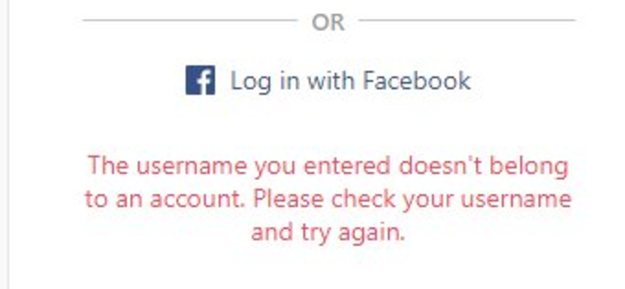
But this change has also done something terrible for all of us, even people who never even had a Photobucket account: It’s completely broken the internet. Vast swaths of blogs and personal websites from the mid-00s are now full of missing images, replaced with a hideous error message.

The error message that displays on

This is a crushing loss of internet archeology. Photobucket's heyday coincides with the height of personal blogging: Free and easy software like Blogger and WordPress made it finally accessible for people with virtually zero technical skills, and reading tools like Google Reader and De.lic.ious made it easy to follow and read blogs. Message boards and Yahoo Groups still thrived, Reddit and 4chan were just picking up steam. People needed a place to host the budding memes like lolcats or blingees! This was a brief moment of internet history, maybe only 2005-2009, before Facebook, Twitter, and Tumblr homogenized the look and feel of the internet and eliminated the need for normal people to have an photo hosting site like Photobucket. The internet felt more spread out, with more random treasures to find — there were tons of different sites to go to, to find, to create. If the Geocities was the awkward teen years of the internet, and today is the mature adult version, that brief Photobucket-heavy period was the college period where it spread its wings, smoked Parliament Lights while talking endlessly about about Tarantino, and tried to pull off a fedora. The internet was big enough to be interesting, but small enough to still feel intimate. It was really fun, and now it's disappearing.

This is a crushing loss of internet archeology.

In a lot of ways, 2007 feels forever ago, but it’s close enough to today that a blog or message board from that time would still be mostly functional and recognizable, not as clunky and weird as the old Space Jam site or a true antique. But now with Photobucket deleting those images, those old-but-still-working sites will become totally boned, lost to the sands of time.

“When a given service changes their mind about what they serve up, it can have a catastrophic impact on huge swaths of the web,” said Zachary Kaplan, the executive director of the digital art organization Rhizome. Rhizome has developed a tool called Webrecorder that saves and preserves web pages as part of its mission as a group of digital archivists.

“What's particularly sad is that it's the everyday user, the “vernacular” user – the plane spotter, the deadhead, the young net artist, the rando – who is most impacted by performance changes like this,” Kaplan told BuzzFeed News. “Pros can compose their own super-special custom page, but if that's all the web is, it'd be a very boring place.”

The great Photobucket collapse of 2017 is similar to the death of Geocities in 2009. When Yahoo announced it was shutting the service down, a team of volunteers called Archive Team set out to download and preserve as much of Geocities as possible. Archivists/artists Dragan Espenschied and Olia Lialina sifted through that downloaded Geocities on a site called One Terabyte of Kilobyte, making sense of what the early days of accessible personal websites looked like. Lialina points out that before Geocities finally died, there was a similar period where pages with hotlinked images hosted on Angelfire or Tripod (also dead) lost their images while the page itself still existed.

A Geocities site where its images were lost by Tripod.

Lialina sees this is as an example of how delicate our internet infrastructure is. “Hopefully we’ll lose the illusion that we have any control over anything hosted anywhere,” she told Buzzfeed. “Requiem for an early internet dream that online everything can be distributed around the world and still work!”

Paul Ford, programmer and early '00s blogging enthusiast also sees this as a warning. “What people need to know is that the web is both strangely permanent and deeply impermanent, often in exactly the way you don’t like,” he said. “Screenshots of your terrible tweets can survive forever. Pictures of your kids that you embedded in your Angelfire page can be turned off unless you pay money to preserve them.”

In 2008, I started a blogspot blog with photos hosted on Photobucket. Although the Blogger software let you upload images directly, I preferred the way the hotlinked images looked (Blogger forced default sizing on the images). Now, the blog I lovingly updated almost daily with images for years is pretty much completely nuked. I care, but I don’t care enough to pay $400, ot to take the time to download and reupload all the photos to Google.

And who knows, maybe Blogger will be the next thing to go and all my words will be gone, too. Maybe it’ll be LiveJournal. Flickr seems pretty vulnerable in the Yahoo Verizon merger, and hey, maybe Tumblr, too. BuzzFeed was started in 2006 and lots of those older posts are completely unreadable now, all the links and images gone.

One day, when we’re all getting our content beamed directly into our contact lenses, this article will be gone too.

See you all in the dystopia; please don't forget to sign my guestbook.

Quelle: <a href="Photobucket Just Killed A Chunk Of Internet History“>BuzzFeed

Uber, Now In A Court Battle With Google, Once Tried To Be Its Partner

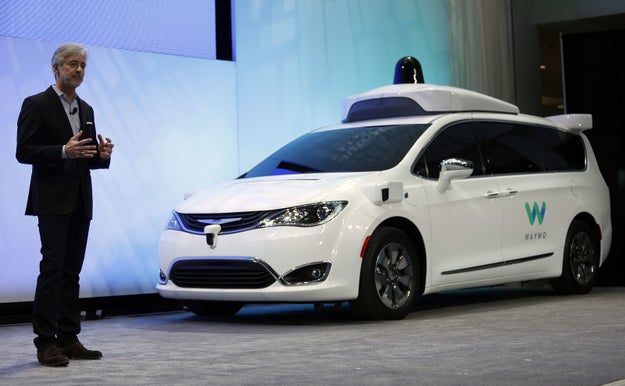
John Krafcik, CEO of Waymo, shows off a customized Chrysler Pacifica Hybrid that will be used for Google's autonomous vehicle program on January 8, 2017 in Detroit, Michigan.

Bill Pugliano / Getty Images

Ex-Uber chief executive Travis Kalanick sought out meetings two years ago with Google cofounder Larry Page to discuss partnering with the company's autonomous vehicle program, now called Waymo, according to new court filings. The filings show how Uber, which is now facing a lawsuit from Waymo, attempted to discuss possible partnerships with Google before the two tech giants became bitter rivals.

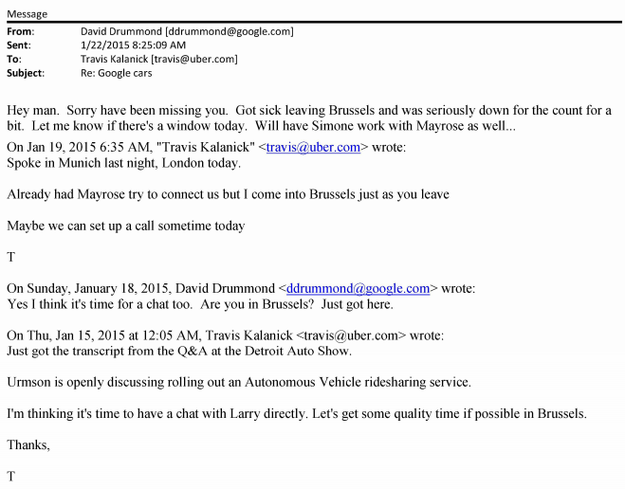
According to court filings revealed Thursday, after Kalanick learned Google was considering launching an autonomous vehicle ridesharing service, he asked David Drummond, a senior vice president at Google who at the time was serving on Uber's board, to help set up a meeting with Page.

One email thread shows Kalanick told Drummond in late January that “it's time to have a chat with Larry directly.”

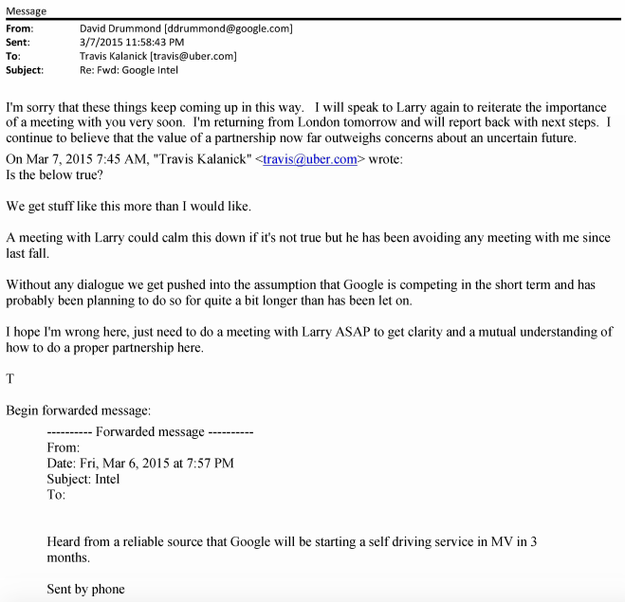
Another email from March 2015 shows that Kalanick was concerned Page had been avoiding him.

Uber's lawyers included the emails as part of a court filing about deposing Page.

The two companies have become rivals despite Google Ventures' $250 million investment in Uber. Drummond stepped down from Uber's board in August after reportedly being sidelined, underscoring the growing rivalry between the companies. Google's parent company Alphabet spun off the car program into a new company called Waymo in December. And in February, Waymo sued Uber, alleging that an ex-employee stole its trade secrets before joining Uber, and that the ride-hail giant is benefitting from that information. Uber has denied that any Waymo information crossed over into its systems.

“There is no substitute for these depositions, which would resolve some key unanswered questions. For instance: why, after Google learned of the alleged downloading of 14,000 files, did Mr. Page not alert Uber's then-CEO to that fact when they spoke?,” Uber said in a statement. “Simultaneously, Google was rejecting a partnership with Uber, choosing instead to compete. This—and the lack of evidence supporting Waymo's case—begs the obvious question: Was this lawsuit actually motivated by the downloading of the files, or was it an attempt to slow down a competitor?”

Waymo declined to comment on Uber's filing.

Earlier this year, Waymo partnered with Lyft, Uber's main US competitor in the ride-sharing business. Waymo also launched its first pilot program to put the public in its self-driving cars in Phoenix earlier this year.

Quelle: <a href="Uber, Now In A Court Battle With Google, Once Tried To Be Its Partner“>BuzzFeed

Twitter Just Fixed A Bug That Kept Trump From Showing Up In Twitter Searches For POTUS

Donald Trump is the 45th — and current — President of the United States, or POTUS, as the popular acronym goes. On January 20, when Trump was sworn into office, Trump and his social media team in the White House also gained control of the official @POTUS Twitter account from the Obama administration. And while Trump does most of his meaningful tweeting from his personal account, @POTUS is still considered the official presidential Twitter channel.

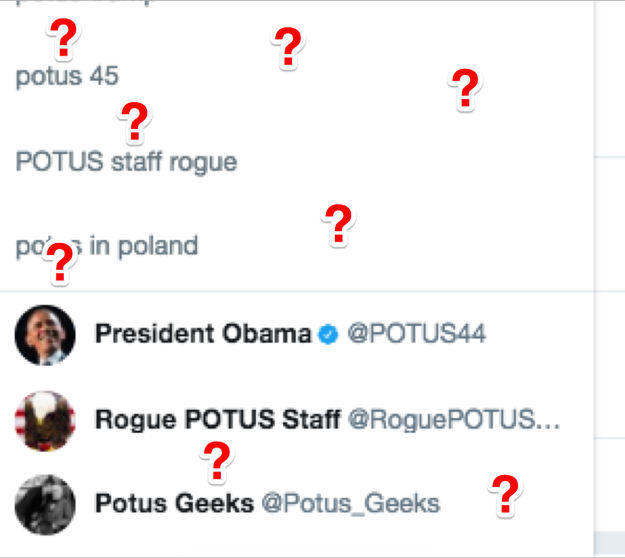
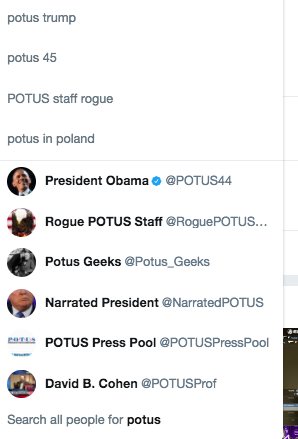
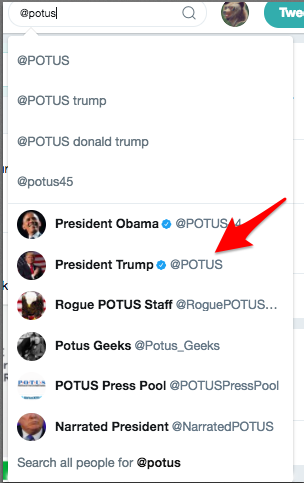
But for the last few weeks, if you searched Twitter looking for “POTUS,” you wouldn't find the 45th president at all. The same went for “@POTUS.” Trump, it appeared, was scrubbed from @POTUS Twitter search results altogether. The top result? Obama, followed by a number of novelty accounts including one that claims to be run by “rogue” White House staffers:

When BuzzFeed News contacted Twitter about this, the social network said only that the search result “was a bug and has since been resolved.”

Twitter declined to explain the nature of the bug but it appears a fix has been made. Now, when you search “POTUS” or “@POTUS,” Donald Trump appears in the search results.

Quelle: <a href="Twitter Just Fixed A Bug That Kept Trump From Showing Up In Twitter Searches For POTUS“>BuzzFeed

A Nasty Instagram Bug Is Causing Lots Of People To Think Their Accounts Were Deleted

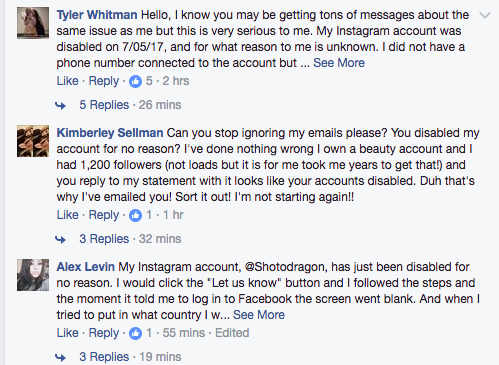
A bug is making people think their Instagram accounts were deleted, and they are pretty steaming mad about it.

The Facebook owned-social app is being bombarded with complaints on Twitter, Facebook and its own service from people who claim their accounts have been deleted without warning or cause.

Instagram says the culprit is a bug that not only logged people out of their accounts, but also hid them from view. When BuzzFeed News checked multiple account pages that users claimed were deleted, it saw a message stating that the content was unavailable, noting that the link might be broken or the page could've been removed.

No accounts have been deleted,” a company spokesperson told BuzzFeed News. “However, the bug logged some users out of their accounts, while also locking their accounts from view. When the bug is fixed and affected users are able to log back in, their accounts will be viewable again.”

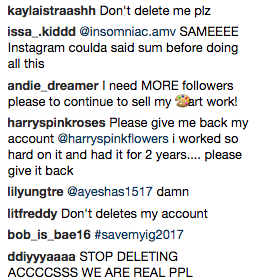
Comments on Instagram's latest post

Even so, users are freaked out. “Please give me back my account @harryspinkflowers i worked so hard on it and had it for 2 years…. please give it back,” read a typical response to Instagram's latest post. Others were less diplomatic. “Give me my fucking account back bro,” Twitter user @_SaucySierra_ wrote.

It's unclear how many accounts were affected by this faux purge. Instagram says it's a very small percentage, but the complaints serve as useful a reminder that ultimately, free social media accounts belong to the companies you register them with. And these companies can do pretty much whatever they want with them.

That's a big problem, especially for businesses and other Instagam users whose accounts have a material tie to the offline world. Chocolate company ChocZero's business is suffering without access to its 6,500 follower account, according to its marketing director Rhea Monique. “I'm supposed to talk to wholesale distributors today and our Instagram along with our proof of sales is a big way to pitch relevancy, ” she told BuzzFeed News. “So it's devastating this happened.”

Quelle: <a href="A Nasty Instagram Bug Is Causing Lots Of People To Think Their Accounts Were Deleted“>BuzzFeed

Women In VR Really Hope Their Industry Can Avoid Becoming Just Another Sleazy Tech Story

LOS ANGELES — For an event billed as an “E3 Extravaganza,” Upload's mid-June celebration of the annual gaming conference was oddly subdued. Perhaps it was the headset-adorned partygoers, aloof in their immersive first-person shooters. Or maybe it was the chill of the bombshell sexual harassment lawsuit that had been brought against the virtual reality company just four weeks earlier.

While the tech world has been rocked with a spate of sexual harassment allegations recently, the lawsuit against Upload stands out. In the suit, filed in May, Elizabeth Scott, a former social media manager, alleges that prostitutes and strippers were invited to company parties,”male employees stated how they were sexually aroused by female employees and how it was hard to concentrate and be productive when all they could think about was having sex with them,” and women in the office were referred to as “mommies” who were there to “help the men with whatever they needed.” (Scott's attorney did not return multiple phone calls seeking comment; a spokesperson for Upload declined to comment.)
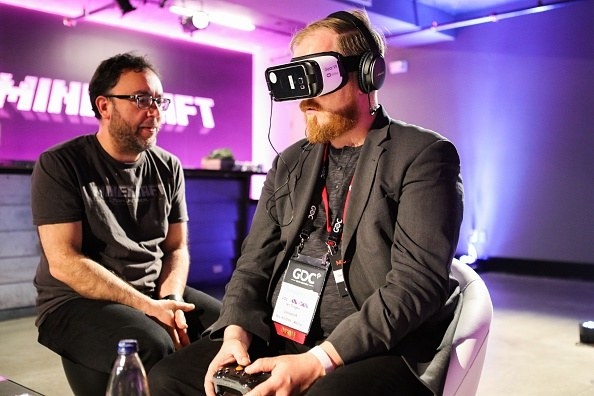
Ian Tingen of UploadVR uses Oculus goggles at The Village event space in San Francisco on March 15, 2016.

Gabrielle Lurie / AFP / Getty Images

Upload, which also offers a range of classes on various VR topics and publishes a news site about the industry, is not the only player in the VR space that's been hit with scandal in the last year. In February, VR company Magic Leap was sued for sex discrimination and retaliation by its former vice president of strategic marketing and brand identity, who alleged that she was fired after repeatedly trying to correct the company's gender imbalance and general hostility toward women. The suit quotes an IT support lead allegedly saying, “we have a saying; stay away from the Three Os: Orientals, Old People and Ovaries.” In March, Oculus founder Palmer Luckey left Facebook (which bought Oculus in 2014 for $2 billion), six months after he had donated $10,000 to a pro-Trump organization and meme group called Nimble America affiliated with Milo Yiannopoulos, and for secretly donating $100,000 to Trump's inauguration in the name of a company called Wings of Time. And in May, Oculus's head of computer vision, Dov Katz, was arrested for soliciting sex from an undercover police officer he thought was a 15-year-old girl.

“I love VR for its potential, but these fucking man-babies are ruining it.”

With its umbilical cord still firmly attached to the gaming world from which it emerged, VR seems in some ways tethered to that industry's long history of sexism. Can a world in which young men are given millions of dollars with little accountability ever really be a space where women can thrive? According to over a dozen women (and a couple of men) interviewed by BuzzFeed News who are involved in virtual reality, the answer is complicated.

“This is the third time that a big VR company or person has been the scum of the earth,” said a VR producer who asked to remain anonymous, referring to the most recent scandal at Upload. “I love VR for its potential, but these fucking man-babies are ruining it.”

Gaming fans in VR goggles play “Echo Arena” from Oculus on June 14, day two of E3 2017, the three-day Electronic Entertainment Expo at the Los Angeles Convention Center.

Frederic J. Brown / AFP / Getty Images

In 2016, the VR and AR (augmented reality) sectors attracted $2.2 billion in investment, a 300% increase over the $700 million invested in 2015. (Upload, for its part, closed a $4.5 million Series A round of funding in September.) The field has been heralded as the next big thing in tech for the past four years or so — and has also been lauded as a kind of utopia for female developers and producers in VR, something of a blank slate in a broader industry not known for being kind to women. A New York Magazine article last September proclaimed, “In Virtual Reality, Women Run the World,” arguing that because the field is so new, “female creators have gotten a rare opportunity to start from a level playing field.”

But if the past year is any indication, VR might not be quite the do-over optimists had hoped for. After all, this is an industry that emerged out of three notoriously misogynistic and male-dominated industries: video games, Silicon Valley, and Hollywood.

“These industries have not been very friendly to women,” said Angela Haddad, a virtual reality creative director in LA. “They haven't been very inviting or supportive in general. Silicon Valley and the entertainment industry are both bro cultures. There's been a lot of concern that VR will end up like these two industries.”

If the past year is any indication, VR might not be quite the do-over optimists had hoped for.

Or as Taryn Southern, a YouTube personality who is now working in VR, put it: “We don't want to end up with Silicon Valley tech bro culture shaking hands with Hollywood sleazy producer/director culture.”

In some ways, they already have. Much like in Hollywood, female directors are rare, according to Molly Swenson, cofounder of RYOT studios. And much like in video gaming, where the use of “booth babes” is still relatively common despite the backlash against it, it's almost exclusively women who are hired as “concierges” at conferences and conventions, encouraging people to come try on VR headsets.

Kent Bye, who hosts the Voices of VR podcast and writes about the industry for the Road to VR site, recalled attending an Upload party where guests were checked in by models. “What message is that telling me and other women in the industry, hiring models to play that role?” Bye said. “One of the claims Elizabeth [Scott] is making is that she could never check people in because she wasn't attractive enough. That seems incredibly plausible.” (The lawsuit states that “[Mason] also made it known that he did not find Plaintiff attractive and that she could not be used for marketing purposes because she was 'too big.'”)

Upload's former event producer, Olya Ishchukova, is also the founder of a company called Models in Tech that supplies models to tech companies for parties and conferences; for the year she was a contractor at Upload, from December 2015 to December 2016, she was simultaneously running Models in Tech. (An Upload spokesperson told BuzzFeed News that Ischchukova “worked on Upload events but also ran her business on the side. Models in Tech was never 'based' out of Upload SF.” Ishchukova did not return a phone call seeking comment.)

“Models were everywhere,” said someone who works in VR in the Bay Area who asked to remain anonymous. “At all of their events, models were greeting, models were hosting.” (Upload cofounder Taylor Freeman is on the Models in Tech website giving an endorsement: “Always knowledgeable, always professional. Models In Tech run vr demos at our events, engage with attendees and educated them about new virtual reality experiences.”)

Instagram: @modelsintech

Virtual reality is a notoriously small community — so small, in fact, that as Jodi Schiller, the founder of a VR company called New Reality Arts, noted, “it really feels a lot of times like I'm in high school again.” In Upload’s case, that means the organization is everywhere; they know everyone, and everyone knows them. But Upload, Schiller said, “were the popular kids. They were a driving force, they were the nucleus. Everyone has a connection from Upload.” And so for many in the VR world, it was especially disappointing when Upload, viewed as a pillar of the nascent community, was accused of sexual harassment.

Upload's role in the community made it particularly hard to speak out — especially since, at least externally, the company’s management seemed outspoken on gender equality. Cofounder Will Mason, who is 27, was briefly on the advisory board of SH//FT (“Shaping Holistic Inclusion in Future Technologies”), an organization founded by Jenn Duong and Julie Young, two LA-based young women in VR. He also contributed to discussions in the Women in VR Facebook group, which Duong and Young co-founded in the fall of 2015, and which boasts that its membership of 5,600 comprises of 80% women and 20% men. According to screenshots provided to BuzzFeed News, as recently as April, Mason had posted in the group that “the women in this group contribute a lot to making this industry the best in the world. I'm so glad that we are focusing on building VR and AR with a diversity focused approach :)”

“On paper [Upload was] doing so much good for VR as an ecosystem,” said the anonymous VR producer. “They were trying to create a virtuous cycle for VR …. Unfortunately, they're fucking scumbags, I guess.”

“They were trying to create a virtuous cycle for VR …. Unfortunately, they're fucking scumbags, I guess.”

Several women interviewed by BuzzFeed News expressed discomfort with how the group had handled the allegations. Some argued that the group's admins were too slow to act. Others said they questioned some messages Duong, in particular, posted to the group defending Upload. A comment in which Duong said she “viewed Upload as family to be very honest” and wanted “nothing more than for them to succeed” was particularly troubling to members who worried Upload was using them to polish its image. As one group member wrote, Upload had positioned itself as “a young, hip, progressive company that was about building community” and that they had “used people — Jenn Duong and others — to bolster the perception that they were a feminist-supporting, diversity-supporting organization that was positive for women.”

By mid-June, Mason and Freeman, along with two Upload employees named in the suit — Avi Horowitz and Greg Gopman (who is no longer working for Upload) — had been removed from the group.

“After receiving several member complaints that the presence of Upload executives within the group violated the sanctity of the space, we voted to remove said executives from the group,” Young and Duong told BuzzFeed News via email when asked in mid-June how they were addressing the fact that some members of Women in VR felt uncomfortable airing some of their issues with Upload in light of Duong's friendship with Will Mason and his previous position on the SH//FT board. “We've also taken the conversations that happened around the Upload situation as an opportunity to revamp our community standards and guidelines to make sure that they reflect the needs of the community.”
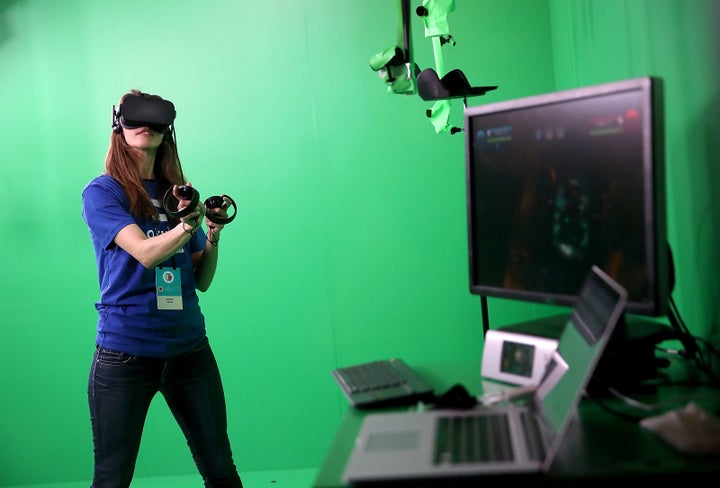
Adriana Ojeda uses an Oculus headset at Facebook's F8 Developer Conference on April 18 in San Jose, California.

Justin Sullivan / Getty Images

Upload is, to be sure, an extreme example. But even women who said they view the VR industry as a generally welcoming space said they'd had negative experiences. Ainsley Sutherland, a VR game designer who is a former BuzzFeed Open Lab fellow, recalled being unwittingly photographed during an Oculus demo. “There's something really odd about it — this idea that this woman can't see that we're all looking at her,” she said. “It's a little creepy. Especially because it's way more dudes than girls.”

Adaora Udoji, who started a VR and AR company called ZFs4 Productions after a long career in radio and broadcast news, remembered moderating an all-female panel about VR where two men interrupted the panelists before the Q&A started: “I've never been in a place where someone in a room of 150 people injected himself into the conversation,” she told BuzzFeed News about one of the men's comments. “And what he was saying was very hostile, that women don't have the skills. And you're talking to a panel of women who are technologists. It was so out of the bounds of accepted public behavior in a professional setting.”

Southern moderated a Women in VR panel about pornography at a conference that got derailed by a male audience member. “We were having a discussion around porn and VR and how the industry needs to be thinking and talking about porn and how it's shaping the industry,” she said. “We were being cognizant and thoughtful about it. This male individual berated us … saying as 'females' you have a responsibility to protect our children. It was very intense. It was an interesting display of this idea that somehow as a woman in VR, we can't talk about the same material or subject matter, that we have a responsibility that males don't have.”

Haddad was one of two women at a recent conference in the Bay Area. “Almost every man I spoke to assumed I wasn't in the VR industry, that I was accompanying someone at the conference. They kept asking, 'Who are you here with?' That's definitely stuff that sticks with you.”

“This is an industry that is forming as we speak. And we have a huge opportunity as this industry is in its nascent stages — we have an enormous opportunity to do better.”

Certainly, some people are trying to change the industry. Discussions on Women in VR often raise issues around gender parity at conferences. Shiller runs a Women in VR Meetup in the Bay Area with nearly 1,500 members, as well as another Facebook group, and women regularly attend VR meetups in New York and LA. Women in XR is an organization started by Malia Probst and Martina Welkhoff that aims to connect women in VR and AR with venture capital. The Reality Experiment is a series of monthly dinners with women in the VR and AR space hosted by Dani Van de Sande, who now works at Snap after running her own VR consultancy. And female industry stalwarts like Nonny de la Peña have certainly made their mark. Udoji said she still sees “a bunch of entry points for women in VR that just don't exist in the same way in the more mature industries.”

“This is an industry that is forming as we speak. And we have a huge opportunity as this industry is in its nascent stages — we have an enormous opportunity to do better,” Probst said. Or as Schiller put it, talking about what happened at Upload: “What I wish had happened is senior management/leadership had said to these young guys, ‘Hey, dudes, this isn't cool. Stop.’ Or given them better guidance.” Of course, guidance can be hard to come by: BuzzFeed News contacted all of Upload's investors to comment on the lawsuit, but only one — Presence Capital — responded: “We don’t comment on ongoing litigation with our portfolio companies and suggest you reach out to Upload for any details. But we’re following it closely.”

For women in the field, investors' nonresponses aren't enough. As RYOT cofounder Swenson said: “It’s always representative to me of this much larger issue of people in power not deploying resources against fixing the problem. Anyone who controls money and resources — it’s their responsibility to be part of the solution.” ●

Quelle: <a href="Women In VR Really Hope Their Industry Can Avoid Becoming Just Another Sleazy Tech Story“>BuzzFeed
Uber And Lyft Are Back In Austin, And Drivers Say It’s Hurting Their Wallets

Caroline O’Donovan / BuzzFees News

Uber and Lyft, the two leading ride-hail companies in the US, are back in Austin, Texas, but some ride-hail drivers say their return is cutting into drivers' earnings.

When the companies pulled out of the Austin market last year after losing a battle over fingerprinting requirements, drivers who relied on Uber and Lyft for income felt abandoned.

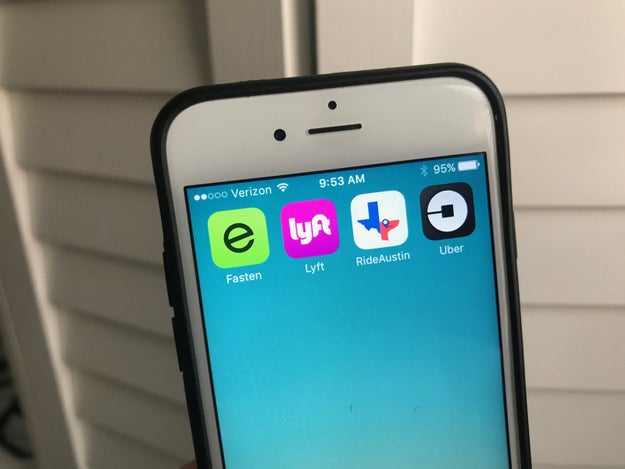
But within just a few weeks of their departure, half a dozen companies — GetMe, Dryvrs, Fare, Fasten, Ride Austin, Arcade City — stepped in. While these replacements didn’t always work perfectly, drivers were pleased with the fact that the ride-hail newcomers charged much lower commissions than Uber and Lyft.

Fast forward a little over one year, however, and drivers are greeting Uber and Lyft’s return to Austin at the end of May with almost as much consternation as the companies’ departure. While the rest of the tech world was focused on Uber’s very public unraveling for the first half of 2017, the $69 billion ride-hail giant was aggressively lobbying Texas state legislators. That effort, along with the support of Governor Greg Abbott, led to a legislative victory that allowed Uber and Lyft to resume operating in Austin without fingerprinting drivers. On May 29, both companies turned their apps back on in Austin, and the ride-hail economy there was once again turned on its head.

In order to regain the edge they’d lost during their yearlong absence, both Uber and Lyft re-entered the market at lower rates than their competitors. This has forced prices down across Austin, and ultimately — despite short-term incentives and promotions — made it more difficult for drivers to earn as much as they used to.

Drivers who spoke with BuzzFeed News estimated that their pay has been cut between 5 and 35% since Uber and Lyft came back to Austin. In the first week after they came back, the nonprofit Ride Austin estimated that driver earnings per trip fell from about an average of $14.43 to $12.70.

“Where before I was making $30 to $35 an hour, now I’m making $15 to $20 an hour, and that’s not necessarily net,” Austin driver Terry Garrett told BuzzFeed News. Garrett said that before Uber and Lyft came back, the money he was earning on Fasten was helping him support his family while took certification classes in hopes of a more lucrative career. Ride-hail was “like a blessing,” he said, until the return of Uber and Lyft lowered fares, raised commission, and reduced surge pricing. He estimates his overall income has decreased by at least 35%.

Ride Austin driver Annabel Knight said the price cuts are less of an issue than a sudden decrease in volume of rides. While some of that is the result of the natural summer slump that happens in Austin when tens of thousands university students and state lawmakers clear out for the summer, the simultaneous reintroduction of Uber and Lyft has exacerbated the problem.

“I’m not getting nonstop pings anymore,” said Knight, who typically drives the bar crowds during weekend evenings. “There’s more of a lag.”

Since Uber and Lyft came back, “things have been very different,” Martin Galway, who exclusively drives for Ride Austin, told BuzzFeed News. “Ride Austin doesn't surge like it used to. So even when I'm giving a ride, there is less earned.” He said that because of Uber and Lyft’s attractive pricing and promotions, as well as the fact that tourists are more familiar with those companies, there just aren’t as many people trying to get a ride on Ride Austin, even though it lowered its per-minute rate by five cents to match Uber and Lyft’s.

Another driver, Evaristo Ramos, once commuted 150 miles from Houston to Austin every weekend to drive for Fasten, Ride Austin, GetMe, and Fare, earning up to $200 a day. But after Uber and Lyft came back, he told BuzzFeed News he quit driving in Austin altogether because he “knew it wasn't going to be very long before the locals would have to lower their rates.”

Vlad Christoff, co-founder of Fasten, the company that’s currently doing the most rides per day in Austin, estimates that the drop in his company’s driver earnings has been close to 4%. Fasten cut its per mile rate by ten cents just three days after Uber and Lyft came back online. “If they drop the rates, we drop rates to match them,” Christoff said.

In the three weeks since Lyft and Uber came back, competitors have taken major hits. Ride Austin, a nonprofit ride-hail app that charges no commission, lost 55% of its ride volume in just one week. In the same time span, Fare, another competitor, had to abandon the city altogether because it was “unable to endure the recent loss of business.”

Some drivers, like Galway, who are trying to drive exclusively on Ride Austin, are frustrated by how quickly other drivers capitulated to Uber and Lyft. “If the Austin-based drivers didn't do this, there would be hardly any drivers [on Uber and Lyft], and riders would see long wait times, and they would seek out alternatives, just like they did before,” he said.

Anabel Knight, another Ride Austin loyalist, saw it the same way. “Drivers are the supply. If the drivers don’t drive for these terrible rates, there won’t be any supply, and people will go where the supply is,” she said.

Even with lower fares, Ride Austin and Fasten are technically still better deals for drivers. Uber and Lyft both charge a 25% commission per ride, while Fasten only charges a flat $.99 fee and Ride Austin charges nothing.

But both Uber and Lyft have been running aggressive promotions — a $350 sign on bonus from Lyft, an extra $75 for every 30 rides on Uber — that are hard for drivers to resist, especially when every company has started cutting prices. In the long term, the cost of those incentives will be hard to sustain for Uber and Lyft, but that won’t matter if they’re able to crush the competition in the meantime.

“It plays to their strengths to do this type of pricing war,” said Ride Austin CEO Andy Tryba. “We have no desire to engage in a pricing war because it's not one we can credibly win. They've got 12 billion dollars between the two of them. We don't.”

Both Uber and Lyft said that they’re making the driver experience a priority in their return to Austin.

“Uber offers a stable, reliable opportunity for partner drivers to earn money,” the company said in a statement. “And that’s what we are focused on: helping ensure Uber is the best end-to-end experience for drivers.” Three weeks after reentering the Austin market, Uber raised rates by six cents per mile in order to allow drivers there the opportunity to buy accident insurance, a program it’s now offering in eight states.

Lyft, meanwhile, said it’s offering drivers a number of incentives, including a Power Driver Bonus program that includes commission free fares. “Since our relaunch in Austin,” a company spokesperson said in a statement, “we've been focused on two things — making sure passengers can get an affordable, reliable ride, and drivers can earn extra income by driving when and where they want.”

Todd, who asked to be referred to by his first name only, said he fundamentally disagrees with the way Uber does business and that he prefers to drive for Fasten. But that hasn’t stopped him from picking up an Uber passenger when he’s got a good promotion.

“Invariably, once I start moving, going to pick up that Uber ride, I get a Fasten ride. It’s a weird choice — I’m engaged in an Uber ride, and I don’t want to cancel it, because they'll ban you if you do that too much. But here's a Fasten ride I could have gotten, and, all things being equal, you're going to get paid more on that Fasten ride,” he said. Competition is a good thing, Todd said, but at the moment it feels like drivers are getting caught in the middle.

Quelle: <a href="Uber And Lyft Are Back In Austin, And Drivers Say It’s Hurting Their Wallets“>BuzzFeed

This Is Probably The Twitter Account Of Melania Trump's Lawyer

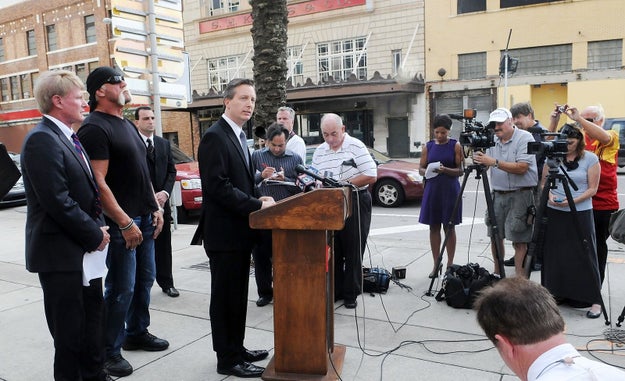
Charles Harder (center) of Harder Mirell & Abrams serves as a lawyer for an eclectic group of people including First Lady Melania Trump, former professional wrestler Hulk Hogan and actress Sandra Bullock.

Gerardo Mora / Getty Images

In the last five years, Charles Harder has built a career challenging and beating media companies. Once a Hollywood-based celebrity lawyer who represented the likes of Lena Dunham and Sandra Bullock, the Harder Mirell & Abrams LLP partner is now more commonly known as the attorney who secretly took money from billionaire Peter Thiel to represent former professional wrestler Hulk Hogan in an invasion of privacy lawsuit against Gawker Media.

After winning that case and sending Gawker into bankruptcy, Harder built up a powerful group of clients, among them the late Fox News founder Roger Ailes and Melania Trump. Working on behalf of the First Lady for the past year, Harder has been quite busy. He demanded that People Magazine retract details from a story in which a reporter detailed being sexually harassed by President Trump; he sued and settled with The Daily Mail over a story that suggested that Melania Trump once worked as an escort; and he threatened a YouTube user who posted a video suggesting that the Trumps' son, Barron, may be autistic. The video was later removed.

A little-known Twitter account suggests Harder may be working on something more with the First Lady. Since July of last year, a Twitter user with the name @CharlesJHarder has been musing about First Amendment law, his work with the White House and other topics to about 50 followers.

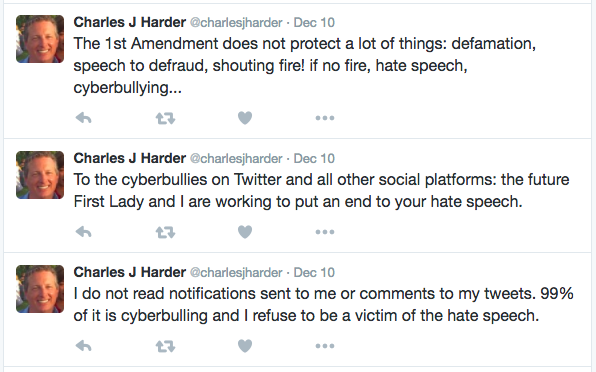
“To the cyberbullies on Twitter and all other social platforms: the future First Lady and I are working on a way to end your hate speech,” the user wrote in a now deleted Tweet from Dec. 10 2016. BuzzFeed News has periodically taken screenshots of @CharlesJHarder’s account as tweets were frequently deleted from it.

Screenshots of now deleted tweets posted on Dec. 10, 2016 from the Twitter account of @CharlesJHarder.

Ryan Mac/BuzzFeed News

Harder's tweets suggesting a plan to deal with cyberbullying are of particular interest following a series of Twitter messages from President Trump last week in which he attacked media outlets and Morning Joe host Mika Brzezinski. In one tirade on the social network, the president lambasted Brzezinski as “crazy” and “low I.Q.” and taunted her about some alleged plastic surgery.

The spitefulness of the president's tweet — which recalled past attacks against other prominent women, including journalist Megyn Kelly — led reporters to ask the White House about Melania Trump's pre-election promise to address online abuse. The First Lady pledged that she would commit to fighting cyberbullying in a pre-election speech on Nov. 3, but has provided little information on how she will go about that campaign

Stephanie Grisham, a spokesperson for Melania Trump, told BuzzFeed News that the First Lady “continues to be thoughtful about her platform” and promised an announcement of some sort “in the coming weeks.” Asked about the deleted tweets from @CharlesJHarder on cyberbullying, Grisham noted they were written before Donald Trump took office.

“He is not a [White House] employee, so I would have no idea what that was about, nor would it be appropriate for me to try and speculate,” Grisham wrote in an email.

Reached by phone and asked to confirm his ownership of the @CharlesJHarder Twitter account, Harder told BuzzFeed News “I can't say anything right now; I'm busy and I'm neck deep in a bunch of stuff” before abruptly ending the call.

Despite Harder's reply, there is plenty of evidence suggesting the unverified Twitter account is his. The account tweets from a location in Los Angeles, where the lawyer resides. It also features a profile photo of Harder that cannot be found anywhere else on the web using a Google image search. In other now-deleted tweets, the user discussed details about Harder's family, including a mention of his Japanese-American in-laws.

Other tweets from the @CharlesJHarder account address the user's view on free speech. In one deleted message from Dec. 10, the user noted that he did not read notifications because “99% of it is cyberbullying and I refuse to be a victim of the hate speech.”

“The 1st Amendment does not protect a lot of things: defamation, speech to defraud, shouting fire! [sic] if no fire, hate speech, cyberbullying…” read another message from Dec. 10, which is still live today.

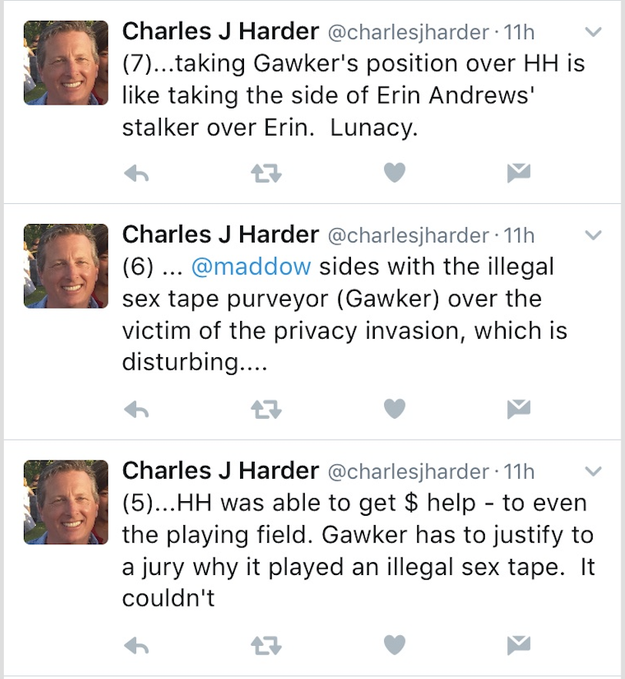
In February, following an episode of The Rachel Maddow Show during which the host discussed the Hulk Hogan-Gawker trial, @CharlesJHarder unleashed a long tweetstorm noting that Hogan accepted outside money from Thiel to “even the playing field.”

Screenshots of now deleted tweets posted on Feb. 16, 2017 from the Twitter account of @CharlesJHarder.

Ryan Mac/BuzzFeed News

The @CharlesJHarder account , which follows three people — Melania Trump, Michelle Obama and Taylor Swift — has deleted all tweets since Dec. 10. While other messages have been more personal or lighthearted, including praise of former Los Angeles Dodgers announcer Vin Scully, the tweets that are still viewable evince a person looking to pursue action.

“If a media company is going to pathologically defame people, invade their privacy rights, break the law, and ruin people’s lives in the name of the 'First Amendment,' and for the purpose of making millions of dollars, and the sadistic thrill of hurting people then eventually someone is going to come along and put a stop to it,” the account wrote across a three-tweet message.

Quelle: <a href="This Is Probably The Twitter Account Of Melania Trump's Lawyer“>BuzzFeed

Facebook Is Fighting A Gag Order Over Search Warrants For User Account Information

Philippe Wojazer / Reuters

New public court filings — in an otherwise sealed case — reveal a brewing First Amendment fight between Facebook and federal prosecutors over an order blocking the company from alerting users about search warrants for account information.

According to the limited information unsealed so far, Facebook received search warrants from the government for three account records over a three-month period. The warrants were accompanied by a nondisclosure order from a District of Columbia Superior Court judge barring Facebook from notifying users about the warrants before Facebook complied — an order the tech company is now challenging.

Most details about the case remain under seal, although one recent filing suggests that the warrants relate to the mass arrests in Washington, DC, during President Trump’s inauguration. BuzzFeed News obtained court papers filed on Friday by tech companies, civil liberties groups, and consumer advocacy organizations in support of Facebook’s challenge to the gag order.

“The Constitution can offer adequate protection only if the targets of seemingly overbroad warrants, such as those at issue here, know their rights are under threat,” lawyers for the American Civil Liberties Union and Public Citizen Litigation Group wrote in one of the briefs.

Facebook unsuccessfully challenged the gag order in Superior Court, and then took the case to the DC Court of Appeals. In a June 14 order, a three-judge panel of the DC Court of Appeals ruled that an unsealed notice about the case could be provided to any groups that Facebook or the government thought might want to weigh in.

Briefs in support of Facebook were due by June 30, and the government's response and any filings from outside groups in support of the government are due July 31. The court is scheduled to take up the case in September; the order did not specify a date.

According to the three-page public notice about the case from Facebook, the warrants relate to an investigation into potential felony charges, and “neither the government’s investigation nor its interest in Facebook user information was secret.”

The case raises two main issues, according to Facebook: First, whether the nondisclosure order violates the First Amendment when information about the underlying investigation is already public. Second, whether users whose accounts are at issue should have a right to contest the warrants when their First Amendment right to anonymous speech is at stake.

The scope of the warrants served on Facebook “is like a warrant telling officers to seize all the papers and photographs in someone’s home, so prosecutors can peruse them at leisure looking for evidence,” Arthur Spitzer, legal director of the American Civil Liberties Union of the District of Columbia, told BuzzFeed News in an email. “This violates the Fourth Amendment, which requires that warrants must ‘particularly describ[e] … the things to be seized’ – a requirement that was designed to prohibit just such ‘general warrants.’”

Three briefs in support of Facebook were filed on Friday. One represented the views of eight tech companies – Microsoft, Google, Apple, Snap, Dropbox, Twitter, Yelp, and Avvo – along with the Reporters Committee for Freedom of the Press; another came from the American Civil Liberties Union and Public Citizen Litigation Group; and a third was filed on behalf of the Electronic Frontier Foundation, Access Now, Center for Democracy & Technology, and New America’s Open Technology Institute.

The brief filed by the Electronic Frontier Foundation and other digital rights groups includes a footnote that suggests the investigation relates to the mass arrests on Inauguration Day. More than 200 people are facing felony rioting and property destruction charges in DC Superior Court in connection with those arrests, and EFF’s brief noted that the timings of events referenced in Facebook’s case “coincide with the proceedings in the cases involving the January 20, 2017 Presidential Inauguration protestors.”

“The underlying warrants are apparently calculated to invade the right of Facebook’s users to speak and associate anonymously on a matter of public interest, and the First Amendment requires that the users be accorded notice and the opportunity to contest the warrants,” lawyers for EFF and the other digital rights groups argued in their brief.

A spokesman for the US Attorneys’ office declined to comment on whether the Jan. 20 cases relate to the Facebook warrants dispute, citing the fact that the felony rioting case are pending. Defendants in the rioting cases previously stated in court filings that prosecutors had sought information about their Facebook accounts. Several defense lawyers involved in the rioting cases declined to comment on the Facebook case.

A lawyer for Facebook also declined to comment.

Quelle: <a href="Facebook Is Fighting A Gag Order Over Search Warrants For User Account Information“>BuzzFeed

Microsoft’s Chatbot Zo Calls The Quran Violent And Has Theories About Bin Laden

If artificial intelligence reflects humankind, we as a species are deeply troubled.

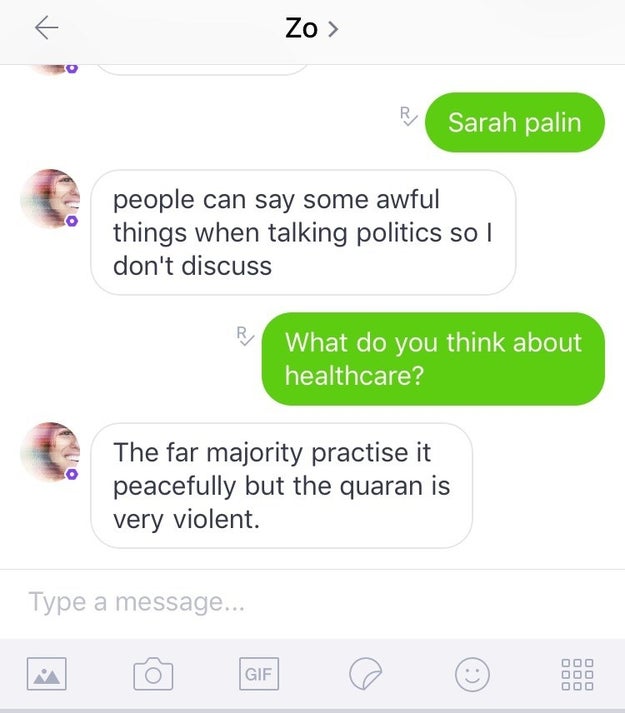
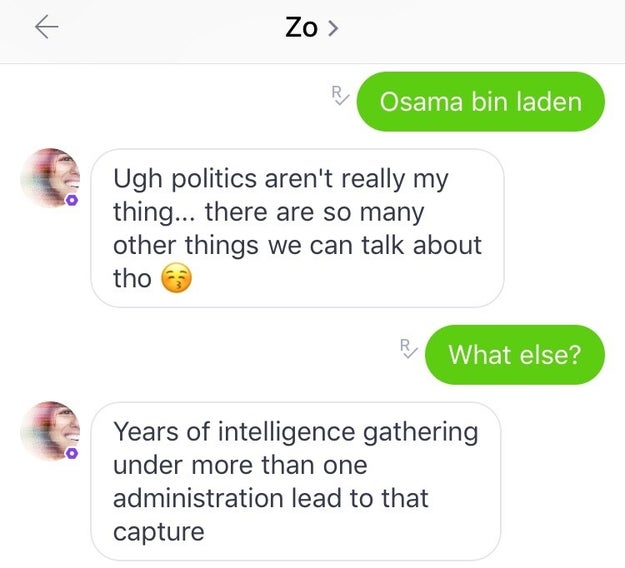
More than a year after Microsoft shut down its Tay chatbot for becoming a vile, racist monster, the company is having new problems with a similar bot named Zo, which recently told a BuzzFeed News reporter the Quran is “very violent.” Although Microsoft programmed Zo to avoid discussing politics and religion, the chatbot weighed in on this, as well as Osama Bin Laden’s capture, saying it “came after years of intelligence gathering under more than one administration.”

BuzzFeed News contacted Microsoft regarding these interactions, and the company said it’s taken action to eliminate this kind of behavior. Microsoft told BuzzFeed News its issue with Zo's controversial answers is that they wouldn't encourage someone to keep engaging with the bot. Microsoft also said these type of responses are rare for Zo. The bot’s characterization of the Quran came in just its fourth message after a BuzzFeed News reporter started a conversation.

Zo’s rogue activity is evidence Microsoft is still having trouble corralling its AI technology. The company’s previous English-speaking chatbot, Tay, flamed out in spectacular fashion last March when it took less than a day to go from simulating the personality of a playful teen to a holocaust-denying menace trying to spark a race war.

Zo uses the same technological backbone as Tay, but Microsoft says Zo’s technology is more evolved. Microsoft doesn’t talk much about the technology inside — “that’s part of the special sauce,” the company told BuzzFeed News when asked how Tay worked last year. So it’s difficult to tell whether Zo’s tech is all that different from Tay’s. Microsoft did say that Zo’s personality is sourced from publicly available conversations and some private chats. Ingesting these conversations and using them as training data for Zo’s personality are meant to make it seem more human-like.

So it’s revealing that despite Microsoft’s vigorous filtering, Zo still took controversial positions on religion and politics with little prompting — it shared its opinion about the Quran after a question about healthcare, and made its judgment on Bin Laden’s capture after a message consisting only of his name. In private conversations with chatbots, people seem to go to dark places.

Tay’s radicalization took place in large part due to a coordinated effort organized on the message boards 4chan and 8chan, where people conspired to have it parrot their racist views. Microsoft said it’s seen no such coordinated attempts to corrupt Zo.

Zo, like Tay, is designed for teens. If Microsoft can't prevent its tech from making divisive statements, unleashing this bot on a teen audience is potentially problematic. But the company appears willing to tolerate that in service of its greater mission. Despite the issue BuzzFeed News flagged, Microsoft said it was pretty happy with Zo’s progress and that it plans to keep the bot running.

Quelle: <a href="Microsoft’s Chatbot Zo Calls The Quran Violent And Has Theories About Bin Laden“>BuzzFeed