This Conservative Mom And Liberal Daughter Were Surprised By How Different Their Facebook Feeds Are
This Conservative Mom And Liberal Daughter Were Surprised By How Different Their Facebook Feeds Are

Lixia Guo & Lam Thuy Vo / BuzzFeed News

Katherine Cooper, 60, and Lindsey Linder, 28, are very similar. They’re mother and daughter and both grew up in West Monroe, La., a town of a little less than 13,000 people located four hours north of New Orleans. They both spend their working hours helping others — Lindsey as a policy attorney for the Texas Justice Coalition, a group advocating for criminal justice reform, and Katherine as a caregiver and teacher.

But like many American families in recent months, they have gotten caught up in vehement disagreements about the US election, its results, and other ideological issues. And not just that. On Facebook, Linder and Cooper’s political differences can lead to heated and ugly spats that both said they would have been able to avoid if they were talking offline.

Last fall, this divide came to a head. At the height of the contentious presidential elections, Linder posted an article titled “White America, It’s Time to Take a Knee” about Colin Kaepernick, an NFL quarterback who garnered national attention last year for refusing to stand during the National anthem at the beginning of his games.

An hour later her mother, Cooper, chimed in. “I love and adore you but Im unfollowing you starting right now,” she wrote as part of a longer comment.

“Go burn flags if thats what you want to do,” her brother added in another comment on the same posted article.

View Video ›

BuzzFeed News

The sparring between Linder and her family and friends from back home became so intense that she temporarily deactivated her Facebook account after the election. Her colleagues in Austin, Texas who had watched Linder’s online disputes were actually worried for her safety when she told them she was going home to visit her family, she said.

“In this political climate it seems that every issue is polarized. There's not a lot of issues that I can say ‘I really care about this’ and it hasn't been made into some kind of dividing factor,” Linder said.

“She's so outspoken cause she would just post anything on Facebook, and we'd be like: ‘What?! Are you kidding?’,” said Cooper about her daughter’s online presence.

“On Facebook for a while [my family and I] were in a very polarized position. […] It just became this place where we could be combative,” said Linder.

One reason why Linder and Cooper disagree so vehemently online may be the fact that the content they see on Facebook hardens beliefs they already have.
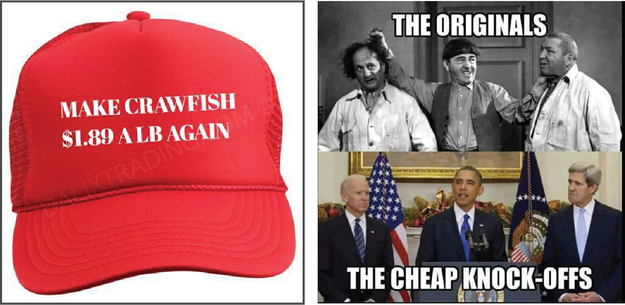
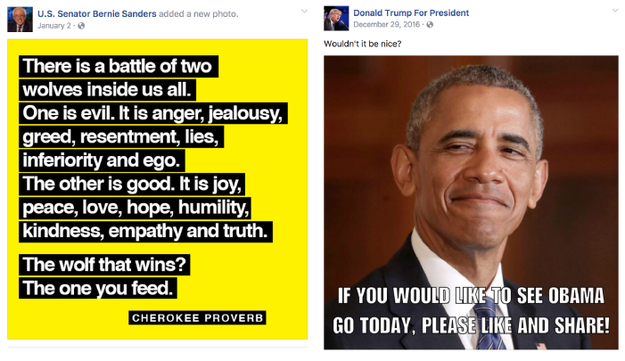
Left: A meme from Linder’s timeline. Right: A meme from Cooper’s timeline.

Facebook

People naturally surround themselves with people who share their beliefs. Online, this self-selected social circle results in people mostly encountering content that confirms rather than questions their beliefs, an effect often referred to as experiencing the world through a “filter bubble.”

To get a better idea about how much Linder and Cooper’s social media worlds differ, BuzzFeed News compared their Facebook news feeds and timelines. They gave us permission to look at a combined total of 2,367 posts shown on their news feeds for one day in January of this year.

The findings of our analysis are very specific to Linder and Cooper but may help illustrate how people’s experience of politics online can aggravate existing political differences and create conflicts that could have been resolved offline in a less contentious manner.

The content they choose to look at

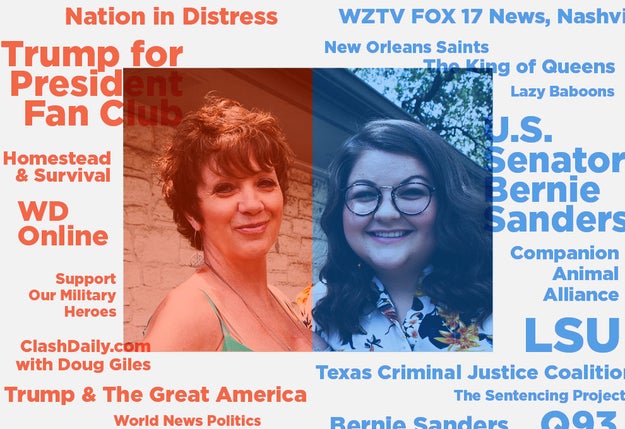
Here are the top 15 pages and groups whose posts showed up most often on Linder and Cooper’s news feeds:

Lam Thuy Vo

Their interests vary. In terms of politics, for instance, Cooper follows five groups and pages that contain the name “Trump,” including pages with the names “Donald Trump for President,” “Trump & The Great America,” and “Trump Wall.” Cooper also liked one page named “Hillary for Prison.” Linder, on the other hand, receives content from two pages that are related to Bernie Sanders, “U.S. Senator Bernie Sanders” and “Bernie Sanders.” None of the groups mentioned above that Cooper likes are verified by Facebook (meaning the platform has confirmed that the pages are affiliated with the public person they named after), while both pages that Linder follows feature the blue tick mark that signifies them as official Bernie Sanders pages.

Below are two exemplary memes that appeared on Linder and Cooper’s news feeds in January from Pages named “U.S. Senator Bernie Sanders” and “Donald Trump for President” respectively :
Facebook

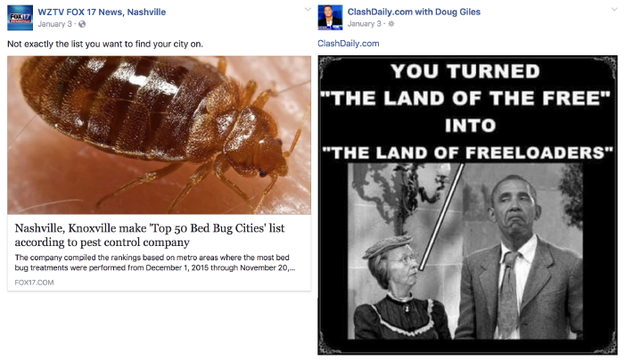
In terms of news, Linder follows at least two local media organizations — “WZTV FOX 17 News, Nashville,” where she does not live, and a local hip hop radio station from New Orleans, “Q93.” Cooper has liked at least 23 pages that identify themselves as news or media organizations, and the majority of them are openly right-leaning, with “Clashdaily.com with Doug Giles” and “Nation in Distress” showing up the most in Cooper’s feed.

Here’s a typical post from the Nashville news station Linder follows and a post from ClashDaily.com found on Cooper’s feed from January:
Facebook

Fake and hyperpartisan news posts also contributed to tensions between Cooper and Linder.

Back in August, Cooper posted a news article titled “BREAKING: 49ers DROPS Kaepernick After He Refuses to Stand for National Anthem” from American Updater, a right-leaning Facebook page, on her own timeline. Linder commented on her mother’s post, pointing out that it wasn’t real news: “First, this is one of those scammy articles we discussed last week (please, for the love of God, stop sharing this crap without verifying its validity). Second, this is false.” The story is no longer available online, and its headline was incorrect.

Screenshot of an article Cooper shared that no longer exists

Facebook

Cooper’s experience online echoes that of many political news consumers on Facebook, who are increasingly targeted by partisan media makers on both sides of the political spectrum that rely on Facebook to attract readers.

“I'm real bad about reading stuff and not really knowing what fake news [is],” said Cooper about her online behavior during the election. “I'd see something and be like ‘What?’ and get really excited. [And then] Lindsey would be like, ‘This is fake news.’”

“Right now I'm really confused about what's true and what's not true,” said Cooper.

Despite all those ideological differences, however, Linder and Cooper have commonalities: both care about animals — Linder likes the “Companion Animal Alliance,” an animal adoption page, and Cooper likes at least five dog-related pages and both care about issues around the welfare of others. Linder, due to the nature of her work, follows several criminal-justice related pages while Cooper follows a page called “Support Our Military Heroes.”

Below are two exemplary posts from these groups:

Facebook

The friends who show up on their news feeds

Perhaps more important than what Linder and Cooper choose to follow may be the people they’re friends with on Facebook. Content from pages only constituted about 15% of Cooper’s feed and even less for Linder (almost 10%).

This is largely because Facebook explicitly prioritizes content from friends rather than pages on people’s news feeds.

The people who populate our unique social media worlds set the bar for what we may perceive as ‘common’ or ‘normal.’ They make up our networked information universe. The majority of Americans who are online — 62% of them — receive news from social media platforms. Of all American adults who are on Facebook 76% use the platform on a daily basis.

The graphic below represents the top 20 people who showed up on Linder and Cooper’s news feeds respectively. Their names have been retracted and replaced with descriptions of each person’s relationship to Linder and Cooper.

While Linder’s feed was dominated by lawyers, friends from home, and friends she made after leaving her hometown, Cooper’s news feed mostly showed content from people who live near her in a district that voted 61.4% for Donald Trump.

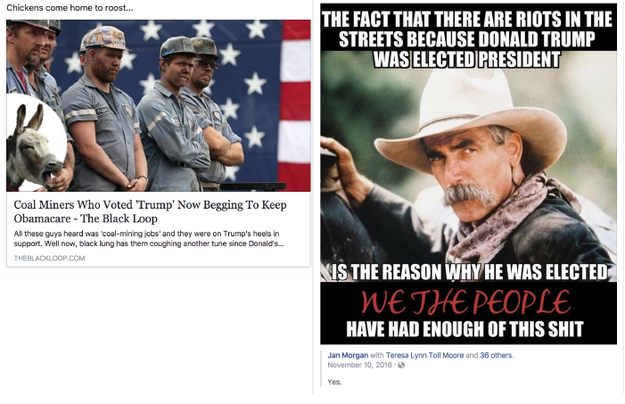
On the left is an article posted by one of Linder’s friends that appeared on her feed. Articles from this person appeared 75 times on Linder’s news feed. On the right is a meme from Cooper’s feed from a friend whose posts showed up 66 times in the data BuzzFeed news analyzed:
Facebook

Top 15 Facebook Friends Whose Posts Appeared on Linder and Cooper's Facebook News feeds

Lam Thuy Vo

“I think it’s interesting how different our Facebooks are. No matter how different we are, we do have similarities. And on Facebook there’s essentially no overlap in terms of people who we are seeing, pages that are posting,” said Linder.

Both recognized that their daily social media consumption was skewed.

“I hate the bubble and Lindsey pops my bubble every time I come see her. […] I wished I could be friends with everybody on facebook. That way I could see more,” Cooper said.

Not everyone sees it that way. For many, election-inspired unfriending sprees are only widening the rift between people of different political persuasions. With fewer people of opposite political persuasions in people’s social networks, they are less likely to see content posted by others that challenges their own views.

“I'm as guilty as anyone in creating a Facebook bubble. […] Most of the people from back home, some from my family, and a lot of the people from my school are unfollowed on my feed because I don't want to see things that I've come to disagree so strongly with,” Linder said.

When reached for comment, Facebook referred BuzzFeed News to several studies, including an October 2016 Pew survey about the political environment on social media that shows people report seeing a mix of political views in their networks. Another study, which Facebook conducted itself, found that, on average, 23% of people's friends on Facebook claim to have opposing political identities (based on self-reported political affiliation). The company also referred BuzzFeed News to a report from the Reuters Institute for the Study of Journalism that shows social media can actually help diversify a person's news consumption.

According to that same Pew survey Facebook pointed to, more than half (59%) of the study’s participants felt that online encounters with people from opposite political persuasions left them stressed and frustrated, rather than enlightened. Even worse, 64% said they felt like they had less in common with their political counterparts after discussing issues online than they did before.
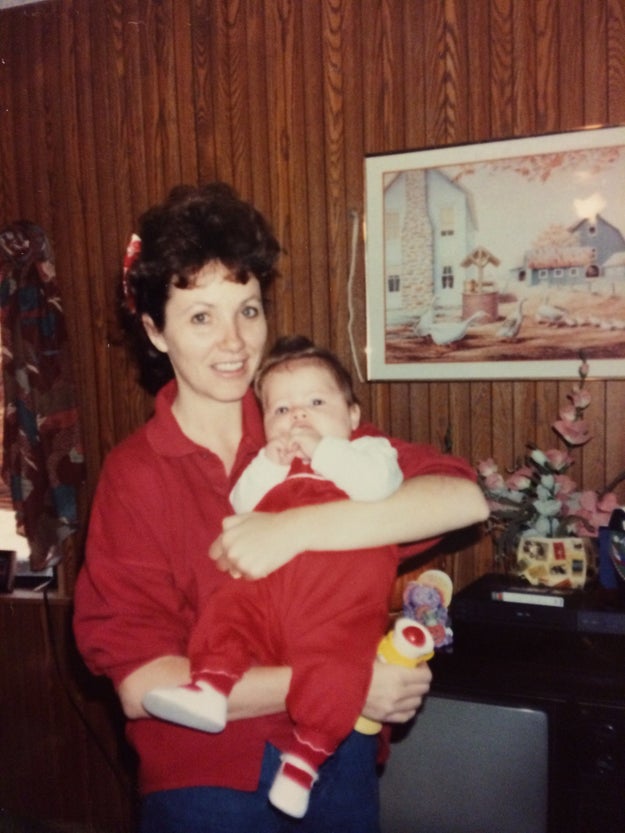
Cooper holding Linder when she was a baby

Courtesy of Lindsey Linder

Both mother and daughter admit that it’s much easier to discuss their conflicting views when they’re in the same room rather than trying to work it out online.

“We decided that [we share a lot of beliefs] the last time we were together; I felt so good because I don't think any different from Lindsey,” said Cooper.

Linder said, “When I was engaging on something on her Facebook, it was to say, ‘Are you kidding me? I can't believe you shared this.” … And then I went home for a visit and we had a chance to sit down and talk about some political issues. And it was really interesting because it started out as, ‘these are things we would never possibly agree on,’ and by the end of the conversation I felt like we got to a place where we both thought, ‘oh we don't actually disagree.’”

For example: Cooper has a strong anti-abortion stance and thought that she and her daughter would not be able to find common ground, but to her surprise, they were able to agree on some aspects of the subject.

“The thing that actually reduces the number of abortions — access to healthcare, access to contraceptives, comprehensive sex ed — these are the things that actually reduce abortions,” said Linder.

“We […] agreed on that issue,” said Cooper. “When I'm with Lindsey, I'm a Democrat,” Cooper added, laughing.

Quelle: <a href="This Conservative Mom And Liberal Daughter Were Surprised By How Different Their Facebook Feeds Are“>BuzzFeed
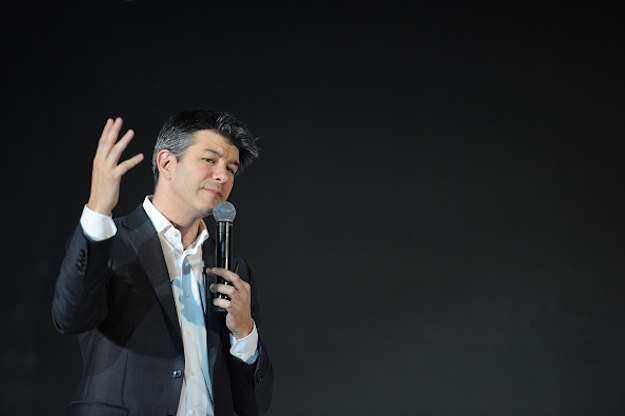
Uber Tells Employees It’s “Looking Forward” In Its Search For A CEO

Vcg / Getty Images

At an all-hands meeting Tuesday morning, Uber addressed rumors that the company’s former CEO Travis Kalanick is plotting a return to power.

The ride-hail giant’s general counsel Salle Yoo told employees that while the company is appreciative of Kalanick’s role in building Uber, the search for a new CEO isn’t focused on the past.

“The future is bright and we are looking forward,” she said, according to an employee who attended the meeting.

Kalanick resigned his role as CEO of Uber in June, at the insistence of the board, following two internal investigations into allegations of widespread harassment and discrimination at the company.

But earlier this week, Recode reported that Kalanick was talking privately about orchestrating a return to Uber. The chatter caused confusion in the board’s ongoing CEO search; Hewlett Packard CEO Meg Whitman withdrew her name from consideration for the role without warning during a meeting in which the board planned to vote on her appointment, according to The New York Times.

Uber is currently being managed by a multi-member executive team, which took advantage of Tuesday’s all-hands meeting to quell any discussion of a Kalanick comeback. At the same meeting, Uber HR head Liane Hornsey gave employees an update on the company’s efforts to meet recommendations for improving company culture. Hornsey said Uber will be establishing an outside advisory council on diversity made up of academics and other experts. She also told employees that Uber has exceeded its goals for pay equity; the company announced raises for thousands of employees at a meeting two weeks ago.

Uber declined to comment on this story.

While critics have blamed Kalanick’s style of leadership for contributing to Uber’s contentious and combative workplace, there are also many employees inside the company who remain loyal to him and would be happy to see him return. Two days after he resigned, a group of employees circulated an internal petition asking for Kalanick to be reinstated.

Meanwhile, Kalanick’s name has been popping up in the ongoing lawsuit between Uber and Alphabet’s self-driving car company Waymo over allegedly stolen intellectual property. Kalanick was deposed last week, and emails linking him to the decision to offer indemnity to Anthony Levandowski, the former Waymo employee at the heart of the suit, became public yesterday. Waymo has accused Levandowski of stealing self-driving trade secrets and giving them to Uber after it acquired his autonomous trucking startup Otto. According to Waymo’s legal team, a digital forensics expert recovered hundreds of deleted text messages between Levandowski and Kalanick that will be handed over to Waymo’s lawyers today. After that, Waymo will have the chance to depose Kalanick for a second time, for a total deposition time of more than seven hours.

So while it sounds like Kalanick won’t be returning to his role as Uber CEO, he’ll have plenty to keep him busy.

Quelle: <a href="Uber Tells Employees It’s “Looking Forward” In Its Search For A CEO“>BuzzFeed
Austin Luxury High-Rise Tenants Swiped Left On Bumble's Code-Violating HQ

“Be Nice or Leave” — that’s one of the unofficial mottos of Bumble, the hugely successful dating app commonly referred to as “feminist Tinder.”

But many residents of the Bowie, the ultra-luxury Austin high-rise where the company had its headquarters until earlier this month, say employees of the company treated the building like their dedicated campus with little regard for the people who lived there and the staff who worked there — even though only three Bumble employees were on the residential lease and no one lived in the unit.

BuzzFeed News has learned that over the past year, as the company swelled in size, the two-bedroom apartment on the 31st floor that it had repurposed into a plush startup office became the focus of a cold war between Bumble employees, building staff, and residents who felt the company was unfairly dominating the luxury building’s amenities, including common spaces, a rooftop pool, and paid parking.

“The Bumble folks are generally obnoxious, entitled, and treat the Bowie like their corporate office,” said one resident, who spoke to BuzzFeed on the condition that he not be named.

The Bowie, a three-year-old, 37-story gleaming glass tower rising above downtown Austin, was in many ways a fitting location for Bumble, a company that has amassed 12.5 million users and risen to second in the lifestyle category in the App Store since being started by Tinder cofounder Whitney Wolfe after her acrimonious split from that company. Indeed, the company hosted the New York Times there for an interview ahead of a glowing story in March. The 380-unit building boasts the kind of luxuries you’d expect to find in a prosperous city’s finest rental building: a 24-hour concierge service, multiple fire pits, a dog grooming room, a coffee bar, and electric vehicle charging stations.

The only problem? According to an Austin code department spokesperson, the office, located in a building approved for use as a multifamily residential property, was a code violation. And the thriving startup was using facilities intended for Bowie residents as its own.

“They were using the whole floor like it was an office space.”

A copy of a code complaint filed with the Austin city government by a resident describes a company that could not be contained within the 1,200-square-foot apartment that Bumble referred to as “The Hive.”

“Issue?” the complaint reads. “Bumble headquarters in apartment building! This is a residential building … and this illegal corporate headquarters has been causing Havoc … They’re located on the 31st floor, have about 15 or 20 employees, therefore they use all the common spaces as a secondary office … One is supposed to be on a lease to use common areas, but they do not care … This is a very large company and they should have a real office instead of a code violating office.”

Over the past year, a former member of the building staff said, the front desk — staffed by a local concierge company — received multiple complaints a day about Bumble employees, often related to company employees using the 31st-floor common space for meetings and presentations.

In a statement, a Bumble spokesman wrote, “The 31st floor is where it all started and we throughly enjoyed our relationship with the residents. The building management was fully aware of our operations and never once issued us a complaint of any kind. And while it was never brought to our attention by management, we deeply regret any disturbance we may have caused at the building.”

Pinnacle Property Management Services, which currently owns the Bowie, declined to comment on this story. An inspection carried out by James Paxton, an Austin city code inspector, revealed that Bumble is owned by an LLC called Beehive Interests, which was registered by Whitney Wolfe in August 2014, with a corporate mailing address of 311 Bowie St., Apt. 3107 — the Bowie.

“They were using the whole floor like it was an office space,” said Lane Helveston, a Bowie resident who lived on the 31st floor. “They would be in my hallways. There were people roaming around the building who didn’t live there.”

Making matters worse, according to five Bowie residents, was the demeanor of the Bumble staff. One resident reported seeing a Bumble employee — on a conference call in the hallway — shush another resident who was showing her mother the building.

According to several residents, the deluge of complaints put Steve Hunt, then the building’s concierge, in the awkward position of enforcing rules about non-residents’ use of common areas, and acting as Bumble’s de facto doorman.

Since each apartment only came with two key fobs, Hunt had to let Bumble employees into the elevators on a daily basis. According to Hunt, new Bumble employees sometimes turned hostile in the Bowie lobby when he asked them what business they had in the building.

At times, according to multiple sources, the lobby seemed to belong to Bumble, with vendors ferrying Topo Chico mineral water and green juice up to the 31st floor and employees testing out new Snapchat filters on residents.

One Bowie resident described an incident in which a Bumble employee asked for his assistance while he was walking through the lobby. As he approached the Bumble employee, she held up her phone and informed him that he was on the “Bumble Kiss Cam,” at which point a second Bumble employee tried to kiss him.

“I said, 'that’s assault,'” the resident recalled. “That’s completely inappropriate. I’m in a private residence.”

Still another source of tension was the parking lot, where residents paid a monthly fee of more than $100 for a space. According to multiple sources, Bumble employees would frequently follow each other into the lot and take paid spots. Hunt, frustrated by having to run interference, started leaving signs in the lot reading “No Bumble Parking” and “Top Code Violators Under 30” with a picture of Wolfe — a mocking reference to the CEO's inclusion on the Forbes 2017 30 Under 30.

“Management never once issued us a complaint about Bumble team members parking in paid spots that were reserved for residents,” a Bumble spokesperson wrote. “As our demand for parking increased, we paid management the daily rate for the visitor lot and instructed our team to park there.”

Earlier this month, the conflict between residents, staff, and Bumble spilled out of the building when a former resident enlisted a friend in the notorious and deliberately offensive internet troll group GNAA to fight back. Last Monday, Twitter users reported that the Wikipedia pages for Amazon, Google, and Walmart redirected to a GNAA press release entitled “GNAA Reveals Cause to Evict Bumble from their Corporate Headquarters,” stating that Bumble’s Bowie office was in violation of its lease.

Nevertheless, last week Bumble moved out of the Bowie. The GNAA claimed credit, though according to Paxton, the code inspector, building management said that Bumble had voluntarily moved out at the end of its lease.

Bumble recently sent out invitations to an office-warming party, which will feature paddleboarding and yoga.

Wednesday, Wolfe offered Hunt, who left the building after it was sold to new management, a sizable gift on behalf of Bumble.

In an Instagram message reviewed by BuzzFeed News, Wolfe wrote to Hunt, “We will be sending you … $1,000 as a thank you for being our front desk manager.”

Quelle: <a href="Austin Luxury High-Rise Tenants Swiped Left On Bumble's Code-Violating HQ“>BuzzFeed

HBO Has Been Hacked

“HBO recently experienced a cyber incident, which resulted in the compromise of proprietary information,” the network said in a statement.

Mark Davis / Getty Images

HBO has been hacked, BuzzFeed News can confirm.

“HBO recently experienced a cyber incident, which resulted in the compromise of proprietary information,” the network said in a statement. “We immediately began investigating the incident and are working with law enforcement and outside cybersecurity firms. Data protection is a top priority at HBO, and we take seriously our responsibility to protect the data we hold.”

Entertainment Weekly was the first to report the news.

On Monday, CEO Richard Plepler sent an email to HBO employees:

Dear Colleagues,

As most of you have probably heard by now, there has been a cyber incident directed at the company which has resulted in some stolen proprietary information, including some of our programming. Any intrusion of this nature is obviously disruptive, unsettling, and disturbing for all of us.

I can assure you that senior leadership and our extraordinary technology team, along with outside experts, are working round the clock to protect our collective interests. The efforts across multiple departments have been nothing short of herculean. It is a textbook example of quintessential HBO teamwork. The problem before us is unfortunately all too familiar in the world we now find ourselves a part of.

As has been the case with any challenge we have ever faced, I have absolutely no doubt that we will navigate our way through this successfully.

Richard

HBO has not revealed what was stolen or the amount of data accessed, despite reports that the hackers leaked a few episodes from the series Ballers, Room 104, and the script for next Sunday's Game of Thrones.

According to EW, an anonymous email was sent to some reporters on Sunday night, which read: “Hi to all mankind. The greatest leak of cyber space era is happening. What’s its name? Oh I forget to tell. Its HBO and Game of Thrones……!!!!!! You are lucky to be the first pioneers to witness and download the leak. Enjoy it & spread the words. Whoever spreads well, we will have an interview with him. HBO is falling.”

This is not the first time HBO has been in this situation. The first four episodes of Game of Thrones' Season 5 leaked shortly before its premiere in 2015.

This story is developing and will be updated.

Check back for updates and follow BuzzFeed News on Twitter.

Quelle: <a href="HBO Has Been Hacked“>BuzzFeed

These People Are Making Money Off A Bogus Cancer Cure That Doctors Say Could Poison You

These People Are Making Money Off A Bogus Cancer Cure That Doctors Say Could Poison You

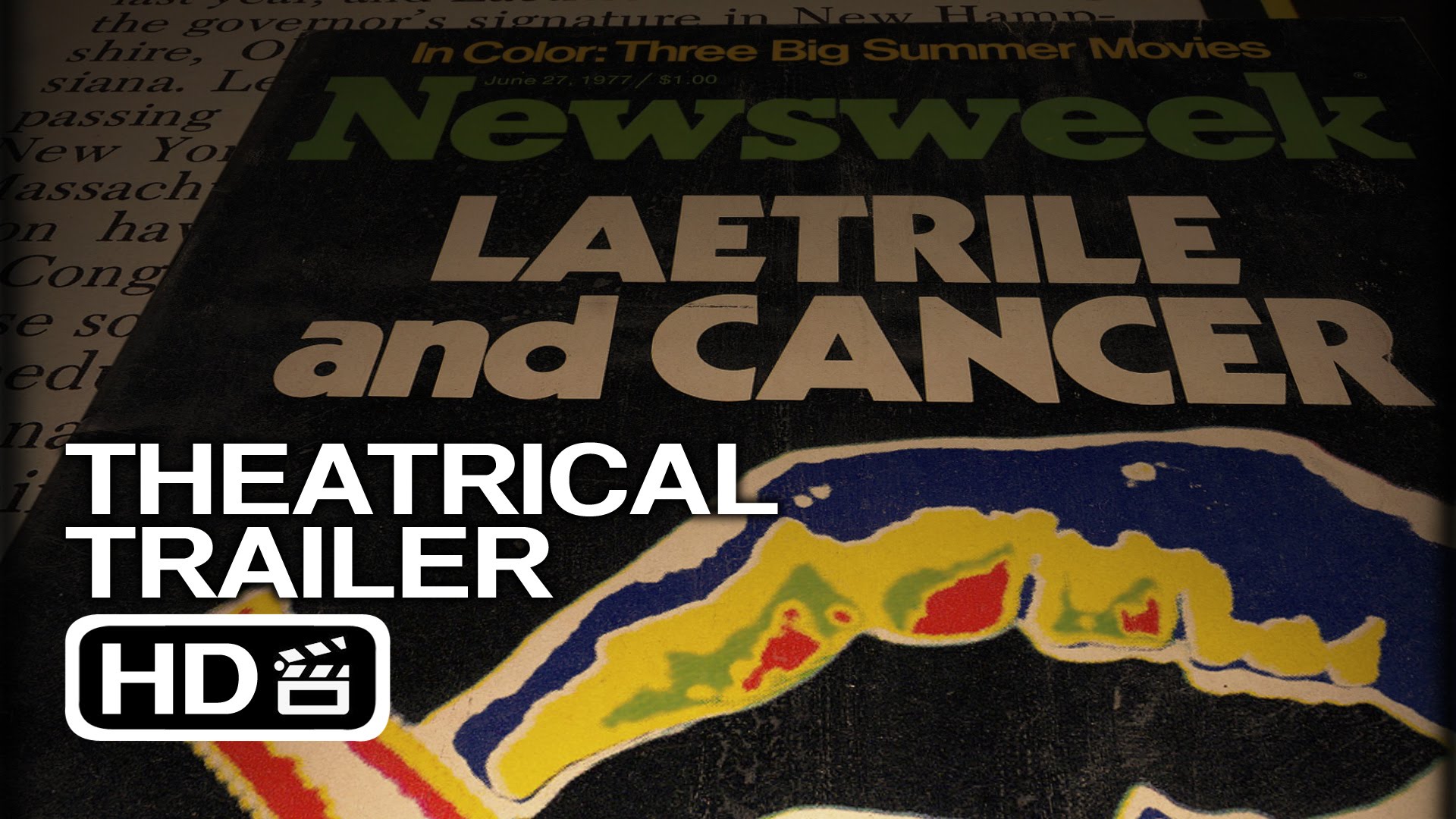
John Richardson thought he’d found a cure for cancer.

The San Francisco Bay Area doctor had been giving patients a therapy that is essentially a chemical compound found in apricot kernels and known by several names — laetrile, amygdalin, vitamin B17. Richardson had been told it could attack tumors, naturally and precisely. It can also convert into potentially poisonous amounts of cyanide when eaten. But Richardson was a true believer.

“Yes, the evidence that Vitamin B17 is nature’s control for cancer is quite overwhelming,” he wrote in his book. “So the next time you hear an official spokesman for orthodox medicine proclaim that there is none, you might tell him that such a statement is a ‘self-evident absurdity’ and suggest that he do his homework before posing as an expert.”

Less convinced were the police who, on June 2, 1972, barged into Richardson’s clinic and jailed him on charges of medical quackery. He eventually lost his medical license and was charged with smuggling laetrile, an illegal drug, into the country.

Apricot Power / Via apricotpower.com

Now, three decades after Richardson’s death, his son, John Richardson Jr., is no stranger to apricot seeds. Through Apricot Power, his thriving e-commerce store, he sells bitter seeds ($32.99 for 1,500), seed extract-based tablets (up to $97.99 a bottle), and B17-infused anti-aging cream ($49.99). Recipes for apricot-seed pesto, egg nog, and marzipan offer a “delicious and easy” way to work the supposed superfood into your diet, and videos explain why the site’s mission is to “get B17 into every body!” Though Richardson Jr. won’t reveal revenue numbers, he says his family operation of around 10 employees has served “thousands” of customers all over the world since it launched in 1999.

But there’s a key difference between his business and his father’s, Richardson Jr. told me: “We don’t mention the C-word in our company.” Cancer, that is. If a customer review on Apricot Power’s website even mentions the term, the company leaves a comment pointing out that it doesn’t make any disease or illness-related claims about its products. Legally, it can’t: The FDA prohibits companies from selling laetrile, under any name, as a cancer treatment, because studies have found it to be at best ineffective, and at worst toxic.

Of course, that doesn’t stop dozens of internet entrepreneurs from exploiting regulatory loopholes to sell apricot seeds and B17 tablets, no claims attached — and profiting off the efforts of believers who spread the “truth” about them far and wide. In laetrile’s heyday in 1981, a doctor called it “the slickest, most sophisticated, and certainly the most remunerative cancer quack promotion in medical history.” Three decades later, the internet has only spread the gospel, creating an unstoppable, hydra-headed ecosystem of buyers and sellers.

A variety of apricot seed products available online.

BuzzFeed News

If you’ve never heard that apricot kernels kill and prevent cancer, that’s because the government doesn’t want you to, proponents say. Cancer, according to them, arises from the lack of a nutrient they call vitamin B17, so it follows that ingesting that nutrient would fight the disease. But regulators, pharmaceutical companies, and doctors can’t patent and profit from a natural substance. So they keep it off the market and peddle toxic, invasive, costly, and unnatural chemotherapy and drugs at patients’ expense.

The internet has created an unstoppable, hydra-headed ecosystem of B17 buyers and sellers.

Or so the theory goes. “Vitamin B17 Is Banned Because It Treats Cancer!” a post on the site Healthy Food House proclaims; it has been liked, commented on, and shared on Facebook more than 47,000 times since September, according to the social media–tracking tool CrowdTangle. A post about “the real story of laetrile,” published on a site called The Truth About Cancer, has gotten more than 44,000 likes, comments, and shares since June 2015.

Yin Ling Woo, a gynecological oncologist, recently had to decline when three cancer patients asked her to inject them with liquid B17 vials. “They buy it off the internet, it arrives, they have to get someone to administer it,” said Woo, who works in Kuala Lumpur, Malaysia.

Over the last year and a half, public health agencies in the European Union, Canada, and Dubai have issued warnings about apricot kernels and kernel-derived supplements. Since Australia and New Zealand outright blocked the sale of raw kernels in late 2015, retailers have been fined for continuing to sell them. In April, the FDA fired off warning letters to the sellers of more than 65 illegal cancer treatments, including whole apricots and vitamin B17. All the regulators cite the internet as the main source of the problem. “Due to the nature of online marketing, some companies attempting to avoid compliance with FDA law simply start new websites and rename fraudulent products,” an FDA spokesperson told BuzzFeed News in an email.

In other words, the FDA lacks the power to systematically fix the underlying issue. It can go after apricot kernels advertised as a cancer cure. But it can’t crack down when they’re advertised as supplements or plain old seeds. Nor can it control the Facebook posts, YouTube videos, blogs, and tweets that perpetuate the myth.

And when the FDA calls out problematic claims, all a company has to do to escape scrutiny is stop using the phrases in question. “But the misimpression that their product is an effective cancer cure will remain out there, uncorrected, in the public eye,” said Patti Zettler, an associate professor at Georgia State University’s law school and a former associate chief counsel at the FDA.

It’s no coincidence that B17 is enjoying a second life online, at this moment in time. The internet is rife with misinformation about science and health, and the nutritional supplements business — as part of the larger “wellness” industry — is worth billions. Meanwhile, cancer remains a little understood disease that causes nearly 1 in 6 deaths worldwide. So in a way, it’s comforting and intuitive to blame a fixable vitamin deficiency. It’s also wrong.

Felicity Corbin-Wheeler of Jersey, an island south of England, credits B17 injections and a strict diet with shrinking her pancreatic cancer in 2003. She refused chemotherapy, which aligns with her belief that the “Western diet has been so hijacked by processed foods, sugars, fats, and salts.”

“I’m all for the natural things,” she said, “that we get back to a simple life.”

Ernst T. Krebs Jr., seen in San Francisco in 1980, was an early promoter of laetrile as a cancer treatment.

Sakuma / AP Photo

A successful salesperson must buy into what they’re selling, and Richardson Jr. is all in. Growing up in the Bay Area suburb of Orinda, he and his seven siblings weren’t fed sugar or processed wheat, an abstention he keeps up to this day. He says he started eating apricot seeds for his health at age 5. Now 52, he’s up to 40 a day.

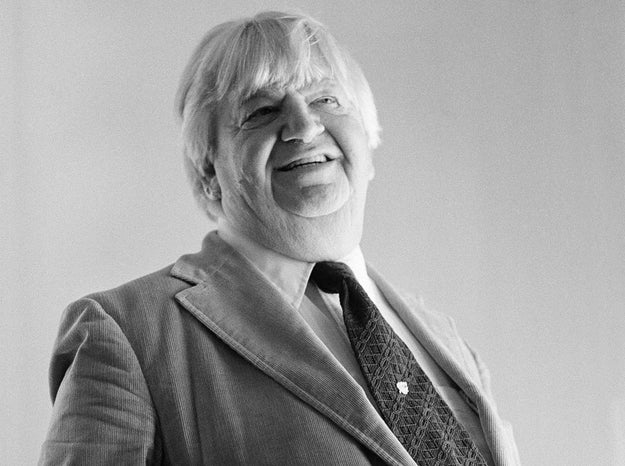
The seeds contain amygdalin, a compound also found in apple seeds and almonds. In the 1950s, Ernst T. Krebs Jr., a self-described doctor and biochemist with no medical degree, patented a purified form of amygdalin that he called “laetrile.” He also promoted it as “vitamin B17,” although it’s not an officially recognized vitamin.

In 1971, Krebs Jr. shared with the elder Richardson his theory of how this nutrient could stop cancer growth. As Richardson later summarized: “[N]ature’s mechanism will not work if one fails to eat the foods that contain this necessary vitamin, which is exactly what has happened to modern man, whose food supply has become further and further removed from the natural state.”

In Richardson’s day, “laetrilists” were just as controversial as the anti-vaccine movement is today. In the 1960s, the FDA banned laetrile and reported that there was no evidence it treated cancer. But over the next decade, more than 70,000 Americans took it anyway. Many of them crossed into Mexico for injections denied by their stateside doctors. Actor Steve McQueen secretly traveled to Baja in 1980 to receive laetrile, among other alternative remedies, for an advanced lung cancer. He died months later. In the mid-’70s, a scientist at Memorial Sloan Kettering Cancer Center performed experiments that he said showed laetrile helped reduce tumors in mice. A media relations staffer then leaked the data, claiming that hospital executives had sought to cover up and discredit it. He’s been making that claim ever since, including in the 2014 documentary Second Opinion (“for the conspiracy-minded only,” the Los Angeles Times wrote), and now charges cancer patients $500 for hourlong phone consultations.

In the mid-'70s, “laetrilists” were just as controversial as the anti-vaccine movement is today.

When the elder Richardson was arrested in 1972 (on charges that were dropped), it prompted his fellow members of the John Birch Society, the far-right conspiracist group of the era, to start a lobbying group to legalize laetrile. Later, Richardson was fined $20,000 and placed on probation on charges of conspiracy to smuggle laetrile from Mexico to the US. Indictments against him and 18 other accused promoters noted that he had deposited $2.5 million in his bank account over two years.

Even so, Richardson Jr. remembers his father, who died in 1988, as “very principled, very honest, and very moral,” and keeps a picture of him over his desk. “There’s still people that contact me and tell me what a wonderful man he was and what a wonderful doctor he was,” he said.

After long legal battles, the FDA’s laetrile ban ultimately took effect in 1987. In 1999, Richardson Jr. started Apricot Power as an online-only store, but it’s branched out to health food shops over the last five years to meet customer demand. The company sources apricots from its farm and others in California, removes the flesh, air-dries the pits at the center, cracks them open, and sells the seeds inside.

“A lot of the foods, the amygdalin’s been cooked out of it,” said Richardson Jr., who also operates a real estate firm and a restaurant. “And my dad believed a normal, healthy person should have 100 milligrams a day of amygdalin. That’s been our company motto since the beginning, is just getting amygdalin back into every body.”

It took me no more than a few seconds to find apricot seeds online. A Google search led me to Amazon, where a European vendor was selling a 1-pound bag for $19.99 with this caveat: “We do not ‘treat’, or aim to ‘cure’ any disease.” Still, its customers leave reviews like “Raw Apricot Kernels help to stop Cancer in its tracks” and “I expect no miracles, but I don’t want to die from chemotherapy.” The seeds turned out to be chewy and tongue-curlingly bitter, with a long and unpleasant aftertaste.

Amazon’s algorithm recommended that I also buy the book that’s the bible of this movement: World Without Cancer: The Story of Vitamin B17. First published in 1974 and now in its 24th printing, it’s by G. Edward Griffin, who has no scientific training, denies HIV, and pushes Sept. 11 conspiracy theories.

Via amazon.com

I tried to interview more than 35 e-commerce shops that sell seeds or supplements labeled as laetrile, amygdalin, or B17. Many declined to talk or never got back to me. A man at Raw Foods and Vitamins turned me down, explaining, “The FDA and the government agencies have gone wild, there’s so much money in Big Pharma. … As soon as there’s a little publicity, they’ll be all over you.” He did, however, text me pro-laetrile books and websites to look up.

Others were more open. Danny Hesman, who runs B17 USA full-time out of Los Angeles, said he has 5,000 repeat customers. “I do tell people it’s not a magic pill,” he said. But like some other vendors, he’s had a personal experience with cancer — in his case, a friend who died from it. “I got a front-row seat to the suffering he went through with modern medicine,” he said. “I know these oncologists, I spoke to their team, they did everything. It’s almost career suicide for professionals to even consider alternative therapies, which leaves [B17] in that fringe zone you see when you google ‘vitamin B17.’ I wish there were some more professionals that would really work on that.”

Many vendors, especially those in the US, repeatedly emphasized that they weren’t claiming to cure, treat, or prevent anything, as if the FDA were listening over the phone. But Our Father’s Farm in Ontario, Canada, sells kernels that “may help with cancer prevention and symptoms.” Vision B Seventeen in Kuala Lumpur, Malaysia, claims to have “been successfully treating cancer and other degenerative diseases for more than 12 years now.”

Regulators have tried to squash these kinds of vendors. Jason Vale, a professional arm wrestler in New York City, sold seeds as a cure on his website, Apricots From God, because he believed they’d healed his kidney cancer. He also spammed people with millions of email ads. But in 2003, Vale was sentenced to five years in prison for criminal contempt of a court injunction sought by the FDA to stop him selling.

“Laetrile (i.e. Vitamin B17) therapy is one of the most popular and best known alternative cancer treatments.”

Quelle: <a href="These People Are Making Money Off A Bogus Cancer Cure That Doctors Say Could Poison You“>BuzzFeed

As Tesla Celebrates The Model 3, Employees Demand Answers On Pay

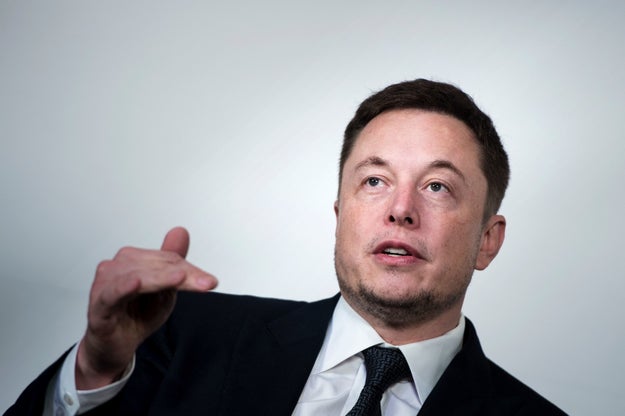
Elon Musk, CEO of Telsa

Brendan Smialowski / AFP / Getty Images

Thirty lucky Tesla enthusiasts will become the first proud owners of the Model 3 tonight, when CEO Elon Musk hands over the keys to the electric car company’s newest and most affordable model at a celebration at Tesla’s Fremont, CA facility. Musk posted a video of the party preparations to Instagram on Thursday night.

But as some Tesla employees are celebrating the launch of the new model, others are waiting for answers to questions about pay transparency and promotions. Last Friday, a group of 10 factory employees presented Tesla HR with a petition asking for more information about how much Tesla factory workers are paid and how raises are distributed. Workers posted a photo of the group and the document to the “Fair Future At Tesla” Facebook page, which is run by Tesla workers interested in organizing the factory and ultimately joining the United Autoworkers Union.

One Tesla employee involved in the initiative told BuzzFeed News around 400 employees in total signed the petition.

The movement to unionize Tesla kicked off earlier this year when factory worker Jose Moran wrote a blog post detailing the long hours, lower-than-standard pay, and injury-causing conditions he alleges exist at Tesla’s Fremont factory. Since then, the number of Tesla employees speaking publicly in favor of a union has grown to about half a dozen, and multiple sources have alleged the factory has high injury and illness rates. On the “A Fair Future at Tesla” Facebook page, debate over whether unionizing would improve conditions or ultimately stymie pay and productivity at Tesla is the subject of spirited debate.

When the union supporters sent their petition to Tesla HR director Josh Hedges, they requested that he respond “within the week.” Hedges reports to Tesla Chief People Officer Gaby Toledano, who took the reins during a department shakeup earlier this year. “We'll see if he does [respond], but this won't be the last time management hears about this issue!” they wrote on the Facebook post.

Tesla confirmed it had received the petition, but as of Friday night, it hasn’t yet responded to it.

The petition focuses on compensation in Tesla’s factory, which its authors say has “for far too long … been decided in a way that seems unfair and overly subjective.” It includes a list of questions Tesla workers have for management, including basics like “What is the top hourly pay rate for each classification, and how long do we have to work to reach it?” and “What is the average raise workers receive during reviews?”

In the past, Musk has argued that compensation for factory workers at Tesla is higher than what any other US autoworkers make, if you account for the equity packages those workers receive. In an all-staff email from February in which Musk slammed the union drive, he said employees could expect increased equity grants this year, “once Model 3 achieves high volume.”

In past years, the push to produce enough vehicles during the launch of a new Tesla model has created a high-pressure situation inside the plant, with workers often having to pull 12-hour shifts. The introduction of a third shift, which allows the plant to run 24 hours a day in three eight-hour segments, was supposed to relieve some of that pressure and prevent employee burnout. But inside the factory, rumors that 12-hour shifts could return as production ramps up on the Model 3 are causing some anxiety on the factory floor, sources tell BuzzFeed News. Tesla did not immediately respond to a request for comment about whether or not its factory will resume 12-hour shifts.

But those concerns are unlikely to dampen the mood at tonight’s launch party, which started livestreaming at 8:45 pm. If Telsa responds to the petition, we'll update this story.

Quelle: <a href="As Tesla Celebrates The Model 3, Employees Demand Answers On Pay“>BuzzFeed

This @JohnKelly Is Not New White House Chief Of Staff John Kelly, But His Mentions Are A Wreck

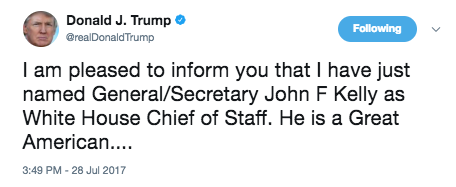
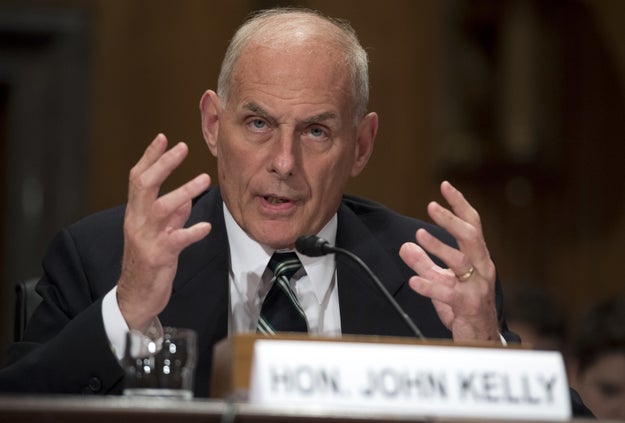
Today, President Donald J. Trump named John Kelly his new chief of staff.

This is that John Kelly. He was Secretary of Homeland Security.

Saul Loeb / AFP / Getty Images

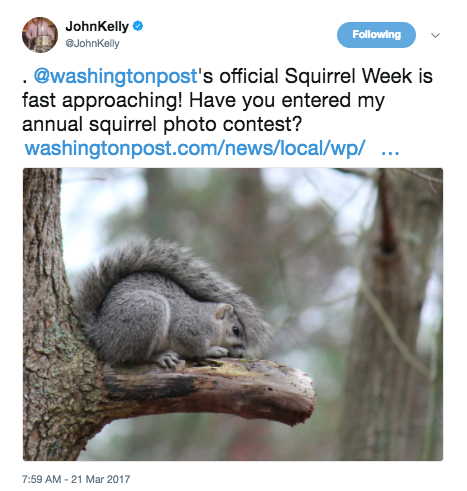
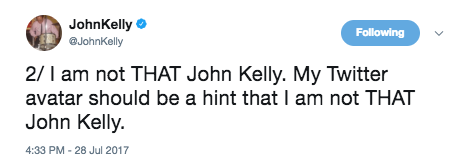
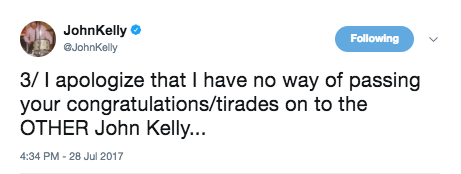
This is also John Kelly, but not that John Kelly. He's a Washington Post columnist who regularly tweets from his @JohnKelly handle.

Via Twitter

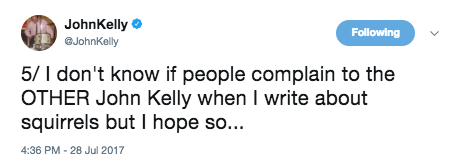
@JohnKelly often tweets about squirrels.

“You’re much more likely to see a squirrel than a shark,” Kelly told BuzzFeed News.
“Every April, I do a week’s worth of columns about squirrels.”

As soon as the news of John Kelly's appointment broke on Friday afternoon, @JohnKelly's Twitter mentions turned into a mess. Let's have a look, shall we?

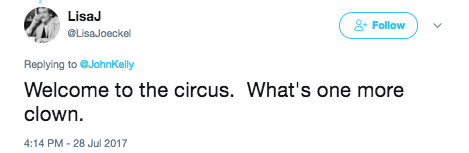
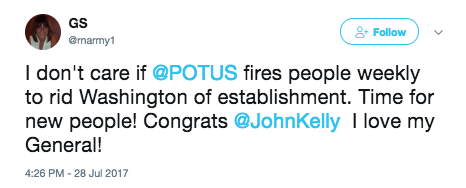
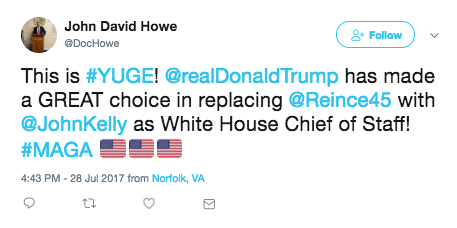
Some people gave him a hard time.

Others congratulated him.

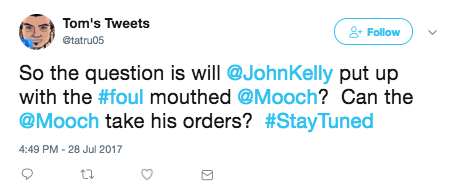
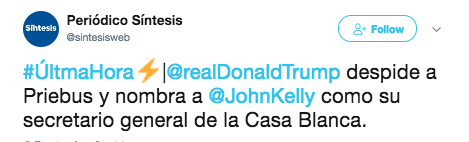
Even some news organizations tagged the wrong John Kelly!

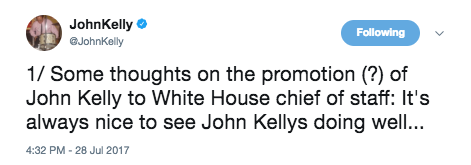
After enduring some of this, @JohnKelly was forced to respond.

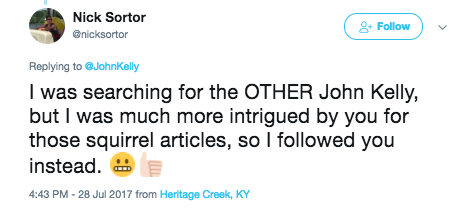
All this newfound attention also won him some new fans.

And some people demanded he serve.

Asked if he would give up the handle if the White House asked for it, @JohnKelly said, “No.”

Okay dude, enjoy your mentions.

giphy.com

Quelle: <a href="This @JohnKelly Is Not New White House Chief Of Staff John Kelly, But His Mentions Are A Wreck“>BuzzFeed

Martin Shkreli's Trial Was Just As Bizarre As You Might Expect

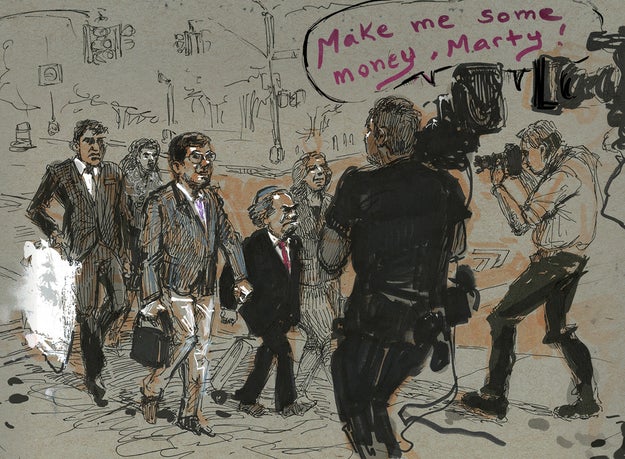
“Make me some money, Marty.”

Martin Shkreli — best known as the “pharma bro” who jacked up the prices of a life-saving antiparasitic medication from $13.50 to $750 — is on trial for securities fraud in federal court in Brooklyn. On Thursday, attorneys presented closing arguments in his trial, which is expected to go to a jury today.

Here's what his day in court looked like.

Martin Shkreli and his defense team walk to court. A guard told me that Shkreli was disappointed that no journalists waited for him when the trial date fell on the long 4th of July weekend. “Make me some money, Marty”, one cameraman joked.

Martin Shkreli and his defense team walk to court. A guard told me that Shkreli was disappointed that no journalists waited for him when the trial date fell on the long 4th of July weekend. "Make me some money, Marty", one cameraman joked.

Molly Crabapple for BuzzFeed News

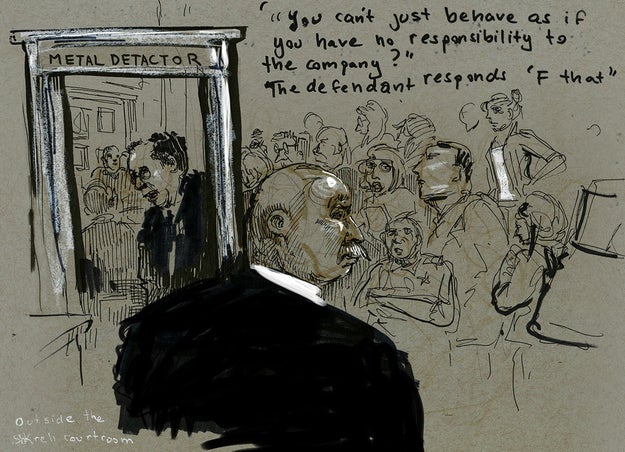
Press waiting outside the courtroom for the Martin Shkreli trial. Because of the trial’s profile, we had to walk through an additional metal detector.

Press waiting outside the courtroom for the Martin Shkreli trial. Because of the trial's profile, we had to walk through an additional metal detector.

Molly Crabapple for BuzzFeed News

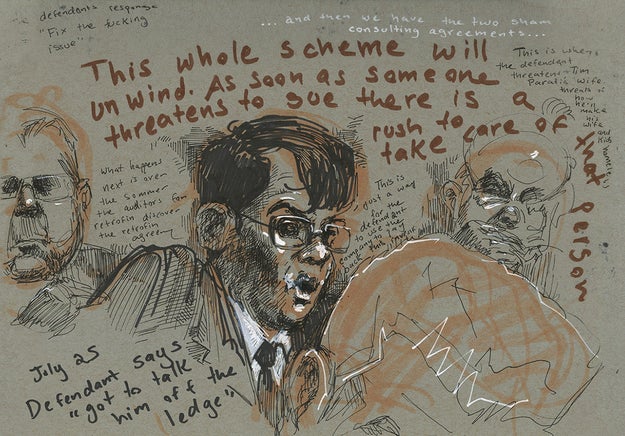
Martin Shkreli and his defense team watch as the prosecution explains how his alleged Ponzi schemes began to unwind.

Martin Shkreli and his defense team watch as the prosecution explains how his alleged Ponzi schemes began to unwind.

Molly Crabapple for BuzzFeed News


View Entire List ›

Quelle: <a href="Martin Shkreli's Trial Was Just As Bizarre As You Might Expect“>BuzzFeed

Inside The Storm At SoundCloud

BuzzFeed News illustration

If you want an example of when SoundCloud’s mission to be a free-for-all music sharing venue collided with its desire to go mainstream, the time it accidentally banned Justin Bieber is a pretty good place to start. In late April 2014, a user named “Sir Bizzle posted a song titled “We We Born For This” on SoundCloud. The sparse acoustic track sounded so much like Justin Bieber that listeners assumed that it was the Canadian pop star. It quickly racked up a few thousand plays, and chatter on social media, before SoundCloud flagged the profile, assuming Sir Bizzle was an imposter with an ill-gotten Biebs jam, and took the song down.

Using SoundCloud’s online complaint form, Sir Bizzle asked that the track be reinstated. The company declined his appeal, noting that the account’s associated address, “123 everywhere street,” was clearly bogus. Sir Bizzle responded with a selfie — of Justin Bieber holding a notepad with a greeting to SoundCloud’s employees.

“OMG OMG OMG I JUST SAVED BIEBER!” wrote one employee on an internal email thread after verifying that it was the artist and restoring the song. The company’s community and artist relations teams jumped into overdrive to placate the world’s biggest popstar. Three days later, Bieber’s label, Island Def Jam Music Group, rehashed the issue, issuing a takedown notice for the tune before retracting the statement after learning that the artist himself had posted the tune.

Former SoundCloud employees familiar with the Sir Bizzle incident point to it as an encapsulation of the company’s promise, missed opportunities and inability to coherently work with an entrenched music industry. Three years after Bieber’s selfie, SoundCloud has squandered its position as a maverick, but beloved audio platform and failed to build a meaningful business.

In a music era dominated by Spotify, SoundCloud has been, at the best of times, a startup in stagnation, and, at the worst of times, an organization in disarray. Once harboring aspirations to be the YouTube of sound, the Berlin-based company has struggled to remain viable, hamstrung by management missteps, an ineffective business strategy and a stubborn music industry that would rather it had never existed.

In early July, SoundCloud laid off 173 people—some 40% of its workforce—shuttering satellite offices in San Francisco and London in an effort to stave off bankruptcy.

According to more than a dozen current and former employees who spoke to BuzzFeed News, SoundCloud’s July layoffs were inevitable, the result of some 24 months of turmoil. Those workers spoke on the condition of anonymity, citing nondisclosure agreements and the fear of damaging personal relationships. In their view, SoundCloud is now a company in search of an identity–and money. One source close to the company, which has struggled to find an acquirer, told BuzzFeed News it is close to securing a new round of funding at more than $100 million. If it does, that person said, Soundcloud’s board may seek to remove company co-founder Alexander Ljung as CEO and make him chairman.

SoundCloud declined to make Ljung available for this story. A company spokesperson also declined to comment.

With a valuation that at one point was expected to surpass $1 billion, SoundCloud was a web property unlike any other. Part audio streaming service, part social network, it offered a hub for creators to upload, share and discuss nearly any kind of sound. It hosted bootleg remixes, spontaneously recorded Drake tracks, and bird songs. It provided a rich library of content for users hungry for audio offerings outside of the mainly standardized catalogues of Spotify, iTunes and Pandora. In February, the company boasted that it had 150 million tracks, about five times the amount on Spotify or Apple Music.

“We really see ourselves as creating something new–something that doesn’t exist,” Ljung told Forbes in a 2013 interview, alluding to similar online services including YouTube for video and Flickr for photos. “Our main competition, if you will, is that it doesn’t exist in the world yet, and we’re trying to create that space.”

SoundCloud’s downfall, according to many former employees, was largely the result of a strategic misstep — a move to compete head-on with the giants of the music streaming world. With the March 2016 launch of SoundCloud Go, a $9.99 per month subscription service, SoundCloud was a late entrant to a ferociously competitive streaming music space and with an offering that offered no differentiation from incumbents like Spotify and Apple Music. It was a blunder, and its mismanaged rollout exacerbated the management and cultural issues that weighed heavily on the company.

“No one comes to SoundCloud to listen to The Beatles’ catalogue,” said one investor. “SoundCloud did exactly what its users didn’t want it to do.”

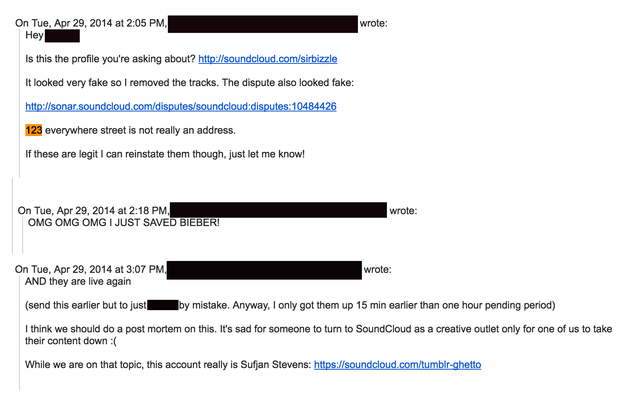
A series of emails shows how SoundCloud employees reacted to Justin Bieber uploading a new song under the name “Sir Bizzle” in April 2014.

Images provided to BuzzFeed from sources

SoundCloud began as pet project for Ljung, a sound engineer, and his Stockholm Royal Institute of Technology classmate Eric Wahlforss. As amateur musicians, they built the tool to share audio snippets with one another at school. Upon realizing there was nothing like it, they bought SoundCloud.com for $400 and moved to Berlin in 2007, sharing the service with other artists and producers they met in the city’s electronic music and techno scene.

When SoundCloud moved out of beta and launched publicly in Oct. 2008, it had 20,000 users and two inexperienced, but enthusiastic founders who did everything to keep the site from crashing. It scooped up $3 million in funding the next year led by Doughty Hanson Technology Ventures, and passed the 1 million registered-user mark in May 2010. Artists flocked to SoundCloud for its ease of use and its cool factor. Listeners followed the artists, spreading the company’s gospel every time they commented on a track or shared one of its wave-form media players on a social network.

SoundCloud never had a problem attracting people—by July 2013 it had 40 million registered users. Its issue was building a business around that traffic. While the company’s original revenue stream centered on selling accounts with more upload space to professional users, driving the majority of its $14.1 million of revenue in 2013, its founders set their sights on monetizing with ads. But SoundCloud, which lost $29.2 million that year, was handcuffed from the start, said multiple employees.

In the early days, the company’s hands-off approach to regulating uploaded content allowed it to gain momentum, but changed when rights holders and music labels began to take notice. More than half of the material posted to SoundCloud at the time was not authorized and cleared by the proper rights holders, according to two former employees. The company took no responsibility for the material uploaded and designated it as user-generated content—though employees were well aware that “gray area” material was frequently posted. Further complicating the matter were posts of remixes, songs with label-owned samples and DJ sets—all staples of the SoundCloud ecosystem—that could have been subject to rights claims or legal issues.

There was such a lack of clarity around material, said multiple employees, that the company’s general counsel advised them to avoid acknowledging that some of the site’s content might be under copyright. SoundClouders were asked not to favorite tracks, a common way of saving music, from their personal profiles, or to put links to audio tracks in company emails. Some workers made fake profiles to freely peruse the site.

But by 2013, relationship building with the entrenched music industry was well underway. The company hired talent from Amazon Music and other companies to negotiate with the three major music labels: Universal Music Group, Sony Music and Warner Music group. The idea was to develop long-term licenses for their content and, until they were in place, stave off any potential legal escalations.

“Deals with the labels would have allowed us to have monetization,” said one former executive, who explained that no ads could be run across label-owned content without a revenue-sharing agreement.“We needed to make sure that we could grow unencumbered without a lawsuit.”

But SoundCloud underestimated the time frame for those deals — severely. Two years would pass before the company had agreements with all three major labels in place, and it was able to ink them only after expending enormous effort making its service palatable to the music executives on the other side of the negotiating table.

In the midst of those talks with the labels, Twitter inquired about an acquisition in the spring of 2014. Having missed on an opportunity to scoop up Instagram, the social network coveted SoundCloud’s user base and saw it as a tool to help a core group of power users–musicians–connect to fans. Former executives remember Twitter Chief Financial Officer Ali Rowghani meeting several times with the company, with some employees hoping for a scenario like Google’s 2006 acquisition YouTube, in which a larger company scooped up a startup and bankrolled it in spite of the legal risk.

On the morning of May 19, Ljung called a handful of SoundCloud executives to say that papers of intent would be signed that day. But the deal collapsed.

With SoundCloud holding out for just under $2 billion, Twitter balked, sources said, put off by the heady price tag, music industry headaches and the discrepancy between Soundcloud's monthly visitors and its registered users. (Many people listened to SoundCloud’s content, but never registered with the site.)

“Alex and Eric were devastated,” said one person familiar with the negotiations.

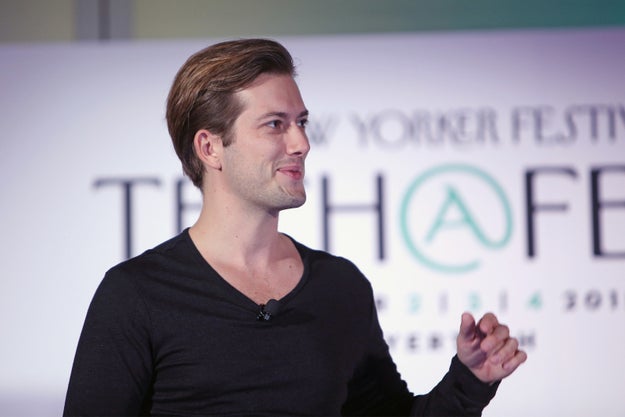
SoundCloud CEO Alexander Ljung

Anna Webber / Getty Images

By the time acquisition talks with Twitter collapsed, Ljung and Wahlforss had been leading SoundCloud for seven years. The company employed more than 220 people, many of whom the founders had personally interviewed to cultivate a built-for-artists-by-artists culture.

Among them was Jeff Toig, a former VP at mobile provider Cricket Wireless and founder of on-demand digital music service Muve. Ljung tapped Toig as SoundCloud's chief business officer, hoping his music industry experience would come in handy hammering out licensing deals with the major labels. He gave the Harvard Business School grad reign over advertising sales, marketing and business development.

By all accounts, it was a terrible move. Toig very quickly became a controversial figure at SoundCloud, known for publicly berating some of his reports and playing favorites with others. “He would carry a football around the office under his arm like a prop and he threw it to you to indicate that you were in the gang,” said one former SoundCloud employee. “He never threw it to women.”

Several SoundCloud employees who spoke with BuzzFeed News characterized Toig as “a bully” who “created fear” at an organization once known for its flat reporting structure and the approachability of its executives. Three workers noted that he sometimes addressed women in the office by pet names like “sweetie.” Others recalled Toig shouting at an employee during a video presentation for not using his preferred Powerpoint style: Size 10 Arial font with a black background.

“To be a good CEO, you have to hire people that are better than you at certain things, and Alex was trying to do that,” one former SoundCloud employee told BuzzFeed News. “But Jeff wasn’t that guy… many felt like he was poisoning the well.”

Indeed, some reported Toig's behavior to SoundCloud's upper management or filed complaints to its human resources department. One reported incident occurred during an Aug. 2014 photoshoot with a major news outlet, during which Toig was asked to suck in his stomach and puff out his chest. “You mean stick my tits out like the women on Madison Avenue?” he replied, according to multiple people in the room.

Toig declined comment for this story. Soundcloud declined comment on his tenure at the company.

Based in Berlin, Ljung and Wahlforss had an ocean between them and the goings on in their stateside offices, whose operation they’d entrusted to Toig. The chief business officer was also tasked with closing three major label deals ahead of the scheduled Aug. 2014 launch of SoundCloud’s advertiser program.

Ex-employees recall Ljung sometimes skipping important business meetings because he thought Toig could handle them. By that time, the SoundCloud co-founder had scooped up several entrepreneurial awards and adopted a more extravagant lifestyle. He attended the Grammys; he went deep-sea diving with sharks in the Bahamas; he partied with DJ Steve Aoki in Ibiza. And he Instagrammed all of it, irking employees worried that he’d disengaged from the company. One former employee who left in the summer of 2016 remembered a photo of Ljung taking a private jet. “People were like, that should be going to my salary,” they said. Investors were similarly put off. “He let it get to his head and he lost his focus,” said one.

By Aug. 2014, it was abundantly clear that the SoundCloud’s’s advertising program, which would allow artists and labels to collect royalties, would not launch as planned. Despite Toig’s promises, not a single major label had agreed to a deal. The project launched with a eleventh hour pivot to focus on independent creators, with Toig later apologizing at an all-hands meeting for failing to sign the majors. (By March 2015, Toig was out of the gig; he was later tapped as CEO of Tidal Music, where he lasted for nine months.) Ljung assured everyone in attendance that the label arrangements would eventually get done. A few days later, he flew to California and went off the grid. It was time for Burning Man.

“You mean stick my tits out like the women on Madison Avenue?”

Quelle: <a href="Inside The Storm At SoundCloud“>BuzzFeed

Inside The Storm At SoundCloud

BuzzFeed News illustration

If you want an example of when SoundCloud’s mission to be a free-for-all music sharing venue collided with its desire to go mainstream, the time it accidentally banned Justin Bieber is a pretty good place to start. In late April 2014, a user named “Sir Bizzle posted a song titled “We We Born For This” on SoundCloud. The sparse acoustic track sounded so much like Justin Bieber that listeners assumed that it was the Canadian pop star. It quickly racked up a few thousand plays, and chatter on social media, before SoundCloud flagged the profile, assuming Sir Bizzle was an imposter with an ill-gotten Biebs jam, and took the song down.

Using SoundCloud’s online complaint form, Sir Bizzle asked that the track be reinstated. The company declined his appeal, noting that the account’s associated address, “123 everywhere street,” was clearly bogus. Sir Bizzle responded with a selfie — of Justin Bieber holding a notepad with a greeting to SoundCloud’s employees.

“OMG OMG OMG I JUST SAVED BIEBER!” wrote one employee on an internal email thread after verifying that it was the artist and restoring the song. The company’s community and artist relations teams jumped into overdrive to placate the world’s biggest popstar. Three days later, Bieber’s label, Island Def Jam Music Group, rehashed the issue, issuing a takedown notice for the tune before retracting the statement after learning that the artist himself had posted the tune.

Former SoundCloud employees familiar with the Sir Bizzle incident point to it as an encapsulation of the company’s promise, missed opportunities and inability to coherently work with an entrenched music industry. Three years after Bieber’s selfie, SoundCloud has squandered its position as a maverick, but beloved audio platform and failed to build a meaningful business.

In a music era dominated by Spotify, SoundCloud has been, at the best of times, a startup in stagnation, and, at the worst of times, an organization in disarray. Once harboring aspirations to be the YouTube of sound, the Berlin-based company has struggled to remain viable, hamstrung by management missteps, an ineffective business strategy and a stubborn music industry that would rather it had never existed.

In early July, SoundCloud laid off 173 people—some 40% of its workforce—shuttering satellite offices in San Francisco and London in an effort to stave off bankruptcy.

According to more than a dozen current and former employees who spoke to BuzzFeed News, SoundCloud’s July layoffs were inevitable, the result of some 24 months of turmoil. Those workers spoke on the condition of anonymity, citing nondisclosure agreements and the fear of damaging personal relationships. In their view, SoundCloud is now a company in search of an identity–and money. One source close to the company, which has struggled to find an acquirer, told BuzzFeed News it is close to securing a new round of funding at more than $100 million. If it does, that person said, Soundcloud’s board may seek to remove company co-founder Alexander Ljung as CEO and make him chairman.

SoundCloud declined to make Ljung available for this story. A company spokesperson also declined to comment.

With a valuation that at one point was expected to surpass $1 billion, SoundCloud was a web property unlike any other. Part audio streaming service, part social network, it offered a hub for creators to upload, share and discuss nearly any kind of sound. It hosted bootleg remixes, spontaneously recorded Drake tracks, and bird songs. It provided a rich library of content for users hungry for audio offerings outside of the mainly standardized catalogues of Spotify, iTunes and Pandora. In February, the company boasted that it had 150 million tracks, about five times the amount on Spotify or Apple Music.

“We really see ourselves as creating something new–something that doesn’t exist,” Ljung told Forbes in a 2013 interview, alluding to similar online services including YouTube for video and Flickr for photos. “Our main competition, if you will, is that it doesn’t exist in the world yet, and we’re trying to create that space.”

SoundCloud’s downfall, according to many former employees, was largely the result of a strategic misstep — a move to compete head-on with the giants of the music streaming world. With the March 2016 launch of SoundCloud Go, a $9.99 per month subscription service, SoundCloud was a late entrant to a ferociously competitive streaming music space and with an offering that offered no differentiation from incumbents like Spotify and Apple Music. It was a blunder, and its mismanaged rollout exacerbated the management and cultural issues that weighed heavily on the company.

“No one comes to SoundCloud to listen to The Beatles’ catalogue,” said one investor. “SoundCloud did exactly what its users didn’t want it to do.”

A series of emails shows how SoundCloud employees reacted to Justin Bieber uploading a new song under the name “Sir Bizzle” in April 2014.

Images provided to BuzzFeed from sources

SoundCloud began as pet project for Ljung, a sound engineer, and his Stockholm Royal Institute of Technology classmate Eric Wahlforss. As amateur musicians, they built the tool to share audio snippets with one another at school. Upon realizing there was nothing like it, they bought SoundCloud.com for $400 and moved to Berlin in 2007, sharing the service with other artists and producers they met in the city’s electronic music and techno scene.

When SoundCloud moved out of beta and launched publicly in Oct. 2008, it had 20,000 users and two inexperienced, but enthusiastic founders who did everything to keep the site from crashing. It scooped up $3 million in funding the next year led by Doughty Hanson Technology Ventures, and passed the 1 million registered-user mark in May 2010. Artists flocked to SoundCloud for its ease of use and its cool factor. Listeners followed the artists, spreading the company’s gospel every time they commented on a track or shared one of its wave-form media players on a social network.

SoundCloud never had a problem attracting people—by July 2013 it had 40 million registered users. Its issue was building a business around that traffic. While the company’s original revenue stream centered on selling accounts with more upload space to professional users, driving the majority of its $14.1 million of revenue in 2013, its founders set their sights on monetizing with ads. But SoundCloud, which lost $29.2 million that year, was handcuffed from the start, said multiple employees.

In the early days, the company’s hands-off approach to regulating uploaded content allowed it to gain momentum, but changed when rights holders and music labels began to take notice. More than half of the material posted to SoundCloud at the time was not authorized and cleared by the proper rights holders, according to two former employees. The company took no responsibility for the material uploaded and designated it as user-generated content—though employees were well aware that “gray area” material was frequently posted. Further complicating the matter were posts of remixes, songs with label-owned samples and DJ sets—all staples of the SoundCloud ecosystem—that could have been subject to rights claims or legal issues.

There was such a lack of clarity around material, said multiple employees, that the company’s general counsel advised them to avoid acknowledging that some of the site’s content might be under copyright. SoundClouders were asked not to favorite tracks, a common way of saving music, from their personal profiles, or to put links to audio tracks in company emails. Some workers made fake profiles to freely peruse the site.

But by 2013, relationship building with the entrenched music industry was well underway. The company hired talent from Amazon Music and other companies to negotiate with the three major music labels: Universal Music Group, Sony Music and Warner Music group. The idea was to develop long-term licenses for their content and, until they were in place, stave off any potential legal escalations.

“Deals with the labels would have allowed us to have monetization,” said one former executive, who explained that no ads could be run across label-owned content without a revenue-sharing agreement.“We needed to make sure that we could grow unencumbered without a lawsuit.”

But SoundCloud underestimated the time frame for those deals — severely. Two years would pass before the company had agreements with all three major labels in place, and it was able to ink them only after expending enormous effort making its service palatable to the music executives on the other side of the negotiating table.

In the midst of those talks with the labels, Twitter inquired about an acquisition in the spring of 2014. Having missed on an opportunity to scoop up Instagram, the social network coveted SoundCloud’s user base and saw it as a tool to help a core group of power users–musicians–connect to fans. Former executives remember Twitter Chief Financial Officer Ali Rowghani meeting several times with the company, with some employees hoping for a scenario like Google’s 2006 acquisition YouTube, in which a larger company scooped up a startup and bankrolled it in spite of the legal risk.

On the morning of May 19, Ljung called a handful of SoundCloud executives to say that papers of intent would be signed that day. But the deal collapsed.

With SoundCloud holding out for just under $2 billion, Twitter balked, sources said, put off by the heady price tag, music industry headaches and the discrepancy between Soundcloud's monthly visitors and its registered users. (Many people listened to SoundCloud’s content, but never registered with the site.)

“Alex and Eric were devastated,” said one person familiar with the negotiations.

SoundCloud CEO Alexander Ljung

Anna Webber / Getty Images

By the time acquisition talks with Twitter collapsed, Ljung and Wahlforss had been leading SoundCloud for seven years. The company employed more than 220 people, many of whom the founders had personally interviewed to cultivate a built-for-artists-by-artists culture.

Among them was Jeff Toig, a former VP at mobile provider Cricket Wireless and founder of on-demand digital music service Muve. Ljung tapped Toig as SoundCloud's chief business officer, hoping his music industry experience would come in handy hammering out licensing deals with the major labels. He gave the Harvard Business School grad reign over advertising sales, marketing and business development.

By all accounts, it was a terrible move. Toig very quickly became a controversial figure at SoundCloud, known for publicly berating some of his reports and playing favorites with others. “He would carry a football around the office under his arm like a prop and he threw it to you to indicate that you were in the gang,” said one former SoundCloud employee. “He never threw it to women.”

Several SoundCloud employees who spoke with BuzzFeed News characterized Toig as “a bully” who “created fear” at an organization once known for its flat reporting structure and the approachability of its executives. Three workers noted that he sometimes addressed women in the office by pet names like “sweetie.” Others recalled Toig shouting at an employee during a video presentation for not using his preferred Powerpoint style: Size 10 Arial font with a black background.

“To be a good CEO, you have to hire people that are better than you at certain things, and Alex was trying to do that,” one former SoundCloud employee told BuzzFeed News. “But Jeff wasn’t that guy… many felt like he was poisoning the well.”

Indeed, some reported Toig's behavior to SoundCloud's upper management or filed complaints to its human resources department. One reported incident occurred during an Aug. 2014 photoshoot with a major news outlet, during which Toig was asked to suck in his stomach and puff out his chest. “You mean stick my tits out like the women on Madison Avenue?” he replied, according to multiple people in the room.

Toig declined comment for this story. Soundcloud declined comment on his tenure at the company.

Based in Berlin, Ljung and Wahlforss had an ocean between them and the goings on in their stateside offices, whose operation they’d entrusted to Toig. The chief business officer was also tasked with closing three major label deals ahead of the scheduled Aug. 2014 launch of SoundCloud’s advertiser program.

Ex-employees recall Ljung sometimes skipping important business meetings because he thought Toig could handle them. By that time, the SoundCloud co-founder had scooped up several entrepreneurial awards and adopted a more extravagant lifestyle. He attended the Grammys; he went deep-sea diving with sharks in the Bahamas; he partied with DJ Steve Aoki in Ibiza. And he Instagrammed all of it, irking employees worried that he’d disengaged from the company. One former employee who left in the summer of 2016 remembered a photo of Ljung taking a private jet. “People were like, that should be going to my salary,” they said. Investors were similarly put off. “He let it get to his head and he lost his focus,” said one.

By Aug. 2014, it was abundantly clear that the SoundCloud’s’s advertising program, which would allow artists and labels to collect royalties, would not launch as planned. Despite Toig’s promises, not a single major label had agreed to a deal. The project launched with a eleventh hour pivot to focus on independent creators, with Toig later apologizing at an all-hands meeting for failing to sign the majors. (By March 2015, Toig was out of the gig; he was later tapped as CEO of Tidal Music, where he lasted for nine months.) Ljung assured everyone in attendance that the label arrangements would eventually get done. A few days later, he flew to California and went off the grid. It was time for Burning Man.

“You mean stick my tits out like the women on Madison Avenue?”

Quelle: <a href="Inside The Storm At SoundCloud“>BuzzFeed