US Cyber Command Is Now One Step Closer To Spinning Off From The NSA

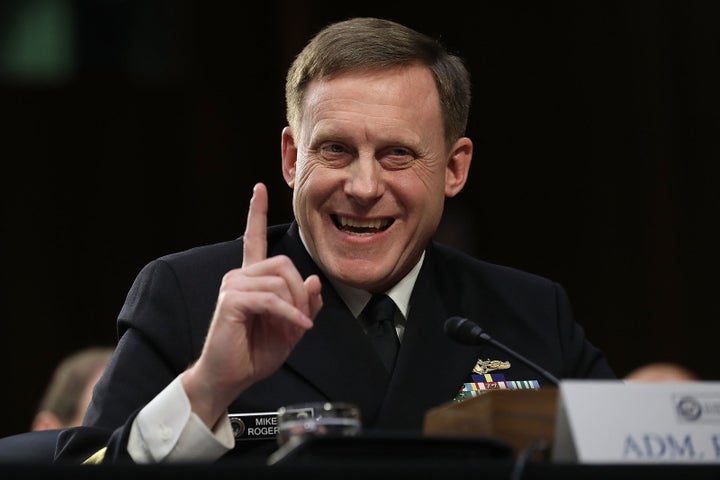
NSA commander Gen. Mike Rogers

Chip Somodevilla / Getty Images

The United States’s cyberwar nerve center inside the military has gotten a promotion.

President Donald Trump announced via Twitter on Friday that US Cyber Command, the Department of Defense’s centralized hub for conducting offensive cyberattacks and protecting its networks against them, will be elevated to the level of a Unified Combatant Command.

The move, anticipated for several years now, gives USCYBERCOM more independent agency. But it’s perhaps most significant as a major step toward it eventually spinning off from the National Security Agency (NSA), whose primary mission is gathering overseas intelligence, into its own independent command.

Since it was first established in 2009, USCYBERCOM has always been helmed by whoever is director of the NSA at the time — a “dual hat” responsibility that critics of the setup, including many Pentagon leaders and former President Barack Obama have said is overwhelming for one person.

President Obama had recommended the reclassification as the end of his term neared, but it was unclear if Trump would continue down that path. As a presidential candidate, Trump often spoke of cybersecurity and war in controversial and confusing terms. On the campaign trail in October, Trump said of cyber capabilities that “America’s dominance in this arena must be unquestioned. And today it’s totally questioned.” The US, alongside allies like the UK, Australia, Israel, and France, are widely regarded as the most powerful nations in the world when it comes to cyber capabilities.

Critics of the idea of separation, however, note that in cyberspace, intelligence gathering sources often overlap with military targets, and fear that operations could conflict with one another. General Keith Alexander, the previous “dual hat” director before current General Mike Rogers, had also argued that if the were agencies distinct, the NSA could withhold key information that could be vital to USCYBERCOM.

It’s unclear when any full separation would take place. According to the White House’s announcement, Secretary of Defense James Mattis is reviewing the idea of separation, and will announce recommendations “at a later date.”

Quelle: <a href="US Cyber Command Is Now One Step Closer To Spinning Off From The NSA“>BuzzFeed

Facebook's Challenge Of A Gag Order Over Search Warrants Will Get A Public Hearing

Thomas White / Reuters

An appeals court in Washington, DC, has scheduled a public hearing next month for arguments on Facebook’s challenge to an order blocking the company from alerting users about search warrants for account information.

The gag order is sealed, as is most information about the case. The issue came to light earlier this summer, after the District of Columbia Court of Appeals issued an order with limited details seeking input from outside groups on the dispute. Tech companies, civil liberties groups, and consumer advocacy organizations filed public briefs in June supporting Facebook’s challenge and arguing that users should have a right to challenge search warrants for their information.

In an Aug. 14 order obtained by BuzzFeed News, the court alerted lawyers that it had scheduled arguments for Sept 14. The court said the hearing would be public, and that it planned to live-stream video of arguments through the court’s website because the case “raises an issue of public interest.”

With much of the case still under seal, the court reminded lawyers to be careful about avoiding any mention of confidential or privileged information. The court also denied a request by the Electronic Frontier Foundation, one of the groups that filed a brief, to participate.

Federal prosecutors served search warrants on Facebook for three account records over a three-month period, seeking “all contents of communications, identifying information, and other records,” according to the public notice the court allowed Facebook to send out to interested groups.

A lower court judge signed off on a nondisclosure order that barred Facebook from notifying account users before complying with the warrants, which Facebook is challenging on First Amendment grounds.

The Electronic Frontier Foundation suggested in its earlier brief that, based on what little information is publicly known about the search warrants and their timing, the case likely relates to the mass arrests in Washington during President Trump's inauguration. More than 200 people were charged with rioting and property destruction, and the bulk of those cases are pending, with trials set for the fall and throughout 2018.

“Reading the tea leaves of an appellate panel is often futile but we hope the court will quickly dispose of the Trump Administration's absurd argument that its pursuit of the January 20 protesters is secret in any sense. The fact that the argument will be public encourages us that the court is going to take the First Amendment seriously,” Nate Cardozo, a lawyer with the Electronic Frontier Foundation, said in an email to BuzzFeed News on Friday.

The briefs filed by Facebook and the US attorney’s office in Washington are sealed, and lawyers in the case have previously declined to comment on whether the search warrants relate to the Jan. 20 arrests.

Quelle: <a href="Facebook's Challenge Of A Gag Order Over Search Warrants Will Get A Public Hearing“>BuzzFeed

Finally: A Good-Looking Android Phone Without The Bloatware

This Android phone is made by Essential, a company you’ve probably never heard of. And it looks really, really nice.

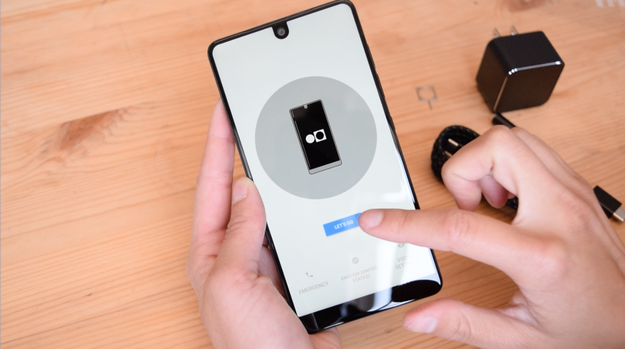
This is the Essential Phone, a new logo-less Android device. It’s the first phone made by Essential, a company you’ve probably never heard of.

This is the Essential Phone, a new logo-less Android device. It's the first phone made by Essential, a company you've probably never heard of.

There are tens of thousands of Android devices currently on the market. Samsung and Huawei are currently the top Android phone makers (with a combined 29.6% of the total smartphone market share worldwide), and China's Oppo and India's Vivo not far behind.

And yet, Essential, a small hardware company out of Palo Alto, CA, thinks that the world needs another Android phone.

Nicole Nguyen / BuzzFeed News

That, on top of the fact that Essential is a beautiful, high-end phone.

That, on top of the fact that Essential is a beautiful, high-end phone.

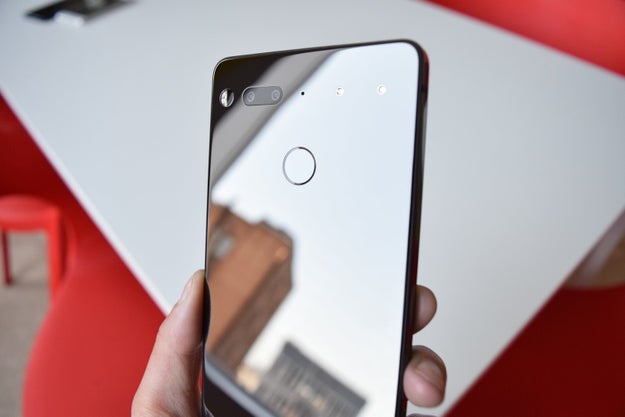
The first thing you'll notice is that it's stunning. The phone is made of titanium (which, apparently, is stronger than the aluminum in the Pixel and iPhone) and as well ceramic. Most notably, it doesn't have a camera bump. It lies completely flat, which reduces any scratch risk for the camera's lens.

And I love that it's logo-less. In fact, that was a design point for Rubin: “On the phone, there’s no branding. It’s not a NASCAR. It doesn’t have a carrier brand. It doesn’t have our brand. Doesn’t have the retail channels' brand. Customers spend their hard-earned money on this. We want it to become their product.”

The black version has a mirrored back that's incredibly shiny and smooth. It also attracts a lot of fingerprints. Speaking of, there's a fingerprint sensor in the back to unlock your phone.

It doesn't feel like it'll slip out of your hand, though. There are matte edges around the display that provide just the right amount of friction (and help cellular signals go through the chassis).

Nicole Nguyen / BuzzFeed News


View Entire List ›

Quelle: <a href="Finally: A Good-Looking Android Phone Without The Bloatware“>BuzzFeed

Former Uber CEO Travis Kalanick Fires Back At Investors In Fraud Lawsuit

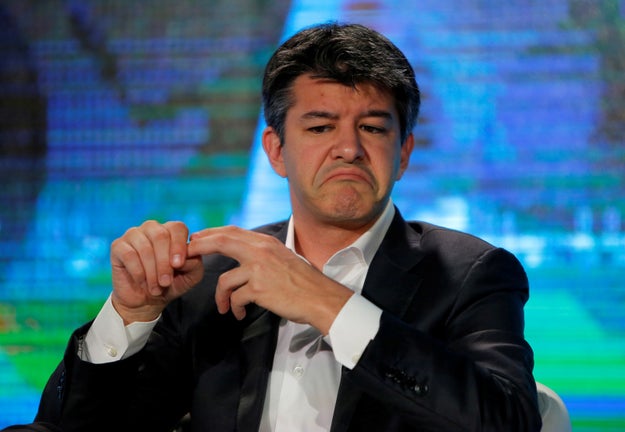
Uber CEO Travis Kalanick attends the summer World Economic Forum in Tianjin, China, June 26, 2016. REUTERS/Shu Zhang

Staff / Reuters

Uber co-founder and former chief executive Travis Kalanick submitted court filings on Thursday that maintain his innocence after being accused of fraud in an unprecedented investor lawsuit.

In responding to the suit brought by Benchmark, a San Francisco-based venture capital firm and one of Uber’s largest shareholders, Kalanick’s legal team said that the Delaware Chancery Court “lacks subject matter jurisdiction” in the case, arguing that “Benchmark's claims are subject to mandatory arbitration.”

Kalanick, who resigned as CEO of the ride-hailing company in June after a series of sexual harassment scandals and reports of executive misbehavior, still sits on its board. Benchmark, which filed its lawsuit last week, also controls a board seat.

“Benchmark Capital Partners initiated this action as part of its public and personal attack on Travis Kalanick, the founder of Uber,” the filing says. “[Benchmark] executed its plan at the most shameful of times: immediately after Kalanick experienced a horrible personal tragedy.”

The legal battle playing out in Uber’s board room, is just the latest sign of dysfunction at the $69 billion company, which has been plagued by a crisis of leadership, complaints about its grinding work culture, and several other high-profile lawsuits. In its suit, Benchmark accused Kalanick of fraud and breach of fiduciary duty for not informing the board of problems at Uber and developing a board power structure that would maintain his influence in case he was removed as CEO. Benchmark also said that Kalanick is interfering in the company’s search for a new chief executive.

A spokesperson for Benchmark declined to comment on Kalanick’s response and referred BuzzFeed News to an earlier statement.

“Resorting to litigation was an extremely difficult step for Benchmark,” read the statement. “Failing to act now would mean endorsing behavior that is utterly unacceptable in any company, let alone a company of Uber's size and importance.”

In its lawsuit, Benchmark alleges that Kalanick deliberately concealed “gross mismanagement and other misconduct” in June 2016 during a crucial vote to expand the number of seats on the board. Those practices included the illegal obtainment of the medical records of a rape victim who was attacked by her driver in India as well as the acquisition of self-driving car startup Otto — which had allegedly stolen intellectual property from Waymo, a subsidiary of Google parent company Alphabet. The rape victim and Waymo are now both suing Uber in separate lawsuits.

As a result of the 2016 vote, Kalanick now has control over who is appointed to three Uber board seats. Benchmark is attempting to have a court reverse that 2016 decision to empower Uber’s former CEO to have control in appointing those positions.

On Thursday, Kalanick’s legal team said that prior to his resignation, Kalanick received “a letter, purportedly on behalf of Benchmark and others, which stated that they were “deeply grateful for your vision and tireless efforts over the last eight years,” but which demanded that Kalanick “immediately and permanently resign as CEO.” At this time, Benchmark was fully aware of all of the allegations involving Kalanick set forth in its Complaint — relating to the Waymo lawsuit, the India investigation, and the “Greyball” investigation — yet it made no mention of having been “fraudulently induced” to enter into the 2016 Voting Agreement.”

The battle between Kalanick and Benchmark has also ensnared other Uber backers. Shervin Pishevar, an early Uber investor and former board observer, penned a letter to Benchmark last Friday asking the company to drop its lawsuit, step off the board and divest from the company for introducing litigation that was “value-destructive.” Pishevar, who’s named himself the coordinator of the Uber Shareholder Alliance, also said in his letter that his group had lined up investors willing to acquire 75% of Benchmark’s current position, which is worth $9 billion at Uber’s most recent $69 billion valuation.

Pishevar doubled down on his words earlier this week and sent a second letter, making accusations at another large Uber shareholder, Lowercase Capital, for working with Benchmark to allegedly undermine the company.

For its part, the rest of Uber’s board has stayed out of the fray. Last Friday, the six other board members, which did not include Kalanick or Benchmark partner Matt Cohler, said they were “disappointed that a disagreement between shareholders has resulted in litigation.”

“The Board has urged both parties to resolve the matter cooperatively and quickly, and the Board is taking steps to facilitate that process,” read the statement. “At a time when thousands of employees around the world are working hard to serve our drivers and riders and continue to innovate, our priority remains to select Uber's new CEO as expeditiously as possible.”

Beyond its CEO search, the company is also wrangling with a several options to allow existing shareholders to sell their shares to outside investors, including Japanese conglomerate SoftBank and Dragoneer investment group. Those discussions are still on-going.

Here's the filing.

Quelle: <a href="Former Uber CEO Travis Kalanick Fires Back At Investors In Fraud Lawsuit“>BuzzFeed

Twitter's “We Don’t Comment On Individual Accounts” Policy Is Failing The Public

This past weekend, when Unite the Right organizers used Twitter to rally supporters following the removal of their Facebook event, Twitter let the tweet — which advertised the time and location of a white supremacist rally near which one person would later be killed and dozens more injured — remain. And nobody knows exactly why, thanks to Twitter’s policy of not commenting on individual accounts for “privacy and security reasons.”

Since the turn of the decade, Twitter has effectively used this policy to shield itself from accountability; now, it’s denying the public and the press crucial information about how one of the world’s most visible platforms — not to mention the president’s go-to communication mechanism — makes decisions about what’s acceptable and what’s not. Even some present at the policy’s creation say it should no longer be used as a means to dodge questions about Twitter’s motivations.

The “individual accounts” policy, initially created when political action was simply a blip on Twitter's radar, has long made rule enforcement surrounding online abuse and harassment — which have dogged the social network for a decade — appear arbitrary and unclear. The policy has been invoked in lieu of serious, detailed explanations when Twitter has taken action against harassers, banned and then reinstated the white nationalist Richard Spencer, and kept up dozens of threatening and harassing images and tweets even after users filed reports.

And following the election of Donald Trump, who consistently uses the platform to threaten opponents and push his viewpoints, it has taken on even greater importance. The president has appeared to violate Twitter’s rules by unleashing mobs on opponents, or threatening violence. But you would never know how Twitter feels about it, because the president possesses an “individual account” himself.

Back in December 2016, after Trump used his Twitter account to criticize Chuck Jones, an Indiana union organizer who criticized the president, the Washington Post reported that Jones was inundated with threatening phone calls. The Jones incident was tricky and unprecedented territory for Twitter: The president had tweeted something that some thought was a clear violation of Twitter's abuse incitement policy (the New York Times dubbed him the “Cyberbully in Chief.”) And Twitter refused to comment on it.

Twitter owes its users an explanation when it comes to the leader of the free world. For example, in the case of Chuck Jones, was Trump’s tweet just barely within the realm of acceptable behavior, or was the service making an exception for the then-president-elect? The same goes for Trump’s tweet this summer that Morning Joe host Mika Brzezinski was “bleeding badly from a face-lift.” Was the tweet within the bounds of Twitter’s rules on targeted abuse? Or was it an exception? We won’t know for sure, as Twitter’s response to both incidents was that it does not comment on individual accounts.

As a defense, Twitter and other tech companies suggest that by revealing nothing, they make it harder for trolls to exploit the terms of service. But in practice, the policies make it difficult for journalists or anyone else to hold Twitter accountable for its seemingly inconsistent enforcement decisions. And there’s reason to believe the policy may actually be working in the favor of bad actors who exploit it — an effective trolling tactic is to use Twitter’s harassment reporting infrastructure and tools against those who are fighting or being trolled.

The policy originated in Twitter’s early days, when it didn’t have the bandwidth to deal with the onslaught of inquiries that could show up during major news events, nor a point of view on how to handle those inquiries, according to one former executive who was at the company when the policy was formed. But Twitter has grown significantly in the years since, and branded itself as a news app — its move to the news section of the iOS App Store was an indication of how it sees itself. But while the company has evolved, its policy has not.

“It definitely seems from the outside that the company is relying on a playbook that was established all those years ago,” the former Twitter executive told BuzzFeed News. “If you declare yourself the most relevant speech platform in the world, then you can’t stonewall the media when people want to know your speech rules.”

Another former Twitter executive told BuzzFeed News the policy mirrors other tech company policies. PayPal, for example, declined to comment on individual accounts recently after banning a number of alt-right personalities from its platform. The executive also said that if Twitter started commenting on individual accounts, it would be overwhelmed with the amount of statements it would be required to draft.

There are also valid privacy reasons — especially pertaining to regular citizens — for not sharing sensitive information with the press and greater public, and Twitter is quick to note them. “Twitter takes user privacy and security very seriously and our users count on us to defend and respect their voice. That's why we do not comment publicly on individual accounts, and instead only communicate with the user directly affected by any content, privacy, or security issues,” a Twitter spokesperson told BuzzFeed News.

But there is a middle ground: Twitter could easily explain big decisions — such as when the president threatens war in a tweet, or when white nationalists organize on its platform — but decline to comment on less consequential decisions.

Facebook is often no better. It regularly hides behind terms like “glitch” and “error” when it removes important content from its site, giving little insight into the process that got it removed in the first place. Still, in a conversation with BuzzFeed News earlier this year, Facebook CEO Mark Zuckerberg acknowledged that his company needed to be more transparent and had room to grow with its approach to handling content. “There's a lot of things that we need to get better on [about] this,” he said.

Twitter has also publicly expressed a desire to be more transparent. At the end of 2016, CEO Jack Dorsey tweeted, “we definitely need to be more transparent about why and how. Big priority for this year” and added that “working to better explain and be transparent and real-time about our methods.” But Twitter hasn’t really been more transparent in 2017. In July, the company touted its progress on combating harassment and released some internal figures on abuse prevention — but the stats offered little context or basis for comparison. And in July when BuzzFeed News presented the company with 27 explicit examples of harassment, Twitter did not respond, instead providing a boilerplate statement.

Quelle: <a href="Twitter's “We Don’t Comment On Individual Accounts” Policy Is Failing The Public“>BuzzFeed

Russia Orders Internet Providers Not To Host The Daily Stormer

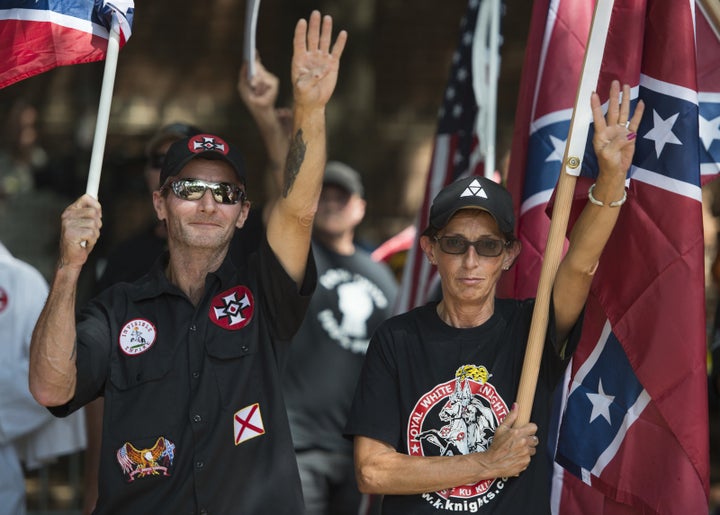
Members of the Ku Klux Klan gesture during a rally in Charlottesville, Virginia on July 8, 2017

Andrew Caballero-reynolds / AFP / Getty Images

Shut down by US tech companies, the internet’s biggest neo-Nazi website has been denied sanctuary by Russia, too.

Daily Stormer had on Wednesday attempted to rebrand itself as dailystormer.ru after several American web hosting services, including GoDaddy.com and CloudFlare, pulled their support. The site had acted as a hub for a white supremacists and neo-Nazis who rallied last weekend in Charlottesville, Virginia, where a driver killed anti-racist protester Heather Heyer. After her death, the Daily Stormer site began posting offensive content about Heyer, prompting widespread outrage.

But while individual American companies made the decision to refuse to host Daily Stormer, in Russia, where government censorship is far more restrictive, it was a legal matter. Russian law specifically prohibits, among other things, online content that glorifies Naziism.

Alexander Zharov, the head of Russia’s Roskomnadzor, the country’s federal communications regulator, wrote in a statement that it was within his agency’s authority to instruct Russian domain registrars to refuse to host the site.

“The Daily Stormer website promotes neo-Nazi ideology, raises racial, national and other types of social discord,” Zharov wrote. “Russian legislation has an extremely tough regime to counter any manifestations of extremism on the Internet.”

It's not clear how quickly the Russian state made its decision, but the site was already inaccessible by early afternoon Wednesday, when attempts to reach it were met with a “DNS address not found.”

It’s unclear where the Daily Stormer will try to land next. The site is down, and its Twitter account, which normally would be used to point followers to its next iteration, has been suspended for violating Twitter’s terms of service.

Quelle: <a href="Russia Orders Internet Providers Not To Host The Daily Stormer“>BuzzFeed

Read Apple CEO Tim Cook's Email To Employees About Charlottesville

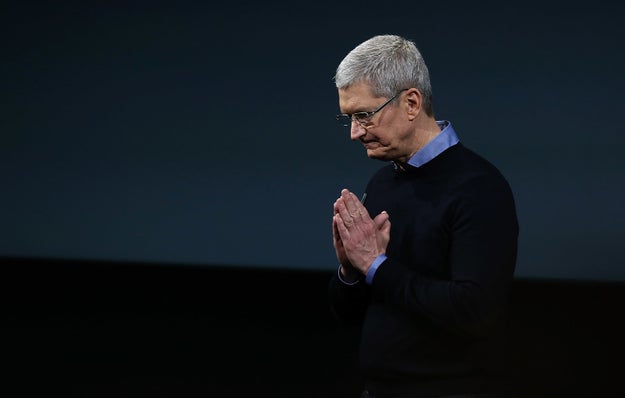
Justin Sullivan / Getty Images

On Wednesday evening Apple CEO Tim Cook sent an email to all global employees condemning racism and bigotry as well as President Trump's response to the tragedy in Charlottesville, according to an email obtained by BuzzFeed News.

“Hate is a cancer,” Cook wrote to employees, noting that Apple must be “unequivocal” about fighting and denouncing bigotry in all forms.

Cook called for unity among Apple employees regardless of political views and affirmed the company's commitment to inclusion. Most notably, Cook came out strongly against Trump's press conference remarks on Tuesday afternoon.

“I disagree with the president and others who believe that there is a moral equivalence between white supremacists and Nazis, and those who oppose them by standing up for human rights. Equating the two runs counter to our ideals as Americans,” he wrote.

According to Cook's memo, Apple will be making two separate $1 million donations to both the Souther Poverty Law Center and the Anti-Defamation League. The company will also match employee donations to these and other groups two-for-one until September 30th. Cook also said that Apple would soon offer its users a way to contribute to the Southern Poverty Law Center through iTunes.

Here is the email in its entirety:

Team,

Like so many of you, equality is at the core of my beliefs and values. The events of the past several days have been deeply troubling for me, and I’ve heard from many people at Apple who are saddened, outraged or confused.

What occurred in Charlottesville has no place in our country. Hate is a cancer, and left unchecked it destroys everything in its path. Its scars last generations. History has taught us this time and time again, both in the United States and countries around the world.

We must not witness or permit such hate and bigotry in our country, and we must be unequivocal about it. This is not about the left or the right, conservative or liberal. It is about human decency and morality. I disagree with the president and others who believe that there is a moral equivalence between white supremacists and Nazis, and those who oppose them by standing up for human rights. Equating the two runs counter to our ideals as Americans.

Regardless of your political views, we must all stand together on this one point — that we are all equal. As a company, through our actions, our products and our voice, we will always work to ensure that everyone is treated equally and with respect.

I believe Apple has led by example, and we’re going to keep doing that. We have always welcomed people from every walk of life to our stores around the world and showed them that Apple is inclusive of everyone. We empower people to share their views and express themselves through our products.

In the wake of the tragic and repulsive events in Charlottesville, we are stepping up to help organizations who work to rid our country of hate. Apple will be making contributions of $1 million each to the Southern Poverty Law Center and the Anti-Defamation League. We will also match two-for-one our employees’ donations to these and several other human rights groups, between now and September 30.

In the coming days, iTunes will offer users an easy way to join us in directly supporting the work of the SPLC.

Dr. Martin Luther King said, “Our lives begin to end the day we become silent about the things that matter.” So, we will continue to speak up. These have been dark days, but I remain as optimistic as ever that the future is bright. Apple can and will play an important role in bringing about positive change.

Best,

Tim

Quelle: <a href="Read Apple CEO Tim Cook's Email To Employees About Charlottesville“>BuzzFeed

Apple Pay Is Cutting Off White Supremacists

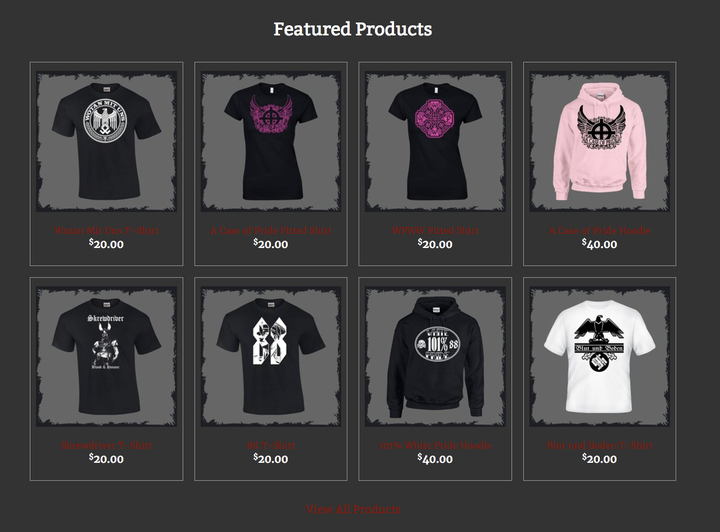
A screenshot of some the product offerings from VinlandClothing.com, which was banned from using Apple Pay and PayPal for selling Nazi apparel.

Blake Montgomery/BuzzFeed News / Via vinlandclothing.com

The most valuable company in the world is taking a stand against websites selling apparel and paraphernalia from white nationalists and hate groups.

On Wednesday, Apple confirmed to BuzzFeed News that it had disabled Apple Pay support for a handful of websites that sold sweaters with Nazi logos, t-shirts emblazoned with the phrase “White Pride” and a bumper sticker showing a car plowing into stick figure demonstrators. Following Saturday’s Charlottesville demonstrations, where one woman was killed by a car driven by a white nationalist, the iPhone maker blocked three white nationalist sites from using Apple Pay.

Apple was unable to provide comment for this story at the time of publication; A spokesperson referred BuzzFeed News to the company’s guidelines for Apple Pay which forbid the service’s incorporation into sites promoting hate, intolerance and violence.

Apple’s move to distance itself from these sites comes as a number of technology companies have faced intense scrutiny for enabling the websites or social media accounts of white nationalist and white supremacist organizations. On Monday, both GoDaddy and Google removed the registration capabilities of The Daily Stormer, a white supremacist blog, in response to its posts about the events in Charlottesville.

“We’ve seen the terror of white supremacy & racist violence before,” Apple CEO Tim Cook wrote on Twitter on Monday. “It's a moral issue – an affront to America. We must all stand against it.”

Uber, Facebook, Twitter, MailChimp, and WordPress have all taken varying levels of action against white supremacists on their platforms in the wake of Charlottesville. Airbnb banned people tied to white supremacist groups who attempted to use its site to book lodging for the rally last week. Intel's CEO and other leaders resigned from President Donald Trump's manufacturing council over what they saw as Trump’s inadequate condemnation of the violence and rhetoric from racist groups over the weekend. On Wednesday, Trump disbanded two major business councils following a cascade of member resignations.

Apple removed Apple Pay capabilities from little-known sites including AmericanVikings.com and VinlandClothing.com, the latter of which sells apparel with Nazi logos. Apple Pay’s “acceptable use guidelines” state that users may not incorporate its payment service into a site that “promotes hate, violence, or intolerance based on race, age, gender, gender identity, ethnicity, religion, or sexual orientation.”

Heidi Beirich, leader of the Southern Poverty Law Center’s Intelligence Project, praised Apple’s actions, and likened the move to one in 2014 when the company removed songs from iTunes that the SPLC had characterized as “hate music.”

“Tim Cook has been the leader in the fight against hate on tech platforms,” she said. “It would be a much better country if people had followed Tim Cook’s lead on this front.

A screenshot of a bumper sticker being sold on AmericanVikings.com, which was banned from using Apple Pay on Wednesday.

Ryan Mac/BuzzFeed News / Via AmericanVikings.com

Both VinlandClothing.com and AmericanVikings.com were hosted by GoDaddy, which provides users several options, including PayPal and Stripe, to process online payments. A spokesperson for Stripe said they were looking into the issue, but typically do not comment on individual users. GoDaddy said it was looking into the issue as well but has not commented.

A third site on which Apple disabled payments had gone offline before publication time. Shopify, which hosted the site, Behold Barbarity, did not return a request for comment.

Brien James, the owner of AmericanVikings.com said he identifies as “a civic nationalist” and “pro-white” and told BuzzFeed News he was unaware his business had even accepted Apple Pay. His six-year-old site currently sells white pride t-shirts as well as a bumper sticker that shows a car plowing into protestors that reads “No one cares about your protest.” James called the site a hobby, and did not seem too worried about losing payments capabilities or the possibility of being taken offline.

“I don’t know the legalities of free speech on a website or if you own a hosting company… but if you run a business you have a right to decide who or not you do business with,” James said. “If they don’t like me, they don’t have to do business with me.”

James said Facebook had removed his “American Viking Political” page earlier on Wednesday. His site still currently accepts PayPal. A PayPal spokesperson said the has banned Vinland Clothing and Behold Barbarity and confirmed that American Vikings can still accept payment via PayPal.

PayPal wrote in a blog post yesterday, “Intolerance can take on a range of on-line and off-line forms, across a wide array of content and language. It is with this backdrop that PayPal strives to navigate the balance between freedom of expression and open dialogue — and the limiting and closing of sites that accept payments or raise funds to promote hate, violence and intolerance.”

“If they don’t like me, they don’t have to do business with me.”

The SPLC’s Beirich had less flattering things to say about PayPal, though she did laud their actions: “PayPal has been the banking system for white nationalism, but this action is a great change in direction for them. We’ve been in correspondence with them about this for two years, and at times didn’t feel like they were taking it seriously. We’re very pleased that PayPal is going to enforce its terms of service aggressively.”

Apple and PayPal’s actions will likely exert pressure on credit card companies to act against white supremacists. Color of Change, a nonprofit advocating for racial justice, has started a campaign called Blood Money listing known hate groups that use major credit cards, employ payment processing services or sell items on Amazon.com. Blood Money was among the first to point out the three sites that Apple later banned from using Apple Pay.

PayPal told BuzzFeed News it had been working with Color of Change “for some time” on reviewing the sites listed for violations of the company’s Acceptable Use Policy. It has removed 34 of the sites on the list but said that “the process can take some time. It’s very thorough.”

After cutting service from larger, more well-known hate group sites — PayPal banned the Daily Stormer back in 2014, for example — payment processors are now scrambling to deal with many smaller ones that litter the web as they face increasing scrutiny over allowing hate groups to use their technology.

PayPal has banned some associated with the alt-right in the past six months, but the Southern Poverty Law Center (SPLC) alleged that PayPal had allowed eight white nationalists, including Unite the Right Organizer Jason Kessler and noted alt-right white nationalist Richard Spencer, to use its technology to raise funds for the Unite The Right rally. PayPal told BuzzFeed News that the company had already banned or hobbled some of the eight accounts in the SPLC’s blog post prior to Unite the Right and that it canceled almost all of the rest after the SPLC’s blog post.

Discover said in a statement to BuzzFeed News, “In light of recent events, we are terminating merchant agreements with hate groups, given the violence incited by their extremist views.”

The credit card company declined to specify which groups.

Quelle: <a href="Apple Pay Is Cutting Off White Supremacists“>BuzzFeed
The Pro-Trump Media's Post-Charlottesville Identity Crisis

The events in Charlottesville have created the first real crisis for the pro-Trump media, which is caught between its mainstream aspirations and its addiction to the traffic and energy of the white nationalist movement.

For the better part of 2017, the collective of Twitter personalities, trolls turned citizen journalists, and social justice-hating memelords that make up the pro-Trump media has tried to distance itself from Trumpism’s more virulently white nationalist elements. Much of that work, though, has likely been undone in the aftermath of Saturday’s deadly Unite The Right demonstrations, during which a white nationalist plowed into a group of anti-racist protesters, killing one and injuring more than a dozen.

Across the internet after the violence, the pro-Trump media’s narrative — usually clear and concise — appeared scrambled. Prominent pro-Trump personalities took to Twitter to condemn the political violence and declare the alt-right to be vile Nazis. They excoriated the anti-fascist movement and the violent and intolerant left, and they bashed the media for its anti-Trump bias and inciting rhetoric that helped create a culture of political violence.

Taken together, the hundreds of tweets, posts, and Periscopes from the “new right” over the last few days have ranged from anxious to defensive to exhausted. But most of all, they reveal a movement that, much like Trump himself, finds itself isolated — trying desperately to dissociate from the convenient alliances it made in the campaign, and in danger of irreparably tarnishing its credibility.

Throughout the campaign, the alt-right was a large, amorphous group of disparate and overlapping factions — neo-Nazis and white nationalists; young, excited, digitally savvy Trump supporters; alienated and anxious white men; media-hating opportunists; and any number of trolls, from the nihilists to the anti-SJWs. It was a convenient alliance under the banner of a candidate who continually gave voice to previously taboo cultural views.

But once their man was in office, the fissures began to show almost immediately. When reports surfaced that attendees of a Richard Spencer-hosted conference had done Nazi salutes, the moderate factions of the alt-right condemned the behavior. Then, a falling out among organizers of the pro-Trump “DeploraBall” inauguration party led to self-proclaimed white nationalist Tim Gionet (Baked Alaska) getting kicked out as an event host. Personalities such as Mike Cernovich and Jack Posobiec began distancing themselves from the alt-right by dubbing themselves the new right, an inclusive, nonbigoted nationalist movement. By June, the split was complete, with the two groups holding competing rallies and slinging insults across Twitter.

But this new right is, at present, ill-defined. It exists instead as a sort of media and communications arm for Trumpism and its core tenets: destroying the mainstream media, winning for the sake of winning, and pissing off liberals. Rather than advocating explicit policies, the new right appears more concerned with constructing a playbook for a formidable digital insurgency: Identify the outrage, swarm it, make it go viral, create chaos, control the narrative. But in order to do this, the new right must appeal to a broad audience. The movement is caught between the mutually exclusive goals of denouncing alienating ideologies like white nationalism, and continuing to appeal to the very people who made it a movement in the first place.

In this way, the new right is much like Trump. Both value attention and prominence in the news cycle above all else. Both must — at all times — speak their minds. Both flirted during the campaign with covert racists, if only by their silence. And both won and now find themselves dogged by their past association, as the alt-right trades in its fashionable haircuts for honest-to-god torches and swastikas.

Politically, the tragedy in Charlottesville offered a rare opportunity for the new right to rise above partisanship. Had the movement simply condemned the attack and said little else, or called for momentary unity with its enemies in the media and on the left, the group could have set itself fully apart from the violence. But it, like the president, opted instead to have the last word and relitigate past arguments. Borrowing from Trump’s playbook, the new right chose to play the victim. It bemoaned the attack as a massive setback for its movement. It castigated the media for dividing the country and not reporting on the violence of the left. It used the method of attack as an attempt to rehash arguments about migrants and Islamic terror.

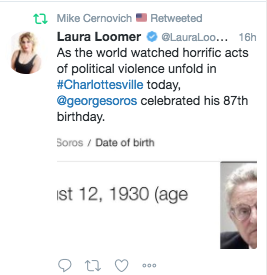
And, like Trump, it seemed unable to avoid dredging up conspiracy theories. Alex Jones of Infowars suggested the rally was “staged” to vilify the right and stop future conservative gatherings. Mike Cernovich tweeted at KKK leader David Duke, calling him “Deep State David” as a nod to clandestine government involvement in the protests. A handful tried to blame the entire event on their favorite enemy: George Soros.

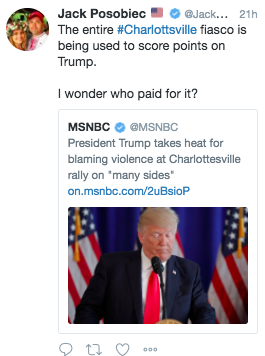
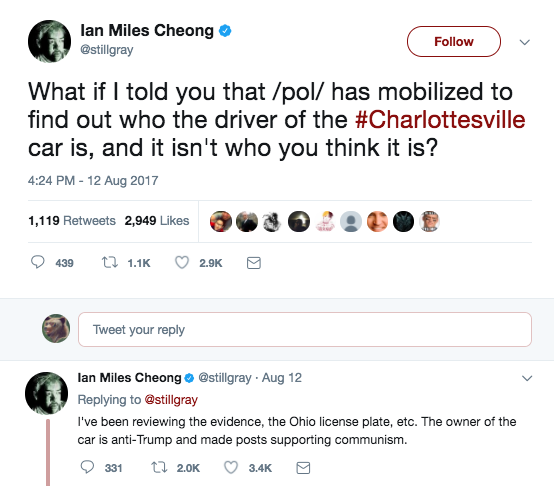
Pro-Trump media sites like Gateway Pundit and Chuck Johnson’s GotNews pushed unconfirmed stories from 4chan identifying the Charlottesville driver as an “anti-Trump druggie.” Posobiec also broadcast the unconfirmed and quickly disproved theories. Ian Miles Cheong — a Daily Caller reporter — referred his 53,000-plus followers to 4chan’s /pol/ message board floating a similar conspiracy. “I've been reviewing the evidence, the Ohio license plate, etc. The owner of the car is anti-Trump and made posts supporting communism,” he tweeted.

Like Trump, the new right appears unable to quit the fever swamp. The pro-Trump media’s leaders, publications, and followers claim the moral high ground with their denouncements of political violence and the alt-right on one hand, while pandering to the most unseemly corners of the internet on the other. Much like the president, who appears unable to sever ties with his small but dedicated base, the new right appears unable to abandon the internet’s underbelly — a place where many pro-Trump media personalities cut their teeth, and which is still frequented by part of the new right's audience. Like Trump, they denounce racism but gesture toward communities like 4chan, where ironic racism is not just an in-joke but a rite of passage.

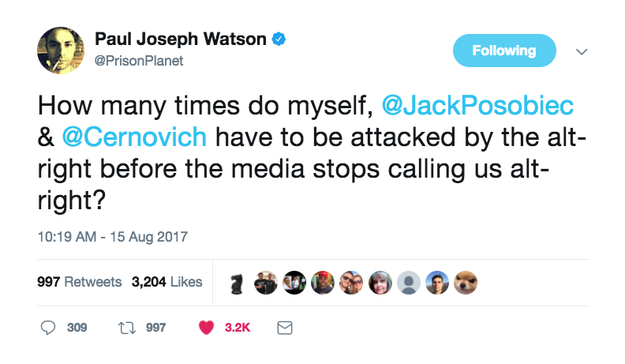
And so for now the isolation continues. On Tuesday morning, Infowars editor Paul Joseph Watson attempted to correct reports from outlets like CNN that labeled Posobiec as a member of the alt-right. For Watson — who nine months ago announced he was severing ties with the alt-right to be part of the group that “likes to wear maga hats, make memes, and have fun” — the constant distancing appears exhausting. “How many times do myself, @JackPosobiec & @Cernovich have to be attacked by the alt-right before the media stops calling us alt-right?” he tweeted.

And they aren't the only ones in this fix. Indeed, the main American figure caught halfway between the fringe and the mainstream, pleasing nobody, is the president of the United States.

Quelle: <a href="The Pro-Trump Media's Post-Charlottesville Identity Crisis“>BuzzFeed

White Supremacist Platforms Are Being Targeted By Hackers And Rejected By Hosts

White Supremacist Platforms Are Being Targeted By Hackers And Rejected By Hosts

Justin Ide / Reuters

Several right wing extremist websites and accounts that amplify bigotry were apparently hacked or denied service on various platforms in the wake of the race-fueled fatal white supremacist march this weekend in Charlottesvile, Virginia.

The Daily Stormer, 4chan's Twitter accounts, and Richard Spencer's website were among those hacked or denied service.

GoDaddy, the world’s largest seller of domain names on the internet, said on Sunday that it would no longer provide service to the Daily Stormer, a popular neo-Nazi and white supremacist website. The company has been criticized for providing services to white supremacist websites despite its terms of service that ban “morally offensive activity.”

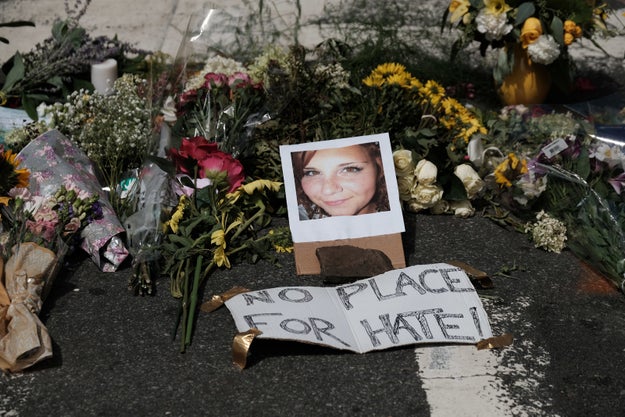
The action was taken after The Daily Stormer posted an offensive article about Heather Heyer, a 32-year-old legal assistant, who was killed after a car drove into a group of protestors following the Unite the Right white supremacist rally in Charlottesville, Virginia on Saturday.

“Given that [The Daily Stormers’] latest article comes on the immediate heels of a violent act, we believe this type of article could incite additional violence, which violates our terms of service,” a GoDaddy spokesperson said. The company clarified that it does not host any Daily Stormer content on its servers but merely provided the domain name.

GoDaddy also appeared to drop the domain privacy protection for the Daily Stormer website, according to one Twitter user.

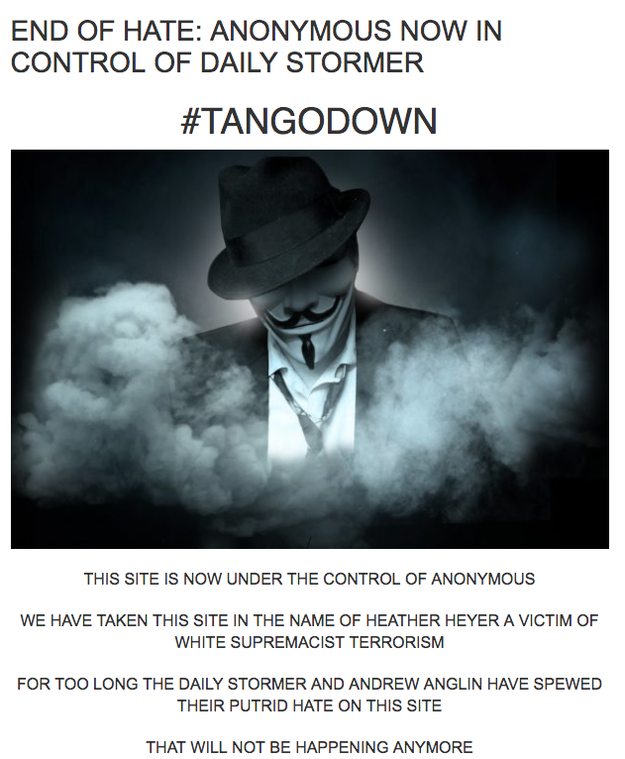
Shortly after GoDaddy announced its decision, the Daily Stormer website appeared to be under the control of the hacker group Anonymous. On Saturday, the group urged its followers to hack alt-right and white supremacist sites as part of what it called #OpDomesticTerrorism.

The Daily Stormer / Via dailystormer.com

After being rejected by GoDaddy, the Daily Stormer was briefly hosted by Google — until the company also shut the site down.

“The Stormer registered this morning with google domains and were immediately reviewed and suspended for Inciting violence,” a source told BuzzFeed News about Google's decision.

The Daily Stormer's YouTube account has also been terminated “due to multiple or severe violations of YouTube's policy prohibiting hate speech,” according to a message now displayed on the page.

BuzzFeed News has reached out to the Daily Stormer for comment.

On Monday, a major Anonymous twitter account, @youranonnews, said that they had no confirmation that Anonymous was behind the Daily Stormer hack and suggested that it was a stunt by the website itself to “woo their clueless base.”

Earlier, the Twitter account had claimed that the campaign had taken down other white nationalist and alt-right websites, including Richard Spencer's Altright.com. (The site appears to now be online forwarding to new servers.)

On Saturday, Henrik Palmgren of Red Ice, a white supremacist multimedia platform based in Sweden with more than 130,000 subscribers on YouTube, said its website was down and that hackers were threatening to release the names of some 23,000 people with paid subscriptions to the site.

And on Monday, Twitter also appeared to shut down accounts affiliated with /pol — a 4Chan message board that has been linked to extremist beliefs — its creator said. Twitter declined to comment on individual accounts, as is its policy.

Other tech platforms made individual or blanket policy decisions after the events in Charlottesville.

Over the weekend, Facebook removed Unite the Right's event page. Facebook removes event pages when the threat of real world harm and an event’s connections with hate organizations become clear, a Facebook spokesperson told BuzzFeed News.

The company also removed a number of other pages since the weekend, and said tools it uses to identify and remove hate speech are the same it's using to combat terrorism.

“Our hearts go out to the people affected by the tragic events in Charlottesville,” a Facebook spokesperson said. “Facebook does not allow hate speech or praise of terrorist acts or hate crimes, and we are actively removing any posts that glorify the horrendous act committed in Charlottesville.”

The newsletter service mailChimp announced Monday that it has updated its terms of service to ban hateful content.

And by Monday night, WordPress had suspended the site belonging to American Vanguard, one of the white supremacist groups that organized the weekend rallies in Charlottesville.

WordPress

WordPress' User Guidelines prohibit illegal content and conduct as well as threatening material, including “direct and realistic threats of violence.”

Over the last few months, PayPal has banned accounts of several alt-righters, and crowdfunding platforms like GoFundMe, Patreon, and YouCaring, have also cut fundraisers for white supremacy-related causes. Last week, Airbnb started deactivating accounts of people it believed were booking units to host gatherings related to the rally.

LINK: Google Joins GoDaddy In Booting Neo-Nazi Site Daily Stormer

LINK: Protests Erupt Nationwide After Deadly White Supremacist Rally In Charlottesville

LINK: This Twitter Account Is Trying To Identify People Who Marched In The Charlottesville White Supremacist Rally

Outside Your Bubble is a BuzzFeed News effort to bring you a diversity of thought and opinion from around the internet. If you don't see your viewpoint represented, contact the curator at bubble@buzzfeed.com. Click here for more on Outside Your Bubble.

Quelle: <a href="White Supremacist Platforms Are Being Targeted By Hackers And Rejected By Hosts“>BuzzFeed