13 Hard Words We Learned From This Uber Investor's Letter

Shervin Pishevar

Patricia De Melo Moreira / AFP / Getty Images

Shervin Pishevar is a technology investor who was an early backer of Uber. He also writes letters. Lately, he has been spilling ink on one topic in particular: an ongoing legal battle between the Uber cofounder Travis Kalanick and the venture capital firm Benchmark for control of the ride-hail behemoth.

Pishevar's latest missive, released on Wednesday, surpasses all his others in style and diction. There's a rich tradition of investors firing off pointed dispatches, though most practitioners of the form work for Wall Street hedge funds. Pishevar, with Benchmark as his subject, manages to infuse the genre not only with venom but also with some particularly obstreperous difficult hard words and phrases.

Here's Pishevar:

@EricNewcomer / Twitter / Via Twitter: @EricNewcomer

Let's take a look at what we've learned. All definitions are from Merriam-Webster online.

1. “We find ourselves swimming in the crucible of one of the grandest business and moral battles of our generation…”

Crucible:

2: a severe test

3: a place or situation in which concentrated forces interact to cause or influence change or development

2. “…and find strength in each stroke of our proverbial digital pens, that we wrote with the indelible, eternal and permanent ink of righteousness.”

Indelible:

1 a: that cannot be removed, washed away, or erased; b: making marks that cannot easily be removed

2 a: lasting; b: unforgettable, memorable

3. “We write with the souls of thousands of lives saved, the lives of millions of jobs created liberating multitudes of drivers from the shackles of servitude to iniquitous taxi cartels…”

Iniquitous, or characterized by iniquity:

1: gross injustice

2: a wicked act or thing

4. “…of corrupt cabals that choked cities with their pollution of air and morals.”

Cabal:

1: the contrived schemes of a group of persons secretly united in a plot (as to overturn a government); also: a group engaged in such schemes

5. “Their allegiance was met by this unholy alliance of perfidious…”

Perfidious, or characterized by perfidy:

1: the quality or state of being faithless or disloyal

6. “…greed devolving rapidly into the audacity of vituperative…”

Vituperative:

uttering or given to censure : containing or characterized by verbal abuse

7. “…unparalleled predatory rapacity.”

Rapacity, or the quality of being rapacious:

1: excessively grasping or covetous

2: living on prey

8. “Let us strike tomorrow with the full and fulsome courage of our convictions.”

Fulsome:

1 a: characterized by abundance; b: generous in amount, extent, or spirit; c: being full and well developed

2: aesthetically, morally, or generally offensive

3: exceeding the bounds of good taste

4: excessively complimentary or flattering

9. “Let our just cause give pause to those who would ever dream of ever emulating the shameful shenanigans of these sanctimonious hypocrites…”

Sanctimonious:

1: hypocritically pious or devout

10. “…who fling filings and letters de haut en bas.”

De haut en bas (French):

: of superiority : of or with condescension

11. “It is we who have the higher moral ground and our letters and filing will hail down upon their platforms, exposing them as bitterly barren barons…”

Barren:

1: not reproducing: such as a: incapable of producing offspring — used especially of females or matings; b: not yet or not recently pregnant; c: of plants: habitually failing to fruit barren apple trees

2: not productive: such as a: producing little or no vegetation; b: producing inferior crops; c: unproductive of results or gain

12. “…of moral turpitude.”

Turpitude:

inherent baseness : depravity

13. “And as the summer sets, we let us be steward of truth who in unison proclaim: fiat justitia ruat caelum.”

Fiat justitia ruat caelum (Latin):

let justice be done, though the heavens fall

Quelle: <a href="13 Hard Words We Learned From This Uber Investor's Letter“>BuzzFeed
This Futuristic Doctor’s Office Is Rolling Across The United States

Jay Watson / Forward

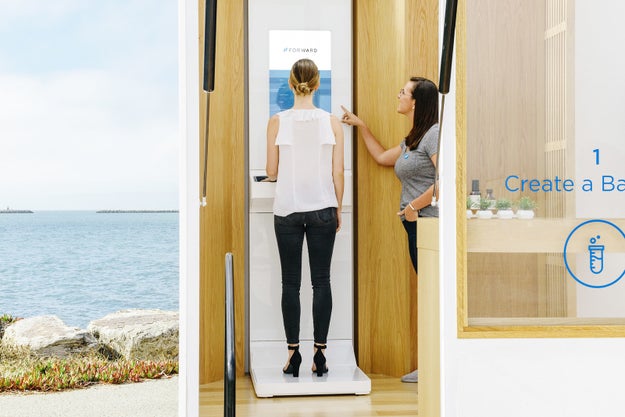
The Google and Uber veterans behind Forward, a new San Francisco health care startup, want to bring their vision for reinventing the doctor’s office to the wider public — so they’re putting it on four wheels.

In January, Forward opened its first concierge clinic in downtown San Francisco. It’s complete with slick tools like iPads to check in patients, biometric-reading body scanners, blood and genetic tests, and giant interactive screens that display your vital signs during visits. Being a Forward member — a $149-a-month commitment that isn’t covered by insurance — also gets you body-monitoring wearables and constant access to doctors and nurses via email and text.

Although Forward’s leaders won’t disclose how many patients have enrolled, they say they’re encouraged by the response and now plan to open up offices in other cities. And to drum up anticipation in those places, Forward has built a pop-up office: an 11-foot-tall, 18-foot-long, nearly 9-foot-wide mobile trailer.

The trailer will first be on display Wednesday in San Francisco, and will be there for the rest of August and early September before it motors to other cities that the company will reveal on Twitter. “We want to tell the story to more people and help catalyze the conversation around ‘What is health care now? What could health care be?’” cofounder Ilya Abyzov told BuzzFeed News.

Visitors to Forward’s mobile trailer will be able to meet a handful of staff members on-board, and try out the body scanner and interactive screen. Some other services — like the blood and genetic tests — won’t be available, though. If they like what they see, they can sign up for a discounted price of $99 a month. Abyzov says the company won’t hang on to any health data from non-customers.

Abyzov was an early Uber employee who was part of launching UberX. Founder and CEO Adrian Aoun previously sold a startup to Google and founded Sidewalk Labs, Alphabet’s experimental urban-design division. Other founders include Erik Frey, who previously oversaw various artificial-intelligence projects at Google, and Rob Sebastian, who led product strategy for several Google projects. Overall, Forward has 80 employees, including six doctors.

Forward has raised $100 million, a person familiar with the situation told BuzzFeed News. A company spokesperson declined to comment.

Jay Watson / Forward

Forward isn’t comprehensive: It doesn’t cover services like hospitalizations, surgeries, or specialist care. Instead, the company says it focuses on encouraging people to proactively take care of their health, before problems and conditions develop. It bears noting that the people most likely to use Forward are tech-savvy and affluent like its founders, a relatively select group compared to the US population as a whole.

“A lot of what we’re trying to do with Forward is build a health care system that’s something you’re excited about, you’re engaged in, and gets better outcomes,” Abyzov said. “It’s part of that bigger story of why can’t health care be something that’s compelling, that’s beautiful, that’s super well-designed, designed to the same standard that Warby Parker designed their store against?”

Quelle: <a href="This Futuristic Doctor’s Office Is Rolling Across The United States“>BuzzFeed

Social Media Saved Harvey Victims In Texas — But That's Not Really A Plan

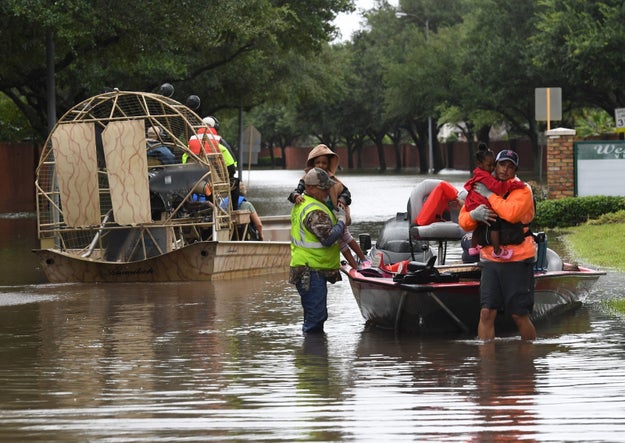
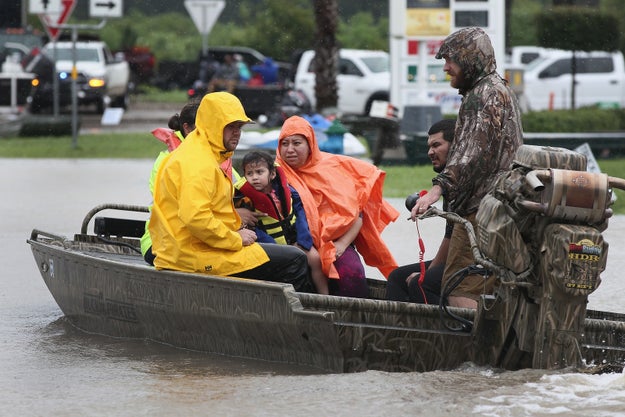
Houston residents being evacuated Tuesday by volunteers from San Antonio.

Mark Ralston / AFP / Getty Images

Tuesday afternoon, with floodwaters rising in Houston and residents still stranded in their homes, hundreds of people turned to the walkie-talkie app Zello, which posts short voice messages in an ever growing feed, to coordinate help.

One Zello group, Houston Harvey, posted hundreds of messages an hour. Among boat owners offering their services and drivers curious for a safe route out of town, much of the chatter focused on Heidi, a mother with an unspecified illness and two autistic sons, one of whom used a wheelchair.

“She’s on the emergency evacuation list several times over,” said a woman with the username mswrt. “We’re trying to get somebody out to her as fast we can.”

“What is the location for that mom with the autistic kids?” asked a man who used the handle yert68. “We have a low-water boat able to get to her, and we’re in the Baytown area right now.”

A third user, sarah1118, gave the address. “She is in an apartment complex that is slowly rising. And she is alone with her two sons and she needs a boat that can accommodate her son’s wheelchair.”

But Zello’s limitations were quickly apparent. It didn't offer a way to respond directly to other users if they hadn't been added as a contact. New messages, posted in real time, overwhelmed older ones. Some gave advice that only might be helpful. Others were just dead air. A quiet man who offered no other information simply asked “How can I help?” No one responded to him. Clearly, no one was in charge.

“The Coast Guard is in that area,” said a user identified as CW2009. “I’m not sure if they’re rescuing them.”

Eventually, according to a woman who said she was Heidi’s sister, the Coast Guard came for Heidi, but they didn’t rescue her. Misty, who said she was in touch with the Coast Guard, said it was because they couldn’t take the wheelchair, and Heidi wouldn’t, or maybe couldn’t, take her son out of it.

“It’s ridiculous. You have two kids and an adult that needs medication. No food, needs supplies, and they left her there behind,” the sister said.

Another user weighed in: did the Coast Guard help?

The response: “They’ve already left the area.”

——

That Texans have turned to social media in the wake of a historic flood shouldn't be surprising. As of Monday, according to the Federal Communications Commission, 16 of the area's 911 call centers were having problems dealing with the deluge of calls they were receiving. That sent people needing help to Twitter, Facebook and Zello to summon help.

But while that's potentially valuable, it is an imperfect way for governments to help disaster victims, Michael Lindell, a professor emeritus at Texas A&M University and the former director of its Hazard Reduction & Recovery Center, told BuzzFeed News.

For one, he said, “You’re not going to wind up with 100% of the local population reading the local emergency management’s Facebook pages.”

For another, social media, with its thousands of users, offers little consistency in standards and practices, making dependence on it risky. Apps such as Zello, better known as a protest organizing tool in countries such as Turkey, Russia and Venezuela, aren't well known in Texas, and the app itself is a major drain on a smartphone battery.

In disaster areas, the internet can be as unreliable as any utility. Nearly 200,000 people have lost internet in their homes due to Harvey, according to the FCC, and internet service on cell phones has been hampered, with 364 cell phone towers in 27 counties in Texas and Louisiana suffering at least partial service outages.

Global Blocks, an activist group that grew out of censorship in Turkey and monitors internet outages around the world, noted that some areas, like Corpus Christi, suffered severe internet outages when the storm hit.

Others, like the city of Victoria, southwest of Houston, have suffered sustained trouble getting online. Dyn Research, an Oracle property that studies connectivity, found correlations between power outages — widespread in Harvey’s wake — and loss of internet connection.

That hasn’t stopped Texas authorities from trying to use social media to coordinate a hodgepodge attempt to connect aid workers and those in need of help. But even as they used it, they recognized its limitations.

At one point, Ed Gonzalez, the sheriff in Harris County, which includes Houston, requested that citizens in need of rescue stop tweeting him and call 911 instead, even though he admitted that it was at times impossible to get through.

Still, he used social media himself. On Sunday, he tweeted that a pregnant woman on Angelo Street was going into labor and needed help, and tagged the Houston Fire Department. Later, he tweeted that she’d gotten an ambulance.

But Twitter wasn’t a great system: another woman tweeted to him, adding a screengrab of a Facebook comment that another pregnant woman needed help. Gonzalez tweeted her address, tagging the Houston Fire Department and City of Houston Office of Emergency Management. But it wasn’t clear if they saw the tweet and were able to help, and he didn’t mention her again.

Conflicting and inadequate communications echo 2005’s Hurricane Katrina and its aftermath, which killed 1,833 people, displaced 600,000, and cost an estimated $130 billion. A congressional report on Hurricane Katrina found that inoperable or damaged communications systems drastically exacerbated problems caused by Katrina.

New Orleans police didn’t have functional communications for three days, and for a period, first responders were restricted to using only two radio channels on a backup system.

Louisiana state police found that damaged towers for its radio system, used by 70 agencies and 10,000 users and last updated in 1996, “severely hampered the ability of emergency responders operating on the state system to communicate with other emergency services personnel.”

That, of course, was before the creation of Twitter in 2006 or the introduction of the iPhone in 2007. The Houston flooding from Harvey makes clear both developments have changed the way disaster communications can work.

At the Digital Operations Center of the Red Cross in Dallas, Texas, volunteers monitored social media distress calls using an in-house software that pulled data from Facebook, Twitter and other web sites using search terms like “hurricane” or “storm.”

The in-house tool clustered the social media data it pulled in various ways — word clouds, heat maps, most tweeted posts and most popular images and videos — and allowed Red Cross workers to monitor the needs of people affected by disasters like Harvey closely.

“Social media is extremely important to the Red Cross because it allows us to connect to more people,” said Krysta Smith, a digital communications specialist. “It's a live feed that lets us know immediately what we’re facing, what residents are facing, and what actions need to be taken.”

But it has its limitations. The geolocation function can be inaccurate, for one.

Still, it shows the ways first responders could make better use of the last decade's advance in personal communications – if public officials and taxpayers are willing to commit to making it happen.

“Society has priorities,” Lindell said. “Could you develop evacuation plans for everybody in Houston? Of course. But the question is how likely is that to happen? How much are you willing to pay now for the capacity for something that might not happen for another 150, 250 years?”

Alex Kantrowitz contributed.

Quelle: <a href="Social Media Saved Harvey Victims In Texas — But That's Not Really A Plan“>BuzzFeed

Facebook Ditched The Red Cross For Hurricane Harvey Relief

Facebook

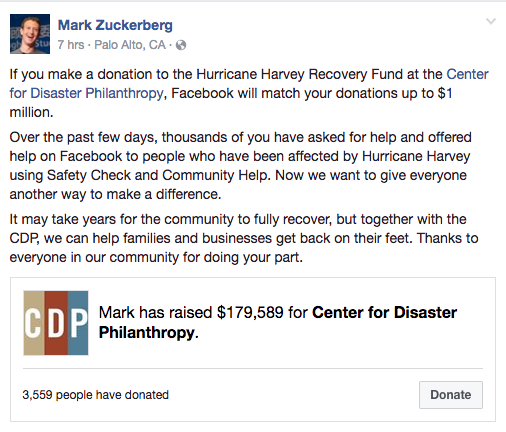
Facebook is steering donations for Hurricane Harvey relief to a tiny, little-known charity called the Center for Disaster Philanthropy — and bypassing the Red Cross, its longtime partner in the midst of disasters.

During Typhoon Haiyan in 2013 and the Ebola outbreak of 2015, a button on Facebook News Feeds prompted users to send money to the Red Cross. And as floodwaters have inundated Houston, Donald Trump and Barack Obama have both publicly donated to the Red Cross, as have dozens of major corporations.

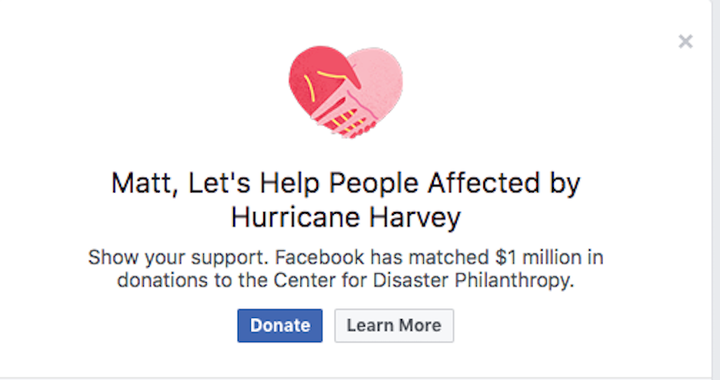
Now, Facebook is routing its millions of users, and $1 million of its own money, to the Center for Disaster Philanthropy, which in 2015 had just $3 million in revenue. A message on Facebook feeds with a donate button said, “Show your support. Facebook has matched $1 million in donations to the Center for Disaster Philanthropy.”

Bob Ottenhoff, the CDP’s president and former CEO of GuideStar, a clearinghouse for information on nonprofits, said the group works to change how donors think about giving during disasters, focusing on long-term recovery. “People are motivated right now, because they’re watching television and reading newspapers,” said Ottenhoff. “But we find there’s a dramatic reduction in contributions almost immediately once the media attention is over. In a case like this, with what we see happening in Houston, it’s going to be a very long recovery.”

Facebook’s shift is a potential sign of the growing discontent with the Red Cross and other rapid-response groups’ activities in the wake of natural disasters — as well as attempts by Silicon Valley to rethink how people give money to charity, steering donations to causes tech magnates think will be the most effective.

The Red Cross has faced intense scrutiny and criticism for its work in previous disasters. During Hurricane Harvey, people have encouraged others on social media to donate to groups other than the Red Cross.

Facebook’s unusual Harvey partnership sent so many users to the CDP that the organization’s website quickly crashed. The CDP’s Facebook page was inundated with comments from people who had never heard of it, demanding to know where their money was going and even worrying that the call for donations was a “scam.”

“I donated $50 and instantly freaked out,” commented one user, Jenna Workman Travers. “I called my bank and they think it’s okay, because it hasn’t come up yet as a scam. But, I cancelled the donation because it suddenly seemed shady.”

The CDP had reached Facebook’s $1 million matching goal in less than four hours, said Ottenhoff — by far its biggest fundraising push.

“We believe the Center for Disaster Philanthropy is well positioned to help meet the recovery needs of communities in Texas,” a Facebook spokeswoman said. “CDP knows from past disasters, especially through their experiences with hurricanes and floods, that full recovery will take many years.”

Facebook still partners with the Red Cross, the spokeswoman said, by allowing the group to raise money through its own page.

Scott Olson / Getty Images

Silicon Valley has been at the forefront of rethinking how philanthropy works — with an eye, tech barons say, toward maximizing well-being with each dollar spent.

Tech figures have been major funders of GiveDirectly, a nonprofit that makes direct, unconditional cash grants to individuals living in poverty. Facebook cofounder Dustin Moskovitz’s wife, Cari Tuna, is the president of the Open Philanthropy Project, which does extensive research to identify “high-impact” charity projects. GiveWell, a charity evaluation service connected with the Open Philanthropy Project, cautions potential donors to “support an organization that will help or get out of the way.”

The investigative journalism outlet ProPublica exposed a series of catastrophic failures at the Red Cross, including a “secret disaster” of mismanagement in the wake of superstorm Sandy and Hurricane Isaac and a massive influx of donations squandered in the wake of the 2010 earthquake in Haiti. One particularly blistering headline from a 2015 story: “The Red Cross Raised Half a Billion Dollars for Haiti and Built Six Homes.”

Last year was the Red Cross’s worst fundraising year since 2000, ProPublica reported. In a statement, the Red Cross said it still had an “established and ongoing” relationship with Facebook, which allowed it to raise money through a disaster fundraisers platform.

Unlike the Red Cross, which provides on-site aid, the Center for Disaster Philanthropy does not itself provide any services. Instead, it collects money and uses an advisory committee to disburse funds to smaller groups, many of them local — filling in gaps left by government organizations and large national charities.

“To have Facebook say ‘this is where we think our money should go and we welcome others to join us’ is a major tipping point in learning about recovery,” Debra Jacobs, the chief executive officer of the Patterson Foundation, told BuzzFeed News. The Sarasota-based charity announced Tuesday that it was donating $250,000 to the CDP’s Hurricane Harvey fund; it had also given money to the group in the wake of other disasters.

Facebook

Quelle: <a href="Facebook Ditched The Red Cross For Hurricane Harvey Relief“>BuzzFeed

These Are The People Scraping Twitter And Crowdsourcing Rescue Requests From Harvey Victims

Scott Olson / Getty Images

Jessica Decker woke up Friday morning at her San Francisco home, having the day off from work, and began reading the news about the hurricane set to make landfall in Texas that night.

Decker, who has a background in science visualization, saw several tweets regarding relief efforts including where shelters will be located and information about food drives.

She put a call out on Twitter, tagging people she has worked with previously, asking if they’d want to map resource information. She was involved in involved in open-mapping projects in the past and wanted to see how it could help with what promised to be — and became — a historic, devastating, and deadly storm.

Danny McGlashing, a coder, responded and the two paired up to create a map of resources. They called their project Harvey Relief.

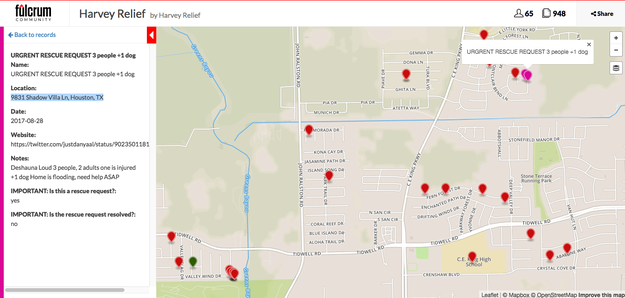
Since Friday, Harvey Relief teamed up with another group — Harvey Rescue — that was searching and mapping rescue requests on Twitter from people who were stranded. Harvey Rescue organized online by a group of people who had previously formed a private Twitter DM.

The groups have received the technical support of a mobile data collection app and have hundreds of volunteers working around the clock, scraping Twitter to log and map the information Houstonians are disseminating online.

“This community of complete strangers has come together and we are literally saving lives,” @RogueEPAstaff, who helped create Harvey Rescue, told BuzzFeed News.

The group doesn’t have a scientific methodology when it comes to collecting the data and mapping it out. The volunteers collect the SOS tweets and vet them “as much as we can” by calling and texting the phone numbers provided, Brooke Binkowski, who serves as the group's spokesperson, told BuzzFeed News.

“We’re allowing for a certain margin of error,” Binkowski said, adding that she knows there will be duplicate entries in the data and that some might be submitted from pranksters — a small price to pay if it means rescue teams will reach people in need, she said.

The group is working to fix the duplicate entries, but could not provide a timeline for when they expect that to be completed.

Harvey Rescue is comprised of about 25 people and was formed in November 2016 after the US presidential election. On Twitter, the users — who met by tweeting with the hashtag #AltGov — created a private DM group where they talk about everything from politics to their families and send each other funny memes.

They’re located all across the country and many have never met in person — or even know each other’s real names. They refer to each other by their Twitter handles and call each other friends.

“It’s obvious what we’re about,” Twitter user @altnoods told BuzzFeed News when asked about the group's politics. “But this action has nothing to do with that. We’re 100% country over party.”

“We have a lot of people who were in government when Katrina happened,” @altnoods added. “We didn’t want that to happen again.”

On Sunday morning, one user suggested they collect and map out the tweets o with people asking for immediate help.

“We were having a conversation as Harvey started coming in and initially wanted to make sure some of our people in Texas were safe,” @RogueEPAstaff told BuzzFeed News. “The conversation turned to how the 911 system was not able to keep up with the volume of calls.”

At the time, local law enforcement agencies were urging people to not use social media to report their whereabouts and instead call 911.

Several people reported on Twitter and in several news outlets that their 911 calls were not going through and that they waited on the phone for a long time.

“People need to be rescued, they're desperate, of course they're going to connect on social media,” @RogueEPAstaff told BuzzFeed News.

Twitter: @HarveyRescue

As the need for help grew, Harvey Rescue started to bring in more people including their family and friends who had data and mapping experience, Binkowski, who is also the the managing editor for Snopes.com, said.

Binkowski said she estimates there are about 200 volunteers involved.

“Everybody is working around the clock,” @RogueEPAstaff said, adding that the work was overwhelming. “I’ve done emergency responses at the federal level, and they say, if it feels like you’re drinking from a firehose, you’re doing it right.”

By Sunday evening, Harvey Rescue and Harvey Relief joined forces. While they’re providing similar services, they’re still operating as two distinct groups.

“We paired up with [Harvey Rescue] on Sunday and we have just volunteers mapping and updating both of these lists day and night,” Decker said.

web.fulcrumapp.com

Decker also reached out to Fulcrum, a data collection app, and requested to use the company’s Community initiative — free and open data-collecting crowdsourcing project specifically created for natural disasters such as earthquakes, tornadoes, and hurricanes.

Fulcrum CEO Anthony Quartararo told BuzzFeed News that through this tool, people on the ground in disaster areas are able to collect data that’s relevant to their humanitarian work.

Quartararo said that Fulcrum Community — which launched earlier this year — approved Decker’s request and anybody with access to Fulcrum’s website or mobile app is able to view the map created by Decker and her team.

About 1,000 entries have been put into Fulcrum related to Harvey rescue and relief efforts, Quartararo told BuzzFeed News.

Volunteers from Harvey Rescue and Harvey Relief told BuzzFeed News their work has identified a service that’s needed and was missing.

@RogueEPAstaff told BuzzFeed News that she hopes relief organizations such as FEMA and Red Cross “can take up this work and make it to something that’s usable long term.”

“I genuinely thought I’d log on and help out for a few hours on Friday,” Decker said. “I had the day off, so I was going to donate some time. All of a sudden you realize, ‘nobody is on this,” so we just had to do it.”

If you've been impacted by the storm in Texas or have a tip about rescue, relief, government, or aid efforts, call the BuzzFeed News tipline at (646) 589-8598. You can also find us on Signal, email, and SecureDrop here.

Quelle: <a href="These Are The People Scraping Twitter And Crowdsourcing Rescue Requests From Harvey Victims“>BuzzFeed

Tinder Will Let US Users Pay To See Who Likes Them For Around $4.99

Tinder is going to start letting users in the US see who likes them — no swiping necessary.

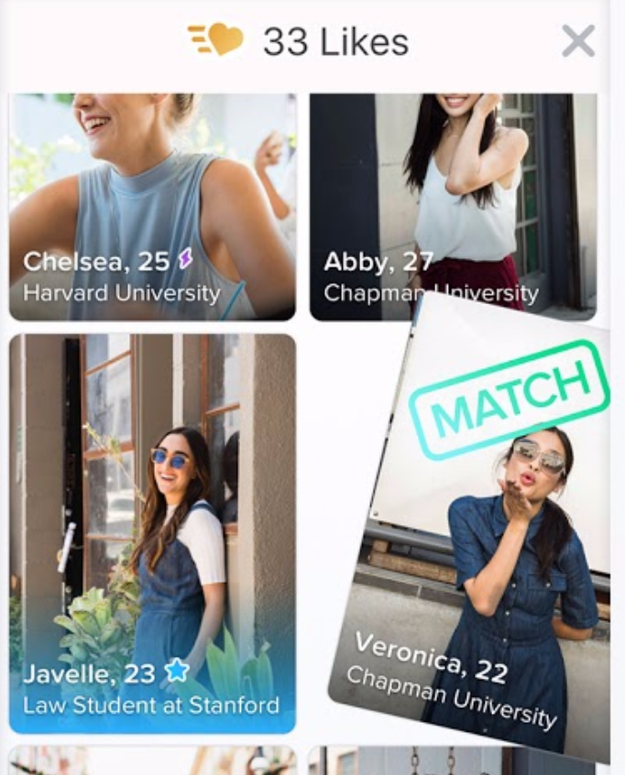
The popular dating app, downloaded by over 100 million people, is offering this feature, at around $4.99 for most users (but still testing), as part of its Tinder Gold product, which debuts in the US today. Already live in a number of countries including Australia and Germany, Tinder Gold nets its users an average of 60% more likes vs. users of Tinder's free version, the company told BuzzFeed News. Instead of swiping with suspense, these users can navigate to a “Likes You” section of the app where the company says they can see everyone who's liked them. “Think of it as your personal Swipe Right concierge—available 24/7—bringing all of your pending matches to you,” the company said in a blog post.

Tinder Gold, which bundles this “Likes You” feature with a handful of other paid enhancements like unlimited likes and extra profile controls, will begin rolling out to US-based users with iOS devices today. The company say it plans to bring Gold to Android in the US next month.

The move adds yet another paid option for Tinder, which already lets you pay to swipe in different geographic locations and to boost your profile's visibility. As it adds more of these options, Tinder risks alienating fans of its free version who must now compete for matches with users paying for an advantage.

Asked how Tinder will balance the needs of these two groups, Tinder chief product officer Brian Norgard told BuzzFeed News the company wants to keep both happy. “We're always working hard to be sure that being a subscriber adds value to your Tinder experience – and that not being one doesn't detract from Tinder's core purpose: to connect you with new people,” he said.

Tinder's enjoyed success in the online dating app market, but it is currently beset by competitors looking to gobble up its market share. Bumble, one of those competitors, is white hot. Founded by former Tinder marketing VP Whitney Wolfe, Bumble is adding 50,000 people per day and has 20 million users, according to Fast Company.

Quelle: <a href="Tinder Will Let US Users Pay To See Who Likes Them For Around .99“>BuzzFeed

Uber Is Scrapping A Feature That Let It Track Users Even After Their Rides Ended

BuzzzFeed News

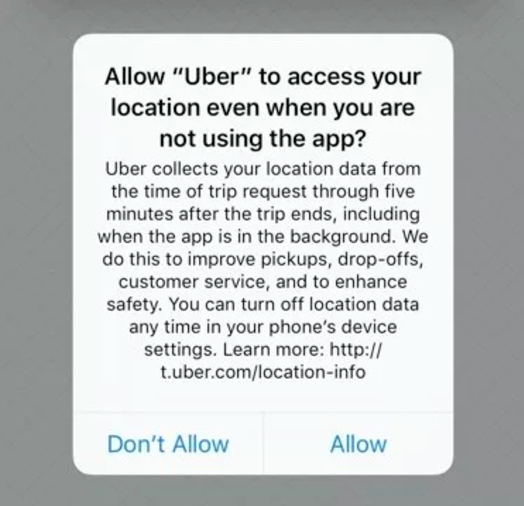
Uber is scrapping a controversial feature that allows it to track riders for up to five minutes after they finished a trip. The change will start rolling out to iPhone users users this week and will eventually also come to Android phones, reports Reuters. The company's decision comes nearly two weeks after Uber settled a Federal Trade Commission complaint about failing to protect driver and rider information, and allowed its employees to snoop on personal user data.

Uber declined to comment to BuzzFeed News.

When the feature was introduced in November 2016, Uber riders were offered two options: they could either allow Uber to always track their location even if they weren’t using Uber, or turn off location tracking entirely, which meant that riders would need to manually enter their pickup location when requesting rides.

The world's largest ride-hailing company had said that it needed to track users’ location data up to five minutes after their trip ended to “improve pickups, drop-offs, customer service, and to enhance safety,” but still came under fire from privacy advocates including the Electronic Frontier Foundation for its decision.

Uber’s security chief Joe Sullivan told Reuters that Uber had “made a mistake” by introducing the feature “without making clear what value Uber would offer in return.” He also said that Uber suffered a “lack of expertise” when it came to privacy.

Uber recently picked Dara Khosrowshahi, the chief executive of travel company Expedia, to be its next CEO following months of internal turmoil including in-board fighting, investigations into sexual harassment and discrimination charges, and a trade secrets lawsuit filed by Google's self-driving arm, Waymo.

Quelle: <a href="Uber Is Scrapping A Feature That Let It Track Users Even After Their Rides Ended“>BuzzFeed

Here's How To Find Out Who Left Your Facebook Requests Hanging

Many people don’t reject Facebook friend requests from semi-strangers, they just leave them hanging as “pending” for a long time.

Many people don't reject Facebook friend requests from semi-strangers, they just leave them hanging as "pending" for a long time.

MTV

I just discovered my very nice coworker here at BuzzFeed had 77 pending friend requests on Facebook. 77! What a monster!

When she gets a request from someone she doesn't know, or barely knows, instead of rejecting them she just leaves them hanging. In her opinion, this is kinder than rejecting them, somehow.

I disagree. I hate seeing all those pending requests, so I quickly reject anyone who I don't know at all (I'll accept acquaintances and put them on a limited privacy list).

I should point out that if you leave someone “pending”, they get subscribed to your updates. That means anything you post with the privacy level “Public”, they see in their feed. This also means they probably THINK you accepted them. Sneaky!

You can see who has left YOU hanging. Here's how.

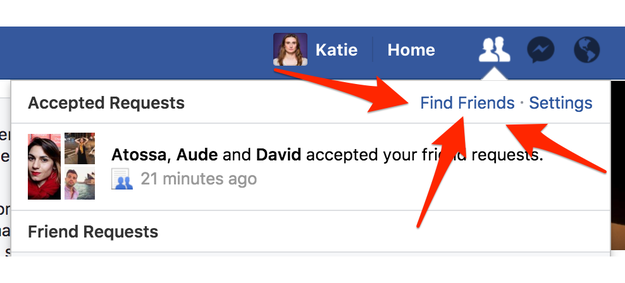
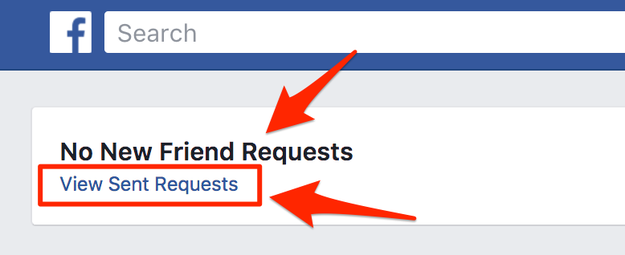
If you're on the Facebook website, you can CLICK THIS LINK to go to the “outgoing requests” page. Or, go into your Friend Requests, then click “view sent requests”.

Click on “Find Friends”

Click on "Find Friends"

Then click on “View Sent Requests” – this is the list of people who have left you pending.

Then click on "View Sent Requests" – this is the list of people who have left you pending.

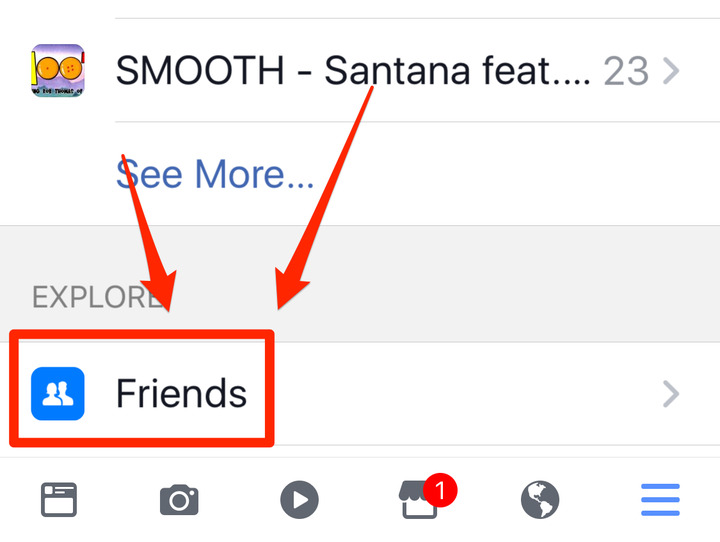
On the mobile Facebook app, go into the 3 lines at the bottom corner.

On the mobile Facebook app, go into the 3 lines at the bottom corner.

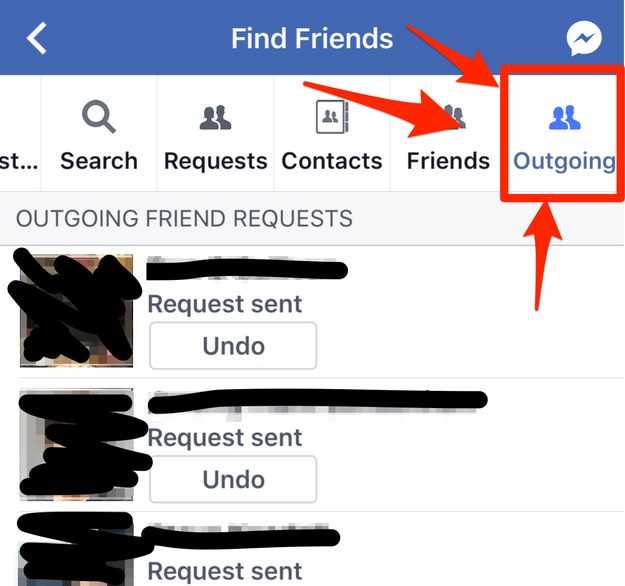
Then go into “Friends.”

Then go into "Friends."

Do this at your own risk – it might be an unexpected blow to your ego to see who hasn't accepted your request!

For example, BuzzFeed's head of U.S. News, just told me she checked her outgoing friend requests, and only one person has been keeping her in friend purgatory: BuzzFeed's CEO.

Quelle: <a href="Here's How To Find Out Who Left Your Facebook Requests Hanging“>BuzzFeed

Facebook Cracks Down On Fake News With New Ad Rules

Justin Sullivan / Getty Images

Facebook is ramping up its fight against fake news.

The company, which was plagued by a wave of fake news in the run up to the 2016 election, is taking another step to prevent these stories from spreading. Today, it announced it will prevent pages that repeatedly share fabricated news stories from running ads on its platform, effectively ending an economic incentive to spread misinformation.

Since Facebook is a prime channel for fake news purveyors use to share false information, the move could deal a blow to their businesses.

“This update will help to reduce the distribution of false news which will keep Pages that spread false news from making money,” Facebook product managers Satwik Shukla and Tessa Lyons explained in a blog post announcing the move. “If a Page repeatedly shares stories that have been marked as false by third-party fact-checkers, they will no longer be able to buy ads on Facebook. If Pages stop sharing false news, they may be eligible to start running ads again.”

Facebook has come a long way since CEO Mark Zuckerberg dismissed the idea that fake news influenced the 2016 election was “pretty crazy.” Outside of these ad restrictions, the company also partnered with third party fact checkers to monitor content on its platform, and will indicate when these fact checkers believe a story is intentionally misleading.

Quelle: <a href="Facebook Cracks Down On Fake News With New Ad Rules“>BuzzFeed

Uber Names Expedia CEO Dara Khosrowshahi As New Chief Executive

Dara Khosrowshahi, chief executive officer of Expedia has been named the new leader at Uber Technologies.

Drew Angerer / Getty Images

Uber Technologies named Dara Khosrowshahi, the chief executive of travel company Expedia, as its new CEO Sunday, bringing an end to a contentious search for a new leader that has been marked by board in-fighting, media leaks and a divisive lawsuit.

Khosrowshahi will take over at the embattled ride-hailing company immediately, leaving his post at the helm of Expedia, which he has led as chief executive for 12 years. The former Allen & Co. Vice President was a shock appointment for the job, beating out much publicized candidates Meg Whitman, the chief executive of HP Enterprise, and Jeff Immelt, the former CEO of General Electric.

A spokesperson for Uber declined to comment.

Despite her July 27 tweeted proclamation “Uber's CEO will not be Meg Whitman,” Whitman was widely rumored as the favorite for the CEO gig at the $69 billion, ride-hail company, along with Immelt. Uber’s board spent two days in determining who would replace former CEO and cofounder Travis Kalanick, but it wasn’t until this late Sunday that it had decided on Khosrowshahi, after Immelt conceded on Sunday morning that the job wasn’t for him.

“I have decided not to pursue a leadership position at Uber,” Immelt wrote on Twitter. “I have immense respect for the company & founders – Travis, Garrett [Camp] and Ryan [Graves].”

Khosrowshahi was a dark horse candidate and was voted in despite a great deal of support for Whitman, a favorite of investor Benchmark, which controls a board seat and is currently pursuing a lawsuit against Kalanick alleging fraud, breach of contract and breach of fiduciary duty. Kalanick resigned in June, and was pushed by Benchmark to do so, after allegations of sexual harassment and discrimination in the company led to two internal investigations into Uber’s workplace culture. His mother also died unexpectedly in a boating accident in May, causing him to take a leave of absence before his resignation.

It remains to be seen how well Kalanick, who still sits on the board and controls two other unoccupied board seats, will work with Khosrowshahi, who has spent more than a decade leading a travel company. Kalanick was staunchly opposed to Whitman, with a person close to him saying that Uber’s cofounder did not trust the HPE CEO, who he viewed as being deceptive about her intentions.

A spokesperson for Kalanick declined to comment.

The incoming CEO will have a lot on their plate at Uber. In addition to the ongoing fallout from two internal investigations into sexual harassment and discrimination and Uber’s workplace culture that launched earlier this year (early Uber investor Benchmark noted in its lawsuit against CEO Travis Kalanick that some of the key recommendations for repairing Uber’s culture still have not been undertaken), Uber is facing a blockbuster trade secrets lawsuit from Google’s self-driving arm Waymo that will go to trial in October. The company also faces a lawsuit from an Indian passenger who says the company mishandled her medical records after she was raped by a driver, as well as regular audits from the FTC over passenger privacy. Though the company now has a CEO, it still has no CFO, and there are almost half a dozen other unfilled executive positions, as top talent continues to exit the company.

Uber’s new leader will have to determine the best path forward for a business that still hemorrhages money. The company lost $1.35 million in the first half of the year, according to unaudited financial statements released by the company to news outlets, and recorded $1.75 billion in net revenue in the second quarter of 2017. That was up from $1.5 billion in the first quarter of this year.

Khosrowshahi may also have to act as a negotiator between Kalanick and Benchmark, whose suit against the former CEO is still on-going. In a Delaware legal filing, Kalanick called the suit a “personal attack” and said that the investment firm had put pressure on him during a time when he was still dealing with the death of his mother.

Benchmark previously released a statement that said that resorting to litigation was a “difficult step,” but a necessary one for the venture capital firm. A spokesperson for the firm declined to comment on the appointment of Uber’s new CEO.

Quelle: <a href="Uber Names Expedia CEO Dara Khosrowshahi As New Chief Executive“>BuzzFeed