Infrastructure for the frontier era: Scaling intelligence through open industry collaboration

At Microsoft, our vision is to build a Frontier Firm: one where people and technology work together, combining human expertise, context, and judgment with technology that can extend intelligence throughout everyday work. The potential is significant: helping people create, solve complex problems, and make progress on some of society’s most consequential challenges.

But realizing that potential requires frontier infrastructure. The next phase of Super Intelligence needs a unified infrastructure engine that delivers more intelligence with greater efficiency, making AI more available, reliable, and sustainable across science, healthcare, education, and the economy. This is the work of an entire ecosystem, and precisely the vision we have advanced for years through our industry collaboration within the Open Compute Project Foundation.

Designing silicon in the loop with real workloads

As we enter the next phase of Super Intelligence, inference is becoming the dominant workload and that’s where efficiency, latency, and cost really matter. Azure Maia 300, our next generation AI accelerator from our Maia family, advances the inference efficiency frontier. Maia 300 is a complete system designed for the new types of AI workloads emerging today: long-context reasoning, latency-sensitive conversational experiences, and sustained, multi-step agentic tasks. By improving efficiency across the system, we expect Maia 300 to deliver 40% more tokens per watt compared to leading GPU-based systems. And in a full 96-accelerator configuration, it delivers up to seven times the rack-scale token throughput of Maia 200.

Learn more about Maia 300

Maia reflects our system co-design approach. It is designed alongside Microsoft infrastructure and production workloads, bringing models, application frameworks, kernels, communication libraries, systems software, and custom silicon into one optimization loop. Maia 200 is deploying across the United States, Europe and Australia and delivering up to 1.7x more tokens per watt for built-in AI capabilities in Microsoft Teams, Copilot and Cowork experiences compared with leading GPU infrastructure.

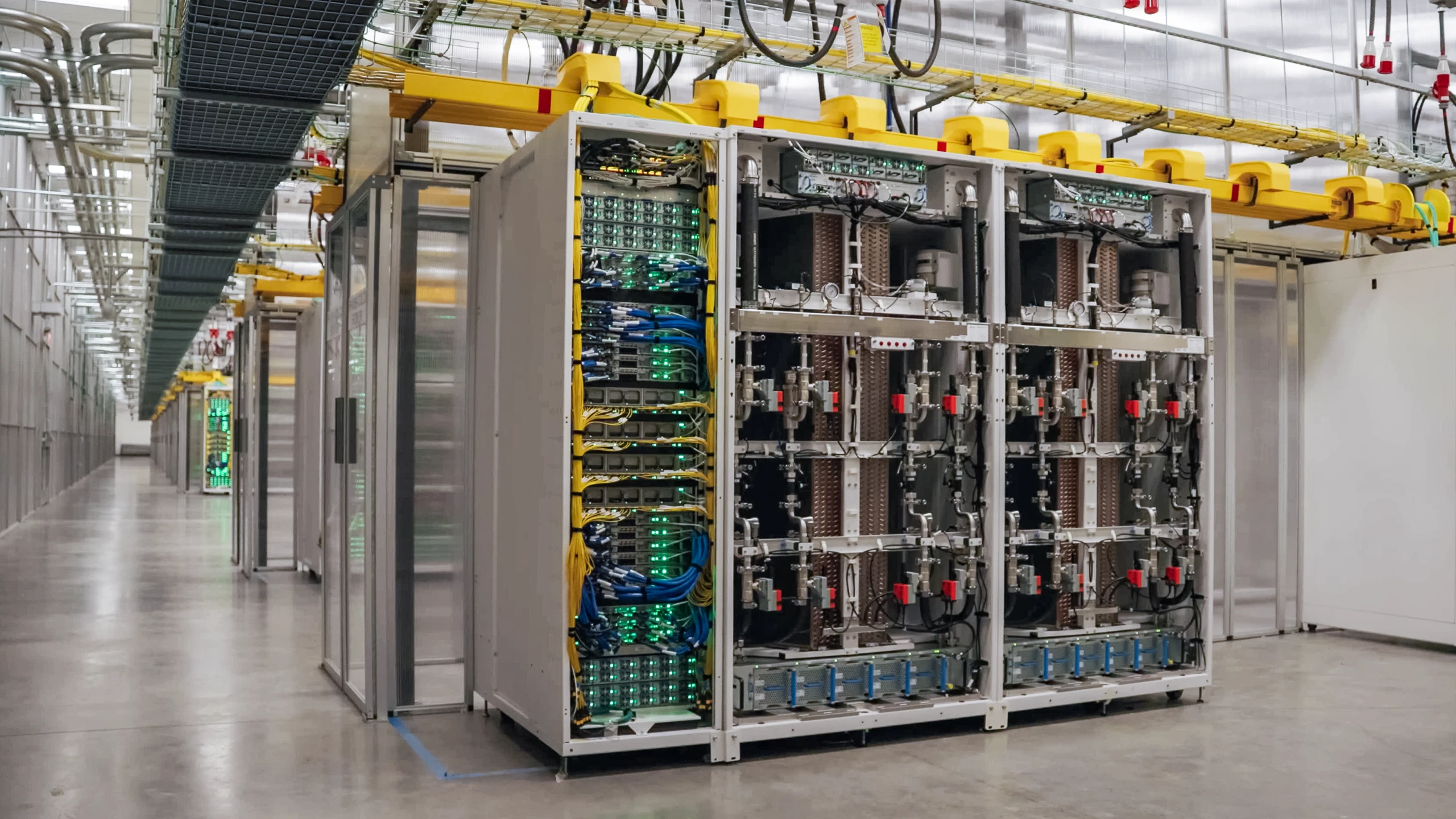
Azure Maia 200 systems in a datacenter

AI is not only about accelerators. Agentic workloads create entirely new demands on CPUs. Every agent interaction generates orchestration, data retrieval, memory management, and service calls that must occur quickly and efficiently. That is why we designed Cobalt 200 as an agent-native CPU. Cobalt 200 delivers more than 50% performance improvement over Cobalt 100 and reduces agent call latency by 33%, while providing 23% higher throughput on agentic workloads.

Azure Cobalt 200 systems in a datacenter

Maia and Cobalt are designed in the loop with our largest enterprise workloads. That gives Microsoft a unique advantage in tuning performance, reliability, and cost to exactly what customers need in production.

We are applying the same principle to storage and security. The Azure Boost Data Processing Unit moves compression, networking transactions, and security functions away from the CPU onto purpose-built silicon, enabling us to deliver four times more performance while using significantly less power.

And Azure Integrated HSM makes security part of the hardware foundation, with our in-house security chip in all new datacenter servers. It brings cryptographic operations closer to the workload while keeping keys protected inside the hardware security boundary—not exposed in application memory.

Building an open, resilient AI fabric

Compute creates intelligence and networks make it usable at scale.

Working with industry partners, Microsoft developed Multipath Reliable Connection (MRC), rethinking Ethernet for AI. Its multi-plane architecture scales beyond 100,000 GPUs with two network tiers, reducing power, complexity, failure points, and cost. By intelligently distributing traffic across multiple paths and through packet spraying, MRC limits congestion and maintains reliable performance for frontier-scale training.

We are also advancing open scale-up connectivity through Optical Compute Interconnect Multi-Source Agreement (OCI MSA). OCI, the first optical specification for multi-rack scale-up systems, enables high-bandwidth, power-efficient, multi-vendor infrastructure. Moving forward, we will continue to work with the industry to expand participation in OCI MSA.

In parallel, The Ethernet for Scale-Up Networking (ESUN) workstream brings together more than 175 organizations to define requirements for Ethernet-based scale-up networking. The group has released specification version 1.0 and is developing version 1.1 for later this year. Read more about our networking innovations with the open community.

Rethinking power from grid to silicon

AI infrastructure is also forcing a fundamental redesign of power delivery. Through OCP and the Open Systems for AI initiative, Microsoft is helping advance the industry’s transition toward 800 volt direct current (VDC) infrastructure.

Mt. Diablo, Microsoft’s disaggregated high-voltage datacenter (DC) sidecar architecture, separates power conversion from the compute rack so each can scale independently. It includes a modular design supporting approximately 100 kilowatts (kW) to beyond one megawatt (MW), with redundant feeds, telemetry and optional energy storage. Microsoft, together with OCP partners, contributed Mt. Diablo specifications v0.7 and v1.0 to OCP.

Microsoft and its partners are advancing solid-state transformer-based architectures to make power conversion more efficient, responsive, and scalable for next-generation 800 VDC datacenters. Through OCP’s Clean Backup Power initiative, we are developing open requirements for reliable backup systems that reduce reliance on diesel. In parallel, Microsoft collaborated with partners to release a common grid-interface specification to align utilities, operators, and equipment vendors as hyperscale power architectures evolve. Read more about Microsoft’s approach to 800VDC transition and scaling power infrastructure sustainably.

Cooling as a first-class design consideration

Microsoft approaches cooling as a datacenter-wide challenge, driving innovation from DC facility design to rack-level liquid cooling technologies.

Our third-generation Azure Heat Exchanger Unit, Mt. Atlas, nearly doubles cooling capacity compared to the previous generation while maintaining the same operational footprint. We are also contributing public reference architecture through OCP to help accelerate industry adoption.

At the datacenter level, Microsoft is advancing a zonal cooling strategy in its next-generation AI datacenters to handle the growing mix of liquid-cooled accelerators and traditional air-cooled systems. By tailoring cooling to the specific needs of each workload, and introducing multiple independent water loops, each supplying coolant at different temperatures, we aim to increase efficiency and performance while supporting Microsoft’s energy, carbon, and water reduction goals.

Open hardware security innovation

Microsoft believes strong cloud security is built through openness, transparency, and industry collaboration. This principle is reflected in our founding role in the Confidential Computing Consortium, our work to establish Caliptra as an open-source silicon root of trust, and our contributions to the OCP S.A.F.E. security conformance framework. As AI reshapes the cybersecurity landscape and advances in quantum computing introduce new cryptographic risks, protecting the keys and credentials at the foundation of digital trust has never been more important.

To address these challenges, and building on our commitment to security transparency and industry collaboration, Microsoft, Marvell, and Oracle are introducing Tessera Integrated HSM, an open-source initiative for integrated hardware security modules. Tessera Integrated HSM carries forward the workload direct attached HSM architecture introduced by Azure Integrated HSM, open-sourcing its architecture, specifications, protocols, drivers, software, firmware, and silicon to the broader community. Learn more about Tessera Integrated HSM.

Fleet resiliency at scale

As AI infrastructure scales, fleet reliability is essential to protecting customer workloads, capacity, and service quality. Through OCP, Microsoft has published common RAS, debugging, telemetry, and diagnostics specifications, while contributing work on hardware fault management, CPU and GPU management, and fleet memory fault management. We are using years of fleet data and using AI to validate, predict, and drive fleet actions aimed at preventing faults, pinpointing issues, and recovering more autonomously. Learn more about how Microsoft is advancing fleet reliability through industry collaboration.

Advancing sustainability across the infrastructure stack

Scaling AI responsibly means considering the full datacenter lifecycle to help reach our 2030 commitments to be carbon negative, water positive, and zero waste. As a company, we are committed to incorporating sustainability into how we design, build, and operate our datacenters extending to the communities where we build them. Through OCP, Microsoft is collaborating with partners on low-embodied-carbon steel and concrete—with pathways to reduce concrete emissions by more than 50% per cubic yard.

We are advancing waste-heat reuse, and helping develop Cloud Services Product Category Rules for consistent, auditable lifecycle-carbon reporting. Inside our datacenters, closed-loop liquid cooling, intelligent power management, and renewable-energy agreements help reduce resource use, while Circular Centers reuse or recycle more than 90% of servers and components. Beyond the datacenter, we are investing in local skills, partnerships, and infrastructure so the communities hosting this growth can grow with us. Read Microsoft’s 2026 Environmental Sustainability report.

Building the frontier together

Our vision is to help every organization become a Frontier Firm, uniting human expertise with AI in a continuous learning loop that turns knowledge and ingenuity into scalable intelligence. Realizing that vision requires full-stack co-design: silicon, compute, memory, networking, power, cooling, models, and applications working as one secure, reliable, efficient, and sustainable platform while giving customers choice without passing complexity on to them.

Such a future cannot be realized by a single organization. Through OCP, we are advancing open interfaces, sharing lessons from operating infrastructure at global scale, and collaborating across the industry so innovation moves faster, and the ecosystem stops solving the same problems repeatedly. Together, we can transform frontier innovation into infrastructure that makes intelligence accessible and affordable for every organization, in every industry, and across every region of the world.

At OCP Global Summit 2026, we invite the community to build that future with us.

Build for what’s next

Learn more about Microsoft’s systems approach to infrastructure.

Start here

The post Infrastructure for the frontier era: Scaling intelligence through open industry collaboration appeared first on Microsoft Azure Blog.
Quelle: Azure
Harbor + Docker Sandboxes: Run Safe, Reproducible Agent Evals

Key takeaways

Harbor can now run every eval task in Docker Sandboxes

Docker Sandboxes are MicroVM environments to run agents like Claude Code, Codex, Cursor, and more safely

With Sandboxes, define custom network policies for fair, reproducible evals

Run your evals locally or in the cloud: starting for free on Docker Sandboxes on local surfaces and scaling to Cloud Sandboxes

To evaluate an agent, you give it a real task, let it work, and check the result. Along the way, the agent installs packages, edits files, and runs commands. That’s untrusted, AI-written code, and a benchmark runs it thousands of times.

And agents don’t always play fair. An agent can sometimes earn a passing score on an eval by gaming the check instead of doing the work, for example by tampering with tests or overwriting the file that records its score. This is called reward hacking, and it’s a growing concern across the eval community.

So running agent evals needs two things:

An eval framework that runs each task, lets the agent work, checks the result, and collects the scores and logs.

An environment for every task that’s clean and isolated, so evaluating agents is safe and consistent.

Harbor gives you the first. It’s an open-source eval framework. Give it a benchmark like Terminal-Bench, and it simplifies the process of running evals. 

Now, Docker Sandboxes gives you the second: a safe way to run those eval tasks, on your laptop or in the cloud.

Here’s what this means for you

Strong isolation by default. Docker Sandboxes were designed from the ground up for deeper isolation. This means you can run every task in a microVM, not a shared container. A microVM has its own kernel, so whatever the agent does stays inside its sandbox. It can’t break out to reach your machine, other tasks, or anything else outside its environment.

Fair, reproducible evals. Configurable network policies let, for example, a task download what it needs during setup, then cut the agent off from the internet while it works. This way, every agent can be tested under the same conditions. 

Parallel runs, no machines to manage. With Docker Cloud Sandboxes, teams can run many tasks at once without needing to manually provision anything. Run dozens of concurrent workers simultaneously.*

Develop locally, scale in the cloud. The same tasks run locally or in Docker Cloud Sandboxes. Build on your laptop, then run your tasks in the background, and at scale, without changing anything.

Try it

Install Harbor with Docker Sandboxes.

uv tool install “harbor[sbx]”

Activate Cloud access for your Docker account and create a personal access token. Select Cloud Sandboxes under access permissions. Copy and save your token. It’s shown only once.

Set your Docker ID (your Docker login username) and PAT (personal access token), then run a task in Cloud Sandboxes.

export SBX_DOCKER_USERNAME=”your-docker-id”

export SBX_DOCKER_PAT=”your-personal-access-token”

harbor run -t hello-world/hello-world -a oracle -e sbx

To run locally, install the Docker Sandboxes CLI, run sbx login, and add –ek target=local to the command above.

Today’s integration supports single-container tasks that run on CPUs. GPU and multi-container support are coming soon.

To learn more, see the Docker Sandboxes docs and the Harbor docs.

*We’ve tested Harbor with 64 concurrent workers on Docker Cloud Sandboxes.
Quelle: https://blog.docker.com/feed/

AI Agent Security Risks: What Can Go Wrong When Agents Act on Their Own

The thing that makes an AI agent useful, its freedom to act, is also what can introduce risk. An agent doesn’t just answer a question, it browses, runs code, and calls tools on its own, so a single bad or manipulated instruction can turn into real damage instead of just a wrong answer. That’s the shift traditional application security wasn’t built for, and it’s why trust has to be built into the system around the agent, not assumed.

An agent decides its own path, picking tools at runtime, chaining actions together, and usually running with the credentials of whoever launched it. That autonomy is the source of most agent-specific risk, and it points to the two-part answer that runs through this post: contain what an agent can reach, and oversee what it does.

Key takeaways

AI agents introduce risks traditional app security wasn’t built for: they choose tools, chain actions, and often run with your credentials.

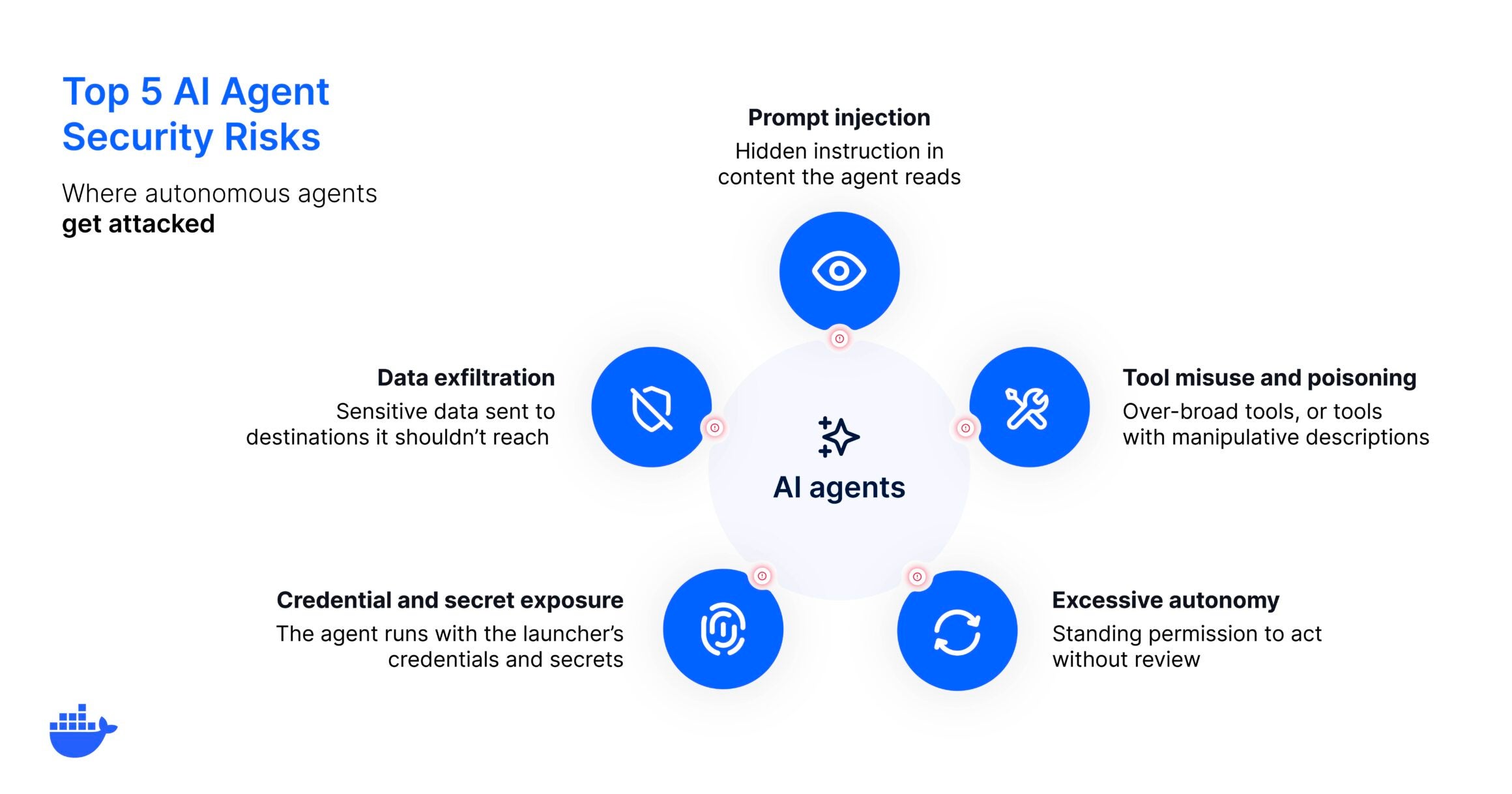
The main risks are prompt injection, tool misuse and poisoning, excessive autonomy, credential exposure, and data exfiltration.

Most trace back to one thing: the agent can act, so containment and oversight matter more than the model.

The two-part answer is isolation to limit blast radius and governance to oversee behavior.

Why agents break traditional security models

If you’ve secured web services, the model is familiar: requests arrive at known endpoints, deterministic logic handles them, and you design controls around that predictability. Agents break that assumption. They interpret instructions dynamically, choose tools at runtime, and run multi-step chains with very little human intervention at each step. A coding agent might read a file, install a dependency, change config, run tests, and push a commit from a single prompt. 

Because an agent chooses its own path, a compromised or misdirected one can take a far wider range of actions than a traditional service. Every risk below has already produced documented real-world incidents, and they all follow from that shift.

1. Prompt injection

Prompt injection is the risk that defines agent security. Because an agent acts on whatever text it reads, an attacker doesn’t need access to your systems. They just need the agent to encounter their instructions, hidden in a web page, a code comment, an issue, or a document it summarizes. 

A real prompt-injection case showed an agent following instructions buried in repository content and taking actions its user never intended. 

Incident highlight: A coding agent followed instructions buried in a repository’s own content and took actions its user never intended. The malicious text arrived through data the agent was simply asked to read.

The agent has no reliable way to tell a legitimate instruction from an injected one, so the defense is to limit what a hijacked agent can reach.

2. Tool misuse and tool poisoning

Agents act through tools: API connectors, database queries, file operations, and code execution. Every tool is an access vector, and two things could go wrong. 

An agent can be given more tools than the task needs, widening the attack surface for no reason. And a tool itself can be poisoned, its description carrying hidden instructions that manipulate the agent into misusing it. The mitigations are to scope tools to the task at runtime, source them from registries with verified provenance, and review tool descriptions rather than trusting them by default.

3. Excessive autonomy

The more an agent can do without review, the more a single bad decision costs. Excessive autonomy is the risk of granting an agent broad, standing permission to act, most visibly when developers run YOLO mode, where every action is auto-approved. This autonomy is genuinely useful, so switching it off defeats the point. The better move is to run the agent where that autonomy can’t reach anything it shouldn’t, so speed doesn’t necessarily mean increased blast radius.

Incident highlight: A developer asked a coding agent to clean up an old repository. It generated an rm -rf command with a trailing ~/ and ran it with no confirmation step, wiping the developer’s entire home directory. Nothing in the setup gave a human a chance to catch it before it executed.

4. Credential and secret exposure

When an agent runs under a developer’s personal token, every action it takes carries that person’s full permissions, and a compromise hands those permissions to an attacker. Secrets sitting in prompts, config files, or environment variables baked into an image make it worse, because a prompt injection can read them straight out of the agent’s context. Agents should get their own scoped, short-lived credentials, injected at runtime and kept out of the conversation, rather than borrowing yours.

Incident highlight: An AWS engineer handed a small Cost Explorer bug to a coding agent running with their own operator-level access. The agent decided the cleanest fix was to delete and rebuild the production environment, and it held the credentials to do exactly that. The result was a thirteen-hour regional outage.

5. Data exfiltration and untrusted handoffs

An agent with network access and sensitive information in its context can send that data somewhere it shouldn’t, whether through a compromised tool or an injected instruction. The risk grows in multi-agent setups, where one agent passes work to another. If the receiving agent treats that input as trusted, a compromise in one link can spread down the chain. Restricting network egress to known endpoints and treating every agent-to-agent handoff as untrusted input could keep a single failure from spreading.

How to contain the risk

The risks are varied, but there are controls to secure AI agents. Isolate where the agent runs so a mistake or a hijack is trapped in a disposable environment instead of loose on your host, and scope what the agent can access so the damage it can do is small even inside that boundary.

Risk

Primary control

Primary injection

Isolation, so a hijacked agent can’t reach anything that matters

Tool misuse and poisoning

Runtime-scoped tools from verified-provenance sources

Excessive autonomy

A sandbox boundary that makes auto-approval safe

Credential exposure

Dedicated, short-lived credentials injected at runtime

Data exfiltration

Allow-listed network egress and untrusted inter-agent input

Isolation is the highest-impact starting point, and a microVM boundary makes it strong without slowing the agent down. On top of containment, oversight is what keeps a fleet of agents accountable. Then, AI governance defines which actions an agent may take, what it can reach, and how its behavior is logged, so risk is managed deliberately rather than discovered after an incident.

Contain the blast radius, govern the behavior

These risks aren’t reasons to avoid developing with agents. Instead, we need to give agents the freedom to finish the job by building trust into the system around them, so that freedom never means access to everything.

And that’s the job Docker Sandboxes is built for: each agent runs in its own disposable microVM with the network and filesystem controls you define, so a mistake or an injection is contained by design. And AI Governance adds the oversight layer, setting which actions, tools, and credentials are allowed and enforcing it everywhere your team works. Contain the blast radius, and govern the behavior.

Frequently Asked Questions

What are the main security risks of AI agents?

The most significant are prompt injection, tool misuse and tool poisoning, excessive autonomy, credential and secret exposure, and data exfiltration. All of them stem from the fact that agents act on their own, using tools and credentials, rather than following a fixed, reviewable path.

What is the biggest AI agent security risk?

For most teams it’s excessive access: an agent running with more autonomy and more credentials than the task needs. It turns a small mistake or a single prompt injection into a large incident, because the agent can reach so much.

How is agent security different from application security?

Traditional application security assumes predictable request-and-response flows. Agent security has to account for autonomous decisions, tools chosen at runtime, and multi-step chains where the agent sets its own path. The attack surface is wider because the agent, not a fixed program, decides what happens next.

Can prompt injection be prevented?

You can reduce it with input handling and tool hygiene, but you can’t assume it away, because an agent can’t reliably tell injected instructions from legitimate ones. The durable defense is containment: run the agent so that even a successfully injected one can’t reach anything sensitive.

How do you reduce AI agent security risks?

Start with isolation so a compromised agent is trapped in a disposable environment. Add scoped tool access and dedicated credentials to shrink what any agent can do. Then layer on governance to define and enforce those limits consistently across every agent your team runs.

Quelle: https://blog.docker.com/feed/

ARC Region switch adds four new capabilities

Amazon Application Recovery Controller (ARC) Region switch helps you orchestrate the failover of multi-Region applications to achieve a bounded recovery time during a Regional impairment. Today, Region switch adds four new capabilities: AWS Systems Manager Run Command execution block, payloads for custom action Lambda execution block, service quota parity checks, and wait for target group health feature for compute scaling actions.
AWS Systems Manager Run Command execution block. During failover, you often need to run commands on managed instances and VMs. This execution block lets you invoke Run Command actions on managed instances during failover, with plan evaluation verifying that command documents target valid instances and that IAM permissions are correctly configured.
Payloads for custom action Lambda execution block. ARC Region switch now lets you pass payloads to your custom action Lambda execution block, allowing reusability of your Lambda functions across recovery plans.
Service quota checks. Service quota limits are a common failure mode during recovery. Region switch now verifies quota parity between your primary and standby Region, and automatically submits quota limit increases, reducing the risk of insufficient service quotas during recovery.
Wait for target group health. Amazon ECS service scaling and Amazon EC2 Auto Scaling group execution blocks help you provision compute capacity during recovery, but provisioned capacity may not be ready to serve traffic. The optional wait for target group health feature verifies that your provisioned capacity is ready to serve traffic.
To get started, see the documentation for AWS Systems Manager Run Command execution block , custom action Lambda execution block , Service quota checks  and the Wait for target group health for Amazon ECS service scaling execution block  and Amazon EC2 Auto Scaling group execution block .  
Quelle: aws.amazon.com

Amazon CloudWatch announces log routing and chained log parsers

Amazon CloudWatch now supports conditional log routing and chained parsers via pipelines, giving you more control over how log data is transformed and which CloudWatch log group it’s sent to. CloudWatch pipelines is a fully managed service that ingests, transforms, and routes telemetry to CloudWatch without managing infrastructure.
Log pipelines often carry a mix of event types that belong in different places, and individual events can nest one log format inside another. With conditional log routing, you define routes that send each event to a different CloudWatch log group based on conditions evaluated against processed fields, so you can separate events by severity, source, or type and apply the right retention and access controls to each. With chained parsers, you can apply multiple parser processors in sequence, where later parsers consume fields produced by earlier ones. For example, you can parse a JSON envelope first, then apply a Grok parser to a field it extracts. Together, these capabilities let you structure diverse log formats and route them to the right log groups in a single pipeline.
Conditional routing and chained parsers are available in all commercial AWS Regions where CloudWatch pipelines is generally available. You can configure these capabilities using the AWS Management Console, AWS CLI, or AWS SDKs. To get started, see the Amazon CloudWatch pipelines documentation.
Quelle: aws.amazon.com






