Neue Fertigung in Houston: Apple entfernt Foxconn-Schriftzug in Pressebild
Apple wird seine Fertigung in Houston ausbauen – Hinweise auf Foxconn werden in einem Pressebild allerdings getilgt. (Apple, Mac)
Quelle: Golem

Apple wird seine Fertigung in Houston ausbauen – Hinweise auf Foxconn werden in einem Pressebild allerdings getilgt. (Apple, Mac)
Quelle: Golem
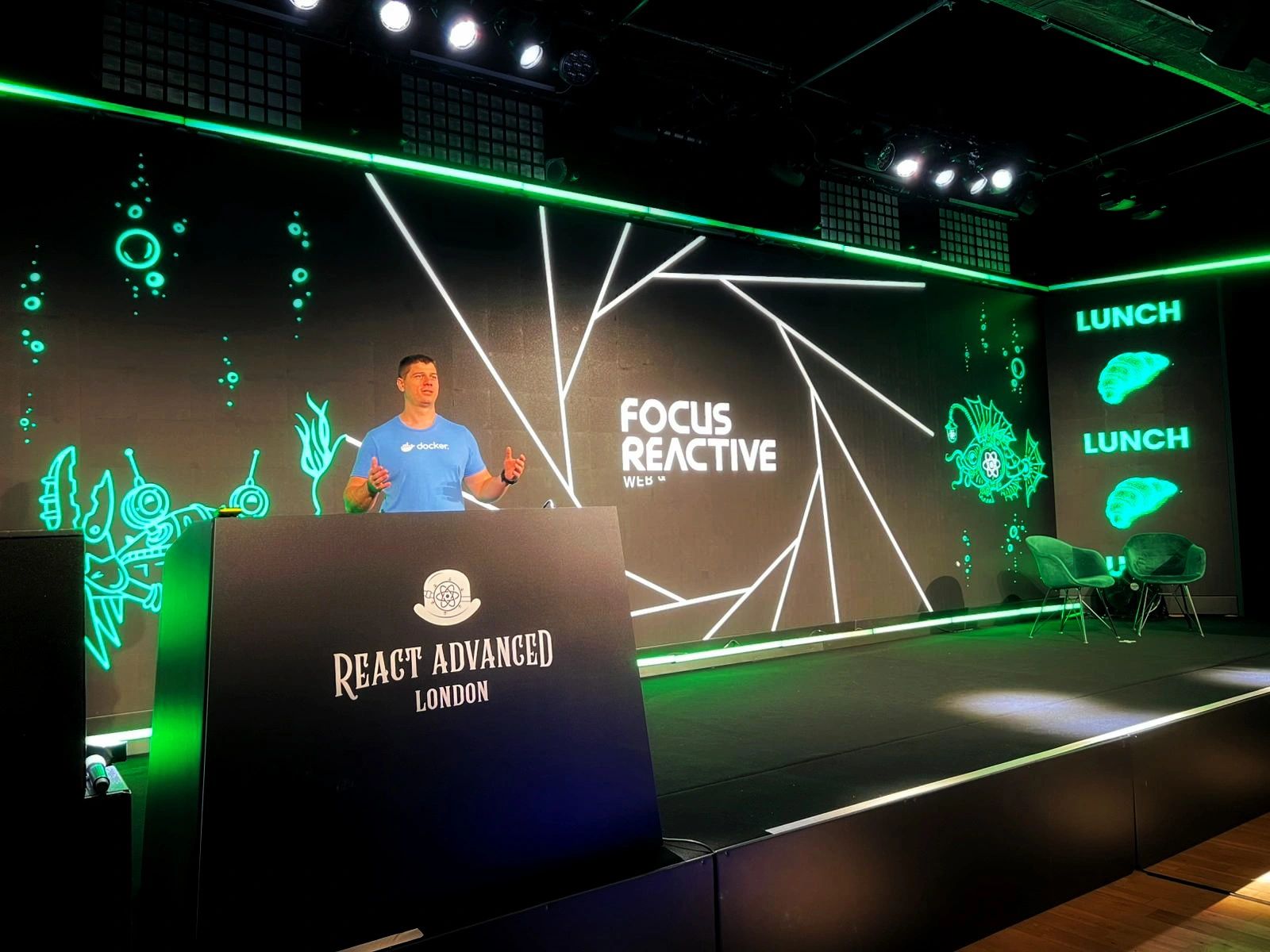
Docker Captains are leaders from the developer community that are both experts in their field and are passionate about sharing their Docker knowledge with others. “From the Captain’s Chair” is a blog series where we get a closer look at one Captain to learn more about them and their experiences.
Today we are interviewing Kristiyan Velkov, a Docker Captain and Front-end Tech Lead with over a decade of hands-on experience in web development and DevOps.
Kristiyan builds applications with React, Next.js, Angular, and Vue.js, and designs modern front-end architectures. Over the years, Docker has become a core part of his daily work — used as a practical tool for building, testing, and deploying front-end applications in a predictable way.
He focuses on production-ready Docker setups for front-end teams, including clean Dockerfiles, multi-stage builds, and CI/CD pipelines that work consistently across environments. His work is grounded in real projects and long-term maintenance, not theoretical examples.
Kristiyan is the author of four technical books, one of which is “Docker for Front-end Developers”. He actively contributes to open-source projects and is the person behind several official Docker guides, including guides for React.js, Node.js, Angular, Vue.js, and related front-end technologies.
Through writing, open source,speaking and mentoring, he helps developers understand Docker better — explaining not just how things work, but why they are done a certain way.
As a Docker Captain, his goal is to help bridge the gap between front-end developers and DevOps teams.
Can you share how you first got involved with Docker?
I first started using Docker because I was tired of making the excuse “it works on my machine”. We didn’t have many DevOps people, and the ones we had didn’t really know the front-end or how the application was supposed to behave. At the same time, I didn’t know Docker. That made communication difficult and problems hard to debug.
As a front-end developer, I initially thought Docker wasn’t something I needed to care about. It felt like a DevOps concern. But setting up projects and making sure they worked the same everywhere kept causing issues. Docker solved that problem and completely changed the way I work.
At first, Docker wasn’t easy to understand. But the more I used it, the more I saw how much simpler things became. My projects started running the same across environments, and that consistency saved time and reduced stress.
Over time, my curiosity grew and I went deeper — learning how to design well-structured, production-ready Dockerfiles, optimize build performance, and integrate Docker into CI/CD pipelines following clear, proven best practices, not just setups that work, but ones that are reliable and maintainable long term.
For me, Docker has never been about trends. I started using it to reduce friction between teams and avoid recurring problems, and it has since become a core part of my daily work.
What inspired you to become a Docker Captain?
What inspired me to become a Docker Captain was the desire to share the real struggles I faced as a front-end developer. When I first started using Docker, I wasn’t looking for recognition or titles — I was just trying to fix the problems that were slowing me down and it was hard to explain to some DevOps developers what and why this should work like that without knowing the DevOps terms.
I clearly remember how exhausting it was to set up projects and how much time I wasted dealing with environment issues instead of real front-end work. Docker slowly changed the way I approached development and gave me a more reliable way to build and ship applications.
At some point, I realized I wasn’t the only one in this situation. Many front-end developers were avoiding Docker because they believed it was only meant for back-end or DevOps engineers. I wanted to change that perspective and show that Docker can be practical and approachable for front-end developers as well.
That’s also why I wrote the book Docker for Front-end Developers, where I explain Docker from a front-end perspective, using a real React.js application and walking through how to containerize and deploy it to AWS, with practical code examples and clear diagrams. The goal was to make Docker understandable and useful for people who build user-facing applications every day.
I also contributed official Docker guides for React.js, Angular, and Vue.js — not because I had all the answers, but because I remembered how difficult it felt when there was no clear guidance.
For me, becoming a Docker Captain was never about a title. It has always been about sharing what I’ve learned, building a bridge between front-end developers and containerization, and hopefully making someone else’s journey a little easier than mine.
What are some of your personal goals for the next year?
Over the next year, I want to continue writing books. Writing helps me structure my own knowledge, go deeper into the topics I work with, and hopefully make things clearer for other developers as well. I also want to push myself to speak at more conferences. Public speaking doesn’t come naturally to me, but it’s a good way to grow and to share real, hands-on experience with a broader audience and meet amazing people. I plan to keep contributing to open-source projects and maintaining the official Docker guides I’ve written for Angular, Vue.js, and React.js. People actively use these guides, so keeping them accurate and up to date is important to me. Alongside that, I’ll continue writing on my blog and newsletter, sharing practical insights from day-to-day work.
If you weren’t working in tech, what would you be doing instead?
If I weren’t working in tech, I’d probably be a lawyer — I’m a law graduate. Studying law gave me a strong sense of discipline and a structured approach to problem-solving, which I still rely on today. Over time, though, I realized that technology gives me a different kind of fulfillment. It allows me to build things, create practical solutions, and share knowledge in a way that has a direct and visible impact on people. I don’t think anything else would give me the same satisfaction. In tech, I get to solve problems every day, write code, contribute to open-source projects, write books, and share what I’ve learned with the community. That mix of challenge, creativity, and real impact is hard to replace. Law could have been my profession, but technology is where I truly feel at home.
Can you share a memorable story from collaborating with the Docker community?
One of my most memorable experiences with the Docker community was publishing my open-source project frontend-prod-dockerfiles, which provides production-ready Dockerfiles for most of the popular front-end applications. I originally created it to solve a gap I kept seeing: front-end developers didn’t have a clear, reliable reference for well-structured and optimized Dockerfiles.
The response from the community was better than I expected. Developers from all over the world started using it, sharing feedback and suggesting ideas I hadn’t even considered.
That experience was a strong reminder of what makes the Docker community special — openness, collaboration, and a genuine willingness to help each other grow.
The Docker Captains Conference in Turkey (2025) was amazing. It was well organized, inspiring, and full of great energy. I met great people who share the same passion for Docker.
What’s your favorite Docker product or feature right now, and why?
Right now, my favorite Docker features are Docker Offload and Docker Model Runner.
Offload is a game-changer because it lets me move heavy builds and GPU workloads to secure cloud resources directly from the same Docker CLI/Desktop flow I already use. I don’t have to change the way I work locally, but I get cloud-scale speed whenever I need it.
Model Runner lets me run open models locally in just minutes. And when I need more power, I can pair it with Offload to scale out to GPUs.
Can you walk us through a tricky technical challenge you solved recently?
A recent challenge I dealt with was reviewing Dockerfiles that had been generated with AI. A lot of developers were starting to use AI in our company, but I noticed some serious problems right away, images that were too large, broken caching, hardcoded environment variables, and containers running as root. It was a good reminder that while AI can help, we still need to carefully review and apply best practices when it comes to security and performance.
What’s one Docker tip you wish every developer knew?
One tip I wish every developer knew is that Docker is for everyone, not just DevOps or back-end developers. Front-end developers can benefit just as much by using Docker to create consistent environments, ship production-ready builds, and collaborate more smoothly with their teams. It’s not just infrastructure , it’s a productivity boost for the whole stack. I saw a racing number of tech jobs required to have such kind of basic knowledge which overall is positive.
If you could containerize any non-technical object in real life, what would it be and why?
If I could containerize any non-technical object, it would be a happy day. I’d package a perfectly joyful day and redeploy it whenever I needed , no wasted hours, no broken routines, just a consistent, repeatable “build” of happiness.
Where can people find you online?
On LinkedIn, x.com and also my website. I regularly write technical articles on Medium and share insights in my newsletter Front-end World. My open-source projects, including production-ready Dockerfiles for front-end frameworks, are available on GitHub.
Rapid Fire Questions
Cats or Dogs?
Both, I love animals.
Morning person or night owl?
Morning person for study, night owl for work.
Favorite comfort food?
Pasta.
One word friends would use to describe you?
Persistent
A hobby you picked up recently?
Hiking, I love nature
Quelle: https://blog.docker.com/feed/
Amazon Elastic Kubernetes Service (Amazon EKS) Node Monitoring Agent is now open source. You can access the Amazon EKS Node Monitoring Agent source code and contribute to its development on GitHub. Running workloads reliably in Kubernetes clusters can be challenging. Cluster administrators often have to resort to manual methods of monitoring and repairing degraded nodes in their clusters. The Amazon EKS Node Monitoring Agent simplifies this process by automatically monitoring and publishing node-level system, storage, networking, and accelerator issues as node conditions, which are used by Amazon EKS for automatic node repair. With the Amazon EKS Node Monitoring Agent’s source code available on GitHub, you now have visibility into the agent’s implementation, can customize it to fit your requirements, and can contribute directly to its ongoing development. The Amazon EKS Node Monitoring Agent is included in Amazon EKS Auto Mode and is available as an Amazon EKS add-on in all AWS Regions where Amazon EKS is available. To learn more about the Amazon EKS Node Monitoring Agent and node repair, visit the Amazon EKS documentation.
Quelle: aws.amazon.com
AWS AppConfig today launched a new integration that enables automated, intelligent rollbacks during feature flag and dynamic configuration deployments using New Relic Workflow Automation. Building on AWS AppConfig’s third-party alert capability, this integration provides teams using New Relic with a solution to automatically detect degraded application health and trigger rollbacks in seconds, eliminating manual intervention. When you deploy feature flags using AWS AppConfig’s gradual deployment strategy, the AWS AppConfig New Relic Extension continuously monitors your application health against configured alert conditions. If issues are detected during a feature flag update and deployment, such as increased error rates or elevated latency, the New Relic Workflow automatically sends a notification to trigger an immediate rollback, reverting the feature flag to its previous state. This closed-loop automation reduces the time between detection and remediation from minutes to seconds, minimizing customer impact during failed deployments.
Quelle: aws.amazon.com
Starting today, the general-purpose Amazon EC2 M8a instances are available in AWS Europe (Frankfurt) region. M8a instances are powered by 5th Gen AMD EPYC processors (formerly code named Turin) with a maximum frequency of 4.5 GHz, deliver up to 30% higher performance, and up to 19% better price-performance compared to M7a instances. M8a instances deliver 45% more memory bandwidth compared to M7a instances, making these instances ideal for even latency sensitive workloads. M8a instances deliver even higher performance gains for specific workloads. M8a instances are up to 60% faster for GroovyJVM benchmark, and up to 39% faster for Cassandra benchmark compared to Amazon EC2 M7a instances. M8a instances are SAP-certified and offer 12 sizes including 2 bare metal sizes. This range of instance sizes allows customers to precisely match their workload requirements. M8a instances are built using the latest sixth generation AWS Nitro Cards and ideal for applications that benefit from high performance and high throughput such as financial applications, gaming, rendering, application servers, simulation modeling, mid-size data stores, application development environments, and caching fleets. To get started, sign in to the AWS Management Console. Customers can purchase these instances via Savings Plans, On-Demand instances, and Spot instances. For more information visit the Amazon EC2 M8a instance page.
Quelle: aws.amazon.com
AWS Elemental Inference, a fully managed Artificial Intelligence (AI) service that enables broadcasters and streamers to automatically generate vertical content and highlight clips for mobile and social platforms in real time, is now generally available. The service applies AI capabilities to live and on-demand video in parallel with encoding and helps companies and creators to reach audiences in any format without requiring AI expertise or dedicated production teams.
With Elemental Inference you can process video once and optimize it everywhere—creating main broadcasts while simultaneously generating vertical versions for TikTok, Instagram Reels, YouTube Shorts, Snapchat, and other mobile platforms in parallel with live video. For example, sports broadcasters can automatically generate vertical highlight clips during live games and distribute them to social platforms in real-time, capturing viral moments as they happen rather than hours later.
The service launches with two AI features: vertical video cropping that transforms live and on-demand landscape broadcasts into mobile-optimized formats, and advanced metadata analysis that identifies key moments to generate highlight clips from live content. Using an agentic AI application that requires no prompts or human-in-the-loop intervention, broadcasters can scale content production without adding manual workflows or production staff—the system automatically adapts content for each platform. In beta testing, large media companies achieved 34% or more savings on AI-powered live video workflows compared to using multiple point solutions.
AWS Elemental Inference is available in the following AWS Regions: US East (N. Virginia), US West (Oregon), Asia Pacific (Mumbai), and Europe (Ireland).
For more information, visit the AWS News Blog or explore the AWS Elemental Inference documentation.
Quelle: aws.amazon.com

Gut verfügbar, bezahlbar und ideal für eine Kreislaufwirtschaft seien Natrium-Ionen-Akkus. Jahrelange Forschungsarbeit muss aufgeholt werden. (Energiewende, Akku)
Quelle: Golem

Die In-Ear-Kopfhörer Soundcore P40i mit adaptivem ANC, BassUp-Technologie und 60 Stunden Spielzeit sind bei Amazon reduziert. (Kopfhörer, Audio/Video)
Quelle: Golem

Hier könnt ihr eure Fragen zu digitaler Souveränität loswerden! Löchert unseren Experten bei unserem ersten Live-Video-AMA am 10. März. (Digitale Souveränität, KI)
Quelle: Golem

Durch eine zwischen Meta und AMD getroffene Vereinbarung könnte der Softwarekonzern Anteile von zehn Prozent am Chiphersteller erhalten. (KI, AMD)
Quelle: Golem






