IT-Expertin Sophie Seiwald-Højer: "In 'IT' steckt viel Legacy"
Sophie Seiwald-Højer ist eine erfahrene IT-Expertin. Warum sie denkt, dass der Begriff IT von gestern ist. (Chefs von Devs, Wirtschaft)
Quelle: Golem

Sophie Seiwald-Højer ist eine erfahrene IT-Expertin. Warum sie denkt, dass der Begriff IT von gestern ist. (Chefs von Devs, Wirtschaft)
Quelle: Golem
This is part of the Powered by Docker series, where we feature use cases and success stories from Docker partners and practitioners. This story was contributed by Ryan Wanner. Ryan has more than fifteen years of experience as an entrepreneur and 3 years in AI space developing software and is the founder of Open Source Genius.
Open Source Genius is a start-up that helps organizations navigate an AI-powered future by building practical, human-centered AI systems. In early 2025, OSG had a good problem: demand. With multiple ventures ramping up, they were shipping more AI solutions and generating more documentation, processes, and assets to manage. But as decks, PDFs, and SOPs piled up, so did the time-sucking chaos: files were misnamed, folders got messy, and teams were constantly hunting for the “real” version of a doc in Slack threads.
OSG called it entropy debt. Instead of hiring ops or layering on another SaaS tool, they built something smarter: an AI-powered file automation agent using Docker’s MCP Toolkit and Claude Desktop. It saves the team two hours per person every week!
Here’s how they did it and what they gained.
The Challenge
OSG’s mission is ambitious – to create over $100M in small business value by 2027 through modular solutions deployed across multiple ventures.
With active projects at Hideout Golf Club, Music City Energy Spa, MHCP USA, and more, the team was generating critical documents constantly: mission/vision frameworks, brand guardrails, operational SOPs (like their comprehensive 4-T Resource Manager tracking Talent, Tech, Tangible Assets, and Tides), business one-pagers, pitch decks, and reference materials. Each venture needed its own organized knowledge base, but the manual overhead was becoming a bottleneck.
This created what the team called entropy debt—time lost to:
Renaming files to match ever‑shifting conventions
Drag‑and‑dropping assets into ad‑hoc folders
Ping‑ponging links in Slack to find “the latest” version
OSG’s team was drowning in files. With 15-30 documents landing in downloads folders daily across multiple business ventures and departments, the chaos was constant. Updated pitch decks, revised SOPs, new brand guidelines—each one needed attention, but nobody had time to properly organize them.
The team faced three equally frustrating options:
Take time to manually rename and organize—pulling people away from higher-value work
Delegate the task to someone else—adding to someone’s already-full plate
Use the search function and hope it works—often ending in Slack messages like “Can someone send me the latest Brand Guardrails?”
OSG tried various organizational systems, but they all required discipline and consistency across a distributed team. The team realized that if they needed to build a system robust enough for effective delegation, they could instead build a process to solve it with automation.
With this increase in lost time and productivity, the founders were looking to create a repeatable, low‑overhead fix, but also one that came with no extra SaaS fees or dedicated ops hire.
The Solution — The Entropy Agent Inside OSG
Enter the solution – OSG built the Entropy Agent in Claude Desktop and hosted supporting MCP servers on Docker Desktop.
Why did OSG choose Docker MCP Catalog and Toolkit?
As an existing Docker practitioner, the OSG Team was already familiar with the platform and had it running locally. When Docker announced MCP support, it was a natural fit—no new approvals needed, no cloud dependencies, and all processing stays on their local machines. For a team that values “In God we trust; all others bring data,” the ability to maintain complete control over sensitive operational documents—tracking everything from employee scorecards to $4.2M in real estate holdings to proprietary business methodologies—was non-negotiable.
OSG team chose the Docker MCP Catalog and Toolkit for its simple, secure approach to discovering, running, and managing MCP servers. True to their value of “Think Big, Act Small,” the setup process took under 1 hour from discovery to first successful file routing. With one-click integration into Claude Desktop, there’s no need for manual configuration files or complex networking—each MCP server is ready to go out of the box.
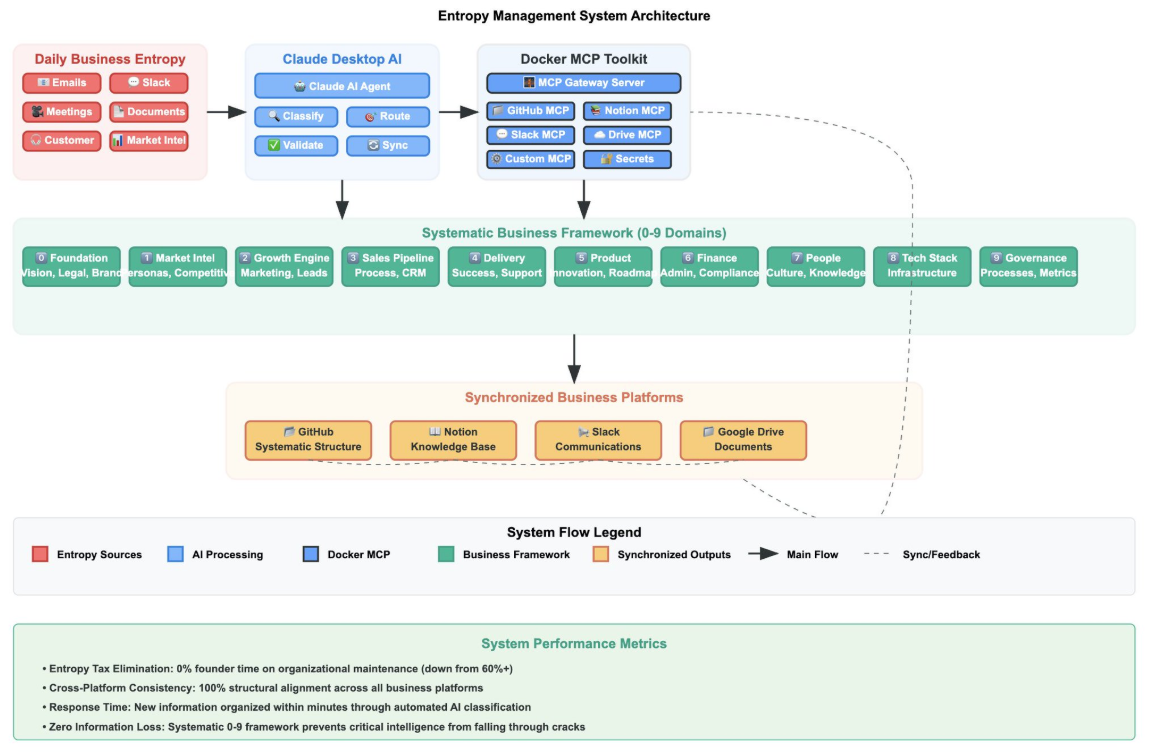
The architecture mirrors the diagram shared by the founders:
Claude Desktop AI – Classifies incoming files, validates they belong in the BOS, routes commands, and syncs updates.
Docker MCP Toolkit – Runs an MCP Gateway Server that exposes callable services. The first service available is the GitHub MCP Server. In the next phase, additional MCP Servers for Notion, Slack, and Google Drive will be introduced.
GitHub BOS – Nine‑domain folder framework (Foundation through Governance) where every validated file lands with a custom.md explainer.
Current Operational Flow
With the Entropy Agent in place, the workflow is simple: the operator drops a file into the local Entropy Inbox, and the agent takes care of the rest, classifying, renaming, and updating the correct BOS folder automatically.
Step
Action
Receive
Operator drops a file (e.g., updated Brand Guardrails) into an “Entropy Inbox” folder on their local machine.
Classify & Validate
Claude identifies the file type, confirms it matches one of the four foundational categories, and renames it using OSG’s convention.
Route
Claude sends a command through the MCP Gateway to the GitHub MCP Server.
Sync
GitHub MCP places the file into the correct BOS folder, commits, and pushes to the private repo.
Context
Claude appends or updates the custom.md in that folder so humans know why the file matters.
Results
OSG implemented the Entropy agent using Docker and Claude in less than an hour. Since then, the team has been saving an estimated two hours per person every week.
Now files are automatically renamed, sorted, and organized into their BOS framework with zero manual effort. When the marketing consultant needs brand guardrails for a campaign, when the founder needs the latest 4-T Resource Manager for a board meeting, or when a virtual assistant needs to onboard a new contractor—the files are always in the same place, named the same way, every time. No searching. No guessing. No wasted time.
The clarity this creates goes beyond just finding files. It means anyone on the team—from engineers to consultants—can confidently access the exact information they need to do their best work, regardless of which venture or project they’re supporting.
OSG set up this first internal agent using the Docker MCP stack in under an hour. It wasn’t perfect, but it worked, and that kind of speed to value is huge. Further, the founder also appreciated the psychological difference. The downloads folder used to be a mess; now everything lives in a predictable structure. That clarity extends beyond just file management. As they build out more systems and internal agents, having everything organized has made their stack easier to navigate and far more AI-friendly.
OSG estimates they’re saving at least two hours a week per person just by cutting down on file-related tasks that weren’t really part of anyone’s job. But more importantly, the way this stack supports context-aware workflows is helping them build toward something bigger: a truly AI-centric organization.
Before OSG started using the Docker MCP stack, a lot of their internal communication was just about locating things. “Where’s that file?” “Who has the latest version?” Those kinds of questions were constant. Now, they’re mostly gone. If something isn’t where they expect it to be, they know it’s either not created yet—or someone needs to build it. That small shift alone has made a noticeable impact on how the OSG team works together.
Pain Point
Pre-Agent
Post-Agent
Manual renaming & filing
100% human
0 % — fully automated
Duplicate file versions
Common
Rare — single canonical copy in BOS
“Where’s that doc?” pings
Daily
< 1 per week
Lessons Learned
OSG’s experience shows that small, targeted automations can deliver big results, especially when built on a flexible, familiar platform like Docker. Other learnings include:
Choose a platform that’s flexible, secure, and familiar like Docker. Docker’s MCP Toolkit gave OSG the freedom to test, iterate, and refine their agent without wrestling with dependency conflicts or complex runtime setup. Because MCP servers run in isolated containers, OSG sidestepped the common pitfalls of environment inconsistencies and version conflicts that plague traditional Node.js or Python installations—just run the container, and it works.
Security was non-negotiable for OSG. With sensitive operational documents—from employee scorecards to $4.2M in real estate holdings—the team needed more than basic access controls. Docker’s container-based approach provides built-in isolation, OAuth support, and secure credential storage, eliminating the risks of plaintext environment variables and full host access that plague many MCP tools. Docker also addresses emerging threats unique to MCP servers, like Tool Poisoning and Tool Rug Pulls, by leveraging its trusted position as both a provider of secure content and secure runtimes. For teams looking to build AI agents, picking a platform like Docker that combines security, simplicity, and extensibility is critical—it removes friction from the development process and lets you focus on solving real problems, not wrestling with infrastructure.
Single Canonical Home Beats Infinite Folders. A GitHub‑based BOS eliminates debate about “real” vs “working” files. When there’s only one authoritative location for each document, version confusion disappears and team confidence goes up. This architectural decision—paired with automated file routing—transformed how the entire team accesses information.
Modular MCP Servers Future‑Proof the Stack. Starting with the GitHub MCP server kept the system light and focused. As Docker expands the MCP ecosystem, OSG can easily add new integrations—Slack digests, Notion knowledge bases, Google Drive syncs—without refactoring their core workflow. Because each MCP server runs as an independent container, adding functionality is as simple as enabling a new service. This modular architecture means the agent can grow with the business.
Small Automation, Big Return. A few hundred lines of Claude prompts and MCP calls replaced repetitive, low-value tasks across every project. The lesson: you don’t need massive infrastructure to see meaningful impact. Start with one painful workflow, automate it completely, and build from there. The psychological shift alone—from “where’s that file?” to “if it’s not there, we haven’t built it yet”—has transformed how the team works together.
Conclusion
OSG’s Entropy Agent shows that you don’t need a heavyweight platform to kill entropy debt. A targeted Claude workflow plus one MCP server delivered immediate, measurable relief—and laid groundwork for richer automation down the road. Docker’s MCP solution makes it easy to extend your agents with MCP capabilities, no complex setup, just scalable, secure, and solid performance out of the box!
Learn more
Visit the Open Source Genius website and sister site to learn more about their services or reach out directly to Ryan.
Explore the MCP Catalog: Discover containerized, security-hardened MCP servers
Download Docker Desktop to get started with the MCP Toolkit: Run MCP servers easily and securely
Quelle: https://blog.docker.com/feed/
Today, AWS announces the general availability of a new capability of AWS Service Quotas called automatic quota management. AWS Service Quotas helps you view and manage your quotas from a central location. This new feature monitors quota usage, and notifies customers before they run out of their allocated quotas supported on AWS Service Quotas. This helps customers with better visibility and proactive awareness about their quota usage, enabling them to scale their applications without interruptions. AWS customers can get notified of their quota usage with automatic quota management. Customers can configure their preferred notifications channels, such as email, SMS, or Slack, through Service Quotas console or API. Notifications are also available in AWS Health, and customers can subscribe to related AWS Cloudtrail events for automation workflows. This new capability is now available at no additional cost in all AWS commercial regions. To explore this feature and for details, please visit Service Quotas console and AWS Service Quotas documentation.
Quelle: aws.amazon.com
Today, AWS Marketplace announces enhanced pricing dimension capabilities, increasing limits and improving flexibility for sellers managing their product pricing. These enhancements increase the maximum pricing dimensions from 24 to 200, enable immediate use of new SaaS dimensions, and remove the 90-day price update restriction for dimensions without active subscriptions. These enhancements address key product pricing needs for sellers offering complex enterprise software. With 200 dimensions each for contract and usage-based pricing, sellers can now fully represent pricing across multiple features, user types, and consumption metrics in a single listing; matching the same pricing structures they offer outside of AWS Marketplace. When sellers add new usage dimensions to their public offers, these become available immediately for use. For instance, when a seller launches a new feature, subscribers can now instantly access it. Similarly, for dimensions without active subscriptions, sellers can adjust prices to align with their external pricing strategies without waiting through multiple 90-day periods. These enhancements to pricing dimensions are now available in all AWS Regions where AWS Marketplace is supported. To learn more, visit the AWS Marketplace Seller Guide, or access the AWS Marketplace Management Portal to try the new capabilities.
Quelle: aws.amazon.com
AWS Marketplace now supports usage-based private offers in four new currencies: EUR, GBP, AUD, and JPY. AWS Marketplace Sellers and Channel Partners can now reach buyers globally without currency conversion complexity or foreign exchange risk by pricing their offers in these new currencies. For sellers, this means faster deal cycles, simplified cash flow management in local currency, and the ability to close larger deals with confidence. For AWS Marketplace buyers, software and services can now be procured in their preferred currency, eliminating foreign exchange risk in invoice amounts, and streamlining the procurement process for private offers. Sellers can now create private offers in EUR, GBP, AUD, and JPY, and receive their disbursements in the offer currency, regardless of pricing types, including contract with consumption-based pricing and usage-based (pay-as-you-go) pricing, in addition to contract-only pricing. For Channel Partner Private Offers (CPPO), the seller, channel partner, and buyer must all transact in the same currency. Sellers need to issue a resale authorization in the negotiated currency, and the channel partner then creates the CPPO in that currency. This functionality is available worldwide for all AWS Marketplace Sellers for all private offers. Public offers remain in USD only. AWS Marketplace Sellers can choose to get disbursed to a bank account in one of the eligible jurisdictions by updating your banking information and set your currency preferences in the AWS Marketplace Management Portal Settings page. To learn more, visit the documentation on local currency offers and disbursements.
Quelle: aws.amazon.com
Amazon Relational Database Service (Amazon RDS) for Db2 now enables customers to perform native database-level backups, offering greater flexibility in database management and migration. With this feature, customers can selectively back up individual databases within a multi-database RDS for Db2 instance, enabling efficient migration of specific databases to another instance or on-premises environment. Using a simple backup command, customers can easily create database copies for development and testing environments, while also meeting their compliance requirements through separate backup copies. By backing up specific databases instead of full instance snapshots, customers can reduce their storage costs. This feature is now available in all AWS Regions where Amazon RDS for Db2 is offered. For detailed information about configuring and using native database backups, visit the Amazon RDS for Db2 documentation. For pricing details, see the Amazon RDS pricing page.
Quelle: aws.amazon.com
Starting today, Amazon VPC Lattice lets you configure the number of IPv4 addresses assigned to resource gateway elastic network interfaces (ENIs). This enhancement builds on VPC Lattice’s capability of providing access to resources on Layer-4 such as databases, clusters, domain names, etc. across multiple VPCs and accounts. When configuring a resource gateway, you can now specify the number of IPv4 addresses per ENI, which becomes immutable after setting. The IPv4 addresses are used for network address translation and determine the maximum number of concurrent IPv4 connections to a resource. You should consider your expected connection volume when configuring the IPv4 address count. By default, VPC Lattice assigns 16 IPv4 addresses per ENI. For IPv6, VPC Lattice always assigns a /80 CIDR per ENI. This feature is available at no additional cost in all AWS Regions where VPC Lattice is offered. For more information, visit the Amazon VPC Lattice product detail page and Amazon VPC Lattice documentation.
Quelle: aws.amazon.com

In der Debatte um die Chatkontrolle stellen sich die Abgeordneten von CDU und CSU gegen Vorschläge auf EU-Ebene. (Chatkontrolle, Politik)
Quelle: Golem

Während des zweiten Prime Day des Jahres sind bei Amazon die beliebtesten Tablets von Apple, Samsung und Lenovo besonders günstig. (Prime Day, Apple)
Quelle: Golem

Amazon-Kunden schwören auf die SanDisk Extreme M.2 SSD. Die 2-TByte-Variante ist bei den Prime Deal Days rund 35 Euro reduziert. (Prime Day, Speichermedien)
Quelle: Golem






