BYD und Co.: China will bessere Qualität für Elektroautos in Europa
Mit einer neuen Lizenz sollen chinesische Autobauer nicht nur besseren Service anbieten. Auch die Herstellungsqualität soll steigen. (Elektroauto, Wirtschaft)
Quelle: Golem

Mit einer neuen Lizenz sollen chinesische Autobauer nicht nur besseren Service anbieten. Auch die Herstellungsqualität soll steigen. (Elektroauto, Wirtschaft)
Quelle: Golem

Die Daten stammen aus einer Support-Anwendung. Discord werfen die Hacker mangelnde Transparenz vor. (Hacker, API)
Quelle: Golem

Star Trek: United ist ein Serien-Pitch von Scott Bakula und Mike Sussman, in dem es um die Abenteuer von Föderationspräsident Archer geht. Der hat auch ein eigenes Schiff. (Star Trek, Science-Fiction)
Quelle: Golem

Imagine a platform where every developer—whether you’re building for a startup or a global enterprise—can unlock the full spectrum of AI: text, images, audio, and video. This OpenAI DevDay, Azure AI Foundry is making that vision real. With today’s launch of OpenAI GPT-image-1-mini, GPT-realtime-mini, and GPT-audio-mini, plus major safety upgrades to GPT-5, you now have the ultimate toolkit to create, experiment, and scale multimodal solutions—faster and more affordably than ever before. We are excited to share that the models announced today by OpenAI will be rolling out now in Azure AI Foundry, with most customers being able to get started on October 7, 2025.
Try Azure AI Foundry today
Today’s announcement joins major innovations we announced last week with the launch of the Microsoft Agent Framework (now in preview), multi-agent workflows in Foundry Agent Service in private preview, unified observability, Voice Live API general availability, and the new Responsible AI capabilities. Microsoft Agent Framework (GitHub) is a commercial-grade, open-source SDK, and runtime designed to simplify the orchestration of multi-agent systems. It unifies the business-ready foundations of Semantic Kernel with the multi-agent capabilities of AutoGen, giving developers the tools to build intelligent, scalable agentic solutions with speed and confidence.
By expanding Azure AI Foundry with the latest OpenAI models and advancing our agentic AI framework, we empower customers with unparalleled choice, flexibility, and business capabilities, enabling developers to build intelligent agent systems that address complex business needs and drive innovation at scale.
Meet the new models: Built for developers, ready for anything
GPT-image-1-mini: Compact power for visual creativity
GPT-image-1-mini is purpose-built for organizations and developers who need rapid, resource-efficient image generation at scale. Its compact architecture enables high-quality text-to-image and image-to-image creation while consuming fewer computational resources, allowing teams to deploy multimodal AI even in constrained settings. Its robust architecture built on Image-1 model optimizes consistency and ease of adoption for organizations already leveraging multimodal AI in Azure AI Foundry.
What makes it special?
Flexible image generation: Deploy high-quality text-to-image and image-to-image features without breaking your budget.
Lightning-fast inference: Generate images in real time, seamlessly integrated with existing Azure AI Foundry workflows.
Use cases:
Generating educational materials for classrooms and online learning.
Designing storybooks and visual narratives.
Producing game assets for rapid prototyping and development.
Accelerating UI design workflows for apps and websites.
Table 1: GPT-image-1-mini pricing and deployment in Azure AI Foundry (per 1m tokens)*
GPT-realtime-mini and GPT-audio-mini: Efficient and affordable voice solution
The two new mini models are designed for organizations and developers who need fast, cost-effective multimodal AI without sacrificing quality. These models are lightweight and highly optimized, delivering real-time voice interaction and audio generation with minimal resource requirements. Their streamlined architecture enables rapid inference and low latency, making them ideal for scenarios where speed and responsiveness are critical—such as voice-based chatbots, real-time translation, and dynamic audio content creation. By consuming fewer computational resources, these models help businesses and developer teams reduce operational costs while scaling multimodal capabilities across a wide range of applications.
What makes them special?
Real-time responsiveness: Power chatbots, assistants, and translation tools with near-zero latency.
Resource-light: Run advanced voice and audio models on minimal infrastructure.
Affordable scaling: Lower your operational costs while expanding multimodal capabilities.
Use cases:
Voice-based chatbots for customer service and support.
Real-time translation for global communication.
Dynamic audio content creation for media and entertainment.
Interactive voice assistants for enterprise and consumer applications.
GPT‑realtime‑mini in Azure AI Foundry enables our customer to build voice solutions with lower latency, better instruction adherence, and cost efficiency—capabilities our customers value, driving shorter handle times, smoother dialogues, and faster time‑to‑value.
Andy O’Dower, VP of Product, Twilio
Table 2: GPT-realtime-mini and GPT-audio-mini pricing and deployment in Azure AI Foundry (per 1m tokens)*
GPT-5-chat-latest: Raising the bar for safety and wellbeing
The latest GPT-5-chat-latest update in Azure AI Foundry introduces a more robust set of safety guardrails, designed to better protect users during sensitive conversations. With enhanced detection and response capabilities, GPT-5-chat-latest is now equipped to more effectively recognize and manage dialogue that could lead to mental or emotional distress. These improvements reflect our ongoing commitment to responsible AI, ensuring that every interaction is not only intelligent and helpful, but also safe and supportive for users in challenging moments.
Table 3: GPT-5-chat-latest pricing and deployment in Azure AI Foundry (per 1m tokens)*
GPT-5-pro: The pinnacle of reasoning and analytics
GPT-5-pro represents the pinnacle of advanced reasoning and analytics within the Azure AI Foundry ecosystem, delivering research-grade intelligence. When deployed through Foundry, GPT-5-pro’s tournament-style architecture leverages multiple reasoning pathways to ensure maximum accuracy and reliability, making it ideal for complex analytics, code generation, and decision-making workflows. With Azure AI Foundry, organizations unlock the full potential of GPT-5-pro, driving smarter decisions and accelerating innovation across their most critical business processes, securely and reliably.
Table 4: GPT-5-pro pricing and deployment in Azure AI Foundry (per 1m tokens)*
The developer’s edge: Build, experiment, and ship—faster
With these new models, Azure AI Foundry isn’t just keeping up—it’s setting the pace. Developers can now move beyond text, tapping into image and audio generation, editing, and understanding. The result? Richer, smarter workflows that drive innovation in every industry—from education and gaming to enterprise automation.
Sneak peek: Sora 2—Next-level video and audio generation
And there’s more on the horizon. Sora 2 in Azure AI Foundry is coming soon, bringing advanced video and audio generation in a single API. Imagine physics-driven animation, synchronized dialogue, and cameo features—all available to developers through Azure AI Foundry. Stay tuned for the next wave of immersive, generative experiences.
Are you ready to create the next wave of immersive, multimodal experiences? Azure AI Foundry is your platform for every possibility.
*Pricing is accurate as of October 2025.
The post Unleash your creativity at scale: Azure AI Foundry’s multimodal revolution appeared first on Microsoft Azure Blog.
Quelle: Azure
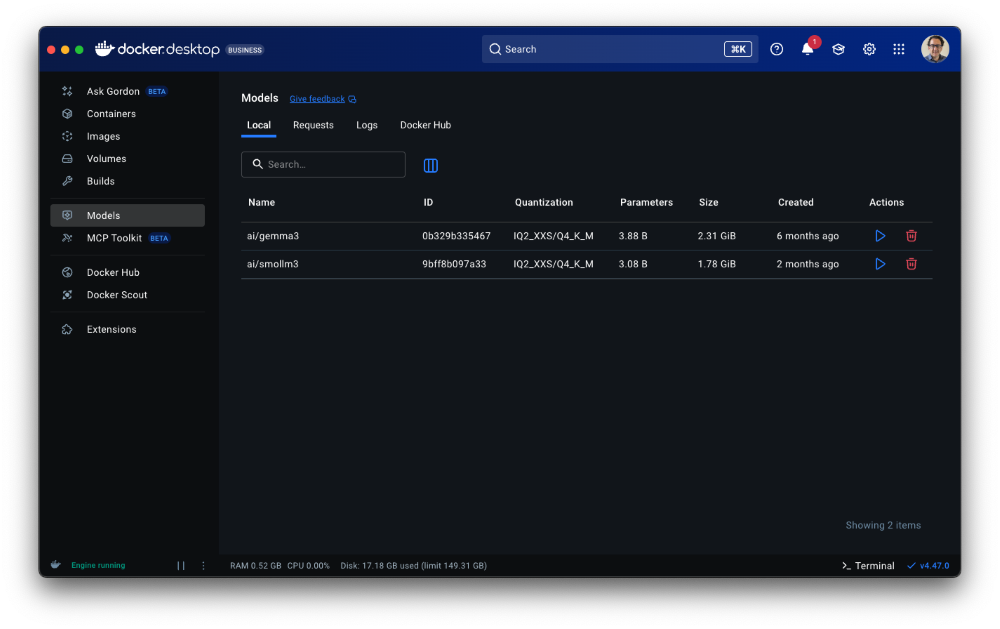
Running large language models (LLMs) on your local machine is one of the most exciting frontiers in AI development. At Docker, our goal is to make this process as simple and accessible as possible. That’s why we built Docker Model Runner, a tool to help you download and run LLMs with a single command.
Until now, GPU-accelerated inferencing with Model Runner was limited to CPU, NVIDIA GPUs (via CUDA), and Apple Silicon (via Metal). Today, we’re thrilled to announce a major step forward in democratizing local AI: Docker Model Runner now supports Vulkan!
This means you can now leverage hardware acceleration for LLM inferencing on a much wider range of GPUs, including integrated GPUs and those from AMD, Intel, and other vendors that support the Vulkan API.
Why Vulkan Matters: AI for Everyone’s GPU
So, what’s the big deal about Vulkan?
Vulkan is a modern, cross-platform graphics and compute API. Unlike CUDA, which is specific to NVIDIA GPUs, or Metal, which is for Apple hardware, Vulkan is an open standard that works across a huge range of graphics cards. This means if you have a modern GPU from AMD, Intel, or even an integrated GPU on your laptop, you can now get a massive performance boost for your local AI workloads.
By integrating Vulkan (thanks to our underlying llama.cpp engine), we’re unlocking GPU-accelerated inferencing for a much broader community of developers and enthusiasts. More hardware, more speed, more fun!
Getting Started: It Just Works
The best part? You don’t need to do anything special to enable it. We believe in convention over configuration. Docker Model Runner automatically detects compatible Vulkan hardware and uses it for inferencing. If a Vulkan-compatible GPU isn’t found, it seamlessly falls back to CPU.
Ready to give it a try? Just run the following command in your terminal:
docker model run ai/gemma3
This command will:Pull the Gemma 3 model.Detect if you have a Vulkan-compatible GPU with the necessary drivers installed.Run the model, using your GPU to accelerate the process.It’s that simple. You can now chat with a powerful LLM running directly on your own machine, faster than ever.
Join Us and Help Shape the Future of Local AI!
Docker Model Runner is an open-source project, and we’re building it in the open with our community. Your contributions are vital as we expand hardware support and add new features.Head over to our GitHub repository to get involved:https://github.com/docker/model-runnerPlease star the repo to show your support, fork it to experiment, and consider contributing back with your own improvements.
Learn more
Check out the Docker Model Runner General Availability announcement
Visit our Model Runner GitHub repo! Docker Model Runner is open-source, and we welcome collaboration and contributions from the community!
Get started with Model Runner with a simple hello GenAI application
Quelle: https://blog.docker.com/feed/

Docker Captains are leaders from the developer community that are both experts in their field and are passionate about sharing their Docker knowledge with others. “From the Captain’s Chair” is a blog series where we get a closer look at one Captain to learn more about them and their experiences.
Today, we are interviewing Pradumna Saraf. He is an Open Source Developer with a passion for DevOps. He is also a Golang developer and loves educating people through social media and blogs about various DevOps tools like Docker, GitHub Actions, Kubernetes, etc. He has been a Docker Captain since 2024.
Can you share how you first got involved with Docker?
If I remember correctly, I was learning about databases, more specifically, MongoDB. Until that time, I had no idea there was something called Docker. I was trying to find a way to get the database up and running locally, and then I came to know from a YouTube video about how Docker is the most common and efficient way for running these kinds of applications locally, and then I skipped learning about databases and dived deep into learning Docker.
What inspired you to become a Docker Captain?
The community. Docker has always been working towards making the developer life easier and listening to the community and users, whether it’s an open source offering or an enterprise, and I wanted to be part of this community. Before even joining the Captains program, I was advocating for Docker by sharing my learning via social media, blogs, etc, and educating people because I was passionate and really loved the potential of Docker. Becoming a Captain felt natural, as I was already doing the stuff, so it was great to get the recognition.
What are some of your personal goals for the next year?
Writing more technical content, of course! Also, giving more in-person talks at international conferences. I also want to get back to contributing and helping open source projects grow.
If you weren’t working in tech, what would you be doing instead?
That’s an interesting question. I love tech. It’s hard to imagine my life without tech because getting into it was not a decision; it was a passion that was inside of me before I could spell technology. But still, if I were not in tech, I might be a Badminton or a Golf player.
Can you share a memorable story from collaborating with the Docker community?
Yes, there was a meetup in Docker Bangalore, India, where Ajeet (DevRel at Docker), a good friend of mine, and I collaborated, and he invited me to deliver a talk on Docker extensions. It was really nice meeting the community, having conversations over pizza about how various people and companies are using Docker in their workflow and bottlenecks.
What’s your favorite Docker product or feature right now, and why?
I am really biased towards Docker Compose. My favourite feature right now is being able to define models in a Docker Compose YAML file and start/stop an AI model with the same Docker Compose commands. Apart from that, I really like the standalone Docker Model Runner (DMR).
Can you walk us through a tricky technical challenge you solved recently?
I was working on an authorization project, where I was verifying users with the right set of permissions and letting them access the resource, and interestingly, Docker had a key role in that project. The role of Docker was a Policy Decision Point (PDP), which was running inside a container and listening to external requests, and was responsible for validating if the entity/user/request is authorized to access the particular resource with the right permissions. This was a particularly unique application of Docker, where I used it as a decision point. Docker made it easy to run, keeping it separate from the main app and making it scalable with almost zero downtime. It showed Docker can also be used for important services like authorization.
What’s one Docker tip you wish every developer knew?
Using multi-stage builds. It helps keep your images small, clean, secure, and production-ready. It’s such a simple thing, but it can make a huge difference. I have seen an image go from 1.7 GB to under 100 MB. Bonus: It will also make your pull and push faster, saving CI cost and making your overall deployment faster.
If you could containerize any non-technical object in real life, what would it be and why?
My age. I’d containerize age so I could choose how old I want to be. If I want to feel young, I will run Docker with an image with the age version of 20, and if I want to think more mature, I will run Docker with an image with the age version of 40.
Where can people find you online? (talks, blog posts, or open source projects, etc.)
People can find social media platforms like Twitter (X), LinkedIn, BlueSky, Threads, etc. For my open source work, people can find me on GitHub. I have many Docker-related projects. Apart from that, if people are more into blogs and conferences, they can find me on my blog and sessionize profile. Or just Google “Pradumna Saraf”.
Rapid Fire Questions
Cats or Dogs?
Cats
Morning person or night owl?
Night Owl
Favorite comfort food?
Dosa
One word friends would use to describe you?
Helpful
A hobby you picked up recently?
Learning more about aircraft and the aviation industry.
Quelle: https://blog.docker.com/feed/
Today, AWS announces a new pricing and cost estimation capability in Amazon Q Developer. Amazon Q Developer is the most capable generative AI-powered assistant for software development. With this launch, customers can now use Amazon Q Developer to get information about AWS product and service pricing, availability, and attributes, helping them select the right resources and estimate workload costs using natural language. When architecting new workloads on AWS, customers need to estimate costs so they can evaluate cost/performance tradeoffs, set budgets, and plan future spending. Customers can now use Amazon Q Developer to retrieve detailed product attribute and pricing information using natural language, making it easier to estimate the cost of new workloads without having to review multiple pricing pages or specify detailed API request parameters. Customers can now ask questions about service pricing (e.g., “How much does RDS extended support cost?”), the cost of a planned workload (e.g., “I need to send 1 million notifications per month to email, and 1 million to HTTP/S endpoints. Estimate the monthly cost using SNS.”), or the relative costs of different resources (e.g., “What is the cost difference between an Application Load Balancer and a Network Load Balancer?”). To answer these questions, Amazon Q Developer retrieves information from the AWS Price List APIs. To learn more, see Managing your costs using generative AI with Amazon Q Developer. To get started, open the Amazon Q chat panel in the AWS Management Console and ask a question about pricing.
Quelle: aws.amazon.com
AWS is announcing Amazon EC2 I7ie instances are now available in AWS South America (São Paulo) region. Designed for large storage I/O intensive workloads, I7ie instances are powered by 5th Gen Intel Xeon Processors with an all-core turbo frequency of 3.2 GHz, offering up to 40% better compute performance and 20% better price performance over existing I3en instances. I7ie instances offer up to 120TB local NVMe storage density (highest in the cloud) for storage optimized instances and offer up to twice as many vCPUs and memory compared to prior generation instances. Powered by 3rd generation AWS Nitro SSDs, I7ie instances deliver up to 65% better real-time storage performance, up to 50% lower storage I/O latency, and 65% lower storage I/O latency variability compared to I3en instances. I7ie are high density storage optimized instances, ideal for workloads requiring fast local storage with high random read/write performance at very low latency consistency to access large data sets. These instances are available in 9 different virtual sizes and deliver up to 100Gbps of network bandwidth and 60Gbps of bandwidth for Amazon Elastic Block Store (EBS). To learn more, visit the I7ie instances page.
Quelle: aws.amazon.com
AWS announces the general availability of new general-purpose Amazon EC2 M8a instances. M8a instances are powered by 5th Gen AMD EPYC processors (formerly code named Turin) with a maximum frequency of 4.5 GHz, deliver up to 30% higher performance, and up to 19% better price-performance compared to M7a instances.
M8a instances deliver 45% more memory bandwidth compared to M7a instances, making these instances ideal for even latency sensitive workloads. M8a instances deliver even higher performance gains for specific workloads. M8a instances are 60% faster for GroovyJVM benchmark, and up to 39% faster for Cassandra benchmark compared to Amazon EC2 M7a instances. M8a instances are SAP-certified and offer 12 sizes including 2 bare metal sizes. This range of instance sizes allows customers to precisely match their workload requirements.
M8a instances are built on the AWS Nitro System and ideal for applications that benefit from high performance and high throughput such as financial applications, gaming, rendering, application servers, simulation modeling, mid-size data stores, application development environments, and caching fleets.
M8a instances are available in the following AWS Regions: US East (Ohio), US West (Oregon), and Europe (Spain). To get started, sign in to the AWS Management Console. Customers can purchase these instances via Savings Plans, On-Demand instances, and Spot instances. For more information visit the Amazon EC2 M8a instance page or the AWS News blog.
Quelle: aws.amazon.com

Während des Prime Days sind bei Amazon noch einige Smartphones zu Top-Konditionen erhältlich. Bis zu 200 Euro Rabatt sind möglich. (Prime Day, Smartphone)
Quelle: Golem






