Aurora DSQL now supports resource-based policies

Amazon Aurora DSQL now supports resource-based policies, enabling you to simplify access control for your Aurora DSQL resources. With resource-based policies, you can specify Identity and Access Management (IAM) principals and the specific IAM actions they can perform against your Aurora DSQL resources. Resource-based policies also enable you to implement Block Public Access (BPA), which helps to further restrict access to your Aurora DSQL public or VPC endpoints. Aurora DSQL support for resource-based policies is available in the following AWS Regions: US East (N. Virginia), US East (Ohio), US West (Oregon), Asia Pacific (Osaka), Asia Pacific (Tokyo), Asia Pacific (Seoul), Europe (Ireland), Europe (London), Europe (Paris), and Europe (Frankfurt). To get started, visit the Aurora DSQL resource-based policies documentation.
Quelle: aws.amazon.com

Amazon EC2 Auto Scaling now supports predictive scaling in six more regions

Customers can now enable predictive scaling for their Auto Scaling groups (ASGs) in six more regions: Asia Pacific (Hyderabad), Asia Pacific (Melbourne), Israel (Tel Aviv), Canada West (Calgary), Europe (Spain), and Europe (Zurich). Predictive Scaling can proactively scale out your ASGs to be ready for upcoming demand. This allows you to avoid the need to over-provision capacity, resulting in lower EC2 cost, while ensuring your application’s responsiveness. To see the list of all supported AWS public regions and AWS GovCloud (US) regions, click here. Predictive Scaling is appropriate for applications that experience recurring patterns of steep demand changes, such as early morning spikes when business resumes. It learns from the past patterns and launches instances in advance of predicted demand, giving instances time to warm up. Predictive scaling enhances existing Auto Scaling policies, such as Target Tracking or Simple Scaling, so that your applications scale based on both real-time metrics and historic patterns. You can preview how Predictive Scaling works with your ASG by using the “Forecast Only” mode. Predictive Scaling is available as a scaling policy type through AWS Command Line Interface (CLI), EC2 Auto Scaling Management Console, AWS CloudFormation and AWS SDKs. To learn more, visit the Predictive Scaling page in the EC2 Auto Scaling documentation.
Quelle: aws.amazon.com

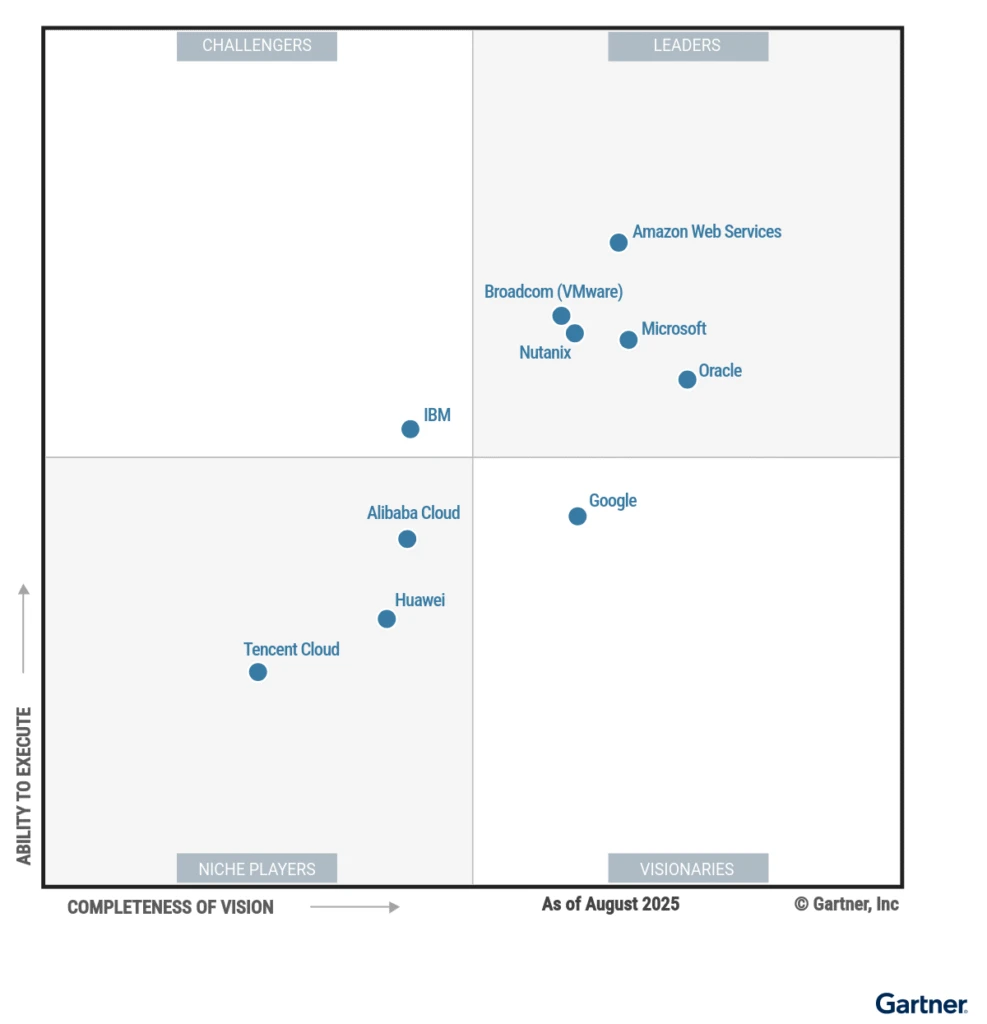
Microsoft named a Leader in the 2025 Gartner® Magic Quadrant™ for Distributed Hybrid Infrastructure

We’re proud that Microsoft has once again been named a Leader in the 2025 Gartner® Magic Quadrant™ for Distributed Hybrid Infrastructure. This is the third year in a row we’ve been recognized by Gartner, and we feel it reflects the impact we’re delivering by helping organizations run workloads seamlessly across hybrid, edge, multicloud, and sovereign environments with Azure. 

See the full 2025 Gartner Magic Quadrant for Distributed Hybrid Infrastructure report here

Azure’s adaptive cloud: built on Azure Arc and Azure Local

The reality for many organizations today is that not every workload belongs in a hyperscale datacenter. Azure’s adaptive cloud approach recognizes that reality and brings the cloud model to every environment through two core technologies.

Azure Arc brings Azure management to any environment, including datacenters, edge, and multicloud. It unifies on-premises and non-Azure resources through Azure Resource Manager and enables services such as Azure Kubernetes Service (AKS), Microsoft Defender for Cloud, Azure IoT Operations, and Azure AI Video Indexer.

Azure Local leverages Azure Arc to bring Azure services and management to customer-owned environments, enabling customers to run cloud-native workloads such as virtual machines and Arc-enabled AKS locally. Azure Local also supports Microsoft’s Sovereign Private Cloud strategy, enabling isolated, compliance-driven operations with Azure consistency.

Together, Azure Arc and Azure Local give customers unified governance, security, and management across distributed environments. They help organizations innovate faster, stay secure, and scale with confidence.

Real-world impact across industries

Azure’s adaptive cloud approach is especially valuable for organizations that need to balance local operations with the flexibility of the cloud. Manufacturers and industrial companies are deploying AI models at the edge to improve safety, quality, and automation while managing them centrally in Azure. Regulated sectors such as financial services, healthcare, and government maintain compliance and data residency as they modernize with Azure. Enterprises with distributed sites are using a single management plane to connect operations, improve efficiency, and gain real-time insight across locations.

Across these industries, we’re seeing customers embrace Azure’s adaptive cloud approach enabled by Azure Arc:

Publix Employees Federal Credit Union (PEFCU) consolidated operations using Azure Arc and Azure Local, reducing disaster recovery time to under 10 minutes per VM and freeing engineers to focus on innovation.

Delta Dental of California modernized its core payor system with containerized workloads, improving performance, uptime, and compliance.

CDW migrated 800 virtual machines to Azure Local, doubling SQL performance and strengthening governance and security with Azure Policy and Microsoft Defender for Cloud.

Coles and Emirates Global Aluminum (EGA) continue to scale operations with Azure Local, running GPU-enabled AI workloads that enhance analytics, customer experiences, and manufacturing insights.

These organizations are adopting Azure’s adaptive cloud approach to run workloads where they are needed most while unifying operations, security, and innovation across every environment.

Building the future together 

Recognition from Gartner is an important milestone to us, but what matters most is what our customers are achieving with Azure every day. We’re continuing to invest in making Azure more adaptive, more secure, and more capable across every environment so organizations can innovate on their own terms. We’re grateful for the trust our customers place in us and inspired by how they are shaping the future of cloud infrastructure right alongside us.

Learn more 

Learn how your organization can accelerate innovation with Azure Local and Azure Arc.

Explore Sovereign Private Cloud with Azure Local and Microsoft 365 Local.

Join us at Microsoft Ignite in San Francisco this November to explore the latest in enterprise innovation.

Gartner, Magic Quadrant for Distributed Hybrid Infrastructure, Julia Palmer, Jeffrey Hewitt, Dennis Smith, Tony Harvey, Elaine Zhang, 8 September 2025.

GARTNER is a registered trademark and service mark of Gartner and Magic Quadrant is a registered trademark of Gartner, Inc. and/or its affiliates in the U.S. and internationally and are used herein with permission. All rights reserved. This graphic was published by Gartner, Inc. as part of a larger research document and should be evaluated in the context of the entire document. The Gartner document is available upon request from Microsoft. Gartner does not endorse any vendor, product or service depicted in its research publications, and does not advise technology users to select only those vendors with the highest ratings or other designation. Gartner research publications consist of the opinions of Gartner’s research organization and should not be construed as statements of fact. Gartner disclaims all warranties, expressed or implied, with respect to this research, including any warranties of merchantability or fitness for a particular purpose. 
The post Microsoft named a Leader in the 2025 Gartner® Magic Quadrant™ for Distributed Hybrid Infrastructure appeared first on Microsoft Azure Blog.
Quelle: Azure

Fully managed cloud-to-cloud transfers with Azure Storage Mover

In today’s modern world, cloud strategies are evolving rapidly. Many organizations are embracing multicloud environments, while others are looking to consolidate and migrate workloads to a single trusted platform. At Microsoft, we recognize that the need for secure, reliable, and efficient data movement across platforms is critical. Today, we are announcing the General Availability of cloud-to-cloud migration from AWS S3 to Azure Blob Storage using Azure Storage Mover. 

Since its launch in 2023, Azure Storage Mover has been simplifying on-premises data migrations for organizations of all sizes, making large-scale data transfers to Azure faster, more secure, and less complex. For those who are unfamiliar, Azure Storage Mover is a free, fully managed migration service designed to move data from Files Shares and NAS Storage into Azure Object and File storage with minimal disruption. It enables efficient, scalable, and reliable data transfers via Azure’s centralized orchestration; while also maintaining file metadata and supporting both one-time migrations and sync tasks without requiring custom scripts or third-party tools.

Ready to simplify migration?

Azure Storage Mover’s new cloud-to-cloud migration capability enables direct transfers from AWS S3 to Azure Blob. Unlike on-premises migrations, cloud-to-cloud transfers do not require a self-hosted agent, simplifying setup and eliminating additional compute requirements. This approach reduces infrastructure costs and migration overhead; no agents, no scripts, and fully managed. Key capabilities include: 

Direct parallel transfers: Storage Mover supports high-speed, server-to-server parallel file transfers, optimizing migration performance for large datasets.

Integrated automation: Users can leverage the Azure portal/CLI for automated workflows and repeatable job tracking while ensuring metadata preservation—removing reliance on scripts or third-party tools. 

Secure transfers: All data transfers are encrypted in transit, and the service integrates with Azure’s security and compliance frameworks, including Azure Active Directory, Multicloud Arc connector and role-based access control (RBAC). 

Incremental sync: After initial migration, Storage Mover can perform incremental syncs, transferring only changed files to minimize downtime and ensure data consistency. 

Monitoring and observability: Migration progress can be tracked via the Azure portal, CLI, or REST API, and is integrated with Azure Monitor and Log Analytics for detailed telemetry and error reporting. 

Real-world impact: How customers are accelerating migration 

During public preview, customers have already realized the benefits of cloud-to-cloud migration and transferred petabytes (PBs) of data from AWS to Azure. For example, one of our customers, Syncro, in partnership with SOUTHWORKS, migrated hundreds of terabytes from AWS S3 to Azure Blob with minimal downtime. The phased migration approach, enabled by Storage Mover, allows for complex orchestration, data integrity, and immediate access to Azure’s analytics and AI capabilities. 

Syncro, a leading provider of IT management solutions, faced the challenge of migrating hundreds of terabytes of data from AWS S3 to Azure Blob. Using Azure Storage Mover, SOUTHWORKS completed the pilot migration, transferring 60 TB in the first phase and planning ongoing migrations for approximately 120 TB. The solution enabled complex, phased migrations, maintained data integrity, and leveraged Azure’s advanced analytics and AI capabilities immediately upon arrival.
— Johnny Halife, CTO, SOUTHWORKS

Beyond simplifying migration, Azure Storage Mover opens the door to a broader ecosystem of innovation, helping organizations maximize the value of their data once it’s in Azure. Migrating AI training data into Azure Blob Storage allows organizations to quickly leverage advanced artificial intelligence and machine learning capabilities. With immediate access to powerful Azure tools, teams can develop, train, and deploy models at scale to unlock innovation and accelerate insights across the Azure ecosystem.

Additional product updates 

We’re also excited to announce several new service capabilities for Azure Storage Mover, including support for additional source and target pairs:

Migration from on-premises SMB shares to Azure Object storage.

Support for migration from on-premises NFS shares to Azure Files NFS 4.1 share.

Planning data migration to Azure storage? Discover recommended Storage Migration solutions using Azure Copilot.

Coming soon: Storage Mover availability in Azure US Government regions. 

Ready to modernize your data estate? 

Azure Storage Mover’s cloud-to-cloud migration capabilities are now available to simplify your multicloud journey and accelerate digital transformation. Get started today! 
The post Fully managed cloud-to-cloud transfers with Azure Storage Mover appeared first on Microsoft Azure Blog.
Quelle: Azure

Amazon Quick Sight announces the general availability of a new data preparation experience

Amazon Quick Sight, a capability of Amazon Quick Suite, now offers a visual data preparation experience that helps business users perform advanced data transformations without writing complex code. Users can now clean, transform, and combine data in multi-step workflows—appending tables, aggregating data, executing flexible joins, and other advanced operations that previously required custom programming or SQL commands. Users can easily track data transformations step-by-step, enhancing traceability and shareability. With the ability to utilize datasets as a source expanded from 3 to 10 levels, teams can build reusable transformation logic that cascades across departments. For instance, centralized data analysts can now prepare foundational data sets that can then be further customized by regional business users, applying territory-specific calculations and business logic with simple clicks. The enhanced experience now also supports 20X larger cross-source joins, moving from a previous capacity of 1GB to 20GB today. This feature is available to Quick Sight Author and Author Pro customers in the following regions: US East (N.Virginia and Ohio), US West (Oregon), Canada (Central), South America (Sao Paulo), Europe (Frankfurt, Milan, Paris, Spain, Stockholm, Ireland, London, Zurich), Africa (Cape Town), Middle East (UAE), Israel (Tel Aviv), Asia Pacific (Jakarta, Mumbai, Singapore, Tokyo, Seoul, Sydney), AWS GovCloud (US-West, US- East) and to Quick Suite Enterprise subscribers in US East (N. Virginia), US West (Oregon), Asia Pacific (Sydney), and Europe (Ireland). For more details, read our documentation here.
Quelle: aws.amazon.com