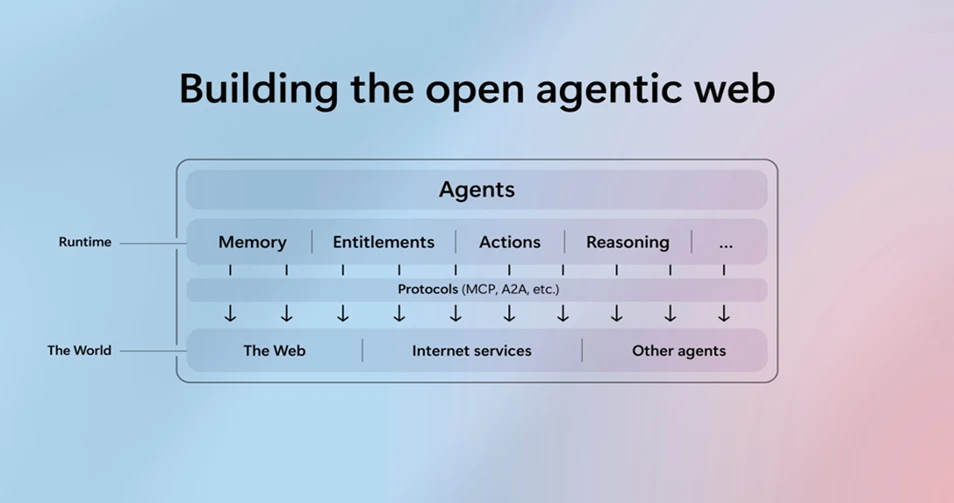
Agent Factory: Designing the open agentic web stack

This blog is a wrap-up post in a blog series called Agent Factory which shares best practices, design patterns, and tools to help guide you through adopting and building agentic AI.

The rise of AI agents—autonomous software entities acting on behalf of users and organizations—marks a transformative moment for enterprise technology. But as we’ve explored throughout this blog series, building effective agents is about more than just code. It requires a repeatable blueprint, spanning use case design, developer tooling, observability, integrations, and governance. 

Throughout this series, we’ve walked through the journey of building enterprise-grade agents: from early use cases and design patterns to the tools and developer workflows needed to move from prototype to production, to the importance of observability, interoperability, and open standards, and finally the governance and security principles required to deploy agents responsibly. 

Now, as we conclude the series, we zoom out to the bigger picture: the agentic web stack. Much like HTTP and TCP/IP standardized the internet, this stack provides the common services and protocols needed to make multi-agent ecosystems secure, scalable, and interoperable across organizational boundaries. 

Learn more with Azure AI Foundry

Blueprint: 8 essential components and services

A robust agentic web stack is not one technology but a composition of services that together provide the foundation for open, secure, and enterprise-grade multi-agent systems. Here’s what it takes—and how Azure AI Foundry is making it real. 

1. Communication protocol service

Agents need a shared “language” to exchange messages, requests, and structured data. Without it, collaboration breaks down into isolated silos. Standards like Model Context Protocol (MCP) and Agent-to-Agent (A2A) provide this foundation, ensuring agents can negotiate, coordinate, and cooperate—regardless of who built them or where they’re hosted. In Azure AI Foundry, A2A support enables not only intra-organization workflows but also cross-boundary collaboration, where supply chain partners or business ecosystems can securely exchange actions through a common protocol.

2. Discovery registry service

Just as the web needed directories and search engines, agents need a way to be found and reused. The Catalog serves as the listing of assets—a curated collection of agents, tools, and applications that can be discovered and composed into new solutions. The Registry, by contrast, tracks the deployed instances of those assets—the live agentic app instances running across providers, with their endpoints, health, and status. Together, the Catalog and Registry bridge the gap between what’s available and what’s active, enabling developers to publish once, discover broadly, and reliably orchestrate workflows against running systems.

3. Identity and trust management service

Trust is the lifeblood of the agentic web. Every agent must carry a verifiable identity, enforced through standards like OIDC (OpenID Connect) and JWT (JSON Web Token), and tied into enterprise systems like Microsoft Entra ID. In Azure AI Foundry, identity is not an afterthought—it’s the control plane. This enables fine-grained role-based access, ensures that only authorized actors participate in workflows, and provides auditable accountability for every action an agent takes. Combined with encrypted channels, this identity-first model enforces a zero-trust security posture across the agentic stack.

4. Tool invocation and integration service

No agent can succeed in isolation; value comes when agents can connect with data, APIs, and enterprise systems. The Model Context Protocol (MCP) provides a vendor-neutral standard for exposing tools in a way that any compliant agent can invoke. In Azure AI Foundry, MCP integration is deeply embedded, so developers can register enterprise APIs once and instantly make them available to multiple agents—whether they’re built on Microsoft’s agent frameworks like Semantic Kernel and AutoGen, LangGraph, or third-party SDKs. This eliminates bespoke integrations and allows enterprises to compose workflows from best-in-class components.

5. Orchestration service

Single agents can handle discrete tasks, but the real breakthroughs come from multi-agent orchestration: teams of agents collaborating across multi-step, distributed processes. Azure AI Foundry delivers this through a unified framework that brings together Semantic Kernel and AutoGen—and extends it with multi-agent workflow orchestration inside Azure AI Foundry Agent Service. These workflows manage dependencies, allocate resources, and resolve conflicts, enabling enterprise-scale use cases such as financial transaction processing or IT incident response.

6. Telemetry and observability service

As we covered in Part 3, observability is non-negotiable for reliable agents. Azure AI Foundry extends OpenTelemetry with agent-aware instrumentation—tracing conversations, capturing performance data, and surfacing anomalies in real time. This makes agent behavior explainable and debuggable, while also serving governance needs: every decision and action is logged, auditable, and tied back to identity. For enterprises, this is the bedrock of trust, compliance, and continuous improvement.

7. Memory service

Agents without memory are limited to stateless interactions; agents with memory become adaptive, contextual, and human-like in their continuity. Azure AI Foundry supports both short-term session memory and long-term enterprise knowledge integration. Imagine a customer support agent that recalls prior interactions across channels, or a supply chain agent that tracks historical disruptions to improve future decisions. With memory, agents evolve from transactional helpers into strategic partners that learn and adapt over time.

8. Evaluation and governance service

Finally, no stack is complete without governance. This includes continuous evaluation, policy enforcement, ethical safeguards, and regulatory compliance. In Azure AI Foundry, governance hooks are built into orchestration, observability, and identity services—enabling enterprises to block unsafe actions, enforce approvals for sensitive workflows, and generate compliance-ready audit trails. This ensures organizations don’t just innovate fast, but innovate responsibly.

Strategic use cases and business value

The agentic web stack is not theoretical; it unlocks concrete enterprise value.

End-to-end business process automation: Imagine a procure-to-pay workflow where one agent negotiates with suppliers, another verifies compliance, a third triggers payment, and a fourth updates ERP records. With Azure AI Foundry’s orchestration and discovery registry, these agents collaborate seamlessly, cutting manual intervention and cycle times from weeks to hours.

Cross-organization supply chain synchronization: In global supply chains, delays often come from mismatched systems and data. With A2A and discovery services, a logistics agent from one company can securely interoperate with a customs agent from another—both governed by identity and observability. The result: faster border clearance, lower costs, and higher resilience. 

Knowledge worker augmentation: Agents built with Azure AI Foundry can take on repetitive but high-value tasks—scheduling, research, first-draft writing—while humans focus on creativity and judgment. The memory integration ensures continuity: a legal research agent remembers prior cases analyzed, while a marketing agent recalls brand guidelines across campaigns.

Complex IT operations: When outages occur, every second counts. Multi-agent workflows in Azure AI Foundry can detect anomalies, route alerts, execute diagnostics, and propose mitigations across distributed environments. Observability ensures root causes are transparent, while governance enforces that corrective actions comply with policy.

Memory-driven customer journeys: A customer support agent that recalls a prior complaint, a personalization agent that adapts recommendations, a compliance agent that enforces rules—working together, these create adaptive, context-rich interactions. The outcome is not just efficiency but stronger relationships and trust.

Preparing for the agentic era

For organizations, the path forward is as much about strategy and culture as it is about technology: 

Start with open standards: Adopt MCP and A2A from the outset, even in pilots, to avoid future rework and ensure interoperability. 

Invest in foundations: Identity, observability, and memory are not optional; they are the pillars that differentiate ad hoc automations from enterprise-grade systems. 

Operationalize governance: Define policies now and embed them into workflows through Azure AI Foundry’s governance services, so oversight scales with adoption. 

Engage the ecosystem: Participate in open-source and standards communities, influence their direction, and ensure your organization’s voice is heard. 

Prepare your workforce: Train employees not just to use agents, but to collaborate with them, supervise them, and improve them over time. 

Leaders who act on these imperatives will not only adopt agentic AI but shape its trajectory in their industries.

Shaping the future together at Ignite 2025 

The Agent Factory series has laid out the foundations: design patterns, developer tools, observability practices, interoperability standards, and governance principles. The agentic web stack brings these threads together into a cohesive vision: an open, secure, and interoperable ecosystem where agents can scale across organizational boundaries. 

Azure AI Foundry is your platform to make this vision real—unifying frameworks, standards, and enterprise capabilities so organizations can accelerate value while staying in control. 

At Ignite 2025, we’ll showcase the next wave of innovations—from multi-agent orchestration to deeper integrations with enterprise apps, data, and security systems. Join us to see how Azure AI Foundry is not only enabling enterprises to adopt agentic AI but also shaping the agent-driven future of business. 

Did you miss these posts in the series?

The new era of agentic AI—common use cases and design patterns

Building your first AI agent with the tools to deliver real-world outcomes

Top 5 agent observability best practices for reliable AI

From prototype to production—developer tools and rapid agent development

Connecting agents, apps, and data with new open standards like MCP and A2A

Creating a blueprint for safe and secure AI agents

Azure AI Foundry
Build AI agents that automate tasks and enhance user experiences.

Learn more

The post Agent Factory: Designing the open agentic web stack appeared first on Microsoft Azure Blog.
Quelle: Azure

Introducing Microsoft Marketplace — Thousands of solutions. Millions of customers. One Marketplace.

An image of part of the Microsoft Marketplace digital dashboard.A new breed of industry-leading company is taking shape — Frontier Firms. These organizations blend human ambition with AI-powered technology to reshape how innovation is scaled, work is orchestrated and value is created. They’re accelerating AI transformation to enrich employee experiences, reinvent customer engagement, reshape business processes and unlock creativity and innovation.

To empower customers in becoming Frontier, we’re excited to announce the launch of the reimagined Microsoft Marketplace, your trusted source for cloud solutions, AI apps and agents. This further realizes Marketplace as an extension of the Microsoft Cloud, where we collaborate with our partner ecosystem to bring their innovations to our customers globally. By offering a comprehensive catalog across cloud solutions and industries, Microsoft Marketplace accelerates the path to becoming a Frontier Firm. With today’s announcement, we are excited to share:

The new Microsoft Marketplace, a single destination to find, try, buy and deploy cloud solutions, AI apps and agents. Azure Marketplace and Microsoft AppSource are now unified to simplify cloud and AI management. Available today in the US and coming soon to customers worldwide.Tens of thousands of cloud and industry solutions in the Marketplace catalog across a breadth of categories ranging from data and analytics to productivity and collaboration, in addition to industry-specific offerings.Over 3,000 AI apps and agents are newly available directly on Marketplace and in Microsoft products — from Azure AI Foundry to Microsoft 365 Copilot — with rapid provisioning within your Microsoft environment through industry standards like Model Context Protocol (MCP).Marketplace integrations with Microsoft’s channel ecosystem, empowering you to buy where and how you want — whether from your cloud service provider (CSP) or relying on a trusted partner to procure cloud and AI solutions on your behalf.YouTube Video

AI apps and agents for every use caseMicrosoft Marketplace gives you access to thousands of AI apps and agents from our rich partner ecosystem designed to automate tasks, accelerate decision-making and unlock value across your business. With a new AI Apps and Agents category, you can easily and confidently find AI solutions that integrate with your organization’s existing Microsoft products.

“With Microsoft Marketplace, we reduced configuration time of AI apps from nearly 20 minutes to just 1 minute per instance. That efficiency boost has translated into increased productivity and lower operating costs. Marketplace is a strategic channel for Siemens, where we’ve seen an 8X increase in customer adoption. It’s a powerful platform for scaling both sides of our business.”

— Jeff Zobrist, VP Global Partner Ecosystem and Go To Market |Siemens Digital Industries Software

Special thanks to these partners who are launching new AI offerings in Microsoft Marketplace today:

A sampling of company logs in Microsoft Marketplace.

Comprehensive catalog across cloud solutions and industriesMicrosoft Marketplace offers solutions across dozens of categories ranging from data and analytics to productivity and collaboration, in addition to industry-specific offerings. Microsoft Marketplace is a seamless extension of the Microsoft Cloud, uniting solutions integrated with Azure, Microsoft 365, Dynamics 365, Power Platform, Microsoft Security and more.

“The Microsoft Marketplace, in particular, helps us balance innovation with confidence by giving us access to trusted solutions that integrate seamlessly with our Azure environment — ultimately enabling us to move faster while staying true to our Five Principles.”

— Matthew Hillegas, Commercial Director – Infrastructure & Information Security |Mars Inc.

For organizations with a Microsoft Azure Consumption Commitment, 100% of your purchase for any of the thousands of Azure benefit eligible solutions available on Marketplace continue to count toward your commitment. This helps you spend smarter to maximize your cloud and AI investments.

Integrated experience from discovery to deploymentContextually relevant cloud solutions, AI apps and agents built by our partners are also available directly within Microsoft products — providing users, developers and IT practitioners with approved solutions in the flow of work. For example, Agent Store includes Copilot agents within the Microsoft 365 Copilot experience. The same applies for apps in Microsoft Teams, models and tools in Azure AI Foundry and future experiences including MCP servers.

By integrating offerings from Marketplace directly into the Microsoft Cloud, IT is equipped with management and control tools that enable both innovation and governance. When you acquire a Copilot agent or an app running on Azure from Microsoft Marketplace, it’s provisioned and distributed to team members aligned to your security and governance standards.

YouTube Video

Powering partner growthFor our partners, Microsoft Marketplace sits at the center of how we work together. We’re continuously expanding its capabilities to help our partners drive growth — whether that means scaling through digital sales, deepening channel partnerships or landing transformative deals.

We’ve invested in multiparty private offers, CSP integration and CSP private offers to connect software development companies and channel partners on Marketplace, creating more complete solutions to address customers’ needs. Today, we’re excited to share that valued partners including Arrow, Crayon, Ingram Micro, Pax8 and TD SYNNEX are integrating Microsoft Marketplace into their marketplaces, further extending customer reach.

Additionally, a new Marketplace capability called resale enabled offers is now in private preview. This empowers software companies to authorize their channel partners to sell on their behalf through private offers — unlocking new routes to market.

“We’re incredibly excited about the path forward with Microsoft. This integration with the Marketplace catalog is just the beginning — we see endless potential to co-innovate and help customers navigate their AI-first transformation with confidence.”

— Melissa Mulholland, Co-CEO | SoftwareOne and Crayon

Nicole Dezen, Chief Partner Officer and Corporate Vice President, Global Channel Partner Sales at Microsoft, shares more details about the partner opportunity with Microsoft Marketplace in her blog.

Becoming Frontier with Microsoft MarketplaceWhether you’re seeking to accelerate innovation, empower your teams with AI or unlock new value through trusted partners, Microsoft Marketplace brings together the solutions, expertise and ecosystem to meet your business needs. Explore the new Microsoft Marketplace. Thousands of solutions. Millions of customers. One Marketplace.

Alysa Taylor is the Chief Marketing Officer for Commercial Cloud and AI at Microsoft, leading teams that enable digital and AI transformation for organizations of all sizes across the globe. She is at the forefront of helping organizations around the world harness digital and AI innovation to transform how they operate and grow.

NOTE

Source: Work Trend Index Annual Report, 2025: The year the Frontier Firm is born, April 23, 2025
The post Introducing Microsoft Marketplace — Thousands of solutions. Millions of customers. One Marketplace. appeared first on Microsoft Azure Blog.
Quelle: Azure

Amazon EC2 C8gn instances are now available in additional regions

Starting today, Amazon Elastic Compute Cloud (Amazon EC2) C8gn instances, powered by the latest-generation AWS Graviton4 processors, are available in the AWS Region Europe (Frankfurt, Stockholm), Asia Pacific (Singapore). The new instances provide up to 30% better compute performance than Graviton3-based Amazon EC2 C7gn instances. Amazon EC2 C8gn instances feature the latest 6th generation AWS Nitro Cards, and offer up to 600 Gbps network bandwidth, the highest network bandwidth among network optimized EC2 instances. Take advantage of the enhanced networking capabilities of C8gn to scale performance and throughput, while optimizing the cost of running network-intensive workloads such as network virtual appliances, data analytics, CPU-based artificial intelligence and machine learning (AI/ML) inference. For increased scalability, C8gn instances offer instance sizes up to 48xlarge, up to 384 GiB of memory, and up to 60 Gbps of bandwidth to Amazon Elastic Block Store (EBS). C8gn instances support Elastic Fabric Adapter (EFA) networking on the 16xlarge, 24xlarge, 48xlarge, metal-24xl, and metal-48xl sizes, which enables lower latency and improved cluster performance for workloads deployed on tightly coupled clusters. C8gn instances are available in the following AWS Regions: US East (N. Virginia), US West (Oregon, N.California), Europe (Frankfurt, Stockholm), Asia Pacific (Singapore) To learn more, see Amazon C8gn Instances. To begin your Graviton journey, visit the Level up your compute with AWS Graviton page. To get started, see AWS Management Console, AWS Command Line Interface (AWS CLI), and AWS SDKs.
Quelle: aws.amazon.com

Amazon Redshift Concurrency Scaling is now available in 10 additional AWS regions

Amazon Redshift Concurrency Scaling is now available in the AWS Africa (Cape Town), Asia Pacific (Hong Kong), Asia Pacific (Hyderabad), Asia Pacific (Jakarta), Asia Pacific (Osaka), Asia Pacific (Thailand), Europe (Milan), Middle East (Bahrain), Mexico (Central) and AWS GovCloud (US-West) regions. With the Amazon Redshift Concurrency Scaling feature, you can now support thousands of concurrent users and concurrent queries, with consistently fast query performance. Amazon Redshift Concurrency Scaling elastically scales query processing power to provide consistently fast performance for hundreds of concurrent queries. Concurrency Scaling resources are added to your Redshift cluster transparently in seconds, allowing for increased concurrency to process queries with minimal wait time. Amazon Redshift customers with an active Redshift cluster earn up to one hour of free Concurrency Scaling credits, which is sufficient for the concurrency needs of most customers. Concurrency scaling enables you to specify usage control, providing customers with predictable month-to-month costs, even during periods of fluctuating analytical demand. To enable Amazon Redshift Concurrency Scaling, set the Concurrency Scaling Mode to Auto in your Amazon Web Services Management Console. You can allocate Concurrency Scaling usage to specific user groups and workloads, control the number of Concurrency Scaling clusters that can be used, and monitor Amazon CloudWatch performance and usage metrics. To learn more about concurrency scaling including regional-availability, see our documentation and pricing page.
Quelle: aws.amazon.com