Anzeige: Amazons meistgekaufte LED-Taschenlampe fällt auf 8 Euro
Amazons derzeit meistgekaufte LED-Taschenlampe mit 5.000 Verkäufen im letzten Monat ist befristet im Angebot. (LED, Technik/Hardware)
Quelle: Golem

Amazons derzeit meistgekaufte LED-Taschenlampe mit 5.000 Verkäufen im letzten Monat ist befristet im Angebot. (LED, Technik/Hardware)
Quelle: Golem

Schon im November 2024 hat die Ampel-Regierung den Entwurf für ein Kritis-Dachgesetz beschlossen. Nun ging dieser praktisch unverändert durchs Kabinett. (Infrastruktur, Deutsche Bahn)
Quelle: Golem
This blog post is the fourth out of a six-part blog series called Agent Factory which will share best practices, design patterns, and tools to help guide you through adopting and building agentic AI.
Developer experiences as the key to scale
AI agents are moving quickly from experimentation to real production systems. Across industries, we see developers testing prototypes in their Integrated Development Environment (IDE) one week and deploying production agents to serve thousands of users the next. The key differentiator is no longer whether you can build an agent—it’s how fast and seamlessly you can go from idea to enterprise-ready deployment.
Deploy AI agents quickly with Azure AI Foundry
Industry trends reinforce this shift:
In-repo AI development: Models, prompts, and evaluations are now first-class citizens in GitHub repos—giving developers a unified space to build, test, and iterate on AI features.
More capable coding agents: GitHub Copilot’s new coding agent can open pull requests after completing tasks like writing tests or fixing bugs, acting as an asynchronous teammate.
Open frameworks maturing: Communities around LangGraph, LlamaIndex, CrewAI, AutoGen, and Semantic Kernel are rapidly expanding, with “agent templates” on GitHub repos becoming common.
Open protocols emerging: Standards like the Model Context Protocol (MCP) and Agent-to-Agent (A2A) are creating interoperability across platforms.
Developers increasingly expect to stay in their existing workflow—GitHub, VS Code, and familiar frameworks—while tapping into enterprise-grade runtimes and integrations. The platforms that win will be those that meet developers where they are—with openness, speed, and trust.
What a modern agent platform should deliver
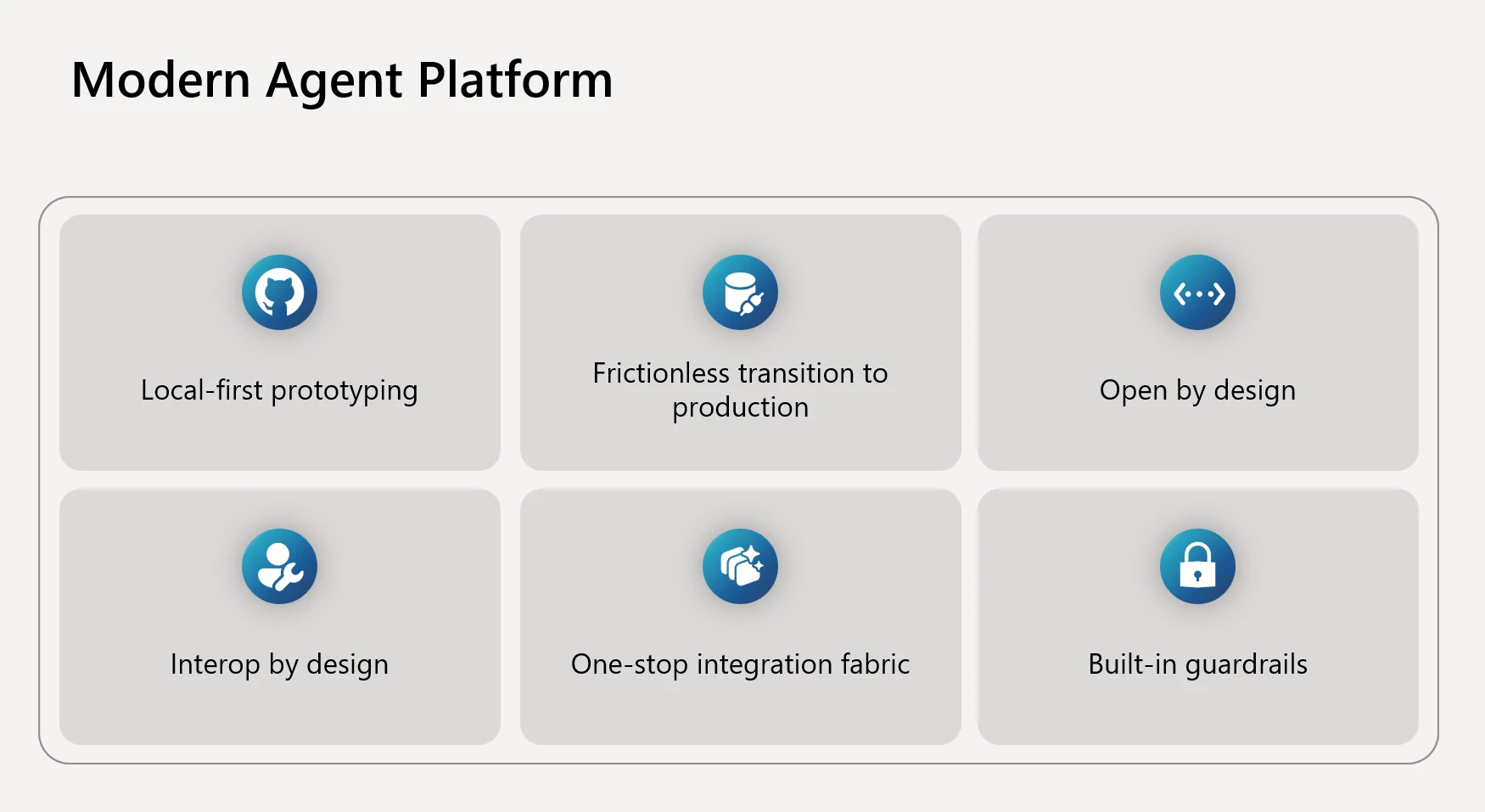
From our work with customers and the open-source community, we’ve seen a clear picture emerge of what developers really need. A modern agent platform must go beyond offering models or orchestration—it has to empower teams across the entire lifecycle:
Local-first prototyping: Developers want to stay in their flow. That means designing, tracing, and evaluating AI agents directly in their IDE with the same ease as writing and debugging code. If building an agent requires jumping into a separate UI or unfamiliar environment, iteration slows and adoption drops.
Frictionless transition to production: A common frustration we hear is that an agent that runs fine locally becomes brittle or requires heavy rewrites in production. The right platform provides a single, consistent API surface from experimentation to deployment, so what works in development works in production—with scale, security, and governance layered in automatically.
Open by design: No two organizations use the exact same stack. Developers may start with LangGraph for orchestration, LlamaIndex for data retrieval, or CrewAI for coordination. Others prefer Microsoft’s first-party frameworks like Semantic Kernel or AutoGen. A modern platform must support this diversity without forcing lock-in, while still offering enterprise-grade pathways for those who want them.
Interop by design: Agents are rarely self-contained. They must talk to tools, databases, and even other agents across different ecosystems. Proprietary protocols create silos and fragmentation. Open standards like the Model Context Protocol (MCP) and Agent-to-Agent (A2A) unlock collaboration across platforms, enabling a marketplace of interoperable tools and reusable agent skills.
One-stop integration fabric: An agent’s real value comes when it can take meaningful action: updating a record in Dynamics 365, triggering a workflow in ServiceNow, querying a SQL database, or posting to Teams. Developers shouldn’t have to rebuild connectors for every integration. A robust agent platform provides a broad library of prebuilt connectors and simple ways to plug into enterprise systems.
Built-in guardrails: Enterprises cannot afford agents that are opaque, unreliable, or non-compliant. Observability, evaluations, and governance must be woven into the development loop—not added as an afterthought. The ability to trace agent reasoning, run continuous evaluations, and enforce identity, security, and compliance policies is as critical as the models themselves.
How Azure AI Foundry delivers this experience
Azure AI Foundry is designed to meet developers where they are, while giving enterprises the trust, security, and scale they need. It connects the dots across IDEs, frameworks, protocols, and business channels—making the path from prototype to production seamless.
Build where developers live: VS Code, GitHub, and Foundry
Developers expect to design, debug, and iterate AI agents in their daily tools—not switch into unfamiliar environments. Foundry integrates deeply with both VS Code and GitHub to support this flow.
VS Code extension for Foundry: Developers can create, run, and debug agents locally with direct connection to Foundry resources. The extension scaffolds projects, provides integrated tracing and evaluation, and enables one-click deployment to Foundry Agent Service—all inside the IDE they already use.
Model Inference API: With a single, unified inference endpoint, developers can evaluate performance across models and swap them without rewriting code. This flexibility accelerates experimentation while future-proofing applications against a fast-moving model ecosystem.
GitHub Copilot and the coding agent: Copilot has grown beyond autocomplete into an autonomous coding agent that can take on issues, spin up a secure runner, and generate a pull request, signaling how agentic AI development is becoming a normal part of the developer loop. When used alongside Azure AI Foundry, developers can accelerate agent development by having Copilot generate agent code while pulling in the models, agent runtime, and observability tools from Foundry needed to build, deploy, and monitor production-ready agents.
Use your frameworks
Agents are not one-size-fits-all, and developers often start with the frameworks they know best. Foundry embraces this diversity:
First-party frameworks: Foundry supports both Semantic Kernel and AutoGen, with a convergence into a modern unified framework coming soon. This future-ready framework is designed for modularity, enterprise-grade reliability, and seamless deployment to Foundry Agent Service.
Third-party frameworks: Foundry Agent Service integrates directly with CrewAI, LangGraph, and LlamaIndex, enabling developers to orchestrate multi-turn, multi-agent conversations across platforms. This ensures you can work with your preferred OSS ecosystem while still benefiting from Foundry’s enterprise runtime.
Interoperability with open protocols
Agents don’t live in isolation—they need to interoperate with tools, systems, and even other agents. Foundry supports open protocols by default:
MCP: Foundry Agent Service allows agents to call any MCP-compatible tools directly, giving developers a simple way to connect external systems and reuse tools across platforms.
A2A: Semantic Kernel supports A2A, implementing the protocol to enable agents to collaborate across different runtimes and ecosystems. With A2A, multi-agent workflows can span vendors and frameworks, unlocking scenarios like specialist agents coordinating to solve complex problems.
Ship where the business runs
Building an agent is just the first step—impact comes when users can access it where they work. Foundry makes it easy to publish agents to both Microsoft and custom channels:
Microsoft 365 and Copilot: Using the Microsoft 365 Agents SDK, developers can publish Foundry agents directly to Teams, Microsoft 365 Copilot, BizChat, and other productivity surfaces.
Custom apps and APIs: Agents can be exposed as REST APIs, embedded into web apps, or integrated into workflows using Logic Apps and Azure Functions—with thousands of prebuilt connectors to SaaS and enterprise systems.
Observe and harden
Reliability and safety can’t be bolted on later—they must be integrated into the development loop. As we explored in the previous blog, observability is essential for delivering AI that is not only effective, but also trustworthy. Foundry builds these capabilities directly into the developer workflow:
Tracing and evaluation tools to debug, compare, and validate agent behavior before and after deployment.
CI/CD integration with GitHub Actions and Azure DevOps, enabling continuous evaluation and governance checks on every commit.
Enterprise guardrails—from networking and identity to compliance and governance—so that prototypes can scale confidently into production.
Why this matters now
Developer experience is the new productivity moat. Enterprises need to enable their teams to build and deploy AI agents quickly, confidently, and at scale. Azure AI Foundry delivers an open, modular, and enterprise-ready path—meeting developers in GitHub and VS Code, supporting both open-source and first-party frameworks, and ensuring agents can be deployed where users and data already live.
With Foundry, the path from prototype to production is smoother, faster, and more secure—helping organizations innovate at the speed of AI.
What’s next
In Part 5 of the Agent Factory series, we’ll explore how agents connect and collaborate at scale. We’ll demystify the integration landscape—from agent-to-agent collaboration with A2A, to tool interoperability with MCP, to the role of open standards in ensuring agents can work across apps, frameworks, and ecosystems. Expect practical guidance and reference patterns for building truly connected agent systems.
Did you miss these posts in the series?
Agent Factory: The new era of agentic AI—common use cases and design patterns.
Agent Factory: Building your first AI agent with the tools to deliver real-world outcomes.
Agent Factory: Top 5 agent observability best practices for reliable AI.
Azure AI Foundry
Build AI agents that automate tasks, enhance user experiences, and deliver results.
Learn more
The post Agent Factory: From prototype to production—developer tools and rapid agent development appeared first on Microsoft Azure Blog.
Quelle: Azure
Whether you’re a new student, a thriving startup, or the largest enterprise, you have financial constraints. You need to know what you’re spending, where your money is being spent, and how to plan for the future. Nobody wants a surprise bill—and that’s where Microsoft Cost Management comes in. We’re always looking for ways to learn more about your challenges and help you do more with less.
See the newest features on Microsoft Cost Management
Here are a few of the latest improvements and updates (July 2025):
Service Principal support for Partner Admin Reader role (EA indirect partners)
Azure Pricing Calculator: Tip of the Month
New ways to save money with Microsoft Cloud
New videos and learning opportunities
Documentation updates
Let’s dig into the details.
Service Principal support for Partner Admin Reader role (EA indirect partners)
We’re excited to announce that Azure now supports assigning the Partner Admin Reader role to Service Principals. This enhancement empowers Enterprise Agreement indirect partners (CSPs who manage customer Azure costs) to programmatically access cost data across their customers’ enrollments under their Partner Customer Number (PCN) via Azure Active Directory applications—without relying on interactive user accounts.
Why this matters:
Managing cloud costs across multiple customers is complex and might be error-prone when relying on manual exports or shared credentials. Partners need secure, scalable, and automated access to cost data to integrate insights into their tools and optimize spend in real time.
With these enhancements, partners can now:
Automate cost data retrieval securely using Azure Active Directory service principals (no shared user credentials).
Integrate Cost Management data into partner billing tools, dashboards, or workflows using APIs.
Maintain strong governance and control access to billing scopes with Azure Role-Based Access Control.
Enable near real-time monitoring, invoice reconciliation, and proactive cost optimization across multiple customers.
To get started, learn more about how to assign Enterprise Agreement roles to service principals.
Azure Pricing Calculator: Tip of the Month
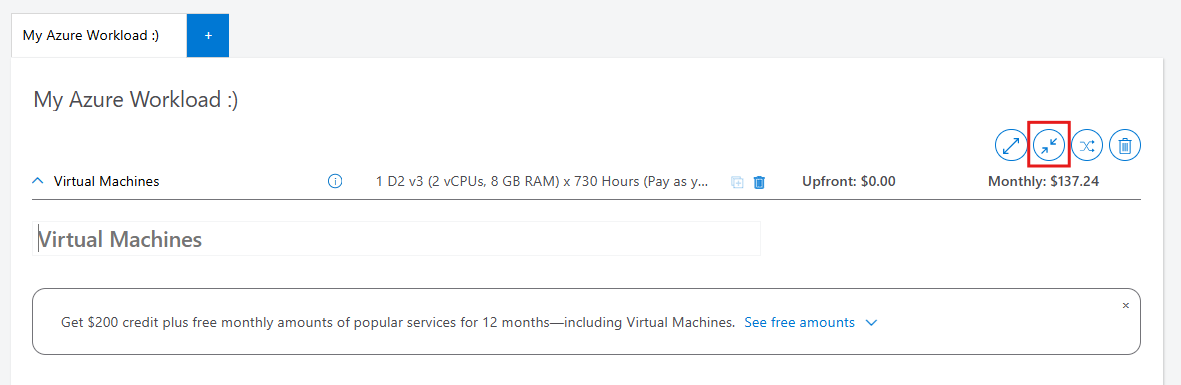
When working with estimates in the Azure Pricing Calculator—that include multiple services—scrolling through all the details can become overwhelming. To simplify your view, click the collapse button on your estimate. This instantly minimizes the detailed configuration for all services in your estimate, leaving just the summary line visible.
Why this helps:
Reduces unnecessary scrolling when managing large estimates.
Makes it easier to focus on the services you want to review or adjust.
Keeps your workspace clean and organized, especially when sharing estimates with others.
Try collapsing services the next time you build a complex estimate. It’s a small trick that makes a big difference in navigating your pricing scenarios!
New ways to save money with Microsoft Cloud
Here are new and updated offers you might be interested in for cost savings and optimization from July and August 2025:
Generally available: Azure Firewall ingestion-time transformation for cost-efficient logging. Now you can filter or transform Azure Firewall logs before they’re ingested into Log Analytics, reducing the amount of data stored and lowering your logging costs without losing critical security insights.
Public preview: Azure Storage Mover–free Amazon Web Services S3-to-Azure Blob migration. Now you can move data from Amazon Web Services S3 to Azure Blob Storage securely and at no additional cost using Azure Storage Mover. This fully managed service simplifies multi-cloud or full migration scenarios without third-party tools, reducing complexity and expenses.
New videos and learning opportunities
We added several new videos for your viewing and learning. Whether you are new to Cost Management or require a refresher, these videos will prove to be highly beneficial:
Managing Access to Cost Management Data
How to use the Azure Copilot to understand your costs
Configuring Cost Allocation Rules and Tags
Documentation updates
The Cost Management and Billing documentation continues to evolve. Here are some our new and updated documents from July and August:
Pay your Microsoft Customer Agreement or Microsoft Online Subscription Program bill: Updated on July 2 to add partial payment options and India-specific payment methods.
Manage Azure Reservations: Updated on July 8 to clarify reservation scope changes, splitting reservations, and limitations on billing subscription changes.
Charge back Azure saving plan costs: Published on July 9 to explain chargeback/showback for savings plans using amortized cost and API queries.
Calculate Enterprise Agreement (EA) savings plan cost savings: Published on July 9 to guide EA customers in calculating savings plan benefits using amortized usage data.
Manage Azure costs with automation: Updated on July 10 to add best practices for Cost Details API, automation workflows, and handling large datasets.
Understand and work with Cost Management scopes: Updated on July 25 to clarify Role-Based Access Control vs. billing scopes and role requirements for cost visibility.
Manage a Microsoft Azure Consumption Commitment resource: Published on August 14 to describe MACC resources, movement between subscriptions, and deletion rules.
Set up your billing account for a Microsoft Customer Agreement: Updated on August 14 to detail EA-to-MCA transition steps, prerequisites, and common migration issues.
Manage a Microsoft Azure credit resource under a subscription: Published on August 19 to introduce Azure Credit resources for MCA accounts and explain moving or deleting them.
Permissions to view and manage Azure reservations: Updated on August 21 to expand guidance on Role-Based Access Control roles, billing roles, and delegation for reservation access.
Want to keep an eye on all documentation updates? Check out the change history of the Cost Management and Billing documentation in the Azure Docs repository on GitHub. If you see something missing, select Edit at the top of the document and submit a quick pull request. You can also submit a GitHub issue. We welcome and appreciate all contributions!
What’s next for Cost Management
These are just a few of the updates from the last two months. Don’t forget to check out previous Microsoft Cost Management updates for more tips and features. We’re always listening and making continuous improvements based on your feedback—please keep it coming!
Follow the team, share your ideas, and get involved:
Submit ideas and vote on requests in the Cost Management feedback forum.
Watch and subscribe to the Microsoft Cost Management YouTube channel.
Stay tuned for more in next month’s update.
Microsoft Cost Management
Manage your cloud costs with confidence.
Get started >
The post Microsoft Cost Management updates—July & August 2025 appeared first on Microsoft Azure Blog.
Quelle: Azure

As cyberattacks become increasingly frequent, sophisticated, and damaging, safeguarding your digital assets has never been more critical, and at Microsoft, your security is our top priority. Microsoft research shows that multifactor authentication (MFA) can block more than 99.2% of account compromise attacks, making it one of the most effective security measures available.
As announced in August 2024, Azure started to implement mandatory MFA for Azure Public Cloud sign-ins. By enforcing MFA for Azure sign-ins, we aim to provide you with the best protection against cyber threats as part of Microsoft’s commitment to enhance security for all customers, taking one step closer to a more secure future.
As previously announced, Azure MFA enforcement was rolled out gradually in phases to provide customers with enough time to plan and execute their implementations:
Phase 1: MFA enforcement on Azure Portal, Microsoft Entra admin center, and Intune admin center sign-ins.
Phase 2: Gradual enforcement for MFA requirement for users performing Azure resource management operations through any client (including but not limited to: Azure Command-Line Interface (CLI), Azure PowerShell, Azure Mobile App, REST APIs, Azure Software Development Kit (SDK) client libraries, and Infrastructure as Code (IaC) tools).
We are proud to announce that multifactor enforcement for Azure Portal sign-ins was rolled out for 100% of Azure tenants in March 2025. Now, Azure is announcing the start of Phase 2 MFA enforcement at the Azure Resource Manager layer, starting October 1, 2025. Phase 2 enforcement will be gradually applied across Azure tenants through Azure Policy, following Microsoft safe deployment practices.
Starting this week, Microsoft sent notices to all Microsoft Entra Global Administrators by email and through Azure Service Health notifications to notify the start date of enforcement and how to prepare for upcoming MFA enforcement.
Prepare for mandatory MFA enforcement
Customer impact
Users will be required to authenticate with MFA before performing resource management operations. Workload identities, such as managed identities and service principals, aren’t impacted by either phase of this MFA enforcement.
Learn more about the scope of enforcement.
How to prepare
1. Enable MFA for your users
To ensure your users can perform resource management actions, enable MFA for your users by October 1, 2025. To identify which users in your environment are set up for mandatory MFA, follow these steps.
2. Understand potential impact
To understand potential impact ahead of Phase 2 enforcement, assign built-in Azure Policy definitions to block resource management operations if the user has not authenticated with MFA.
Customers can gradually apply this enforcement across different resource hierarchy scopes, resource types, or regions.
3. Update your Azure CLI and PowerShell clients
For the best compatibility experience, users in your tenant should use Azure CLI version 2.76 and Azure PowerShell version 14.3 or later.
Next steps for multifactor authentication for Azure sign-in
To ensure your users can perform resource management actions, enable MFA for your users by October 1, 2025.
To understand the potential impact, apply a built-in Azure Policy definition in audit or enforcement mode.
For the best compatibility experience, users in your tenant should use Azure CLI version 2.76 and Azure PowerShell version 14.3 or later.
If you can’t enable MFA for your tenant by October 1, 2025, the Global Administrator for your tenant can postpone the enforcement date through Azure Portal.
Keep an eye out for further communications through the previously communicated notification channels.
MFA for Azure sign-in
Prepare for Phase 2 of multifactor authentication enforcement.
Learn more
The post Azure mandatory multifactor authentication: Phase 2 starting in October 2025 appeared first on Microsoft Azure Blog.
Quelle: Azure

Wer ein Streaminggerät oder einen Smart-TV mit Google TV oder Android TV nutzt, kann dieses womöglich durch einen Kniff beschleunigen. (Google TV, Google)
Quelle: Golem

Dass die Bevölkerung im Kriegsfall geschützt werden muss, ist Konsens. Politik und Verwaltung scheitern auch hier wieder an der Umsetzung. Eine Analyse von Manuel Atug und Andreas Kling (Politik, Bundesregierung)
Quelle: Golem

Jeder hätte über offizielle Social-Media-Kanäle des US-Militärs eigene Inhalte streamen können. Die nötigen Keys sind wohl über Google auffindbar gewesen. (Streaming, Google)
Quelle: Golem

“Developer Happiness ist der Schlüssel zu erfolgreichen Produkten”, sagt der Openproject-CTO. Wie er sie erreicht, erklärt er im Chefs-von-Devs-Newsletter. (Chefs von Devs, Ruby)
Quelle: Golem

Gerade in Deutschland geht der Anteil der Windows-11-Installationen wieder stärker zurück. Es gibt aber eine Unbekannte in den Daten. (Betriebssysteme, Microsoft)
Quelle: Golem






