Anzeige: Tragbarer Monitor mit 15,6 Zoll FHD für nur 67,99 Euro
Einen tragbaren Monitor mit 15,6-Zoll-FHD-Display für PC und Mac sowie Laptop, Smartphone und Tablet gibt es bei Amazon zum Aktionspreis. (TV & Monitore, Display)
Quelle: Golem

Einen tragbaren Monitor mit 15,6-Zoll-FHD-Display für PC und Mac sowie Laptop, Smartphone und Tablet gibt es bei Amazon zum Aktionspreis. (TV & Monitore, Display)
Quelle: Golem

Xiaomis Smart Band 10 kommt auch in einer Keramikversion. Außerdem lässt es sich als Halskette tragen. (Xiaomi, Fitness)
Quelle: Golem

Ein gestärktes Urheberrecht soll Bürger vor KI-Deepfakes schützen, wie sie etwa über soziale Netze verbreitet werden. (Deepfake, Urheberrecht)
Quelle: Golem

Zunächst zahlt RTL für Sky 150 Millionen Euro. Später können noch maximal 377 Millionen Euro dazukommen – oder auch weniger. (RTL, Disney)
Quelle: Golem

A proliferation of satellite constellations and connectivity to hyperscale clouds has made geospatial data available for a wide variety of sectors and use cases: from coordinating supply chains, to managing climate risk, and planning urban infrastructure, just to name a few. Yet despite its growing importance, geospatial data remains notoriously complex and siloed across a variety of sources, including satellites, drones, and other sensors—often accessible only to experts.
To help solve this challenge, Microsoft has invested in simplifying the complex geospatial landscape—and we are excited to introduce the Public Preview of Microsoft Planetary Computer Pro, a comprehensive platform that makes it dramatically easier for organizations to harness geospatial data for real-world impact. Microsoft Planetary Computer Pro is a next-generation platform designed to bring geospatial insights into the mainstream analytics workflow. It empowers organizations to ingest, catalog, store, process, and disseminate large volumes of private geospatial data in Microsoft Azure, using familiar tools and AI-driven insights. The result? Easier access, optimized datasets, unified security, identity, and governance, and faster time to insight.
Geospatial insights at your fingertips with Microsoft Planetary Computer Pro
Industries are already realizing the benefits. For example, energy companies are using earth observation data to help monitor infrastructure health and anticipate maintenance needs. In agriculture, organizations are optimizing crop yields by analyzing soil conditions, weather trends, and land use patterns. Retailers are refining site selection strategies by combining demographic data with mobility and footfall analytics.
These are not isolated cases; they reflect a broader shift. As enterprises face rising pressure to become more efficient, resilient, and sustainable, the ability to operationalize geospatial data is becoming a defining competitive advantage.
Partner momentum: A thriving ecosystem
Microsoft’s commitment to working with partners is foundational to our mission.
Microsoft has been collaborating closely with Esri to integrate ArcGIS Pro and Enterprise into the platform. Esri users will be able to directly access managed content for use in imagery analysis workflows at any scale. This partnership enables geographic information system (GIS) professionals to continue using their preferred tools while benefiting from the scalability and AI capabilities of the Microsoft cloud.
Microsoft partner Xoople is a start-up launching an end-to-end Earth Intelligence system powered by a new Xoople satellite constellation and Microsoft’s Planetary Computer Pro. With the help of Planetary Computer’s efficient data ingestion, indexing, management, and processing, Xoople plans to transform the datasets and deliver the latest industry insights to end customers via the Azure Marketplace and specialized ISVs.
Microsoft’s partnerships are also helping provide value to organizations working around the world to enable a more sustainable future.
Space Intelligence provides customers with audit-grade data on forest coverage and carbon storage for nature-based projects. Space Intelligence uses geospatial data analysis and machine learning through Microsoft Planetary Computer Pro to support zero deforestation and mass restoration. Space Intelligence required easy access in their AI/ML pipelines to a large-scale catalog of input data, both public and private, to process petabytes of data annually. Microsoft Planetary Computer Pro enabled them to scale their AI data storage layer with high-speed access, integrate through APIs, visualize data efficiently with an on-demand tiling stack, and maintain alignment between their open and closed data sources.
Impact Observatory uses Planetary Computer Pro, Azure Batch, and proprietary models to optimize the production of their land-use land cover map product. By moving their inference pipeline on to Azure and using Azure Batch, Impact Observatory was able to run their model in parallel on 1000 VMs, utilizing a total of 1 million core hours. In less than a week, they produced their global land-use land cover map.
EY Consulting has emerged as a pivotal force in revolutionizing geospatial capabilities across diverse industries. Their strategic collaboration with Microsoft has empowered supported customers by integrating leading cutting-edge geospatial into Azure. Through their experienced expertise in geospatial data analytics, EY Consulting has made significant strides in embedding these insights into business operations, effectively redefining the geospatial landscape.
Looking forward: Mainstreaming geospatial insights with AI-ready infrastructure
Microsoft Planetary Computer Pro helps break down the barriers of complexity by integrating directly with tools like Microsoft Fabric, Azure AI Foundry, and Power BI—along with third-party platforms. This interoperability means data analysts, developers, and business users can access and act on geospatial data from mainstream analytics workflow. More than just access, Planetary Computer Pro sets the stage for applied AI—standardizing diverse datasets in a secure, cloud-native environment to enable advanced modeling, forecasting, and decision support. This is the foundation for a future where geospatial insights can help power everyday decisions across nearly every industry.
Satellite image of Western Washington captured by Landsat 8.
Conclusion: Geospatial insights at your fingertips
By helping make geospatial insights more accessible, actionable, and AI-ready, Microsoft Planetary Computer Pro empowers organizations to make better decisions for their business and the planet.
The public preview of Microsoft Planetary Computer Pro is available now in select Azure regions.
Microsoft Planetary Computer Pro
Unify geospatial data with enterprise AI and analytics to enhance business decisions.
Discover more >
To get started:
Visit Microsoft Planetary Computer Pro.
Review our documentation on Microsoft Planetary Computer Pro.
Contact us at MPCPro@microsoft.com.
As the world grapples with complex challenges, Microsoft Planetary Computer Pro helps ensure that geospatial insights are no longer a luxury for specialists, but accessible to all.
The post Microsoft Planetary Computer Pro: Unlocking AI-powered geospatial insights for enterprises across industries appeared first on Microsoft Azure Blog.
Quelle: Azure
When you’re building with AI, every decision counts—especially when it comes to cost. Whether you’re just getting started or scaling enterprise-grade applications, the last thing you want is unpredictable pricing or rigid infrastructure slowing you down. Azure OpenAI is designed with that in mind: flexible enough for early experiments, powerful enough for global deployments, and priced to match how you actually use it.
From startups to the Fortune 500, more than 60,000 customers are choosing Azure AI Foundry, not just for access to foundational and reasoning models—but because it meets them where they are, with deployment options and pricing models that align to real business needs. This is about more than just AI—it’s about making innovation sustainable, scalable, and accessible.
Azure OpenAI deployment types and pricing options
This blog breaks down the available pricing and deployment options, and tools that support scalable, cost-conscious AI deployments.
Flexible pricing models that match your needs
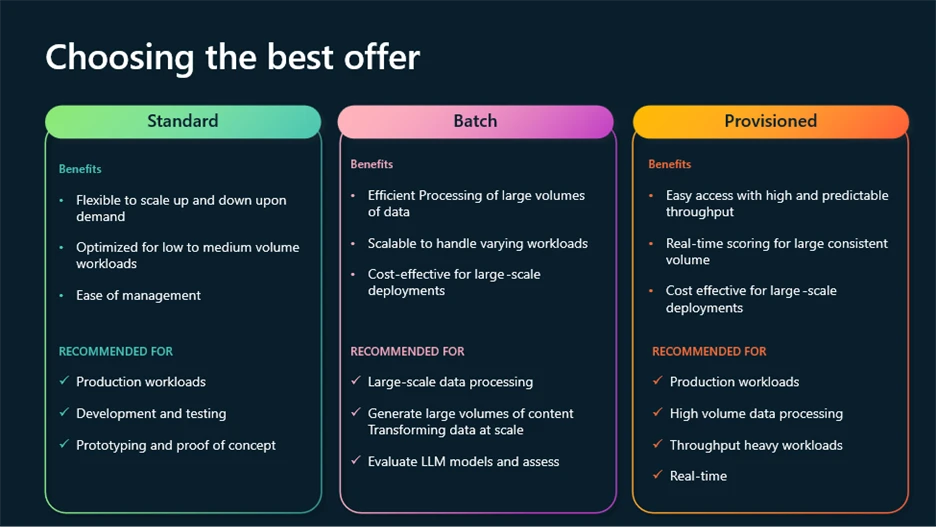
Azure OpenAI supports three distinct pricing models designed to meet different workload profiles and business requirements:
Standard—For bursty or variable workloads where you want to pay only for what you use.
Provisioned—For high-throughput, performance-sensitive applications that require consistent throughput.
Batch—For large-scale jobs that can be processed asynchronously at a discounted rate.
Each approach is designed to scale with you—whether you’re validating a use case or deploying across business units.
Standard
The Standard deployment model is ideal for teams that want flexibility. You’re charged per API call based on tokens consumed, which helps optimize budgets during periods of lower usage.
Best for: Development, prototyping, or production workloads with variable demand.
You can choose between:
Global deployments: To ensure optimal latency across geographies.
OpenAI Data Zones: For more flexibility and control over data privacy and residency.
With all deployment selections, data is stored at rest within the Azure chosen region of your resource.
Batch
The Batch model is designed for high-efficiency, large-scale inference. Jobs are submitted and processed asynchronously, with responses returned within 24 hours—at up to 50% less than Global Standard pricing. Batch also features large scale workload support to process bulk requests with lower costs. Scale your massive batch queries with minimal friction and efficiently handle large-scale workloads to reduce processing time, with 24-hour target turnaround, at up to 50% less cost than global standard.
Best for: Large-volume tasks with flexible latency needs.
Typical use cases include:
Large-scale data processing and content generation.
Data transformation pipelines.
Model evaluation across extensive datasets.
Customer in action: Ontada
Ontada, a McKesson company, used the Batch API to transform over 150 million oncology documents into structured insights. Applying LLMs across 39 cancer types, they unlocked 70% of previously inaccessible data and cut document processing time by 75%. Learn more in the Ontada case study.
Provisioned
The Provisioned model provides dedicated throughput via Provisioned Throughput Units (PTUs). This enables stable latency and high throughput—ideal for production use cases requiring real-time performance or processing at scale. Commitments can be hourly, monthly, or yearly with corresponding discounts.
Best for: Enterprise workloads with predictable demand and the need for consistent performance.
Common use cases:
High-volume retrieval and document processing scenarios.
Call center operations with predictable traffic hours.
Retail assistant with consistently high throughput.
Customers in action: Visier and UBS
Visier built “Vee,” a generative AI assistant that serves up to 150,000 users per hour. By using PTUs, Visier improved response times by three times compared to pay-as-you-go models and reduced compute costs at scale. Read the case study.
UBS created ‘UBS Red’, a secure AI platform supporting 30,000 employees across regions. PTUs allowed the bank to deliver reliable performance with region-specific deployments across Switzerland, Hong Kong, and Singapore. Read the case study.
Deployment types for standard and provisioned
To meet growing requirements for control, compliance, and cost optimization, Azure OpenAI supports multiple deployment types:
Global: Most cost-effective, routes requests through the global Azure infrastructure, with data residency at rest.
Regional: Keeps data processing in a specific Azure region (28 available today), with data residency both at rest and processing in the selected region.
Data Zones: Offers a middle ground—processing remains within geographic zones (E.U. or U.S.) for added compliance without full regional cost overhead.
Global and Data Zone deployments are available across Standard, Provisioned, and Batch models.
Dynamic features help you cut costs while optimizing performance
Several dynamic new features designed to help you get the best results for lower costs are now available.
Model router for Azure AI Foundry: A deployable AI chat model that automatically selects the best underlying chat model to respond to a given prompt. Perfect for diverse use cases, model router delivers high performance while saving on compute costs where possible, all packaged as a single model deployment.
Batch large scale workload support: Processes bulk requests with lower costs. Efficiently handle large-scale workloads to reduce processing time, with 24-hour target turnaround, at 50% less cost than global standard.
Provisioned throughput dynamic spillover: Provides seamless overflowing for your high-performing applications on provisioned deployments. Manage traffic bursts without service disruption.
Prompt caching: Built-in optimization for repeatable prompt patterns. It accelerates response times, scales throughput, and helps cut token costs significantly.
Azure OpenAI monitoring dashboard: Continuously track performance, usage, and reliability across your deployments.
To learn more about these features and how to leverage the latest innovations in Azure AI Foundry models, watch this session from Build 2025 on optimizing Gen AI applications at scale.
Integrated Cost Management tools
Beyond pricing and deployment flexibility, Azure OpenAI integrates with Microsoft Cost Management tools to give teams visibility and control over their AI spend.
Capabilities include:
Real-time cost analysis.
Budget creation and alerts.
Support for multi-cloud environments.
Cost allocation and chargeback by team, project, or department.
These tools help finance and engineering teams stay aligned—making it easier to understand usage trends, track optimizations, and avoid surprises.
Built-in integration with the Azure ecosystem
Azure OpenAI is part of a larger ecosystem that includes:
Azure AI Foundry—Everything you need to design, customize, and manage AI applications and agents.
Azure Machine Learning—For model training, deployment, and MLOps.
Azure Data Factory—For orchestrating data pipelines.
Azure AI services—For document processing, search, and more.
This integration simplifies the end-to-end lifecycle of building, customizing, and managing AI solutions. You don’t have to stitch together separate platforms—and that means faster time-to-value and fewer operational headaches.
A trusted foundation for enterprise AI
Microsoft is committed to enabling AI that is secure, private, and safe. That commitment shows up not just in policy, but in product:
Secure future initiative: A comprehensive security-by-design approach.
Responsible AI principles: Applied across tools, documentation, and deployment workflows.
Enterprise-grade compliance: Covering data residency, access controls, and auditing.
Get started with Azure AI Foundry
Build custom generative AI models with Azure OpenAI in Foundry Models.
Documentation for Deployment types.
Learn more about Azure OpenAI pricing.
Design, customize, and manage AI applications with Azure AI Foundry.
Azure OpenAI
Deploy the latest reasoning series and foundational models.
Learn more >
The post Maximize your ROI for Azure OpenAI appeared first on Microsoft Azure Blog.
Quelle: Azure
Businesses today are under pressure to innovate faster, reduce costs, and stay secure—all while preparing for an AI-driven future. As part of this shift, many organizations are turning to Microsoft Azure to modernize their infrastructure. In doing so, they find that migrating to Azure helps meet these evolving demands by improving agility, strengthening security, and laying the foundation for AI readiness.
Microsoft Azure supports your migration and modernization journey with services built for Linux and Open Source. Central to this transformation is Ubuntu, Canonical’s enterprise-grade Linux distribution, which integrates seamlessly with Azure’s IaaS and PaaS. Together, they deliver high performance, reliability, and enterprise support—plus a broad set of tools to make migration smooth and efficient.
Optimize your Ubuntu experience in Azure
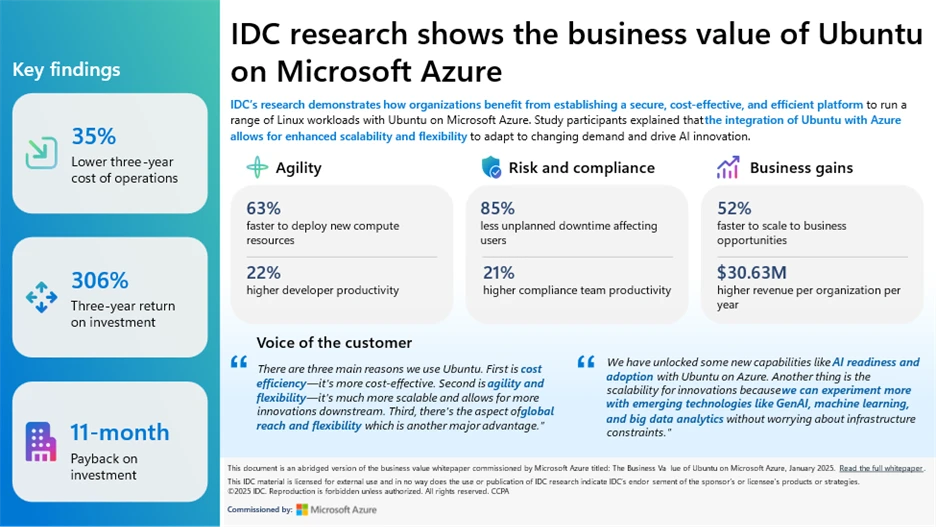
To bring a data-driven perspective to these benefits, Microsoft commissioned International Data Corporation (IDC) to conduct a business value study* based on interviews with organizations that moved their Ubuntu workloads from on-premises to Azure. Study participants shared that Azure provides a more efficient and effective platform for their Ubuntu workloads, maximizing their value in core business functions and supporting new technology adoption. Using the data derived from these interviews, IDC analysts created a typical customer profile to represent common experiences and business outcomes. The consolidated data from study participants shows that running Canonical Ubuntu workloads on Azure delivers the following benefits:
306% three-year return on investment with an 11-month payback on investment.
35% lower three-year cost of operations.
63% faster to deploy new compute resources and 52% faster to scale to new business opportunities.
85% less unplanned downtime affecting users.
$30.63M higher revenue per organization per year.
Quantified benefits of Ubuntu on Microsoft Azure
IDC interviewed stakeholders involved with Ubuntu workloads on Azure, uncovering significant benefits cited by participants, including:
Run mission-critical workloads with robust performance and flexibility
Organizations running workloads such as data analytics, engineering simulations, and machine learning, experience increased agility and operational efficiency with Ubuntu on Azure. By leveraging Ubuntu on Azure, businesses can scale seamlessly and respond swiftly to changing market conditions, ensuring optimal application performance while accelerating innovation and maintaining a competitive edge.
“With Ubuntu on Azure, we’ve unlocked AI adoption. We can scale innovations and experiment with technologies like GenAI, ML, and big data analytics without infrastructure constraints.”
The study participants also highlighted the ease of migrating Ubuntu workloads to Azure and the ability to add or remove capacity as needed. Gains in agility and development were notable, with users able to adjust and scale their Ubuntu environments more rapidly and flexibly in Azure, reducing deployment-related friction on development and business activities.
“Scalability is one of the reasons we moved to Ubuntu on Azure. We now have rapid scaling and flexible deployment, which enhance our responsiveness to business needs by almost 40%.”
Strengthen security and empower your IT teams
Security was another standout benefit for organizations adopting Ubuntu on Azure. They experienced enhanced operational resilience and reduced exposure to security and performance risks. Azure’s built-in security tools, including Microsoft Defender for Cloud, offer continuous security assessment threat detection, and actionable recommendations. This enables IT teams to proactively identify vulnerabilities, respond swiftly to potential threats, and maintain robust protection, ultimately supporting business continuity and fostering trust with customers and stakeholders.
“Ubuntu on Azure provides built-in security features such as Microsoft Defender for Cloud, which is a continuous security assessment and actionable recommendations. This proactive approach helps us identify vulnerabilities before they can be exploited, which is what we all are looking out for.”
In addition, IT teams have been able to shift their focus from maintenance-heavy tasks to more strategic, innovation-driven efforts, including AI initiatives. The transition to Azure simplified operations, streamlined development cycles, and enabled teams to make faster progress on business-critical projects by leveraging built-in AI tools and infrastructure that support rapid experimentation and deployment.
“With Ubuntu on Azure, we leverage AI and refocus our IT team. Managing on-premises infrastructure was difficult, but Azure AI services enhanced our applications and drove innovation. We’ve shifted IT resources from maintenance to strategic projects, improving productivity by 25%.”
Reduce operational costs while scaling efficiently
Organizations also realized significant cost efficiencies with Ubuntu on Azure. By taking advantage of Azure’s pay-as-you-go pricing and removing hardware maintenance burdens, businesses achieved notable infrastructure and licensing savings.
IDC found that customers reduced the cost of running Ubuntu workloads by an average of 35% over three years, saving $6,500 per Azure VM. Many also saw a 29% reduction in annual infrastructure costs, equating to approximately $581,100 per year.
“Ubuntu on Azure has reduced our direct IT costs by 40%, and it also optimizes our resource allocation, so we have better operational efficiency and staff time savings.”
“Ubuntu on Azure offers significant cost savings and scalability compared to on-premises solutions. It also provides excellent integration and interoperability and helps address data challenges, enhancing completeness, accuracy, and availability to support business decisions.”
Learn more from the IDC study
Download the full study: The Business Value of Ubuntu on Microsoft Azure.
Register to attend the webinar and listen to our guests from IDC, Microsoft, and Canonical discuss the benefits of running Ubuntu Linux on Azure.
To learn more about Ubuntu on Azure, visit our website.
The Business Value of Ubuntu on Microsoft Azure
Read the full International Data Corporation business value study.
Learn more >
*IDC White Paper, sponsored by Microsoft, The Business Value of Ubuntu on Microsoft Azure, doc # US52857024, January 2025.
The post IDC Business Value Study: A 306% ROI within 3 years using Ubuntu Linux on Azure appeared first on Microsoft Azure Blog.
Quelle: Azure
Microsoft is named a Leader in The Forrester Wave™: Serverless Development Platforms, Q2 2025
We are thrilled to announce that Microsoft has been recognized as a leader in The Forrester Wave™: Serverless Development Platforms, Q2 2025. We believe this recognition is a testament to our relentless focus on empowering developers, driving innovation, and delivering real value at scale for organizations across industries with Azure Functions and Azure Container Apps. Download the full report here (Forrester subscription required).
Focus on code, not infrastructure with serverless
Build smarter, scale faster with serverless compute in the era of AI applications and agents
Microsoft’s vision for serverless has always been clear: enable every developer to build, deploy, and manage modern applications with unmatched productivity, security, and agility—no matter the architecture, language, or workload. With Azure’s end-to-end serverless platform, we have moved beyond function-as-a-service to a comprehensive environment where containers, event-driven architectures, AI, and cloud-native patterns come together seamlessly.
Build and deploy serverless apps at scale
Our serverless offerings are designed to do more than abstract infrastructure—they are the foundation for building next-generation intelligent apps. With deep integrations into AI services, robust event handling, and developer-centric tooling, Azure Functions and Azure Container Apps make it easy for teams to transform ideas into impactful solutions.
What sets Microsoft’s serverless compute platform apart?
Unified event-driven and container-based models: Azure Functions and Azure Container Apps let you run any code, anywhere, scaling instantly from zero to hyper-scale—supporting both serverless functions and fully managed serverless containers without worrying about underlying infrastructure.
AI integration at every layer: With native support for Azure OpenAI, serverless GPUs and AI toolchains, you can embed generative AI, retrieval-augmented generation (RAG) patterns, and agentic workflows directly into serverless workflows, accelerating innovation in every app.
Best-in-class developer experience: From Visual Studio and VS Code to GitHub Actions, GitHub Copilot for Azure and familiar open-source frameworks, Microsoft’s stack puts developer productivity first—backed by extensive documentation, templates, and integrated DevOps capabilities.
Enterprise-grade security and compliance: Azure offers comprehensive identity and access management, role-based controls, and regulatory compliance, ensuring your applications and data are always protected.
Flexible pricing and hosting: Choose between consumption-based serverless, dedicated compute, or adaptive models. Features like Flex Consumption Plan and serverless GPU let you optimize for cost, performance, and specific workload needs.
Seamless and instant scaling: Instantly scale from zero to global with negligible cold start delays—ensuring always-on performance and real-time responsiveness for AI-powered and event-driven workloads, without manual intervention or infrastructure management.
Industry impact: With over a decade of operating a reliable cloud platform, we support mission-critical workloads across financial services, manufacturing, media, retail, and beyond.
Fully managed serverless container platform
Real-world impact: Customer success stories
Our customers continue to inspire us, showing what’s possible with Azure Functions and Azure Container Apps:
Hera Space Mission: Hera Space Companion, in collaboration with Terra Mater Studios, European Space Agency and Impact AI, is using Azure Container Apps and Azure AI Foundry to power the Hera AI Companion—an interactive, multilingual experience that lets users converse with a spacecraft in deep space—while also enabling rapid satellite image analysis and streamlined AI model deployment to accelerate innovation in space-based environmental insights.
Coca Cola: By adopting Azure Container Apps and Azure Functions to orchestrate real-time interactions in its global “Create Real Magic” holiday campaign, Coca Cola created a serverless, AI-powered Santa to engage over a million consumers across 43 countries in 26 languages with personalized experiences.
NFL: The National Football League integrates Azure Container Apps into its scouting platform, NFL Combine, to deliver real-time, sideline-ready AI insights, transforming hours of manual analysis into seconds of actionable data for coaches and scouts—without managing infrastructure.to power advanced fan engagement platforms, delivering real-time updates, personalized content, and data analytics during live events—all at massive scale.
Indiana Pacers: The Pacers build a real-time, in-arena captioning system that delivers instant, accurate captions to fans, enhancing accessibility and redefining the live sports experience through serverless compute and AI.
Coldplay: The iconic band, Coldplay, partners with Pixel Artworks to deliver immersive, AI-driven visual experiences at live shows, blending creativity and technology in real time using Azure Functions.
Heineken: Heineken is leveraging Azure Functions to build secure, scalable AI agents that automate workflows and power real-time RAG experiences—enabling intelligent, cost-optimized innovation across its global operations.
These stories are just a glimpse into the transformative potential of serverless at Microsoft. Visit the Microsoft Customer Stories for deeper dives into how organizations are succeeding with Azure Functions and Azure Container Apps, and check out the latest Build updates for even more innovation highlights.
Innovation continues: Build what’s next with Microsoft serverless
This recognition as a leader isn’t just a milestone—it’s a launchpad for what’s next. We’re continuously investing in AI-powered development, seamless hybrid cloud, and flexible deployment models. Our recent updates at Microsoft Build highlight advanced AI apps and agents, new serverless GPU capabilities, and an ever-growing ecosystem of tools, templates, and partner solutions to help you modernize, build, and scale.
Whether you’re building intelligent agents, orchestrating real-time data, or delivering engaging digital experiences, Microsoft’s serverless platform provides the power, flexibility, and trust you need.
Join us on this journey. Explore the latest on Azure Functions and Azure Container Apps, and let’s build the future—together.
Forrester does not endorse any company, product, brand, or service included in its research publications and does not advise any person to select the products or services of any company or brand based on the ratings included in such publications. Information is based on the best available resources. Opinions reflect judgment at the time and are subject to change. For more information, read about Forrester’s objectivity here .
The post Celebrating innovation, scale, and real-world impact with Serverless Compute on Azure appeared first on Microsoft Azure Blog.
Quelle: Azure
Microsoft Build 2025 showcased how Microsoft is reimagining the software development lifecycle with powerful new capabilities that redefine what’s possible with AI.
From streamlining enterprise workflows to accelerating scientific discovery, AI agents are transforming how developers build and how businesses operate.
15 million developers are using GitHub Copilot, using features like agent mode and code review to handle repetitive tasks, allowing them to focus on the fun, creative parts of software development.Hundreds of thousands of customers are using Microsoft 365 Copilot to assist with research, brainstorming, and solution development, allowing increased for efficiency.More than 230,000 organizations—including 90% of the Fortune 500—have used Microsoft Copilot Studio to build AI agents and automations to improve productivity and scale business quickly.More than 11,000 AI models are now available through Azure AI Foundry, including Microsoft-hosted and partner-hosted models. This extensive library of AI models provides unparalleled resources for organizations to innovate and scale their AI-powered solutions.In this edition of FYAI, a series where we dive deep on AI trends with Microsoft leaders, we hear from Yina Arenas, Vice President of Product, Azure AI Foundry, who is leading the work at Microsoft to empower every developer to shape the future with generative AI using breakthrough models and enterprise AI agents.
Explore Microsoft AIIn this Q&A, Yina shares her insights on the shifting AI landscape, including why businesses are getting stuck in the “proof of concept” phase and how Azure AI Foundry can meet organizations where they are and take their AI projects to the next level.
What shifts in the AI landscape are you seeing that are fundamentally changing how people—and organizations—build and scale AI?We’re seeing a profound shift from AI as a research experiment to AI as a core business capability. What’s exciting—and challenging—is that organizations are no longer just asking, “Can we build this?” but “How do we build this responsibly, at scale, and with real impact?” That shift requires new tools, new mindsets, and new ways of working across teams. At Microsoft, we’re focused on making AI more accessible and inclusive—so that everyone, from developers to domain experts, can contribute to building solutions that matter. It’s not just about the tech—it’s about empowering people to solve real problems with AI.
Why is it still so hard for businesses to move from experimentation to production with AI—and what needs to change to unlock that next wave of value?Azure AI Foundry is supporting open Agent2Agent (A2A) protocol
Learn howMany organizations get stuck in the “proof of concept” phase because the leap to production is complex. It’s not just about selecting the right model—it’s about integrating it into systems, ensuring it’s secure and responsible, and aligning it with business goals. What’s missing is a cohesive, end-to-end approach that brings together the right tools, governance, and collaboration in a developer-friendly environment. That’s where Azure AI Foundry comes in—it’s designed to help teams not only move faster but do so thoughtfully by providing a cohesive end-to-end platform and offering traceability across prompts, models, and runtime behavior. We’re making it easier and less complex for developers to build apps while also giving business decision makers the ability to see how these apps perform, measure their ROI, and meet compliance requirements. To unlock the next wave of value, we need to make AI development more collaborative, transparent, and outcome-driven.
How does Azure AI Foundry help bridge that gap—and how is it different from other approaches out there?Azure AI Foundry is built to meet organizations where they are—whether they’re just starting or scaling AI across the enterprise. It brings together the best of Microsoft’s AI capabilities from foundational models to orchestration and monitoring in a unified platform. What sets Azure AI Foundry apart is not only that it’s built on decades of world-class research but that it’s built with humans at the center, so whether you’re a data scientist, product manager, engineer, or business leader, our AI solutions work for you. It also bakes in responsible AI from the start by integrating tools, from testing to monitoring to governance, that support the entire life cycle.
Who is Azure AI Foundry built for, and how does it support cross-functional teams—from data scientists to decision-makers—to build together?Azure AI Foundry: Your AI App and agent factory
Learn moreAzure AI Foundry is designed for anyone looking to take their AI projects to the next level—whether you’re part of a big enterprise, a startup, or a software development company. It offers access to the leading frontier models, integrates orchestration frameworks, supports open protocols for multi-agent collaboration, and provides native observability tooling—all within a secure, governed environment. Whether it’s optimizing call centers, analyzing data, improving product searches, or automating workflows, Azure AI Foundry pulls everything—models, tools, and agents—into one user-friendly platform. With tools like GitHub, Visual Studio, and Copilot Studio, Azure AI Foundry makes it easy for developers, data scientists, IT pros, and decision-makers to shorten the journey from idea to production.
A close up of a spiralAzure AI FoundryDesign, customize, and manage AI apps and agents at scale.
Get started todayWhere are you seeing Azure AI Foundry already making an impact—and what kinds of transformation are customers unlocking?As the central hub for building, orchestrating, and managing AI solutions, Azure AI Foundry remains the centerpiece of our AI platform strategy. It is now used by developers at more than 70,000 enterprises and software development companies—including Atomicwork, Epic, Fujitsu, Gainsight, H&R Block, and LG Electronics—to design, customize, and manage their AI apps and agents. And just six months in, more than 10,000 organizations have used Azure AI Foundry Agent Service to build, deploy, and scale their agents. Developers are designing agents that act, reason, take initiative, and deliver measurable business outcomes.
Heineken, for example, used Azure AI Foundry to build a multi-agent platform called “Hoppy” that helps employees access data and tools across the company in their native language. Their implementation has already saved thousands of hours, reducing tasks that once took 20 minutes to just 20 seconds.
Fujitsu evaluated Azure AI Foundry Agent Service to automate sales proposal creation. This boosted productivity by 67%, letting their teams to focus on customer engagement. The AI agent integrates with existing Microsoft tools familiar to around 38,000 employees, retrieves dispersed knowledge, and lays the foundation for broader AI-powered innovation.
Draftwise, a digital native offering an AI-powered contract drafting and review platform, is using cutting edge models in Azure AI Foundry (Cohere multimodal and AOAI reasoning) to help streamline the contract drafting process by integrating with a lawyer’s document storage system.
What excites you most about what’s next—for Azure AI Foundry, and for how people can reimagine the way they work and create with AI?What excites me most about what’s next for Azure AI Foundry is how it’s unlocking a new era of creativity and empowerment—not just for developers, but for everyone. We’re moving beyond the idea of AI as a tool you use to AI as a copilot you build with. Azure AI Foundry is helping people imagine and create agents that understand their goals, adapt to their workflows, and evolve with their needs.
That shift—from writing code to orchestrating intelligence—is profound. It means that a product manager, a marketer, or a frontline worker can shape how AI works for them, without needing to be a machine learning expert. It’s about putting the power of AI into the hands of the many, not the few.
And what’s most inspiring is that we’re just getting started. The agents people are building today are solving real problems—automating complex processes, accelerating insights, and freeing up time for more meaningful work. But the agents of tomorrow? They’ll be collaborators in creativity, partners in problem-solving, and catalysts for innovation we haven’t even dreamed of yet.
That’s the future I see—and it’s being built right now, by people who are reimagining what’s possible with AI.
Design, customize, and manage AI apps and agents at scaleThrough leaders like Yina Arenas, Microsoft’s vision for the future of AI is both inspiring and deeply human-centered. With platforms like Azure AI Foundry, we’re entering a new era where AI becomes not just a tool, but a true collaborator—empowering everyone, regardless of technical expertise, to innovate and solve real-world problems. With Azure AI Foundry, the potential of AI is being unlocked by developers everywhere, sparking a wave of transformation and boundless possibilities.
Interested in learning more? Here are a few resources:
Build your first production-grade AI agent in under an hour: Azure AI FoundryLearn how Azure AI Foundry is supporting open Agent2Agent (A2A) protocolRead Azure AI Foundry Agent Service documentationEmpower your team to grow their AI skillsFYAI: How agents will transform business and daily work
The post FYAI: How to leverage AI to reimagine cross-functional collaboration with Yina Arenas appeared first on Microsoft Azure Blog.
Quelle: Azure

Gesund und einfach zu kochen wünschen sich fast alle. Mit der Heißluftfritteuse von Cosori ist das möglich. Bei Amazon ist sie reduziert. (Technik/Hardware, Amazon)
Quelle: Golem






