Freevee: Amazon startet werbegestützten Streaming-Sender
Amazon Freevee ist in Deutschland gestartet: Zahlreiche Serien und Filme lassen sich kostenlos schauen – allerdings mit Werbung. (Freevee, Amazon)
Quelle: Golem

Amazon Freevee ist in Deutschland gestartet: Zahlreiche Serien und Filme lassen sich kostenlos schauen – allerdings mit Werbung. (Freevee, Amazon)
Quelle: Golem
Today we are announcing Data Studio, our self-service business intelligence and data visualization product, as a Google Cloud service, enabling customers to get Data Studio on the Google Cloud terms of service, simplifying product acquisition and integration in their company’s technology stack.Why are we doing this?Google Cloud customers of all types widely use Data Studio today as a critical piece of their business intelligence measurement and reporting workflow. Many of our customers have asked for Data Studio on Google Cloud terms, to ensure Google supports the same privacy and security commitments for Data Studio as for other Google Cloud products. Now, that’s possible. What benefits do customers get?Data Studio now supports additional compliance standards for internal auditing, controls and information system security, including SOC 1, SOC 2, SOC 3 and PCI DSS, with more compliance certifications coming soon. Data Studio can be used under the same terms as other Google Cloud services, reducing procurement complexity and enabling it to be covered by customers’ existing Cloud Master Agreement.If customers are subject to HIPAA and have signed a Google Cloud Business Associate Amendment (BAA), it will apply to Data Studio as well. Data Studio is still free to use, although as a free offering, it is not currently supported through Google Cloud support.What’s not changingThis additional certification does not change a single pixel of the end-user experience for Data Studio. Customers can still analyze their data, create beautiful reports, and share insights using all of Data Studio’s self-service BI functionality with no disruption. For customers who aren’t yet using Google Cloud, Data Studio will continue to be available under our existing terms and conditions as well.When everyone is empowered to dig into data, the results can be transformational. This is just the beginning of our investment in making the power of Google Cloud accessible to everyone through easy-to-use cloud BI. To switch Data Studio to the Google Cloud terms, follow these simple steps. Visualize on.Related ArticleBringing together the best of both sides of BI with Looker and Data StudioGet the self-serve speed you need with the certainty of central BI by integrating Looker and Data Studio.Read Article
Quelle: Google Cloud Platform
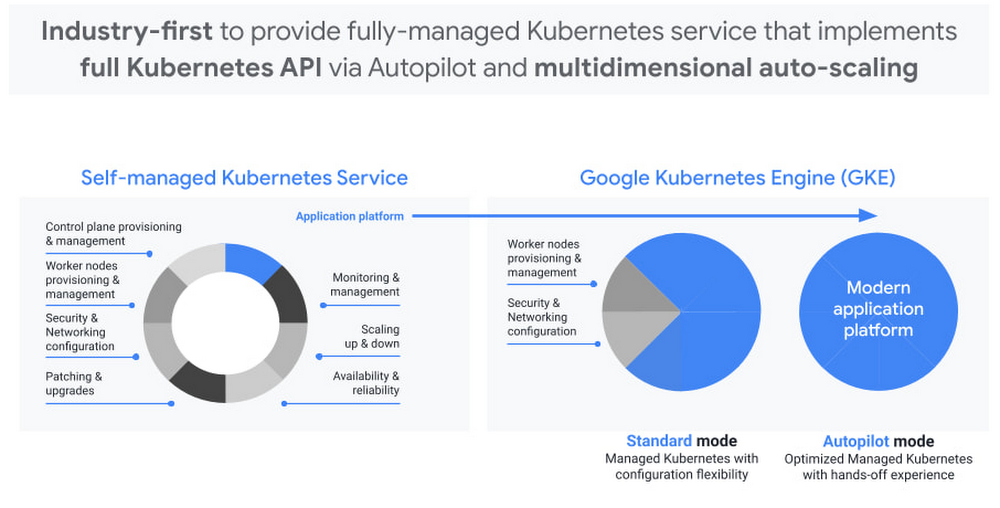
Today’s consumers expect incredible feats of speed and service delivered through easy-to-use apps and personalized interactions. Modern conveniences have taught consumers that their experience is paramount—no matter the size of the company, complexity of the problem, or regulations in the industry. “Cloud-native technologies empower organizations to build and run scalable applications in modern, dynamic environments such as public, private, and hybrid clouds. Containers, service meshes, microservices, immutable infrastructure, and declarative APIs exemplify this approach. These techniques enable loosely coupled systems that are resilient, manageable, and observable. Combined with robust automation, they allow developers to make high-impact changes frequently and predictably with minimal toil.” (per Cloud Native Computing Foundation)Modern cloud is container-firstContainers are a better way to develop and deploy modern cloud applications. Containers are more lightweight, faster, more portable, and easier to manage than virtual machines. Containers help developers to build more testable, secure systems while the operations team can isolate workloads inside cost-effective clusters. In a climate where IT needs are rapidly changing, driven by evolving customer demands, building and managing modern cloud applications means so much more than having a managed service platform. Modern cloud has become synonymous with containers and having a Kubernetes strategy is essential to success in IT.Kubernetes for next-generation developersA managed container platform like Kubernetes can extend the advantages of containers even further. Think of Kubernetes as the way to build customized platforms that enforce rules your enterprise cares about through controls over project creation, the nodes you use, and libraries and repositories you pull from. Background controls are not typically managed by app developers, rather they provide developers with a governed and secure framework to operate within. Kubernetes is not just a technology — it’s a model for creating and scaling value for your business, a way of developing reliable apps and services, and a means to secure and develop cloud-based IT capabilities for innovation.Open source makes it easy Google invented Kubernetes and continues to be the leading committer to this open source project. By betting on open source, you get the freedom to run where you want to. And the ecosystem around open source projects like Kubernetes means you get standardized plugins and extensions to create a developer-friendly, comprehensive platform. You can build best-in-class modern applications using open source that can seamlessly and securely be moved to Google Cloud when they are ready to deploy in the cloud.GKE leads the way Open source gives you freedom, while managed services based on open source give you the built-in best practices for deploying and running that software. Created by the same developers that built Kubernetes, Google Kubernetes Engine (GKE) is the best of both. Use standard Kubernetes, expertly operated by the company that knows it best. GKE lets you recognize the benefits of innovation initiatives without getting bogged down troubleshooting infrastructure issues and managing day-to-day operations related to enterprise-scale container deployment. The recipe for long-term success with Kubernetes is two-fold: automation that matters and scale that saves.#1 Automation that mattersFor cloud-based companies, the only constant is change. That means you need to be able to adapt quickly to changing conditions. This applies to your platforms too! Your application platform needs to be elastic and able to absorb changes without downtime. GKE delivers most dimensions of automation to efficiently and easily operate your applications. With fully managed Autopilot mode of operation combined with multi-dimensional auto-scaling capabilities, you can get started with a production ready secured cluster in minutes and have complete control over the configurations and maintenance.Day 2 operations: With GKE, you have the option to automate node provisioning and upgrades, control plane upgrades, with choice of selective node auto upgrades and configurations. These capabilities provide you the flexibility to automate your infrastructure the way you want and gain significant time savings and alleviate maintenance requirements. Moreover, with GKE release channels, you have the power to decide not only when, but how, and what to upgrade in your clusters and nodes.Modern cloud stack: You can install service mesh and config management solutions with the click of a button, and leave the provisioning and operations of these solutions to us. Google Cloud provisions, scales, secures and updates both the control and data planes, giving you all the benefits of a service mesh with none of the operational burden. You can let Google manage the upgrade and lifecycle tasks for both your cluster and your service mesh. In addition, you can take advantage of advanced telemetry, security and Layer 7 network policies provided by the mesh.Cost optimization: You can optimize your Kubernetes resources with actionable insights: use GKE cost optimization insights, workload rightsizing and cost estimator, built right into the Google Cloud console . Read how a robotics startup switched clouds and reduced its Kubernetes ops costs with GKE Autopilot; fewer pages at night as clusters are scaled and maintained by Google Cloud, reduced cost, and a better and more secure experience for customers, freed up developer time away from managing Kubernetes.Partner solutions: You can use your favorite DevOps and security solutions with GKE Autopilot out of the box. Despite being a fully managed Kubernetes platform that provides you with a hands-off approach to nodes, GKE Autopilot still supports the ability to run node agents using DaemonSets. This allows you to do things like collect node-level metrics without needing to run a sidecar in every Pod.#2 Scale that savesWhether your organization is scaling up to meet a sudden surge in demand or scaling down to manage costs, modern cloud applications have never been more important. Only GKE can run 15,000 node clusters, outscaling other cloud providers by up to 10X, letting you run applications effectively and reliably at scale. Organizations like Kitabisa and IoTex are already experiencing the benefits of running their modern cloud applications on the most scalable Kubernetes platform.“The transformative value of GKE became apparent when severe flooding hit Sumatra in November 2021, affecting 25,000 people. Our system easily handled the 30% spike in donations.” – Kitabisa “We regularly experience massive scaling surges from random places in the crypto universe. In the future, the IoTeX platform will secure billions of connected devices feeding their data snapshot to the blockchain. With GKE Autopilot and Cloud Load Balancing, we can easily absorb any load no matter how much or how fast we grow.” – Larry Pang, Head of Ecosystem, IoTeXWant to learn how to incorporate GKE into your own cloud environment? Register now to learn helpful strategies and best practices to power your business with modern cloud apps.Related ArticleHow tech companies and startups get to market faster with containers on Google CloudGoogle Cloud’s whitepaper explores how startups and tech companies can move faster with a managed container platformRead Article
Quelle: Google Cloud Platform
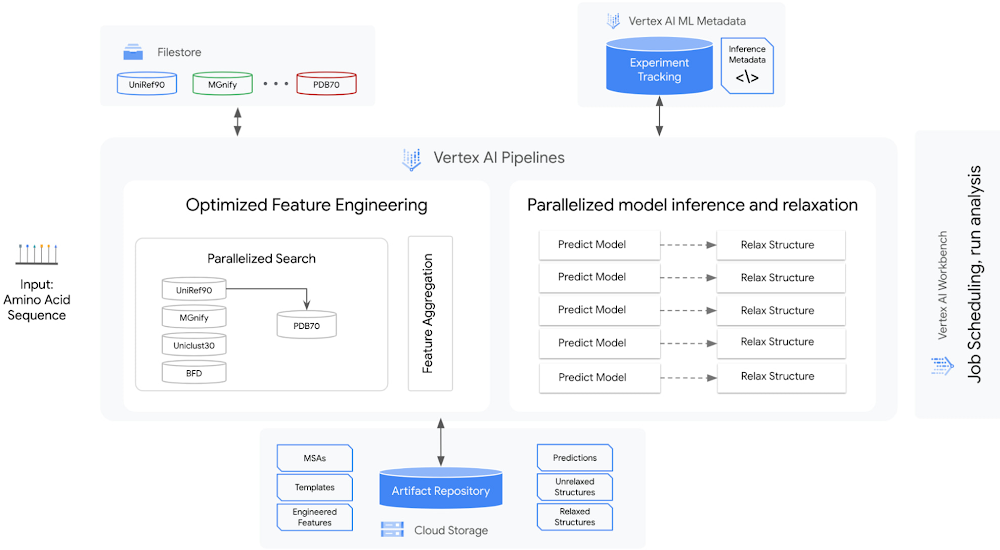
Today, to accelerate research in the bio-pharma space, from the creation of treatments for diseases to the production of new synthetic biomaterials, we are announcing a new Vertex AI solution that demonstrates how to use Vertex AI Pipelines to run DeepMind’s AlphaFold protein structure predictions at scale. Once a protein’s structure is determined and its role within the cell is understood, scientists can develop drugs that can modulate the protein function based on its role in the cell. DeepMind, an AI research organization within Alphabet, created the AlphaFold system to advance this area of research by helping data scientists and other researchers to accurately predict protein geometries at scale.In 2020, in the Critical Assessment of Techniques for Protein Structure Prediction (CASP14) experiment, DeepMind presented a version of AlphaFold that predicted protein structures so accurately, experts declared the “protein-folding problem” solved. The next year, DeepMind open sourced the AlphaFold 2.0 system. Soon after, Google Cloud released a solution that integrated AlphaFold with Vertex AI Workbench to facilitate interactive experimentation. This made it easier for many data scientists to efficiently work with AlphaFold, and today’s announcement builds on that foundation.Last week, AlphaFold took another significant step forward when DeepMind, in partnership with the European Bioinformatics Institute (EMBL-EBI), released predicted structures for nearly all cataloged proteins known to science. This release expands the AlphaFold database from nearly 1 million structures to over 200 million structures—and potentially increases our understanding of biology to a profound degree. Between this continued growth in the AlphaFold database and the efficiency of Vertex AI, we look forward to the discoveries researchers around the world will make. In this article, we’ll explain how you can start experimenting with this solution, and we’ll also survey its benefits, which include offering lower costs through optimized selection of hardware, reproducibility through experiment tracking, lineage and metadata management, and faster run time through parallelization.Background for running AlphaFold on Vertex AIGenerating a protein structure prediction is a computationally intensive task. It requires significant CPU and ML accelerator resources and can take hours or even days to compute. Running inference workflows at scale can be challenging—these challenges include optimizing inference elapsed time, optimizing hardware resource utilization, and managing experiments.Our new Vertex AI solution is meant to address these challenges.To better understand how the solution addresses these challenges, let’s review the AlphaFold inference workflow:Feature preprocessing. You use the input protein sequence (in the FASTA format) to search through genetic sequences across organisms and protein template databases using common open source tools. These tools include JackHMMER with MGnify and UniRef90, HHBlits with Uniclust30 and BFD, and HHSearch with PDB70. The outputs of the search (which consist of multiple sequence alignments (MSAs) and structural templates) and the input sequences are processed as inputs to an inference model. You can run the feature preprocessing steps only on a CPU platform. If you’re using full-size databases, the process can take a few hours to complete.Model inference. The AlphaFold structure prediction system includes a set of pretrained models, including models for predicting monomer structures, models for predicting multimer structures, and models that have been fine-tuned for CASP. At inference time, you independently run the five models of a given type (such as monomer models) on the same set of inputs. By default, one prediction is generated per model when folding monomer models, and five predictions are generated per model when folding multimers. This step of the inference workflow is computationally very intensive and requires GPU or TPU acceleration.(Optional) Structure relaxation. In order to resolve any structural violations and clashes that are in the structure returned by the inference models, you can perform a structure relaxation step. In the AlphaFold system, you use the OpenMM molecular mechanics simulation package to perform a restrained energy minimization procedure. Relaxation is also very computationally intensive, and although you can run the step on a CPU-only platform, you can also accelerate the process by using GPUs.The Vertex AI solutionThe AlphaFold batch inference with the Vertex AI solution lets you efficiently run AlphaFold inference at scale by focusing on the following optimizations:Optimizing inference workflow by parallelizing independent steps.Optimizing hardware utilization (and as a result, costs) by running each step on the optimal hardware platform. As part of this optimization, the solution automatically provisions and deprovisions the compute resources required for a step.Describing a robust and flexible experiment tracking approach that simplifies the process of running and analyzing hundreds of concurrent inference workflows.The following diagram shows the architecture of the solution.The solution encompasses the following:A strategy for managing genetic databases. The solution includes high-performance, fully managed file storage. In this solution, Cloud Filestore is used to manage multiple versions of the databases and to provide high throughput and low-latency access.An orchestrator to parallelize, orchestrate, and efficiently run steps in the workflow. Predictions, relaxations, and some feature engineering can be parallelized. In this solution, Vertex AI Pipelines is used as the orchestrator and runtime execution engine for the workflow steps.Optimized hardware platform selection for each step. The prediction and relaxation steps run on GPUs, and feature engineering runs on CPUs. The prediction and relaxation steps can use multi-GPU node configurations. This is especially important for the prediction step because the memory usage is approximately quadratic with the number of residues. Therefore, predicting a large protein structure can exceed the memory of a single GPU device.Metadata and artifact management. The solution includes management for running and analyzing experiments at scale. In this solution, Vertex AI Metadata is used to manage metadata and artifacts.The basis of the solution is a set of reusable Vertex AI Pipelines components that encapsulate core steps in the AlphaFold inference workflow: feature preprocessing, prediction, and relaxation. In addition to those components, there are auxiliary components that break down the feature engineering step into tools, and helper components that aid in the organization and orchestration of the workflow.The solution includes two sample pipelines: the universal pipeline and a monomer pipeline. The universal pipeline mirrors the settings and functionality of the inference script in the AlphaFold Github repository. It tracks elapsed time and optimizes compute resources utilization. The monomer pipeline further optimizes the workflow by making feature engineering more efficient. You can customize the pipeline by plugging in your own databases.Next stepsTo learn more and to try out this solution, check our GitHub repository, which contains the components and universal and monomer pipelines. The artifacts in the repository are designed so that you can customize them. In addition, you can integrate this solution into your upstream and downstream workflows for further analysis. To learn more about Vertex AI, visit our product page. AcknowledgementsWe would like to thank the following people for their collaboration: Shweta Maniar, Sampath Koppole, Mikhail Chrestkha, Jasper Wong, Alex Burdenko, Meera Lakhavani, Joan Kallogjeri, Dong Meng (NVIDIA), Mike Thomas (NVIDIA), and Jill Milton (NVIDIA).Finally and most importantly, we would like to thank our Solution Manager Donna Schut for managing this solution from start to finish. This would not have been possible without Donna.Related ArticleGetting started with ML: 25+ resources recommended by role and taskWhether you are a Data Analyst, Data Scientist, ML Engineer or Software Engineer, here are specific resources to help you get started wit…Read Article
Quelle: Google Cloud Platform
As enterprise and public sector cloud adoption continues to accelerate, having an accurate picture of who did what in your cloud environment is important for security and compliance purposes. Logs are critical when you are attempting to detect a breach, investigating ongoing security issues, or performing forensic investigations. These five must-know Cloud Logging security and compliance features can help customers create logs to best conduct security audits. The first three features were launched recently in 2022, while the last two features have been available for some time.1. Cloud Logging is a part of Assured Workloads. Google Cloud’s Assured Workloads helps customers meet compliance requirements with a software-defined community cloud. Cloud Logging and external log data is in scope for many regulations, which is why Cloud Logging is now part of Assured Workloads. Cloud Logging with Assured Workloads can make it even easier for customers to meet the log retention and audit requirements of NIST 800-53 and other supported frameworks. Learn how to get started by referring to this documentation.2. Cloud Logging is now FedRAMP High certified.FedRAMP is a U.S. government program that promotes the adoption of secure cloud services by providing a standardized approach to security and risk assessment for federal agencies adopting cloud technologies. The Cloud Logging team has received certification for implementing the controls required for compliance with FedRAMP at the High Baseline level. This certification will allow customers to store sensitive data in cloud logs and use Cloud Logging to meet their own compliance control requirements. Below are the controls that Cloud Logging has implemented as required by NIST for this certification. In parenthesis, we’ve included example control mapping to capabilities: Event Logging (AU-2) – A wide variety of events are captured. Examples of events as specified include password changes, failed logons or failed accesses related to systems, security or privacy attribute changes, administrative privilege usage, Personal Identity Verification (PIV) credential usage, data action changes, query parameters, or external credential usage.Making Audits Easy (AU-3) – To provide users with all the information needed for an audit, we capture the type of event, time occurred, location of the event, source of the event, outcome of the event, and identity information. .Extended Log Retention (AU-4) – We support the outlined policy for log storage capacity and retention to provide support for after-the-fact investigations of incidents. We help customers meet their regulatory and organizational information retention requirements by allowing them to configure their retention period. Alerts for Log Failures (AU-5) – A customer can create alerts when a log failure occurs.Create Evidence (AU-16) – A system-wide (logical or physical) audit trail composed of audit records in a standardized format is captured. Cross-organizational auditing capabilities can be enabled.Check out this webinar to learn how Assured Workloads can help support your FedRAMP compliance efforts. 3. “Manage your own Keys,” also known as customer managed encryption keys (CMEK), can encrypt Cloud Logging log buckets.For customers with specific encryption requirements, Cloud Logging now supports CMEK via Cloud KMS. CMEK can be applied to individual logging buckets and can be used with the log router. Cloud Logging can be configured to centralize all logs for the organization into a single bucket and router if desired, which makes applying CMEK to the organization’s log storage simple. Learn how to enable CMEK for Cloud Logging Buckets here.4. Setting a high bar for cloud provider transparency with Access Transparency.Access Transparency logs can help you to audit actions taken by Google personnel on your content, and can be integrated with your existing security information and event management (SIEM) tools to help automate your audits on the rare occasions that Google personnel may access your content. While Cloud Audit logs tell you who in your organization accessed data in Google Cloud, Access Transparency logs tell you if any Google personnel accessed your data. These Access Transparency logs can help you: Verify that Google personnel are accessing your content only for valid business reasons, such as fixing an outage or attending to your support requests.Review actual actions taken by personnel when access is approved. Verify and track Assured Workload Support compliance with legal or regulatory obligations.Learn how to enable Access Transparency for your organization here.5. Track who is accessing your Log data with Access Approval Logs. Access Approvals can help you to restrict access to your content to Google personnel according to predefined characteristics. While this is not a logging-specific feature, it is one that many customers ask about. If a Google support person or engineer needs to access your content for support for debugging purposes (in the event a service request is created), you would use the access approval tool to approve or reject the request. Learn about how to set up access approvals here. We hope that these capabilities make adoption and use of Cloud Logging easier, more secure, and more compliant. With additional features on the way, your feedback on how Cloud Logging can help meet additional security or compliance obligations is important to us. Learn more about Cloud Logging with our qwiklab quest and join us in our discussion forum. As always, we welcome your feedback. To share feedback, contact us here.Related ArticleHow to help ensure smooth shift handoffs in security operationsSOAR tech can help make critical shift handoffs happen in the SOC, ensuring pending tasks are completed and active incidents are resolved.Read Article
Quelle: Google Cloud Platform
If you’re thinking about what it takes to modernize your applications, you’re not alone. Companies everywhere now understand that migrating applications to the cloud and shifting to a cloud-first approach is critical to business competitiveness. The purpose of modernizing applications is to better align them to current and future business needs. By deploying enterprise applications to the cloud, you gain greater ability to innovate, improve security, scale to meet demand, manage costs, and deliver rich and consistent customer experiences anywhere in the world more quickly.
But as you move to the cloud, there are many options to choose from and skills to gain. One of the most important parts of this effort is understanding how to prepare developers for cloud modernization—and one of the trickiest parts is knowing where to start.
According to research on Developer Velocity, the number one driver of business performance is best-in-class developer tools.1 Companies that create the right environment—by providing strong tools and removing points of friction for developers to innovate—have 47 percent higher developer satisfaction and retention rates than those in the lowest quartile for Developer Velocity. With Microsoft Azure, you’ll find not only the tools and technologies that you need to move to the cloud, but also extensive developer support for cloud modernization.
In this article, we’ll walk you through technical documentation, educational resources, and step-by-step guidance to help you build the skills and strategy needed to successfully modernize your applications. We use Azure App Service as our example, but the same concepts apply to other tools you might use in your modernization efforts.
Here are five steps to take to start preparing for cloud modernization:
1. Watch how application migration works.
Migrating existing, on-premises applications to the cloud is often the focus of initial application modernization efforts. Once the business case has been made to migrate an application to the cloud, you’ll need to assess the application for all the dependencies that can affect whether it can be successfully migrated without modifying the application. In the case of App Service, a migration assistant guides you through the assessment. Then, if the assessment indicates that the application can be migrated, the migration assistant performs the migration. To get an introduction to how the assessment and migration process works, watch the overview video on how to migrate web apps to App Service.
2. Learn to migrate an on-premises application to the cloud.
The best way to understand what it takes to migrate an application is to try it for yourself. To learn how to migrate an on-premises web application to App Service, take the step-by-step online course—including a hands-on lab—that guides you through migration and post-migration. Using a sandbox environment and access to free resources, you’ll get an in-depth walkthrough of how to migrate your web application, from assessment through post-migration tasks. You’ll also get background on why the assessment phase is so important, what types of problems it’s intended to identify, and what to do if any problems are found. Next, the course takes you through the migration process and provides guidance on the settings you’ll need to choose from, and it prepares you for additional tasks that might be necessary to get the web app in working order.
3. Build a web app in the language of your choice.
Learning how to build a cloud-native application is another important step in preparing yourself to shift to a cloud-first approach. To give it a try, sign up for an Azure free account, which gives you access to dozens of free services, including App Service. Along with access to a wide range of cloud resources, you get developer support for cloud modernization through quickstart guides that walk you through creating and deploying a web app in App Service using the language of your choice, including .NET, Node.js, Java, Python, and other languages. This is also a great time to explore other Azure cloud capabilities and use the $200 credit that you get with the Azure free account.
4. Assess your own web apps for modernization readiness.
Once you understand the basics of migrating and deploying applications in the cloud, it’s time to get to work on the process of assessing and migrating your own web apps. Use the free App Service migration tool to run a scan on your web app’s public URL. The tool will provide you with a compatibility report on the technologies your app uses and whether App Service fully supports them. If compatible, the tool will guide you through downloading the migration assistant, which simplifies migration in an automated way with minimal or no code changes.
5. Download the App Migration Toolkit.
With a solid background in how to prepare for modernization, you’re in a good position to start putting the full range of Azure developer support for cloud modernization to work. Download the App Migration Toolkit to find the resources you need to successfully modernize your ASP.NET applications from start to finish. From building your business case to best practices and help gaining skills, the toolkit provides practical guidance and support to help you turn your application modernization plans into reality.
While application modernization is a significant initiative that requires strategy, planning, skill-building, and investment of time and resources, the benefits to the business are worth the effort. Fortunately, Azure simplifies the process of figuring out how to prepare developers for cloud modernization. The App Migration Toolkit gives you the skills and knowledge needed to help your organization innovate and stay competitive.
1Developer Velocity: How software excellence fuels business performance.
Quelle: Azure
Das AWS Outposts-Rack wird jetzt in der AWS-Region Asien-Pazifik (Jakarta) unterstützt. Das AWS Outposts-Rack ist ein vollständig verwalteter Service, der dieselbe AWS-Infrastruktur, dieselben AWS-Services, APIs und Tools für praktisch jedes On-Premises-Rechenzentrum oder jeden Co-Location-Raum bietet, um eine wirklich konsistente Hybrid-Erfahrung zu ermöglichen.
Quelle: aws.amazon.com
AWS-Lambda-Support für AWS X-Ray ist jetzt in AWS-GovCloud-Regionen (USA) verfügbar. Mithilfe des AWS-Lambda-Supports für AWS X-Ray kannst du ganz einfach X-Ray-Tracing für deine Funktionen aktivieren.
Quelle: aws.amazon.com
Application Manager, eine Funktion von AWS Systems Manager, kündigt heute ein vereinfachtes Onboarding-Erlebnis für Kunden an. Application Manager ist bei AWS ein zentraler Hub zum Erstellen, Anzeigen und Ausführen von Anwendungen über eine einzige Konsole. Mit Application Manager können Kunden ihre Ressourcen in mehreren AWS-Services wie AWS CloudFormation, AWS Launch Wizard, AWS Service Catalog App Registry, AWS Resource Groups, Amazon Elastic Kubernetes Service (Amazon EKS) und Amazon Elastic Container Service (Amazon ECS) erkennen und verwalten. Durch die Anwendung dieser Funktion können IT-Fachleute jetzt einem geführten einfachen Prozess zum Einrichten der Application-Manager-Dashboards durchlaufen.
Quelle: aws.amazon.com
AWS Cloud Map ist jetzt in den AWS-Regionen Asien-Pazifik (Osaka) und Asien-Pazifik (Jakarta) verfügbar. AWS Cloud Map ist ein Service für die Erkennung von Cloud-Ressourcen. Mit AWS Cloud Map kannst du kundenspezifische Namen für deine Anwendungsressourcen vergeben, wie z. B. für Amazon Elastic Container Services (Amazon ECS)-Aufgaben, Amazon Elastic Compute Cloud (Amazon EC2)-Instances, Amazon DynamoDB-Tabellen oder andere Cloud-basierte Ressourcen. Du kannst diese benutzerdefinierten Namen anschließend verwenden, um den Standort und die Metadaten von Cloud-Ressourcen über deine Anwendungen mit AWS SDK und authentifizierten API-Abfragen zu ermitteln.
Quelle: aws.amazon.com






