Tomtom: 9-Euro-Ticket bewirkt weniger Staus in den Großstädten
Tomtom hat erneut Verkehrsdaten zur Wirkung des 9-Euro-Tickets in Deutschland ausgewertet. Offenbar zeigt die starke Preissenkung Wirkung. (9-Euro-Ticket, Tomtom)
Quelle: Golem

Tomtom hat erneut Verkehrsdaten zur Wirkung des 9-Euro-Tickets in Deutschland ausgewertet. Offenbar zeigt die starke Preissenkung Wirkung. (9-Euro-Ticket, Tomtom)
Quelle: Golem

Mit einer optimierten Aerodynamik soll der Mercedes EQS eine höhere Reichweite erzielen. Brabus hat dafür ein teures Tuning-Paket geschnürt. (Mercedes Benz, Elektroauto)
Quelle: Golem

Besonders im Bereich Cloud erzielt Huawei wieder Zuwächse. (Huawei, Wirtschaft)
Quelle: Golem

Auf Tiktok und Youtube machen Videos die Runde, in denen Jugendliche Autos von Kia und Hyundai klauen. Wäre das auch hier möglich? Von Dirk Kunde (Auto, Technologie)
Quelle: Golem

Das Bundeswirtschaftsministerium hat bestätigt, dass ab September 2023 neben Privatpersonen auch gemeinnützige Organisationen Fördermittel für E-Autos bekommen. (Elektroauto, GreenIT)
Quelle: Golem

XPeng hat technische Details zu seinem elektrischen SUV G9 veröffentlicht. Das Elektroauto soll sich besonders schnell laden lassen. (Xpeng, Elektroauto)
Quelle: Golem

Der 42 Zoll große LG OLED C2 passt doch perfekt auf den Tisch. Er gibt einen tollen Monitor für Games und Office ab, trotz TV-Herkunft. Ein Test von Oliver Nickel (LG, Display)
Quelle: Golem

Ein 15-Zöller mit ARM-Prozessor: Der Bitblaze Titan soll sich für Office und Youtube eignen, die Akkulaufzeit aber ist fast schon miserabel. (Notebook, Computer)
Quelle: Golem

Does your development team want to snooze alerts during non-business hours? Or proactively prevent the creation of expected alerts for an upcoming expected maintenance window? Cloud Alerting in Google’s Cloud operations suite now supports the ability to snooze alert policies for a given period of time. You can create a Snooze by providing specific alert policies and a time period. During this window, if the alert policy is violated, no incidents or notifications are created. When the window ends, the alerting behavior resumes as normal. Your team can use this feature in a variety of ways. One example is to avoid being paged for non-production environments over the weekend. Another way is to plan for a known maintenance window or cutover period. You can also quiet the noise during a growing outage, among other approaches. To create a Snooze, go to Monitoring > Alerting. See the new table with Snoozes and click on Create Snooze. You provide the name of the Snooze, time period, and select the desired Alert Policies. After you select the criteria, a table lists recent Incidents that match this criteria. Events like those won’t cause an alert when the snooze is active.You will see a timeline visualization of all past, active, and upcoming Snoozes. If you’d like to adjust the duration, you can go back and edit the details. For more information, please see the documentation.In the future, we’ll expand this functionality to allow snoozing by labels. You’ll be able to temporarily silence by the resource, system, metric, and custom labels which will allow you to snooze all alert policies in a specific environment, zone, or team. This functionality will be extended to be supported in the API, allowing you to create Snoozes programmatically for regularly repeating events.Related ArticleAdd severity levels to your alert policies in Cloud MonitoringAdd static and dynamic severity levels to your alert policies for easier triaging and include these in notifications when sent to 3rd par…Read Article
Quelle: Google Cloud Platform
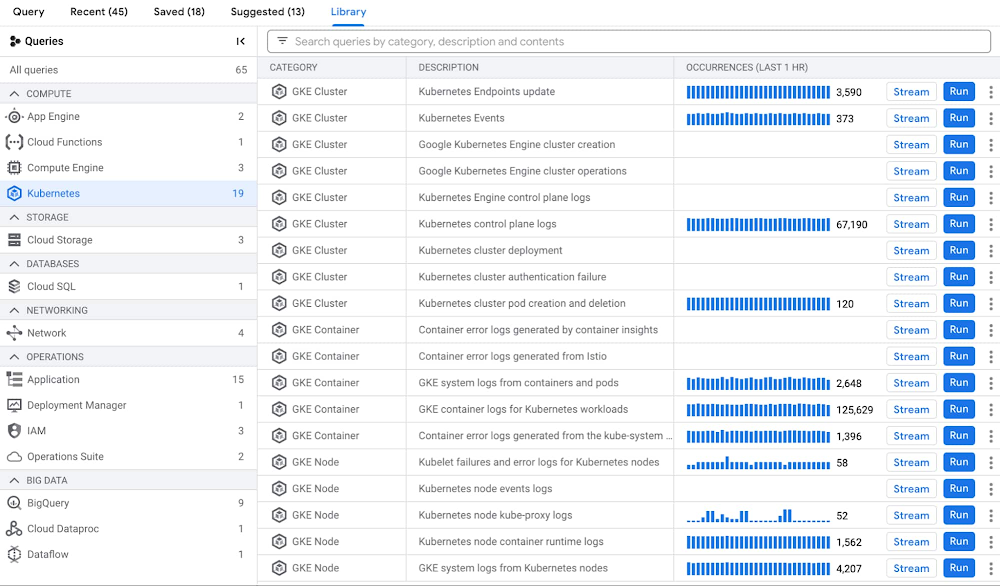
Our goal in Cloud Logging is to help increase developer productivity by streamlining the troubleshooting process. The time spent on writing and executing a query, and then analyzing the errors can impact developer productivity. Whether you’re troubleshooting an issue or analyzing your logs, finding the right logs quickly, is critical. That’s why we recently launched a Query Library and other new features to make querying your logs even easier. The Query Library in Cloud Logging makes it easier to find logs faster by using common queries.Build queries faster with our templatesThe new text search and drop-down features are designed to make querying something that you can achieve with a few mouse clicks. These features automatically generate the Logging query language necessary for you. The Query Library extends this simplicity with templates for common GCP queries.The Query Library is located in the query builder bar next to the Suggested queries. To help find the most relevant queries you’ll notice the following details:Query categories – Each query is broken down into categories that can be used to easily narrow down to relevant queries. Query occurrences – To help you pick queries that have the most useful results, sparklines are displayed for queries that have logs in your project. Query details – Each query has a description along with the Logging query Run/Stream – Run the query or start streaming logs right from the librarySave – Save the query in your list of saved queriesThe road aheadWe’re committed to making Logs Explorer the best place to troubleshoot your applications running on Google Cloud. Over the coming months, we have many more changes planned to make Logs Explorer both easier and more powerful for all users. If you haven’t already, get started with the Logs Explorer and join the discussion in our Cloud Operations page on the Google Cloud Community site.Related ArticleGoogle Cloud Deploy gets continuous delivery productivity enhancementsIn this latest release, Google Cloud Deploy got improved onboarding, delivery pipeline management and additional enterprise features.Read Article
Quelle: Google Cloud Platform






