Kaluza: Powering greener, smarter energy usage with Google Cloud

Editor’s note: Kaluza is a UK-based technology company that provides energy retailers with real-time billing, smart grid services, and seamless customer experiences. In this blog, Tom Mallett, Sustainability Manager, Kaluza, explains how Kaluza leverages Google Cloud to improve energy visibility throughout the company. He also explores how better emissions data informs sustainability solutions that make the world’s energy greener, smarter, and more reliable.Consumers are facing tough times right now, with energy bills a very real and rising cost. But meanwhile, the climate crisis hasn’t gone away – and sustainability is very much still front of mind for boths consumers and for businesses, as it rightly should be. In the UK, 40% of emissions come from households, which includes electricity, heating, and transport. But people often do not have the time or resources to investigate and test out myriad ways to save energy, while grappling with lots of other demands at once. That’s why at Kaluza, we’ve made it our mission to help people save money and reduce their household emissions. Born out of OVO Energy back in 2019, Kaluza is a software-as-a-service company that helps to accelerate the shift to a zero carbon world. With our Kaluza Energy Retail product, energy companies can put their customers at the heart of this transition, by providing them with real-time insights to help reduce their bills. And with Kaluza Flex, advanced algorithms charge millions of smart devices at the cheapest and greenest possible times. Kaluza works with some of the biggest energy and auto OEM businesses around the world including AGL in Australia, Fiat and Nissan in the UK, and Mitsubishi Corporation and Chubu in Japan.Leveraging Google Cloud data to support 2030 carbon negative goalBy 2030, we want to avoid the production of 10 million tons of CO2, by reaching 100 million energy users and reducing our energy retail clients’ cost to serve by 50%. And that’s only the half of it. As we’re accelerating the energy transition for our customers, we also want to drastically reduce our own emissions. While the world is rushing towards net zero, we’re going one step further, committing to be carbon negative by 2030.But we can only reduce what we can measure. That’s why we’ve developed an internal carbon footprint tool to track the impact of our cloud usage. Our technology stack spans a multicloud estate, and it’s especially easy to get emissions data from Google Cloud applications – thanks to the Carbon Footprint solution.For every single process we run through Google Cloud, we get half-hourly electricity usage information, enabling us to point to the exact carbon emission of every process we run on Google Cloud. These insights have helped us shape Kaluza’s own carbon footprint tool, which we use to pull together information from all of our cloud providers in our multi-cloud setup, and create much more effective dashboards, which has been invaluable for our data teams.Cutting emissions by 97% with Green DevelopmentToday, our teams can use our carbon emissions tool to really dig down into the granularity of the data. This enables them to understand what drives their carbon footprint and how to address it. And this is where things get interesting, because better data translates into actual sustainability projects. So far, we’ve launched two large-scale initiatives.First, there’s Green Software Development. We’ve created a Green Development handbook, which contains a list of guides and best practices our software developers and engineers can use to make their software greener. With information from our carbon footprint tool, for example, we’ve been able to consolidate a number of large BigQuery queries into a single query at a greener time of day and location, resulting in a 97% reduction of emissions. That means, we’ve reduced the amount of CO2 from 200kg to 6kg, every time we run this query. And that’s just one way we’re making a difference.Increasing the efficiency of cloud infrastructureOur second big initiative relates to our cloud infrastructure. Choosing a cleaner cloud and a cleaner cloud region to run workloads is one of the simplest and most effective ways we can reduce our carbon emissions. Fortunately, Google Cloud publishes carbon data for all cloud regions. This includes the average percentage of carbon free energy consumed in that particular location on an hourly basis and the grid carbon intensity of the local electricity grid.By digging into the data, we can identify cloud waste and take action. For example, while many of our workloads have to run throughout the day, not all of them have to run at certain times. This creates potential for optimization. We’re using data from Google Cloud to understand the state of our workloads. By combining this information with carbon intensity data from the grid, we can identify and reschedule workloads to lower intensity times, and have a positive impact on Kaluza’s emissions.Using data to help people make an impactMany of our sustainability projects have one important thing in common: they’re bottom-up initiatives, developed by and with our team. With emissions data at our fingertips, we’re constantly organizing hackathons or Green Development days to inspire action and test new ideas.Making sustainability actionable and accessible for everyone is part of our core mission, and we’re bringing that same idea to our own teams. The feedback has been encouraging too. At a recent Green Development day, one of our employees said he now really understands how his role can impact on the sustainability of Kaluza and the world. We’re putting sustainability at the heart of our organization, by empowering our employees to take direct climate action in their roles. And by showing employees the direct impact of their work, we can encourage them to build even stronger solutions that will result in more carbon savings for our customers.Driving change by turning electric vehicles into green power stationsThere are many ways to make a difference at Kaluza. Our internal pledge to reduce carbon emissions, and pass these savings on to our energy retail clients and their customers, is just one of our sustainability pillars. We’re also using Google Cloud solutions for many other exciting projects, for example the world’s first and largest domestic vehicle-to-grid (V2G) technology deployment we are leading with OVO Energy and Nissan. With V2G, drivers can charge their electric vehicles when renewable energy is in abundance, and sell it back to the grid when it’s short of supply. By analyzing grid and vehicle data in real time with Google Cloud, we’re essentially turning millions of cars into dynamic batteries, to build a greener, more resilient energy system while helping drivers earn hundreds of pounds a year. In a market such as California, this could reduce the stress on the grid at peak times by 40%.Powering the future of energy, togetherFrom houses to vehicles and beyond, at Kaluza, we’re using technology to make the energy transition a simple and affordable option for our clients and their customers. We’re excited to keep working with Google Cloud to scale our business and bring new energy solutions to life. We’re striving to be a market leader in sustainability, and with Google Cloud, we’ve found a cloud vendor whose sustainability goals really align with ours. Together, we’re building a world where net zero is in everyone’s reach.Related ArticleGoogle Cloud announces new products, partners and programs to accelerate sustainable transformationsIn advance of the Google Cloud Sustainability Summit, we announced new programs and tools to help drive sustainable digital transformation.Read Article
Quelle: Google Cloud Platform

Amazon Location Service unterstützt zirkuläre Geofences

Amazon Location Service unterstützt jetzt zirkuläre Geofences, mit denen Entwickler virtuelle Grenzen ziehen können, indem sie einen Punkt und einen Radius auf einer Karte angeben. Entwickler können Amazon-Location-Geofencing nutzen, um Aktionen auszulösen, wenn Geräte ein bestimmtes Zielgebiet betreten oder verlassen, indem sie ihre Positionen mit Zehntausenden von Geofences in nahezu Echtzeit abgleichen. 
Quelle: aws.amazon.com

Announcing curated detections in Chronicle SecOps Suite

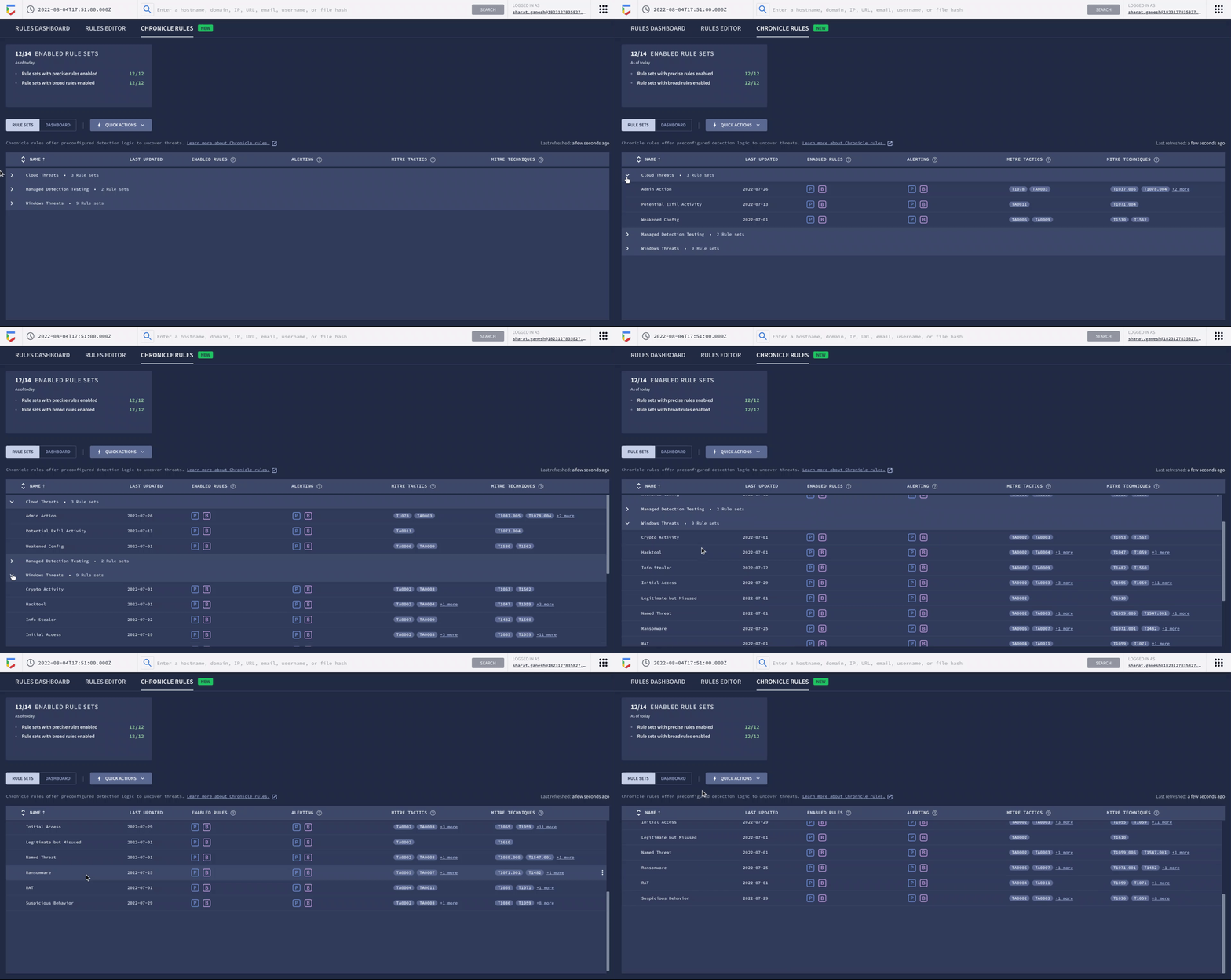
A critical component of any security operations team’s job is to deliver high-fidelity detections of potential threats across the breadth of adversary tactics. But increasingly sophisticated threat actors, an expanding attack surface, and an ever-present cybersecurity talent shortage make this task more challenging than ever. Google keeps more people safe online than anyone else. Individuals, businesses and governments globally depend on our products that are secure-by-design and secure-by-default. Part of the “magic” behind Google’s security is the sheer scale of threat intelligence we are able to derive from our billions of users, browsers, and devices. Today, we are putting the power of Google’s intelligence in the hands of security operations teams. We are thrilled to announce the general availability of curated detections as part of our Chronicle SecOps Suite. These detections are built by our Google Cloud Threat Intelligence (GCTI) team, and are actively maintained to reduce manual toil in your team.Our detections provide security teams with high quality, actionable, out-of-the-box threat detection content curated, built and maintained by Google Cloud Threat Intelligence (GCTI) researchers. Our scale, and depth of intelligence, gained by securing billions of users everyday, gives us a unique vantage point to craft effective and targeted detections. These native detection sets cover a wide variety of threats for cloud and beyond, including Windows-based attacks like ransomware, remote-access tools (RAT), infostealers, data exfiltration, suspicious activity, and weakened configurations.With this launch, security teams can smoothly leverage Google’s expertise and unique visibility into the threat landscape. This release helps understaffed and overstressed security teams keep up with an ever evolving threat landscape, quickly identify threats, and drive effective investigation and response. With this new release, security teams can: Enable high quality curated detections with a single click from within the Chronicle console. Operationalize data with high-fidelity threat detections, stitched with context available from authoritative sources (such as IAM and CMDB). Accelerate investigation and response by finding anomalistic assets and domains with prevalence visualization for the detections triggered. Map detection coverage to the MITRE ATT&CK framework to better understand adversary tactics and techniques and uncover potential gaps in defenses.Detections are constantly updated and refined by GCTI researchers based on the evolving threat landscape. The first release of curated detections includes two categories that cover a broad range of threats, including:Windows-based threats: Coverage for several classes of threats including infostealers, ransomware, RATs, misused software, and crypto activity.Cloud attacks and cloud misconfigurations: Secure cloud workloads with additional coverage around exfiltration of data, suspicious behavior, and additional vectors. Let’s look at an example of how you can put curated detections to work within the Chronicle dashboard, monitor coverage, and map to MITRE ATT&CK®.An analyst can learn more details around specific detections and understand how they map to the MITRE ATT&CK framework. There are customized settings to configure deployment and alerting, and specify exceptions via reference lists. You can see each rule which has generated a detection against your log data in the Chronicle rules dashboard. You can observe detections associated with the rule and pivot to investigative views. For example, here is the detection view from the timeline of an Empire Powershell Stager launch triggered by the Windows RAT rule set. You can also easily pivot to associated information and investigate the asset on which it was triggered.By surfacing impactful, high-efficacy detections, Chronicle can enable analysts to spend time responding to actual threats and reduce alert fatigue. Our customers who used curated detections during our public preview were able to detect malicious activity and take actions to prevent threats earlier in their lifecycle. And there’s more to come. We will be delivering a steady release of new detection categories covering a wide variety of threats, community-driven content, and other out-of-the-box analytics.Ready to put Google’s intelligence to work in your Security Operations Center? Contact Google Cloud sales or your customer success CSM team. You can also learn more about all these new capabilities in Google Chronicle in our product documentation.  Thank you to Mike Hom (Product Architect, Chronicle) and Ben Walter (Engineering Manager, Google Cloud Threat Intelligence), who helped with this launch.Related ArticleIntroducing Cloud Analytics by MITRE Engenuity Center in collaboration with Google CloudTo better analyze the growing volumes of heterogeneous security data, Google has partnered with MITRE to create the Cloud Analytics proje…Read Article
Quelle: Google Cloud Platform

How a Vulnerability Exploitability eXchange can help healthcare prioritize cybersecurity risk

Diagnosing and treating chronic pain can be complex, difficult, and full of uncertainties for a patient and their treating physician. Depending on the condition of the patient and the knowledge of the physician, making the correct diagnosis takes time, and experimenting with different treatments might be required. This trial-and-error process can leave the patient in a world of pain and confusion until the best remedies can be prescribed. It’s a situation similar to the daily struggle that many of today’s security operations teams face. Screaming from the mountain tops “just patch it!” isn’t very helpful when security teams aren’t sure if applying a patch might create even worse issues like crashes, incompatibility, or downtime. Like a patient with chronic pain, they may not know the source of the pain in their system. Determining which vulnerabilities to prioritize patching, and ensuring those fixes actually leave you with a more secure system, is one of the hardest tasks a security team can face. This is where a Vulnerability Exploitability eXchange (VEX) comes in.The point of VEXIn previous blogs, we’ve discussed how establishing visibility and awareness into patient safety and technology is vital to creating a resilient healthcare system. We’ve also looked at how combining software bills of materials (SBOM) with Google’s Supply chain Levels for Software Artifacts (SLSA) framework can help build more secure technology that enables resilience. The SBOM provides visibility into the software you’re using and where it comes from, while SLSA provides guidelines that help increase the integrity and security of software you then build. Rapid diagnostic assessments can be added to that equation with VEX, which the National Telecommunications and Information Administration describes as a “companion” document that lives side-by-side with SBOM. To go back to our medical metaphor, VEX is a mechanism for software providers to tell security teams where to look for the source of the pain. VEX data can help with software audits when inventory and vulnerability data need to be captured at a specific point in time. That data also can be embedded into automated security tools to make it easier to prioritize vulnerability patching.  You can then think of SBOM as the prescription label on a bottle of medication, SLSA as the child-proof lid and tamper-proof seal guaranteeing the safety of the medication, and VEX as the bottle’s safety warnings. As a diagnostic aide, a VEX can help security teams make accurate diagnoses of “what could hurt” and system weaknesses before the bad guys do. Yet making an accurate assessment of that threat model can be challenging, especially when looking at the software we use to run systems. The ability to quickly and accurately evaluate an organizations’ weaknesses and pain points can be vital to hastening response to a vulnerability and stopping cyberattacks before they become destructive. We believe that VEX is an important part of the equation to help secure the software supply chain. As an example, look no further than the Apache Log4j vulnerabilities revealed in December 2021. Global industries including healthcare were dealt another blow when Apache’s Log4j 2 logging system was found to be so vulnerable that relatively unsophisticated threat actors could quickly infiltrate and take over systems. Through research conducted by Google and information contributed by CISA, we learned of examples of where vulnerabilities in Log4j 2, a single software component, could potentially impact thousands of companies using software that depend on it because of its near-ubiquitous use. While a VEX would not capture zero-day vulnerabilities, it would be able to inform security teams of other known vulnerabilities in Log4j 2. Once vulnerabilities have been published, security teams could use SBOM to find them, and use VEX to understand if remediation is a priority or not.How does VEX contribute to visibility?A key reason we focus on visibility mechanisms like SBOM and SLSA is because they give us the ability to understand our risks. Without the ability to see into what we must protect, it can be difficult to determine how to quickly reduce risk.Visibility is a crucial first step to stopping malicious hackers. Yet without context, visibility leaves security teams overwhelmed with data. Why? Well, where would you start when trying to mitigate the 30,000 known vulnerabilities affecting just open source software, according to the Open Source Vulnerabilities database (OSV)? NIST’s National Vulnerability Database (NVD) is tracking close to 181,000 vulnerabilities. We’ll be patching into the next millennium if we adopt a “patch everything” approach.It’s impossible to address every vulnerability individually. To make progress, security teams need to be able to prioritize findings and go after the ones that will have the greatest impact first. The goal of a VEX artifact is to make prioritization a little easier.While SBOMs are created or changed when the material included in a build is updated, VEXs are intended to be changed and distributed when a new vulnerability or threat has changed. This means that VEX and SBOM should be maintained separately. Since security researchers and organizations are constantly discovering new cybersecurity vulnerabilities and threats, a more dynamic mechanism like VEX can help ensure builders and operators have the ability to quickly ascertain the risks of the software they are using.Let’s dig into this VEX example from CycloneDX. You can see the list of vulnerabilities found, third parties who track and report those vulnerabilities, vulnerability ratings per CVSS, and most importantly, a statement from the developer that guides the operator reading the VEX to those vulnerabilities that are exploitable and need to be protected. At the bottom, you’ll see the VEX “affects” an SBOM. This information allows the user of the VEX document to refer to its companion SBOM. By necessity, the VEX is intentionally decoupled from the SBOM because they need to be updated at different times. A VEX document will need to be updated when new vulnerabilities emerge. An SBOM will need to be updated when changes to the software are made by a manufacturer. Although they can and need to be updated separately, the contents of each document can stay aligned because they are linked. Increasing resilience powered by visibility—SBOM+VEX+SLSA VEX could dramatically improve how security vulnerabilities are handled. It’s not uncommon to find operators buried in vulnerabilities, best-guessing the ones that need fixing, and trying to make sense of tens (and sometimes hundreds) of pages of documentation to determine the best, lowest impact fix.With SBOM+SLSA+VEX, operators are using software-driven mechanisms to conduct analyses and evaluate risk instead of relying on intuition and best guesses. The tripartite SBOM+SLSA+VEX approach provides an up-to-date list of issues and perspective on what needs attention. This is a transformative development in security—enabling teams to get a better handle on doing vulnerability mitigation, starting where it could hurt the most.Driven by repeated cyberattacks on critical infrastructure such as healthcare, government regulators have taken a more interested stance in software security and supply chains. Strengthening the effectiveness of SBOMs in the United States is a big part of the newly proposed Protecting and Transforming Cyber Health Care (PATCH) Act. The law would require medical device manufacturers adhere to minimum cybersecurity standards in their products, including the creation of SBOMs for their devices, and plans to monitor and patch any cybersecurity vulnerabilities that are discovered during the device’s lifetime.Meanwhile, new draft medical device cybersecurity guidance from the FDA continues that agency’s involvement in aggressively encouraging medical device manufacturers to improve the cybersecurity resilience of their products. The White House spoke for SBOMs, as well. An Executive Order from May 2021 lays out requirements for secure software development, including the production and distribution of SBOM for software used by the federal government.Regardless of how these initiatives pan out, Google believes controls like those provided by SBOM+SLSA+VEX are critical to protect software and build a resilient healthcare ecosystem. This approach provides detailed, critical risk exposure data to security teams so they can take necessary steps to reduce immediate and long-term risks. What do we suggest you do?At Google, we are working with the Open Source Security Foundation on supporting SBOM development. Our Know, Prevent, Fix report on secure software development creates a broader outline of how Google thinks about securing open source software from preventable vulnerabilities. You can read more about these efforts for securing workloads on Google Cloud from our Cloud Architecture Center. Take a look at Cloud Build, a Google Cloud service that can be used to generate up to SLSA Level 2 build artifacts.Customers often have difficulty getting full visibility and control over vulnerabilities because of their dependence on open source software (OSS). Assured Open Source Software (Assured OSS) is the Google Cloud service that helps teams both secure the external OSS packages they use and overcome avoidable vulnerabilities by simply eliminating them from the code base. Finally, ask us about Google’s Cybersecurity Action Team, the world’s premier security advisory team and its singular mission supporting the security and digital transformation of governments, critical infrastructure, enterprises, and small businesses.If you’re a software supplier, please consider our suggestions above. Whether you are or not, you should begin:Contractually mandating SBOM+VEX+SLSA (or their equivalent) artifacts to be provided for all new software.Train procurement teams to ask for and use SBOM+VEX+SLSA to make purchasing decisions. There should be no reason an organization procures software or hardware with known, preventable issues. Even if they do, the information these mechanisms provide should help security teams decide if they can live with the risks before equipment enters their networks.Establishing a governance program that ensures those who control procurement decisions are aware of and owning the risks associated with software they are buying.Enabling security teams to build pipelines to ingest SBOM+VEX+SLSA artifacts into their security operations and use it to strategically advise and drive mitigation activities.At Google, we believe the path to resilience begins with building visibility and structural awareness into the software, hardware, and equipment it rides on as a critical first step. Time will tell if VEX becomes widely adopted, but the point behind it won’t change—we can’t know how we are vulnerable without visibility. VEX is an important concept in this regard.Next month, we’ll be shifting gears slightly to focus on building resilience by establishing a security culture that obsesses over its patients and products.Related ArticleHow SLSA and SBOM can help healthcare’s cybersecurity resiliencyThere’s more to securing healthcare technology than just data privacy. Here’s why resilient healthcare security needs SBOM and SLSA.Read Article
Quelle: Google Cloud Platform

Gain Deeper Insights with Microsoft Intelligent Data Platform

Data is foundational to any digital transformation strategy, yet many organizations struggle to understand what data they have, how to extract insights from it, and how to govern it—according to a 2022 Evanta survey1, over half of Chief Data Officers (CDOs) struggle with siloed operating models when it comes to data sharing and democratization. According to Harvard Business Review2, organizations that have embraced their data as a strategic asset have been better positioned to drive strategic differentiation and grow their revenue, but the fragmentation that exists today between databases, analytics, and governance is a common barrier to success.

The Microsoft Intelligent Data Platform, empowers organizations to invest more time creating value rather than integrating and managing their data estate. It integrates best-in-class solutions across Microsoft’s technology stack—breaking down data siloes and enabling organizations to extract real-time insights with the data governance needed to run the business safely.

“Shifting from a legacy on-premises data warehouse to Azure Synapse, supported by Datometry, has allowed us to virtualize the vast majority of our code without needing to repoint it. We have gained speed, performance, and agility while reducing costs and taken a big step forward in modernizing our enterprise data storage and management.”—Charlotte Lock, Director of Data, Digital & Loyalty at Co-op.

Added security and analytics features for the Azure data portfolio

The Microsoft Intelligent Data Platform features everything already available in the Azure Data portfolio (Azure Data Factory, Azure Data Explorer, SQL Server 2022, Azure SQL, Cosmos DB, and more.) as well as new products and features, including SQL Server 2022, Azure Synapse Link for SQL, Microsoft Purview Data Estate Insights, and Datamart in Power BI:

SQL Server 2022, currently in preview, is the most secure database of the last decade. And is now integrated with Microsoft Purview and Azure Synapse Link, allowing for richer insights and governance from data at scale. SQL Server 2022 also comes with new features including AWS S3 support, Azure Active Directory authentication, Query Store hints, as well as security improvements compared to SQL Server 2019.
Azure Synapse Link for SQL, now in preview, offers real-time analytics for data stored in Azure Synapse Analytics and Azure SQL. It is an automated system that allows for replication of data from transactional databases (both SQL Server 2022 and Azure SQL Database) to a dedicated SQL pool in Azure Synapse Analytics. Azure Synapse Link features near real-time analytics, low-code/no-code solutions for replicating data, as well as minimal operational impact on source systems.
Purview Data Estate Insights is an application that provides Chief Data Officers and other strategic leaders with a summary of their data estate and the risk associated with that data. Purview provides insights on data stewardship, inventory, curation, and governance through automatically generated reports which can be easily shared with stakeholders.
Lastly, Datamart in Power BI allows analysts to access richer insights from their data sets through data marts. Datamarts are self-service analytic solutions that help to bridge the gap between business users through a simple and optionally no-code experience. With datamarts, you can easily ingest and prepare data, add business semantics to data, manage and govern data, as well as build and share reports.

Real-world applications for businesses through real-time data

Let’s explore one example of how the Microsoft Intelligent Data Platform helped navigate supply chain issues:

Many operations companies conduct daily batch runs, where they must manually track their inventory levels and input the data at least once a day. With this method, these organizations cannot accurately predict how much product to sell and must err on the side of selling less to avoid running out of inventory. In times when supply chains are uncertain, this means companies miss out on even more sales.

.

With the Microsoft Intelligent Data Platform, companies can get real-time information on current inventory levels, rather than a daily report. They can also extract AI-driven insights based on demand spikes, shipping delays, and factory status that predict how many units will be available in a week’s time. This information is supported by the upgraded SQL Server 2022 as well as Azure Synapse Link for SQL server, which allows for more on-premises data to be extended to the cloud, analyzed, and used for decision making.

But what about using data for customer-facing solutions? The Microsoft Intelligent Data platform leverages the CosmosDB platform, providing consumers with recommendations for the best product based on real-time availability of units, delivery time, and compatibility with their needs. Consumers also have access to a support number powered by Power Virtual Agents; through Conversational AI, consumers can get intelligent updates on their order status so they can get the information they need quickly.

Learn more

These applications are only the tip of the iceberg when it comes to using the Microsoft Intelligent Data Platform. Learn more about the platform and how to get started—and make sure to watch the entire episode of the Microsoft Intelligent Data Platform Mechanics video, where we cover the technology and sample scenario, by clicking the linked image below!


Sources:

1Top 3 Goals & Challenges for CDOs in 2022, evanta.com.

2How to Lead a Data-Driven Digital Transformation, hbr.org.
Quelle: Azure