Ukrainekrieg: Russland Zensurinfrastruktur hat offenbar viele Probleme
Die russischen Provider müssen die Umsetzung der Maßnahmen der Zensurbehörde testen. Sie funktionieren offenbar nicht ausreichend. (Ukraine-Krieg, Zensur)
Quelle: Golem

Die russischen Provider müssen die Umsetzung der Maßnahmen der Zensurbehörde testen. Sie funktionieren offenbar nicht ausreichend. (Ukraine-Krieg, Zensur)
Quelle: Golem
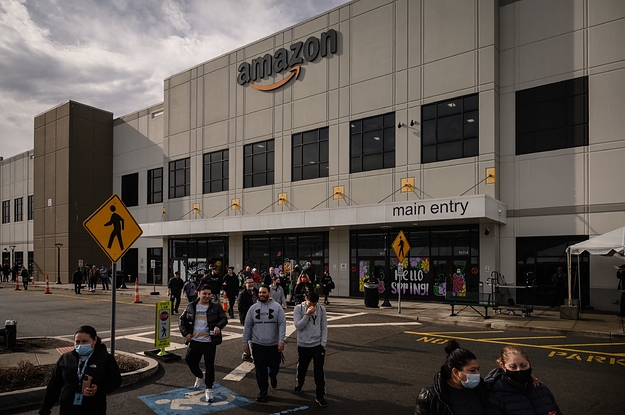
Quelle: <a href="Unions Are Making A Strong Showing In Elections At Two Amazon Warehouses“>BuzzFeed
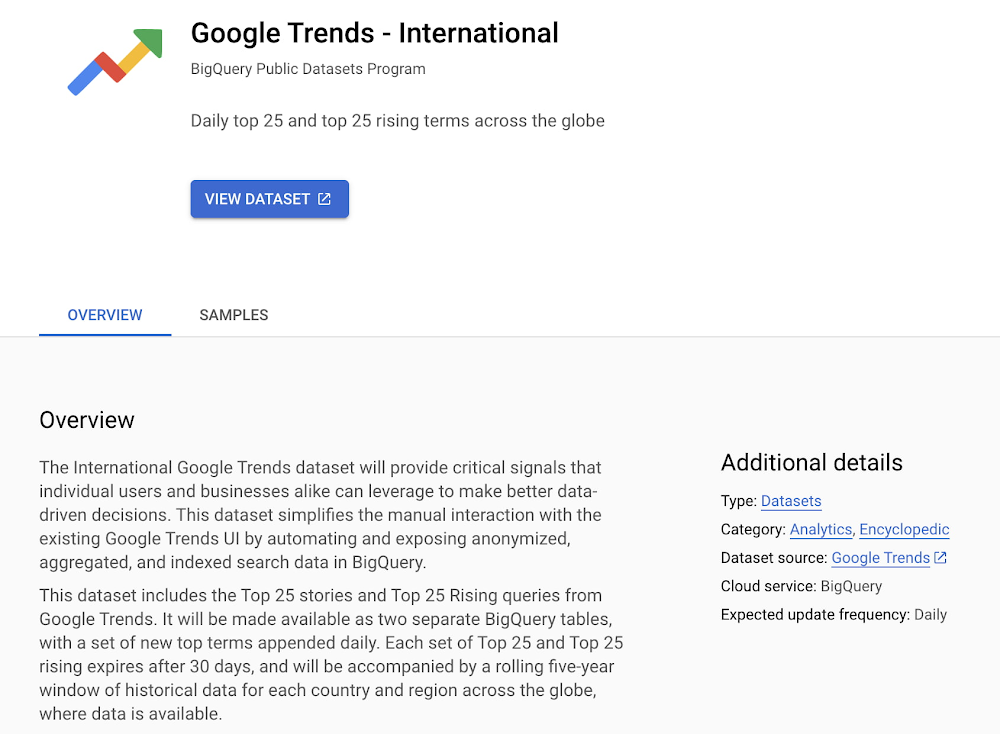
Sharing and exchanging data is a critical element of any organization’s analytics strategy. In fact, BigQuery customers already share data using our existing infrastructure, with over 4,500 customers swapping data across organizational boundaries. Creating seamless access to analytics workflows and insights has become that much easier with the introduction of Analytics Hub and surfacing datasets unique to Google.Last summer, the Google Trends public dataset was launched to democratize access to Google first-party data and drive additional value to our customers. At no additional cost, you can access Top 25 stories and Top 25 Rising search queries in the United States through a SQL-interface, unlocking countless new opportunities to derive insights from blending Google Trends datasets with other structured data sources. Since launching in June of 2021, over 30 terabytes of the Google Trends dataset have been queried by users across the United States. From joining the Search Trends data to Nielsen Designated Market Area (DMA) boundaries to know where to activate marketing campaigns, to creating term forecasts and predictions to hypothesize and experiment product development, there are a broad range of applications across many business and consumer profiles. Through the secure and streamlined access to this highly desirable data in BigQuery, business and consumers alike are finally able to make better data-driven decisions at scale.With the success of the Google Trends dataset launch in the United States, we knew that meeting the needs of our global counterparts would be a fast follow. After all, we are citizens of a global economy and must do better to accommodate the world we operate in. As such, we began our journey to provide a more comprehensive view of how trends occur across the globe for our customers.What’s new?Today, we are excited to announce the expansion of the Google Trends public dataset beyond the US to cover approximately 50 additional countries worldwide. This is available in public preview and covers all major countries where the Google Trends service exists today. Most of the features of the international Google Trends dataset will mimic its United States counterpart, backed by the same privacy-first mindset. The international dataset will remain anonymized, indexed, normalized, and aggregated prior to publication. New sets of top terms and top rising queries will continue to be generated daily, with data being inserted into a new partition of their respective table. The expiration date of each top term and top rising set (e.g. each set’s partition) will also stay at 30 days. Every term within a set will still be enriched with a historical backfill over a rolling five year period. Learn more about the schema of each table in the dataset listing.In addition to surfacing the top trends in the United States by Designated Market Area (DMA), the international dataset will provide the daily top stories and top rising queries by ISO country and sub-region. Countries and/or sub-regions may be excluded based on data-sharing regulation and policies. The sheer scale of coverage and reach now increases multi-fold by simply applying similar or existing use cases to different parts of the globe.International Google Trends dataset now available in the Google Cloud Marketplace or Analytics Hub.Working with the international Google Trends datasetJust like all other Google Cloud datasets, users can obtain access without charges of up to 1TB/month in queries and up to 10GB/month in storage through BigQuery’s free tier and leverage the BigQuery sandbox, all subject to BigQuery’s free tier thresholds.To begin exploring the global Google Trends dataset, simply query the international tables for the top 25 and top 25 rising terms from the Google Cloud Console. To minimize the data scanned and processed, utilize the partition filter, as well as country and region filters (if possible) in your query:code_block[StructValue([(u’code’, u”SELECTrn *rnFROMrn `bigquery-public-data.google_trends.international_top_terms`rnWHERErn refresh_date = DATE_SUB(CURRENT_DATE(), INTERVAL 1 DAY)rn AND country_code = ‘CA’rn AND region_name = ‘Alberta'”), (u’language’, u”)])]Sample data:We’ve also updated the Looker dashboard to incorporate the new global dataset, and it even includes filtering for the countries and regions you care about most.What’s next for Google Cloud Datasets?We are continuing to progress forward in the path to making Google’s first-party data universally accessible. Stay tuned for updates on more dataset launches and availability, as well as our integration with Analytics Hub. In the meantime, explore the new international Google Trends dataset in your own project, or if you’re new to BigQuery spin up a project using the BigQuery sandbox.Related ArticleTop 25 Google Search terms, now in BigQueryGoogle Trends datasets for the Top 25 terms and Top 25 Rising terms now available in BigQuery to enhance your business analysesRead Article
Quelle: Google Cloud Platform
Two themes have been resonating for me across the security industry over the last month. The first is a topic from my personal blog that I wrote more than two years ago: Resilience is about Capabilities not Plans. Collectively, organizations have proven their ability to be resilient in light of many disruptive events like a pandemic, natural disasters, and cyber conflicts. Our resilience will only continue to be tested in existing or new ways into the future. Organizations that prioritize testing and re-testing capabilities across their people, process and technology vs. plans alone will continue to be the most resilient. The next theme is focusing on building secure products, not just security products. As an industry, we can be doing more in this area as recent weaknesses in security products have demonstrated. Security is the cornerstone of Google’s product strategy. We build secure solutions and products that strive to make security easier as well as secure-by-default choices that lead to the security outcomes we want our customers, users and employees to achieve.Below, I’ll recap the latest updates from the Google Cybersecurity Action Team, industry highlights and upcoming events. Event UpdatesMcKinsey Webinar on Security as Code: Next week, I’ll join the McKinsey team for a webinar on Security as Code to break down how the cloud can help make organizations more secure. Ensuring the safe adoption of cloud computing is becoming an increasing priority across the industry, reflecting the benefits that an organization can achieve from digital transformation. Increasingly, the cloud is viewed not as a risk to manage, but a means of managing risk in new, innovative and more substantial ways, while also improving an organization’s security posture. We’ll cover this and more during the webinar. Register here.Cloud Security Talks: Threat Detection & Response Edition: Earlier this month, we hosted our first Cloud Security Talks of 2022. The sessions covered all things security operations (SecOps) across on-premises, cloud and hybrid environments, highlighted product innovations and updates, and talked about how threat detection, investigation and response fits into our invisible security vision. Check out the on-demand sessions to learn more. Google Cybersecurity Action Team Highlights Here are the latest updates, products, services and resources from our cloud security teams this month: Security Federated workload identity with Certificate Authority Service (CA Service): To help support our customers’ implementation of zero trust strategies across all their IT environments, we announced that Google Cloud Certificate Authority (CA) Service can issue certificates for workloads reflecting their federated identities, even if the workloads are hosted on-premises or in other clouds. There’s a session in our Q4 2021 Zero Trust Security Talks on this topic that’s available on demand as well.New threat detection capabilities in Google Chronicle: The Chronicle team released the public preview of context-aware detections designed to create efficiencies for customers’ detection and response journey. Customers can use this contextualization to write better detections, prioritize existing alerts, and drive faster investigations. Community Security Analytics: As part of our efforts to help customers move toward Autonomic Security Operations, the Google Cybersecurity Action Team announced Community Security Analytics, a set of open-sourced queries and rules designed to help detect common cloud-based threats. Account Defender in reCAPTCHA Enterprise: Enterprises need tools to help fight online fraud targeting their user accounts and payments. To help, the reCAPTCHA Enterprise team introduced account defender, a new feature built into reCAPTCHA Enterprise that helps businesses determine if an action aligns or deviates from the account owner’s typical behavior.Chrome’s ongoing efforts to keep enterprises safe: For a long time Chrome has been the first line of defense to protect our employees and users against malicious URLs and content on the web. The security capabilities built into Chrome can help IT administrators strengthen their organization’s posture. Also of note, the new Chrome 2.1 CIS Benchmark covers independent recommendations on which Chrome policies to configure to help support organizations’ security and compliance needs. Introducing Automatic Certificate Management Environment: We introduced an enhancement of Certificate Manager (in preview) which allows Google Cloud customers to acquire public certificates for their workloads that terminate TLS directly or for their cross-cloud and on-premise workloads. This provides Cloud Customers with a common certificate lifecycle management capability based on ACME without a single point of failure.Industry updatesHealthcare: In our latest healthcare security series post, Taylor Lehmann and Seth Rosenblatt from Google’s Cybersecurity Action Team discuss the value of sustainable visibility mechanisms for cybersecurity teams working in global healthcare organizations to help secure and preserve patient care and safety. U.S. Public Sector: Accelerating U.S. government security and compliance implementations: To help accelerate cloud adoption of cloud services, Google Cloud’s Public Sector Professional Services Organization (PSO) offers specialized consulting engagements. These engagements include helping customers on their journey to achieve Agency ATOs for the cloud products and services they use and developing zero trust strategies and architectures to help organizations meet requirements under the Executive Order on Improving the Nation’s Cybersecurity.Modernizing the U.S. Federal Government’s Approach to Cyber Threat Management with Autonomic Security Operations: The Google Cybersecurity Action Team released its latest whitepaper that details how Google Cloud can help drive federal agencies’ ability to meet the White House cybersecurity analytics requirements of EO 14028 and OMB M-21-31. Scaling and securing the cloud for defense applications: Read our latest blog post on how our secure cloud access solution built in partnership with Palo Alto Networks is helping Defense Innovation Unit (DIU) users access services in any commercial cloud environment, while performing the required security actions of logging, threat analysis, and session control.Fortifying Federal Networks: Google Workspace provides security based on zero trust concepts that support the business and operations of government, easy collaboration across teams regardless of location, and seamless access from any endpoint. To help federal agencies navigate implementations, our Work Safer program is available through many partners like Carahsoft. Financial Services: Cloud and the future of financial markets: Cloud Googlers participated in a fireside chat at FIA Boca 2022 to discuss the future of markets and policy, the new technologies that are already paving the way for greater speed and transparency, and how cloud can help promote greater resiliency, performance, and security in financial markets. The team also published a detailed paper on this topic.ComplianceCloud vendor due diligence services: One way we help our customers scale and accelerate their cloud assessments is by collaborating with third party risk management (TPRM) providers to provide independent due diligence services and platforms to help automate vendor risk management based on the data they collect and provide. By enabling our TPRM assessors to examine the controls present in our infrastructure and operations, they can develop independent and unbiased audit reports that can be shared directly with our customers. We currently work with industry-leading TPRM providers such as CyberGRX, TruSight, and KY3P to deliver high-quality risk assessments for our customers globally. Learn more in this blog post. Data governance in the cloud: Along with a corporate governance policy and a dedicated team of people, implementing a successful data governance program requires tooling. Google Cloud offers a comprehensive set of tools that enable organizations to manage their data securely, ensure governance, and drive data democratization.To have our Cloud CISO Perspectives post delivered every month to your inbox, sign-up for our newsletter. We’ll be back next month with more security-related updates.Related ArticleCloud CISO Perspectives: February 2022Google Cloud CISO Phil Venables shares his thoughts on the latest security updates from the Google Cybersecurity Action Team.Read Article
Quelle: Google Cloud Platform

When planning a potential migration of on-premises infrastructure to Azure, you may want to retain your existing public IP addresses due to your customers' dependencies (for example, firewalls or other IP hardcoding) or to preserve an established IP reputation. Today, we are excited to announce the general availability of the ability to bring your own IP addresses (BYOIP) to Azure in all public regions. Using the Custom IP Prefix resource, you can now bring your own public IPv4 ranges to Azure and use them like any other Azure-owned public IP ranges. Once onboarded, these IPs can be associated with Azure resources, interact with private IPs and VNETs within Azure’s network, and reach external destinations by egressing from Microsoft’s Wide Area Network. Read more about how bringing your IP addresses to Azure can help to speed up your cloud migration.
Provisioning a custom IP range
Onboarding your ranges to Azure can be done through the Azure portal, Azure PowerShell, Azure CLI, or by using Azure Resource Manager (ARM) templates. In order to bring a public IP range to use on Azure, you must own and have registered the range with a Routing Internet Registry such as ARIN or RIPE. When bringing an IP range to use on Azure, it remains under your ownership, but Microsoft is permitted to advertise it from our Wide Area Network (WAN). The ranges used for onboarding must be no smaller than a /24 (256 IP addresses) so that they will be accepted by Internet service providers. When you create a Custom IP Prefix resource for your IP range, Microsoft performs validation steps to verify your ownership of the range and its association with your Azure subscription. Each onboarded range is associated with an Azure region.
Using a custom IP range
Once your range has been provisioned on Azure, you have the option to assign public IP addresses from the range to resources immediately or to begin advertising the range before assigning, depending on what fits your specific use case. After the command is issued to commission a range, Microsoft will advertise it both regionally (within Azure) and globally (to the Internet). The specific region where the range was onboarded will also be posted publicly for geolocation providers. To assign the BYOIPs, you would create public IP prefixes (contiguous blocks of Standard SKU public IP addresses), from which you can allocate specific individual public IP addresses. Note that while an IP range is onboarded under the context of an Azure subscription, prefixes from this range can be derived from other subscriptions with appropriate permissions. Onboarded IPs can be associated with any resource that supports Standard SKU public IPs, such as virtual machines, Standard Public Load Balancers, Azure Firewalls, and more. You are not charged for maintenance and hosting of your onboarded Public IPs Prefix; you are charged only for egress bandwidth from the IPs and any attached resources.
Key takeaways
The ability to bring your own IP addresses (BYOIP) to Azure is currently available in all regions.
The minimum size of an onboarded range is /24 (256 IP addresses).
Onboarded IPs are put in a Custom IP Prefix resource for management, from which Public IP Prefixes can be derived and utilized across subscriptions.
You are not charged for the hosting or management of onboarded ranges brought to Azure.
Additional resources
Custom IP Prefixes.
Create a Custom IP Prefix using Azure PowerShell.
Quelle: Azure

How does a retail giant administer COVID-19 vaccinations in days, not months? Can a series-A startup’s innovation help identify massive fraud in seconds instead of hours? For leaders driving business growth, the cloud has forever opened our minds to endless possibilities. In a time of tectonic shifts in all markets and ways of life, what will distinguish the brands we choose tomorrow is an ability to inspire developer ingenuity, create immersive customer experiences, and not just adapt to changing needs, behaviors, and trends, but to anticipate them.
It sounds good, doesn’t it? But the environment and endurance needed to keep innovating can be hard for companies of all sizes, and this is why we’re kicking off Innovate for Impact on Tuesday, April 5 from 9:00 AM to 10:30 AM Pacific Time. When you register for the event, you’ll get to hear from thought leaders, technologists, and executives about the business impact of app innovation from every angle. Let’s talk about entrepreneurial ethos, dev culture, and how to read and leverage trends with cloud-native and AI technology—there’s so much we can learn from each other on this journey.
The event also brings together both born-in-cloud and enterprise perspectives on how to solve big challenges. You'll learn how Aqua Security, Confluent, Elastic, Trimble, and KPMG defied conventional thinking and built something new by empowering their teams, forging business models, and scaling through better processes. Don’t miss the opportunity to learn from tangible, motivating cloud stories—not just what each company achieved, but what they overcame to differentiate.
Microsoft is one of the most innovative companies I know—from championing innovation through a ‘growth mindset’, to transforming our own business model to be cloud-first, to continuing to be at the forefront of delivering immersive experiences in gaming and the metaverse. Microsoft’s ability to continuously reimagine, this clairvoyance at predicting and getting ahead of trends, and the humility to “always be learning” is what makes it successful.
We’ve learned a lot from the thought leaders who joined us for this event, and I can’t wait to share the learnings with all of you. I also hope you’ll participate in the Q and A during the event. We want to hear from you and have an ongoing dialogue about making innovation real.
Thank you and enjoy!
Ashmi
Register now
Innovate for Impact
Drive business growth with app innovation,
Tuesday, April 5, 2022,
9:00 to 10:30 AM Pacific Time.
Quelle: Azure

Das von einem Bastler gebaute Handheld läuft mit MacOS und ist für Game-Boy-Spiele gedacht. Es lässt sich aber auch als Desktop-Rechner verwenden. (Hackintosh, Mac OS X)
Quelle: Golem

Einen umfassenden Überblick über Netzwerktechnologien und -konzepte für alle Admins und IT-Sicherheitsbeauftragten bietet der Fünf-Tage-Workshop der Golem Akademie. (Golem Akademie, WLAN)
Quelle: Golem

Was am 31. März 2022 neben den großen Meldungen sonst noch passiert ist, in aller Kürze. (Kurznews, Onlineshop)
Quelle: Golem

Auf anderen Kontinenten sei man deutlich weiter, was Digitalwährungen angeht, meint der G+D-Vorstandschef. Der Digitale Euro wird noch untersucht. (Kryptowährung, Datenschutz)
Quelle: Golem






