Photovoltaik: Solar-Elektroauto Lightyear wird 100.000 Euro teurer
Das Elektroauto Lightyear One sollte eigentlich 150.000 Euro kosten, doch nun wird der Preis angehoben – auf eine Viertelmillion Euro. (Elektroauto, Technologie)
Quelle: Golem

Das Elektroauto Lightyear One sollte eigentlich 150.000 Euro kosten, doch nun wird der Preis angehoben – auf eine Viertelmillion Euro. (Elektroauto, Technologie)
Quelle: Golem

Das Bremer Unternehmen ist Anfang der Woche Ziel eines Angriffs geworden. Mittlerweile läuft der Betriebs größtenteils wieder. (Cyberwar, Security)
Quelle: Golem
Amazon Web Services (AWS) hat heute bekannt gegeben, dass AWS Single Sign-On (AWS SSO) jetzt mit dem HIPAA (Health Insurance Portability and Accountability Act) konform ist. Bei AWS SSO erstellen oder verbinden Kunden Mitarbeiteridentitäten und verwalten ihren Zugriff zentral über AWS-Konten hinweg. Die HIPAA-Konformität bedeutet, dass Kunden, die dem HIPAA unterliegen – einschließlich Krankenversicherungen, Gesundheitsdienstleister, Clearingstellen für das Gesundheitswesen, staatliche Programme, die für die Gesundheitsversorgung zahlen, Militär- und Veteranengesundheitsprogramme sowie deren Partner – jetzt AWS SSO für die Authentifizierung und Autorisierung von Benutzern verwenden können, die AWS-Workloads konfigurieren oder verwalten, die geschützte Gesundheitsinformationen (PHI) speichern, verarbeiten oder übertragen, sowie von Benutzern, die sich bei Anwendungen anmelden, die mit AWS SSO integriert sind und PHI verwenden.
Quelle: aws.amazon.com

Mit einem Tweet kann Musk den Tesla-Kurs abstürzen und Kryptowährungen aufsteigen lassen. Diese Macht ist ihm 41 Milliarden US-Dollar wert. Von Daniel Ziegener (Elon Musk, Twitter)
Quelle: Golem

Increased customer demands, climate concerns, and higher delivery expectations from the consumer market are just a few of the emerging macro trends that retail, logistics, and consumer packaged goods industries face. To stay competitive in this environment, businesses need to improve execution, both to serve customers and to address the onslaught of logistical and environmental factors that go into delivery. Significant and pressing among those factors: companies need to make intelligent use of new technologies that not only accelerate business impact, but also contribute to sustainability improvements required in a post-carbon digital economy.That’s why today, Google Cloud is announcing the public general availability ofOptimization AI and of its first feature: Cloud Fleet Routing (CFR) API. Optimization AI helps businesses plan for the future, decide the appropriate action, and clarify the business impact; CFR specifically helps vehicle fleet operators to create accurate fleet-wide routing plans at scale.Quickly create complex plans reliablyOur customers have shared with us that they would like to send out the fleet as early as possible, allow for later cutoff times, and easily incorporate changes to plans. In addition, providing an effective action plan that customers can quickly and reliably disseminate to their fleet is a must. By intelligently harnessing the scale of Google Cloud’s infrastructure, CFR can solve small route planning problems in seconds and offers batch processing that can scale up to model even very large logistics operations.Example illustration of routes built by Cloud Fleet Routing APIFor example, to continue improving its delivery service and leverage one of its main strategic pillars, which is to offer the fastest delivery in the country, Brazilian retailer Magalu adopted the CFR API to optimize last-mile route for same-day delivery, all while navigating a dense logistics network that involves more than 2.1 million shipments per month. “Google’s Cloud Fleet Routing API not only helps us meet our growing demand with efficient routes, it also gives us more reliability. The Google Cloud solution allows you to calculate multiple pickups and deliveries on the same route in seconds. Thus, we improve our ability to plan routes quickly, flexibly and accurately, generating more productivity and scalability. This also contributes to more efficient costs, which keeps us more competitive,” said Talita Paschoini, IT Director at Magalu. Reduce CO2 and deliver business impactIt is not easy to accurately predict and fulfill competitive ETAs while making cost-effective allocation and scheduling decisions, and it is near-impossible to do so with manual planning. With our CFR API, customers have options to bring their own distance matrix or use the native integration with Google Maps to take advantage of AI-infused ETA. Sharing accurate visit times and infeasibilities as early as possible helps customers build trust with the brand. With CFR, it has never been easier to spot opportunities to reduce CO2 footprints via fuel savings, promote work-life balance by providing optimal workloads, and meet customers’ demands.“At Instabox we have environmental sustainability close to heart – and optimizing our routes is a crucial way of bringing more value to customers while limiting our environmental footprint,” said Staffan Gabrielsson, CTO and co-founder at Instabox. “Google’s Cloud Fleet Routing API improved the efficiency of our routes and reduced the planning time. Our customers are getting their deliveries faster through our increased capacity and we are reducing operating costs at the same time.”Navigate through uncertainty with easeLast mile operations are fraught with disruptions: change of delivery time, vehicle malfunction, last-minute workforce changes, and the list goes on. To help our customers stay agile, the CFR API lets them reoptimize their existing plan up to 20 times a day without incurring any additional cost. This ability is especially useful for the last mile, where dynamic changes such as traffic congestion or ad hoc requests can require frequent re-optimization. As a result, customers can use our CFR API to plan effective disruption responses worry-free, so that operators can quickly take the best action with consumers as soon as possible.Get startedTo learn more about how to get started on the Optimization AI: Cloud Fleet Routing API, check out the product page. For an integrated last mile planning and execution use case, check out Last Mile Fleet Solution to get started. Please join us for the Spotlight session “Shining a light on supply chain and logistics” to learn more about how Google Cloud can support demand shaping, inventory positioning, and perfect fulfillment by providing the end-to-end visibility you need for optimized planning and decision making.We are thrilled to partner with you to help deliver joy to your customersFor additional support, select partners have created discovery sessions, proof of value projects, and pilots to help you get started.Related ArticleIntroducing Last Mile Fleet Solution: Maximize fleet performance from ecommerce order to doorstep deliveryStarting today, Last Mile Fleet Solution is available to help fleet operators create exceptional delivery experiences, from start to finish.Read Article
Quelle: Google Cloud Platform
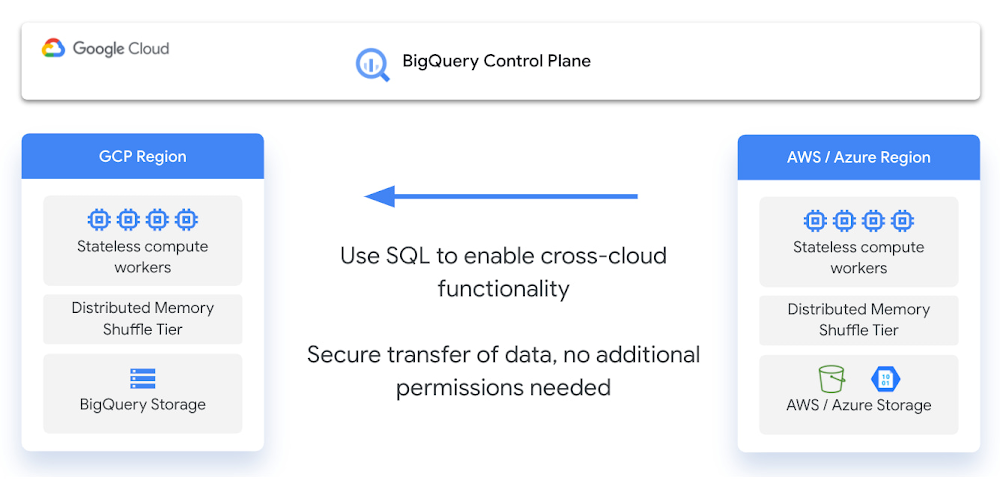
IT leaders pick different clouds for many reasons, but the rest of the company shouldn’t be left to navigate the complexity of those decisions. For data analysts, that complexity is most immediately felt when navigating between data silos. Google Cloud has invested deeply in helping customers break down these barriers inherent in a disparate data stack. Back in October 2021, we launched BigQuery Omni to help data analysts access and query data across the barriers of multi cloud environments. We are continuing to double down in cross-cloud analytics: a seamless approach to view, combine, and analyze data across-clouds with a single pane of glass. Earlier this year, one of BigQuery Omni’s early adopters, L’Oreal, discussed the merits of a cross-cloud analytics to maximize their data platform. We know that enterprises need to analyze data without needing to move or copy any data. We also know that enterprises sometimes need to move small amounts of data between clouds to leverage unique cloud capabilities. A full cross-cloud analytics solution offers the best of both worlds: analyzing data where it is and flexibility to replicate data when necessary. Last week, we launched BigQuery Omni cross-cloud transfer to help customers with combining data across clouds. From a single-pane-of-glass, data analysts, scientists, and engineers, can load data from AWS and Azure to BigQuery without any data pipelines. Because it is all managed in SQL, it is accessible among all levels of an organization. We have designed this feature to provide three core benefits:Usability: With one single-pane-of-glass, users tell BigQuery to filter and move data between clouds without any context-switchingSecurity: With a federated identity model, users don’t have to share or store credentials between cloud providers to access and copy their dataLatency: With data movement managed by BigQuery’s high-performance storage API, users can effortlessly move just the relevant data without having to wait for complex pipesA core use case that we have heard from customers is to combine point of sales (PoS) data from AWS/Azure with Google Analytics data and create a consolidated purchase prediction model. Here’s a demo of that:As you saw in the demo, a data analyst can drive end-to-end workflows across clouds. They can transform data using BigQuery Omni, they can load data using cross-cloud transfer, and they can train an ML model all in SQL. This empowers them to drive real business impact by providing the ability to: Improve training data by de-deuplicating users across datasetsImprove accuracy of marketing segmentation modelsImprove Return on Ads Spend and save potentially millions for enterprise campaignsBut we’re not stopping there, we will continue to build upon this experience by providing more BigQuery native tools for our customers to assist with smart data movement. Over time, our cross-cloud data movement will be built on pipeless pipelines: A cross-cloud lakehouse without the fuss. Get involved with the preview and start participating in our development process by submitting this short form.Related ArticleBigQuery Omni now available for AWS and Azure, for cross cloud data analyticsBigQuery Omni helps teams break down silos by securely and cost-effectively analyzing data across clouds.Read Article
Quelle: Google Cloud Platform
Sie können jetzt AWS PrivateLink verwenden, um privat auf Amazon Connect Wisdom-Instances von Ihrer Amazon Virtual Private Cloud (Amazon VPC) aus zuzugreifen, ohne öffentliche IPs zu verwenden und ohne dass der Datenverkehr über das Internet geleitet werden muss.
Quelle: aws.amazon.com

In Alibabas g8m-Instanz gibt es viel Leistung: Bis zu 128 ARMv9-Cores samt 512 GByte DDR5-Speicher sollen aktuelle x86-Angebote schlagen. (Alibaba, Prozessor)
Quelle: Golem

IBMs AP-101 wurde auf Spaceshuttle-Missionen eingesetzt und flog an Bord des B-52 Stratofortress. Der geschätzte Wert: 50.000 US-Dollar. (IBM, Raumfahrt)
Quelle: Golem

Mit geschmierten Switches und ansteckbarem Nummernblock eignet sich die Gaming-Tastatur Everest 60 auch fürs Büro – mit einer Einschränkung. Ein Test von Tobias Költzsch (Tastatur, Eingabegerät)
Quelle: Golem






