Help us define the next stage of Professional Email

If you’ve been a WordPress.com user in any capacity, you’re probably aware that we believe in democratizing publishing and e-commerce. We believe in designing products for everyone, emphasizing accessibility, performance, security, and ease of use. We believe great software should focus on you, so you can share your story, product, or services, and achieve your dreams. We believe you have a say in this product and how it can make your life easier every day you use it.

Since last year, we’ve been working hard to enable more features for Professional Email and our other email products. One of the things we heard from you is that you want annual payment options, so you don’t have to worry about monthly payouts and pricing. Now, we’re happy to announce that annual plans are officially available for Professional Email. Don’t worry: our 3-month free trial is still available, so that you can try out the best-in-class email product with either payment method — without committing up front.

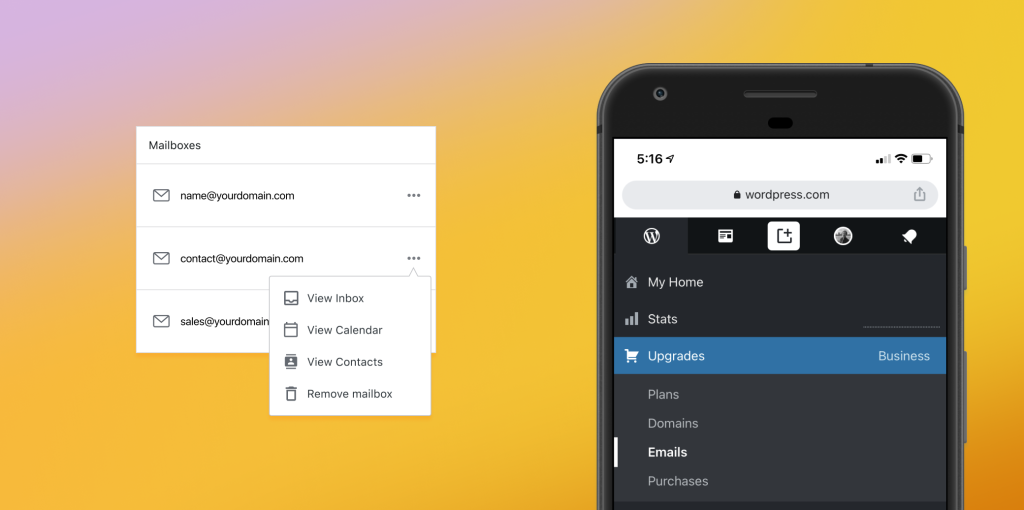
And we haven’t stopped there. WordPress.com now offers one-click webmail access, making it easier than ever to access and manage your emails directly within your site admin panel. That’s better for you, your community, and your customers. We’re also working on integrating webmail into the admin panel to make it easier to manage Professional Email and save you more time to focus on things important to you.

We want to make sure we continue building a product that makes your everyday life a bit better. If you have any ideas for features you’d want us to add, or any cool Professional Email experiences to share with us, drop us a line. We’re in this together!

Not sure where to get Professional Email?

Start here

Quelle: RedHat Stack

Congrats to Vasyl Saienko, Outstanding Employee Award Winner

At Mirantis, our strength and success comes from the talent and hard work of our employees, and we believe in recognizing and rewarding excellence among our staff. Recently, our HR team asked managers across the company to nominate candidates for our Outstanding Employee awards who not only embody Mirantis’ core values but also produce outstanding … Continued
Quelle: Mirantis

Four ways Google Cloud Marketplace simplifies buying cloud software

Discovering, purchasing, and managing solutions on Google Cloud has never been easier thanks to Google Cloud Marketplace, where you can explore thousands of enterprise-ready products and services that integrate with Google Cloud. Marketplace simplifies buying solutions from Google and top software vendors as all purchases are seamlessly added to your existing Google Cloud invoice, so you receive just one bill from Google. We’re continuously improving how our customers can evaluate, procure, and manage cloud software online because we know that’s increasingly how you want to buy. In fact, in 2021 our marketplace third-party transaction value was up more than 500% YoY from 2020 (Q1-Q3). Let’s revisit the top four improvements we’ve made to the cloud software buying and selling experience in just the last few months that have accelerated buying momentum.1. Find what you’re looking for fasterWith enhanced filters, quickly discover top solutions ready to run in your Google Cloud instance. Filters are now more intuitive, allowing you to browse solutions by industry, type, category, use case, and more. Check out the “free trial” filter if you want to try a solution before buying. And if you’re looking for inspiration, we surface popular, new, and featured products across categories. Once you’ve found what you’re looking for, you’ll benefit from more detailed product cards to help you evaluate what’s best for your organization. Explore the Google Cloud Marketplace catalog to find innovative solutions to your business problems.2. Buy and sell the way you wantWe’ve added new subscription models and payment schedules, making it simpler than ever to save money and meet your organization’s procurement needs. Through Google Cloud Marketplace, you can negotiate with third-party vendors and retire Google Cloud committed spend on first and third-party purchases. Many of our software vendors now have the ability to offer flexible subscription models, including flat fees, usage-based, hybrid flat fee + usage, and committed use discounts that customers can pay for monthly or up front. These partners can now also include standard or customized terms to meet your organization’s procurement needs. Learn more about initiating and accepting customized offers. And to make buying easier in large organizations, billing admins can now set up a procurement governance workflow that allows end-users to submit procurement requests for new SaaS products directly from Google Cloud Marketplace.For the many software vendors accelerating growth via the Google Cloud Marketplace, in addition to these new pricing tools and the partner investments we announced last month, we’ve also broadened migration to Producer Portal, our new offer publishing, deal-making, and analytics portal. This new experience makes many of the new pricing features possible. Plus we’ve improved partner disbursements to set you up for success as your marketplace deal flow grows – all in pursuit of being the easiest cloud to go-to-market with. If you’re interested in selling your enterprise-grade solution to Google Cloud customers, here’s how to get started.3. Manage purchases convenientlyAfter purchasing a great solution, you’ve got to set up and manage it. We’ve also made a few improvements to speed up your post-purchase time-to-value: The new Your Orders page provides a unified experience where you can view and manage all third-party subscription purchases under a single billing account. Your Products helps developers easily find, access, and receive relevant updates for the products that they used or are available to them within their project so they always have them at their fingertips.Plus we’ve simplified SaaS setup for admins with the Service Account Provisioning UI. It used to be that the software vendor had to manually share service account details with you, and someone on your end needed to provide access via command-line interface (CLI). We’ve made this easier: software vendors can now get the access their product needs with just a few clicks. And if you’re a SaaS vendor looking to speed up customer onboarding, read how you can incorporate this feature into your product. 4. Maintain control over your solutions – easilyOnce customers build or buy, establishing and enforcing standards and controls across your cloud landscape can be a headache, especially in large organizations. Luckily, Google Cloud Marketplace has Service Catalog functionality built-in to make teams more productive by helping you efficiently distribute approved solution configurations across your organization. Enforcing governance policies in-console with Service Catalog not only simplifies compliance, but it also saves engineering time by reducing manual configuration steps and post-build reviews. And now with the ability to publish Terraform configurations, Service Catalog allows for a consistent, flexible approach that reduces the need for organizations to learn multiple infrastructure-as-code (IaC) solutions. Ready to get started? Be up-and-running fast with our Service Catalog quickstart guide.We know you’ll love these enhancements, and we’re not slowing down. We can’t wait to share more about what we’re working on soon.Related ArticleGoogle Cloud doubles-down on ecosystem in 2022 to meet customer demandGoogle Cloud will double spend in its partner ecosystem over the next few years, including new benefits, incentives, programs, and training.Read Article
Quelle: Google Cloud Platform

Observability from cloud to edge in Azure

This post is co-authored by Rahul Bagaria, Principal Product Manager, Azure Monitor Customer Success

Our customers are transforming their digital environments, whether migrating workloads to Azure, building new cloud-native apps, or unlocking new scenarios at the edge. As they combine these strategies to meet their business needs, they must also maintain their existing environments. It’s critical that customers can monitor the health, performance, and security of their mission-critical systems, and an observability solution is a best practice for streamlined well-governed management.

With Azure Monitor, our approach to observability centers on simplicity. We know from our customers how important it is to have monitoring available out-of-the-box and to easily get started with samples and recommendations including effective alerts, optimal queries, and customizable reports. To ensure that you can monitor your largest production workloads anywhere in a trustworthy manner, we have designed our data platform to handle thousands of terabytes of data per day easily and reliably. We also understand that our customers have their workloads in Azure, their on-premises datacenters, edge, and multi-cloud environments, and thus extend Azure Monitor through Azure Arc so that our customers have the flexibility to run their applications anywhere and monitor or manage them effectively.

With 99 percent of the top 1,000 Azure customers using advanced capabilities of Azure Monitor, large enterprises using Azure offer a master class in well-monitored environments across cloud, on-premises datacenters, and the edge. As customers including Ernst & Young, Nokia, LinkedIn, Mercedes Benz, and Asos.com trust Azure Monitor for their observability needs, several themes emerge for companies of all sizes to be successful in building a well-monitored environment.

Ability to observe at any level across the stack and get deep insights

Rich insights: You can take advantage of curated visualizations, reports, and diagnostic tools for specific resources, using insights from Azure Monitor. Application Insights provides application performance management (APM) capabilities, and you can use VM insights, Container insights, or Network Insights (and many more) for infrastructure monitoring.
Distributed tracing: Tracing is a key pillar of observability, and with Azure Monitor, you can easily correlate transactions end-to-end from apps to dependencies to infrastructure. There are multiple topology views built-in like Application Map, VM Map, and Network Map for you to visualize the architecture or drill down on transactions. With our investments in OpenTelemetry, we are starting to add support for vendor-agnostic tracing as well.
Log analytics: The heart of Azure Monitor is our powerful centralized logs platform which stores together all logs in Azure across monitoring, security, and management. You can even send your own custom logs, define schemas and transforms, and take advantage of the full power of log analytics. You get a rich query language (KQL) capable of correlations, troubleshooting, analytics, and even AIOps. This platform also powers the security monitoring and SIEM scenarios in Azure with Microsoft Sentinel and Defender for Cloud.

Open and extensible platform for partners and customers to innovate

Partners and integrations: While Azure Monitor provides rich observability and analytics capabilities, as a customer you have a choice to use any monitoring or analytics solution that suits your requirements, and we will fully support that from the platform. We integrate data from Azure resources with partner solutions like Datadog and Elastic (now natively available in Azure) using the same underlying platform that powers our experiences. We also provide hooks for you to export data, connect alerts with ITSM systems, or shift left by incorporating monitoring within your DevOps toolchains.
Open-source solutions: If you need to use open-source metrics or logging solutions alongside Azure Monitor, we support multiple CNCF (Cloud Native Compute Foundation) projects. You can seamlessly scrape Prometheus metrics for Kubernetes clusters with Container insights, and there is a Logstash output plugin for sending custom logs to Azure Monitor.
Operational dashboarding: Beyond the dashboarding and reporting capabilities natively available in Azure, Grafana provides a very rich single-pane-of-glass visualization solution for multi-cloud environments. Azure Monitor is natively part of the core Grafana software with a variety of dashboarding templates that you can build on.

Enterprise-ready for mission-critical scenarios

Privacy: Azure Monitor is fully GDPR compliant and does not collect any PII out-of-the-box. We do support data purging on request. Lockbox protection allows you to control access to any data you are collecting requests during support incidents.
Security: For all your logs in Azure Monitor, we provide data encryption at rest with customer-managed keys (CMK) in your Azure Key Vaults. There is even more security at the infrastructure level with 256-bit AES encryptions. You can take advantage of private links support to connect securely to any of your private network endpoints. To ensure further trust and data security, we recommend you configure agents to use at least Transport Layer Security (TLS) 1.2, and if needed, ingest Azure Active Directory authenticated logs into Azure Monitor.
Compliance: We provide many capabilities to help you meet any compliance requirements in your organization, industry, or geography. You can leverage activity logs and audit logs for security compliance and retain or archive specific data for long durations (up to 7 years) as needed, with additional support for data immutability (in Azure Storage). Overall, we comply with most of the data residency and sovereignty requirements and are even targeting to support Schrems II very soon.

For a more in-depth look at Azure and observability, you can learn more about monitoring best practices for your cloud and edge environments with our dedicated guidance cookbooks; we welcome you to reach out to us with any questions or feedback on our Tech Community.
Quelle: Azure