Sicherheit: Erfolgreicher Angriff auf Nutzerkonten bei Thalia
Die Buchhandelskette Thalia ist Opfer einer Cyberattacke geworden, bei der Unbefugte an Anmeldedaten von Kunden gelangt sind. (Onlineshop, Internet)
Quelle: Golem

Die Buchhandelskette Thalia ist Opfer einer Cyberattacke geworden, bei der Unbefugte an Anmeldedaten von Kunden gelangt sind. (Onlineshop, Internet)
Quelle: Golem

Neben einem neuen Film der Reihe Wallace & Gromit ist eine Fortsetzung von Chicken Run geplant, die beide bei Netflix laufen sollen. (Netflix, Streaming)
Quelle: Golem

Bis zu drei Soldaten im Kampf gegen Außerirdische: Rainbow Six Extraction bietet taktisch anspruchsvolle Einsätze statt wilder Action. Ein Test von Peter Steinlechner (Rainbow Six, Spieletest)
Quelle: Golem

Der Wohnwagen Airstream eStream besitzt einen eigenen Elektroantrieb nebst Akku. Das entlastet das Zugfahrzeug und eröffnet weitere Möglichkeiten. (Elektromobilität, Technologie)
Quelle: Golem
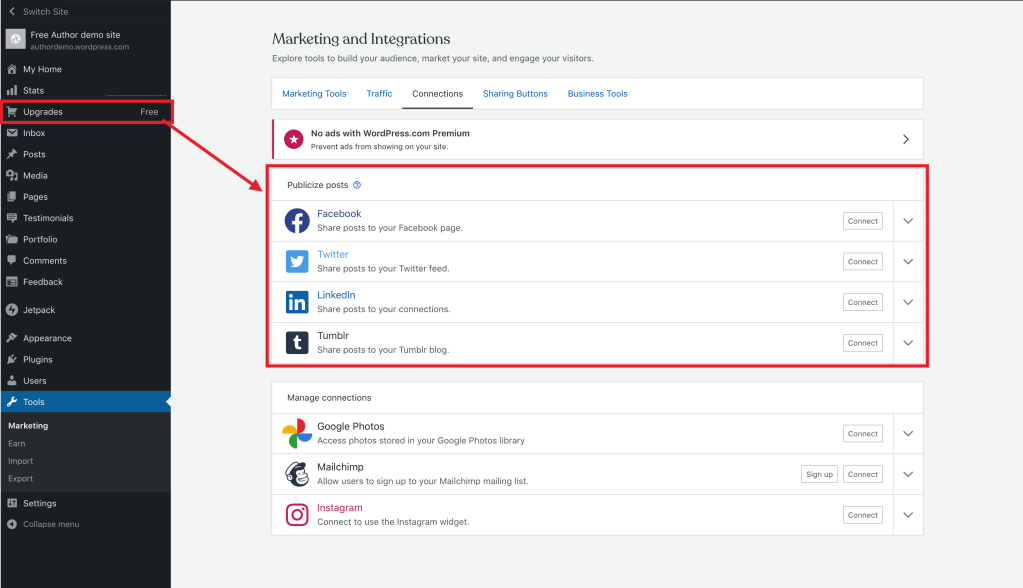
Integrating your social media presence with your WordPress.com website has never been easier. We offer many options and tools that are available on all plans, at no additional cost. Whether you want to auto-share your website posts to a social media platform, display your social media posts on your website, provide links to your various accounts, or encourage your website visitors to share your content, we’ve got what you need to connect with your audience.
Posting to Social Media
All WordPress.com plans include Publicize, a feature that lets you automate posting to Facebook, Twitter, LinkedIn, and Tumblr. When you set up and configure these social media accounts to your site, every new post you publish will automatically post to the platforms you’ve selected. This is a great way to repurpose your website content on your social channels, reach your audience where they already are, and drive traffic to your site.
It’s important to note that Publicize cannot push posts to Instagram since Instagram doesn’t allow auto-posting from third-party services. However, if you’re on the Business plan or ecommerce plan, then you could consider using a third-party automation tool such as Buffer or Hootsuite, both of which can be connected to your WordPress.com site using plugins. There may be other tools that offer this feature as well, though you’ll want to research their limitations and plans to learn more.*
*Please note that third-party tools and plugins are outside the scope of WordPress.com support.
Social Media Feeds on Your Site
Another option that WordPress.com offers is displaying your social media platforms on your website. You can add widgets, blocks, or feeds to your WordPress.com site to display posts from your social media accounts in real-time. This can help you stay connected with your audience when they’re taking a break from social media, but still checking your site.
WordPress.com offers built-in features for displaying your social media feeds from Instagram, Facebook, Twitter, Pinterest, and TikTok, to name a few. We also provide a number of support documents to help walk you through the options for these embedding features.
Social Media Menus
You can also strengthen the cross-connection between your website and your social media platforms with the addition of social media menus. Many WordPress.com themes offer a dedicated Social Menu that allows you to connect your site to various social media platforms and display their respective icons on your site.
If your theme doesn’t offer this menu option, you can still create social media-style menus using our Social Icons Block. This ensures that your audience knows how to easily find you on your preferred social media platforms.
Social Sharing
Last but not least, don’t forget to enlist your visitors to share the love from your website to their social accounts by setting up WordPress.com’s Social Sharing option.
This feature allows you to choose which social platforms you want to encourage your visitors to spread the word by providing a Share button on every piece of content you publish. Nothing connects your audience more than the ability to share.
WordPress.com provides you with multiple built-in tools to make your website the centralized hub for connecting and integrating with your social media platforms—at no additional cost—so you can connect to your audience smoothly and seamlessly, all while driving traffic to your WordPress.com website.
WordPress.com will be hosting a live special topic webinar on Tuesday, February 22, 2022 at 19:00 UTC. Join our WordPress experts to learn all of the essential tips to integrate social media with your website and how to add Link in Bio pages to your website. Register for free today!
Quelle: RedHat Stack

Docker Captains are select members of the community that are both experts in their field and are passionate about sharing their Docker knowledge with others. “Docker Captains Take 5” is a regular blog series where we get a closer look at our Captains and ask them the same broad set of questions ranging from what their best Docker tip is to whether they prefer cats or dogs (personally, we like whales and turtles over here). Today, we’re interviewing Thomas Shaw, one of our Docker Captains. He works as a Principal Automation Engineer at DIGIT Game Studios and is based in Ireland.
How/when did you first discover Docker?
I remember it like it was yesterday. he date was August 23rd 2013 and I was working as a Build Engineer for Demonware. During a visit to the Vancouver office, one of the developers named Mohan Raj Rajamanickham mentioned “a cool new tool” called Docker. It sounded too good to be true but I downloaded version 0.5 the next day while waiting for the flight back home to Dublin, Ireland. I played with the Docker CLI for several hours on the flight and that was it. Before the plane had touched the runway in Dublin I was completely sold on the potential of Docker. It solved an immediate problem faced by developers and build engineers alike, dependency hell.
Over the following 12 months we replaced our bare metal build agents with containerized build agents. It was a primitive approach at first. We built a CentOS 5 VM, tarred it up and created a container image from it. This was the base image on which we ran builds and tests over the next 2 years. We went from 8 bare metal build agents, each unique, each manually setup, each with different tooling versions to 4 build agents with just Docker installed.
It was a simple approach but it eliminated the management of several unique build agents. We saw a number of other benefits too, such as better build stability, increased build throughput by 300% and most importantly teams now owned their own dependencies. This approach worked well and around 2015 we started looking at moving our CI/CD pipelines into AWS. We originally took a hybrid approach and ran the majority of builds and tests in our own datacenter and just a handful in AWS. This was easier than expected. Docker made our workloads portable and we began to leverage the scalability of AWS for running tests. The unit tests (which were actually functional tests) for one of our main projects was taking over 1 hour per commit. Using containers we were able to split the tests across multiple containers on multiple build agents and we reduced the execution time to around 10 minutes. It was at this point that more folks started to pay attention to the potential of Docker.
What is your favorite Docker command?
I really enjoy “docker diff”. I find it incredibly useful to see what files/directories are being added or modified by the process within the container. It’s great for debugging. A close second would be “docker stats”.
What is your top tip for working with Docker that others may not know?
When possible, own your own base image and pin tooling versions. It’s convenient to use the public images on Docker Hub but when working in an organization where hundreds of developers are relying on the same base image try to bring it in house. We set up an image “bakery” at Demonware where we would build our base images nightly, with pinned versions of tools included, ran extensive tests, triggered downstream pipelines and verified that our base image was always in a good state. From experience it’s the base image where the most “bloat” occurs and keeping it lean can also help when moving the image around your infrastructure.
What’s the coolest Docker demo you have done/seen ?
My favorite demo was by Casey Bisson from Joyent. In the demo he showed off how Triton worked and how he could scale from a single container running locally out to an entire datacenter by just updating a single endpoint. This was in 2016 and I still love the simplicity of this approach.
What have you worked on in the past six months that you’re particularly proud of?
I’ve been using containers daily since late 2013 and still find new uses for them regularly. I’m currently working on improving developer tooling and UX at DIGIT Games Studios in Dublin. Part of this work includes containerizing our tooling and making it accessible in multiple ways including from Slack, command line, callable by API and even runnable from a spreadsheet. Docker enables us to bring the tooling closer to the end user whether they are technical or non technical. Rolling out updates to tools is now trivial.
What do you anticipate will be Docker’s biggest announcement this year?
Development Environments (DE) has received a huge amount of positive feedback based on the early announcements. I think the potential of DE is huge. To have these environments tightly integrated into a developers IDE, easily shareable and customizable will remove existing friction and help developers move from idea to production with greater velocity.
What are some personal goals for the next year with respect to the Docker community?
Our last Docker Dublin Meetup was in February 2020 and with a community of over 3000 members I’d like to start the in-person meetups again in 2022. I’d also like to continue running more Docker Workshops around Ireland and take the power of containerization out to other communities.
What talk would you most love to see at DockerCon 2022?
Any talks that include gaming would be great. I particularly loved the live migration demo of Quake a few years ago. Some studios are doing really cool stuff with containers. As early adopters of containers, Demonware may have some useful experiences to share with regard to their journey from self-hosted Kubernetes to the cloud.
Looking to the distant future, what is the technology that you’re most excited about and that you think holds a lot of promise?
That’s a tough question. Any technology that focuses on the user experience first and is a joy to use excites me. From a gaming perspective Augmented Reality has so much potential, particularly for mobile gaming. I’m not going to mention Blockchain or NFTs since I don’t know enough about either to comment. They may have their place but if they negatively impact the environment as suggested then perhaps they need to go back to the drawing board for a few more iterations.
Rapid fire questions…
What new skill have you mastered during the pandemic?
Mindfulness.
Cats or Dogs?
Dogs.
Salty, sour or sweet?
Sweet.
Beach or mountains?
Mountains.
Your most often used emoji?
DockerCon2022
Join us for DockerCon2022 on Tuesday, May 10. DockerCon is a free, one day virtual event that is a unique experience for developers and development teams who are building the next generation of modern applications. If you want to learn about how to go from code to cloud fast and how to solve your development challenges, DockerCon 2022 offers engaging live content to help you build, share and run your applications. Register today at https://www.docker.com/dockercon/
The post Docker Captain Take 5 – Thomas Shaw appeared first on Docker Blog.
Quelle: https://blog.docker.com/feed/

Eine neue Grafikkarte und eine mysteriöse Behörde: die Woche im Video. (Golem-Wochenrückblick, Microsoft)
Quelle: Golem
Monica Sasso, our EMEA Financial Services Chief Technologist, has a wealth of experience in the financial services industry. Read about some of her greatest insights and takeaways from working in various financial services firms.
Quelle: CloudForms
We had a chance to chat with Andrew Block, Distinguished Architect at Red Hat, about his experience working with Red Hat customers and the innovation that architects can help bring to their organizations. Learn more.
Quelle: CloudForms

Enterprises are increasingly seeking out technologies that help them create unique experiences for customers with speed and at scale. At the same time, customers want flexibility when deciding where to manage their enterprise data, particularly when it comes to business-critical applications.That’s why I’m thrilled that Sprinklr, the unified customer experience management (Unified-CXM) platform for modern enterprises, has partnered with Google Cloud to accelerate its go-to-market strategy and grow awareness among our joint customers. Sprinklr will work closely with our global salesforce, benefitting from our deep relationships with enterprises that have chosen to build on Google Cloud. Akin to Google Cloud’s mission to accelerate every organization’s ability to digitally transform their business through data-powered innovation, Sprinklr’s primary objective is to empower the world’s largest and most loved brands to make their customers happier by listening, learning, and taking action through insights. With this strategic partnership now in place, Sprinklr and Google Cloud will go-to-market together with the end-customer as our sole focus.Traditionally, brands have adopted point solutions to manage segments of the customer journey. In isolation, these may work — but they rarely work collaboratively, even when vendors build “Frankenstacks” of disconnected products. These solutions can’t deliver a 360° view of the customer, and often reinforce departmental silos. All of which creates point-solution chaos.Sprinklr’s approach is fundamentally different and is the way out of the aforementioned point-solution chaos. As the first platform purpose-built for unified customer experience management (Unified-CXM) and trusted by the enterprise, Sprinklr’s industry-leading AI and powerful Care, Marketing, Research, and Engagement solutions enable the world’s top brands to learn about their customers, understand the marketplace, and reach, engage, and serve customers on all channels to drive business growth. Sprinklr was built from the ground up as a platform-first solution, designed to evolve and grow with the rapid expansion of digital channels and applications. The results? Faster innovation. Stronger performance. And a future-proof strategy for customer engagement on an enterprise scale.”Sprinklr works with large, global companies that want flexibility when deciding where to manage their enterprise data and consider our platform a business-critical application,” said Doug Balut, Senior Vice President of Global Alliances, Sprinklr. “Giving our customers the opportunity to manage Sprinklr on Google Cloud empowers them to create engaging customer experiences while maintaining the high security, scalability, and performance they need to run their business.”To learn more about this exciting partnership and the challenges we jointly solve for customers, check out the recent conversation between Google Cloud’s VP of Marketing, Sarah Kennedy, and Sprinklr’s Chief Experience Officer, Grad Conn. Or read the press release on the partnership.
Quelle: Google Cloud Platform






