Activekey: Cherry kauft Hersteller hygienischer Tastaturen
Mit dem Kauf von Activekey erhofft sich Cherry, im aktuell sehr wichtigen medizinischen Umfeld mehr präsent zu sein. (Cherry, Maus)
Quelle: Golem

Mit dem Kauf von Activekey erhofft sich Cherry, im aktuell sehr wichtigen medizinischen Umfeld mehr präsent zu sein. (Cherry, Maus)
Quelle: Golem

Kaum eine IT-Anwendung erfährt in der Netz-Community eine solche Ablehnung wie die Luca-App zur Eventregistrierung. Warum? Eine Analyse von Friedhelm Greis (Luca-App, Google)
Quelle: Golem

Das Vive Pro 2 ist technisch der VR-Konkurrenz von HP und Valve teils leicht überlegen, bei Controllern und Tracking aber von diesen abhängig. (Vive, Steam)
Quelle: Golem

2020 hat Apple im App Store über 150.000 betrügerische Apps abgelehnt und verhindert, dass über 3 Millionen gestohlene Kreditkarten eingesetzt wurden. (Apple App Store, Apple)
Quelle: Golem

Der aktuelle Patch sollte Outlook eigentlich verbessern. Stattdessen verschwinden E-Mail-Texte. Microsoft hat aber einen Fix parat. (Outlook, Microsoft)
Quelle: Golem
“It was just a whirlwind,” Caitlyn Speranza says, remembering her return to work at Red Hat after giving birth to daughter, Zelda. “We had picked out a daycare and put down deposits. We were ready. And then I got a call from my manager saying that everyone was going to work from home, and everything changed.”
Quelle: CloudForms
By now, we’ve answered the question of whether public sector agencies can innovate, transform, and operate with a remote workforce. They can do so quite well. Government organisations worldwide have been using technology to manage remote work challenges and continue to provide services to constituents. In my role as a Customer Engineer for Google Cloud in EMEA, I see opportunities to innovate by using technology and want to share how government agencies across Europe embraced new methods to gain efficiencies and tremendous cost savings.Transformation is happening nowPublic Sector organizations and Google alike changed the way they provided services. At Google, for example, Google Meet hosted 1 trillion minutes of video calls during 2020, and usage increased exponentially from previous levels. We saw many public sector customers change the way they operated to continue providing services to their constituents:The UK’sNational Institute for Health Research built a digital hub on Google Workspace, allowing users to continue to work without pause. The use of Google Meet went up by 379% within two months of quarantine, and users shared and collaborated on documents more frequently, with Drive usage increasing by 198%.Instead of relying on legacy on-premises solutions, the city ofTrondheim in Norwayturned to Google Cloud and Google Workspace to help city employees work together and stay connected in these difficult times. Google Meet also allows the city to continue governmental meetings and keep classes running in schools.Over in the United States, the Illinois Department of Employment Security deployed Google Cloud Contact Center AI when the volume of requests for help spiked to 11 times the normal amount. It took only four weeks to roll out a system that supports millions of people. The virtual agent answered 3.2 million inquiries in its first two weeks, helping the state pay unemployment benefits on time to 99.99% of claimants.Keep the momentum going: Empower, automate, experimentThere are a few things public sector agencies can do to keep the momentum going and take advantage of technological innovation.Enable remote lifelong learning: Google has a wide variety of lifelong learningresources, including numerous training materials—such as ITcertificates—withspecific EMEA programmes. As the pandemic accelerates changes in how and where we work, many of us will need to upgrade our skills or even change careers. The new Google Career Certificates enable people to become job-ready for growing career areas, such as IT Support, Project Management, UX Design, and Data Analytics, and are available online on Coursera.Increase efficiency with virtual agents and AI:Artificial intelligence capabilities can save time and increase productivity for government employees and the public. For example,Rhode Island’s government is harnessing the power of artificial intelligence (AI) and machine learning (ML) to connect the state’s workforce with pathways to new careers. Conversational technologies likeGoogle Cloud Contact Center AI help governments handle large volumes of inbound interactions with constituents. Similarly, automating the manual processing of documents (images, PDFs, and more) with Google’sDocument AI saves time, increases efficiency, and frees employees to perform more meaningful work. Google helps with all kinds of government forms, including specialised content extraction forprocurement documents.Innovate in healthcare technology:Moorfield’s Eye Hospital uses Google Cloud’s AutoML to allow clinicians, without prior experience in coding or deep learning, to develop models that accurately detect common diseases from medical images. Johns Hopkins uses AI algorithms to improve treatments instroke survivors, reducing the time needed to evaluate brain scans from 5 hours to 30 seconds. With the help of Google Cloud’s AutoML, AI, and analytics tools, Emory University can better predict the likelihood ofsepsis in patients. TheETH Zurich and theWellcome Sanger Research Institute are using Google Cloud’s multi-cloud solution, Anthos, to help researchers collaborate and share their analyses more effectively.Make data-driven decisions: During the pandemic, public sector agencies have been usingsentiment analysis and mobility data to inform government policy. In particular, public health agencies can use this technology to evaluate the acceptance of COVID-19 vaccines.Experimentation has provided great benefits over the past 12 months. I’m excited to work with the Public Sector to continue experimentation and sustain improvements in efficiency and cost reduction—the innovations that drive growth. Public sector agencies have the opportunity to try many low cost and low commitment experiments that will save money and increase efficiency. The key is to keep moving forward and not let the pace of innovation slow down as things begin to return to normal.If you work for any public sector organisation, we welcome you to sign up to Google Cloud’s publicsector community and talk with other public sector technologists about how they are building innovation.
Quelle: Google Cloud Platform
What’s the first thing you do when you get something new? It depends, right? When I bought a new mobile phone, I jumped in to reload my favorite apps and explore the new features. After I got a kitchen remodeled, I looked around and wondered what to do next. Organize things? Cook something? Learn to cook something? Buying Anthos is more like the latter than the former—there are so many possibilities that it can be hard to know where to start. But once you have your new application platform in place, there are some things you can do to immediately get value and gain momentum. Here are six things to get you started. 1. Deliver a series of workshops for your teamsIf you work in a platform team, part of your job is to enable and empower users of your platform. You can’t assume that if you build it, they will come. Rather, you need to invest heavily in helping internal teams understand when, and how, to use the platform.To get your developers on track, you might start by sharing a link to the Anthos Developer Sandbox. Or take a step back and coordinate training seminars on topics such as containerization, Kubernetes, and Google Cloud. Check out the coursework we propose for Anthos and application modernization. And there’s terrific content for Google Cloud, Kubernetes, and distributed systems on platforms like Pluralsight and Coursera. Then go ahead and assemble a similar program for architects and system administrators. You can also encourage folks to apply to the exclusive Anthos Fellows program.Just don’t be passive and leave it up to each individual or team to learn Anthos. Get engaged! Build a program and explain why you’ve chosen Anthos, and what fundamentals each team should learn to get the most out of it. In all of the above, your Google team is here to help you establish a plan. Our pre-sales and post-sales teams are ready and willing to help with workshops and co-design (and delivery!) of training.2. Develop an operational runbookThis should have happened during the pilot phase, but just in case it didn’t, you need to make a concerted effort to document and exercise your common operational use cases. This might include provisioning user clusters, patching clusters, installing an upgrade, or creating a sandbox environment. Part of this documentation might even include your operational use cases from your traditional deployment platform, and translating that to Anthos operational motions.Your Google Cloud team will happily collaborate with you on this work to ensure you’ve got a rock solid process for building and managing your Anthos clusters on-premises and in the public cloud of your choice.3. Choose base policies to apply to user clustersOne of the most powerful (and underrated) parts of Anthos is its declarative configuration management and policy. As you create more and more distributed infrastructure, the only sensible way to keep it all under control is through centralized automation. With Anthos Config Management (ACM) you can create and deploy policies and configurations that apply to your clusters from a well-defined source of truth. Based on the OPA Gatekeeper open-source project, Anthos Config Management provides more than forty unique, built-in policies to keep your clusters safe. These policies cover things like AppArmor policies used by containers, restricting host file system access, privileged container restrictions, and more.Apply base policies, create your own, and then confidently scale out your infrastructure without worrying about noncompliance. This is a great opportunity to work with security teams towards an improved, centralized security posture.4. Connect Anthos to your app deployment pipelinesMake it easy for your teams to deploy to Anthos! Because Anthos exposes the standard Kubernetes API to your team, it’s straightforward to deploy your own container images or Helm charts, from the CI/CD tool of your choice.Cloud Build is a powerful service for deploying your software, and with the new Connect gateway for Anthos, you can deploy to any Anthos connected cluster. Regardless of which CI/CD tool you prefer, make the effort to configure access for your teams, and offer up some sample pipelines that they can use to deploy their workloads.5. Migrate a few workloads from your existing platformsSpeaking of workloads, as soon as you get Anthos in place it’s time to get something running on the platform. First, migrate at least two applications from your legacy application platform, evaluating whether you can move these apps without refactoring them. Anthos adds the most value when it helps you replace existing platforms and consolidate your control plane across clouds.Don’t stop there. We also offer the kf interface to make it easy to redirect any Cloud Foundry applications to Anthos. With rich support for the Cloud Foundry API, kf makes it possible to keep the dev experience you’re familiar with, while running on a modern, cloud-native stack.Additionally, grab a handful of apps that currently live on virtual machines. With the powerful Migrate for Anthos functionality, you can yank those apps—Linux or Windows, stateful or stateless—from the current host, and run them in a denser, more agile environment.6. Sketch out your roadmap for advanced featuresI think it’s a mistake to gold-plate a platform before seeing how your team wants to take advantage of it. Give them a minimum viable platform, learn, and iterate. Eventually though, you’ll want to figure out your more advanced implementation roadmap with the help of your developers and architects. Do devs want to hide more of Kubernetes and focus on their “inner loop”? Install Cloud Run for Anthos. Are they looking to strip network libraries from their code and focus on business logic? Configure Anthos Service Mesh. Maybe they want to bring together Windows and Linux workloads under one management layer? Deploy Windows-based node pools on GKE. Could your developers be exploring AI/ML in their applications? Deploy Hybrid AI components into your Anthos clusters.When you adopt any application platform, you’re making an investment. An important one. Anthos is an investment in your organization. To ensure you’re building momentum as you start your journey, start with these steps listed above. Check out the recent blog post on Anthos 1.7 release, where we discuss new features that customers tell us will drive business agility and efficiency in the multicloud world. And don’t forget to work with your Google team to initiate an ongoing rhythm with the Anthos product management team. We’re here to help.
Quelle: Google Cloud Platform
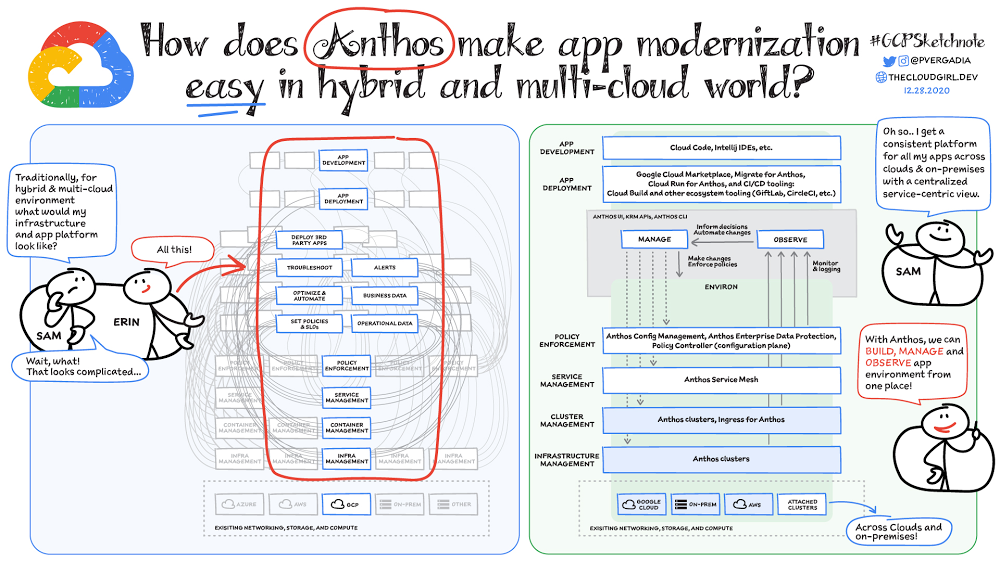
Most enterprises have applications in disparate locations—in their own data centers, in multiple public clouds, and at the edge. These apps run on different proprietary technology stacks, which reduces developer velocity, wastes computing resources, and hinders scalability. How can you consistently secure and operate existing apps, while developing and deploying new apps across hybrid and multicloud environments? How can you get centralized visibility and management of the resources? Well, that is why Anthos exists!This post explores why traditional hybrid and multicloud deployments are difficult, and then shows how Anthos makes it easy to manage applications across multiple environments. (Click to enlarge)Why is traditional hybrid and multicloud difficult?In hybrid and multicloud environments, you need to manage infrastructure. Let’s say you use containers on the clouds, and you develop apps using services on Google Cloud and AWS. Regardless of environment, you will need policy enforcement across your IT footprint. To manage your apps across the environment, you need monitoring and logging systems. You need to integrate that data into meaningful categories, like business data, operational data, and alerts.Digging further, you might use operational data and alerts to inform optimizations, implement automations, and set policies or SLOs. You might use business data to do all those things, and to deploy third-party apps. Then, to actually enact the changes you decide to implement, you need to act on different parts of the system. That means digging into each tool for policy enforcement, securing services, orchestrating containers, and managing infrastructure. Don’t forget, all of this work is in addition to what it takes to develop and deploy your own apps.(Click to enlarge)Now, consider repeating this set of tasks across a hybrid and multicloud landscape. It becomes very complex, very quickly. Your platform admins, SREs, and DevOps teams who are responsible for security and efficiency have to do manual, cluster-by-cluster management, data collection, and information synthesis. With this complexity, it’s hard to stay current, to understand business implications, and to ensure compliance (not to mention the difficulty of onboarding a new hire). Anthos helps solve these challenges!How does Anthos make hybrid and multicloud easy?With Anthos, you get a consistent way to manage your infrastructure, with similar infrastructure management, container management, service management, and policy enforcement across your landscape.As a result, you have observability across all your platforms in one place, including access to business information, alerts, and operations information. With this information you might decide to optimize, automate, and set policies or SLOs. Digging deeper into Anthos EnvironsYou may have different regions that need different policies, and also have different development, staging, or production environments that need different permissions. Some parts of your work may need more security. That’s where environs come in! Environs are a way to create logical sets of underlying Kubernetes clusters, regardless of which platform those clusters live on. By considering, grouping, and managing sets of clusters as logical environs, you can think about and work with your applications at the right level of detail for what you need to do, be it acquiring business insights over the entire system, updating settings for a dev environment, or troubleshooting data for a specific cluster. Using environs, each part of the functional stack can take declarative direction about configuration, compliance, and more.(Click to enlarge)Modernize application developmentAnthos also helps modernize application development because it uses environs to enforce policies and processes, and abstracts away the cluster and container management from application teams. Anthos enables you to easily abstract away infrastructure from application teams, making it easy for them to incorporate a wide variety of CI/CD solutions on top of environs. It lets you view and manage your applications at the right level of detail, be it business insights for services across the entire system, or troubleshooting data for a specific cluster. Anthos also works with container-based tools like buildpacks to simplify the packaging process. It offers Migrate for Anthos to take those applications out of the VMs and move them to a more modern hosting environment. What’s in it for platform administrators? Anthos provides platform administrators a single place to monitor and manage their landscape, with policy control and marketplace access. This reduces person-hours needed for management, enforcement, discovery, and communication. Anthos also provides administrators an out-of-the-box structured view of their entire system, including services, clusters, and more, so they can improve security, use resources more efficiently, and demonstrate measurable success. Administrators also save time and effort by managing declaratively, and they can communicate the success, cost savings, and efficiency of the platforms without needing to manually combine data. Interested in getting started with Anthos? Check out the free on-demand training here and my YouTube series. For more resources, you can also read the Anthos ebook at no cost. For more #GCPSketchnote and similar cloud content, follow me on twitter @pvergadia and keep an eye out on thecloudgirl.devRelated ArticleWhat are my hybrid and multicloud deployment options with Anthos?Anthos is a managed application platform that extends Google Cloud services and engineering practices to your environments so you can mo…Read Article
Quelle: Google Cloud Platform
More people than ever have been conducting more of their lives online due to the COVID-19 pandemic. This creates a new landscape for fraudsters to create and release new attacks. Researchcommissioned by Forrester Consulting showed 84% of companies have seen an increase in bot attacks. 71% of organizations have seen an increase in the amount of successful attacks. 65% of businesses have experienced more frequent attacks and greater revenue loss due to bot attacks. With so many people visiting government websites to learn more about the COVID-19 vaccine, make vaccine appointments, or file for unemployment, these web pages have become prime targets for bot attacks and other abusive activities. But reCAPTCHA Enterprise has helped state governments protect COVID-19 vaccine registration portals and unemployment claims portals from abusive activities.Assisting with unemployment claims during COVID-19Alongside the wave of unemployment claims caused by COVID-19, many state government agencies, such as Wisconsin’s Workforce Development, have seen an increase in attempted malicious bot logins on their external websites. Many states have had malicious actors visit unemployment claims portals and enter stolen credentials to file fraudulent unemployment claims. Because many unemployment claims portals are mandated to pay a recipient within 2 weeks, the claims portal processes this fraudulent information and bad actors receive unemployment checks weeks before their false claims are recognized. By then, the fraudsters have their money and have repeated this process using other stolen credentials.reCAPTCHA Enterprise helps state governments reduce false claims by preventing adversaries from automatically reusing credentials on unemployment claims portals. reCAPTCHA Enterprise’s scale and speed to determine fraudster behavior across the Internet helped some of the largest states in the United States, such as Texas. Registering for the COVID-19 Vaccine and accessing state-sponsored resourcesSeveral states, such as Pennsylvania, are challenged by web traffic that fluctuates based on the COVID-19 Vaccine Phase. For example, during Phase 1, there was a large increase in web traffic from both humans and bots because of the demand for the very few available vaccination slots. As more states move into Phase 2 and Phase 3, and the vaccine is more widely available, traffic is increasing because bad actors know more people are coming to these websites to register to be vaccinated. reCAPTCHA Enterprise was implemented to stop bad actors from scripting bots to book vaccine appointments and then sell those appointment slots on another website for profit. These fake web pages are falsely promoted as websites where people can register for the vaccine. Vaccine appointments are not the only government system from which fraudsters try to profit. Transportation and social service departments also face frequent attacks, wherein fraudsters try to profit by booking and then selling appointments with those organizations. Fending off these attacks was made easier thanks to reCAPTCHA Enterprise, a frictionless fraud detection service that leverages our experience from more than a decade of defending the internet and data for our network of more than 5 million sites. The reCAPTCHA Enterprise platform can understand fraudulent behavior, introduce friction to block bots from booking appointments, and allow legitimate users to access the vaccine portals and other state portals. Because reCAPTCHA Enterprise does not require end users to complete captcha challenges, several state governments installed reCAPTCHA Enterprise across search, login, and registration web pages. State governments are also placing reCAPTCHA Enterprise on webpages where end users can access healthcare, receive assistance for housing or food, register motor vehicles, or propose legislation. With reCAPTCHA Enterprise on more pages, it becomes more difficult for malicious software or bots to carry out their attacks against different pages, but not for end users to browse, login into accounts, book appointments, or apply for resources. Because reCAPTCHA Enterprise requires no action from end users to stop fraud, state governments implemented reCAPTCHA Enterprise on all points of interaction on their webpages to ensure maximum security without impacting the user experience. Providing security everywhere and pricing for allMany state governments are familiar with buying cloud services in a pay-as-you-go model. reCAPTCHA Enterprise eased the purchasing process by providing state governments with predictable, scalable, and customizable pricing. State governments know up front how much they can expect to pay each month based on the number of assessments reCAPTCHA Enterprise performs. reCAPTCHA Enterprise’s flexible pricing model keeps pace with the natural fluctuations of visitors to vaccination registration and unemployment claims. reCAPTCHA Enterprise has a dedicated sales team that can tailor pricing to your specific use cases so both your webpages and budget are not compromised. reCAPTCHA Enterprise has helped many state governments serve their constituents by making it easier to get vaccinated and collect unemployment. It helps constituents take advantage of public services and makes it more difficult for fraudsters to manipulate and interfere with them. To start protecting your web pages from credential stuffing and other attacks, get started with reCAPTCHA Enterprise today.
Quelle: Google Cloud Platform






