Installing and using Dynatrace to prevent outages

In this post we’re going to look at the next part of our fictional company’s journey to digital transformation. Over the past several months Davie Street Enterprises’ (DSE) digital transformation has progressed quickly with much success. Now it’s time to tackle predicting and preventing, if possible, outages and improving user experience.
Quelle: CloudForms

Google Cloud’s contribution to an environment of trust and transparency in Europe

Google Cloud’s industry-leading controls, contractual commitments, and accountability tools have helped organizations across Europe meet stringent data protection regulatory requirements for years. This commitment to supporting the  compliance efforts of European companies has earned us the trust of businesses like retailers, manufacturers and financial services providers.As part of our continued efforts to uphold that trust, Google Cloud was one of the first cloud providers to support and adopt the EU GDPR Cloud Code of Conduct(CoC). The CoC is a mechanism for cloud providers to demonstrate how they offer sufficient guarantees to implement appropriate technical and organizational measures as data processors under the GDPR.  Today the Belgian Data Protection Authority, based on a positive opinion by the European Data Protection Board (EDPB), approved the CoC, a product of years of constructive collaboration between the cloud computing community, the European Commission, and European data protection authorities. We are proud to say that Google Cloud Platform and  Google Workspace already adhere to these provisions. This is the first European code approved under the GDPR; it is excellent news for the industry to have a new transparency and accountability tool that helps promote trust in the cloud. In addition to the CoC, Google Cloud has already been certified against internationally-recognized privacy standards such as ISO/IEC 27001, ISO/IEC 27017, ISO/IEC 27018 and ISO/IEC 27701. These certifications provide independent validation of our ongoing dedication to world-class security and privacy.This initiative reaffirms Google Cloud’s commitment to help our customers navigate their compliance journey when using our services. To learn more about how Google Cloud can help organizations with their compliance efforts, visit our Cloud Compliance resource center.
Quelle: Google Cloud Platform

Forrester names Google Cloud a Leader in Unstructured Data Security Platforms

As organizations expand their use of cloud computing services, more of their sensitive data inevitably moves to and lives in the cloud. Much of this sensitive data is unstructured and can be challenging to secure. Despite this potential challenge, the usefulness of cloud for data storage and processing is too big for most organizations to ignore and has in turn led to data sprawl, where their sensitive data is spread over many resources, both in the cloud and on-premise. Addressing data sprawl requires solutions that can discover, manage, and secure sensitive data, especially unstructured data, as it spreads.To help organizations confidently move their sensitive data to the cloud, Google Cloud works diligently to earn and maintain customer trust. Control and transparency are pillars of our approach to offering a trusted cloud. Therefore, we’ve been expanding our capabilities to act on unstructured data as sprawl increases.Given the importance of these capabilities to our strategy, we are happy to announce today that Forrester Research has named Google Cloud a Leader in The Forrester Wave™: Unstructured Data Security Platforms, Q2 2021 report, and rated Google Cloud highest in the current offering category among the providers evaluated.The report evaluates the 11 most significant providers with platform solutions to secure and protect unstructured data, spanning from cloud providers to data security-focused vendors. The report notes that “Google offers breadth and depth with built-in data security in the cloud. Google Cloud Platform, Google Workspace, and BeyondCorp Enterprise have underlying data security products and features for protecting customer data.”Google Cloud tools focused on protecting unstructured data were developed and battle-tested internally at Google to alleviate some of our own data security challenges. This brings the best of Google security to the organizations utilizing Google Cloud and our security tools. The report highlights that “Google productizes capabilities originally developed to secure its own business, and brings a disciplined approach to product enhancements for enterprise requirements. It serves a wide range of enterprise and mid-market, with a focus on emphasizing data protection needs by industry. ”Google Cloud’s data security strategy focuses on meeting customers wherever they are in their cloud migration journey. The report highlights that “Google further enables a Zero Trust approach with third-party integrations through its BeyondCorp Alliance of partners in device management, endpoint security and gateways.”Google Cloud received the highest possible score in sixteen criteria, in total receiving the most 5 out of 5 ratings among all vendors assessed. These criteria include: Data Intelligence, Access Control, Deletion, Obfuscation-Scope, Obfuscation-Key Management, Deployment, Security and Risk, APIs and Integration, Data Security Platform Vision, Data Security Execution Roadmap, Performance, Planned Enhancements, Zero Trust Enabling Partner Ecosystem, Diversity, Equity and Inclusion, Installed Base, and Revenue. Notably, Google Cloud received the highest possible score in the Obfuscation criteria. Obfuscation can help protect sensitive data, like personally identifiable information (PII), which is critical to many enterprise workflows. Cloud DLP helps customers inspect and mask this sensitive data with techniques like redaction, bucketing, and tokenization, which help strike the balance between risk and utility. This is especially crucial when dealing with unstructured or free-text workloads, in which it can be challenging to know what data to redact. More than 150 detectors combine to power Cloud DLP’s masking, which can be deployed in data migrations and business workloads like real-time data collection and processing. For Obfuscation specifically, the report mentioned that Google “takes a broad view of DLP, which includes in-line redaction of sensitive elements in unstructured data and DLP APIs that extend support to additional data types like images or other media.”We are honored to be a Leader in The Forrester Wave™ Unstructured Data Security Platforms Q2 2021 report, and look forward to continuing to innovate and partner with you on ways to make your digital transformation journey safer as we work to become your most trusted Cloud.A copy of the full report can be viewed here.
Quelle: Google Cloud Platform

Datasets for Google Cloud: Introducing our new reference architecture

We are so excited by the announcement of Datasets for Google Cloud. In this blog post, I’d like to share more details about the new reference architecture that we built for a more streamlined data onboarding process for the Google Cloud Public Datasets Program.Data onboarding: Enhancing the developer experienceFor us, data onboarding isn’t only about pulling, transforming, and storing data from pre-existing sources into their desired destinations. It’s also about making the resulting data easier for analysis, and providing a better experience for developers tasked with building and maintaining data pipelines. The developer experience plays an increasingly vital role in the productivity of data engineering teams as they scale their efforts to hundreds or even thousands of data pipelines.Our team uses Cloud Composer to manage and monitor data pipelines in a centralized and standardized way. Every data pipeline is represented as a directed acyclic graph (DAG), and every node (also known as a task) in a DAG is represented by an Apache Airflow operator. Each operator performs a single action: from simple actions such as transferring data to and from Cloud Storage, to more complex operations such as using a Google Kubernetes Engine cluster to apply custom data transforms on large datasets. The ability for data engineers to monitor the states of DAG executions and to visualize them as graphs of operations greatly improves comprehensibility and maintainability.There are many components of a Cloud Composer environment that engineers must constantly manage to keep its pipelines operating like well-oiled machines: writing DAGs in a consistent and predictable manner; declaring, setting, and importing Airflow variables; and actuating other cloud resources that every pipeline relies on. Our new reference architecture aims to simplify all the work mentioned by using YAML configuration files to unify control of these components.The benefits of open sourceWe have proudly made the decision to open source the new reference architecture for our public datasets. It can be found on GitHub under the Google Cloud Platform organization.Open sourcing the data pipeline architecture that powers all of Google Cloud Public Datasets helps in three ways. First, it gives transparency to data consumers such as analysts and researchers about where the data was sourced and how it was derived. Second, it opens up the program to communities interested in making their datasets publicly available on Google Cloud. And third, it lets others use the architecture in their own way—for example, by using a private fork to onboard their own datasets for commercial use in their own Google Cloud accounts.A framework for data engineeringOne way to think of the new reference architecture is through an analogy with web frameworks. We think of web frameworks as tools to help with much of the heavy lifting required when building web applications. In the same way, our new reference architecture helps reduce overhead when developing and maintaining data pipelines. Maxime Beauchemin, the creator of Airflow, coined the term Meta Data Engineering in his talk Advanced Data Engineering Patterns with Apache Airflow. Meta Data Engineering revolves around the concept of providing layers of abstraction on top of data engineering overhead. Being able to dynamically generate data pipelines based on a set of rules and conventions is one concrete way to accomplish such a concept. The new reference architecture does this, and our goal is for data engineering to adopt the benefits that web frameworks did for software engineering.ConclusionAs we ramp up our efforts in migrating hundreds of our existing data pipelines to Google Cloud, we will keep expanding the space of possible reference patterns that this architecture can support. On top of that, we also plan to integrate the architecture with documentation sets such as data descriptions, policies, and example use cases. Including these will add greater value to the datasets—imagine bundling up data analysis and visualization as part of the onboarding process.We’re only scratching the surface when it comes to what the new reference architecture can potentially unlock for Datasets on Google Cloud. We invite everyone who’s interested in collaborating with us in three ways by opening an issue on GitHub: send data onboarding requests, file a bug, or help us develop new features.Related ArticleDiscover datasets to enrich your analytics and AI initiativesDiscover and access datasets and pre-built dataset solutions from Google, or public and commercial data providersRead Article
Quelle: Google Cloud Platform

Transforming your business with the data cloud

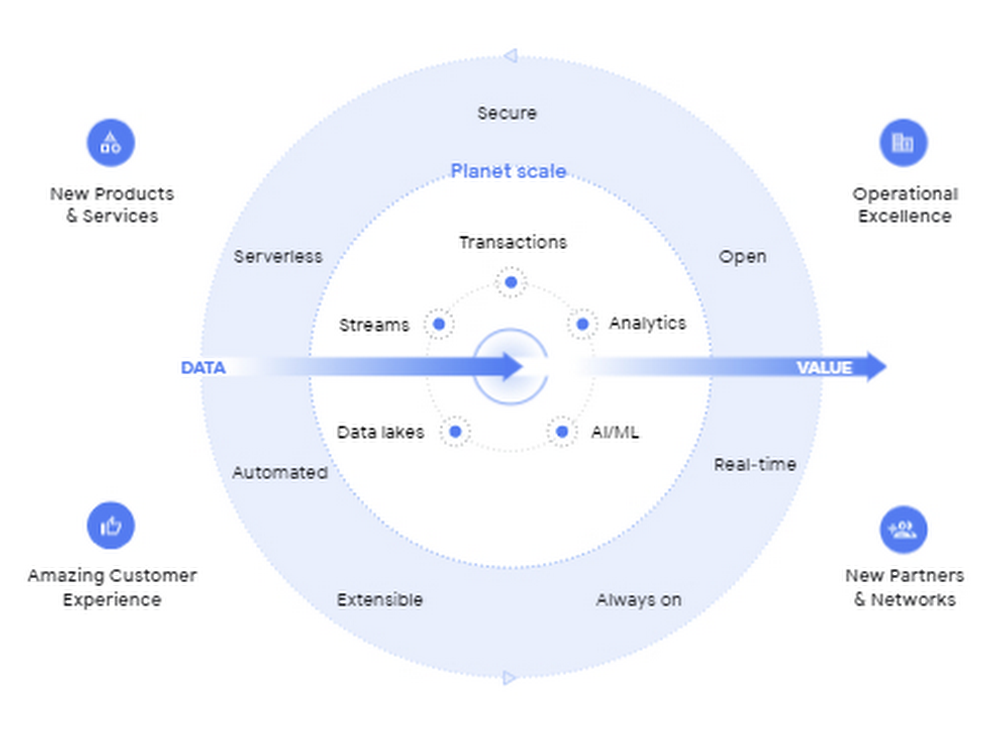
I’m so excited to be part of Google Cloud. Data has been a longstanding part of my career and it is at the heart of business transformation. Many companies have mastered the ability to collect data and have mechanisms in place to draw on some of it to solve business problems.  But most data collected piles up and is never put to a useful purpose. Accessing it and mining it for helpful insights is practically impossible at many companies. It’s always stuck in hard to reach places, fragmented across departments and unavailable when you need it the most.  Our mission at Google Cloud is to accelerate your ability to digitally transform your business with data. Solving data challenges is in our DNA, and over the last two decades we’ve been in a unique position to help our customers get the most out of data to drive real business value.  Google products are used and loved by billions of people across the globe. These products bring together the complex web of disconnected, disparate, and rapidly changing data that makes up the internet. When you get an answer in milliseconds from google.com via a simple search bar, you know we have this down to a science. Google Cloud brings this expertise in data and software together for businesses of all sizes so that you can gain advantage from your data. We call this the data cloud. Enter the data cloudA data cloud offers a comprehensive and proven approach to cloud and embraces the full data lifecycle, from the systems that run your business, where data is born, to analytics that support decision making, to AI and machine learning (ML) that predict and automate the future. A data cloud allows you a way to securely unify data across your entire organization, so you can break down silos, increase agility, innovate faster, get value from your data, and support business transformation. This is the heart of the data cloud.Why a data cloud is essentialBuilding a data cloud using Google Cloud’s technologies helps organizations accelerate business transformation by giving everyone access to the right information at the right time so that they can act more intelligently based on it.Since I’ve joined Google, I’ve been not only inspired by the work that the team has done to build products with a user-first mindset, but our customers have been an inspiration to each of us in what’s possible. The Home Depot built a data cloud using Google Cloud technologies to help keep 50,000+ items stocked at over 2,000 locations. They’re making their 400,000+ associates smarter by giving them visibility into the things each customer needs, like item location within a local store. By leveraging BigQuery, their query performance dropped from hours and days to seconds and minutes. The Home Depot also uses Cloud SQL, Spanner, and Bigtable for their operational use cases and AI to help locate goods using their mobile apps for in-store navigation. Major League Baseball (MLB) is reimagining the fan experience with their data cloud. To build engagement with today’s fans, drive engagement with future generations, and lay the groundwork for future innovation, MLB consolidated its infrastructure and migrated to Google Cloud’s Anthos, Google Kubernetes Engine, Cloud SQL, and BigQuery. MLB tracks every moment of every game for an audience on seven continents with Cloud SQL,  this valuable data to drive deeper engagement with fans.Vodafoneis using their data cloud to offer their customers new, personalized products and services across multiple markets. By identifying more than 700 use cases to deliver new products and services, Vodafone can support fact-based decision-making, reduce costs, remove duplication of data sources, and simplify operations.  With Google Cloud,  Vodafone’s operating companies in multiple countries can access improved data analytics, intelligence, and machine-learning capabilities. Here are four reasons why customers trust  Google Cloud to build their data cloud strategy: First, Google  delivers insights at planet scale  Customers often gravitate to Google Cloud for our specific data tools that were built for Google’s internal data needs and are unmatched for speed, scale, security, and capability for any size organization. BigQuery is the leading solution for analytics and allows you to run analytics at scale with a 99.99% SLA and up to 34% lower TCO than cloud data warehouse alternatives. Spanner provides unlimited scale, global consistency across regions, and high availability up to 99.999%, at a TCO that is 78% lower compared to on-prem databases and 37% lower than other cloud options. Firestore continues to see rapid adoption with over 2M databases created to power mobile, web, and IoT applications across customer environments. And finally Looker, an API for all your data, offers a single shared place for people and apps to interact with it, no matter the cloud environment. Second, Google’s AI helps your business be more intelligentGoogle was built on pioneering AI research and the principle of making the world’s information useful to people and businesses everywhere. AI powers some of Google’s most popular products, such as Search, Maps, Ads, and YouTube. We have leveraged this expertise to deliver a new, unified AI platform that gives every data scientist, data analyst, and ML engineer access to the same AI toolkit Google uses. Automated machine learning, accelerated experimentation and custom training, and more deployed models than any other platform enable your entire data team to drive business outcomes at any scale. Third, Google is the open data platform Google Cloud’s open platform gives customers maximum flexibility for managing transactional, analytical, and AI-based applications. Customers can choose from a wide range of transactional, processing, and analytics engines, open source tools, open APIs, and ML services to eliminate lock-in. This includes choice of deployment across multi-cloud and hybrid environments and easy interoperability with existing partner solutions and investments. With BigQuery Omni, organizations can choose to deploy their data warehousing solution to work natively with AWS or with Azure (coming soon). Looker supports 50+ distinct SQL dialects across multiple clouds and our database services like Cloud SQL, one of the fastest growing services at Google Cloud, offers familiar open source MySQL and PostgreSQL standard connection drivers, so you can work with your preferred tools and stay up-to-date with the latest community enhancements. In addition, Google offers an unrivaled developer community across the fields of AI, machine learning, mobile, application development, microservices, and access to third party solutions and open source systems. Fourth, Google offers a trusted platform for your data needsCustomers can take advantage of the same secure-by-design infrastructure, built-in data protection, and global network that Google uses to ensure compliance, redundancy, and reliability. All of Google’s data is encrypted in transit and at rest, by default. Google offers industry-leading reliability across regions so you’re always up and running. Spanner offers a 99.999% SLA and BigQuery offers a 99.99% SLA. For BI and embedded analytics, Looker supports data governance via a semantic layer that organizes your data and stores your business logic centrally, delivering consistent and trusted KPIs. And finally, our multi-layered security approach across hardware, services, user identity, storage, internet communication and operations provides peace of mind that your data is protected.Learn more at Data Cloud SummitWe are committed to helping you build a data cloud that gives you deep insights into your business and process automation. Join me as I welcome Anders Gustafsson, CEO of Zebra and Gil Perez, CIO of Deutsche Bank at the Data Cloud Summit on May 26, 2021 to learn and share new ways to use data for good. I can’t wait to hear what you accomplish.Related ArticleRead Article
Quelle: Google Cloud Platform
Follow your org’s app dev best practices with Cloud Code custom samples

As an engineering leader, it can be difficult to disseminate best practices to developers in your organization. This is critical, however, as these best practices can be used as a starting point to accelerate the time-to-market for your team’s ideas. Today, we are excited to introduce custom samples in Cloud Code, our family of IDE plugins, helping you easily distribute your best practices directly to your developers’ environments. Cloud Code helps developers increase their productivity by providing them with:An easy way to run, debug, and update their apps locallyYAML authoring supportExplorers to navigate Kubernetes and Cloud Run appsThese helpful and intuitive Cloud Code features help improve day-to-day workflows for enterprise developers. Cloud Code is available for VS Code, JetBrains IDEs (IntelliJ, PyCharm, etc), and Cloud Shell Editor. And with new custom samples, developers can quickly access your enterprise’s best code samples via a versioned Git repository directly from their IDEs. For example, one team may have a set of best practices for standing up a REST API using a specific set of libraries and frameworks, complete with integrated logging and monitoring systems and optimized security settings. They’ve gotten things just right to integrate with your logging and monitoring systems and security posture. Putting that code in the custom samples repository can make it easy for all other teams to access this code, right from their IDEs, and alleviate the challenge of recreating something another team has already mastered.Three steps to custom samples Setting up a custom samples repository is a straightforward process.1. Create a repository with a configuration file that maps out which folders within your repo contain samples, and gives them a name and description.2. Add the repo as a sample source within your preferred IDE and pick from one of the samples.1 add repo.jpg2 add repo.jpg3 add repo.jpg4 add repo.jpg3. Reload your IDE and get right to coding and building from your company’s recommended starting point!With custom samples, your developers now have the ability to access code samples that are created and maintained by your organization, right from Cloud Code. All they need to do is configure Cloud Code within their preferred IDE to retrieve your enterprise specific starter samples from a source code repository, then they can quickly get started developing with your company’s requirements configured for them.Getting started today with custom samplesWith Cloud Code custom samples, you can keep developers focused on coding knowing that your organization’s requirements are top of mind. We’ve created a custom sample repo of our own where we’ve aggregated some of our favorite Google Cloud sample apps. It provides an example of how to configure a custom sample repo using our recommended best practices. It can also be used to integrate a new set of samples into Cloud Code for you to explore. Check out the example repo here.Try out this feature using our Cloud Shell tutorial below, which gives you a tour of adding a custom sample repo to your IDE and then creating a new app from one of the samples.Visit the documentation pages here:VS CodeIntelliJCloud Shell EditorRelated ArticleCloud Code makes YAML easy for hundreds of popular Kubernetes CRDsCloud Code makes working with Kubernetes YAML easy thanks to expanded support for CRDs.Read Article
Quelle: Google Cloud Platform

AWS CloudFormation Guard 2.0 ist jetzt allgemein verfügbar

AWS CloudFormation kündigt die allgemeine Verfügbarkeit von AWS CloudFormation Guard 2.0 an. Diese Version macht Guard zu einem universellen Richtlinien-Evaluierungstool für allgemeine Zwecke. Mit Guard 2.0 können Entwickler zusätzlich zu den bereits unterstützten CloudFormation-Vorlagen Richtlinienregeln für beliebige JSON- und YAML-formatierte Dateien wie Kubernetes-Konfigurationen und Terraform-JSON-Konfigurationen schreiben.
Quelle: aws.amazon.com

Amazon Lex ist jetzt in der AWS-Region Kanada (Zentral) verfügbar

Ab heute ist Amazon Lex in der AWS-Region Kanada (Zentral) verfügbar. Amazon Lex ist ein Service zur Erstellung von Konversations-Schnittstellen für Sprache und Text in jeder Anwendung. Amazon Lex kombiniert fortgeschrittene Deep-Learning-Funktionen der automatischen Spracherkennung (Automatic Speech Recognition, ASR) für die Umwandlung von Sprache in Text und das Verstehen natürlicher Sprache (Natural Language Understanding, NLU), um die Absicht des Textes zu erkennen. So können Sie Anwendungen mit fesselnden Benutzererlebnissen und lebensechten Interaktionen erstellen. Mit Amazon Lex können Sie einfach anspruchsvolle, Konversations-Bots („Chatbots“), virtuelle Agenten und IVR-Systeme in natürlicher Sprache erstellen.  
Quelle: aws.amazon.com