[Norwegian] Cassandra Cederblad – Do not buy the advanced tech

Du kan ikkenå målet, kun ved å trykke på en magisk knapp. Cassandra Cederblad i Red Hat forteller hvorfor det er viktig å få med seg både ledergruppa og organisasjonen på endringsprosessen. 

“Vi vil kjøpe denne teknologien nå med en gang! Hvordan går vi fram?”. Jeg har ikke tall på hvor mange ganger jeg har hørt denne setningen, og hvor mange ganger jeg har anbefalt kunden å vente. 
Quelle: CloudForms

IDC: A multicloud strategy can mitigate regulatory, business risks

In recent years, cloud has become an important driver for innovation, enhancing security and operational resilience, and the COVID-19 pandemic has only accelerated the trend. But cloud adoption has been slower in regulated sectors including government agencies and financial institutions, due to the complexity of their legacy systems, cultural perceptions, and certain compliance challenges. In particular, the industry is focused on reducing vendor lock-in, concentration risk and over-reliance on third-party providers. To address these concerns, many regulated organizations are looking to implement innovative multi-vendor strategies. A multicloud approach lets them pick and choose cloud services from multiple cloud providers, helping to address commercial risks while providing more flexibility and choice. At Google Cloud, we are strong advocates of portability, interoperability and customer choice. To better understand the benefits as well as the challenges associated with a multicloud approach, we supported IDC in their work to produce a whitepaper that investigates how multicloud can help regulated organizations mitigate risks of using a single cloud vendor. The whitepaper looks at different approaches to multi-vendor and hybrid clouds taken by European organizations and how these strategies can help organizations address concentration risk and vendor-lock in, improve their compliance posture and demonstrate an exit strategy. Here’s a glimpse into the whitepaper’s findings:. Open source and technologies such as containers, open APIs, and open source databases are enablers of multicloud. Containers and container orchestration services such as Kubernetes are the runaway favorites—at least 50% of organizations prefer to run databases on a container platform. A container-based multicloud architectural approach gives organizations the portability to build once and deploy across multiple cloud environments.One in three financial services organizations are increasing their public cloud spend to accelerate feature delivery for their end customers. Choosing a multicloud strategy enables them to address cloud concentration risk for critical financial technology while still prioritizing innovation.In the public sector, multicloud has become a preferred way to address regulatory concerns and leverage the best services from different providers. Unfortunately, many governments have grown their multicloud adoption organically, rather than strategically.The whitepaper also offers recommendations for the regulated industries as well as policymakers to accelerate adoption of cloud and multi-vendor strategies in a secure and resilient way. To learn more about how regulated enterprises are adopting multicloud, you can download the IDC whitepaper or visit our multicloud solutions website.Related ArticleHow computing has evolved, and why you need a multi-cloud strategyA multi-cloud strategy gives companies the freedom to use the best possible cloud for each workload. Here’s why we’re all in.Read Article
Quelle: Google Cloud Platform

OpenX is serving over 150 billion ad requests per day with cloud databases

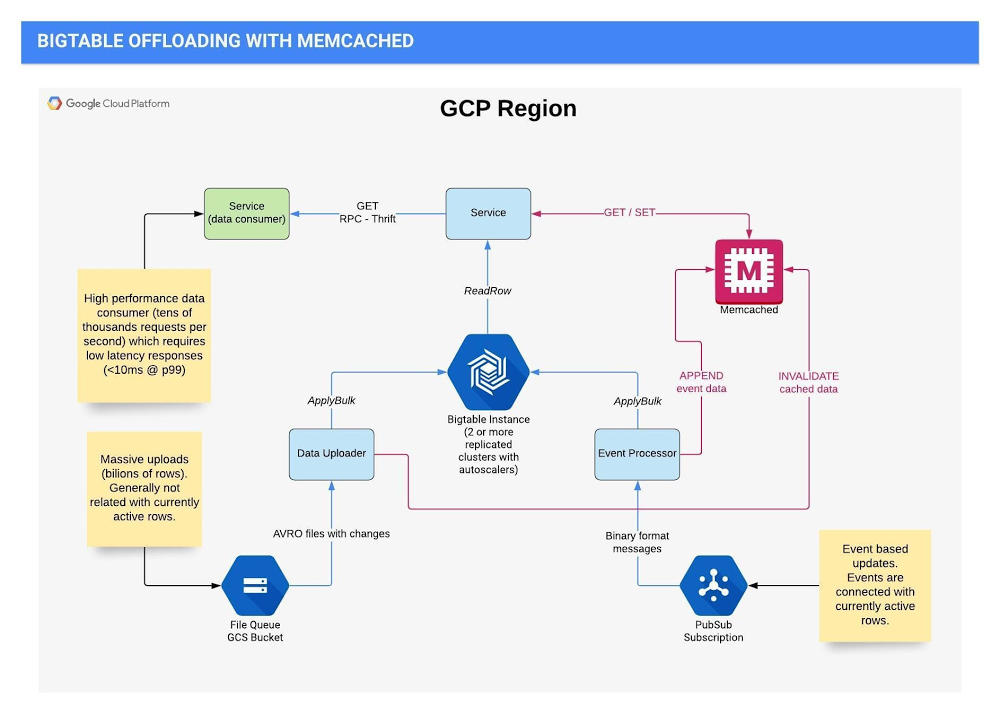
Editor’s note: When ad tech provider OpenX was migrating to Google Cloud, they found a scalable, dependable and cost-effective solution in Bigtable and Memorystore for Memcached. Here’s how—and why—they made the move.Running one of the industry’s largest independent ad exchanges, OpenX developed an integrated platform that combines ad server data and a real-time bidding exchange with a standard supply-side platform to help ad buyers get the highest real-time value for any trade. OpenX serves more than 30,000 brands, more than 1,200 websites, and more than 2,000 premium mobile apps.We migrated to Google Cloud to save time, increase scalability, and be available in more regions in the world. As we were migrating to Google Cloud, we also sought to replace our existing open-source database because it was not supported anymore, which led us to search for a cloud-based solution. The combination of Cloud Bigtable and Memorystore for Memcached from Google Cloud gave us the performance, scalability, and cost-effectiveness we required. Leaving behind an unsupported databaseWhen OpenX was hosted on-premises, our infrastructure included a main open source key value database at the back end that offered low latency and high performance. However, the vendor eventually left the market, which meant we had the technology but no commercial support. This opened up the opportunity for us to take the important step of migrating to the cloud and get a more convenient, stable, and predictable data cloud solution.Performance was a huge consideration for us. We used the legacy key value database to understand the usage patterns of our active web users. We have a higher percentage of get requests than update requests, and our main requirement was, and remains, low latency. We need the database requests to be handled in less than 10 milliseconds at P99 (99th percentile). The expected median is less than five milliseconds, and if the time is shorter, it’s better for our revenue.  Scalability was another consideration and, unfortunately, our legacy database wasn’t able to keep up. To handle traffic, our clusters were maxed out and external sharding between two relatively large clusters was required. It wasn’t possible to handle the traffic in a single region by a single instance of this database because we’d reached the maximum number of nodes. In search of a cloud-based solutionChoosing our next solution was a crucial decision, as our database is mission-critical for OpenX. Cloud Bigtable, a fully managed, scalable NoSQL database service, appealed to us because it’s hosted and available on Google Cloud, which is now our native infrastructure. Post migration  we had also made it a policy to leverage managed services when possible. In this case we didn’t see the value in operating (installing, updating, optimizing etc) a key value store on top of Google Kubernetes Engine (GKE) – work that doesn’t directly add value to our products.We needed a new key value store and we needed to move quickly because our cloud migration was happening on a very compressed timeline. We were impressed with the foundation paper written about Bigtable, one of the most-cited articles in computer science, so it wasn’t a complete unknown. We also knew that Google itself used Bigtable for its own solutions like Search and Maps, so it held a lot of promise for OpenX. OpenX processes more than 150B ad requests per day and on average 1M such requests per second, so response time and scalability are both business-critical factors for us. To start, we created a solid proof of concept and tested Bigtable from different aspects and saw that the P99s and the P50s met our requirements. And with Bigtable, scalability is not a concern. Where is the data coming from?In each of our regions, we have a Bigtable instance for our service with at least two clusters replicated and with independent autoscalers because we write to both clusters. Data gets into Bigtable in two very different flows. Our first flow handles event-based updates like user-based activity, page views, or cookie syncing, and these events are connected to the currently active rows. We update Bigtable with the updated cookie. It’s a process focused on updating and during this event processing, we usually don’t need to read any data from Bigtable. Events are published to Pub/Sub and processed on GKE.The second flow manages massive uploads of billions of rows from Cloud Storage, which include batch processing results from other OpenX teams and some external sources.We perform reads when we get an ad request. We’ll look at the different numbers that Memorystore for Memcached provided us later in this blog, but here, before we used Memcached, the reads were 15 to 20 times more than the writes.  The following chart shows the current architecture today for the flows described above:Click to enlargeThings just happen automaticallyEach of our tables contains at least one billion rows. The column families available to us through Bigtable are incredibly useful and flexible because we are able to set up different retention policies for each, what should be read, and how they should be managed. For some families, we have defined strict retention based on time and version numbers, so the old data is set to disappear automatically when the values are updated. Our traffic pattern is common to the industry; there’s a gradual increase during the day and a decrease at night, and we are using autoscaling to handle that. Autoscaling is challenging in our use case. First of all, our business priority is to serve requests that read from the database because we have to retrieve data quickly for the ads broker. We have the GKE components that write to Bigtable and we have Bigtable itself. If we scale GKE too quickly, it might send too many writes to Bigtable and affect our read performance. We solved this by gradually and slowly scaling up the GKE components , and essentially throttling the rate in which we consume messages from Pub/Sub, an asynchronous message service. This allows the open-source autoscaler we are using for Bigtable to kick in and work its magic, a process which takes a bit longer than GKE scaling, naturally. It’s like a waterfall of autoscaling.At this point, our median response time was about five milliseconds. The 95 percentile was below 10 millisecond and the 99 percentile was generally between 10 and 20 milliseconds. This was good, but after working with the Bigtable team and the GCP Professional Services Organization team we felt like we could do better by leveraging another tool in the Google Cloud toolbox.Memorystore for Memcached saved us 50% in costsCloud Memorystore is Google’s in-memory datastore service, a solution we turned to when we wanted to improve performance, reduce response time and optimize overall costs. Our approach was to add a caching layer in front of Bigtable. So we created another POC with Memorystore for Memcached to investigate and experiment with the caching times, and the results were very fruitful. By using Memorystore as a caching layer we reduced the median and P75 to a value close to the Memcached response times and which is lower than one millisecond. P95 and P99 also decreased. Of course, response times vary by region and workload, but they have been significantly improved across the board. With Memorystore, we were also able to optimize the number of requests to Bigtable. Now, over 80% of get requests are fetching data from Memorystore, and less than 20% from Bigtable. As we reduced the traffic to the database, we reduced the size of our Bigtable instances as well. With Memorystore, we were able to reduce our Bigtable node count by over 50%. As a result of this, we are paying for Bigtable and Memorystore together 50% less than what we paid for Bigtable alone before that. With Bigtable and Memorystore, we could leave the problems of our legacy database behind and position ourselves for growth with solutions that provided low latency and high performance in a scalable, managed solution.To learn more about OpenX, visit our site. To explore Memorystore for Memcached, read how it powers up caching.Thank you: None of this would have been possible without the hard work of Grzegorz Łyczba, Mateusz Tapa, Dominik Walter, Jarosław Stropa, Maciej Wolny, Damian Majewski, Bartłomiej Szysz, Michał Ślusarczyk, along with the rest of the OpenX Engineering Teams. We’re also grateful for the support of Google strategic cloud engineer Radosław Stankiewicz.Related ArticleHow Memorystore cut costs in half for Quizlet’s Memcached workloadsSee how online learning platform Quizlet uses managed database service Memorystore for Memcached to cut costs, improve reliability for SRE.Read Article
Quelle: Google Cloud Platform
Introducing request priorities for Cloud Spanner APIs

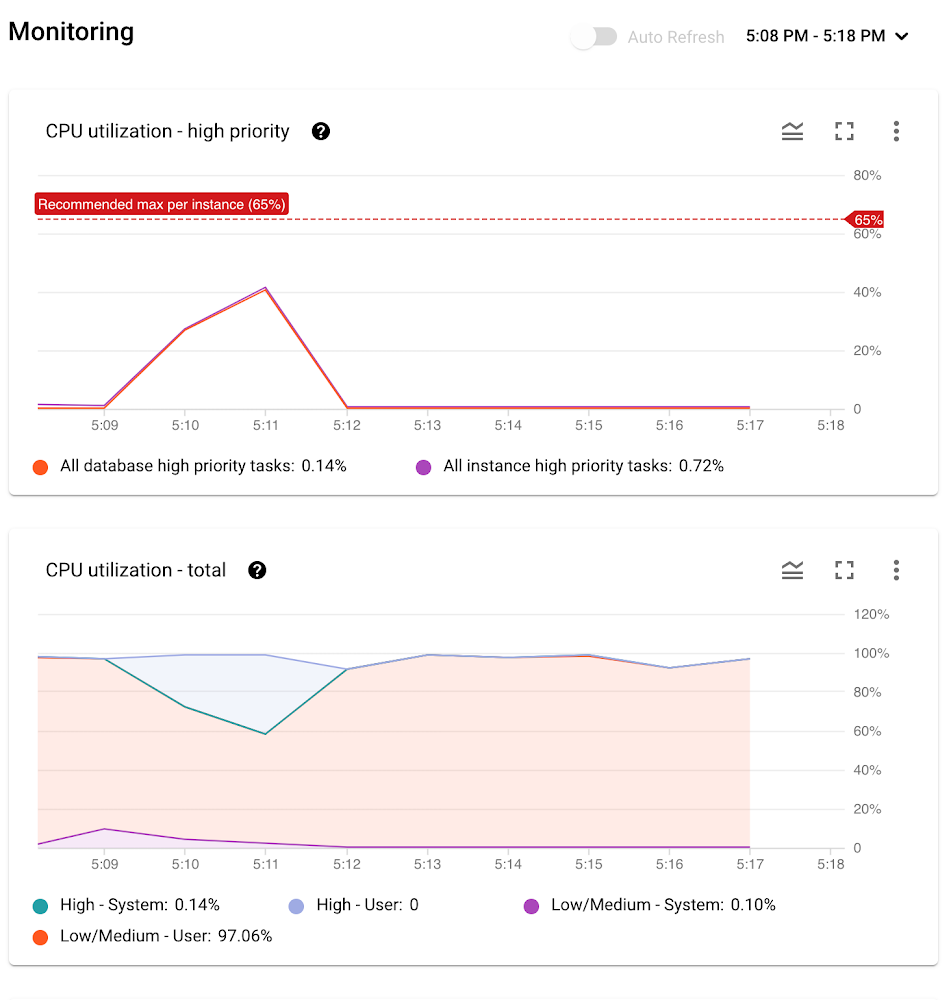
Today we’re happy to announce that you can now specify request priorities for some Cloud Spanner APIs. By assigning a HIGH, MEDIUM, or LOW priority to a specific request, you can now convey the relative importance of workloads, to better align resource usage with performance objectives. Internally, Cloud Spanner uses priorities to differentiate which workloads to schedule first in situations where many tasks contend for limited resources.Customers can take advantage of this feature if they are running mixed workloads on their Cloud Spanner instances. For example, if you want to run an analytical workload while processing DML statements, and you are okay with your analytical workload taking longer to run. In that case, you’d run your analytical queries at a LOW priority, signaling to Spanner that it can reorder more urgent work ahead if it needs to make tradeoffs.When there are ample resources available, all requests, regardless of priority, will be served promptly. Given two requests, one with HIGH priority and the other with LOW priority, but otherwise identical, there will not be noticeable differences in latency between the two when there is no resource contention. As a distributed system, Spanner is designed to run multiple tasks in parallel, regardless of their priority. However, in situations where there aren’t enough resources to go around, such as a sudden burst of traffic or a large batch process, the scheduler will try to run high-priority tasks first. This means that lower priority tasks may take longer than in a similar system that wasn’t resource constrained. It is important to note that priorities are a hint to the scheduler rather than a guarantee. There are situations where a lower priority request will be served ahead of a higher priority request, or example, when a lower priority request is holding a transaction lock that a higher priority request needs access to.Using Request PrioritiesThe Priority parameter is part of a new optional RequestOptions you can specify in the following APIs:ReadStreamingReadExecuteSqlExecuteStreamingSqlCommitExecuteBatchDmlYou can access this newly added parameter if you are directly issuing requests to our RPC API, REST APIor via the Java or Go Client libraries, with the rest of the client libraries implementing support for this parameter soon.The following sample code demonstrates how to specify the priority of a Read request using the Java Client LibraryQueryOption queryOption = new PriorityOption(RpcPriority.LOW);ResultSet resultSet = dbClient.singleUse().executeQuery(Statement.of(“SELECT * FROM TABLE”), queryOption);Note: Even though you can specify a priority for each request, it is recommended that requests that are part of the same transaction all have the same priority. MonitoringCloud Console reflects these new priorities in the CPU utilization, grouping metrics into HIGH and LOW/MEDIUM buckets.In the screenshot above, at 5:08 there was a low priority workload that was running with no other competing workloads. The low priority workload was allocated 100% of the available CPU. However, when a high priority workload started at ~5:09, the high priority workload was served immediately and the low priority workload CPU utilization dropped to 60%. When the high priority workload completed, the low priority workload resumed using 100% of the available CPU,Access this newly added parameter by issuing requests to our RPC API, REST APIor via the Java or Go Client libraries.Related ArticleIntroducing Django ORM support for Cloud SpannerToday we’re happy to announce beta support for Google Cloud Spanner in the Django ORM. The django-google-spanner package is a third-party…Read Article
Quelle: Google Cloud Platform

AI in Retail: Google Cloud transforms Cartier's product search technology

Ever since jeweler Louis-Francois Cartier opened his first workshop in Paris in 1847, the name “Cartier” has been synonymous with exceptional quality. Almost two centuries later, the luxury Maison has popularized wristwatches for men, been dubbed the “jeweler of kings and king of jewelers” by King Edward VII, and continues to design, manufacture, and sell jewelry and watchmaking creations globally renowned for timeless design. While Maison Cartier prides itself on the vastness of its collection, manually browsing its catalog to find specific models, or comparing several models at once, could sometimes take quite some time for a sales associate at one of the Maison’s 265 boutiques. This was not ideal for a brand that is known for its swift and efficient client service. Thus, in 2020, Cartier turned to Google Cloud and its advanced AI and machine learning capabilities for a solution.Thomas Meyer, Data Officer at Cartier: “We aim to build a global data & digital platform for our Maison, providing our teams with at scale analytics, versatile applications and artificial intelligence capabilities. Google Cloud is to be the core component of this data & digital platform.”No time to spare: Overcoming product search challenges with AICartier’s goal was to develop an application which, when shown an image of any Cartier watch ever designed in its 174-year history, could retrieve detailed information about its specific model and suggest similar-looking watches (with possibly different characteristics such as price) in under two seconds. Using the app, sales associates would be able to find specific products swiftly within a catalogue of more than a thousand watches—even some with only very slight variations between them.But creating this app meant Cartier’s data team had to overcome some unique challenges. Training machine learning models requires huge volumes of training data—in this case, images of Cartier wristwatches—but Cartier has always been driven by exclusive design and its prestigious collections had very few in-store product images available, with variations in backgrounds, lighting, quality, and styling, making it difficult to categorize images. As a result, Cartier had to find a way to develop an image recognition system that was performing above the required benchmarks, as the Maison has very high standards for its client service. For the app to be successfully adopted in its stores, Cartier required at least a 90% accuracy rate, with the entire pipeline running within five seconds end-to-end when integrated. That’s when, leveraging their existing partnership with Google Cloud, Cartier’s data team reached out to us for support looking for more advanced machine learning capabilities to bring their vision to life. Move beyond customer experienceWorking together with Cartier’s data team, we were able to help them solve their data and visual search challenge through trying out a number of machine learning experiments with Google Cloud AI Platform services, such as AutoML Vision, and Vision API, before rewriting custom code. In the end we built a data model specifically designed for Cartier’s use case: a combination of classifiers that run in parallel that first recognize a watch’s colors and materials, and then identifies which watch collection it belongs to. In the end, it provides a top three list of possible identities (visually similar watches) for the image, which users can click on to get more information, with up to 96.5% accuracy within three seconds.GCP project architecture & processNow, when customers are in need of a specific Cartier watch, the boutique team can help by taking a picture of the desired model (or use any existing photo of it as reference), and use the app to find its equivalent product page online. This solution also locates visually similar designed products in the catalog, displaying each with their own image, similarity score, and detailed description (if the boutique team clicks on it) for customers to explore. Meanwhile, an automatic tracked feedback mechanism enables users to evaluate how relevant the recommendations were so that the Cartier data team can continually improve the app. Served with style, thanks to the cloudToday, Cartier’s image recognition app has been rolled out across the Maison’s 200+ global stores and is available to sales associates in need of quickly calling up catalogue data on Cartier’s vast watchmaking creations. It now takes a sales associate seconds to answer a question that used to take them several minutes. And over time the Maison hopes to further expand the app’s functionality. “The performance of cutting edge machine learning and easy handling makes Google Cloud Vision API a fantastic tool to quickly prototype most classification projects” explains Alexandre Poussard, Data Scientist at Cartier. “We look forward to deepening our collaboration with Google Cloud in the future.”With AI and machine learning, the future looks bright for Cartier, just in the nick of time. Even beyond the boutiques, the success of this pioneering project is also opening doors to more innovation as it attracts the interest of other retail brands looking to tackle similar challenges. Learn more aboutGoogle Cloud AI and machine learning and retail solutions.Related ArticleGoogle Cloud Retail & Consumer Goods Summit: The Future of RetailJoin us at the Google Cloud Retail & Consumer Goods Summit and learn how combining technology and business insights can solve retail chal…Read Article
Quelle: Google Cloud Platform

Google Cloud Retail & Consumer Goods Summit: The Future of Retail

The way consumers make their everyday decisions is evolving, as digital ways of working, shopping and communicating have become the new normal. So now it’s more important than ever for companies in the retail sector to prioritise an insights-driven technology strategy and understand what’s truly important for their customers.  Through its partnerships with some of the world’s leading retailers and brands, Google Cloud provides solutions that address the retail sector’s most challenging problems, whether it’s creating flexible demand forecasting models to optimize inventory or transforming e-commerce using AI-powered apps. Over the past few years, we’ve been observing and analyzing the many facets of changing consumer behaviour. We are here to support retailers and brands as they transform their businesses to adapt to this new landscape.  Featuring consumer research and insights from your peers, Google Cloud’s Retail & Consumer Goods Summit will offer candid conversations to help you solve your challenges. We’ll be joined by industry innovators, including Carrefour Belgium and L’Oréal, who’ll discuss the future of retail and consumer goods. Bringing together technology and businessThe Google Cloud Retail & Consumer Goods Summit brings together technology and business insights, the key ingredients for any transformation. Whether you’re responsible for IT, data analytics, supply chains, or marketing, please join! Building connections and sharing perspectives cross-functionally is important to reimagining yourself, your organization, or the world. Capturing consumers with an insights-driven approach At the Google Cloud Retail & Consumer Goods Summit, you can choose from sessions that are tailored specifically to retail or to consumer goods, as well as the following:  Keynote: Our Human Truths team will kick off the summit by sharing insights into consumers’ hearts and minds to help inform your transformation strategy. Learn what consumer behaviors they think will be around for the long-term as we move into a post-pandemic world. “Hey Google, Show Me the Future of Retail” (featuring Carrefour Belgium): The Retail landscape is challenging, changing and full of possibilities. Join us for a transparent conversation about transformation roadmaps and how retailers should be planning for the future.How to Grow Brands in Times of Rapid Change (featuring L’Oréal): For consumer brands, this past year has been a catalyst of digital transformation that was already under way for several years. At Google, we’ve been closely studying a rapidly evolving landscape and will share with you our findings on where the high growth opportunities are for your brands so you can drive innovation across your organization.You’ll also be able to learn from experts who are leading transformations in their own sectors. These include German wholesaler METRO Digital, which is transforming the hospitality industry by making its digital solutions available to customers, and French retailer Maisons du Monde, which is taking a data-driven approach to personalize its customer experience.   Developing your transformation strategy To round off the day, you are invited to join MasterChef 2020 winner Thomas Frake. While retailers are using cloud technology to forecast the hottest products on the shelves and avoid shortages, Thomas will demonstrate how to cook like a chef using ingredients that you should already have at home. The Google Cloud Retail & Consumer Goods Summit will take place on Thursday, 22 April from 9:30am GMT+1. Please join us and register today by visiting our event landing page. You’ll leave the day inspired and ready to start your transformation journey. Related ArticleMeet the EMEA startups and scaleups redefining their industries with cloud technologyIndustries across EMEA are being disrupted and redefined by startups and scaleups, and we’re proud that many are Google Cloud customers. …Read Article
Quelle: Google Cloud Platform






