Donnerstag: Ferrari wird elektrisch, Valhalla-DLC verschoben, Peloton
Was am 15. April 2021 neben den großen Meldungen sonst noch passiert ist, in aller Kürze. (Kurznews, Sony)
Quelle: Golem

Was am 15. April 2021 neben den großen Meldungen sonst noch passiert ist, in aller Kürze. (Kurznews, Sony)
Quelle: Golem

Laut Telekom ist das Kabelnetz nicht der Lage, Gigabit zu liefern. Außer in Österreich, wo man selbst eines betreibt. (Docsis 3.1, Telekom)
Quelle: Golem

Mit dem EQS ist Mercedes-Benz dort angekommen, wo Tesla schon 2012 gestartet ist. Doch in einigen Punkten will Mercedes besser sein als die Konkurrenz. (Mercedes Benz, Technologie)
Quelle: Golem
Artificial intelligence (AI) and machine learning (ML) drive much of the world around us, from the apps on our phones to electric cars on the highway. Allowing such things to run as accurately as possible takes huge amounts of data to be collected and understood. At the helm of that critical information are data scientists. So, what’s a day on the job look like for data scientists at Red Hat?
Quelle: CloudForms
Adopting modern IT service management practices is an important part of a digital transformation strategy. Many businesses depend on ServiceNow to implement modern workflows, and with the Ansible Certified Content Collection for ServiceNow, they can help improve speed, efficiency and consistency.
Quelle: CloudForms
Your website is a product of your hard work and passion. Therefore, when your site hits a milestone — it shouldn’t go unrecognized. To make it easier for you to keep track of your site’s achievements, we’ll be rolling out a new celebratory notification that will alert you when your site reaches or surpasses a certain number of views.
We hope these celebrations are meaningful and motivational for you and that they inspire you to take time to pause, reflect, and celebrate.
If you have the WordPress app on your mobile, we also have a little surprise for you each time you unlock a milestone! Be sure to update your WordPress app to the latest version. If you don’t have the app yet, download it for free on both Android and iOS.
We’d love to hear your feedback! Reach out to us from within the app by going to My Site, tapping your photo on the top right, tapping Help & Support, and then selecting Contact Support.
Quelle: RedHat Stack
Since Google opened its first office in Poland over 15 years ago, we have been supporting the country’s growing digital economy, providing our partners and customers with cutting-edge technology, knowledge and global insights. With our announcement of a strategic partnership with Poland’s Domestic Cloud Provider in September 2019, we further committed to bring the power of Google Cloud to support the rapid growth, entrepreneurial spirit and passion for innovation of Polish businesses.Now, as Poland looks towards economic recovery, enterprises and public organizations of all sizes are taking advantage of new cloud technologies, and we are delivering on our commitment. To support customers in Poland and Central and Eastern Europe (CEE), we’re excited to announce that our new Google Cloud region in Warsaw is now open.Designed to help Polish and CEE companies build highly available applications for their customers, the Warsaw region is our first Google Cloud region in Poland and seventh to open in Europe. What customers and partners are sayingNavigating this past year has been a challenge for companies as they grapple with changing customers demands and greater economic uncertainty. And we’ve been fortunate to partner with and serve people, companies, and government institutions around the world to help them adapt. The Google Cloud region in Warsaw will help our customers in CEE adapt to new requirements, new opportunities and new ways of working. “We want to build the bank of the future, and to do that, we need the most innovative technology. By choosing Google Cloud, we believe we will have access to the tools we need, now and in the years to come.”—Adam Marciniak, CIO PKO Bank Polski “Google Cloud really helped us to make better use of their products and save money. As a result, we were able to dramatically increase our CPU and memory usage while keeping costs flat. We delivered a stable service to more customers without having to pass the cost on to them.”—Lenka Gondová, Chief Information Security Officer, Exponea“We have ambitious plans for the next few years, so we have decided to engage with Google Cloud as an experienced partner who provides us with both the know-how and the infrastructure and tools we need to build and maintain our ecommerce sites.”—Arkadiusz Ruciński, Omnichannel Director, LPP“We double in size every year, and our previous infrastructure providers couldn’t keep up. It became really hard to maintain hundreds of dedicated servers. As our stack grew, we decided to deploy our service to Google Cloud as the most effective and efficient way to support our business model.”—Paweł Sobkowiak, CTO, Booksy“We are seeing even more benefits from Anthos as our use evolves. The biggest advantage so far has been increased engagement among our staff. Teams are working passionately to achieve as much as possible because they can now focus on their core responsibilities rather than infrastructure management. That’s a testament to the power of Anthos and the value of the Accenture partnership.”—Monika Nowak-Toporowicz, Chief Technology and Innovation Officer, UPC PolskaA global network of regionsWarsaw joins the existing 24 Google Cloud regions connected via our high-performance network, helping customers better serve their users and customers throughout the globe. Learn more about Google Cloud locations.With this new region, Google Cloud customers operating in Poland and the wider CEE will benefit from low latency and high performance of their cloud-based workloads and data. Designed for high availability, the region opens with three availability zones to protect against service disruptions, and offers a portfolio of key products, including Compute Engine, App Engine, Google Kubernetes Engine, Cloud Bigtable, Cloud Spanner, and BigQuery.Helping customers build their transformation cloudsGoogle Cloud is here to support Polish businesses, helping them get smarter with data, deploy faster, connect more easily with people and customers throughout the globe, and protect everything that matters to their businesses. The cloud region in Warsaw offers new technology and tools that can be a catalyst for this change. Google Cloud will also support our customers with people and education programs. We have already trained thousands of IT specialists in Poland, helping both large enterprises and medium-sized companies get access to experts in cloud technologies. And since last year, as part of our local Grow with Google programme, we offer all SMBs in Poland free support in starting their cloud journey. Our ongoing commitment to Poland goes beyond our newest Cloud region. Google Cloud’s engineering center in Warsaw is a leading cloud technology hub in Europe and continues to grow each year, employing highly-skilled specialists that work on our global cloud computing solutions. We are also expanding our office in Wrocław, hiring experts to help companies migrate to cloud. In Poland and across Central and Eastern Europe, we’re proud to support businesses in every industry, from retail and banking, to manufacturing and public sector helping them recover, grow and thrive. And we are very excited to see how our partners and customers will use the power of the new Google Cloud region in Warsaw to accelerate their digital transformation.
Quelle: Google Cloud Platform
With brand experience increasingly online and digital-native players entering the market, financial services institutions (FSIs) will need to adopt a human-centric design philosophy to remain relevant and build stronger ties with their customers. Financial services providers must keep the customer in mind as they design their product offerings. This is especially critical in Asia-Pacific, where more consumers are coming online and online sectors are seeing robust growth.In Southeast Asia alone, at least 40 million people connected to the internet for the first time in 2020 and one in three digital services are consumed by new users, according to the2020 eConomy SEA report released by Temasek Holdings, Google, and Bain & Company. The region’s online population has hit 400 million, and seven internet economy sectors, including digital financial services and e-commerce, will clock more than $100 billion in gross merchandise volume.Fuelled in part by the COVID-19 outbreak, the growth momentum is expected to continue with 90% of new online consumers indicating plans to continue using such services post-pandemic. In Southeast Asia, digital payments are expected to surpass US$1.2 trillion in gross transaction value by 2025, according to the e-Conomy SEA 2020 report. Adoption of online remittance services also climbed two-fold since safe distancing measures kicked into place, with online value predicted to account for up to 40% of the total value of these payment services by 2025.What customers expect from their financial services providersWith customers heading toward online platforms, traditional FSIs in the region that fail to transform quickly to ride the wave will be left behind and risk losing their foothold against their digital-savvy neobank competitors. As it is, 71% of Singapore consumers experience at least one pain point with their bank today. And amongst those with three or more pain points, 77% express an interest in opening a digital bank account, according to aPwC survey.Consumers want personalized, real-time engagements and FSIs need to understand their customers’ requirements to differentiate their brand experience and build loyalty.This can be particularly challenging in Asia, where customer segments are widely diverse. Online users speak multiple languages, live in developed or developing nations, and reside in communities that are either largely unbanked or highly tapped financially.FSIs will have to identify their targeted customer segments and figure out solutions they should offer to address these consumers’ different requirements, such as those living in rural areas versus those living in urbanized cities.It means they will require tools powered by artificial intelligence (AI) and data analysis to understand their customers’ needs and improve service experience accordingly. At the same time, they will need to drive down operational costs.Chatting up to better customer satisfactionThese shifts in consumer needs prompted insurance companyFWD Group to develop an AI chatbot with the aim to enhance customer service delivery, reduce operational spend, and drive its Asian expansion. It was critical that the chatbot, dubbed Enzo, had the ability to establish a more sophisticated understanding of human intent—the customers’ main objective when they key in a question or request.To achieve this, FWD tapped Google’s AI-powered contact center solutionDialogflow as well as machine learning text analysis toolNatural Language to create Enzo.Dialogflow, in particular, proved essential as it could interpret human intent in several languages, including slang. This was important since FWD had plans to expand its presence across Southeast Asia and the versatile language support would enable the company to do so more rapidly.Within two months of Enzo’s introduction in the Philippines, the chatbot had handled queries from more than 4,000 customers, bumping up FWD’s previous response capacity by 7%. Enzo also registered a customer rating of 4.5 stars out of 5, which was equivalent to the company’s live chat service rating. In addition, the insurance company is using Google’s Cloud Vision AI andAutoML to power its KYC (Know Your Customer) identity verification, enabling it to quickly determine the validity of a customer’s ID. The AI tools have improved FWD’s operational efficiencies by 20% and reduced identity verification costs by half.Forward-looking FSIs such as FWD have achieved strong business results primarily because they realize customers should be at the center of everything they do. For FWD, the ability to dynamically translate and analyze their customer interactions as well as understand the context of what they actually need, regardless of language, has proven especially valuable in this region.This type of customer understanding will go a long way towards creating stronger brand awareness and loyalty, particularly as digital transactions mean less human contact, and FSI customers increasingly use multiple service providers for their daily banking needs.Adopting human-centric design thinking ensures products and services will actually be relevant and beneficial to the customers they are designed to serve. It also empowers banks to differentiate the human experience in every interaction they facilitate.When an individual applies for a home loan, they do not simply want a loan; their ultimate objective here is to own a home. So rather than focus on providing a home loan, banks instead need to think about how to build their loan offerings around the customer’s desire to buy a house. And technology offerings are already emerging to make this easy for financial institutions, such as Google Cloud’s Lending DocAI. By tapping data and infusing machine learning to understand context, as well as adopting more agile practices, FSIs not only ensure they remain competitive against their digital-native counterparts and amid changing consumer expectations, but create more genuine and enduring bonds with customers.Learn more about Google Cloud for financial services.Related ArticleNew white paper: Strengthening operational resilience in financial services by migrating to Google CloudLearn how migrating to Google Cloud can play a critical role in strengthening operational resilience in the financial services sector.Read Article
Quelle: Google Cloud Platform
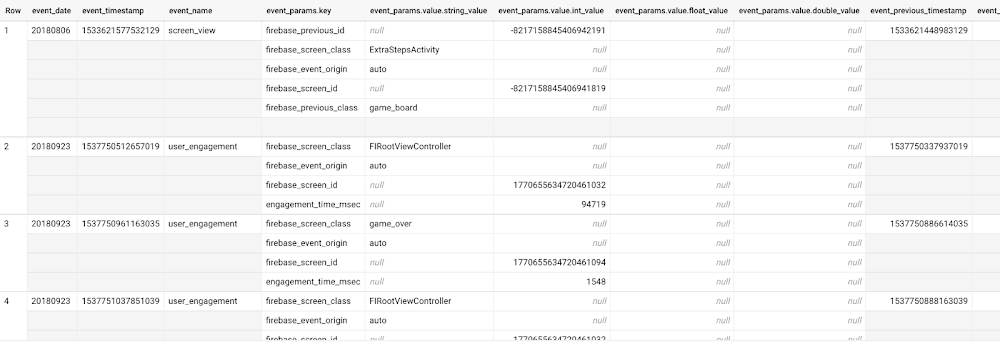
User retention can be a major challenge for mobile game developers. According to the Mobile Gaming Industry Analysis in 2019, most mobile games only see a 25% retention rate for users after the first day. To retain a larger percentage of users after their first use of an app, developers can take steps to motivate and incentivize certain users to return. But to do so, developers need to identify the propensity of any specific user returning after the first 24 hours. In this blog post, we will discuss how you can use BigQuery ML to run propensity models on Google Analytics 4 data from your gaming app to determine the likelihood of specific users returning to your app.You can also use the same end-to-end solution approach in other types of apps using Google Analytics for Firebase as well as apps and websites using Google Analytics 4. To try out the steps in this blogpost or to implement the solution for your own data, you can use this Jupyter Notebook. Using this blog post and the accompanying Jupyter Notebook, you’ll learn how to:Explore the BigQuery export dataset for Google Analytics 4Prepare the training data using demographic and behavioural attributesTrain propensity models using BigQuery MLEvaluate BigQuery ML modelsMake predictions using the BigQuery ML modelsImplement model insights in practical implementationsGoogle Analytics 4 (GA4) properties unify app and website measurement on a single platform and are now default in Google Analytics. Any business that wants to measure their website, app, or both, can use GA4 for a more complete view of how customers engage with their business. With the launch of Google Analytics 4, BigQuery export of Google Analytics data is now available to all users. If you are already using a Google Analytics 4 property, you can follow this guide to set up exporting your GA data to BigQuery.Once you have set up the BigQuery export, you can explore the data in BigQuery. Google Analytics 4 uses an event-based measurement model. Each row in the data is an event with additional parameters and properties. The Schema for BigQuery Export can help you to understand the structure of the data. In this blogpost, we use the public sample export data from an actual mobile game app called “Flood It!” (Android, iOS) to build a churn prediction model. But you can use data from your own app or website. Here’s what the data looks like. Each row in the dataset is a unique event, which can contain nested fields for event parameters.This dataset contains 5.7M events from over 15k users.Our goal is to use BigQuery ML on the sample app dataset to predict propensity to user churn or not churn based on users’ demographics and activities within the first 24 hours of app installation.In the following sections, we’ll cover how to:Pre-process the raw event data from GA4Identify users & the label featureProcess demographic featuresProcess behavioral featuresTrain classification model using BigQuery MLEvaluate the model using BigQueryMLMake predictions using BigQuery MLUtilize predictions for activationPre-process the raw event dataYou cannot simply use raw event data to train a machine learning model as it would not be in the right shape and format to use as training data. So in this section, we’ll go through how to pre-process the raw data into an appropriate format to use as training data for classification models.This is what the training data should look like for our use case at the end of this section:Notice that in this training data, each row represents a unique user with a distinct user ID (user_pseudo_id). Identify users & the label featureWe first filtered the dataset to remove users who were unlikely to return the app anyway. We defined these ‘bounced’ users as ones who spent less than 10 mins with the app. Then we labeled all remaining users:churned: No event data for the user after 24 hours of first engaging with the app.returned: The user has at least one event record after 24 hours of first engaging with the app.For your use case, you can have a different definition of bounce and churning. Also you can even try to predict something else other than churning, e.g.:whether a user is likely to spend money on in-game currency likelihood of completing n-number of game levelslikelihood of spending n amount of time in-game etc.In such cases, label each record accordingly so that whatever you are trying to predict can be identified from the label column.From our dataset, we found that ~41% users (5,557) bounced. However, from the remaining users (8,031), ~23% (1,883) churned after 24 hours:To create these bounced and churned columns, we used the following snippet of SQL code. You can view the Jupyter Notebook for the full query used for materializing the bounced and churned labels. Process demographic featuresNext, we added features both for demographic data and for behavioral data spanning across multiple columns. Having a combination of both demographic data and behavioral data helps to create a more predictive model. We used the following fields for each user as demographic features:geo.countrydevice.operating_systemdevice.languageA user might have multiple unique values in these fields — for example if a user uses the app from two different devices. To simplify, we used the values from the very first user engagement event.Process behavioral featuresThere is additional demographic information present in the GA4 export dataset, e.g. app_info, device, event_params, geo etc. You may also send demographic information to Google Analytics through each hit via user_properties. Furthermore, if you have first-party data on your own system, you can join that with the GA4 export data based on user_ids. To extract user behavior from the data, we looked into the user’s activities within the first 24 hours of first user engagement. In addition to the events automatically collected by Google Analytics, there are also the recommended events for games that can be explored to analyze user behavior. For our use case, to predict user churn, we counted the number of times the follow events were collected for a user within 24 hours of first user engagement: user_engagementlevel_start_quickplaylevel_end_quickplaylevel_complete_quickplaylevel_reset_quickplaypost_scorespend_virtual_currencyad_rewardchallenge_a_friendcompleted_5_levelsuse_extra_stepsThe following query shows how these features were calculated:View the notebook for the query used to aggregate and extract the behavioral data. You can use different sets of events for your use case. To view the complete list of events, use the following query:After this we combined the features to ensure our training dataset reflects the intended structure. We had the following columns in our table:User ID:user_pseudo_idLabel:churnedDemographic featurescountrydevice_osdevice_languageBehavioral featurescnt_user_engagementcnt_level_start_quickplaycnt_level_end_quickplaycnt_level_complete_quickplaycnt_level_reset_quickplaycnt_post_scorecnt_spend_virtual_currencycnt_ad_rewardcnt_challenge_a_friendcnt_completed_5_levelscnt_use_extra_stepsuser_first_engagementAt this point, the dataset was ready to train the classification machine learning model in BigQuery ML. Once trained, the model will output a propensity score between churn (churned=1) or return (churned=0) indicating the probability of a user churning based on the training data.Train classification model When using the CREATE MODEL statement, BigQuery ML automatically splits the data between training and test. Thus the model can be evaluated immediately after training (see the documentation for more information).For the ML model, we can choose among the following classification algorithms where each type has its own pros and cons:Often logistic regression is used as a starting point because it is the fastest to train. The query below shows how we trained the logistic regression classification models in BigQuery ML.We extracted month, julianday, and dayofweek from datetimes/timestamps as one simple example of additional feature preprocessing before training. Using TRANSFORM() in your CREATE MODEL query allows the model to remember the extracted values. Thus, when making predictions using the model later on, these values won’t have to be extracted again. View the notebook for the example queries to train other types of models (XGBoost, deep neural network, AutoML Tables).Evaluate modelOnce the model finished training, we ran ML.EVALUATE to generate precision, recall, accuracy and f1_score for the model:The optional THRESHOLD parameter can be used to modify the default classification threshold of 0.5. For more information on these metrics, you can read through the definitions on precision and recall, accuracy, f1-score, log_loss and roc_auc. Comparing the resulting evaluation metrics can help to decide among multiple models.Furthermore, we used a confusion matrix to inspect how well the model predicted the labels, compared to the actual labels. The confusion matrix is created using the default threshold of 0.5, which you may want to adjust to optimize for recall, precision, or a balance (more information here).This table can be interpreted in the following way:Make predictions using BigQuery MLOnce the ideal model was available, we ran ML.PREDICT to make predictions. For propensity modeling, the most important output is the probability of a behavior occurring. The following query returns the probability that the user will return after 24 hrs. The higher the probability and closer it is to 1, the more likely the user is predicted to return, and the closer it is to 0, the more likely the user is predicted to churn.Utilize predictions for activationOnce the model predictions are available for your users, you can activate this insight in different ways. In our analysis, we used user_pseudo_id as the user identifier. However, ideally, your app should send back the user_id from your app to Google Analytics. In addition to using first-party data for model predictions, this will also let you join back the predictions from the model into your own data.You can import the model predictions back into Google Analytics as a user attribute. This can be done using the Data Import feature for Google Analytics 4. Based on the prediction values you can Create and edit audiences and also do Audience targeting. For example, an audience can be users with prediction probability between 0.4 and 0.7, to represent users who are predicted to be “on the fence” between churning and returning.For Firebase Apps, you can use the Import segments feature. You can tailor user experience by targeting your identified users through Firebase services such as Remote Config, Cloud Messaging, and In-App Messaging. This will involve importing the segment data from BigQuery into Firebase. After that you can send notifications to the users, configure the app for them, or follow the user journeys across devices.Run targeted marketing campaigns via CRMs like Salesforce, e.g. send out reminder emails.You can find all of the code used in this blogpost in the Github repository:https://github.com/GoogleCloudPlatform/analytics-componentized-patterns/tree/master/gaming/propensity-model/bqmlWhat’s next? Continuous model evaluation and re-trainingAs you collect more data from your users, you may want to regularly evaluate your model on fresh data and re-train the model if you notice that the model quality is decaying.Continuous evaluation—the process of ensuring a production machine learning model is still performing well on new data—is an essential part in any ML workflow. Performing continuous evaluation can help you catch model drift, a phenomenon that occurs when the data used to train your model no longer reflects the current environment. To learn more about how to do continuous model evaluation and re-train models, you can read the blogpost: Continuous model evaluation with BigQuery ML, Stored Procedures, and Cloud SchedulerMore resourcesIf you’d like to learn more about any of the topics covered in this post, check out these resources:BigQuery export of Google Analytics dataBigQuery ML quickstartEvents automatically collected by Google Analytics 4Qwiklabs: Create ML models with BigQuery MLOr learn more about how you can use BigQuery ML to easily build other machine learning solutions:How to build demand forecasting models with BigQuery MLHow to build a recommendation system on e-commerce data using BigQuery MLLet us know what you thought of this post, and if you have topics you’d like to see covered in the future! You can find us on Twitter at @polonglin and @_mkazi_.Thanks to reviewers: Abhishek Kashyap, Breen Baker, David Sabater Dinter.Related ArticleHow to build demand forecasting models with BigQuery MLWith BigQuery ML, you can train and deploy machine learning models using SQL. With the fully managed, scalable infrastructure of BigQuery…Read Article
Quelle: Google Cloud Platform

Die EU-Kommission will KI-Anwendungen regulieren. Einsatzmöglichkeiten wie Social Scoring sollen verboten werden. (Videoüberwachung, KI)
Quelle: Golem






