Latest Mirantis Container Cloud Enables Consistent Cloud-Native Experience Across VMware, Bare Metal, Public Clouds, and On-Premises Data Centers

Includes hundreds of updates for flexible, stable Kubernetes deployments CAMPBELL, Calif.–(BUSINESS WIRE) —Mirantis, the open cloud company, today announced Mirantis Container Cloud with hundreds of updates, including support for the market-leading IaaS solution VMware, that enables businesses to build and operate container and virtual machine (VM) clouds anywhere they want, all consistent with one another. “Mirantis Container Cloud … Continued
Quelle: Mirantis

Customers cut document processing time and costs with DocAI solutions, now generally available

Some of the most important data at your company isn’t living in databases, but in documents, and most business processes begin, involve or end with a document. Yet most companies are still manually entering data and reliant on guesswork to make sense of it all as the volume and variety of data explodes. Organizations are also leaving heaps of value on the table in the form of new and better customer experiences that can be unlocked with artificial intelligence (AI) applied to documents. The latest releases of Document (Doc) AI platform, Lending DocAI and Procurement DocAI, built on decades of AI innovation at Google, bring powerful and useful solutions to these challenges. Under the hood are Google’s industry-leading technologies:Computer vision (including OCR) and Natural Language Processing (NLP) that creates pre-trained models for high-value, high-volume documents. Google Knowledge Graph to validate and enhance the fields in your documents.Training and creation of your own custom document models. Human interaction with AI to ensure accuracy where needed.Google Cloud DocAI platform, Lending DocAI and Procurement DocAI are now generally available. Thousands of customers have tried these products in the preview phase—and DocAI has already processed tens of billions of pages of documents across lending, insurance, government and other industries.Cut document processing costs by up to 60%Lending DocAI helps banks, mortgage brokers and other lending institutions fast track the loan application process from weeks to days, dramatically reducing the cost of issuing a loan. And Procurement DocAI enables companies to automate procurement data capture at scale, lowering processing costs by up to 60%.These solutions are built on DocAI platform, a unified console for document processing that lets you quickly access all parsers and tools. From the platform, you can automate and validate documents to streamline workflows, reduce guesswork, and keep data accurate and compliant. Get more value from AI with DocAI’s industry-specific solutionsAccording to Accenture’s AI: Built to Scale report: “Companies that scale successfully see 3x the return on their AI investments compared to those who have not fully rolled out AI capabilities.” Core to our strategy at Google Cloud is the creation of industry-specific solutions that help companies get maximum value out of their investments in AI. We announced Lending DocAI, our first solution designed specifically for the financial services industry, at the Mortgage Bankers Association convention last year. It processes borrowers’ income and asset documents using a set of specialized machine learning (ML) models, and automates routine document reviews so that mortgage providers can focus on more important work. Lending DocAI is now generally available and includes more specialized parsers for critical loan documents including paystubs, bank statements, and more. Our goal is to provide the right tools to help borrowers and lenders have a better experience and close home loans faster. For more, watch this video.Procurement DocAI is also now generally available. This solution helps companies accelerate document processing for invoices, receipts, and other valuable documents in the procurement cycle. Automating data capture is helping our customers increase accuracy and also lower their procure-to-pay processing costs. We are continually expanding the types of documents Procurement DocAI can process—the latest is a utility parser for electric, water and other bills. In addition, Procurement DocAI leverages Google Knowledge Graph to validate and enrich parsed information to make the data even more useful. Check out this overview video for more details. One company that lives and breathes AI-enabled document management is AODocs. It uses Procurement DocAI to simplify invoice processing for enterprise customers and launched a new Gmail add-on, Invoice to Sheet, for SMB customers who just want to track their invoices in Google Sheets.”Google Cloud’s Procurement DocAI service allows our document management platform to better automate the processing of invoices; AODocs customers who have tested our new account payables workflow estimate that the productivity of their A/P team has more than doubled, thanks to the reduction of manual data input brought by the Procurement DocAI.”—Stéphan Donzé, Founder and CEO, AODocsThe new specialized parsers for Lending and Procurement DocAI can be used alongside our existing AutoML Text & Document Classification and AutoML Document Extraction services. These technologies provide a state-of-the-art toolset for creating new document models and have been widely deployed by customers in financial services and other industries. Partner to accelerate your AI deployment and resultsHaving the right partner to ease the complexity of rolling out your AI-strategy in mortgage document processing is critical to transforming your customers’ experience. We’re excited to announce a partnership with Mr. Cooper, a leader in mortgage servicing, to provide customers with more automation and workflow tools throughout their entire mortgage life cycle. As part of this agreement, both companies will collaborate on digitizing Mr. Cooper’s core mortgage platform, creating a more personal customer experience utilizing AI, and driving a broader culture of innovation to imagine and develop services and solutions that will transform the mortgage experience for American homeowners.“Over the last few years, we have made substantial investments in our servicing technology and core mortgage platform that have revolutionized the customer experience, while providing dramatic efficiencies in operating cost. Our partnership with Google Cloud AI will build on those advances and help make these technologies available for the mortgage industry.” —Jay Bray, Chairman and CEO, Mr. Cooper GroupThis builds upon the robust partner ecosystem we’re creating to help customers revolutionize the home loan experience, which includes last year’s partnership announcement with Roostify.Integrate human review into ML predictions Next up is the general availability of Human-in-the-Loop AI, a new DocAI feature that will help companies achieve higher document processing accuracy with the assurance of human review. Adding human review can increase accuracy and help businesses interpret predictions using purpose-built tools to enable those reviews. Processing documents quickly and cost-effectively is important. But it’s often necessary to have a high level of assurance on data accuracy for compliance. CIOs and IT decision-makers need highly accurate ML predictions to fulfill compliance requirements, improve employee experience (e.g. less rework), and raise customer satisfaction (e.g. fewer data errors). Including human participation in ML processes allows AI and humans to work together for the best possible results.Human-in-the-Loop AI provides the workflow to manage human review tasks and produces a percentage confidence score of how “sure” it is that the AI ingested the document correctly. Document AI extracts data from documents with ML, and when paired with Human-in-the-Loop AI, human reviewers are able to verify the data captured. This system is customizable, providing the flexibility to set different thresholds and assign individual groups of reviewers to various stages of the workflow. With Human-in-the-Loop AI, developers can choose trusted reviewers to assign to the task; these reviewers can be from within their own or partner organizations.More Document AI resourcesTo learn more, check out the Document AI webpage and watch a demo of how to process sample forms in AI Platform notebooks to inspect data extraction and confidence scores. For more on how customers and partners like Workday, AODocs, and Mr. Cooper are using Document AI, listen to our fireside chat. And stay tuned for the exciting evolution of these technologies in future releases of DocAI.
Quelle: Google Cloud Platform

New Redis Enterprise for Anthos and GKE

Among forward-looking developers, the open-source Redis in-memory data structure store is a popular option for anyone looking for a database, cache, and message broker. At Google Cloud Next 2019, Redis Labs, the home of Redis announced Redis Enterprise, a fully managed Database-as-a-Service (DBaaS) running on Google Cloud. This week at RedisConf 2021, we are building on that collaboration to bring Redis Enterprise for Anthos and Google Kubernetes Engine (GKE) onto the Google Cloud Marketplace in private preview. This brings a self-managed Redis Enterprise solution for Google Cloud customers who need to run co-located apps and services in container clusters. Anthos is built on the foundational elements of GKE. It provides a managed hybrid and multi-cloud platform for deploying, managing, and scaling containerized applications on Google Cloud, on-premises, on AWS and soon on Azure. This enables enterprise customers with heterogeneous (on-prem and cloud) environments to seamlessly orchestrate their applications estate across a broad range of deployment topologies. The addition of new Kubernetes-based data services from Redis Labs makes it easier to couple apps and data services together, allowing both to operate from a global control plane with unified billing through Google Cloud. “As we worked to deliver a more customized and tailored experience for our customers, we needed a solution that allowed us to scale quickly with low overhead and low maintenance,” said Avneendra Arun, IT Director, Belk. “With GKE and Redis Enterprise we have a flexible, cost-effective solution that has been a wonderful combination, both quick to deploy and easy to maintain.”To learn more about Redis Enterprise with Anthos on GKE, please see the Redis Labs press release or contact the Redis team.
Quelle: Google Cloud Platform

Solving for more sustainable and resilient value chains

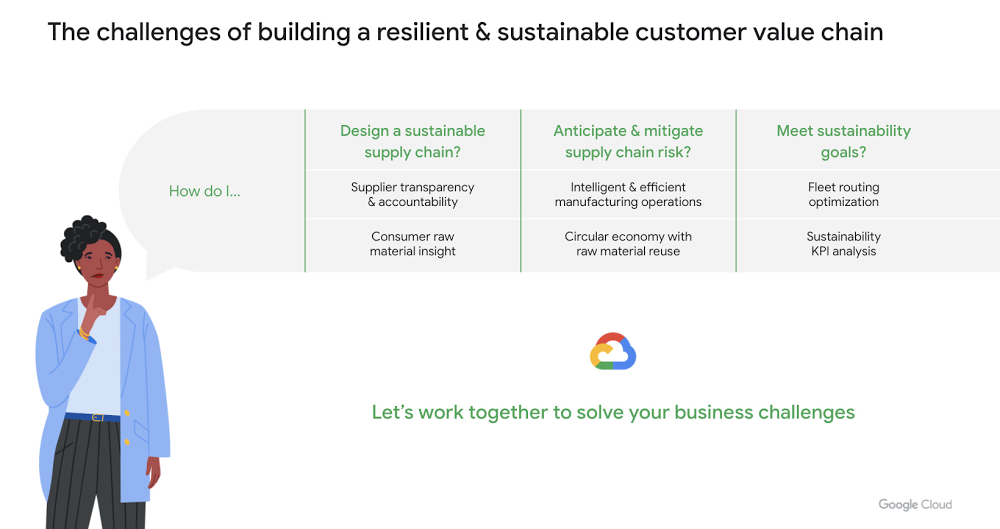
The past year highlighted the fragility of global supply chains and logistics networks and the need to adapt to rapidly changing business models and customer preferences. The importance of flexible, resilient and sustainable customer value chains is critical as organizations recalibrate to a post-pandemic world. Global supply chains are also subject to environmental risks. In 2020, over 8,000 suppliers disclosing through CDP, a global disclosure system for environmental impacts, reported that US$1.26 trillion of revenue is likely to be at risk over the next five years due to climate change, deforestation, and water insecurity1. Organizations are also likely to be challenged with reputational and regulatory risks across their value chain. For instance, emissions from supply chains are on average 11.4x higher than emissions from a company’s direct operations2. In many sectors, supply chains are responsible for over 80% of total greenhouse gas emissions. There is a strong argument for accelerating efforts to tackle these emissions, as suppliers reported combined savings of US$33.7 billion in 2020 by actively cutting emissions.3 Challenges in creating a sustainable customer value chain Organizations struggle with achieving sustainable value chain goals largely due to three factors: Limited visibility across the end-to-end value chain to drive transparency and accelerate adoption of sustainable best practicesLack of flexibility to adapt to new business models as highlighted during the pandemic and the rapid shift to e-commerce Limited insight into an organization’s operational decisions and their impact in reducing carbon emissions, preventing data-driven decision making.How Google Cloud can helpOur mission at Google Cloud is to accelerate your organization’s ability to digitally transform your business. That includes supply chains. With better insights from data you can automate processes more intelligently. With smarter ML models you can optimize systems and routing. With an open platform you can integrate partner solutions. And you can connect your workforce in real time to collaborate up and down the value chain. Leveraging these technologies, we’re partnering with our customers to tackle the unique sustainability challenges they face to help transform their supply chains.Click to enlargeEnabling sustainable sourcing atUnilever: By combining the power of cloud computing with satellite imagery and AI, Google Cloud and Unilever are building a more holistic view of the forests, water cycles, and biodiversity that intersect Unilever’s supply chain—raising sustainable sourcing standards for suppliers and bringing Unilever closer to its goal of ending deforestation and regenerating nature.Reducing emissions from last-mile logistics and fleet operations atUPS: UPS leverages Google Cloud smart analytics platform to reduce fuel consumption by 10 million gallons a year, reducing carbon emissions and saving up to $400 million a year.Reducing manufacturing waste and improving production quality at LG and GlobalFoundries: LG improved defect detection accuracy by 6% and reduced the time to design and train ML models from days to hours using Google Cloud Vision AI. The Vision AI solution was able to reduce waste and increase customer satisfaction and quality at GlobalFoundries.Reducing packaging at Lush: Lush was able to nearly eliminate plastic packaging by using Google AI to develop an app that leverages AI and augmented reality to recognize products and overlay product information.In solutions engineering our goal is to take these unique experiences and scale them to help organizations reduce emissions and meet their sustainability goals. To facilitate collaboration along this journey we are creating a program to work with our customers and assess where cloud technology can impact their value chains in an environmentally positive way.  Steps for creating more sustainable value chains We’ve developed innovative models to tackle challenges from reducing IT costs to data center transformations to IT infrastructure emissions. We’re excited to apply it to our customers’ sustainability priorities and pain points across the supply chain. We will partner closely to build proof of concepts (PoCs) to tackle new opportunities that help customers achieve their sustainability goals.We’ll start with benchmarks. We measure where customers are relative to industry benchmarks, to better help them achieve their target goals.Next, we’ll assess sustainability and supply chain processes against a maturity curve. This creates a gap analysis to identify areas for improvement.We’ll prioritize the areas of focus using factors such as cost reduction, productivity improvement, revenue impact, and environmental and financial risks.We’ll map the Google Cloud solutions against your areas of focus identifying where cloud technology can potentially reduce environmental impact and operational costs, and where it can enhance security, compliance, and flexibility. With a short list of opportunities, we’ll partner closely with your teams to build PoCs and test the impact of our solutions and ability to scale across your end-to-end value chain.Click to enlargeThis is just the beginning of our journey to help address the most challenging problems across the supply chain and partner with our customers to help them achieve sustainability goals. You can learn more about our sustainability efforts and how we’re integrating circular economy principles into our own supply chain to make it more sustainable. Contact us to tell us what you’re solving for and get started. A Google Cloud expert will help you find the best engagement for you. We look forward to helping you achieve your sustainable value chain goals.1. CDP Global Supply Chain Report 20202. CDP Global Supply Chain Report 20203. CDP Global Supply Chain Report 2020Related ArticleRun a transformed supply chain—see how at Google’s Digital Supply Chain summitCheck out how to build modern digital supply chain and logistics platforms and check out Google’s Supply Chain Summit.Read Article
Quelle: Google Cloud Platform

Choosing the right orchestrator in Google Cloud

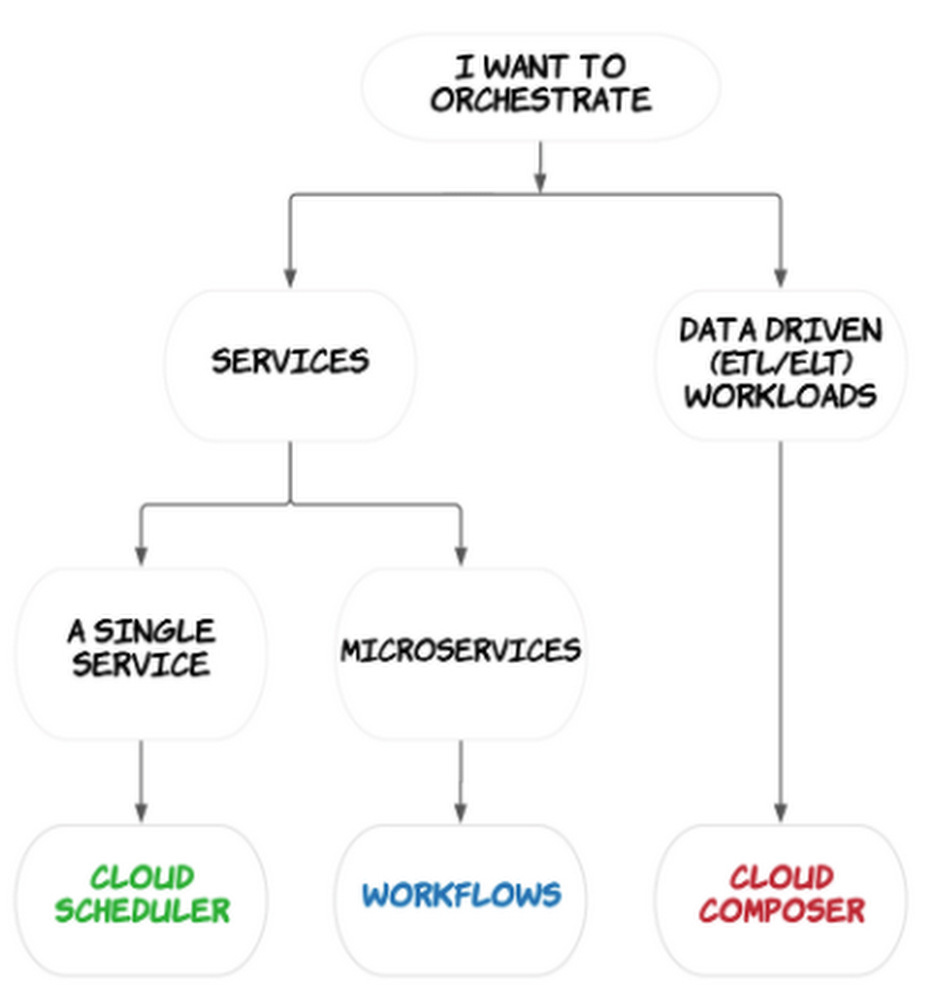
What is orchestration? Orchestration often refers to the automated configuration, coordination, and management of computer systems and services. In the context of service-oriented architectures, orchestration can range from simply executing a single service at a specific time and day, to a more sophisticated approach of automating and monitoring multiple services over longer periods of time, with the ability to react and handle failures as they crop up. In the data engineering context, orchestration is central to coordinating the services and workflows that prepare, ingest, and transform data. It can go beyond data processing and also involve a workflow to train a machine learning (ML) model from the data.There is no shortage of orchestration tools in Google Cloud. In this blog post, we will explore service and data orchestration tools and help you choose what’s best for your use case.Orchestration in Google CloudGoogle Cloud Platform offers a number of tools and services for orchestration:Cloud Scheduler for schedule driven single-service orchestrationWorkflows for complex multi-service orchestration Cloud Composer for orchestration of your data workloadsLet’s take a closer look at each of these tools.Cloud SchedulerCloud Scheduler is a service for scheduling the execution of a single service on a recurring schedule — this is about as simple as it gets for orchestration in Google Cloud.Cloud Scheduler uses cron scheduling to trigger the execution of HTTP-based services at a schedule you define.We often see customers using Scheduler alongside Pub/Sub and Cloud Functions to execute their code serverlessly on Google Cloud.Cloud Scheduler is a good fit if you just need to call a single service at regular intervals. But what if you have multiple services that you want to chain together, feeding the output of one service to the next? Or what if you need to apply complex logic to determine how and when services are invoked?  Then, you should start considering Workflows.WorkflowsWorkflows is a service for orchestrating multiple HTTP-based services into a durable and stateful workflow.Like Cloud Scheduler, Worklows enables you to automate the execution of HTTP-based services running on Cloud Functions and Cloud Run, as well as external services and APIs. Unlike Scheduler, Workflows has sophisticated logic that lets you manage the execution of multiple services as part of a wider workflow. You can use either YAML or JSON to express your workflow. You can specify the order of services as steps and define how to handle step failures. The result of one step can be used as an input to other steps throughout the workflow, or as a condition to determine which step to execute next.Workflows is great for chaining microservices together, automating infrastructure tasks such as starting or stopping a VM, and integrating reliably with external systems. It acts as a central source of truth for service integrations, improving observability and error handling in services. It is also completely serverless, so you don’t have to worry about maintaining resources. To execute a workflow you can manually trigger the workflow (via API or UI) or you can set up a recurring schedule with Cloud Scheduler.Workflows is very useful in service-oriented architectures but if your focus is more on engineering data pipelines or big data processing then you should consider using Composer.Cloud Composer Composer is a service designed to orchestrate data driven (particularly ETL/ELT) workflows and is built on the popular open source Apache Airflow project.Composer is fully managed so you don’t have to worry about installing or maintaining Airflow deployments and it supports your pipelines wherever they are, be that on on-premises or across multiple cloud platforms.Like Workflows, you can create a task for each step in your workflow, configure the order of tasks, and specify which task to execute next based on some conditions.Your tasks are expressed in a Python Directed Acyclic Graph (DAG) that can be scheduled to run at a time of your choice:You would use Composer to orchestrate the services that make up your data pipelines, for example, triggering a job in BigQuery or starting a Dataflow pipeline. Operators can be used to communicate with services across multiple cloud environments and on-prem; there are over 150 operators for Google Cloud alone. For example, by passing a few parameters to operators in your DAG file you can easily execute BigQuery jobs or schedule and start pipelines in Dataflow or Dataproc:Composer or Workflows?Both Composer and Workflows support orchestrating multiple services and can handle long running workflows. Despite there being some overlap in the capabilities of these products, each has differentiators that make them well suited to particular use cases. Composer is most commonly used for orchestrating the transformation of data as part of ELT or data engineering or workflows. Workflows, in contrast, is focused on the orchestration of HTTP-based services built with Cloud Functions, Cloud Run, or external APIs. Composer is designed for orchestrating batch workloads that can handle a delay of a few seconds between task executions. It wouldn’t be suitable if low latency was required in between tasks, whereas Workflows is designed for latency sensitive use cases. While you don’t have to worry about maintaining Airflow deployments in Composer, you do need to specify how many workers you need for a given Composer environment. Workflows is completely serverless; there is no infrastructure to manage or scale.Have a look at these example use cases to help you understand which product to use:SummarySo there you have it, a quick overview of the different orchestration tools in Google Cloud and a decision tree on how to choose the right one for your use case. In the end, the systems and services you’re trying to orchestrate will determine the right tool to use. Coming up in the next blog post, we will deep dive into data orchestration in more detail, so stay tuned! In the meantime, check out our Quickstart guides on Cloud Scheduler, Cloud Composer and Workflows to get started!Related ArticleBetter service orchestration with WorkflowsWorkflows is a service to orchestrate not only Google Cloud services such as Cloud Functions and Cloud Run, but also external services.Read Article
Quelle: Google Cloud Platform