Spaceborne Computer 2: HPE schießt zweiten Weltraumcomputer ins All
Der Spaceborne Computer 2 soll auf der ISS zwei bis drei Jahre Daten sammeln und verarbeiten – auch als Vorbereitung für Mars-Missionen. (HPE, Computer)
Quelle: Golem

Der Spaceborne Computer 2 soll auf der ISS zwei bis drei Jahre Daten sammeln und verarbeiten – auch als Vorbereitung für Mars-Missionen. (HPE, Computer)
Quelle: Golem
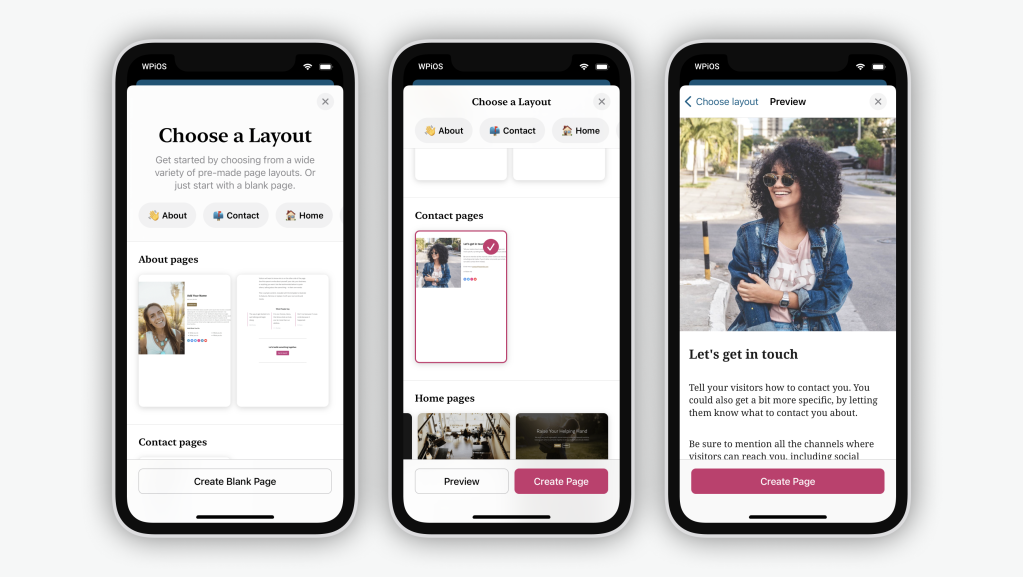
Your WordPress mobile app is a convenient way to create and manage your WordPress site. Now, you can design a new page right from your phone or tablet — and build the site of your dreams — with predesigned page layouts.
Introducing starter page layouts
Not all of us are designers, and building a page on your site with the layout in your mind can be intimidating and time-consuming — but it doesn’t have to be that way! Now when you create a new page on WordPress for iOS or Android, you can choose from premade layouts. You can also customize them to fit your needs, right from the block editor.
Choosing a layout
When you create a new page in the app, you’ll see a list of premade page layouts, including about pages, contact pages, team pages, services pages, and more. Whether you’re the owner of an online shop of sustainably made clothing, the founder of a newly formed digital magazine, or a financial strategist who’s just launched a consulting business, you can use these premade layouts to build the most essential pages on your website.
Once you find a layout that you’d like to try, tap it to select it. After you’ve selected a layout, you can either preview it or create a new page with the chosen layout.
Ready to try these new Starter Page Layouts? Be sure to update your WordPress app to the latest version. If you don’t have the app yet, download it for free, on both Android and iOS.
We’d love to hear your feedback on these new layouts. Reach out to us from within the app by going to My Site, tapping your photo on the top right, tapping Help & Support, and then selecting Contact Support.
Quelle: RedHat Stack
Migrating and modernizing your application and moving to the Cloud can be a really fun and interesting challenge. You can learn a lot through looking at solutions and architectures. But, If anyone tells you that migrating applications is “easy”, you probably stop listening immediately. The tools might be easy to use, but application migration is never instant, never just a clean one-and-done kind of adventure. It can be daunting to even know what tools to try out. We can make it easier for you and help you experiment. Here are my top four Google tips on how to make your migration journey a bit easier that you (probably) didn’t know about.Modern developer experience: Try Anthos without buying Anthos, or anything elseAnthos is Google’s platform to build and manage distributed infrastructure and services. You want a bunch of cloud native services plus GKE? Then you want Anthos. You can run it in a lot of places including other major clouds and on prem, not just on Google Cloud.However, taking on a full Anthos deployment can be daunting and what the heck is it anyway? Sure you can learn about it in our great videos. But wouldn’t you rather just try it? Back in November, in order to help people try out Anthos we announced the Anthos Developer Sandbox. All you need is a Google account. That’s it, you don’t even need a credit card. Bonus you get to try out Cloud Build.You can ask Mike Coleman about this at his upcoming live Getting Started with Anthos event on Feb. 18 from 9-10am PST.Migrate VM-based workloads to Kubernetes: Use Anthos Migrate without buying AnthosAnthos Migrate lets you extract, migrate and modernize your existing applications. Sure you COULD rebuild the whole application, or manually refactor a monolithic application to run in containers. But if you don’t have the time or inclination, or you have a bunch of apps you need to move over, Anthos Migrate helps you do that. What you may not know is that Anthos Migrate is provided free of charge, and can be used to migrate apps to Google Kubernetes Engine as well as to Anthos.If you want to know more about Anthos Migrate, check out these videos we just released:Intro to Anthos MigrateMigrating Linux applications with Migrate for AnthosMigrating Windows applications with Migrate for Anthos Migrate platforms: Use Kf for a Cloud Foundry experience on KubernetesCloud Foundry is a popular open source PaaS platform and has a great developer experience. Migrating developers to a new platform isn’t just about the tech. It’s also about infrastructure and development workflows and practices. It can be really disruptive, particularly if you have application development workflows that really work for you. To address this problem for Cloud Foundry developers we created Kf. You can use Kf in place of many Cloud Foundry cf commands. Platform engineers can migrate the platform to Google Kubernetes Engine and take advantage of all the declarative infrastructure goodness that GKE gives you. All with minimal disruption to developers who love Cloud Foundry.Migrate databases: Database Migration Service makes migration easierMoving to a fully managed database, such as Cloud SQL, can help you reduce maintenance costs and downtime. And, it provides easier integration with our other Cloud Services. Data migration is one of the more complicated aspects of moving applications.We recently released Database Migration Service to preview. Migrating a MySQL database – and soon Postgres and SQL Server – to Cloud SQL is now easier. Check out this form to request access.Preparing a database for migration is an important step, and part of what makes this “easier” and not “easy”. Check out these posts detailing more on how to prepare and to use DMS, and this video introducing the service.Where to go from hereMigrations are never easy, don’t let anyone tell you otherwise. And every new tool takes some evaluation, some testing. Hopefully these tips can help you smooth over some of the rougher steps, make the jump to a new platform easier.For more thoughts, check out the: Getting Started with Anthos event on Feb. 18 from 9-10am PST as a great place to get started, and check out some of the following resources:More events at Cloud OnAirThe GCP PodcastThe Kubernetes Podcast from GoogleAnd of course our YouTube channel
Quelle: Google Cloud Platform
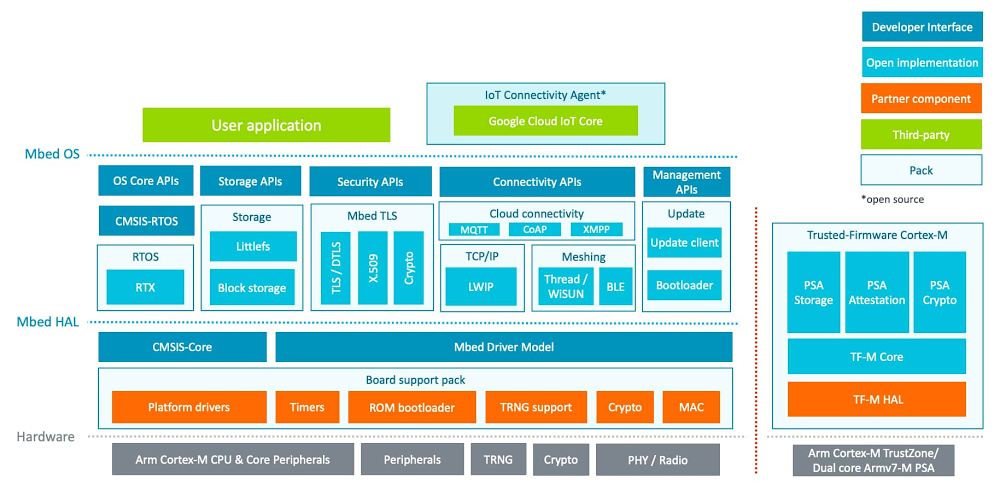
For IoT to be successful and scale, IoT devices need to seamlessly communicate the data they capture to cloud services, where any additional compute capabilities cloud vendors provide can efficiently analyse the data and unlock business value. In this blog, we highlight how Mbed OS and Google Cloud IoT Core together provide developers with quick and easy access to a range of features and services to accelerate their IoT product. Mbed OS: simplifying IoT developmentArm’s key goal for Mbed OS is to simplify the development and deployment of IoT devices for software developers. Mbed OS provides a complete software platform OS for IoT that can be used with a wide array of hardware platforms. Arm has an active ecosystem of sensor vendors who provide software drivers that can easily be integrated with microcontrollers to quickly prototype and develop a fully functioning IoT device. Last year, Mbed OS announced the ability to connect to any public cloud, including Google IoT Cloud, providing developers more choice for building and deploying IoT devices.A seamless development experienceWhilst Arm’s focus has been on the device side of IoT, no IoT solution can add value without accessing and using cloud services to unlock the value of the data captured by the device through the onboard sensors. The integration with Google IoT Cloud enables Mbed OS-based devices to securely connect and ingest data to Google Cloud through Cloud IoT Core. The data received by Cloud IoT Core is seamlessly forwarded to Google Cloud’s data analytics platform that comes with some of the most popular tools such as BigQuery, Dataflow, BigTable, and Looker for developers and data scientists to efficiently analyze, store, and visualize large amounts of data. These services are managed by Google Cloud and will easily scale with the amount of workload. Without needing to manage the infrastructure, development time is saved to focus on solving the problem and creating new solutions that deliver value for users and businesses.Cloud IoT Core’s device management capability also enables control and configuration messages to be pushed to the IoT devices. By centrally controlling the devices with insights from data analytic processes, we can make an IoT solution data-driven and smart.Integration architecture diagramIntelligent IoTIn addition to our collaboration with Arm to simplify their IoT device development, our engineering teams are also optimizing support for developers building AI applications.The combination of Google’s TensorFlow Lite for Microcontrollers (TF-Lµ) and Arm’s open-source CMSIS-NN library help developers achieve accelerated AI performance without having to do any additional work. The TF-Lµ framework is optimised for Arm Cortex-M processors and the Mbed development environment. Arm and TensorFlow team have recently announced improved benchmarks demonstrating a 4.9x performance uplift for a person detection example using TF-Lµ and CMSIS-NN.Read more about the enhanced performance here.In the future, we expect most AI processing to be delivered on-device, making technology more efficient, reliable, and secure. However, cloud connectivity will remain key. Using a predictivemaintenance machine in an industrial setting as an example, the machine learning model on-device will be trained to recognize an anomaly, with cloud connectivity being used to signal when a failure is imminent.AI and IoT have the potential to ignite a new wave of creativity, and the work underway between Arm and Google Cloud will make it easier for developers to innovate the devices of the future.Mbed OS and Google IoT Cloud: Get started Learn about the Cloud IoT Device SDK used in this integration on the github repository.Follow this example integration to quickly configure and connect an Mbed OS-based device to Google services.At the Mbed OS Tech Forum on Feb 10 this integration is discussed in more detail. Watch the episode here.Read about the improved inference on Arm microcontrollers with TensorFlow Lite for Microcontrollers and CMSIS-NN. Learn more about Google Cloud IoT Core.Related ArticleIntroducing the Cloud IoT Device SDK: a new way for embedded IoT devices to connect to Google Cloud IoT CoreThe Cloud IoT Device SDK provides flexible libraries for your embedded devices to connect to Cloud IoT Core.Read Article
Quelle: Google Cloud Platform

We’re excited to announce that our next Community All Hands will be on March 11th, 2021. This quarterly event is a unique opportunity for Docker staff and the broader Docker community to come together for live company updates, product updates, demos, community shout-outs and Q&A. We had more than 1,500 attendees for our last all-hands and we hope to double that this time.
This all-hands will be particularly special because it will coincide with none other than….you guessed it…Docker’s 8th birthday! For this “birthday edition,” we’re going to make the event extra special.
We’ll start by extending the format from 1 hour to 3 hours to pack in more Docker goodness. The main piece of feedback we got from our last all hands was that it was way too short. We had too much content that we tried to squeeze into 60 minutes. This longer format will give us plenty of time to cover everything we need to cover and let presenters catch their breath
Another new feature of this all-hands will be integrated chat and multi-casting made possible by a new innovative video conferencing platform we’ll be using. This will give us the opportunity to present content simultaneously in different virtual rooms and enable attendees to not only tune in to content that’s most relevant to them but also engage more with the presenters and other attendees.
Agenda
We’re still building out the agenda but you can expect the event to unfold as follows:
The first hour will focus on company and product updates with presentations from Docker executive staff, including Scott Johnston (CEO), Justin Cormack (CTO), Donnie Berkholz (VP of Products) and Jean-Laurent de Morlhon (VP of Engineering). The second hour will focus on breakout sessions with live demos and workshops so that attendees can deep dive into particular areas of interest. The final hour will be focused on community, with a Captain-led live show where we’ll be giving fresh updates on programs, initiatives as well as shout-outs to outstanding Docker contributors.
Openness and participation are key pillars of a healthy open source community. We’re constantly exploring ways to better engage the Docker community, and we hope this new format will make this Community All Hands even more awesome. Join us!
Click here to register for the event.
The post Save the Date! Next Docker Community All Hands appeared first on Docker Blog.
Quelle: https://blog.docker.com/feed/

Zwei der drei neuen Mäuse für größere Hände fügt EVGA einen 8-KHz-Sensor hinzu. Die dritte Maus funkt kabellos per 2,4 GHz. (Maus, Eingabegerät)
Quelle: Golem

Forscher haben eine Milliarde Phishing-Mails an Gmail-Nutzer untersucht und herausgefunden, bei welchen persönlichen Faktoren diese erfolgreich sind. (Phishing, Virus)
Quelle: Golem

Microsoft bringt endlich sein klappbares Android-Smartphone Surface Duo nach Deutschland – zu einem wesentlich höheren Preis als in den USA. (Microsoft, Smartphone)
Quelle: Golem

Was am 11. Februar 2021 neben den großen Meldungen sonst noch passiert ist, in aller Kürze. (Kurznews, Browser)
Quelle: Golem

Bei der Umsetzung des Rechts auf schnelles Internet wolle die Bundesregierung die niedrigste Datenrate anbieten, die möglich sei, kritisieren die Grünen. (Breko, Internet)
Quelle: Golem






