Amazon AppFlow speichert jetzt Anmeldeinformationen im AWS Secrets Manager-Konto der Kunden

Amazon AppFlow, ein vollständig verwalteter Integrationsservice, der es Kunden ermöglicht, Daten zwischen AWS Services und Cloud-Anwendungen sicher zu übertragen, speichert jetzt verschlüsselte Anmeldeinformationen, die dazu verwendet werden, sich mit Fluss-Quellen und Zielanwendungen einschließlich OAuth-Tokens, Anwendungen und API-Schlüsseln und Passwörtern im eigenen AWS Secrets Manager-Konto des Kunden zu verbinden. Vorher hat AppFlow diese verschlüsselten Anmeldeinformationen im AWS Secrets Manager-Konto gespeichert, das im Besitz des Amazon AppFlow-Service ist.
Quelle: aws.amazon.com

Softwareanbieter im AWS Marketplace können jetzt das Selbstverwaltungsportal verwenden, um ihre Container-Produkte zu aktualisieren

Heute kündigte AWS Marketplace eine neue und leichtere Self-Service-Erfahrung für unabhängige Softwareanbieter (ISVs) an, um neue Versionen hinzuzufügen und Produktinformationen zu ihren Container-Produkt-Auflistungen zu aktualisieren. AWS Marketplace verbessert konsistent die Art und Weise, auf die Verkäufer ihre Produkte aktualisieren können. Mit dieser Version können ISVs mit Container-Produkten jetzt schnell ihre Auflistung selbst aktualisieren und anpassen. AWS Marketplace hat es für ISVs einfacher gemacht, neue Container-Images und Helm-Diagramme zu veröffentlichen, durch Hosting dedizierter ECR-Repositorys für ihr Produkt.
Quelle: aws.amazon.com

Amazon Machine Image-Kopiegrenzwerte sind auf 100 Images pro Zielregion gestiegen

Amazon EC2 ermöglicht Ihnen jetzt bis zu 100 Amazon Machine Images (AMIs) gleichzeitig pro Zielregion pro Konto zu kopieren. Dies bedeutet einen Anstieg von 50 gleichzeitigen Kopien. Dieser Anstieg trägt zur Senkung der Drosselung von Ausnahmen und Propagierungs-Einschränkungen bei, mit denen man sich konfrontiert sieht, während mehrere AMIs regionsübergreifend gleichzeitig kopiert werden. Sie können CopyImage API verwenden, um eine AMI aus einer Region in eine andere zu kopieren.  
Quelle: aws.amazon.com

Expanding our global footprint with new cloud regions

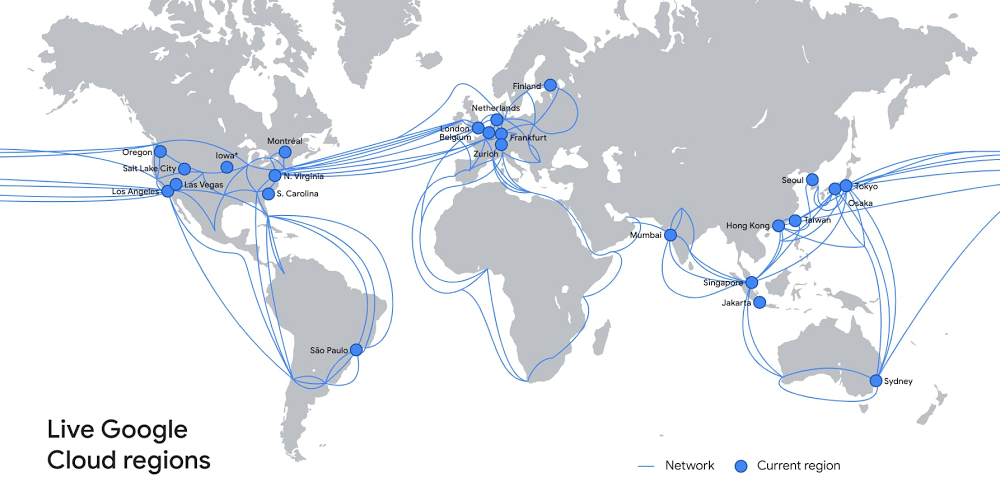
Our global network of Google Cloud Platform (GCP) regions underpins all of the important work we do for our customers. With 24 regions and 73 zones in 17 countries, Google Cloud delivers high-performance, low-latency cloud services to our customers no matter where they are around the globe. Google Cloud regions are designed and dedicated to providing enterprise services and products for Google Cloud Platform customers. (Separately, for information about our data centers that support Google’s consumer services please visit this page). Our Cloud regions provide faster service in a given location so organizations can deliver their products and services more reliably and at higher speeds.In 2020, we launched four new cloud regions—Jakarta (Indonesia), Las Vegas (U.S.), Salt Lake City (U.S.), and Seoul (South Korea)—and announced more to come, including Doha (Qatar), Madrid (Spain), Milan (Italy), and Paris (France). Google Cloud customers around the world, like Carrefour Spain, Lufthansa Group, Nokia, and Procter & Gamble depend on us to drive operational efficiencies, reduce IT costs, and accelerate their digital transformations in order to better serve end consumers. A growing number of Google Cloud regions puts our trusted infrastructure everywhere our customers are today and need to be tomorrow. “Our focus is on our customers,” says Jose Antonio Santana, CIO at Carrefour Spain. “We want to meet them wherever they are. Google Cloud has given us the flexibility to adapt our infrastructure and the agility to make changes very quickly. We’ve been able to adopt and standardize industry best practices across the whole company and provide the highest possible service to our customers.”“Google Cloud is a strategic partner as we optimize our operations performance to better serve our customers around the world,” says Henning Krüger, VP Ops Suite at Lufthansa Group. “We’re digitizing our operations atop Google Cloud’s global infrastructure, and we’re using their machine learning capabilities to combine previously disparate systems and data feeds into one unified platform.”“Nokia is accelerating its digital ambitions by modernizing and migrating all its on-premises data centers and servers across multiple countries on to Google Cloud,” says Ravi Parmasad, VP Global IT Infrastructure at Nokia. “The scale, breadth, reliability, and security of Google Cloud’s growing platform ensures we can fundamentally change how we operate and do business; and drive meaningful operational efficiencies and cost savings in a long-term, sustainable way.”“P&G has a long history of innovation, and today, we’re delivering more personalized experiences to consumers than ever before, thanks to the help of partners like Google Cloud,” said Vittorio Cretella, CIO at Procter & Gamble. “We’re implementing agility at scale, and Google Cloud’s continued commitment to scale and grow its global platform is an important enabler of these efforts.”Our expanding Google Cloud region roadmapToday, we’re excited to announce the expansion of our global network with new cloud regions in Chile, Germany and Saudi Arabia. When launched, each region will have three zones to protect against service disruptions, and include a portfolio of key Google Cloud products, while offering lower latency to nearby users and a more robust global network of regions for multinational enterprises. ChileIn South America, Chilean businesses both large and small are accelerating their cloud adoption and transforming their businesses to bring new products and services to customers. Companies like Red Salud, one of the leading networks of private healthcare providers in Chile, have migrated their infrastructure to the cloud to increase the resilience and flexibility of their services as demand continues to evolve and grow.“The announcement of a new Google Cloud region in Chile is welcome news to those of us in the healthcare space, where providers need quick access to complete information in order to make informed decisions about patient care,” says Daniel de la Maza, Manager of Systems and Technology at Red Salud. “With this new cloud region, we will be physically closer to the resources that Google Cloud has to offer, and we will be able to access cloud technology in a faster and more complete way, which will help us strengthen our mission: to bring high quality, accessible care to our patients.” GermanyIn Germany, this second cloud region will complement our existing region in Frankfurt, expanding our ability to meet growing demand for cloud services in the country. With this additional region, customers like Deutsche Börse, one of the world’s leading exchange organizations, and German wholesaler METRO, can continue to scale their businesses atop our world-class cloud infrastructure. “Adopting public cloud as part of our strategic focus on new technologies helps us to improve agility, drive efficiency, and gain access to cutting-edge analytics and AI tools,” says Michael Girg, Chief Cloud Officer at Deutsche Börse Group. “As one of the largest market infrastructure providers, Deutsche Börse Group stands for innovative and stable solutions, which are essential for creating trust in today’s and tomorrow’s markets. Google Cloud impressed us with its technical capabilities, robust security posture, and partner mindset. A second Google Cloud region in Germany will provide even more capacity and technical runway to scale our business.”“METRO is leading a digital transformation in the wholesale travel industry not only through our own move to the cloud, but also by making digital solutions available to our customers,” says Timo Salzsieder, Chief Solution Officer and Chief Information Officer at METRO AG. “We’ve increased the stability of our ecommerce platform and reduced infrastructure costs with Google Cloud, and the new Google Cloud region in Germany will help us serve our millions of customers across 34 countries with even greater reliability.”Saudi ArabiaIn 2018, we announced a memorandum of understanding (MoU) with Aramco to jointly explore establishing cloud services in the region. Building on that MoU, we concluded an agreement in December 2020 and Google Cloud will now deploy and operate a Cloud region in Saudi Arabia, while a local strategic reseller, sponsored by Aramco, will offer cloud services to customers, with a particular focus on businesses in the Kingdom.  This new Cloud region will enable Google Cloud customers to confidently grow and scale their offerings in this market and support companies like Noon and Snap, Inc. as they deliver their products and services to consumers. “In order to deliver a positive user experience, it is important to put our infrastructure as close as possible to our customers,” says Karl D’Adamo, Senior Director for Infrastructure at Snap, Inc. “Google Cloud’s continuing expansion into additional regions will enable us to better serve our hundreds of millions of customers around the world, no matter where they may be.” “We chose Google Cloud because of the scalability and resilience of its products and infrastructure,” says Hisham Zarka, CTO and Managing Director at Noon. “With the new Google Cloud region in the Kingdom of Saudi Arabia, we will be able to securely deliver services to our nearby customers at higher speeds and with greater flexibility.”Our second region in Germany, first in Saudi Arabia, and first in Chile will join our current network of 24 regions, shown here, along with nine other forthcoming regions worldwide.The cleanest cloud in the industryWe do all of this while operating the cleanest cloud in the industry, matching 100 percent of the electricity we use with renewable energy. This commitment to sustainability enables our customers to meet their own cloud computing needs with zero net carbon emissions. You can learn more about our global infrastructure, including new and upcoming regions, here.
Quelle: Google Cloud Platform

Multicloud analytics powers queries in life sciences, agritech and more

In the 2020 Gartner Cloud End-User Buying Behavior survey, nearly 80% of respondents who cited use of public, hybrid or multi-cloud indicated that they worked with more than one cloud provider1.Multi-cloud has become a reality for most, and in order to outperform their competition, organizations need to empower their people to access and analyze data, regardless of where it is stored. At Google, we are committed to delivering the best multi-cloud analytics solution that breaks down data silos and allows people to run analytics at scale and with ease. We believe this commitment has been called out in the new Gartner 2020 Magic Quadrant for Cloud Database Management Systems, where Google was recognized as a Leader2.If you, too, need to enable your people to analyze data across Google Cloud, AWS and Azure (coming soon) on a secure and fully managed platform, take a look at BigQuery Omni.BigQuery natively decouples compute and storage so organizations can grow elastically and run their analytics at scale. With BigQuery Omni, we are extending this decoupled approach to move the compute resources to the data, making it easier for every user to get the insights they need right within the familiar BigQuery interface. We are thrilled with the incredible demand we have seen since we announced BigQuery Omni earlier this year.  Customers have adopted BigQuery Omni to solve their unique business problems and this blog highlights a few use cases we’re seeing. This set of use cases should help guide you on your journey towards adopting a modern, multi-cloud analytics solution. Let’s walk through three of them:Biomedical data analytics use case:  Many life science companies are looking to deliver a consistent analytics experience for their customers and internal stakeholders. Because biomedical data typically resides as large datasets that are distributed across clouds, getting holistic insights from a single pane of glass is difficult. With BigQuery Omni, The Broad Institute of MIT and Harvard is able to analyze biomedical data stored in repositories across major public clouds right from within the familiar BigQuery interface, thus making this data available to enable search and extraction of genomic variants. Previously, running the same kind of analytics required ongoing data extraction and loading processes that created a growing technical burden. With BigQuery Omni, The Broad Institute has been able to reduce egress  costs, while improving the quality of their research. Agritech use case: Data wrangling continues to be a big bottleneck for agriculture technology organizations that are looking to become data-driven. One such organization aims to reduce the amount of time and money spent by their data analysts, scientists, and engineers on data wrangling activities. Their R&D datasets, stored in AWS, describe the key characteristics of their plant breeding pipeline and their plant biotechnology testing operations. All of their critical datasets reside in Google BigQuery. With BigQuery Omni, this customer plans to enable secure, SQL-based access to their data living across both clouds, and help improve data discoverability for richer insights. They will be able to develop agricultural and market-focused analytical models within BigQuery’s single, cohesive interface for their data consumers, irrespective of the cloud platform where the dataset resides. Log analytics use case: Many organizations are looking for ways to tap into their logs data and unlock hidden insights. One media and entertainment company has their user activity log data in AWS and their user profile information in Google Cloud. Their goal was to better predict media content demand by analyzing user journeys and their content consumption patterns. Because each of their AWS and Google Cloud datasets were updated constantly, they were challenged with aggregating all the information while still maintaining data freshness. With BigQuery Omni, the customer has been able to dynamically combine their log data from AWS and Google Cloud  without needing to move or copy entire datasets from one cloud to another, thus reducing the effort of writing custom scripts to query data stored in another cloud.A similar example that blends well with this use case is the challenge of aggregating billing data across multiple clouds. One public sector company has been testing multiple ways to create a single, convenient view of all their billing data across Google Cloud, AWS and Azure in real time. With BigQuery Omni, they aim to break down their data silos with minimum effort and cost and run their analytics from a single pane of glass.To get started with  BigQuery Omni and simplify your journey toward multi-cloud analytics, sign up here.  BigQuery Omni is currently in preview for AWS and Azure is coming soon.Gartner does not endorse any vendor, product or service depicted in its research publications, and does not advise technology users to select only those vendors with the highest ratings or other designation. Gartner research publications consist of the opinions of Gartner’s Research & Advisory organization and should not be construed as statements of fact. Gartner disclaims all warranties, expressed or implied, with respect to this research, including any warranties of merchantability or fitness for a particular purpose1. Gartner, “2021 Planning Guide for Data Management”, Sanjeev Mohan, Joe Maguire, October 9, 2020.2. Gartner, “Magic Quadrant for Cloud Database Management Systems”, Donald Feinberg, Merv Adrian, Rick Greenwald, Henry Cook, Adam Ronthal, November 23, 2020Related ArticleBringing multi-cloud analytics to your data with BigQuery OmniBigQuery Omni, powered by Anthos, lets you analyze data in Google Cloud, as well as AWS and Azure (coming soon). It’s multi-cloud data an…Read Article
Quelle: Google Cloud Platform