Airpods-Konkurrenz: Bluetooth-Hörstöpsel von Oneplus können ausfallen
Es wird derzeit ein Hardware-Defekt an den Bluetooth-Hörstöpseln vermutet. Die Oneplus Buds werden weiter verkauft. (Bluetooth-Hörstöpsel, Oneplus)
Quelle: Golem

Es wird derzeit ein Hardware-Defekt an den Bluetooth-Hörstöpseln vermutet. Die Oneplus Buds werden weiter verkauft. (Bluetooth-Hörstöpsel, Oneplus)
Quelle: Golem

Bundesinnenminister Seehofer lehnt ein Verbot von Huawei wie in Großbritannien ab. In Deutschland habe man nun ein gutes, ausgewogenes Ergebnis zur technischen Prüfung. (5G, Huawei)
Quelle: Golem

Dank Resizable BAR Support bekommen AMDs Big-Navi-Grafikkarten auch mit Intels Comet-Lake-Prozessoren einen Performance-Schub. (AMD Navi, AMD)
Quelle: Golem
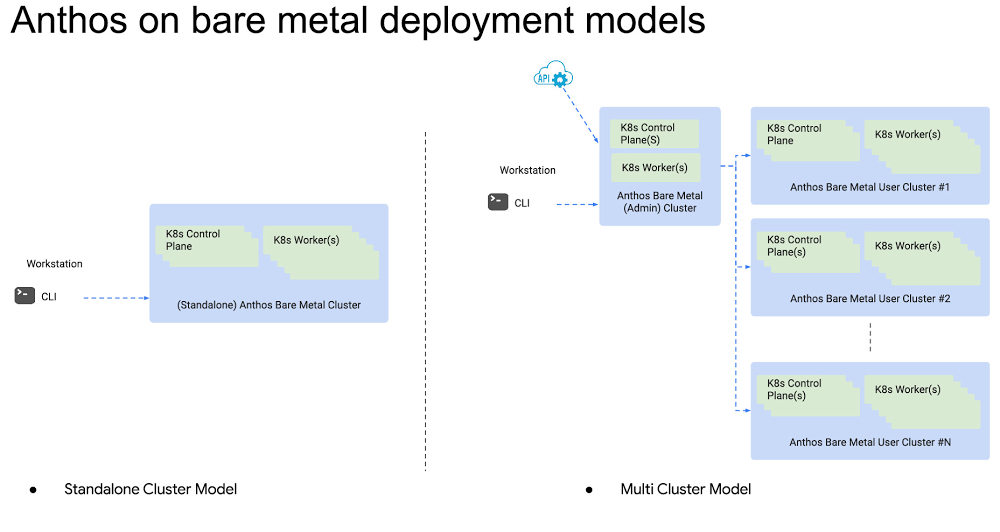
Enterprise IT organizations want it all, don’t they? Choice and freedom in their technology choices, but also automation, security, scale, and support. From the beginning, Anthos has been about putting you back in charge of how you consume the cloud (private or public), while imparting some of the best practices we’ve learned from running a global cloud at scale. With Anthos on bare metal, now generally available, we’ve gone a step further. Anthos on bare metal opens up new possibilities for how you run your workloads, and where. Some of you want to run Anthos on your existing virtualized infrastructure, but others want to eliminate the dependency on a hypervisor layer, to modernize applications while reducing costs. For example, you may consider migrating VM-based apps to containers, and you might decide to run them at the edge on resource-constrained hardware. Anthos on bare metal is generally available today, with subscription or pay-as-you-go pricing. Let’s dive into the specifics of Anthos on bare metal and also share technical details for how to get started. Leverage your existing investmentsAnthos on bare metal allows you to leverage existing investments in hardware, OS and networking infrastructure. The minimal system requirement to run Anthos on bare metal at the edge is two nodes with a minimum of 4 cores, and 32 GB RAM, and 128GB of disk space with no specialized hardware. The setup allows you to run Anthos on bare metal on most any infrastructure.Anthos on bare metal uses a “bring your own operating system” model. It runs atop physical or virtual instances, and supports Red Hat Enterprise Linux 8.1/8.2, CentOS 8.1/8.2, or Ubuntu 18.04/20.04 LTS. Anthos provides overlay networking and L4/L7 load balancing out of the box. You can also integrate with your own load balancer such as F5 and Citrix. For storage, you can deploy persistent workloads using CSI integration with your existing infrastructure.You can deploy Anthos on bare metal using one of the following deployment models:A standalone model allows you to manage every cluster independently. This is a good choice when running in an edge location or if you want your clusters to be administered independently from on another. A multi-cluster model allows a central IT team to manage a fleet of clusters from a centralized cluster, called the admin cluster. This is more suitable if you want to build automation, tooling or to delegate the lifecycle of clusters to individual teams without sharing sensitive credentials such as SSH keys or Google Cloud service account details.Click to enlargeLike with all Anthos environments, a bare metal cluster has a thin, secure connection back to Google Cloud called Connect. Once it’s installed in your clusters, you can centrally view, configure, and monitor your clusters from the Google Cloud Console. We’ve been working on Anthos on bare metal with early-access customers and design partners, and their feedback has been overwhelmingly positive. For example, VideoAmp offers a video measurement and optimization platform, and uses Anthos on bare metal to help reduce the operational overhead of managing clusters while also maximizing the utilization of their cloud infrastructure. “Here at VideoAmp, we run real-time compute-intensive applications, which enable advertisers to optimize their entire portfolio of linear TV, OTT and digital video to business outcomes. Kubernetes is a critical part of our strategy because of the scalability, portability, and flexibility it provides our developers,” says Hector Sahagun, Director of Engineering at VideoAmp. ”Anthos brings centralized lifecycle and policy management tools, allowing our infrastructure teams to focus on key initiatives instead of the day-to-day management of Kubernetes.” Expanding the Anthos Ready Partner Program We’re launching Anthos on bare metal with our partners in the Anthos Ready Partner Initiative. The program highlights partner solutions that adhere to Google Cloud’s interoperability requirements and meet the infrastructure and application development needs of enterprise customers running Anthos. These solutions are validated to work across Anthos deployment options including: Anthos on Google Cloud, Anthos on VMware, and Anthos on bare metal.Atos, Dell Technologies, Equinix Metal, HPE, Intel, NetApp, Nutanix, NVIDIA, and other partners have committed to delivering Anthos on bare metal for their customers’ infrastructure requirements. In addition, our storage partners including Dell Technologies, HPE, NetApp, Portworx, Pure Storage, and Robin.io are providing shared storage solutions by qualifying their respective CSI drivers for Anthos on bare metal.Finally, system integrators including Arctiq, Atos, IGNW, SADA, SoftServe, and World Wide Technology can help you get started with Anthos on bare metal with services and solutions to integrate Anthos on bare metal in your environment. More workloads from more places, with more ease No matter where you run your workloads—in Google Cloud, on-prem, in other clouds or at the edge—Anthos provides a consistent platform on which your teams can quickly build great applications that adapt to an ever-changing world. We developed Anthos to help all organizations to tackle multi-cloud, taking advantage of modern cloud-native technologies like containers, serverless, service mesh, and consistent policy management; both in the cloud or on-premises. Now, with the option of running Anthos on bare metal, there are even more ways to enjoy the benefits of this modern cloud application stack. To learn more about Anthos on bare metal, check out this video, from which you’ll learn how to create a cluster and how to deploy your own application on an on-prem cluster. Then, if you’re interested in seeing how Anthos on bare metal can help your organization get hybrid cloud right, reach out to our sales team to schedule an architecture design session.Related ArticleIntroducing the Anthos Developer Sandbox—free with a Google accountThe new Anthos Developer Sandbox spins up all the tools you need to learn how to develop for the Anthos platform.Read Article
Quelle: Google Cloud Platform
Google Cloud is a leader when it comes to data, and in the past few years, we’ve made leaps and bounds to help our customers level up their enterprise databases and analytics capabilities. Our data platform is a primary reason why the largest enterprises in the world like The Home Depot, HSBC, and UPS run their mission-critical applications on Google Cloud. We’ve also seen momentum in the analyst community, with Gartner, Forrester, and IDC validating our leadership in analyst evaluations across data analytics, databases, and AI. Our fully managed database and analytics services continue to power enterprise digital transformation as the always-on, hyperconnected world drives migrations to the cloud. Google was built to organize the world’s information and make it universally accessible and useful. To deliver on this vision, we process and analyze the world’s largest data sets on the cleanest and most reliable cloud infrastructure. We have leveraged this expertise to deliver a new kind of enterprise-ready data cloud to our customers that is simple, intelligent, and open. It offers built-in automation to ensure your data-first business is operating at its best, with the simplicity to build whatever is next. Let’s dive into five reasons why we lead in the data cloud space.1. Leading analyst firms agree that Google Cloud’s database and analytics are proven and enterprise-ready for any size data team. Today, our customers process and analyze up to petabytes of data on the world’s most advanced and scalable data platform. Customers of every size and maturity are able to seamlessly grow from small prototypes to global success. Cloud Spanner leads the relational world with its unique pairing of a relational operational database with non-relational scale. Cloud Bigtable unlocks high-throughput, low-latency applications and supports customers with millions of queries per second. Google Cloud delivers industry-leading reliability across regions, so you’re always up and running to support your mission-critical applications. Google has some of the highest SLAs in the industry. Spanner includes up to a 99.999% SLA and BigQuery recently announced a 99.99% SLA. When it comes to performance, third-party analyst firms recognize that Google Cloud is a leader when it comes to high-performance and scalable data management for analytics. To bring this all together, you need robust security and governance controls to protect customer’s data. Our customer’s data is encrypted by default, and identity and access management across our solutions are provided by Cloud Identity and Access Management (Cloud IAM). 2. Google Cloud is one of the fastest-growing cloudsin the world across industries.We’re seeing growth across customer segments and industry verticals. BigQuery is widely perceived as the leading solution for analytics and data warehousing; Looker, with its multi-cloud universal semantic layer, gets people to insights from data quickly; and our database services, like Spanner and Cloud SQL, power the most mission-critical applications while redefining the bounds of scale, availability, and performance. Our document database, Cloud Firestore, even has the most satisfied developers compared to any other cloud databases on the market, according to a recent study by SlashData. Over the past year we’ve seen Cloud SQL’s popularity grow—it’s now one of Google Cloud’s fastest-growing top services. With the release of Database Migration Service, we’re now making it even easier for enterprises to move to Cloud SQL from on-premises or other clouds without disrupting their business. Our leadership in the data realm is a primary reason organizations like HSBC, Major League Baseball, Mayo Clinic, and Sharechat choose Google to run their data-driven applications. And that’s also why IDC named our data platform a leader in their 2020 MarketScape report on APeJ Cloud Data Analytics Platform Vendors.3. Google Cloud’s databases and analytics operate with an open philosophy, which includes open source software and databases, open APIs, open data formats, and an inclusive partner ecosystem. Customers can choose from a wide range of operational and analytical engines, open source tools, and machine learning services. Cloud SQL provides a managed service for the world’s most popular open source databases, MySQL and PostgreSQL, so customers can benefit from the latest community enhancements paired with enterprise-grade availability, security, and performance. And open APIs ease migrations, portability, and data access through your preferred tools. In addition, our open platform enables out-of-the-box interoperability between a variety of services for ingestion, storage, processing and analytics—including Apache Spark, Presto and more. And with our rich partner ecosystem and integrations with core Google services (such as Google Analytics), you can quickly and seamlessly integrate with the data sources and technologies you and your team know and love. We are committed to partner and customer success. Our open, partner-friendly platform not only helps our customers scale their data and analytics needs, but helps our partners like Elastic, Confluent, and MongoDB scale their cloud go-to-market. 4. Google makes it easy for enterprises to solve their biggest data-driven problems with packaged horizontal and vertical analytics solutions, embedded with market-leading AI. Packaged, priced, and supported by partners, solutions range from improving contact center operations and document processing to targeted industry solutions for healthcare, retail, manufacturing and industrial, financial services, and media and entertainment. As companies look to expand their business across new channels and deliver real-time experiences, Firestore helps accelerate mobile, web, and IoT application development. Firestore enables developers to quickly build reliable, real-time applications at scale that can handle the changing demands of today’s business. For companies that want to build their own analytics solutions and ask questions of their data, we’ve made it easier for anyone within the organization—from the business user to the data scientist—to get insights from data with BigQuery ML, Dataproc Hub, Connected Sheets, and Data QnA. “With Connected Sheets, we’re not really pulling the data into the spreadsheet; rather it lives in the database where it belongs,” says Peter Van Nieuwerburgh, Global Change Manager at PwC. “The ability to go and so easily analyze and visualize the data is really powerful.”5. We’re the only hyperscale cloud provider that’s executed on a multi-cloud vision. Google Cloud’s commitment to multi-cloud enables customers to use their data where and how they want. Customers can build or modernize their apps anywhere and deliver new app features faster, enabling success in this rapidly changing environment. Industry analysts have recognized Google Cloud as one of the only hyperscale cloud vendors to deliver on the promise of multi-cloud. In addition to facilitating customer innovation with our dedication to open standards, Google Cloud ensures customers can choose the right cloud vendor or environment for each of their workloads, removing over-dependence on one IT vendor. Customers can run apps wherever they want and get the management and support that comes with Google Cloud, creating opportunities for developers to rapidly build and innovate in any environment, including on-premises. With solutions like Anthos, customers can run cloud offerings in a hybrid environment using containers. This architecture also runs in a multi-cloud environment and today runs on AWS. Moving up the stack, Dataproc on Kubernetes allows enterprises to build containerized Spark machine learning and data processing jobs that can be deployed anywhere. Additionally, BigQuery Omni allows you to analyze data in AWS using standard SQL, and without leaving the familiar BigQuery interface. We’re just getting startedGoogle is a leader when it comes to data. By building a data infrastructure that powers Google products used by billions of people, such as Search, Maps, Ads, and YouTube, we have stress-tested our systems, services, and expertise. We have used this expertise to deliver a new kind of data cloud to every enterprise, with fully managed automations to ensure your data-first business is operating at the highest level and the simplicity to build whatever is next. We will continue to help our customers spend less time on management and more time on building. That means continuing to deliver a data cloud that creates an integrated experience across multi-cloud and hybrid environments for your enterprise data and analytics needs. Stay tuned for more to come, and get started today with our free trial offering. Gartner, Magic Quadrant for Cloud Database Management Systems, November 23, 2020, Donald Feinberg, Adam Ronthal, Merv Adrian, Henry Cook, Rick GreenwaldGartner does not endorse any vendor, product or service depicted in its research publications and does not advise technology users to select only those vendors with the highest ratings or other designation. Gartner research publications consist of the opinions of Gartner’s research organization and should not be construed as statements of fact. Gartner disclaims all warranties, expressed or implied, with respect to this research, including any warranties of merchantability or fitness for a particular purpose.
Quelle: Google Cloud Platform
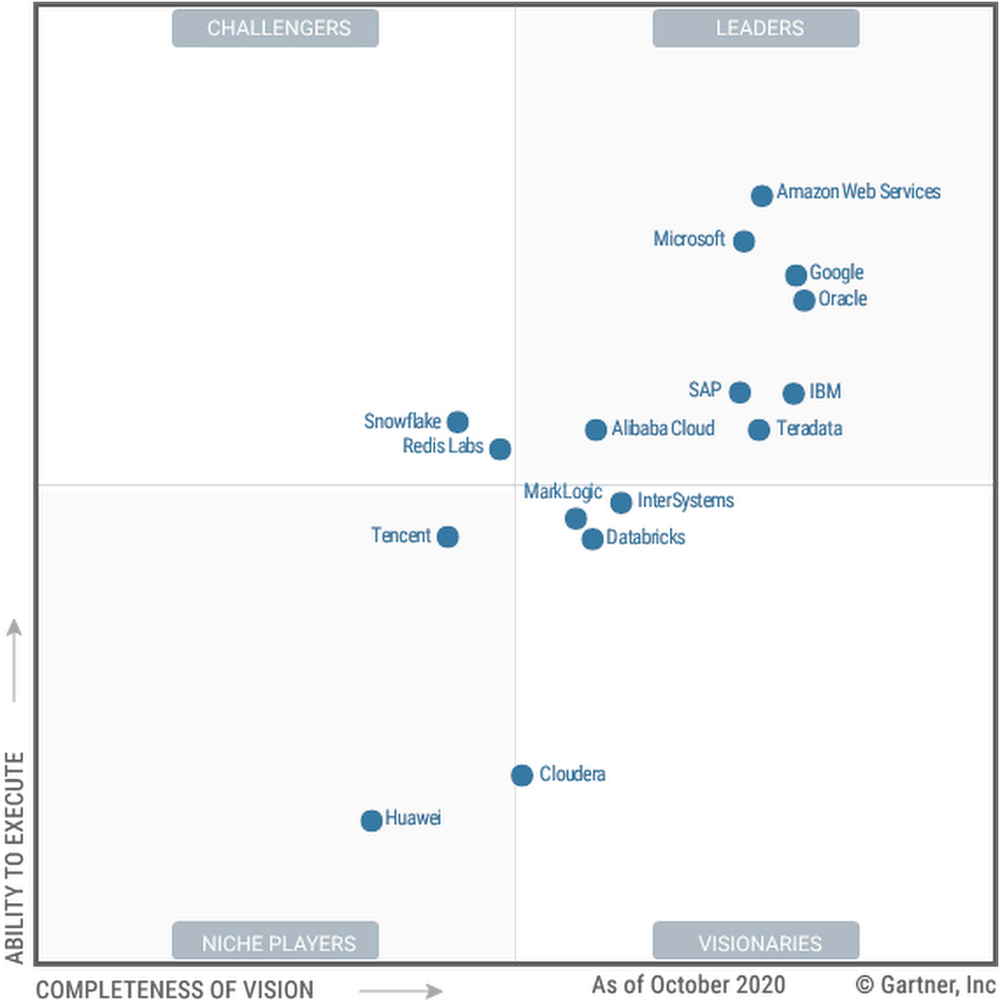
We’re announcing today that Google has been named a Leader in the first-ever Gartner Magic Quadrant for Cloud Database Management Systems (DBMS), 2020. We believe this recognition is due to Google Cloud’s data analytics and databases vision and strategy, and is echoed by the growth in customers across all industries and geographies selecting Google Cloud as their data platform of choice. Gartner has positioned Google as a Magic Quadrant Leader among the furthest three positioned vendors on the completeness-of-vision axis. We are delivering on our multi-cloud and hybrid promise, showcasing adoption across a diverse customer base in every region and industry, setting the new standard for flexible pricing with strong financial governance capabilities, and partnering across a diverse ecosystem. We’re making our vision a reality and are proud of the work we’re doing as the first hyperscale provider to offer a multi-cloud data warehouse with BigQuery Omni. In addition, we offer the industry’s most flexible pricing with Committed Use Discounts across Cloud SQL engines; instant insights for your entire business with Data QnA; and even better reliability and development experience with Cloud Spanner, just to name a few.In today’s world, it’s clear that you have to consider a comprehensive end-to-end ecosystem of data analytics and database services to get full value from your data. So it doesn’t make sense to evaluate analytic and operational use cases in isolation. Per our understanding, as the operational and analytic markets for database management systems (DBMSs) have converged, Gartner has converged its evaluations into a single DBMS Magic Quadrant, with vendors and products that provide support for both classes of use cases. Having been a Leader in both of the previous Magic Quadrants, we’re very supportive of this move, since it aligns to the way our enterprise customers buy, deploy, and consume our services. Moving the focus to customer innovation, not infrastructureEnterprises like Procter & Gamble, Vodafone, and Sharechat have trusted Google Cloud to help them build and scale their products faster while improving digital customer experiences using our fully managed data platform. “We’re always looking to ensure a great consumer experience across all our categories, from healthcare to beauty products and much more,” says Vittorio Cretella, CIO, Procter & Gamble. “As a leader in analytics and AI, Google Cloud is a strategic partner helping us offer our consumers superior products and services that provide value in a secure and transparent way.”We are honored to be a Leader in the 2020 Gartner Magic Quadrant for Cloud Database Management Systems (DBMS), and look forward to continuing to innovate and partner with you on your digital transformation journey. Download the full 2020 Gartner Magic Quadrant for Cloud Database Management Systems report. You can get started for free with Google Cloud today. Gartner, Magic Quadrant for Cloud Database Management Systems, November 23, 2020, Donald Feinberg, Adam Ronthal, Merv Adrian, Henry Cook, Rick GreenwaldThis graphic was published by Gartner, Inc. as part of a larger research document and should be evaluated in the context of the entire document. The Gartner document is available upon request from Google Cloud.Gartner does not endorse any vendor, product or service depicted in its research publications and does not advise technology users to select only those vendors with the highest ratings or other designation. Gartner research publications consist of the opinions of Gartner’s research organization and should not be construed as statements of fact. Gartner disclaims all warranties, expressed or implied, with respect to this research, including any warranties of merchantability or fitness for a particular purpose.Related ArticleBringing databases to the center of a modern businessDatabase migration is at the heart of a modern business transformation strategy. See how a phased approach can bring the cloud to your da…Read Article
Quelle: Google Cloud Platform

Nach Betrugsvorwürfen gegen den Autobauer Nikola ist eine angekündigte Kooperation mit General Motors geplatzt. Was bleibt, ist ein wesentlich kleineres Abkommen. (Elektroauto, Wissenschaft)
Quelle: Golem

Die versprochenen Dienst-Notebooks für Lehrkräfte aus dem mit 500 Millionen Euro ausgestatteten Zusatzprogramm der Schulenförderung kommen später. (Schulen, Notebook)
Quelle: Golem

In Immortals tauchen wir in die Mini-Antike ein. Leider schickt uns das Offene-Welt-Actionspiel von Ubisoft zu oft in den Untergrund. Ein Test von Peter Steinlechner (Immortals Fenyx Rising, Spieletest)
Quelle: Golem

Die Bundesregierung will vorerst keine automatische Gesichtserkennung gesetzlich erlauben. Stattdessen erhält die Bundespolizei andere Befugnisse. (Gesichtserkennung, Datenschutz)
Quelle: Golem






