Prozessoren: Chinesische Chiphersteller werben von TSMC und anderen ab
Etwa 100 Spezialisten werden künftig in chinesischen Konzernen arbeiten. Diese werden mit viel Regierungskapital unterstützt. (TSMC, Prozessor)
Quelle: Golem

Etwa 100 Spezialisten werden künftig in chinesischen Konzernen arbeiten. Diese werden mit viel Regierungskapital unterstützt. (TSMC, Prozessor)
Quelle: Golem

Der Nettogewinn der Telekom fiel um rund 20 Prozent auf 754 Millionen Euro. Doch der Umsatz legte stark zu. (Quartalsbericht, Telekom)
Quelle: Golem

Ausgerechnet mit Gesichtserkennung will Am I in Porn gegen Rachepornos vorgehen und mehr Privatsphäre schaffen. Die Technik dafür dürfte rechtswidrig sein. Eine Recherche von Moritz Tremmel (Gesichtserkennung, Datenschutz)
Quelle: Golem

Wer sein Parkticket mit der App Park Now kauft, kann künftig auf einer Karte schauen, wie die Parkplatzsituation am Zielort ist. (Auto, Android)
Quelle: Golem
loft.sh – We’re proud to announce that loft is the first cloud-native technology that ships a stable implementation for virtualized Kubernetes clusters. With loft v0.3, users are now able to create virtual Kub…
Quelle: news.kubernauts.io

I am very inspired by creative podcasts. Entertaining guests and the unscripted nature of the conversations make me feel like I am right there, chatting about world affairs or the deep societal transformations of the connected age. I decided to start my own show with a group of friends — loosely about blogging, but delving into all sorts of things.
It took three hours, with a total cost of $5/month, including our own domain name. In this post, I’ll share my journey of launching a brand-new podcast on WordPress.com, and later promoting it on iTunes and Spotify.
Why start a podcast?
Podcasting has been hailed as “the new blogging.” According to Edison Research, 51% of Americans have listened to a podcast, and hosts have created over one million podcasts on iTunes Podcasts.
Starting a podcast comes with a lot of perks:
You can connect with your audience on a much deeper level, thanks to your voice and the unscripted nature of the conversation.It’s a fantastic excuse to reach out and meet interesting people.Podcasting pairs really well with other projects — blogging, writing, or even a corporate ”day job.”
A group of Polish bloggers and I had been dreaming of a foray into podcasting for a while. We created the Placebo podcast in hopes of meeting interesting people and, frankly, having fun.
The tagline in Polish reads: “Your dose of absolutely nothing. Confirmed clinical efficacy.”
How does it all work?
You may have listened to a podcast on iTunes, Spotify, or another app — but did you know the content you’re enjoying doesn’t originate there? The beating heart of every podcast is its RSS feed. It is a particular format for content that services like iTunes or Spotify can process and display in the appropriate apps — iTunes, Alexa devices, and other services.
When you upload an audio file to your blog (for example, an .mp3) and hit publish, the new post (including the file) shows up in your RSS feed. From there, iTunes, Spotify, Pocket Casts, or another podcast app downloads the file to play it to your listeners.
WordPress.com also has built-in podcasting tools to make that job easier. To upload audio files, you’ll need a paid plan — any plan, including the Personal plan at $5/month, will do.
What do you need to start?
The name
The name of your podcast helps listeners find you in their favorite podcasting app. With Placebo, our main concern was making it memorable; our secondary goal, humor. (Which is related — funny is memorable!) We came up with “Placebo — a podcast with a confirmed clinical efficacy.”
Other memorable name examples include therapist Esther Perrell’s podcast, Where Should We Begin, Matt Mullenweg’s podcast about remote work, Distributed, and Joe Rogan’s The Joe Rogan Experience. If you are still stuck, try out our recently launched business name generator to help you brainstorm.
Recording
We didn’t want to get expensive gear. It’s better to start simple with the equipment you already have. The Placebo podcast is recorded over Zoom, with video-call headsets. I recommend recording at least three episodes, so when you publish, your listeners will have a better taste of your style.
The Distributed podcast has a great walkthrough of the various recording options you can try.
Cover art
In addition to your name, there are other ways to stand out from all the other podcasts and voices: strong cover art and a succinct, solid summary. (You can add all three on WordPress.com in My Sites → Settings → Writing → Podcasting.)
The cover art should be easy to recognize. Since our podcast is named Placebo, we decided on a satirical medical vibe. We found a nice graphic, and after a few tweaks, tada!
Placebo podcast cover image
Pro tip: Cover art should be 1400×1400 px, so be sure to use an image that’s big enough.
The summary
When writing your summary on iTunes, you must distill the description of your podcast content to 250 characters or less. For Placebo, we wanted to give listeners a taste and encourage them to give us a try:
Placebo is a podcast with confirmed clinical efficacy. Artur, Agnes, and Michael chat about building your online home, technology, culture, business ideas, and being the best citizen of the Internet you can be. More on placebo.pro
We also included the link to our site, where listeners can learn more.
Here is where you upload your cover art and summary on WordPress.com
Light audio editing
Some podcasts (like Distributed) are edited to equalize audio levels or condense the episode. We opted to publish the raw audio — I only attach the pre-recorded intro music in GarageBand. I delve into details of audio editing on my blog Deliberate Internet.
Before I upload a new episode to iTunes Podcasts, I add relevant ID3 tags in the iTunes player (where you edit rather than publish). ID3 tags are used by the iPhone Podcasts app to display your cover image. Import each one of your recorded files in iTunes player and select “Information.” There, you can tweak the image, category, and title of the audio file.
After you edit the information in iTunes player, or wherever you are editing your podcast, upload your cover art and click “OK”; your episode will appear in the iTunes Player Podcast library on your computer. You can find this file in your Home Directory → Music → iTunes → Podcasts.
Your audio files are now ready for distribution! That’s where WordPress.com comes in.
Uploading to WordPress.com
Create a separate WordPress.com post for each episode of your podcast. This gives you a unique link to share with your audience, a way for them to listen to your episode without the app, and a place to add extra notes and links.
To publish a podcast post:
Create a new post. Add any extra notes or info you want to share with the podcast.Add the Audio block and upload your podcast file.Give the post the Podcast category.Publish the post.
This guide on the WordPress.com Support Site has more details.
Time to go live
You have your domain and a site for your podcast. You’ve recorded and uploaded a few episodes. Now it’s time to share your podcast with the world!
Your podcast is available on your WordPress.com site, but the majority of people consume podcasts through an app — iTunes podcasts, Spotify, Google Play, etc. Fortunately, they all work by checking your RSS feed. Once you submit your RSS feed to those services, new episodes will appear there automatically.
Spotify
Copy the RSS URL from the WordPress.com podcasting settings pageGo to Podcasters SpotifySubmit your RSS feedWait two to three days for your podcast to appear
iTunes
Copy the RSS URL from the WordPress.com podcasting settings pageGo to Podcasts ConnectSubmit your RSS feedWait about a week for them to review and approve your podcast
When the podcast is reviewed, approved, and appears in the Spotify and iTunes libraries, add those links to your site. That way, you can promote your nifty WordPress.com custom domain, and visitors can choose their preferred podcast consuming technology. We put these buttons right up at the top:
You can download these buttons here:
Apple Podcasts badgeSpotify badge
The lucky number seven
Recording new podcast episodes are plenty of fun, but can sometimes feel like work. Podcasts with seven or more episodes are likely to continue growing. The Placebo podcast crew has pledged to record at least eight.
And don’t forget to enjoy it! The conversations with interesting guests are why we do it.
I’ve published the full version of “How to Start a Podcast” on my personal website. There, I’ve expanded on my process to record episodes over Zoom, and how I later edited them in GarageBand. Dive deeper if you’re interested!
Cover Photo by The Teens Network Daytime Show Studios on Pexels.com
Quelle: RedHat Stack
Calling all data practitioners: It’s week 5 of Google Cloud Next ‘20: OnAir, and this week we’re covering all things data analytics. This covers the full spectrum of data workflows in Google Cloud, from data ingestion using Dataflow and Pub/Sub to BigQuery’s machine learning and geospatial capabilities and data visualization with Looker. And, of course, this week includes a session about BigQuery Omni, which lets you use BigQuery’s capabilities across Google Cloud, Amazon Web Services, and Azure (soon). After checking out the sessions below, if you have questions, join me this Friday, August 14 at 9 AM PST for a developer- and operator-focused live recap and Q&A session. Our APAC team is also hosting a recap Friday, August 14 at 11 AM SGT. Several colleagues will join me to discuss their sessions, data analytics news, and future events to look forward to. Join us live to ask our experts questions or watch it on-demand at any time after it airs. Hope to see you then.We have a lot of great content to share this week, so let’s dig in to a few highlights:Analytics in a multi-cloud world with BigQuery Omni—BigQuery Product Manager Emily Rapp brings BigQuery Omni to life with a demonstration of how it can help multi-cloud users better understand their analytics insights with their data stored across multiple clouds.MLB’s data warehouse modernization—Google Cloud data engineer Ryan McDowell and Robert Goretsky, Major League Baseball’s VP of data engineering, detail the challenges Major League Baseball experienced in their traditional data warehouse, their migration to BigQuery, and the benefits they saw.Building a streaming anomaly detection solution at TELUS using Pub/Sub, Dataflow, and BigQuery ML—Google Cloud solutions architect Masud Hasan and TELUS Lead Architect for Cybersecurity Analytics and Enterprise Data Lake Abdul Rahman Sattar break down the Google Cloud-native architecture TELUS uses to stream and analyze real-time events to detect anomalies that might be a security threat to their customers. Also, this week’s Cloud Study Jam features opportunities for hands-on cloud experience with workshops on BigQuery. These workshops are led by Google Cloud’s experts, and feature opportunities to learn more about BigQuery, as well as an opportunity to chat with some of our training teams. Be sure to check out the entire session catalog for this week for a wide variety of content that drills down into Looker, developing data lakes in Google Cloud, building data pipelines, real-time AI, and more. Google Cloud Next ‘20: OnAir is running through the week of September 8, so be sure to check out the full session catalog and register now.
Quelle: Google Cloud Platform
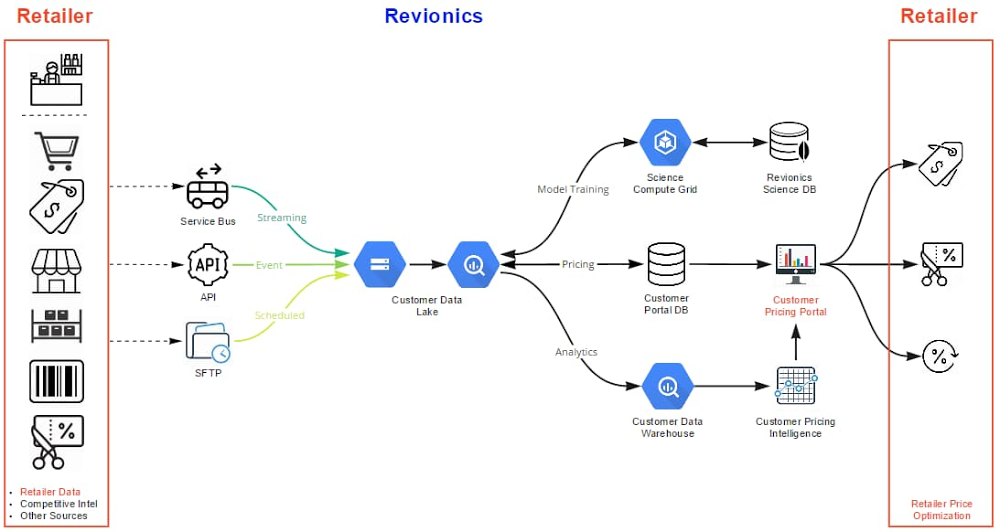
Editor’s note: Today we’re hearing from Revionics, a lifecycle pricing platform that gives retailers the confidence to ask the “what ifs” and “why nots” that result in profitable pricing strategies. In this blog, the Revionics team shares their cloud data warehouse migration journey and the lessons learned along the way. At Revionics, we’ve been in the data analytics business for nearly two decades, serving retail customers who wanted to leverage their data to drive their pricing strategies. At the company’s founding in 2002, our advanced AI models were probably the most complex in commercial use. Out of necessity, Revionics built the advanced technology infrastructure to handle the data volume and processing for our AI models. Fast forward to today, and cloud infrastructure has finally caught up. The state of current cloud computing infrastructure has opened up new avenues of data exploration for our teams and customers.Researching cloud optionsFrom the beginning, we didn’t just want to solve known problems. We wanted to improve our overall infrastructure to become more nimble to support our customers’ needs, today and in the future. Just like our AI models help retailers focus on what is possible, we need infrastructure that enables our data scientists to create that vision.We had been using on-premises Teradata appliances, and the parallelism and performance had worked well for us. But appliances have hardware and software restrictions that made it hard for us to share data and seamlessly scale. They’re not elastic, and couldn’t offer us the space we needed. We had maxed out the physical storage capacity of the appliances themselves, and we were rapidly approaching the time where we would need to renew the hardware to upgrade and expand performance and capacity. The space required for processing resulted in access constraints to the latest analytical results, impacting decision making based on current information. Replacing appliances with newer ones couldn’t alone solve our elasticity and data access problems, so we started exploring cloud options. In addition, many of our tech-savvy customers have in-house data analytics experts, and we wanted to offer them plug-and-play capabilities on our data warehouse infrastructure. That way, they could dig into their data and respond to market shifts accordingly. Once we learned more about current cloud options, we could visualize many ways to drive our business forward. For example, the elasticity and amount of storage available could let us really accelerate our product development and overall customer success.Cloud migration decisionsPartnering with Google Cloud, we adopted BigQuery. For each client, we built a data lake and a complete structured data warehouse, so every client’s data is isolated and securely accessible to meet client queries. The scale that BigQuery brought became essential when the COVID-19 pandemic wrought huge, overnight changes for our retail clients, who needed to meet unexpected demand while keeping their employees and customers safe. We were able to rapidly update our AI pricing models with our customers’ most current data and give them clarity to make the right pricing decisions. We migrated Teradata SQL to BigQuery SQL, which facilitated a fast migration. Converting Teradata DDL to BigQuery DDL was straightforward—we encountered a few challenges in our view queries due to differences in SQL, but this also gave us an opportunity to learn about how BigQuery works. We’re a lean company, so we needed to move data efficiently without a lot of manual work required. Our DevOps team helped us build tools so we could create script templates for different projects and customer datasets. For us, it was faster to redeploy our own tools than learn new tools. We had a lot of practical conversations discussing our options, and ultimately we did what was least disruptive to our customers and provided the greatest continuity for operational management, while leveraging select services available in Google Cloud.Revionics puts customers first in all that we do. Ensuring they were not impacted during the migration was a top priority, and we worked with our customers closely throughout the process. We migrated following retail’s busiest season, and we carefully performed our due diligence to internally sync and enable our customer go-live in January 2020. Google Cloud helped support our no-downtime migration and ensure business continuity.Google Cloud helped support our no-downtime migration and ensure business continuity.Migration learnings and lessonsMigrating our reports to run on BigQuery required some planning. We primarily did a lift-and-shift migration to minimize the total changes involved; all we had to do was point our existing metadata model to BigQuery. We made adjustments to some data types where necessary, but most of the reports did not need to be updated. However, some queries generate differently in BigQuery, so we took the opportunity to improve the design and performance of selected reports. As an example, our reports sit on views in a separate dataset, and we were able to simply move logic upstream, leveraging a few of the unique capabilities of BigQuery to improve runtime performance.Click to enlargeFor a successful migration, it helps to establish standards and adopt production tools early. We migrated chunks of the data model at a time, allowing us to test and improve through the project. We also took immediate advantage of several BigQuery database capabilities, such as implementing partitioning and clustering. For us, it was the right move and enabled a fast transition. Now, our next step is how to improve our data model. There are changes we can make under the covers that are impactful, such as views and the interface between BigQuery and our reporting platform. Composer and Airflow both came in handy for our data load process. We built extract pipelines to move data from our SQL Servers to Cloud Storage to load into BigQuery, all executed through Composer. We also take full advantage of built-in monitoring and logging tools (formerly known as Stackdriver). On the other side of migrationToday, the infrastructure we’ve created with Google Cloud has helped address the immediate needs we had, and provides the foundation for Revionics to solve new and interesting problems. We’re opening new doors, and Google Cloud has helped improve how we operate our infrastructure, forecast growth, and manage costs. Data access: For example, moving data to construct new analytics had at times been a slow, unwieldy process that could require days of copying and processing. Now, all of a client’s data is securely co-located in BigQuery, enabling immediate access to data for customer-specific analysis without impacting production operations in any way. Data processing happens in seconds and minutes rather than hours and days, whereas to analyze any one customer’s data before our cloud migration, end users often encountered roadblocks to move data off the SQL Server instance. Now, they don’t have to move data at all.Security: We’d been used to focusing on security, at times sacrificing usability out of necessity. With Google Cloud, we use Google’s built-in encryption at rest and in transit without any impact to usability, and with zero configuration requirements or management needed. We’ve improved our security footprint, lowered our management overhead, and improved performance significantly. Additionally, BigQuery makes it simple to triage issues, and we’ve gained significant efficiency in the way we find and solve any issues. The time spent triaging customer questions has been reduced dramatically. Seeing the business impactWhen we first started almost twenty years ago, retailers would set prices for all their products once a year. As retailers adopted our AI-based pricing models, Revionics introduced the ability to automatically model prices every week, and optimize on demand. We have now set the foundation to enable even more advanced modeling and optimization techniques, and are able to model at a deeper and more granular level than ever before, for orders of magnitude greater data volumes, all while improving our processing times. With this new functionality, we will enable retailers to update prices at the speed of their business, providing the ability to test “what ifs” and run pricing scenarios in minutes. Our data scientists can access so much more data than they could before, at speed, and perform data modeling at the transactional level. We’re able to create models now that we’ve been wanting to create for years that are broad and go deeper into the details. This capability is a pillar for Revionics and has helped speed up our product development and unleashed our data scientists. For our customers, this means that we can continually stay ahead of the complexity of modern retail environments, and this new scalability means we can respond to them immediately and help them adapt quickly. Earlier tools didn’t allow many of our teams to self-serve their analytics needs, but with access to BigQuery, they’re able to do analytics work on their own. From a support angle, that’s been beneficial. Custom reporting requests that used to take hours now are available immediately and securely for the end user through BigQuery. Combined, this has opened up exciting new roadmap possibilities. We’re looking at improving how we give our customers access to their data, exploring new and intriguing visualizations, all while leveraging the built-in global access and security, giving us a lot of capabilities and potential products. When it comes to the cloud, there’s a lot to learn. If you’re just getting started, we recommend that you master what you can and don’t try to learn everything all at once. To help, allow your teams to explore, then identify the most critical functional and non-functional requirements and stay focused on those to prevent scope creep and help drive success in your own cloud adoption journey.Learn more about Revionics. Thanks for additional contributions from Clinton Pilgrim and Kausik Kannan.
Quelle: Google Cloud Platform

We’ve heard from customers about how important it is to be able to reliably operate your applications and infrastructure running on Google Cloud. In particular, observability is critical to reliable operations. To help you quickly gain insight into your Google Cloud environment, we’ve added 21 new features to Cloud Operations, the observability suite we launched earlier this year, which gives you access to all our operations capabilities directly from the Google Cloud Console. The new features we’re discussing today make it easier for you to get the observability you need from your environment, whether it’s in Google Cloud, other clouds, on-premises or a mix.Perhaps more importantly, Cloud Operations is built on top of infrastructure with breathtaking scale—and we pass the resulting performance on to you. Two of Cloud Operations’ central services, Cloud Monitoring and Cloud Logging, are built on core observability platforms used by all of Google that handle over 16 million metrics queries per second, 2.5 exabytes of logs per month, and over 14 quadrillion metric points on disk. That’s a lot of data! To get to this scale, we developed the culture and practices that go into building, launching and running production applications with high velocity and reliability. The practice of Site Reliability Engineering (SRE) is core to this, and an integral part of product planning. In addition to offering the power of this massive platform to Google Cloud customers, we’ve been picking relevant capabilities from the SRE approach that we believe will simplify customer experiences, and building them into Cloud Ops products, broken down according to the five steps of the process for adding observability in your environment—plan, collect, store, configure and troubleshoot. Let’s take a closer look.PlanBefore you start building your operational workflow, it’s a best practice to outline your services and how you want each to perform, defining Service Level Objectives, (SLOs). That leads us to our first new feature:1. The general availability of SLO Monitoring Now, focusing on your SLOs is easier than ever. SLO Monitoring gives you the ability to focus on signals and improve the signal-to-noise ratio. This, along with out-of-the-box alerts, reduces the levels of expertise required to monitor production environments, and makes it easier to identify and remediate issues before they impact critical business metrics.In just two weeks since making it generally available, we’ve had hundreds of new users for SLO Monitoring, and gotten some great feedback about how it can simplify your monitoring practices.“SLOs measure how the user feels about your product—that is what truly matters,”said Vipul Makar, SRE Lead & Enterprise Architect, Equifax.”With SLO Monitoring we make data-driven decisions and build more reliable products. Once we learned how to use SLOs we never looked back!”To learn more about SLOs and using custom metrics to create SLOs, join us at these Google Cloud Next ’20: OnAir sessions: OPS200 – Kubernetes Engine Infrastructure and Service Monitoring with Equifax and OPS102 – Best Practices for Custom Metric Telemetry on Google Cloud.CollectCollecting logs and metrics is easy when you leverage out-of-the-box observability for Google Cloud system logs and metrics. You can add application and third-party logs and metrics from wherever they are generated: OpenTelemetry / OpenCensus, captured by Google Cloud monitoring and logging agents, or submitted directly through Cloud Operations APIs. Today, we’re expanding the types of logs that you can use in Logging in two important ways:2. G Suite audit logs – The integration betweenG Suite audit logs and Cloud Logging is now generally available, adding to the dozens of Google Cloud services already providing audit logs out of the box.3. Multi-cloud and on premise – We’ve partnered with Blue Medora to provide agents for collecting logs and metrics from anywhere — now generally available at no additional cost.We’ve also made it even easier to capture metrics and logs from your Compute Engine VMs:4. You can now install, run, and manage the Cloud Logging and Monitoring agents across groups of Compute Engine instances or your entire fleet with a single command.To learn more about collecting logs and metrics, join us at OPS102 – Best Practices for Custom Metric Telemetry on Google Cloud and OPS203 – OpenTelemetry and Observability at Shopify, Splunk, and Google.StoreBeing able to store and protect your data in Cloud Logging and Monitoring is critical to your observability strategy. That’s why we’ve been working hard to launch new features to help you meet your security and privacy requirements.Cloud Logging makes it easy to search and analyze logs as well as provides a central, secure, compliant, and scalable log storage solution. Today we’re announcing a number of improvements to log storage and management building on several recent improvements for exploring and analyzing logs. Here’s a selection of what’s new:5.Logs buckets (Beta) – Centralize or subdivide your logs based on your needs for ownership, retention, and region. 6. Logs views (Preview) – Gain better control over who has access to your logs data.7. Regionalized log storage (Preview) – Configure your log buckets in five separate cloud regions, with more to come.8. Improved log routing (Preview) – Route logs from one project to another or even using an aggregated log sink at the folder or organization level to centralize logs into a logs bucket.9. Customizable retention (Generally Available) – In addition to announcing that custom retention is generally available, allowing you to retain your logs data for anywhere from one day to 10 years, you can now use custom retention through the end of March 2021 for no additional cost. This means you can try out our log management capabilities for your long-term compliance and analytics needs for logs without a cost commitment. Regionalized logs buckets and logs views are now in private preview but coming to beta in September 2020. Some examples of our new functionality that preview users have enjoyed include centralizing all audit logs from across your organization, splitting out logs from a multitenant GKE cluster into multiple projects, or setting up regionalized log storage. Sign up for access or to be notified of future releases of the preview of logs views and regionalized storage.Then, there’s your ability to write and retain custom and Prometheus metrics, which can be critical to the observability of your applications and services. To help ensure that you have these metrics when you need them:10. Extended Retention for Custom and Prometheus metrics – they are now retained for 24 months rather than 6 weeks, at no additional cost.11. 10 second resolution for Agent, Custom, and Prometheus metrics – you can write metrics at 10 second granularity for agent, custom and Prometheus metrics. You can use these higher resolution metrics to track rapidly changing environments, applications, services, and infrastructure.To learn more about our new log management capabilities, join us at OPS100 – Designing for Observability on Google Cloud.ConfigureOur Cloud Operations suite offers several ways for you to customize your environment to meet your business and reliability goals: dashboards, alerting policies, logs-based metrics, uptime checks and SLOs. We’ve got a range of new improvements to help you both automate your configuration and get started quickly with new out of the box dashboards.12. Monitoring Dashboards API – Building out your dashboards at scale is easier than ever with our new Dashboards API, which allows you to manage your monitoring as code. 13. Out of the box dashboards – The only thing better than easy-to-build dashboards are dashboards that are already built for you. We’ve added a range of new out-of-the-box dashboards including a Cloud Logging dashboard and a newly refreshed dashboard for Compute Engine that shows cross-fleet metrics.14. Pub/Sub alerting notifications – In addition to visualizing your system, you’ll want to use alerting for reliability and automation to reduce toil with the new Pub/Sub integration for alerting in Cloud Monitoring.15. Monitoring Query Language (generally available) – The new Monitoring Query Language allows you to manipulate time series to create useful charts, for example plot ratios between different metrics or current vs. past metrics, define arithmetic expressions over time-series values, or create new aggregations. To learn more about alerting and dashboarding with Cloud Operations, join us at OPS208 – Alerting Best Practices for Google Cloud Monitoring and OPS302 – Monitoring as Code.TroubleshootNow that you’ve got everything set up, you’re ready to troubleshoot issues in production. We’ve added six new features to the Cloud Logging to help you find issues fast.16. Our new logs viewer is now generally available (GA) and boasts a variety of new features for analyzing logs data, and now supports viewing your logs at the folder or org level in your GCP organization.17. We’ve added histograms to the new logs viewer to help you spot patterns in your logs over time.18. We’ve added the logs field explorer to the new logs viewer which helps you rapidly refine queries and spot interesting distributions across your data.19. Saved and recent searches in the new logs viewer to help you get to your most valuable logs more quickly. 20. Integration with traces now provides in-context insight about latency and makes it easy to find all logs that include a specific trace. 21. Our logging query language also got a major upgrade with support for regular expressions. To learn more about troubleshooting with Cloud Operations, join us at OPS201 – Creating a Better Developer Experience with Google Cloud’s Operations Suite of Products and OPS301 – Analyzing Distributed Traces to Find Performance Bottlenecks.For an overview of the new functionality and how it can be used with GKE, check out this short video:Get started with Cloud OperationsWith a Google-scale foundation, and an aggressive roadmap of new features and functionality, you can rely on the observability tools in Cloud Operations to help you manage, monitor and troubleshoot your most mission-critical applications. To learn more about Cloud Operations, register for and join us at these NEXT’20 OnAir sessions:OPS100 – Designing for Observability on Google CloudOPS200 – Kubernetes Engine Infrastructure and Service Monitoring with EquifaxOPS213 – Cloud Operations Spotlight
Quelle: Google Cloud Platform
The economic challenges posed by the global health pandemic continue to affect every organization around the world. During this difficult time, cost optimization has become an especially critical topic. Recently, we provided an overview of how to approach cost optimization on Microsoft Azure, which laid out three focus areas to help you get the most value out of your Azure investment: understanding and forecasting your costs, optimizing your workload costs, and controlling your costs.
Today, we’ll dive more deeply into the second focus area—how you can optimize your Azure workloads costs—and show you how guidance in the Microsoft Azure Well-Architected Framework, tools like Azure Advisor, and offers like the Azure Hybrid Benefit and Azure Reservations can help you operate more efficiently on Azure and save.
Design workloads for cost optimization using best practices from the Azure Well-Architected Framework
The Azure Well-Architected Framework is designed to help you build and deploy cloud workloads with confidence, using actionable and simple to use deep technical content, assessments, and reference architectures based on proven industry best practices. You can assess workloads against the five pillars of the Azure Well-Architected Framework cloud design—cost optimization, reliability, security, performance efficiency, and operational excellence—to help you focus on the right activities and to ensure you optimize workloads and proactively meet business needs.
The cost optimization section of the Azure Well-Architected Framework is all about managing costs to get the most value out of your Azure workloads and covers:
Cost management principles, a series of important considerations that can help you achieve both business objectives and cost justification.
Cost best practices for design, provisioning, monitoring, and optimization.
Trade-offs between cost and other pillars like reliability and performance.
A great way to get started with the Azure Well-Architected Framework is by taking the Azure Well-Architected Review. This review examines your workload against the best practices defined by the pillars of reliability, cost optimization, operational excellence, security, and performance efficiency. You can choose to take the review for any or all of the pillars, so you can start by focusing on cost optimization, if you prefer.
Optimize your Azure resources with best practice recommendations from Azure Advisor
Your workloads are composed of resources, so configuring your resources according to the latest Azure best practices is critical to ensuring your workloads are cost optimized. Azure Advisor is a free service that helps you optimize your already-deployed Azure resources for cost, security, performance, reliability, and operational excellence. Advisor is aligned with the Azure Well-Architected Framework, but is targeted at the resource level instead of the workload level. Advisor’s recommendations are personalized to your Azure environment based on your resource telemetry and configurations.
Examples of Advisor cost recommendations include rightsizing underutilized or shutting down unused resources, buying reserved instances to save over pay-as-you-go costs, and using storage lifecycle management. Our full list of Advisor cost recommendations is available.
Advisor offers several features to make it faster and easier to optimize your resources. Quick Fix enables one-click bulk remediation of recommendations, so you can multi-select resources you’d like to remediate. Click Quick Fix, and Advisor takes care of the rest. You can configure Advisor to display only the recommendations that mean the most to you, such as those for your production subscriptions and resource groups. Advisor alerts notify you when you have new recommendations, and Advisor recommendation digests remind you about available recommendations you haven’t remediated yet.
Visit the Advisor documentation to learn more and get started remediating your cost recommendations.
Save big on Azure by leveraging your existing on-premises licensing investment with the Azure Hybrid Benefit
The Azure Hybrid Benefit is a licensing benefit that lets you bring your Windows Server and SQL Server on-premises licenses with Software Assurance or subscriptions to Azure and save up to 85 percent compared to standard pay as-you-go rates,1 so you only pay for the compute costs on Azure. You can apply these savings across Azure SQL and Azure Dedicated Host.
License mobility benefits offered by Azure include the ability to bring your Windows Server and SQL Server licenses to the cloud, leverage SQL Server licensing in Infrastructure as a Service (IaaS) and Platform as a Service (PaaS) environments, and gain additional licensing benefits, including 180-day dual use rights of your licenses, both on-premises and in Azure. For your heavily-virtualized workloads, you get four vCPUs of Azure SQL Database or Azure SQL Managed Instance for each core of SQL Server Enterprise.
These unique advantages plus additional benefits such as, free fail-over servers licensing for SQL Server disaster recovery and free extended security updates, make Azure the best-in-class cloud for Windows Server and SQL Server.
Check out the Azure Hybrid Benefit Documentation for more technical tutorials and resources.
Reserve upfront and pay less with Azure Reservations
Receive a discount on your Azure services by purchasing Azure Reservations, which is a one-year or three-year commitment to specific Azure services. Giving us visibility into your one-year or three-year resource needs in advance allows us to be more efficient. In return, we pass these savings onto you as discounts of up to 72 percent.2 When you buy a reservation, you immediately receive a discount and are no longer charged at pay-as-you-go rates. This offer is ideal for Azure services that use significant capacity or run for long periods of time in a consistent way.
Reservation discounts apply to the following eligible subscriptions and offer types:
Enterprise agreements (offer numbers: MS-AZR-0017P or MS-AZR-0148P).
Microsoft Customer Agreement subscriptions.
Individual plans with pay-as-you-go rates (offer numbers: MS-AZR-0003P or MS-AZR-0023P).
Cloud Solution Provider (CSP) subscriptions.
Learn more
Learn more about how to lower your upfront cash outflow with various monthly payment options at no additional cost in the reservations documentation.
You could achieve the lowest cost of ownership when you combine the Azure Hybrid Benefit, reservation pricing, and extended security updates. Cost optimize your Azure workloads today with these Azure cost saving options.
Check back soon for more cloud cost optimization guidance or visit our Azure cost optimization page to learn more.
1The 85 percent savings is based on 8-Core D13 v2 VM in East US 2 region. Savings are calculated from full price (license included) for SQL Server Enterprise edition VM against reduced rate (applying Azure Hybrid Benefit for SQL Server and Windows Server), which excludes Software Assurance costs for SQL Server and Windows Server, which may vary based on EA agreement or any applicable volume licensing agreement. Actual savings may vary based on region, instance size and compute family. Prices as of June 5, 2018 are subject to change.
2The 72 percent saving is based on one M32ts Azure VM for Windows OS in US Gov Virginia region running for 36 months at a pay-as-you-go rate of ~$3,660.81/month; reduced rate for a 3-year Reserved Instance of ~$663.45/month. Azure pricing as of October 30, 2018 (prices subject to change). Actual savings may vary based on location, instance type, or usage.
Quelle: Azure






