Snapdragon 865 Plus: Qualcomm knackt die 3-GHz-Grenze
So hoch wie der Snapdragon 865 Plus taktet bisher kein Smartphone-SoC. (Snapdragon, Smartphone)
Quelle: Golem

So hoch wie der Snapdragon 865 Plus taktet bisher kein Smartphone-SoC. (Snapdragon, Smartphone)
Quelle: Golem

Updates von Spielen auf die Xbox Series X sollen kostenlos sein – möchte Microsoft. Bislang ist nur ein Spiel bekannt, das nicht mitmacht. (Xbox Series X, Microsoft)
Quelle: Golem

Die Ultrastar DC HC650 mit 20 TByte will Western Digital auch bald ausliefern. (Western Digital, Speichermedien)
Quelle: Golem

Ebenso wie Deutschland verfolgt nun auch die EU eine eigene Wasserstoffstrategie. Diese könnte bis zu 340 Milliarden Euro kosten. (Wasserstoff, GreenIT)
Quelle: Golem
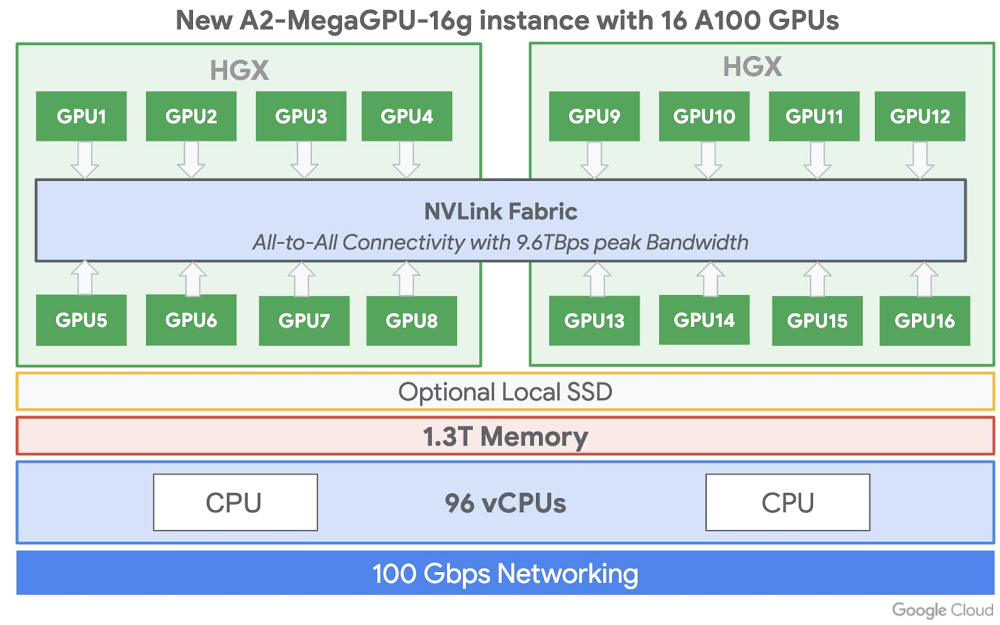
Machine learning and HPC applications can never get too much compute performance at a good price. Today, we’re excited to introduce the Accelerator-Optimized VM (A2) family on Google Compute Engine, based on the NVIDIA Ampere A100 Tensor Core GPU. With up to 16 GPUs in a single VM, A2 VMs are the first A100-based offering in the public cloud, and are available now via our private alpha program, with public availability later this year. Accelerator-Optimized VMs with NVIDIA Ampere A100 GPUs The A2 VM family was designed to meet today’s most demanding applications—workloads like CUDA-enabled machine learning (ML) training and inference, and high performance computing (HPC). Each A100 GPU offers up to 20x the compute performance compared to the previous generation GPU and comes with 40 GB of high-performance HBM2 GPU memory. To speed up multi-GPU workloads, the A2 uses NVIDIA’s HGX A100 systems to offer high-speed NVLink GPU-to-GPU bandwidth that delivers up to 600 GB/s. A2 VMs come with up to 96 Intel Cascade Lake vCPUs, optional Local SSD for workloads requiring faster data feeds into the GPUs and up to 100 Gbps of networking. Additionally, A2 VMs provide full vNUMA transparency into the architecture of underlying GPU server platforms, enabling advanced performance tuning. A whopping 16 GPUs per VMFor some demanding workloads, the bigger the machine, the better. For those, we have the a2-megagpu-16g instance with 16 A100 GPUs, offering a total of 640 GB of GPU memory and providing an effective performance of up to 10 petaflops of FP16 or 20 petaOps of int8 in a single VM when using the new sparsity feature. To maximize performance and support the largest datasets, the instance comes with 1.3 TB of system memory and an all-to-all NVLink topology with aggregate NVLink bandwidth up to 9.6 TB/s. We look forward to seeing how you use this infrastructure for your compute-intensive projects.Compute Engine’s new A2-MegaGPU VM: 16 A100 GPUs with up to 9.6 TB/s NVLINK BandwidthOf course, A2 VMs are available in smaller configurations as well, allowing you to match your application’s needs for GPU compute power. The A2 family of VMs come in two different CPU- and networking-to-GPU ratios, allowing you to match the preprocessing and multi-vm networking performance best suited for your application.Available A2 VM shapesNVIDIA’s new Ampere architecture The new Ampere GPU architecture for our A2 instances features several innovations that are immediately beneficial to many ML and HPC workloads. A100’s new Tensor Float 32 (TF32) format provides 10x speed improvement compared to FP32 performance of the previous generation Volta V100. The A100 also has enhanced 16-bit math capabilities supporting both FP16 and bfloat16 (BF16) at double the rate of TF32. INT8, INT4 and INT1 tensor operations are also supported now making A100 an equally excellent option for inference workloads. Also, the A100’s new Sparse Tensor Core instructions allow skipping the compute on entries with zero values, resulting in a doubling of the Tensor Core compute throughput of int8, FP16, BF16 and TF32. Lastly, the multi-instance group (mig) feature allows each GPU to be partitioned into as many as seven GPU instances, fully isolated from a performance and fault isolation perspective. All together, each A100 will have a lot more performance, increased memory, very flexible precision support, and increased process isolation for running multiple workloads on a single GPU. Getting startedWe want to make it easy for you to start using the A2 VM shapes with A100 GPUs. You can get started quickly on Compute Engine with our Deep Learning VM images, which come preconfigured with everything you need to run high-performance workloads. In addition, A100 support will be coming shortly to Google Kubernetes Engine (GKE), Cloud AI Platform, and other Google Cloud services. To learn more about the A2 VM family and request access to our alpha, either contact your sales team or sign up here. Public availability and pricing information will come later in the year.
Quelle: Google Cloud Platform
Getting the most from cloud technologies means organizations need the right talent with the right combination of skills. However, 86 percent of IT leaders report that the shortage of cloud computing skills will slow down their 2020 cloud projects. To find the cloud skills they need, companies are increasingly turning to industry-recognized certifications: 93 percent of IT decision-makers around the world agree that certified employees provide added value above and beyond the cost of certification. To further measure the impact our portfolio of Google Cloud certifications have on individuals and businesses, we commissioned an independent third-party research organization to conduct a survey of 1,789 recent Google Cloud certified individuals. You can dig deeper into the results of the survey in this report. Here are some of the highlights, which showcase how industry-recognized Google Cloud certifications help individuals validate their cloud expertise, elevate their careers, and transform businesses with Google Cloud technology. Google Cloud certifications help individuals build expert, real-world cloud skills that businesses needTo become Google Cloud certified, you must prove your ability to build strong cloud solutions and your knowledge of business use-cases you’ll encounter day-to-day in a real job. Google Cloud certifications give individuals confidence in their mastery of cloud skills with 87 percent of survey participants more confident about their cloud skills and 83 percent able to prove cloud competency to recruiters. Moreover, 78 percent of respondents were satisfied with how accurately Google Cloud certifications validated their skills for a particular role.Certifications help with promotions, raises, and career changesThe majority of those who pursued a certification did so with the intention to increase opportunities in their current job, which materialized for most. More than 1 in 4 Google Cloud certified individuals took on more responsibilities or leadership roles while almost 1 in 5 received a raise.Furthermore, 30 percent of Google Cloud certified individuals applied for a new role, of which 70 percent received at least one job offer while 42 percent of applicants received two or more job offers. Certified individuals help organizations modernize faster and increase business impact 71 percent of Google Cloud Certified individuals report becoming certified enabled or will enable their employer to get more business, increase work with existing customers, or help scale up their business. If you’re interested in learning more about Google Cloud certifications, register for our free “Why certify?” Cloud Study Jam session at Next ‘20: OnAir on July 15. Ready to start preparing for your certification? Sign up here to receive a six-week learning path designed to help you get ready for the certification most suited to your role.
Quelle: Google Cloud Platform

Data governance is an essential part of managing your cloud infrastructure, particularly if you’re taking advantage of multiple cloud providers. In many industries, you need to show where data has been stored, and how it’s been used, to meet regulations. In addition, using access controls and other data governance tools helps ensure that only those who need to see certain data are able to.Google’s data governance security primitives are built into our data warehousing service BigQuery. For example, fine-grained access controls at the column level—provide the ability to control data by assigning a policy tag based on the nature of the data itself (i.e., personally identifiable information, or PII) and control it across multiple data containers (tables, datasets, and more). Furthermore, with BigQuery table-level ACLs, it’s possible to assign permissions to a table-sized data container. We’re also now partnering with Collibra to offer a cloud-agnostic, source-agnostic data governance solution. Collibra’s technology will directly interface with Google Cloud security primitives, allowing your data governance policies to be natively enforced as direct-column, table-security elements at the storage layer. In addition, this serves as an independent control plane to provide visibility to data outside of Google Cloud. Integrations down to the column level of your dataCollibra is deploying its native SaaS managed service on Google Cloud, to be available within our console by the end of the year. Over the past two years, Google has been bringing more and more of its internal data governance practices to Google Cloud, particularly to data warehousing solution BigQuery. As we introduce additional security primitives, Collibra plans to enable them in the policy provisioning of its own platform for increased data security, governance, and discoverability.Click to enlargeSolving for multi-cloud data governance journeysWith our joint roadmap, you can take advantage of a multi-cloud management plane for data governance, which includes a data acquisition workflow, lineage tracking, and the ability to maintain an enterprise dictionary, as well as access provisioning and enforcement of access through BigQuery. For example, you might request access to a data mart in Collibra’s Data Catalog, identify the relevant data containers in BigQuery, provision secure access to that data mart from BigQuery, then execute high-performing queries with a detailed audit log. You can ensure that data is protected and save time accessing data across multiple clouds.Click to enlargeCustomers including ATB Financial have used Google Cloud and Collibra together to enable users to access a single view of data from anywhere in their organizations. Get more details in this recent session: How Google Cloud is bringing decades of Google’s data governance and security practices to the enterprise. Upcoming virtual events to learn moreAnd, check out this upcoming webinar with our joint customer: How ATB Financial built consistent governance across a hybrid data lake with Google Cloud and Collibra. Finally, join our breakout session at Google Cloud Next ‘20: OnAir, where we’ll explore best practices around data governance.
Quelle: Google Cloud Platform

Die 14-nm-Chips sind Geschichte, doch Intel hat die nächsten Atoms parat. (Atom, Prozessor)
Quelle: Golem

Ein Haus im Funkloch ist noch lange kein Grund, da nicht auch zu arbeiten – oder doch? Die Geschichte eines Selbstversuchs. Eine Kolumne von Sebastian Grüner (Digitalisierung, EDGE)
Quelle: Golem

Im Code der jüngsten iOS-14-Beta finden sich Hinweise darauf, dass Apple Pay Zahlungen über QR-Codes ermöglichen wird. (Apple, iPhone)
Quelle: Golem






