Bringing multi-cloud analytics to your data with BigQuery Omni

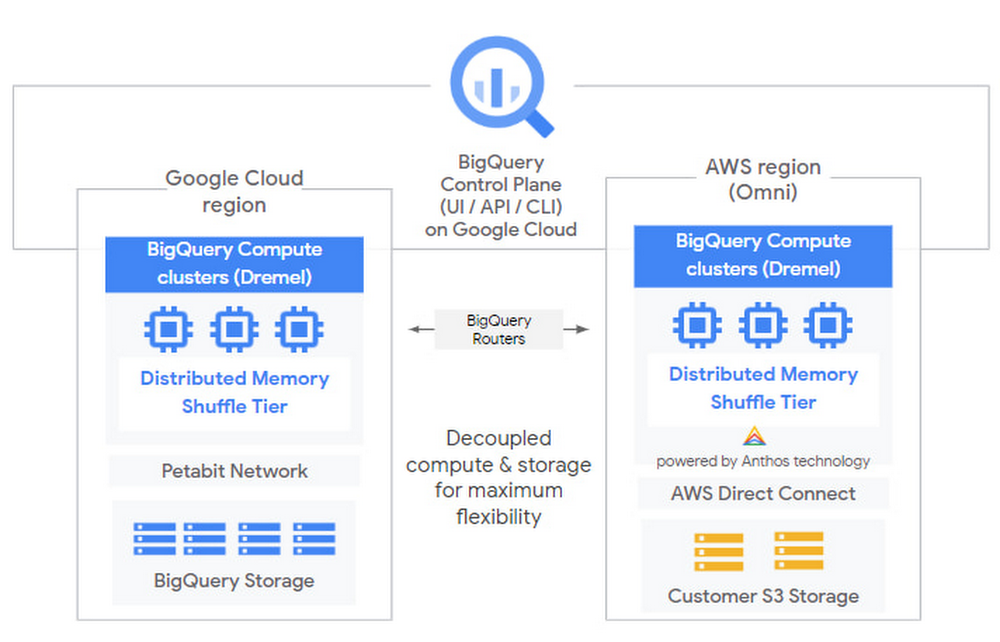
Today, we are introducing BigQuery Omni, a flexible, multi-cloud analytics solution that lets you cost-effectively access and securely analyze data across Google Cloud, Amazon Web Services (AWS), and Azure (coming soon), without leaving the familiar BigQuery user interface (UI). Using standard SQL and the same BigQuery APIs our customers love, you will be able to break down data silos and gain critical business insights from a single pane of glass. And because BigQuery Omni is powered by Anthos, you will be able to query data without having to manage the underlying infrastructure.A recent Gartner research survey on cloud adoption revealed that more than 80% of respondents using the public cloud were using more than one cloud service provider (CSP)1. While data is a critical component of decision making across organizations, for many, this data is scattered across multiple public clouds. BigQuery Omni is an extension of our continued innovation and commitment to multi-cloud, bringing you the best analytics and data warehouse technology, no matter where your data is stored. How BigQuery Omni works The cost of moving data between cloud providers isn’t sustainable for many businesses, and it’s still difficult to seamlessly work across clouds. BigQuery Omni represents a new way of analyzing data stored in multiple public clouds, which is made possible by BigQuery’s separation of compute and storage. By decoupling these two, BigQuery provides scalable storage that can reside in Google Cloud or other public clouds, and stateless resilient compute that executes standard SQL queries. Until now, though, in order to use BigQuery, your data had to be stored in Google Cloud. While competitors will require you to move or copy your data from one public cloud to another, where you might incur egress costs, this is not the case with BigQuery Omni. The same BigQuery interface on Google Cloud will let you query the data that you have stored in Google Cloud, AWS and Azure without any cross-cloud movement or copies of data. BigQuery Omni’s query engine runs the necessary compute on clusters in the same region where your data resides. For example, you can use BigQuery Omni to query Google Analytics 360 Ads data that’s stored in Google Cloud, and also query logs data from your e-commerce platform and applications that are stored in AWS S3. Then, using Looker, you can build a dashboard that allows you to visualize your audience behavior and purchases alongside your advertising spend. BigQuery Omni runs on Anthos clusters that are fully managed by Google Cloud, allowing you to securely execute queries on other public clouds. Our Anthos hybrid and multi-cloud application platform allowed us to build, deploy, and manage the BigQuery query engine (Dremel) on multiple clouds. When developing BigQuery Omni, we knew that a consistent and unified operations experience was critical to supporting our customers. Here’s what the architecture looks like:With BigQuery Omni, you can:Break down silos and gain insights on data. Power your business across clouds with a flexible, multi-cloud analytics solution. There’s no need to move or copy data from other public clouds into Google Cloud for analysis. Tap into the power of BigQuery to cost-efficiently break down data silos and make analytics work for you. Get a consistent data experience across clouds. Enjoy a unified analytics experience across your datasets, in Google Cloud, AWS and Azure (coming soon). Use standard SQL and BigQuery’s familiar interface to write queries and build dashboards across your data. Quickly answer questions and share results from a single interface.Enable flexibility powered by Anthos. Securely run analytics to another public cloud with a fully managed infrastructure, powered by Anthos. This means that you can query data without worrying about the underlying infrastructure. Compute resources run in the same cloud region data is stored, allowing you to have a completely seamless data analysis experience.Getting started with an already familiar interface in BigQuery OmniStart in the BigQuery UI on Google Cloud, choose the public cloud region where your data is located, and run your query. There’s no need to format or transform your data—BigQuery Omni supports Avro, CSV, JSON, ORC, and Parquet. You don’t need to move or copy your raw data out of the other public cloud, manage clusters, or provision resources. Computation occurs within BigQuery’s multi-tenant service running on the AWS region where the data is currently located.Behind the scenes, BigQuery’s query engine is running on our Anthos clusters within the BigQuery managed service. BigQuery gets the data from data storage within your account once you’ve authorized permissions via your other public clouds’ IAM roles. Note that data is moved temporarily within AWS from your data storage to the BigQuery clusters running on Anthos to execute queries.Choose to have the query results returned to Google Cloud to see them in the BigQuery UI.Or, you can export the results directly back to your data storage, with no cross-cloud move of results or data.BigQuery Omni is currently in private alpha. If you’re interested in trying it out, fill out this form. And check out our Google Cloud Next ‘20: OnAir session in August: Analytics in a multi-cloud world.1. Gartner, The Future of Cloud Data Management is Multicloud, December 2019
Quelle: Google Cloud Platform

Compliance without compromise: Introducing Assured Workloads for Government

As U.S. government agencies and the enterprises that serve them adopt cloud technologies, security and compliance requirements around data locality and personnel access are key considerations. To meet these requirements, many cloud providers have built separate environments, with standalone data centers, to run government workloads. But these “government clouds” don’t come with the technology and benefits that a modern commercial cloud provides, and often require users to operate two distinct application and operation supply chains, adding cost, complexity, and risk.At Google Cloud, we believe that compliance shouldn’t require compromising functionality or service availability. Today, we’re introducing Assured Workloads for Government, currently in private beta, to help you serve your government workloads without the compromises of traditional “government clouds.” This service simplifies the compliance configuration process and provides seamless platform compatibility between government and commercial cloud environments. With Assured Workloads for Government, Google Cloud customers can quickly and easily create controlled environments where U.S. data location and personnel access controls are automatically enforced in any of our U.S. cloud regions. Assured Workloads for Government helps government customers, suppliers, and contractors meet the high security and compliance standards set forth by the Department of Defense (i.e., IL4), the FBI’s Criminal Justice Information Services Division (CJIS), and the Federal Risk and Authorization Management Program (FedRAMP), while still having access to all the latest features in our portfolio.At Deloitte, our goal is to enable our clients to modernize, adopt new technologies, and innovate quickly. For our regulated government customers, Assured Workloads for Government provides a differentiated ‘government cloud’ capability that reduces the friction of compliance while providing access to Google Cloud’s latest technologies. DeloitteHow it worksTo help you take advantage of our best-in-class infrastructure and services, while supporting your compliance needs, Assured Workloads gives you access to the following features:Automatic enforcement of data location: Meet U.S. government compliance requirements by choosing to store data at rest in U.S. regions.  Personnel access: At Google Cloud, we do not access customer data for any reasons other than in accordance with our contracts with you. With Assured Workloads, you’ll be able to limit Google support personnel access based on predefined attributes such as citizenship, a particular geographical access location, and background checks.Built-in security controls: Reduce the risk of accidental misconfigurations by choosing from available platform security configurations—we’ll help put the controls in place.Automatic enforcement of product deployment location: Restrict the deployment of new resources to specific Google Cloud regions based on Organization Policy.Assured Workloads Support (coming in Q4): Receive Premium Support from a U.S. Person, in a U.S. Location, 24/7, with 15-minute target SLOs for P1 cases, to help meet compliance requirements. (This requires additional support services purchase.) Configure a new Assured Workloads environment in alignment with your compliance needs.Compliance with confidenceAssured Workloads for Government helps reduce the risk and toil of running compliant workloads, without sacrificing functionality, so you can focus on all the other important tasks your business deals with every day. We look forward to making Assured Workload generally available, with Beta features, this fall. To learn more about how Assured Workloads for Government can help your organization, click here.
Quelle: Google Cloud Platform

Announcing C2C, an independent community to serve, educate and connect Google Cloud customers

Over the last several months, I’ve seen first-hand how the power of knowledge-sharing and community has galvanized our customers in the face of an unprecedented global pandemic. Our customers are asking important questions, forging partnerships, and creating real solutions to today’s most challenging problems by harnessing the power of the cloud, and each other. It’s been nothing short of inspiring. We know from experience that when we support our customers and expand their access to insights and community, there’s no limit to what they can achieve.That’s why we’re excited today to launch a new, independent community for our customers, C2C (Customer to Community). C2C is a platform that will bring together IT executives, developers, and other cloud professionals from Google Cloud customers across the globe. By building a community where our customers can learn, connect, and share knowledge, we can harness our collective power to create an even better cloud to address customer needs.Customers who join C2C will receive exclusive networking opportunities, as well as visibility into the Google Cloud ecosystem, with benefits such as:Opportunities to make connections and learn from other customers, including sharing knowledge and best practices through virtual and in-person events;Expanded access to Google Cloud experts and content, such as knowledge forums, white papers, and methodologies;Early and exclusive access to Google Cloud product roadmaps, with opportunities to provide feedback and act as customer-advisors.Today, we’re inviting all customers in North America and EMEA to join C2C, and we look forward to expanding the community to more regions and more customers in the coming weeks and months. So click here to join us today and, together, let’s shape the future of the cloud.
Quelle: Google Cloud Platform

Google Cloud Next ‘20: OnAir—Accelerating digital transformation in the cloud

Today, I am excited to welcome you to Google Cloud Next ‘20: OnAir, our first digital event series that gives our community an opportunity to learn from top industry leaders and get inspired by our latest cloud innovations. As we’ve all experienced, the COVID-19 pandemic has fundamentally changed how we live and work—for citizens, communities and organizations. At Google Cloud, we’ve been touched by how heroically and graciously people and organizations everywhere have stepped up to the challenge, and we have been humbled by the opportunity to support them during this period of profound change. Remote work, telemedicine, digital banking and distance learning have all become new standards in today’s environment. As we face a period of gradual recovery, we see organizations shifting to digital models to sell to and service customers, to deliver products and services and even to design and manufacture products. These changes have driven many organizations to modernize their technology infrastructure rapidly using the cloud to pivot quickly, optimize costs and prepare for the future. Our mission at Google Cloud is to accelerate our customers’ ability to digitally transform and reimagine their businesses through data-powered innovation. We offer three primary capabilities to help you: global-scale distributed infrastructure as a service, a digital transformation platform, and industry-specific solutions powered by Google’s AI and machine learning advances. We continue to see organizations across various industries place their trust in Google Cloud because of the differentiated technology we provide to help them solve real business problems. This includes several leading global companies we’ve recently announced such as Deutsche Bank, FOX Sports, Procter & Gamble, Group Renault, Telefónica and Verizon—to name just a few.Over the past year, we’ve made many significant advances in our technology and we have several important updates to share with you as we kick off Next OnAir. Here are just a few of the important areas where we are introducing new capabilities:Infrastructure enhancements: We continue to expand our global footprint, opening several new regions over the last year, with plans for many more. We have introduced new capabilities in compute with expanded availability of our Bare Metal solution; in storage with our high scale file solutions; and in new networking with enhancements to our CDN, Cloud Armor, and Network Intelligence Center solutions. We have also introduced important new machine learning-powered capabilities to make our infrastructure significantly easier for you to use.Multi-cloud application modernization: We continue to see rapid uptake of Anthos and have introduced new capabilities that bring Anthos to bare metal hybrid environments, and to other clouds including Microsoft Azure and AWS. We also continue to build tools to help you migrate and modernize a broad array of enterprise workloads to Google Cloud. Multi-cloud analytics: We are introducing BigQuery Omni, our new multi-cloud analytics solution—powered by Anthos—which extends our analytics platform to other public clouds, allowing you to use BigQuery’s familiar interface to break down data silos and create actionable business insights, all from a single pane of glass. We are also introducing new capabilities to make analytics significantly easier with new natural language interfaces and enhancements to Looker, our enterprise analytics offering.More control over data: Also new today is Confidential VMs, the first product in our Confidential Computing portfolio, which lets you run workloads in Google Cloud while ensuring your data is encrypted, not only at rest and in transit, but while it’s being processed as well. This helps remove cloud adoption barriers for customers in highly-regulated industries.Additional compliance controls: We are also announcing Assured Workloads for Government, which allow you to automatically apply controls to your workloads, making it easier for customers to comply with things like data location and personnel access requirements. Industry-specific solutions: We continue to enhance our roadmap for industry-specific solutions across retail, financial services, communications, healthcare and manufacturing. One important example is the new capabilities we have introduced to help you harness 5G as a business services platform. Our Global Mobile Edge Cloud strategy will deliver a portfolio and marketplace of 5G solutions built jointly with telecommunications companies; an open cloud platform for developing these network-centric applications; and a global distributed edge for optimally deploying these solutions. These are only a few of the new product innovations and customer stories we’re showcasing over the course of Next OnAir. Throughout the next nine weeks, we’ll be exploring in detail all the ways we’re building on these and other announcements with an aim toward supporting you no matter where you are in your cloud journey. Our Sales, Customer Engineering, and Customer Service teams are here to support you with industry knowledge and technology expertise to meet your needs. We are also grateful for the broad network of partners who help us create and deliver new solutions to our customers. Together, with all of the Googlers who help support our customers each and every day, I invite you to join us as we kick off Next OnAir.
Quelle: Google Cloud Platform

Next OnAir as it happens: All the announcements in one place

Across our keynote presentations and breakout sessions over the nine weeks of Google Cloud Next ‘20: OnAir, we’ll be sharing a wealth of news and updates on all things cloud. And we want to make sure you don’t miss a thing. Check back in with this blog each week to see a running list of what’s happened—and what’s to come.Week 1From major customer news, to solutions for every industry, to first-of-its-kind product announcements, week one of Next OnAir kicked off with a bang.After an inspiring intro from Alphabet and Google CEO Sundar Pichai, Next OnAir kicked off with Google Cloud CEO Thomas Kurian sharing an overview of our strategy and how we’re helping businesses grow and transform digitally. Read Thomas’ blog post or watch the keynote.We shared a number of new customer stories including our work with Deutsche Bank, FOX Sports, Procter & Gamble, Group Renault, Telefónica and Verizon.We announced BigQuery Omni, in private alpha, a flexible, multi-cloud analytics solution, powered by Anthos, that allows you to cost-effectively access and securely analyze data stored across Google Cloud, AWS, and Azure (coming soon), all without leaving the familiar BigQuery user interface. We announced our first Confidential Computing product—Confidential VMs (beta)—a breakthrough technology which encrypts data in-use—while it is being processed. We announced Assured Workloads for Government (in private beta) to help US government agencies, and the enterprises that serve them, serve government workloads without the compromises of traditional “government clouds.” We’re launching C2C, a new, independent community where our customers can learn, connect, and share knowledge. We announced the Google Cloud ISV/SaaS Center of Excellence (CoE), a new resource to help independent software vendor (ISVs) transform their applications with open, cloud-agnostic architectures, improve user experience through AI/ML and voice, and deliver intelligent insights from their applications by providing rich analytics to business users.You’re invited to join usGoogle Cloud Next ‘20 OnAir is running now through Sep 8, 2020, offering nine full weeks of programming to help you solve your toughest business challenges in the cloud. And the best part is you can join in, for free, no matter where you are, and at a time that works for you. Haven’t yet registered? Get started at g.co/cloudnext.
Quelle: Google Cloud Platform

Azure Partner Zone brings new resources and special events for Partners

On July 1, 2020, the Microsoft Azure team launched a new experience for Azure Partners on Azure Partner Zone. The site will feature the latest news, resources, and content to help partners stay abreast of emerging trends, learn about new products and features, and find the tools needed to build a thriving Azure practice.

In addition to the new web experience for Azure Partners, engineering and marketing teams across Azure will be hosting special events for partners, designed to help build, scale, and secure your Azure practice. The most recent event was with industry experts, Service Leadership Inc, aimed at helping our IT Service Partners prepare and manage a new global economic climate. The webinar illustrated likely upcoming macro-economic scenarios, likely Service Provider revenue and profit paths through recovery, and suggested actions for Service Providers to maximize revenue, profit, and safety. Access to the event recording is available on Partner Zone.

The next event is an exclusive pre-Inspire workshop for Microsoft Partners on Monday, July 20. This full-day, eight-session series is an interactive experience for partners designed to help you build and scale managed services on Azure.  Hear from leadership about the future of Azure and learn how you can leverage our cloud-native management solution to reduce operational costs, generate new revenue opportunities, and expand the value of your offerings. 

Azure Management Workshop details

The Azure Management Workshop: An interactive journey for building, scaling, and optimizing your Azure practice using our one native management solution for Azure.

Monday, July 20 from 9 AM to 5 PM Eastern Time.

Sessions include:

Unplugged with Azure Leadership, an Interview with Julia White, CVP Azure Marketing and Erin Chapple, CVP Azure Compute.
Partnering to Drive Customer Success Pre-, During, and Post-Migration to Azure.
Building Scalable Managed Services on Azure with Azure Lighthouse.
Enabling Governance for Managed Services with Azure Policy.
Enabling Hybrid Managed Service Capabilities with Azure Arc.
Deploying Azure Managed Services at Scale Using ARM Templates.
Building and Scaling a Managed Security Practice on Azure Using Azure Sentinel and Azure Lighthouse. 
Taking the Next Step: Becoming an Azure Expert MSP.

Register today for this one-time event on Azure Partner Zone.

The relaunch of Azure Partner Zone

Azure Partner Zone will be updated regularly to help partners migrate existing applications to Azure, innovate with new apps, and enable customers for success. Explore the Practices pages to discover Azure services aligned to support each of these business needs and alleviate challenges. To learn more about each one and drill further into available training documentation, head over to the Solutions pages. You’ll also find a section for building a COVID-19 strategy, showcasing the best tools and resources to help you and your customers navigate this unchartered climate.

For extended education, check out the Training Library, Partner Resources Catalog, and Partner News Center. Here you can dive into self-paced learning for almost any Azure topic, plus find white papers, datasheets, infographics, videos, latest industry blogs, and more. If you are short on time, try the ‘save’ feature to post things to your Partner Zone profile for viewing or revisiting later on. Visitors who log in to the site with their LinkedIn profile can find saved content under View my Toolkit from the profile dropdown.

Partner Zone also helps partners stay connected to the Azure team through the year-round Partner Newsletter and Azure Partner Community. Newsletter subscribers will get early access to the latest news, events, and opportunities for partner engagement while the Azure Partner Community offers a place for partner-to-partner connections and direct communications with the Azure team.

Build and expand your Azure practice today and visit Azure Partner Zone.
Quelle: Azure


