Fake News: Keine Google-Werbung für Corona-Verschwörungsmythen
Google ändert die Richtlinien für Werbung und will der Verbreitung von Verschwörungsmythen zur Covid-19-Pandemie den Geldhahn abdrehen. (Google, Onlinewerbung)
Quelle: Golem

Google ändert die Richtlinien für Werbung und will der Verbreitung von Verschwörungsmythen zur Covid-19-Pandemie den Geldhahn abdrehen. (Google, Onlinewerbung)
Quelle: Golem

Derzeit gibt es kaum 8K-Fernseher, da bringt Blackmagic schon eine 12K-Videokamera namens Ursa Mini Pro auf den Markt. (Camcorder, Canon)
Quelle: Golem
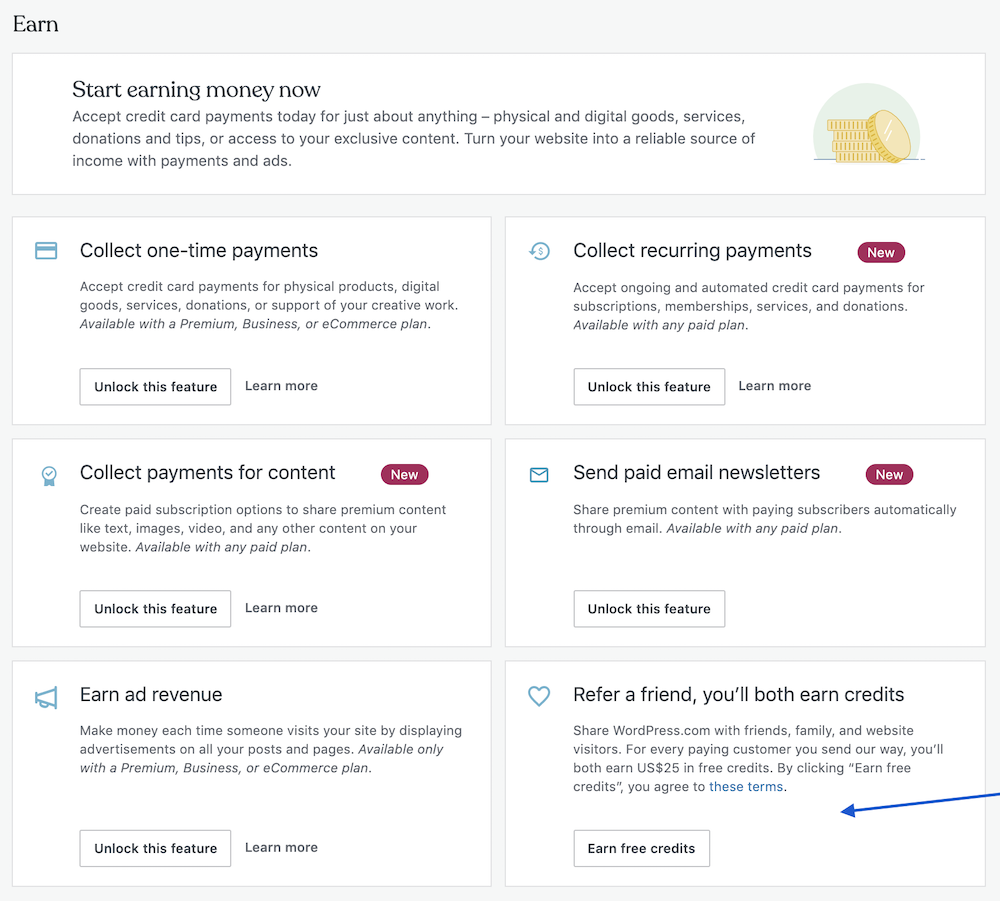
All of us know interesting people with unique talents. Some have business ideas. Others write beautiful poetry. Some are inspired to make the world a better place.
If they’re not online, they should be. If you’ve ever encouraged a friend or family member to create a blog, launch a podcast, or sell what they make online, the WordPress.com Refer-a-Friend program is your chance to help them get started.
How the referral program works
With the Refer-a-Friend program, you and people in your network can earn credits for your WordPress.com websites. When you invite friends, family, and colleagues — or even your own site visitors — to build a website, they’ll receive a US$25 credit toward a WordPress.com plan. (Note: referrals need to be new WordPress.com customers.)
Every time someone you refer purchases a plan, you receive a US$25 credit, too! The credit will be applied within two months after your referral signs up and makes an eligible purchase.
Under current pricing, a $25 credit offers more than 50% off the first year of a Personal plan and more than 25% off the cost of a Premium plan. Plus, your referrals also receive a free custom domain name for their first year.
Here’s how to start:
Log in to your WordPress.com account and go to Tools → Earn.Locate your unique referral link in the Refer-a-Friend section.Copy the link and share it via email, social media, or text message.
Not sure what to say? When reaching out to a referral, tell them why you use WordPress.com and how you believe it will help them, too.
Want to send along some inspiration? Check out the websites and customer stories featured on Discover!
Quelle: RedHat Stack
On July 16, 2020, the Court of Justice of the European Union (CJEU) issued a ruling invalidating the EU US Privacy Shield Framework, but upholding the validity of EU Model Contract Clauses (MCCs), also known as Standard Contractual Clauses. Both of these mechanisms were created for the lawful transfer of personal data from the European Union (EU) to countries outside of the EU under the EU Directive, and then the EU’s General Data Protection Regulation (GDPR). Given the CJEU has upheld the MCCs, it is important to know that your use ofG SuiteandGoogle Cloud Platformmeets GDPR’s standards for transfer of personal data outside of the EU. Google Cloud has always been committed to compliance with EU privacy legislation since we began offering our first Google Cloud services in 2006. We have ensured our products and services are built with the highest standards of security and privacy, enabling not only our customers in Europe—but all of our customers—to meet regulatory and compliance frameworks, even as legislation evolves. Millions of organizations rely on our cloud services to run their businesses, and we’re committed to helping them directly address global privacy and data protection requirements by offering industry-leading security, third-party audits and certifications, legal commitments, and products and services to support compliance needs. Beginning in 2012, Google Cloud began offering MCCs as a data transfer mechanism, and in 2017, the Article 29 Working Party, the predecessor of the European Data Protection Board, concluded that Google’s agreements for international transfers of data for G Suite and Google Cloud Platform are in alignment with the European Commission’s MCCs. Our customers have been able to rely on Google Cloud MCCs for the international transfer of their data, and this continues today.Regardless of the location of the data, data protection remains a priority for Google. We will continue to follow and be certified against internationally-recognized privacy standards such as ISO 27018 and ISO 27701.We have been closely monitoring the developments around the evolution of the international data transfer mechanisms permitted under the General Data Protection Regulation (GDPR). We are currently studying the ruling, as well as related developments, and will keep you updated as things evolve.
Quelle: Google Cloud Platform

Wegen eines Fehlers reduzierte sich der Netzwerkverkehr bei Cloudflare auf nur noch 50 Prozent. Davon waren viele Webseiten betroffen. (Cloudflare, Netzwerk)
Quelle: Golem
openshift.com – During the 3.x release timeframe, OKD has been a stable basis for OpenShift Container Platform, acting as an upstream distribution based on community-driven components – CentOS and Project Atomic to …
Quelle: news.kubernauts.io
awesome.jimmysong.io – A curated list of cloud native tools, software, and tutorials. A curated list of cloud native tools, software, and tutorials. Cloud Native is a behavior and design philosophy. At its essence, any beh…
Quelle: news.kubernauts.io
Have you ever written a Twitter thread, and then wished you could turn it into a blog post? You can now do it in seconds.
Writing Twitter threads, also known as tweetstorms, can be a great way to clarify your thoughts: keeping each paragraph under 280 characters forces you to focus on your message.
Threads are great for engagement and sudden bursts of inspiration. But when the thread is done, wouldn’t it be nice to have a quick way to capture the full conversation in one place — one page to read, one link to share, all your thoughts captured on a website you own?
Now, when you embed a tweet that’s part of a larger thread, you’ll see a new “Unroll” button on the block toolbar. Click or tap it to import the entire thread into your post.
Publish the whole thread as one easy-to-read post — and since WordPress has no character limit, add any extra thoughts that have popped up in the meantime!
Originally tweeted by WordPress.com (@wordpressdotcom) on July 17, 2020.
We hope you enjoy this new way to make your WordPress site the canonical place for everything you publish — leave a comment if you have any questions, suggestions for how we can make it easier for you to share content between your site and other platforms, or if you’d like to share a link to a post that started as a Twitter thread!
Quelle: RedHat Stack

Google Cloud Next ’20: OnAir kicked off this week, and we couldn’t be more excited. From inspiring words from Google and Alphabet CEO, Sundar Pichai, to a deep dive into the future of cloud with Thomas Kurian, to dozens of industry-specific breakout sessions, this week set the tone for what’s to come during our nine-week series, with plenty of resources to get started.Spotlight on customersWe’re continually inspired by the ways Google Cloud customers are growing and transforming in the cloud. Here are just a few of the Google Cloud customer stories we’ve recently shared.Deutsche BankFOX SportsProcter & GambleGroup RenaultTelefónicaVerizonGoldman SachsCarrefourHumanaSpotifyWe also heard directly from our innovative customers and partners during ourindustry keynotes, including MLB, Lowe’s, Capital One, Activision Blizzard King, New York State Department of Labor, Mayo Clinic Platform and Groupe Renault who each shared stories about how Google Cloud is helping them adapt to the current environment. Key announcements from the weekThomas Kurian, CEO of Google Cloud, kicked off Next OnAir with an overview of Google Cloud’s strategy and how we’re helping businesses grow and transform digitally. Read Thomas’ blog post and watch the keynote.Data is a critical component of decision making across organizations, but is often scattered across multiple public clouds, resulting in a fragmented user experience, multiple copies of data across different environments, siloed IT and varying levels of access and controls needed. This week we announced BigQuery Omni, a flexible, multi-cloud analytics solution that allows you to cost-effectively access and securely analyze data across Google Cloud, AWS, and Azure (coming soon), without leaving the familiar BigQuery user interface. BigQuery Omni is powered by Anthos, and is an extension of our continued innovation and commitment to multi-cloud. BigQuery Omni is currently in private alpha. Learn more in our blog post, or read our recent Forbes BrandVoice piece on the future of multi-cloud.At Google, we believe the future of cloud computing will increasingly shift to private, encrypted services that give users confidence that they are always in control over the confidentiality of their data. To complement our encryption in-transit and at-rest, Google Cloud will now offer the ability to encrypt data in use—while it’s being processed. This is called Confidential Computing and our first product in this space, Confidential VMs is now in beta. Learn more in our blog post.As US government agencies, and the enterprises that serve them, adopt cloud technologies, security and compliance requirements around data locality and personnel access are key considerations. Many cloud providers have built separate environments to run government workloads, requiring users to operate two distinct application and operation supply chains. To provide a better way, this week we announced Assured Workloads for Government (private beta) to help you serve government workloads without the compromises of traditional “government clouds.” Learn more in our blog post or read our recent Forbes BrandVoice article.The need for flexible work has increased the volume of demands on everyone’s time, and many of us want the tools we already use to be even more helpful. That’s why we introduceda better home for workin G Suite that integrates core tools like video, chat, email, files, and tasks. This makes them better together, so you can stay on top of things from anywhere. Learn more in our blog post, or check out G Suite Vice President and General Manager Javier Soltero’s keynote, available on demand starting next Tuesday, July 21.Thomas’s keynote also included recaps of key announcements made in the past month including Filestore High Scale (beta), Cloud VMware Engine (GA), Active Assist,Data QnA (alpha), and our expansion of Bare Metal Solution in five more regions.Our partners play a critical role in supporting the needs of our customers. At our Partners Summit this week, we announced updates to our Partner Advantage program which helps partners differentiate themselves through certification, expertise, and specialization. We also announced the Google Cloud ISV/SaaS Center of Excellence (CoE), a new resource to help independent software vendor (ISVs) transform their applications with open, cloud-agnostic architectures, improve user experience through AI/ML and voice, and deliver intelligent insights from their applications by providing rich analytics to business users.Industry-focused demos to help you get hands-on with the cloud As part of our broader Next OnAir program, we also launched 18 industry-focused demos this week, where attendees could explore AI/ML for manufacturing use cases, how to fuel growth with retail market insights, how to transform customer service with Contact Center AI, and more. You can find the complete list on the Demos page.Looking ahead to Week 2: Productivity and collaboration with Google CloudNext OnAir started off with a bang, and we can’t wait to share more in the eight weeks ahead. Next week we’ll be giving you a deeper look into productivity and collaboration with Google Cloud. Here’s where you can browse the complete session catalog.COVID-19 accelerated the shift to flexible work faster than we ever thought possible, and an organization’s success has never been more reliant on virtual collaboration. In our solution keynote, Helpful and Human: G Suite’s Vision for Your Future Workspace, Vice President and General Manager Javier Soltero will share what the future of G Suite means for teams and organizations. You’ll get a deep dive on our newest, most exciting innovations and hear how G Suite is helping our customers navigate what’s next.We’re also excited to be bringing you weekly live technical talks and learning opportunities, aligned with each week’s content. Click “Learn” on the Explore page to find each week’s schedule. Haven’t yet registered for Google Cloud ’20 Next: OnAir? Get started at g.co/cloudnext and check out the 200+ sessions over the coming weeks.Click to enlargeSee you next week!
Quelle: Google Cloud Platform

When migrating a data warehouse to BigQuery, one of the most critical tasks is mapping existing user permissions to equivalent Google Cloud Identity and Access Management (Cloud IAM) permissions and roles. This is especially true for migrating from large enterprise data warehouses like Teradata to BigQuery. The existing Teradata databases commonly contain multiple user-defined roles that combine access permissions and capture common data access patterns. Mapping those Teradata roles to predefined or custom BigQuery IAM roles requires a deeper understanding of your organization’s common data access patterns.Based on our experiences helping customers migrate to BigQuery, we’ve identified some common data access patterns that our customers define as roles in their Teradata environments. In this post, you’ll learn how to map those common Teradata user-defined roles to BigQuery IAM custom roles. Those roles may be helpful not only to users who migrate from Teradata but also to any data admins who manage data warehouses on BigQuery. Understanding this concept ahead of your migration can help save time and ensure that your users and data are protected throughout the process.Teradata access rights codes and user-defined rolesIn Teradata, access rights codes describe the user access privilege on a particular database, table, or column. There are some common access rights codes combinations that describe common actions that a user can perform on Teradata objects. For example, one user may only read and modify metadata, another user may read the data, and yet another user may read and modify that data. Here are the common combinations of access rights codes with corresponding role name and description:Note that to build views or stored procedures in both Teradata and BigQuery, a user should have access to objects that are referenced in those views or procedures in addition to the schema editor or developer role. Cloud IAM equivalent permissionsOur Cloud IAM controls are used by some of our most security-conscious customers, and you can map many of the concepts you’re used to in Teradata into Google Cloud. You can grant permissions to access BigQuery by granting roles to a user, a group, or a service account. There are three types of roles in Cloud IAM:Predefined roles are managed by Google Cloud and meant to support common use cases.Custom roles are a user-specified list of permissions. You’ll leverage them to map BigQuery IAM to Teradata user-defined roles.Primitive roles existed prior to the introduction of Cloud IAM.Below, you’ll see how to map identified Teradata roles to BigQuery Cloud IAM permissions:Note that none of the above roles grant a user permissions to create datasets, or grant permissions to other users. Those actions are best performed by the data warehouse admin, for whom BigQuery specifies the predefined Cloud IAM role roles/bigquery.admin.Create and assign Cloud IAM rolesYour next step is to create corresponding Cloud IAM custom roles with the privileges listed above. The fastest way to assign multiple permissions to a role is to use gcloud command, as described in the documentation.In Google Cloud, you can create a custom role on a project or organization level. If you decide to create a role on the organization level, consider adding resourcemanager.projects.get and resourcemanager.projects.list permissions to the schema reader and schema editor roles. Those additional permissions authorize a user to see information about projects in your organization, which fosters openness and transparency in the cloud environment.After you define the custom roles, the next step is to bind those roles to a Google group (groups offer a convenient method of assigning roles to users). These bindings of roles to groups form a policy, and you can attach this policy to Google Cloud resources at any level of your entire organization’s resource hierarchy (shown in the image below). Attaching policies in this way provides optimal resource sharing by limiting the need to duplicate data as a means for sharing data.For example, an engineer in your organization may create stored procedures in the BI-dev project, which reads data stored in the Data-dev project, in addition to engineers running their BigQuery jobs from the Billed-dev project to easily gauge the engineering spend using the project-level total in your invoice. To implement this in Google Cloud, grant your engineering group these roles: Developer role on BigQuery datasets in BI-devData reader role on BigQuery datasets, tables, and views in Data-devPredefined BigQuery roles/bigquery.jobUser role or at least bigquery.jobs.create permission on Billed-dev project. Give it a shotIn addition to trying out the roles we’ve described here, consider using BigQuery predefined roles, which are helpful in managing your data warehouse users. Special thanks to Daryus Medora, who verified the permissions mapping and provided valuable feedback on this content.
Quelle: Google Cloud Platform






